Storytelling 101 — part six

Stories, we humans need them for many reasons.   They make us feel better about contradictions that are otherwise impossible to reconcile.   They bolster our ideals, confirm our worst doubts, or clinch the deal on the things we already know.  They cause us to walk forward, united with brothers and sisters, millions of them, not alone in a terrifyingly cold universe.   We do not live random, meaningless lives that end in inevitable death, we are part of a larger story, connected to our ancestors, our living loved ones, our lives nurturing the lives of those who come after us.  There is great comfort in a good story.

It was a bit of a shock to hear the story today, three weeks after the murder of Saudi journalist Jamal Khashoggi, told by the dictatorial leader of Turkey, speaking to his parliament and the world beyond.   Erdogan announced unequivocally that the journalist had been the victim of premeditated murder in the Saudi consulate in Istanbul.   He asked pointedly where the body of the murdered man is.    

Our president has been very coy about this whole affair involving our cherished Saudi allies, telling Americans that we have to wait for the Saudi investigation into the alleged murder to be complete, so that we have all the facts.    Meanwhile, he dispatched the U.S. Secretary of State, and more recently the Secretary of the Treasury, to Riyadh and CIA Director Gina Haspel to Istanbul.    

It may be an odd thing, to some of us, that the president was waiting for the alleged murderer to finish investigating whether they had committed a murder, but in the rush of ongoing chaotic events, there hasn’t been much time for most people to even consider this troubling story.   Besides, POTUS reminded us, the sacred democratic presumption of innocence was once again being discarded by people rushing to find someone they don’t like guilty until proven innocent.   Very unfair!   It’s not like the Saudi royal family is in any way comparable to the hoards of Mexican rapists surging toward our own borders.  

The president compared this lynch mob mentality of those who feel the Saudis should be accountable for their crimes (including, of course, massive war crimes against the poorest nation in the Middle East) to the people who insisted there should be a full investigation into the multiple terrible allegations against innocent choir boy Brett Kavanaugh, or at least into the most credibly detailed of them.  A mob, a violent angry mob, motivated by tribal bloodlust, satisfied with nothing but the fatal lynching of a good man, a good tribal monarchy, presumed guilty until proven innocent, in the president’s telling.

The president was not wrong to make the connection between the aftermaths of the murder of Khashoggi and the allegations against Kavanaugh.   There were credible stories in both cases to check out and investigations to be concluded.  In Kavanaugh’s case a quick investigation proved he was innocent, at least to the satisfaction of these who mattered in the 51-49 vote.   In the murder of Khashoggi, after a few weeks of thorough investigation, the Saudi story was that the chubby sixty year-old journalist and critic of the thirty-three year old Crown Prince got pugnacious and decided to take on the fifteen armed men who were tasked with merely ‘interrogating’ him.   He resisted, starting a fist fight, and was, unfortunately, well, he died during the altercation.  

Subtle, but valuable, that passive voice.   In law school we were actually instructed about the only proper situation for a lawyer to use the passive voice.   If your client’s knife, in your client’s hand, was plunged into the heart of the now dead man, you can’t deny it, exactly, but you can soften it with the passive voice.   The knife, admittedly belonging to my client, was plunged into the heart of the victim.   Sounds so much better than the active voice since it highlights not the act itself, but facts that are not in dispute, facts that appear to damn your client.   So in the belated Saudi spin on Khashoggi’s last moments alive, it’s not that he was killed, so much, as that he, unfortunately, died.  Why wait more than two weeks to admit that the journalist was dead?   We had to investigate everything very, very thoroughly.  Where is the body?   No fucking idea.

Stories rule, in every situation we can think of.  Whose story do we believe?  Which story makes more sense?   Which story moves us more?   I was practicing my writing with a new nib last night and decided to copy Lincoln’s famous 272 word Gettysburg Address.    The poor Irish immigrants who were drafted into the slaughter to reluctantly fight for the Union — and die gruesome deaths, by the thousands–  were transformed in Lincoln’s immortal rhetoric into ‘honored dead’ devoted to that cause ‘to which they gave the last full measure of their devotion’. That their sacrifice not be in vain, Lincoln said in his marvelous short speech, should be our work going forward as we pursue Liberty in the nation dedicated to the proposition that all men are created equal.  

He gave that moving speech, appealing to the better angels of our nature [1], almost 155 years ago (it’ll be 155 years exactly on November 19th).   We have come very far since then in becoming a land honestly and tirelessly devoted to true liberty and equality for all.   Or we have come a few halting steps, and taken many more steps backwards.   Which is the more inspiring story?   Not much of a contest, I’d say.

It is, of course, like this in personal life too.  A man who has a long history of lying, stealing and committing fraud, a man who made death threats against his own wife and children in a moment of rage– well, your view of him will depend on which story you believe, based on your relationship to him.   He has a warm, loving side too, is a supremely sensitive reader of the moods and needs of everyone around him, he has a good heart.   He is a loving father, the death threats were a one time thing, he was very desperate!   The story becomes tricky only if you try to reconcile the two indisputable yet jarringly contradictory sides of this fellow.   For his part, the man will never admit he did anything wrong.   Either you have love in your heart or you’re a vicious asshole, is his position.    

The facts, we often think, matter.  This turns out to be a quaint belief.  The story is the only thing that matters.   Was Lincoln lying about the heroic dead who so nobly gave their lives that we might have a more just nation?   He was telling the story that needed to be told so that we did not conclude the massive number of American dead and dismembered had been merely a sickening instance of the intransigent, inhuman greed of a powerful few unleashing a river of American blood to protect their right to have complete control of their way of making a living, a way that makes most of us shudder today.

Likewise, if you put your friend in an unfair, untenable, even vicious situation, forcing him to convince you that he did not deliberately, or thoughtlessly, jeopardize your most sacred relationship, there is a way to put it that sounds infinitely better than that.  “That thing in the car” you can call it, if you confronted him in a car.  Now then, it was referred to directly.  It was a thing, like many other things.   Then you fucking overreacted and blew it up into this huge justification of why you can never fucking forgive me, you judgmental fucking piece of shit!   You’re dead!   You’re fucking dead!!!

As always, it’s all in how the story is told, my friends.


[1]  “We are not enemies, but friends. We must not be enemies. Though passion may have strained, it must not break our bonds of affection. The mystic chords of memory will swell when again touched, as surely they will be, by the better angels of our nature.”    source
Nurture the Creative Spark Inside

20180913_172332.jpg

Preserving the joy of creativity is essential to a happy life, in my experience.  I don’t know how you nurture the creative spark inside you, though I hope you handle that spark with great tenderness.  I wish you the blessing of doing something you love that transports you, involves you completely, makes you feel grateful to be doing it. The surest way to nurture this feeling is by truly loving the things you create and everything about the process of invention and refinement that leads to their creation.  

Speaking for myself, the reverb on a note sustained on the guitar is reason enough to love that note, continue to exercise vibrato upon it, to love the notes that preceded it, the ones to follow, to enjoy their interaction with the beat.   A good cook gets to eat well, feed others well with the best ingredients perfectly combined and prepared.  The sung note, melding with the harmony of a chord, with other voices, the sound of it all, a kind of miracle.  Pick whatever you love most, and love it from time to time.  Your love may light a love in others who cannot help but be a tiny bit inspired.   The world is better for that love.

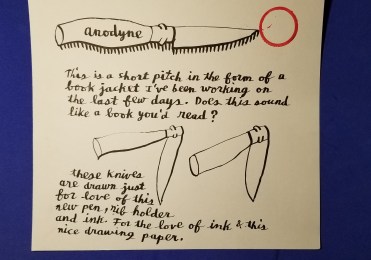
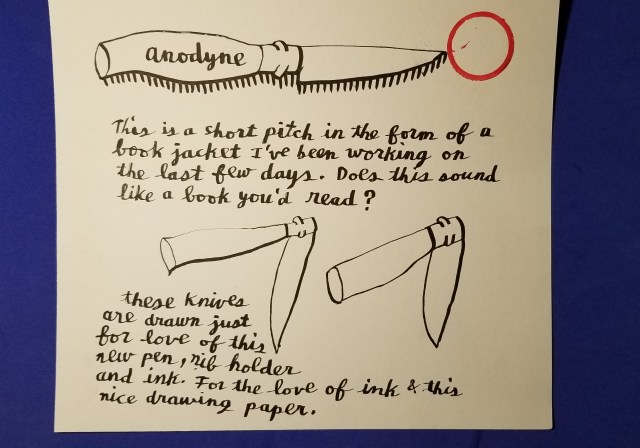
For me, late last night, finding this great, discarded Speedball C-4 nib, stuck in an old cork handled nib holder I’ve had for years, dipping it in ink and bringing it down toward a nice piece of drawing paper, with a low-medium tooth, made me excited to drag the ink across the page.   That thrill on contact, to see what a succulent line it was, was enough to make me wonder, did I actually have anything to write in my best flowing hand?  

It was no matter, just as much fun to draw the knife, pen the word ‘anodyne’ on its handle.  I thought how nice it would be to hand write the short note for the short Book Jacket copy I’m going to send to one of my oldest friends tonight.  


20180913_172332.jpg 

She would immediately wonder why the hell I’ve drawn folding knives, Opinels by the looks of ’em, all over my note explaining what the enclosed page was.   I answered that question as best I could, alongside the knives, and while I dipped the pen and wrote that answer I had no wonder about what to write to keep the pleasure of using this lovely nib going.  A pleasure on top of a pleasure.   Pretty good, in the scheme of things. 

Labor Day

I heard a piece on NPR just now about apprenticeship and somebody mentioned digging a ditch.   On Labor Day in America today I celebrate the time I spent the day digging a forty foot long ditch in the East Bay in earth that was like cement due to several years of drought.  This was back in the 1970s.  The signs in California bathrooms read “if it’s yellow, it’s mellow, if it’s brown, flush it down”.   Sekhnet’s friend Uncle Tony had a sign in his rustic bathroom that expressed a similar sentiment:  “on these isles of sun and fun, we never flush for number one.”

I was in my early twenties, broke and strong.   A friend negotiated the job for me.   This guy was a genius negotiator, always getting the best deal possible for himself.   I don’t know what his motivation was in making this particular deal, but as I remember it I was paid $20 for the long trench I was supposed to dig.   I didn’t kick.  I needed the money, and twenty back then was like a hundred today, and headed out in the morning with a borrowed mattock and shovel.  

The job required not only strength and determination but great delicacy, as it turned out, and a certain amount of ingenuity.  I was digging around a thin water pipe, buried about a foot deep in the hard ground, that connected the house to the water main.    I had to work around the old pipe, which was about the thickness of a big toe.   I discovered on my first swing that my friend had negotiated an absolute shit deal for me.   The heavy mattock hit the earth and barely dented it.  

It took a while, but using the pick end of the mattock I was able to poke holes in the baked earth on either side of the pipe and then sculpt out little chunks with the flat end, carefully working away from the pipe.   I worked shirtless under a decent sun, and I remember feeling glad that it wasn’t too hot out.   It was slow work, impossibly depressing at first, but I made steady progress from the sidewalk toward the house, across the the baked brown expanse of hard dirt that was previously a lawn.   I probably sang as I swung my mattock and later, and more to the point, my pickaxe.  My friend had dropped off a pickaxe with a handy sharper point, after he came by to check up on me during his lunch break.  The pickaxe helped.

It was just one of those days in the life of a young man with big dreams.  I was about three feet from the end of my work, had skillfully dug a channel around the thin pipe, and had maybe an hour left.   The muscles on my back were starting to twinge a bit, and I had slowed my pace.  The end of this shit day of work was quite near.  It had been a long and productive eight hours or so so far.    I was taking a few breaths, leaning on the mattock, when a friend rode up on her bicycle.     I told her I was almost done and started back to work.    

She was one of these people who know everything.   She is the expert on everything, without exception.  It turned out, according to her, that it had taken me so long because I was going about it all wrong.  My form with the mattock, apparently, was ridiculous.  To stop her unwanted lecture I smirked and handed her the mattock, which I’d been using to lift out the dirt the pickaxe had loosened around the pipe.   She told me to watch carefully as she showed me how it should be done.   She raised the mattock high over her head, almost tottering backward at its weight.   Then she brought it down hard, directly on the center of the ancient pipe.  

A geyser of water shot up high into the air as the pressurized water made its hissing escape.  The long trench immediately filled with water, the baked dirt of the former lawn was now mud.  I never heard her drop the mattock as I turned to kick her as hard as I could in the ass.   She was off on her bicycle before I could take any revenge at all, outside of hurling a few curses at her as she sped off.  

Thinking about it now, I realize that fuck who offered me $20 for that job got exactly what he paid for.   I have wised up over the years, finally casting out people like the great negotiator, a highly successful businessman who resembles nobody as much as Trump in his need to win at all costs and his inability to maintain friendships that are not purely transactional. The know-it-all lasted a few years longer, but in the end, the spectacle of her pummeling her feeble husband became too sickening to endure.  

I will always fondly remember that day digging that ditch in Albany (or maybe El Cerrito).  Oddly enough, I had a date that night, in those free love days.  I cheerfully rode my bike a few miles to Berkeley where I was going to have sex with a young woman I’d known for some time.   It was the first time we’d gone to bed.  I recall, in the middle of things, literally while we were making the beast with two backs, she had to excuse herself to go pee.  She may have had some kind of urinary tract infection, I think.   I don’t remember the rest, I may have fallen asleep while she was in the bathroom leaving some mellow yellow in the bowl.

The DU was not generous

My father, the Dreaded Unit, was not a generous person.  He gave us things, he provided a nice lifestyle for the family, he didn’t begrudge us what we needed or wanted, he just was not personally generous.   It seems easy enough to blame this on the “grinding poverty” he experienced until he was drafted into the Army.   Though the most generous kids I ever worked with were always the poorest.   My sister’s experience working with children has been the same.   We both, at different times and in different places, taught classes of well-to-do kids and classes of poor kids.   Certain rich kids were prone to grabbing the last cookie and shoving it into their mouth.   Poor kids always seem concerned that everyone gets a fair piece.  Of course, I over-generalize, there were wonderful rich kids and poor kids who were complete dicks.   When it came to sharing, and my sister will back me up, the poor kids unfailingly shared, rich kids not such unfailing sharers.  So my father’s poverty by itself does not explain his difficulty being generous.

Generosity is a trait, like kindness and fairness, that if not planted young has a hard time growing later in the depleted soil of a love-starved soul.  My father told me as he was dying, in that weakened voice as his life force ebbed, that he’d had never had any idea how to show affection.   “I’d never seen it done,” he told me, a slight pleading in his tone, alluding to the house of violence, poverty and madness he’d grown up in.   His mother and father never touched each other.   No affection was ever shown.

These days I am trying to learn each of the lessons of my father’s tragic life and put them into practice to live a better life.   Being unforgiving is closely related to a lack of generosity — you will not extend the pardon you yourself would want to be given in the same situation.   It is a terrible thing never to forgive.  I watched my father do it all his life, the man never forgave anyone, starting with himself.   Unforgiveness feeds a deeply destructive need, the need to feel completely vindicated in one’s anger.  We see it played out on a mass level today with our vengeful Insane Clown President, as Matt Taibbi dubbed him when writing about the 2016 campaign.

I am always impressed by generosity.   I recall going to the home of a Palestinian who lived in East Jerusalem, in the Old City.   He took everything out of his refrigerator, he and his children literally emptied it, and put it all on the table in front of us.  “Take, take,” he said, smiling, gesturing at everything.   There turned out to be more to the story, but this kind of generosity, holding nothing back, is a beautiful thing.   

What does it cost to be moved by something beautiful somebody has just done and saying “beautiful”?   The thing is beautiful, is there a price to saying so?   I don’t know, I can’t see one.   To some people, I suppose, it costs a lot.  It appears that way, anyway.    Maybe it’s related to envy, or distraction, or simply being bitter, I don’t really have a handle on that kind of reticence.  My mother didn’t have it.   She would read something I’d picked out for her and smile and say “it’s wonderful”.   I could tell she meant it.   My father would read the same piece looking for the fatal booby trap I’d hidden in there, the tell-tale adjective that would show the rigging about to collapse on his head.

What does it cost to give the benefit of the doubt?   You can give it once, be disappointed, give it again, remaining hopeful.   After enough disappointments you will stop extending this generous courtesy, but what does it cost to give it in the first place?   It requires trust, I suppose, a certain faith that good will is going to be returned.   It often is.   It often isn’t.   I think more often than not, good will is reciprocated.   My father did not think so.   It was hard for him to make himself vulnerable in any way.    

As he was dying he said:

I know a lot of people are sorry for what they did, yet at the time you don’t see anything but just a battle which there has to been winners or losers, and there’s no gradation.

 I know when we had our differences, I realize that it was nothing personal in the classic sense but I also know that it’s the only way that I could live… like I told mom, we always had these battles where she’s saying “we’ve got enough money, we’ve got enough money” — for me it was never enough. I’ve got to make sure that every dot is dotted, every ‘t’ is crossed because I don’t want her to want a thing.  So, it’s kind of a lifetime battle, I don’t know, I think now how much richer my life would have been if I hadn’t seen it as a battle—good versus evil.

I know we should have had this talk ten, fifteen years ago. I couldn’t reach that level because I was really thinking that it was going to be a battle and that there wasn’t any way I could make it into a dialogue, and that’s my fault. You’re supposed to have some fucking insight.


OK… All Right…

I have found, as I get older, that when I am alone, as happens in my life of contemplation, and I need to exert myself even slightly, I more and more often accompany the action with a reassuring “all right… OK…”    This involuntary self-encouragement is delivered in a slightly rough voice, but very softly.  It is as much a breath as a voice, really.    I don’t know where it comes from, except that such self-talk must go deep in the human experience.

It is unusual, in many lives, to have a gentle hand to guide us along.  Like many things we learn to do on our own, we sometimes provide our own gentle hand.   However otherwise gruff the voice is that encourages me to get up slowly after sitting for a long time, say, it is more than anything a gentle voice.   I don’t mind it at all.    I greatly prefer it to my outbursts.

I watched the last hour or so of the wonderful Princess Bride the other night.   It reminded me again, watching Peter Falk play a character years older than he was at the time, a kid’s grandfather, both gruff and extremely gentle, that Falk’s character was probably a main source of this voice.

The grandfather reads the end of the story, closes the book, says goodnight to his grandson and gets up to leave.   The boy asks his grandfather if he’ll come back and read it to him again the next day.    Falk turns at the door of the boy’s room,  bows his head slightly, like a vassal about to address his lord and says “as you wish.”

Why Do You Bother?

A voice started nagging me the other day, a familiar voice with famously bad breath.  “What the hell are you doing?” the voice said, with annoying, random inflection, the words arriving unpleasantly warm and fetid in my ear after wafting past my nostrils.

“You continue, day after day, to sit and write.  You seem to write about whatever comes into your head.   You write clearly enough, we’ll stipulate to that, but the larger question is ‘what the fuck’?   Seriously– what is your plan?”

A fair enough question, ass breath.

“More than fair, really.  If you are writing literally every day, taking the trouble to clearly set out all these things that are on your mind, document your long wrestling matches with anger, futility, depression, vexation with the ongoing triumph of incoherent narratives… why are you not spending as much time every day branding, marketing and selling your content?   Why are you not monetizing the skill you’ve been honing for decades?”

Nicely summarized, my inscrutable dilemma, there, toe cheese breath.    

“You can sit there asyntactically smarting me all you like, as you worry about the warranty for the nib of a very expensive fountain pen you love, the fairly new acoustic/electric guitar that is no longer electric, trying to overcome the frustrations of a smart phone that is smarting you daily, having failed to write down the robotically delivered authorization code for PT that the health insurance company robot read to you– foolishly assuming that same code had been sent to PT (it hadn’t, of course) and now you can’t make an appointment for tomorrow’s session since they are no longer picking up the phone, after you called Healthfirst back and were eventually connected to the third party who had the authorization number you need to continue rehabbing your sore knees…”  

I get it, sweat gland breath.  

“A blessing that you can’t smell your own breath, my decomposing friend. I’m just giving you a little friendly advice: you’re not a writer just because you write, even if you write clearly and convincingly, even if you do it every single day of your life. You are a writer if your writing is in print, paid for by somebody else, and with a check written to you for writing whatever the hell it is. Period.”  

Sure thing.


Shades of Anger and Avoiding Rage

Anger comes in varying shades.   Not every shade is dangerous, but unchecked anger always has the potential to explode into rage, which is the main thing to avoid.  Anger is a threatening emotion, difficult to sit with, and anger that is denied, pushed down, diverted toward people who don’t deserve it, is as corrosive as sulphuric acid.

Anger often starts as annoyance, escalates to feeling provoked.  Sufficient provocation gives rise to a righteous and difficult to control desire to strike back.   Depending on the situation, anger can easily turn to rage.   Recognizing the initial signs that you are becoming angry, and taking as many breaths as needed to avoid the easy cycle of anger,  is crucial to not flying into a rage.  Not flying into a rage may be the best we pitiful earthlings can do when we are provoked to anger.   Important work, friends, learning to not fly into a rage, even when sorely provoked.

I have been in this cycle of provocation and escalation countless times.  Over my childhood angry confrontations were a regular occurrence in the little house I grew up in.   I was a kid, and did the best I could in an insane situation where everyone was screaming at each other.   Much of the anger came straight out of my parents’ frustrations with their own lives.   Neither of them ever learned to control their anger very much, certainly not when it came to the two ungrateful children who presented such challenges to them.  In terms of dealing with their anger, both of my parents were essentially children.

I had a friendship for a while with a New York City criminal court judge.   He was a brilliant man, if also deeply troubled.  Sekhnet, who has a talent for hitting such nails on the head, said of him “Bill’s a child.   A brilliant child, but a child.”   The same could be said for my father, and to a great extent, my mother.   Both were highly intelligent, both had been raised by domineering mothers who frequently made irrevocable vetoes of their child’s deepest wishes.  

Each overbearing mother had broken up the most exciting  romance of each of their childrens’ lives.  My mother’s mother chased off her daughter’s first fiance, simply would not stand for this dashing young con-man becoming her son-in-law.  In my father’s case, it was a longterm relationship with a Christian woman, a young widow a couple of years older than my father.   There are photos of them together before World War Two in Connecticut and after the war in Syracuse.   My father never looked happier than in those couple of black and white photos.   It appears to have been some kind of love story.   In the end, the overbearing mother won, the lover was extirpated forever from my father’s life.  

There is the kind of anger that makes people lose their minds.  When angry, they feel they are simply fighting to stay alive.   Anything is fair to somebody in this hopped up state.   This is very common with anger– it convinces you of the rightness of whatever you do in that state.   Defend the homeland!!!  Death to the infidels!!!  Death before dishonor!!!  Take it out of their skulls!!!

I am thinking about anger today because yesterday, once again, I spent a considerable amount of time on the phone with someone who called to tell me, essentially, that I had no right to my feelings.  No matter how much I may have been hurt and provoked, the caller told me, or how many times I may have been hurt in the exact same way, they love me, I am like family and the thought of me not in their lives is too painful for them to deal with.   All this was happening, I was told, because I was not looking at myself deeply enough, not finding a way to forgive a series of escalating provocations that were very aggravating, true, but completely, or at least largely, unintended.

It was an aggravating conversation with a person I like very much.  It was aggravating largely because the person had no idea, outside of endless, limitless forgiveness on my part, for what I should do going forward with a friend seemingly incapable of not provoking me in every encounter.  Aggravating because I’ve thought deeply about all these things, studied the situation over the course of the last few months, consulted friends whose opinions I respect.  

In the end, I had nothing, and nobody else could see any way forward, outside of the miracle of an old friend suddenly discovering how to be a mensch, something completely out of my hands.  I gave this old friend every opportunity not to keep attacking, but he was unable to refrain from being on defense and offense instead of seeking a way out of the toxic cycle that was killing our friendship.

A few times during the conversation yesterday I got angry.   Each time the person I was talking to squawked, hurt and mad that I was expressing anger at not being heard.   Each time I took a deep breath and quietly expressed the thing that couldn’t be heard when I expressed it with anger.  In the end little that I said seemed to have had much effect, but the exercise of not exploding in anger was a good workout.  A sad, mutually unsatisfying conversation ended calmly enough, with neither of us telling the other to fuck off.

No matter what else can be said about the difficulty, sometimes, of not exploding in rage, it is always a good idea.   It is hard work, Jack, very goddamned hard work. Especially if I keep denying your right to feel hurt by something I did to you, no matter how unfair I admit that thing was.   Keep bringing it up, I will keep shifting the blame back to you — you are unforgiving, you are heartless, rigid, you don’t see yourself, you exaggerate, you betray.  If you look deeply enough into yourself, I will say, you will see that you are wrong — it is possible, isn’t it, that you are wrong also? Love conquers all.    I will lay down the love card, the final card, the card only someone without love could deny.   I could not have really hurt you that badly because I LOVE YOU.

You respond that love is not words, no matter how beautiful, but actions, how we treat the person we love.  If I treat you harshly you have every right to expect a sincere apology from me, if I care about your feelings.  If I can’t give you an assurance that I understand the harm I’m doing, will do my best not to inflict more of it, there is no way forward.

I will insist, if I am that type of person, that you are no saint either.  You betrayed my confidence by writing on a blahg that you know a person who has a faulty memory.  I would never do that to you!   You have no idea how hurtful that public betrayal was to me.   I wouldn’t be surprised if you wore a wire on me when we talked the other day.   Are you wearing a fucking wire on me now, you fucking fuck!?   I’ll bet you are.

And away we go!


The climbing sorrow of death

Death waits, in no particular hurry most of the time, since every living soul must go with Death in the end.   Some beings get to live the full wink of an eye, eighty, ninety years.   Many delightful winks are far briefer.  It helps to think of the quality of a short life in these cases.  

A tiny colony of feral cats coexist in Sekhnet’s garden, along with a couple of large, gingery raccoons and the occasional giant possum, who come by after dark to finish off whatever food the cats leave over.   We get to witness the brutality of nature up close, its brutal cuteness and its seemingly random viciousness. 

Screenshot_20180717-212209_WhatsApp (1).jpg

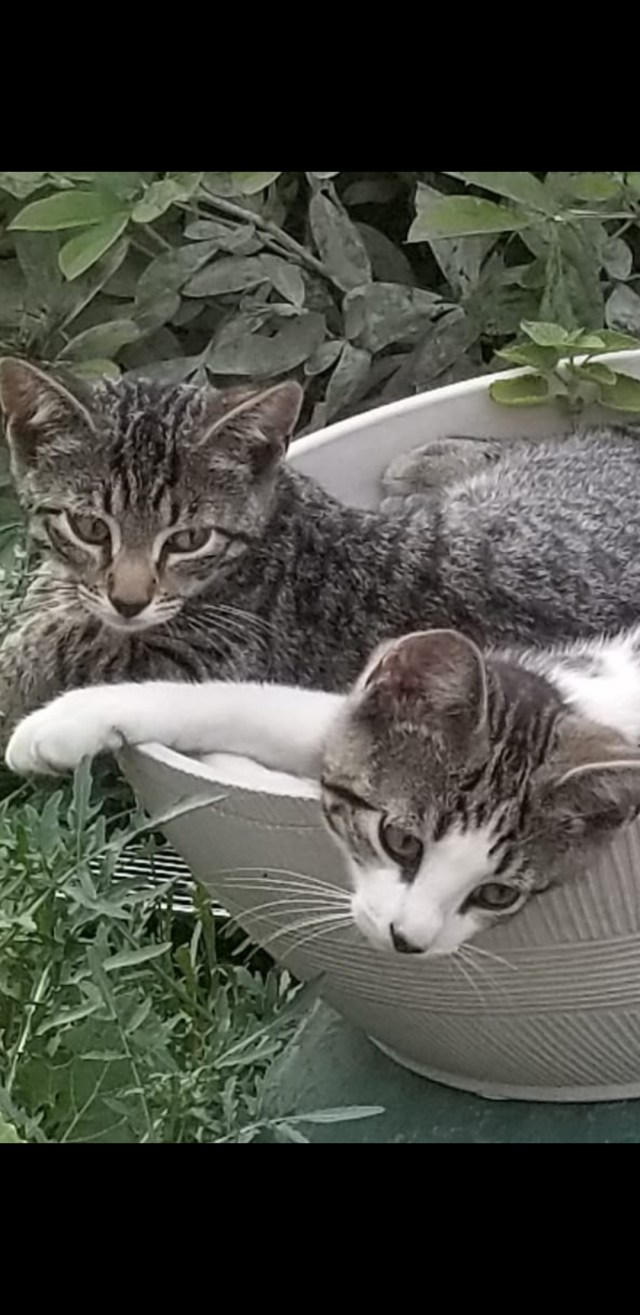
These two brothers, Whitefoot and Turtleback (foreground) were photographed hanging out in a flower pot on July 17, 2018.   They were three months old at the time.  I am lucky to have this photo, one of very few pictures I’ve shot in the last year or so that I’m still able to view on my phone. [1]   

Their mother, the beautiful Mama Kitten, had her first litter two or three years ago, at six months old.   Talk about babies giving birth to babies.   Six months old and Mama Kitten.  When they were big enough she dragged them from their hiding place and marched the adorable mice in front of Sekhnet.  

“You see,” she told her kittens, “soon, when I stop giving you milk, you will come to her, act cute, and do just what I’m doing now, see?”.  Mama Kitten would fix Sekhnet with a winsome look, make a quick cat move toward her and rub her head and her side along the human’s leg, using the tail to give a gentle caress as she makes her circle.

Sekhnet and I became familiar with the exquisitely gentle touch of a cat’s tail from my original cat Oinsketta, an affectionate cat who practiced the art delightfully.   The late A.W. Skaynes was also a master of the tail caress.   A few of these feral cats get pretty adept with their tails too, they’re generally the ones who like to be petted.  Mama Kitten did not let a human touch her until she was several months old.  She took to human affection cautiously, but she is now a very tactile cat who sometimes loves to have her sideburns scratched.  And she uses her head and her tail very tenderly.

We had many great photos of those adorable kittens interacting with mom, playing with each other, eating food off of spoons.   Suddenly it seemed Mama Kitten was in a hurry to wean her kittens and turn them over to Sekhnet for feeding.  We didn’t understand the urgency.  We soon realized she was pregnant again.  Chemicals coursing through her body telling her to protect her turf, make it safe for her offspring who were about to be born.

Mama Kitten had her most recent litter, four beautiful kittens, two male, two female, in April.  These four made the number of good-looking little cats Mama Kitten had given live birth to around twenty.   She has been pregnant or taking care of a litter continuously since before she was  six months old.   When she is about to give birth to the next brood she drives her young kittens out to fend for themselves.  Of course, they only know how to hunt by being cute to the humans who feed them, and there is only one other house on the block where feral cats are welcomed (see this here for that).

We once trapped three of her kittens who had lived to be five or six months old.  We took them to a vet and had them all neutered.   Each of them was dead within a very short time.   There was no connection to the minor surgery, they were all fine after they got back from the vet’s.   They simply disappeared, one after another, in the space of a couple of weeks.

Their lives tend to be short.  The oldest so far was probably Grey Guy, who lived almost two years.  There are hawks around that love a nice one or two pound kitten for lunch.   We assume the hawks get most of them.   A few have died from some kind of poisoning, we think they may have drank anti-freeze on a hot day.  All four of those kittens died within a few hot early summer days one awful summer before Mama Kitten was born.  A feral cat in this area that lives to be a year old is a survivor, an outlier.

It is a cruel thing to grow attached to these beautiful little creatures who have little hope of surviving more than a season or two.   We try not to give them names, remembering the fate of oddly cute Dobbie, or Cathead (a playful, affectionate kitten I would have made a pet, if it was up to me, and we’d had her spayed, too) since the attachment makes their disappearance more painful.

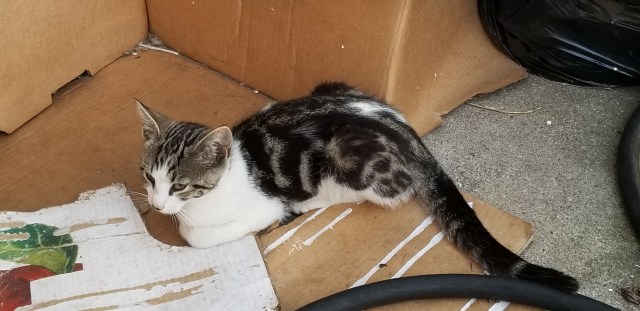
Still, it turns out that just for reference you need to call each one something.  Sekhnet takes care of that, keeping it simple.  Whitefoot advances on a white foot, both of his front feet are white.  Turtleback, mostly white but with nice markings, including a large beautifully painted section on his back that looks like a tortoise shell.    Here is a picture of Turtleback taken two days ago.   We were a little worried since we hadn’t seen the adventurous young male when his siblings were having dinner.  I later found him relaxing on their favorite box, and snapped this to send Sekhnet to reassure her that Turtleback was alive and well.

20180806_191451.jpg

Sekhnet has been furious at Mama Kitten since seeing how viciously she keeps attacking her almost year-old daughter, Paintjob (talk about a beautiful coat, that little cat was painted by a genius).   Mama drove that poor soul Paintjob out of the yard two or three litters ago and somehow the timid Paintjob is still alive and, until recently, managing to get fed by me or Sekhnet every second or third day.  

She eats fast, warily, wolfing her food and then stopping, tensing every muscle, marshaling all of her senses for threats.  Then she will eat another can of food, using the same procedures.   Paintjob is skinny but appears otherwise quite healthy.

Lately, even though she has lost her last pregnancy through some kind of natural miscarriage, Mama Kitten has been particularly vigilant and ruthless in violently chasing Paintjob off.

Sekhnet has seen this many times, how Mama Kitten discovers each secret place where Sekhnet has arranged with Paintjob to throw her a quick feed.   Paintjob was quite adept at making Sekhnet know where she’d be for a fast secret feed.  Mama keeps guard, watches Sekhnet like a hawk, peeks around every corner, pops out of nowhere and viciously attacks Paintjob who runs off at an amazing speed.   Their screams are heart-rending.  

I keep telling Sekhnet not to make such human judgments against Mama Kitten.  I point out that Mama is, and has always been, in pure survival mode, plus she’s crazed with chemicals produced by her constant pregnancies.  I point out that she’s  programmed to survive and is by far the longest lived feral cat to live season after season in Sekhnet’s garden in the back.   Sekhnet points out that Mama is a complete psycho bitch who savagely attacks her own daughter when there is plenty of food for everybody.

Yesterday as I fed the kittens, Mama Kitten came around to see what was on the menu.  She was not impressed with the first offering, which her kids all ate quite happily.   She tasted a bit of the tuna and found it not to her liking that day, though her kittens were quite pleased with that one too.   As everyone seemed interested in having a bit more dinner, I opened a third can, and this one Mama Kitten found to her liking.  I fed her some slime from the spoon, to test it before dividing it among her kittens, and this one she wanted.   She ate a bit.  

Then I saw, suddenly standing less than two feet away, an emaciated, haunted, desperate looking Paintjob, staring at the food, almost hypnotized.  I was aware that as soon as Mama saw her the savage attack would occur and that there was nothing I could do to get any food to Paintjob, or to stop what was about to happen.  A few seconds later Mama Kitten took off screaming in savage pursuit of a wailing Paintjob.  The kittens scattered in terror.

This scene was truly heartbreaking.  I understood why Sekhnet finds it so hard to forgive Mama Kitten for this seemingly heartless, irrational and murderous rage against her own kitten.  True they’re now both adult females, we get that, but, it’s hard to understand why it has to be this way.   Only a cruel god would design nature to feature this kind of nonchalant, horrible savagery.  

After I told Sekhnet this story of witnessing the vicious attack on Paintjob she became morose.  I had a text from her at 3:20 a.m. (we stay together half the week) and I called her right away.   She was tearful, couldn’t stop thinking about the doomed Paintjob.   “As she gets weaker and weaker from lack of food it will become impossible for her to escape her psycho mother,” she said, her voice cracking, and it planted an image in my mind I did not want to see either.

Sekhnet reported a bad night’s sleep.  She dreamed of Paintjob, lying on her side, her paws cut off, crying for food.  In the dream Sekhnet was unable to get any food to the helpless cat.  I tried to reassure her that she had not made the world, that nature was cruel, we’d seen it first hand over and over, the short, brutal lives these beautiful little animals live in the extremely limited, ruthlessly competitive wild in that part of Queens.  Then she got a call, there was a dead white kitten near the area where the backyard animals eat dinner.

It was one time when, being a man, all I could say is what a man should say at such a time.  I told Sekhnet I’d go to the house, carry away the body, that I would take care of it.  We arranged to go together.  There was a real-feel of 99 degrees in New York City again today.   We had images of the little cadaver getting ripe, covered with flies, possibly bloated.  

Halfway to the house, the sky got dark and a deluge fell from the sky in a massive electrical storm.  It rained as hard as I have ever seen rain fall, the traffic began to crawl along cautiously, and it continued to pour down in sheets for a long while.  The windshield wipers, on their fastest speed, had a hard time keeping the windshield clear.  There was flooding in places.

We killed some time, gassed up the car, sat in front of the house until the rain stopped.  I went to the back of the house.  It was Turtleback, on his side, feet stretched in a slightly grotesque final pose.  His timid little white-faced sister, who looks like him but without the turtleback, looked sad.  All of the kittens, and Mama Kitten, seemed determined to make sure I knew that their fellow was dead, was just lying there   Before I fed them dinner they all made sure I noticed the dead Turtleback lying there on his side, skinny and soaked.   Each one passed close to him as I went to get their food.

Sekhnet brought a sturdy box, just the right size, and handed me a shovel.  It took a moment, but it was an easy operation once I got the shovel positioned the right way.  He fit in the box perfectly.  “Watch his tail,” said Sekhnet and I tucked it into the box before I closed the flaps.  

I carried him a short distance, to a wooded place by the highway.  The area was filthy, littered with plastic bags and plastic take-out containers and probably much worse.  I did not venture far in the dark, placing his coffin behind the closest trees.  I got back and Sekhnet and I agreed that Turtleback himself was not there in that squalid place, just an empty vessel that had been, briefly, the beautiful little cat.

I am aware that nature is cruel, even as it can be so generous.  That severe thunderstorm struck me as a gratuitous, a mocking touch for a gentle God to interpose in the path of two people heading somewhere to try to do a decent thing.   I had several thoughts about God as that rain pissed down, as we killed an hour in the car before I could go back and lay whichever poor devil had died so young to his or her rest.  

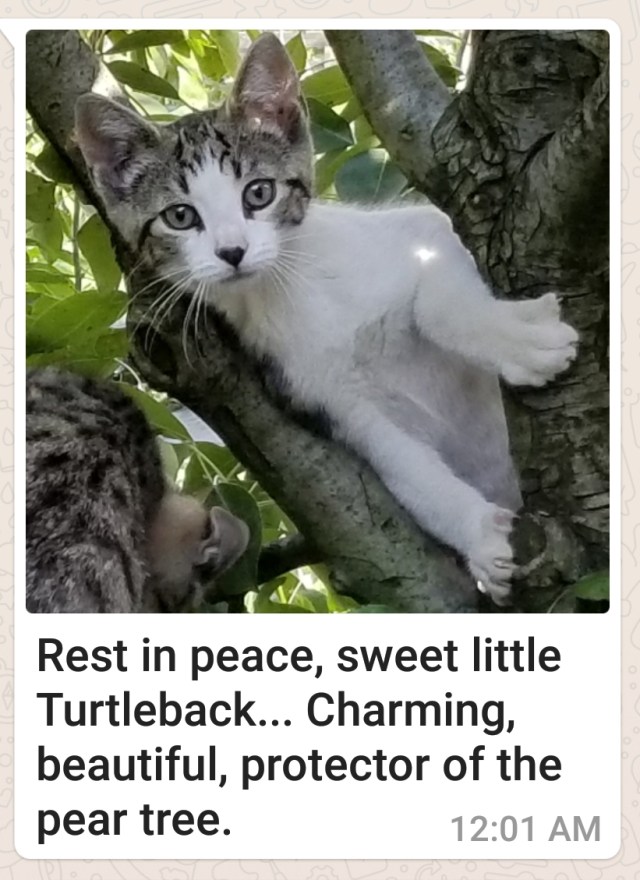
Afterwards we hung around a bit hoping Paintjob would show up for a feed while I was there to distract Mama in the back, but no sign of her anywhere.  It is hard to shake the thought that yesterday’s desperate move by Paintjob may have been her final one on this earth.   I got back home and began writing this, my attempt to, as they say, process all these thoughts and feelings.  Then a notification beep, a WhatsApp from Sekhnet.  

Sekhnet, among her many talents, apparently also has the power the make me sob in loud, honking notes, my nose drowning in snot, alone in my apartment.   My emotions all night had betrayed nothing but manly resolve, stoically placing the tiny cadaver in its carboard coffin, stilly carrying the dead kitten to his eternal resting place, manfully reassuring Sekhnet at every turn.   I don’t know what my neighbors must have been thinking to hear me weeping that way, it is rare to hear a grown man sobbing, especially a grown man prone to angrily cursing.

Screenshot_20180808-000553_WhatsApp.jpg 


[1]  Naturally, of course, the format has been randomly dicked with, it is not displaying full frame as I shot it, it’s messed up.   I never inserted those moronic blocks of black at the top and the bottom.   I am not even sure how to edit those out with the programs and apps I have.  

Background:   I took dozens of photos of these beautiful cats.  Yesterday my phone spontaneously deleted  over 2,400 photographs.   The girl at the T-Mobile store said there is no way T-Mobile can recover the photos and that they were probably deleted because I accidentally hit something.  I told her I had hit “restart” after several days of being unable to move or delete photos.   When the phone restarted, 3,000 photos were wiped out.  She was a pretty girl, and friendly enough, but there was something about her reply “you must have accidentally hit something that deleted the photos:  that made me want to ask her to come around the counter to take a nice, quick knee to the stomach.

“A Samsung problem,” she told me.   She showed me how to find the randomly saved photos in something called Google photos that I never signed up for.   Apparently Google randomly collects images from your phone, to show you how they provide this great cloud backup for all your data.   If you pay them, they will save everything.  If you take their free version, which you might not ever know you even are using, they will choose what to save and what to delete, probably by some brilliantly calibrated algorithm.

This was the only photo  remaining of perhaps 100 shots of these great looking feral kittens and their beautiful mother.


Noticing Small Things

They call this mindfulness these days.   Awareness of your mind, your body, your surroundings, other living beings, their presence, your presence, your interactions with the world.   We live in an age where “reality” itself is presented to us, constantly, in small, exciting boxes.   These boxes arrive continuously, with alert beeps if you set your phone to give you notifications.   You look at the phone and through a filter you instantly see a selected slice of life.  

Your life is clearly not this selected thing you are looking at, but the irresistible device  is designed to make you feel that it is very important.  Breaking news, crucial, need to know, this just in, ten things that will make your jaw drop, five amazing secrets nobody will ever tell you, the seven, yea, eight best cures for distraction,  the most erotic nude photo of the most beautiful person ever photographed, very tasteful.  Click here.

All very compelling, but not your life.  In most cases it is only the thinnest, most superficial slice of your life.  In many cases it has nothing whatsoever to do with you as an individual and everything to do with you as part of a discrete/discreet [1] demographic.    

I had some drama with my smartphone the last few days, it wasn’t letting me move, copy or delete photos.  I take hundreds of photos, very happy now to finally have an excellent camera on my phone.  I had more than 2,000 photos in the folder marked Camera.   There have long been two folders marked Camera.  The first has about 80 photos in it, the last one taken on July 4, 2017.   All the photos since have been saved in a second folder, also marked Camera, which was created autonomously by the smartphone on July 5th.

Frustrated at being unable to delete or sort photos the last few days, I finally restarted the phone.  The phone reset.  When it came back on-line there was one folder marked Camera.  It had 80 pictures in it, all taken before July 5, 2017.   Almost every photo and video I’ve taken since is, inexplicably and without warning of any kind, no longer on the phone.

I think of this and consider it in the context of a glance I had at my face in a magnified mirror just now.  I see the results of the original “plastic surgery” I had to close and cover the incisions from removing  the basal cells on the right side of my nose a decade ago,  a kidney shaped piece of shiny beef jerky, with jagged outlines.   It is my own fault, I had shit insurance.   The upper East Side surgeon wasn’t going to bust her ass for what they were paying her.  My mother actually put up $500 for some cosmetic follow up, but that was clearly money down the toilet.

My skin is scarred, so the ugly one on my nose sort of blends in.  My hair is gone, eyebrows scraggly.  My teeth are crooked, uneven, brownish.  My eyes are strained, pinkish in the whites, and they do not track exactly.  I rarely look at my face closely in the mirror, and that’s better, since my general impression of myself is of a decent looking man.   Do not look too close, you will see the enlarged pores, the tiny veins in the eyeballs, the unhealthy-looking little tags growing on your skin.

Still, it gave me perspective.   I am a unique and beautiful creature, I realize and remind myself at times like this.  It is not my skin, or even my bones, that make me this way.  It is how I try to be with the creatures around me.   I rarely clench my hands these days, they’re open.  Soft to the touch.  I do not often offend with my touch.  

I don’t even mind taking a metaphorical punch, if there’s a chance for something better on the other side.   I won’t take more than one, usually, but I extend that courtesy.   It is a better world if we do extend each other the courtesy.  Kant’s Categorical Imperative, Hillel’s Golden Rule, Ahimsa and all.  Good enough for these deepest of thinkers, who am I to say no?

I will go to the T-Mobile store tomorrow and try to recover those deleted photos, though I have no reason to be optimistic.  It would be a great bummer if they are gone forever, yes, but no less a blow than seeing that jagged piece of beef jerky over my right nostril, extending across half the lower nose, and half again as tall.  A ragged dry lake bed on a bumpy, pitted topographical map in a place where the most lovely faces have a smooth expanse of skin.  Think of any beautiful face.

That is what I see, actually, when I think of my face, when I think of faces I love.   There is nothing to compare to those faces, in my world.


[1] discrete:  individually separate and distinct.   Discreet:  careful and circumspect in one’s speech or actions, especially in order to avoid causing offense or to gain an advantage.  also, intentionally unobtrusive. 

The Process

Humans are not strictly rational beings.  Human Nature 101, people will kill, march to certain death, commit unimaginable atrocities, for seemingly insane causes, or for no rationale they can articulate.   In America millions of us routinely vote against our interests, in nakedly profit-driven elections now decided by the unlimited “speech” of legally created “persons” who exist only in the minds of unappealable activist judges.     We vote for imperfect candidates who serve these interests,  in the states where we’re still allowed to vote, our ability to vote less a given now than a few years ago, when the Supreme Court deemed the Voting Rights Act unnecessary in our colorblind, post-racist, er, post-racial democracy.   Yeah, we all know, n-words can’t take an f-wording joke, particularly about American history.  I’m not laughing either, and I’m technically a white man.

As fucked up as human beings so often are, there is a quality called integrity that many of us admire.   The dictionary defines integrity as “the quality of being honest and having strong moral principles; moral uprightness.”   The synonyms include — honesty, probity, rectitude, honor, good character, principle(s), ethics, morals, righteousness, morality, virtue, decency, fairness, scrupulousness, sincerity, truthfulness, trustworthiness.

It’s plain to see that the definition of integrity will vary based on your beliefs about the nature of decency, fairness, morality.    There are often arguments, in democracy, about what is moral, honorable,  right.   These debates, in our smash-mouth culture, are often conducted by adamant partisans (many of dubious intellect) on a maddeningly reductionist level: abortion is always murder, a sin despised by God; abortion is a mother’s difficult decision and her absolute right to choose, at any time and for any reason, even the day before birth.  

“You got a glass of water, Elie?    Even for a blahg that virtually nobody reads, this post is a little bit dry, no?   A tad academic, might we dare suggest?  A wee bit pedantic, preacher?” says a pile of bones, interrupting.  “Seriously, Elie, don’t mind me, I’m just here wearing the coxcomb, so to speak, to break the spell.”

Fuck me.

“Let’s get down to it, man.  You’re thinking hard about something that is stuck like a jagged fiber between your molars.   Play it out, motherfucker, work the damned dental floss.  This piece is called ‘Process’, explain the process.  Show us, don’t perfessor us.”

Fair enough.  There is little enough we control in our lives.  I’ve been in two discussions recently with people who doubt there is such a thing as “free will”.  Let us suppose that free will is like the “free market”, a tiny speck of truth in the ocean of bullshit it claims is all fact, all freedom.  There is little enough we have control of here in a world of chaos often run by the most ruthless psychopaths among us.    We have our reputations, which are built on the goodwill of people who… never mind.  

On the most elemental level, in our personal lives, all we really have is how we act in the world, how we are with the people we encounter.   Each of us almost without exception have hurtful things we do, morally neutral things, and helpful things.  If we are great, we also have the healing things that we do. There is no greater work, I think, than calming a distraught kid, listening with empathy, helping someone recover from trauma.   There is plenty of trauma in our troubled world.

“Like this excruciating fucking post, for example.   What the fuck, really, Elie, can you make your goddamned point while some of them are still alive?” said the pile of bones.  

Your friend Eichmann cited Kant’s Categorical Imperative during his trial for crimes against humanity in Jerusalem.   Hannah Arendt gave the otherwise dull defendant a gold star for stating it more or less correctly: to act in such a way that your actions could be universally practiced and the world would be better for it.  Kant’s imperative is related to Hillel’s famous formulation of the Golden Rule:  what is hateful to you, do not unto another.   Now all this is quaint stuff in our modern world, our commodified, monetized world where the exact worth of an individual;s life can be reckoned down to the nickel by calculating their “net worth.”   

“Elie, I’m fucking begging you,” said the skeleton.  

No good deed goes unpunished.  The sassy devil of this cliche is in the waggish details.  Say you take the high road with an old friend, somebody who we will stipulate can be difficult, prone to tirelessly trying to prove himself right, no matter how many contortions are involved, a man in deep trouble, at any rate.   He is unaware of the effect his actions have on those around him, seems to have little insight into how provocative he can be, is locked in a constant zero-sum war for survival.   In this war he has shown that he will do whatever he has to do to survive, even things most of us would shrink from.  That is what people often do in war.

“So why take the notoriously thankless high road?  Why not just take your leave of him if he’s such a toxic person?”

I don’t have a good explanation, except that I am trying to redeem a friendship we once had, for the sake of learning a better way than just shoving these types off the back of my yacht and leaving them bobbing in my wake. 

“Nothing better than a good shove and bobbing in the wake job, it seems to me, if the person has been loudly demanding it for some time.”

Well, I wont say no to that.   But here’s the point I’ve been stumbling toward about my process.    First I have to try to understand as much about the thing as I can, try to see the thing from as many sides as I can, extend the benefit of the doubt if a friend is involved.  I do that by thinking and then writing here.   I arrange things until they make sense.   I arrive at conclusions that help shape my actions.   In writing I see clearly…

“Unless you’re as deluded as your, eh, friend…”

… for example, that this chap has rage he is unaware of, pent up, waiting for an occasion to let some of it out.   He appears to be largely unaware of this rage or its unconscious seepage.  He is nervous, so that things that might not rile a less nervous person really drive him nuts.  He reacts pungently.  I have to map all these things out, to get a handle on how to best approach the problem.

“While exacerbating the problem by writing about it here where your angry, nervous, distracted friend can stumble on it and stoke his righteous anger at being once again betrayed.   A laudable process, I have to say.”   

Well, sure, he  would know the anonymous allusion to, say, a person who keeps forgetting key agreements and so on, are about him.   On the bright side, he’s too busy most of the time to read anything that’s not somehow related to his overwhelming professional life, so his stumbling on anything on my blahg is unlikely.   In any case, I always write with an eye toward preserving the anonymity of the people I mention in my “work” here.

“Your ‘work’,” said the skeleton, silently opening his jaws in a pantomimed guffaw, “I love that.  Thanks for tickling me with those quotation marks.”  

Shut up.  Here is my point.  Someone can make you mad, give a meaningless apology that is dragged out of them (“implied apology” asshole, I’m already covered, you merciless dick), and then continue aggravating you in the very manner he’s already apologized for.   That’s a person that needs to be extirpated from your world, no question.  Is it better or worse if the motherfucker has no idea of their neurotic habit of making others angry?  An irrelevant question, really.    

My point: I wrestle with the right way to approach all this and then, after a hellishly combative several hour long attempt at reconciliation during which I manfully avoided physically assaulting my decisively unrepentant old friend, I get an email congratulating me on the test showing a trend toward remission of my kidney disease (which I’d bcc’d to everyone on the list) and saying he’s looking forward to our next get together.

“Your fault, Elie, why on earth did you bcc him the health news?”

Point taken, bone breath.  I suppose in an ill-considered attempt to preserve relationships with his wife and kids.   Eichmann again: Hannah Arendt notes that the three German-Jewish judges who decided the war criminal’s fate were unfailingly humane and respectful to Eichmann.   Unaccustomed to this treatment, Eichmann took their attitude as sympathy and was cruelly disappointed when these men, who had treated him so decently, suddenly condemned him to death.  Arendt watched the face of the man in the glass booth and saw this reaction for herself.   He couldn’t believe it, they’d been so respectful, even kind, and now they were fucking hanging him?  

“Look, if you’re comparing an old friend to Eichmann, I’d say the poor devil is already off the back of your yacht and bobbing, utterly betrayed, in the wake.”  

My friend would never do what Eichmann did.  I take your point, but let me finish.   I am stuck musing over this, and because I cannot clear my mind of it, it floats up in conversation.  I made the mistake of bringing it up yesterday.   I myself don’t know a productive thing to say about this festering idiocy that remains so clearly oppressive to me.  I’ve done everything I know how to try to make this person understand the peril our long friendship is in,  I’ve been more patient [1] than I ever thought myself capable of being, in the face of mind-numbing obliviousness, denial and attack from my desperate old pal.  

“Yer a fucking saint, Elie, no question now.  Join a religion pronto, my boy, so you can be canonized.”  

Good idea.  Anyway, there is nothing anyone can say about this situation.  I’ve got nothing.

“Outside of the last few thousand words of postmortem.”  

Yeah, and I’m hoping this last bit of coughing will hack up whatever’s left of it.   The point is, this process has made me see all the issues very clearly, anyway.  If someone is unaware of their anger, and it causes them to provoke others, who then become angry, and they are bitter about the angry friend’s demand that they apologize for something they don’t even know they’ve done, no matter how clearly the facts point to it, and then they argue instead of being at all contrite… well, there you have it.  So there’s not much that can be said.  My experiment failed.  Case closed.  But still you feel compelled to rattle on about it.  What is a friend supposed to say at this point?

“You’re empowering him to bother you,” a friend says, in an attempt to be helpful.   The attempt was well-meant.   The effect of the comment is to blame you for being unable to put the hideous conundrum out of your head.  

“We’re back to free will now, Bozo.  If you have free will, your friend is right.  You’re giving this irredeemable neurotic the power to continue endlessly fucking with your mind.  Be done with the slimy little bastard.  Trust me, the clueless, enraged little fuck will look much, much better bobbing hopelessly in the wake of your yacht.”       


[1]  The Hebrew word for patience is more profound than our English word.   In Hebrew they say “sovlahnoot” which means the ability to endure suffering.  The Hebrew word for patience comes from the root “sevel” which means suffer.  It takes no patience to endure something that does not make us suffer, true patience involves enduring something that is difficult to endure.