Write Every Day

Anything you care about, want to get better at, you need to do every day. This goes for music, learning languages, reciting poetry, improving your vocabulary, gaining flexibility in body or mind, mastering any skill. Daily practice is the best way to improve your skill.

More productive than a five hour session, followed by a week of inaction, are seven daily fifteen minute sessions. Constant, regular practice is the way we build better habits, better technique. This kind of daily practice helps us remember and internalize our advances and make steady improvement.

Take your 140 character tweet (I don’t use Twitter myself) and really look at it before you let it fly out into the world. Is there anything you wrote that can be written better? Fix it. Is there a phrase that could be read two ways? Turn it to the way you want it to be read.

You can say it really doesn’t matter if you write well, badly, clearly, muddily, that ignorance and sloppiness clearly rule already so what is the stinking point, Daddy-O? The point is not to lose the notion of craft, pride in your work, the pursuit of excellence, reinforcing the benefits of steady effort to make yourself better at what you love to do.

George Carlin had it right: think of how stupid the average American is, and realize half of them are stupider than that.

That does not apply to your efforts, if you are dedicated to self-improvement in any field. It is never stupid to try to do better. Also, don’t forget that half of Americans are also smarter than the average– that’s 150,000,000 people. Also, stupid people deserve the best we have too.

My two cents: put in at least fifteen minutes toward the worthy goal of making yourself better every day. If you miss a day, don’t trouble yourself, just start a new streak the next day. The improvement you will begin to see will motivate you to continue. In your small way, you will be making the world a better place.

The Benefit of Thinking

I’m currently experiencing an annoying and intermittently painful medical situation, a bit of the old gross hematuria that’s been going on for a few days.   I’ve learned not to stray too far from a bathroom, as the sudden urge to piss a little blood and a few clots sometimes becomes, in two seconds, completely unbearable.   I am assured by my urologist that this is not unexpected in a man my age and that medicine doesn’t know the exact reason I’m having these troubles (science calls such unknowable things “idiopathic”) or how long they will persist.   I’m waiting for test results that could shed more light in a day or two.   I’m told we can safely rule out all of the most scary end-stage cancer possibilities and so I’m inconvenienced, and drinking ridiculous amounts of water (a gallon and a half the other day) but otherwise not full of fear.

But enough of my medical troubles which nature will resolve, or medical science eventually will.   The reason I bring them up is to foreground the life-affirming power of wrestling a difficult intellectual/emotional/moral puzzle into comprehensibility and how the effort brings a great sense of satisfaction as it helps put physical suffering into perspective.   I find it a particularly rewarding exercise in this age when supremely confident, heedless ignorance is triumphantly strutting at the head of several of the earth’s largest nations.

I’ve spent the last few days, between hundreds of sessions straining and groaning in the bathroom, writing and thinking, thinking and writing, digging my way to the bottom of a deep, extremely vexing situation, the tragic end of a friendship of fifty years.   Thinking helps writing, of course, and writing — and rewriting —  greatly helps clarify thinking, I find.   

After many hours, I finally wrote the final words on the subject, explaining to a perplexed girlfriend (two actually, my friend’s and mine)  exactly why I could struggle no more to save something that appears to be dead.   When any doubt about my motives and my sincere efforts to resolve things was cleared away I felt a great sense of relief and release, having worked to fully set out what had been impossible for me to fully grasp — or explain– before the hours and hours I put into grappling with the thorny issues.  It was not the effort to be “right” that consumed me, it was the effort to fully understand and articulate exactly why I’d been so hurt, why the situation was so intolerable to me.

One great beauty of this process was that in the end I had something I could read to Sekhnet, that put my feelings into a reasonable frame for her.  It allowed her to understand that I had not acted out of blind anger, or pettiness, or pride or any impulse but trying to preserve a friendship that was clearly on life support while in a death spiral.  It put its finger squarely on what has become unsupportable in that friendship.

In the midst of this exercise, which took several days across several weeks, we watched an excellent 2013 movie called Hannah Arendt.   I rediscovered Hannah a couple of years ago and wrote a kind of intro to her calling her the Intellectual It-Girl for this moment in history.  She is a hero of mine and, among other things, a great analyst of totalitarianism and how it operates — how it requires ignorant faith in irrational ideas and leads to the violent repudiation of rational thought.

Her masterpiece, Eichmann in Jerusalem, is perhaps my all-time favorite book [1].  In that short book, which made her legions of devoted enemies, she gets as close as anyone to isolating and describing that irresistible impulse in some humans, pursuing a perverse but common notion of ambition and integrity, conforming without thought to abnormal new norms, to commit the most monstrous evils, while themselves being neither psychopaths, fanatics nor monsters. 

We watched the 2013 movie, which starred the superb Barbara Sukowa as the Hannah of my dreams.   Take a look at the trailer.  I was tickled all the more, watching the film a couple of days before what would have been my mother’s 92nd birthday (happy belated birthday, mom), at Barbara Sukowa’s uncanny resemblance to a younger Yetta, my mother’s mother.  We both thought the movie was great.  It showed clearly the price Hannah Arendt willingly paid to not kowtow to any particular interest group, tribe or ideology, but to get to the deeper, more difficult truth of the matter she was investigating, wrestling into comprehensibility and presenting for readers.  

To my knowledge nobody has ever written a better short history of the Nazi era than Hannah Arendt’s masterpiece.  It would certainly be hard to imagine one.   The unsettling insight that emerges from the book is that ordinary people will do unspeakable things under unspeakable conditions and that some of history’s greatest “monsters” are simply ambitious people who unthinkingly go along with their insane masters’ plans [2].

In the case of Eichmann, he unquestioningly did whatever he was told by his superiors.  First he diligently sought to expedite Jewish emigration, a good solution, he thought.  Then, in phase two, he applied himself to the forced expulsion and concentration of Jews, which was admittedly less pleasant for him, but nonetheless necessary.  He was equally diligent in the performance of his duties in the final stage, his least pleasant task: getting the optimum number of Jews on the optimum number of trains to optimize the number that could be solved, finally.

A man like Eichmann deserves to be executed, if anyone does; Arendt doesn’t flinch for a second over the fate of a blindly obedient unthinkingly murderous cog like Adolf Eichmann.  He doesn’t get a pass, because he’s a clown, for his willing participation in one of the most gruesome mass murders, certainly the most coldly efficient, in world history.   Hannah:

The German text of the taped police examination, conducted from May 29, 1960, to January 17, 1961, each page corrected and approved by Eichmann, constitutes a veritable gold mine for a psychologist — provided he is wise enough to understand that the horrible can be not only ludicrous but outright funny.   Some of the comedy cannot be conveyed in English, because it lies in Eichmann’s heroic fight with the German language, which inevitably defeats him.   (p.48)

She was right, the comedy couldn’t be conveyed in English, though she gave it a shot, a short parade of absurd examples of Eichmann’s limited and ridiculous powers of expression, to give a sense of it.  She concludes:

The longer one listened to him, the more obvious it became that his inability to speak was closely related to his inability to think, namely think from the standpoint of somebody else.   (p.49 — in the margin I see I have written “Trump” in pencil, hmm…)

To present Eichmann as one of history’s greatest monsters — well, to her it completely missed the point.   An important point.  A crucial point.  When we stop thinking, analyzing, acting as moral agents, we become capable of unimaginably monstrous things.   Like shipping millions of Jews to their deaths while insisting you are no killer, never ordered a single killing, never deliberately hurt anyone, are not in the least bit antiSemitic, have never harbored any ill will toward anyone.

Fortuitously, a friend just sent me a link to the first article by Arendt published in the New Yorker in Febaruary, 1963  (the articles that later became Arendt’s book length masterpiece).  Read the opening, admire the mind that, fluent in English, French and German (and probably other languages) can say, without hesitation, that the German translation (the only one Eichmann and his lawyer could understand) was by far the worst.   The three Israeli judges, good men all, were originally German Jews.   They struggled at times to correct the poor German translation, to clarify things, and they did not pretend to wait for things to be translated into Hebrew before they replied.   Hannah admired these qualities in the judges as she lamented the terrible German translation that surely muddied the clarity of the proceedings.   She wonders why, with so many fluently bilingual German Jews in Israel, the German translation had been so poor.  It is something to think about — and perhaps another of several reasons Arendt’s book was not published in Hebrew, or available in Israel — none of her books were–  until 1999.  

Of course, thought is famously hard, as is expressing thought coherently, as is arguing intelligently about which thought is more profoundly thought.  Sekhnet and I loved the movie.   A very articulate and well-read critic at the New Yorker had problems with the movie, serious ones, and equally profound problems with Arendt herself.   You can read it and emerge convinced that the filmmaker and Hannah Arendt both missed the mark, badly.  In the end, the critic acknowledged that Arendt had inadvertently written a ‘masterpiece’– though he claims this happened by accident.   Take a look at the smart review if you have some time.  Or, better still, watch the movie — then read her book.   Then read this brilliant jerk-off’s well-argued opinion.

For me, the guy’s surgical critique of Arendt (and the film about her)  brought to mind words I read at the end of a short biography of Django Reinhardt, included as part of a book teaching a few of Django’s guitar parts note for note.    The writer who’d been paid to write the short bio (not the musician who lovingly transcribed what Django had composed and improvised) concluded with his considered opinion that Django had been a “near genius.”   I immediately felt the urge to contact this hack writer and correct him.  Actually, the urge was a bit more direct than that.   Everyone is entitled to their own opinion, of course, but, as someone pithily put it once: not their own facts [3].

There are facts, things that actually happened, physical things, tapes that can be played back to confirm what was said or show what was actually done, documents, there is data, ideally verifiable and reliable data compiled by scientists.  Facts make our beliefs more or less solid, basing action on fact separates considered opinions from absolute, blind faith or sheer stupidity.  The factual world, the idea of truth itself, is under attack.  No useful understanding of anything is possible without first knowing, as factually as possible, the thing you are trying to understand.

In Brazil, strongman former military junta member Jair Bolsonaro is doing the same work Narendra Modi is doing in India, the tireless work this orange-toned manipulator is doing here:  the human and scientific facts have NOTHING TO DO WITH ANYTHING!   Bolsonaro has taken to insisting, aping his American counterpart, that hydroxychloroquine (70% of the world supply is manufactured in Modi’s India) is a miracle drug that will protect everyone from the virus, as the pandemic sweeps through Brazil’s crowded favelas, its slums, as it has been wildly spreading here in what has become the world epicenter, of the pandemic and denial of the pandemic, both.  As it is sure to sweep the crowded slums of India, makers of most of the world’s most miraculous miracle drug.    If you follow leaders like these, and carry out their orders, in spite of the shakiness of the “logic” they present, be prepared for the judgment of history — if, indeed, we will have history in the future — or any human future at all, for that matter.


[1]  Right up there with The Collected Stories of Isaac Babel (Walter Morrison translation).   If you have not read these stories, particularly if you’re a writer pick up this out-of-print book, (you can also read this post.)

[2]   A tangentially related point enraged legions of Jews and others against Arendt.   She noted that had the Jews not voluntarily organized themselves, had their leaders not helped keep order in their ghettos and make lists of Jewish property and designate which individuals were to be deported, that fewer Jews would have died in the chaos that would have resulted from lack of Jewish cooperation — chaos that would have required massively more Nazi manpower to supervise (the Jews were forced to provide their own police forces to assist the Nazis).   People wanted her head for this, though she made this hard to dispute observation in passing while describing several desperate cases of certain Jewish elders, forced into the unimaginably hellish position of having to deal with the Nazis who were busily killing them, some of whom believed they could make moral deals with monsters, at times making decisions a few would later commit suicide over or, in at least one case, later face criminal prosecution in Israel for (he was murdered during the trial)

[3]  Daniel Patrick Moynihan, as the internets inform us.

The Last Song is Always the Same when a Friendship is Dead

One of Charles Bukowski’s swarm of trivialities, the accumulation of which send a man to the madhouse and can kill quicker than cancer, is people who insist they’re your friends.   Friendship (I’m referring to the kind of close, hopefully lifelong, friend we rely on) requires mutuality, above all else, a common desire to treat the other person’s feelings gently.  Sometimes a relationship becomes heavier on one side than on the other and after a time things become insupportable.  If both friends are not trying their best to keep things mutual, in balance, things will eventually go badly.  The end of a friendship tends to be the death of many small cuts.   The music it goes out on as it dies is always hauntingly similar, as I have noticed over the years.

Maybe because I was raised in a house of hissing rivals, the comfort of friendship has always been very important to me.     Friends, they say, are the family we choose.  A parent may be an unhappy, demanding, critical person who reflexively crushes any sign of excitement or spirit in the child, but friends, the kindred souls we find and choose to befriend, hopefully don’t act this way.   A good friend, of course, will never knowingly crush your dream or piss on your enthusiasm, never withhold sympathy when you are in a tight spot.   

When a friend sees you’re hurt, they will be quick to find out why, see what they can do to make you feel better.  Until that sad day arrives when, for reasons that are always complicated and impossible to know for certain, that is no longer the case.   Your friend, for whatever reason, may decide that nothing you say or do can change anything that is bothering you in the relationship.   This unresolvable conflict will inevitably escalate until the friendship is a shambling zombie devoid of the soul that once animated it.  Cue the end music, which is always familiar.

I’ve been through this sad cycle enough times over the years that I’ve come to consider myself something of an expert (I’ll come to that in a moment).   I can recognize the familiar signs now, and know, after a certain point, that my efforts will probably be in vain, though I always try to save a moribund friendship, apparently I can’t help myself.  Call me sentimental, I’ve tried, try still, to hold on to even very frayed friendships — a thing not always possible or desirable.  The death of good will is something I have a very hard time grasping, it seems.  It’s a sad thing to resign yourself to not being able to work things out with someone you once shared a great relationship with.  But it is far sadder to remain in a relationship that is no longer mutual, has become intolerably troubling.

I used to condemn my father for the way he cast his closest friends over the side, to the sharks.  If they hurt him, they were dead.   As a kid this struck me as typically immature behavior on my father’s part — people we loved and laughed with many times were suddenly as absent as the dead.   When I’d ask the old man about the latest casualty, he’d snarlingly describe how they’d shit on him.    He was an insecure and hard man, quick to condemn and unable to forgive, and it always struck me as just part of his weakness to cast dear friends out of his life that way.   I’ve come to realize that sometimes ending a friendship that has become toxic is the most merciful thing you can do for yourself.

The song at the end of every long, intimate relationship remains uncannily the same, the hints of the refrain in the lead up and its final statement as the last music you will hear from that particular person.   At the end of most of my long friendships that eventually had to be put out of their misery: an indignant protestation of love.   That’s the common theme in virtually every friendship I’ve watched die, in spite of my efforts to keep it alive.  The friend swears they love me, but that I am a vicious, unloving fuck.   I think about this problematic statement of love each time I pick up the hammer to solemnly drive the stake through a heart and move out of the moldy graveyard.   

“You complain that I have mistreated you,”  says your aggrieved old friend “and you go into this long description of something that, frankly, I can’t even begin to understand, let alone take responsibility for — and I also dispute it — but you can’t end our friendship, pal, because I LOVE YOU.”    This desperate trump card comes out when all else fails, and it is a tell.    “You can’t be hurt by me, as you irrationally claim you are, BECAUSE I LOVE YOU, man!”

The first of these several sad standoffs came about twenty years after high school.   A close high school friend named Tom, a young man damaged beyond repair, apparently, by his father, an uneducated man who nonetheless had no respect for his son’s educational achievements or his professional career, somehow placed me in the position of being the approving father he never had.   

We do this sometimes, place new, more sympathetic people in the roles of problematic family members who did us wrong.   There is nothing inherently unhealthy about this desire to make a painful past thing right by reenacting it in more sympathetic circumstances, except that much of the time it doesn’t work out the way we might have unconsciously planned.  

I had no idea, until very late in the game, that Tom was expecting the validation from me that he never got from his affable but ignorant, crushingly opinionated father.   I had no hint that this could remotely be the case, until it was way too late, when he revealed this was why he was so furious at me.  Tom began a series of escalating passive aggressive moves, until I could finally not miss how enraged he was.   I then learned how I had failed him.   Never ONCE did I validate him for his educational or professional achievements!  Not one fucking time!   Then, too late, I made the connection, and only after the mad idea had been stated out loud.   

When I realized the friendship was over, I told Tom the reasons why.  I immediately got a letter from Tom (this was decades ago, when we still wrote words on paper), telling me that nothing I could do could end our friendship.    He understood that I was trying to pretend we were no longer friends but that, no matter what I did, we would always be friends.  I used a photocopying machine to enlarge and print out his memorable line, decorated it with a nice, floral frame, and hung it on the wall in my kitchen:  “sorry, pal, but it’s not in your power.”

How right he was.  

Last fall I spread the ashes of the most unhappy, demanding, manipulative person I have ever known.   We’d been friends for years, close friends.  Over those years I saw Mark make and lose countless friends.   His most compatible girlfriend (the only one I knew who was funny, likable and fairly sane) was not good enough for him — something about the unworthiness of a club that would have somebody like him as a member.    When he changed his mind, years after dumping her, she considered carefully and then declined his offer of eternal love.   Another great betrayal in his life, a betrayal I played a supporting role in.   

Everyone Mark ever knew ultimately betrayed him.  I finally wrote him off years ago, after a long, doomed struggle to fix things.   One day his brother, Gary, got a call from the medical examiner, they’d found his little brother’s corpse, in a chair in his house.  Gary flew down to supervise the cremation and tie up the dead man’s business affairs.   He felt terribly guilty, having not spoken to his estranged brother in three years.   I hadn’t spoken to Mark in maybe 15 years.   Gary acknowledged that Mark had had no other friends, and that if I was willing, he’d appreciate the company as he went to spread the ashes (he also needed a guide to show him where the lake was).   He and I trudged to the guy’s favorite lake, on a gorgeous day, and spread the poor fuck’s ashes in that sparkling, clear water.  Then we had a nice lunch on the lake, exchanging illuminating stories about the unhappy departed as we ate our sandwiches.

We humans all carry pain, and anger, and grief, and other things that are hard to bear alone, like loneliness.    Many of us did not have the nurturing childhood we would wish for people we care about.   We can sometimes come to understand the limitations of our parents, the great difficulty of becoming your own nurturing parent, the necessity to move past anger about things we did not receive when we needed them as vulnerable children.  Things, by the way, that sadly our parents were incapable of doing for us any better than they did.   

Coming to grips with these painful things is very difficult.   I understand that not everybody is cut out for this kind of work.   Forgiving the unforgivable seems like an impossible task, to those who despair of the effort.   No matter how much progress you may think you’ve made, or may have actually made, there will always be pain there, and the chance that strong emotions will flare up, however profound the understandings you may have reached.   This is our fate as sentient beings.

Here’s a common mechanism I’ve seen a few times, for how the combustion of a friendship can come about, and it usually seems to be, at least in my life, centered around who has the right to be angry or hurt.  Express anger or hurt, about anything, to somebody who has learned only to swallow and repress anger, deny hurt, and you will often provoke anger in return.  This anger tends to be wild and rage out of control, since it is so threatening to the person that they spend their whole life choking it down.  The rage of somebody who almost never expresses anger is truly terrible to behold.   

The way this cycle of anger works is not hard to understand, in hindsight.  They have plenty to be angry about, much more than you do, actually, and you don’t hear them whining about it.  Yet you go on and on, self-righteously ranting about an intolerable injustice you have suffered, casting about for a remedy that doesn’t even exist, outside of the realm of creative imagination.   Even if it is a clear injustice you’ve suffered, even if you have a right to be angry about it– you have no right to tell them why you’re so angry, even if they ask.   They don’t get to tell anyone about their anger or their pain.  Never.   

So they will question whether what you’re angry about is really that bad.  They may point out that Job, in the Bible, suffered far worse than what you claim to be going through.   They will suggest that not everyone would be so mad, just because they were arguably the victim of something that could make a person angry.   Just because something happened that made you angry, that might make someone else, even most people, reasonably angry, does not give you the right to be this angry.   And just because I impatiently question your right to be angry doesn’t give you the right to be angry at me for reasonably questioning your unreasonable right to be mad!

You could see this as neglecting the first law of friendship when you see a friend upset — listen to her, hear her out,  sit with her until she’s calmer.  Friendship 101:  first do no harm. 

Recently my oldest friend, who I’ve known since Junior High School,  called to challenge me about an email I wrote him that he’d found uncharacteristically snide, and inaccurate.    What right did I have to write him a snide, inaccurate email, he wanted to know.   We argued about the extent of the snideness of my email, which he eventually conceded had been small — and the email had turned out not to be snide and inaccurate, but merely snide–  but still strikingly snide, coming from me, a person who generally refrains from snideness, at least as directed toward him. 

He told me he’d called because he was worried about how disproportionately angry I seemed to be, simply because I’d had my health insurance suddenly terminated without notice.  He argued that I was excessively, unhealthily, irrationally angry.  After an hour trying to convince me of this, and growing frustrated, I imagine at the irrational persistence of my anger, he screamed at me, challenged me to tell him he was an asshole and to go fuck himself.   I took a gentler tack and by the end of the long call we had worked things out.  He told me he loved me, apologized for making me angry.    We seemed to be on the right path.  But, of course, if I’d paid attention to the background music, I’d have known this reconciliation would turn out to be an fond illusion. 

Then his next offer to help came, in any way I specifically requested, in figuring out how to right this injustice I complained of.   Of course, if I was not 100% specific in my request for help, he kept pointing out, he couldn’t really specifically help me.  Our emails went back and forth in this way, two lawyers making distinctions, splitting hairs, seeking clarification, reframing what we were actually really discussing, and so forth.  He constantly restated his desire to help in any way he could.   

When I told him, after many annoying questions, that the greatest help I needed was not being forced to debate every point of how he could help and how he couldn’t,  He said I was being unreasonable.   When I pointed out that professions of incomprehension of my anger and his endless, cool, clarifying devil’s advocate questions had inadvertently hurt me, he said that because the harm he’d inflicted had been inadvertent, as I myself had conceded, it was wrong of me to hold him responsible, or even point it out to him.   And so forth.

Things escalated, as they do in these sorts of impasses.   He apologized in an email for accidentally hurting me and then proposed we talk on the phone again.  I called.  Within fifteen minutes he was so enraged he cut me off to yell “you think I’m an idiot, I’m a fucking moron!  I’m an asshole!”    Then, as if resting his case, he hung up on me.   He clarified by sending me a text informing me that he no would no longer tolerate being “reamed” by me. 

So be it, all clear enough now.   A few days of writing and thinking it through, I pretty much understood what had happened, that there was nothing further I could say or do to fix this broken thing.  The matter of our friendship was out of my hands.

Then, as often seems to be the case in a long friendship in this digital era, a long email.  Not mentioning his angry childishness, but defending himself a bit, telling me how important my friendship is to him, and asking me to consider this decades-long friendship and asking me to get back to him when I felt able to. 

He also pointed out, I’m not sure why, that his apology in that long, angry phone call about my snideness, had been a desperate attempt to calm me, since I was so out of control, and that he’d “abjectly capitulated” not because I’d made a strong case for why he should, but merely because I’d been so upset and he saw no other way to continue the conversation.   He’d greatly appreciate my reply he wrote, as he considered me his closest friend, and would continue to hold me in that high esteem until after he heard from me that I wasn’t his friend.

I thought of my buddy Tom. 

I waited a couple of weeks, and, goddamn my better nature, wrote him the most thoughtful analysis of our impasse I was capable of.   I spent a few days carefully combing out any formulation I thought might offend him.  In the end I was fairly proud of the piece, one of the best things I’ve ever written, I think.   

It described Complementay Schismogenesis, a dynamic that our impasse was a vivid illustration of.   Two very different types locked in a conflict, the respective efforts of each of them to resolve the conflict makes the schism deeper and wider.   It went into the infernal lawyerly habit of reframing: taking the discussion in a completely different direction so as to change the subject away from the issue at hand.   It talked about the first requirement of friendship: to listen and try to understand before responding.   I reminded him of my particular vulnerability: the hurtfulness of getting silence as response to my question or concern.   It was as deep a discussion of our particular friendship as I could have written. 

I urged him to take his time considering everything I’d written, that there was a lot to think about, a lot to consider, that our friendship was clinging to life at this point.   I reminded him that there was no need for a quick reply, that a rushed or emotional reply would not be helpful, with our badly damaged friendship on the line, as it clearly was.

Naturally, two days later, I got his thoughtful, unfailingly high-minded email.  A friend gratefully replying to his oldest friend’s attempt to get their friendship back on solid ground.    He thanked me for my thoughtful reply and the clear effort I’d made not to hurt his feelings.  He told me he appreciated how I tried to express my feelings.   I couldn’t help noting, as I read, that he’d not responded to a single point I’d raised, or even mentioned one, beyond what is embedded these two perfectly reasonable, well-written paragraphs (note the reframing, by the way):

I know you’ve tried earnestly to educate me as to the nature of the various flaws you perceive in me, and I appreciate that. I know you’re trying to help me be a better person as well as a better friend. I’d like to be able to tell you that, thanks to you giving me a good shaking, I now see the light, and painful though personal growth may be, I see the situation and see myself as you  do.  I’d like ti telk (sic) you I’m confident that I’m on my way to being the better person and friend you’d like me to be. I’d like to be able to say that I can therefore offer you assurance that you need not be concerned that I will again act in a manner that hurts your feelings in a similar way. This would indeed be a happy outcome to all of this. I value our friendship, and know that neither of us is pleased with the prospect of such a long and rich friendship coming to an end. 

At the same time, I have too much respect for you, and too little ability to knowingly try to con a friend, to feed you a line just to smooth over a rough patch. I can certainly assure you that you’ve given me much valuable food for thought, and that I take very seriously everything you’ve said to me. I can assure you that in whatever interactions we might have in the future, I will strive be more aware of how my actions might affect you, and strive to avoid causing you pain. Yet, I understand that we all will determine for ourselves the sorts of behaviors we will tolerate, and the sorts of people we want as friends. So if the person I am at this point in my life isn’t someone you feel you can trust, or my various assets and liabilities just don’t add up to someone you want as a friend, it will sadden me greatly but I’ll understand. You deserve to surround yourself with people who make you feel good. If you conclude that doesn’t include me, my best to you, and thanks for everything–is (sic) been a great ride in countless ways. I’ll hope that at some point you change your mind, and I’ll be here if you do. 

This time there was no need for further delay, my last words on this great ride of our long friendship went back to him at once:   

I understand that this patronizing gloss of a response allows you to believe you’ve acquitted yourself with fairness and integrity, subject to whatever admitted emotional/moral limitations may be in play.   I have too much respect for you to pretend otherwise.  From my point of view, silence would have been infinitely preferable to this last gust of your familiar, unerringly rational superiority, so impeccably polite and correct you can hardly smell the seething, or the fear.

Style tip: the undeniable pathos of it aside, the tell-tale, suck-my-ass bitchiness of lines like these kind of gives the emotional game away:

And, I’m aware that this pain is on top of a lot of other stresses with which you’ve had to contend over the past months–health issues, sudden loss–twice–of health insurance, the pandemic, dismay over the sorry state of our government and our predatory economic system, conflicts in other personal relationships, and so on. I can only imagine how difficult it has been for you.   

I suggest next time you feel called upon to respond to a detailed, vulnerable, emotionally nuanced attempt to save a valued friendship you have already evacuated on, from an old friend you claim to love (and who refrained from lambasting you for acting in the childishly dickish way you unapologetically did the last time we spoke) you follow this template, which works exactly as well as what you’ve written and has the advantage of brevity:     

 
Eliot,
I did appreciate what you wrote last year. I apologize for not writing sooner. I do not however wish to continue dialogue or be in a relationship with you at this time.
Please respect my feelings and refrain form further contact. I honestly wish you well. 
Noam

You have my sympathy, I suppose, for the indigestible lack of nurturing in your early life that left you this rigidly implacable.  You win — your indomitable, bullying father did a more thorough job on your psyche than poor old Irv ever could on mine.    Please tell R_____ I wish her the best of luck, and my best to your sons.   

We’ll have to allow those last words you said to me, before hanging up in rage back in April, to be the final zero-sum words on this matter — true and complete they turn out to have been.   

Then, the stake driven, I put down the hammer and noticed, to my relief, the silence, that fucking music had stopped.   Now all that was left was to digest how my accursed better nature had once again allowed me to believe it was in my power. taking somebody at his word, to carefully think things through, state them as clearly as I am able and have a positive effect on an unresolvable impasse.
It’s Essential to Have Words to Describe Tricky Things

Without the language to describe something, it’s hard to even conceptualize the thing we may want to talk about.   We see this everywhere.   In the absence of a good frame in language, you basically have to invent a way to talk about things that are hard to make clear.  When you have the phrase — voila! — it’s instantly much easier to have a meaningful discussion.

When I heard our scarcity-based economic system called “extractive” and the sustainable alternative called “regenerative” a light bulb went on — it’s a very clear, concise way to describe an energy policy based on burning up resources that can’t be renewed, a regime that has taken us a long way toward destroying the planet we all live on– and a saner alternative.   A fossil fuel run economy is “extractive” by it’s nature.

Yesterday I heard a great phrase that explains the forces that ensured the rise, and unchecked power, of the Mitch McConnells and the Donald Trumps — “Plutocratic Populism” — unpopular policies that benefit only the super-wealthy that are ushered in by mass popular rallies of galvanized angry have-nots funded by the plutocrats, who ride these tractable hoards, booted and spurred, as their kind was born to do, in their quest for ever more well-protected privilege.    

Same with racism.   One response to centuries of deep institutional racism in our great land, an organized movement to protest regular police shootings of unarmed minority citizens– “Black Lives Matter”– has been seized on by very fine people on both sides — an overdue demand for justice;  another example of unprovoked rage by dangerous, very angry people [1].  

I am thankful to a friend who, several years back, clipped out a little definition of an odd, ingeniously descriptive term for a tricky, but widespread, problem and called my attention to it.  The concept is called Complementary Schismogenesis, and it explained a lot about a certain kind of irreconcilable difference that only gets worse the more energetically both sides try, blindly, to resolve it.  

My every attempt to calm you down only makes you more upset, and vice versa. Seeing the other incomprehensibly more upset, instead of less, we redouble our vain efforts, to similar effect, our now mutually impatient, morally obtuse-seeming responses increasing the frustration between us.   Let me see if I can find the clipping, which was sent to me in digital form.

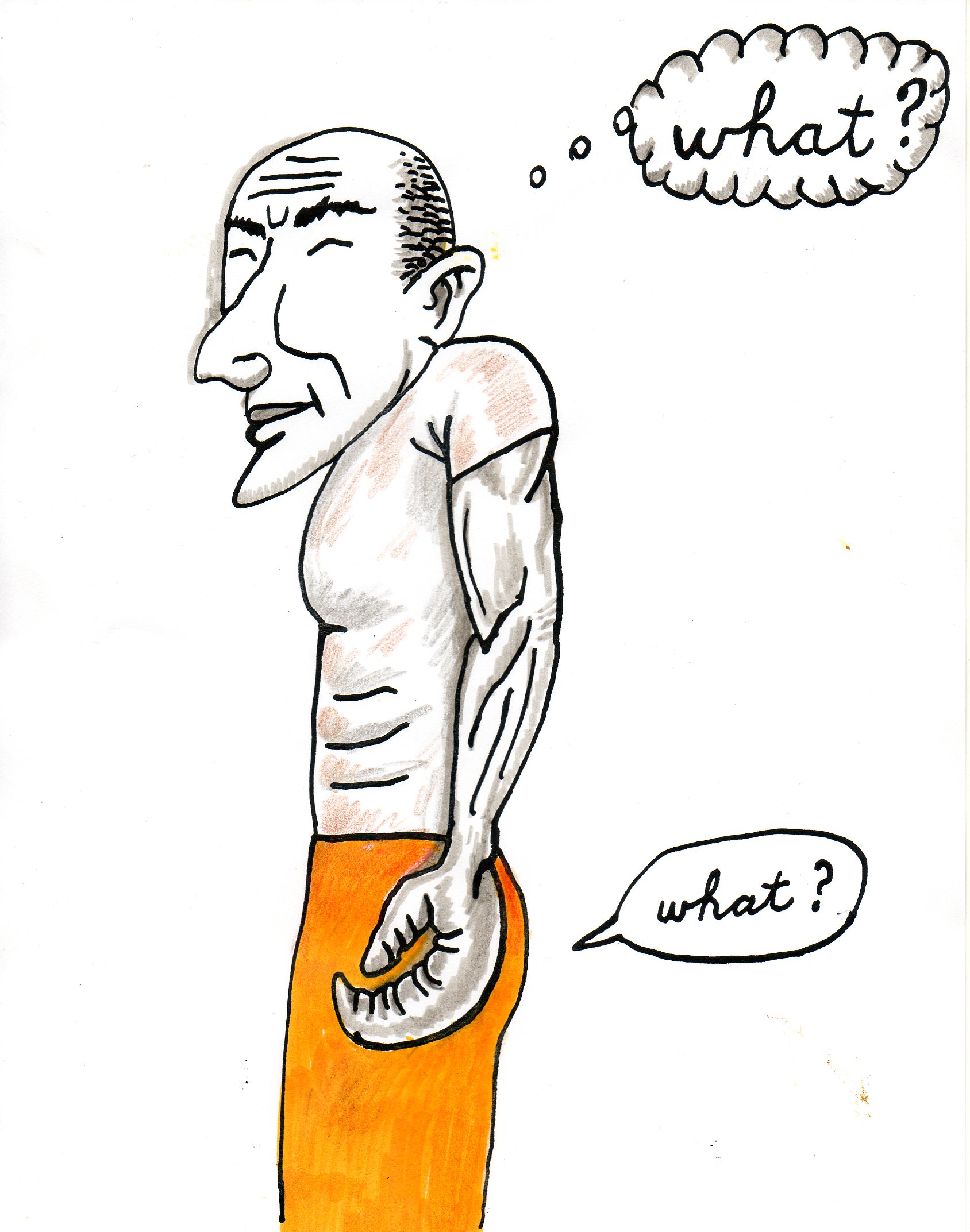
I can’t find it.  I did find this 2012 drawing, though:

what  2-19-11003


Turns out I’d written out my take on Complementary Schismogenesis pretty clearly four years ago:   

Complimentary Schismogenesis, I am told, is when two opposites are locked in some kind of conflict, neither getting what they need out of the arrangement, the attempts of each to resolve it, coming from opposite orientations, only make the problem more intractable, tighten the knot.   The schism continues to deepen as the two struggle cluelessly in opposite directions to heal the underlying fissure.

If we assume everyone is somewhat fucked up, damaged by life, laboring under certain sometimes vexing disabilities, friends are those whose asshole side we are able to overlook.  The friend has other lovable qualities we value that counterbalance the bad tendencies we all have.  We extend the benefit of the doubt to friends, a benefit we do not readily confer on random people we encounter.  

I told a friend recently that whatever other problems we may have had with each other over the years, we both are confident that neither of us would, seeing the other strapped in the electric chair, throw the switch before insisting that every single witness had a chance to speak.  He agreed.


Only one thing has changed since then, the guy who agreed that if I was strapped to the electric chair he’d let every witness for me speak before throwing the switch, may have revised that generous offer, the witness list might no longer be very extensive.  

The precipitating reason for this recent falling out — my attempt not to get angry when hurt wound up infuriating my friend who honestly had no way of knowing how upset I was since I didn’t even fucking scream at him like a normal person who claims to be so goddamned upset!   Plus, I was an aggressively self-righteous cunt about my “right” not to be “hurt,” even thoughtlessly, innocently.

My attempt to remain mild made him wild.  

If the glove don’t fit, don’t have a snit.

The Difficult to See Murder of Slow-killing Love (part one)

A few days after an unfortunate event at my sister’s wedding decades ago, my parents and I met in their living room for a violent confrontation.  There was snarling, bad language exchanged, overheated comments made on both sides, and once things became too much for me, physical violence — a single finger passed inexcusably across my father’s nose — to illustrate to him the real difference between physical violence and the emotional violence that was his specialty.

I have to back up for a moment, as I’ve tried to condense too much there.   The argument between my parents and me was over whether I had a right to be upset after an attempted beating, by the caterer of my sister’s wedding, who, by the end, had the assistance of three or four fellow off-duty cops who held me by my arms. True, he’d only thrown a dozen punches, or so, and I’d managed not to be hurt, though it was an undeniable ordeal, deserved or not, particularly while wearing a rented tuxedo I later got some of my blood on.  

My parents position was that, since I had clearly provoked the confrontation with this polite, smiling stranger, no matter how I might try to spin it to justify myself, I had only gotten what I deserved.  I found that position unfair, particularly coming from my parents, who I’d hoped would be at least partially sympathetic listening to my side of things.   Their unified, hardline attitude made it impossible for me to restrain myself from expressing my opinion at length, and with increasing conviction.

And so, because these two irreconcilable emotional positions could not be peacefully resolved, things quickly came to an ugly stalemate there in my parent’s comfortable living room.   After the illustrative pass of a single finger across my father’s nose, all hell broke loose.  It was like throwing a lit match onto a lake of gasoline.   The explosion of ugliness was not without an instant of timely, dark wit from me, but this story is not about any of that.

After enough screaming was done, I gave my parents the finger one last time as I left their home, a home I’d been told I was no longer welcome in, and rode off on my bicycle, through the rain, toward the subway for the long ride back to my apartment.   Passing the nearby home of an artist friend, a woman my parent’s age, I stopped by and rang the bell.   Florence and her husband listened to my story, troubled and sympathetic, and told me gently that time would heal this too, that these kind of mad family things have a way of blowing over and that I should not be too hard on myself.   All good to hear.  I hugged them and went on my way through the cold, dark, rainy night.

The point of this story:  the next morning I woke up to sunshine, birds singing, feeling unexpectedly light as a feather.   It was as though an immense anvil had been lifted off my chest, a tremendous weight I’d carried always, without realizing it, was suddenly gone.  I felt like leaping through the air, the relief was exhilarating. I remember the surge of energy I felt to be free of the kind of love that sadly concludes that if somebody wanted to punch you in the face over and over, they probably had a damned good reason for it.  [1]

Understand, I’m not trying to present myself as an innocent victim.   As you can probably conclude just from reading these words today, the words of a man who’d whip his own father across the nose with an outstretched finger, I am not a person who shrinks from a fight, nor any kind of angel.  When I was younger, if somebody told me I couldn’t talk to them like that I’d smile and tell them to go fuck themselves.  Cost me more than a few jobs in my day.   I have tried to learn to do better.  I’m pretty sure I do better, certainly in terms of not always giving vent to my anger, but that is not the point of this story either.  

People who insist they love you sometimes don’t really grasp what love is, and, in fairness to them, they may have come to their understanding of love honestly, never having experienced it.  The first requirement of love, it seems to me, is wishing no harm to the person, or creature, that you love.   First order of business, tend to the hurt they are expressing.   Feelings are real and can’t be dispelled by mere logic when they are enflamed.   Later order of business, once things are calm, if it will be helpful in the future, talk about the underlying issues involved, how to resolve things, etc.  But when you see a loved one crying, the first instinct must be to help them dry their tears and sit with them until they start to breathe normally again.  

That may sound kind of tender, coming from a man who’d slap his father across the nose with a finger, I know, but does it ring true to you?  

You come to me upset.  I say “before I hear your entire long story, let me quickly tell you five reasons why you really shouldn’t be upset, you need to let me finish — JUST LET ME FINISH–  before you can continue.  Try not to interrupt me, it will only take a few minutes and my calm explanations will clarify everything for you.  I have a right to tell you these things, because I love you.”  You raise a hand, extend one finger and slap me smartly across the nose.   Knowing what I know now, I really can’t blame you for that reaction.  

The thing to do, except in a situation where someone you love is about to hurt herself or somebody else, is let the person you love do what they need to do, say all they need to say, particularly when they’re upset.   The time may come, when heads are cooler, to discuss why I wasn’t actually wrong to insist on telling you the reasons you were wrong to be so upset.   But that time is not when you are upset.  

The immortal Charles Bukowski, in his immortal “The Shoelace” catalogues some of that swarm of trivialities that kill quicker than a heart attack.  On that list, and leaping off of it some days, are “people who insist they’re your friends.”   They claim to love you like family, and often they do.   It is good to remember that many assaults, most murders, and all incest, occurs in families, but that is a side note.

The main note is this — horrific as it also is, and upsetting to the stomach and disruptive to sleep as it is — if a person who tells you they love you does not treat you the way they’d want to be treated by the people they love, then that love is probably not the best kind of love for you.  

If they impatiently sit through your explanation of why you were hurt, when they meant only to help, and they insist on their right to tell you why they still believe they did nothing to hurt you, intentionally or otherwise, no matter how precisely you try to explain the hurt — and they wind up screaming at you and hanging up the phone because you have so upset them by denying their right to be just as upset as you are, in fact, more upset because your upset over an “accidental tasering” is such an irrational and unfair accusation of them… well, the best you can probably hope for is waking up the next day feeling a bit lighter.   As I can practically guarantee you will.  


[1]  This wonderful feeling of liberation would not last long, my father called a few days later to negotiate a peaceful return to the status quo, and after some wrangling over the course of several powwows, we went back to the way things had always been.  It would take until the last few hours of my father’s life, thirty years later, before he expressed his deep regrets about having been the way he’d always been.


Inner Dialogue, Pandemic installment #1

I used to have frequent conversations with the skeleton of my long-dead father.  I did this for about two years, almost every day, sitting at the computer, taking dictation to the steady beat of my tapping fingers, thumb adding off-beats on the space bar.  Once in a while I read one of these chats, often out of curiosity after I see someone has clicked on one (as somebody did yesterday) and realize I miss talking to my witty lifelong enemy, now that he is dead and full of self-knowledge and empathy.

“Who are you talking to, motherfucker?”  

You’re a droll one, doll-face.  You know goddamned well who I’m talking to.  I’m having what you might call an inner dialogue, something that becomes necessary from time to time to straighten out my unruly thoughts, if you know what I’m saying.  

“Talking to yourself…”    

I’m going to ignore these interruptions.   The nagging, niggling voice of the reflexive interrupter is not something to be interrupted by, if you seek clarity of any kind.  

“If you say so, Chief.”  

You can be 100% correct in your analysis, based on specific past experience and outside knowledge, your overall analysis can be dead on, and you can still, in an individual case, be wrong.  For example, you can be dealing with an inhuman bureaucracy, bent on saving money by cutting the eligibility of anyone it can, in a system brutally skewed toward protecting the privileges of the privileged; that bureaucracy can have twice or more arbitrarily fucked you, in excruciating detail, for reasons they later reverse — and in “the instant case”, as we are taught to say by law professors,  you may have simply been fucked by your own inaction or error, the inhuman bureaucracy in that particular case virtually, or at least legally, blameless.

“Seriously, man, who are you talking to?”

That is a disgusting and fake question.  You have a sickening smell.   You’re a disgraceful excuse for an interrupter!  

“Apologies, SIR!”  

As you were.  Now men, it is very important, and I say this to you as a role model and the steward of your morality, that you not be confused by these competing truths.   Both things can be true at the same time, even if one is more true at the moment than the other.  Do not doubt your essential analytical skills because you find yourself mistaken in one instance.   Yes, the enemy is brutal and sneaky.   Yes, sometimes you fall asleep at your post with your hand on your dick, mouth open, vulnerable to even the kindest, most considerate attack.  

“Sir, yes Sir!”

The exploitation of your vulnerability, even if done by the enemy in the most considerate possible way AT THAT TIME, does not mean that at any other time your ruthless enemy will not revert to character, not revert to the supremely inconsiderate beast it also is.  

Your faith in your fact-based analysis, men, should be as clear to you as a glass of pure water.  Be the water, not the glass.

“Bruce Lee, Jeet Kun Do, the Way of the Intercepting Fist.”  

Just so.

You can live on a low income, by choice, and not really be entitled to call yourself low-income, though why you would want to do that  is another question entirely.  You can be protected by someone who loves you, who has the means to protect you financially from the worst, and still be vulnerable to the same institutional cruelties that routinely kill many other people in your situation.   

Be self-effacing at your own risk, men.  Remember, the boy who cries “poison gas!” in a coal mine filled with odorless gas will still be killed by the poison gas he can’t smell.

It’s may be easy to view someone you feel has not worked as hard as you, at least not for pay, as a whiner complaining about the brand new rope being used to hang him.  

To consider me a pampered stuck pig screaming in pain from a self-inflicted wound I imagine is another of the thousand cuts freely given to anybody who speaks up, or stays silent, howling at unbearable, over-amped length, tediously advertising myself as the most learned and righteous of victims, giving pompous, imagined voice to the other, voiceless, real victims, is to paint only a corner of the larger picture.  I am also, potentially, with the right marinade and glaze, and slow-cooked to a turn, a very tasty rack of ribs.

“Sir, yes SIR!  Oh, yum! SIR!”


The Boy Who Cried “Poison Gas in the Coal Mine!”

Things are bad right now, we all know it.  If it was only this relentless pathogen we were up against, we’d be up against it.   Of course, it’s much worse than that.  The inhabitable earth, our natural world, is also in immediate and irreparable jeopardy, as demagogic strong men around the world ignore the approaching catastrophe, appealing to unifying ethnic and racial hatreds instead.

My mother, when I was a hyperbolic young boy (I got that poetic trait from her) used to warn me about being The Boy Who Cried Wolf.  She told me the story of the scaredy-cat shepherd boy who would yell “WOLF!” whenever he was scared.  The men from the village would come running with axes.  After a while the village just started ignoring his cries and, of course, one night, real wolves came and ate him and all of the sheep.

Then there is Kurt Vonnegut’s “canary in the coal mine,” a bird that (in human form) can also cry wolf, I suppose.    Vonnegut said that artistic types, being more attuned to and easily distracted by odd smells than most people, were society’s canaries in the coal mine. Miners used to carry these small birds into the mine shafts in cages.   The birds have tiny lungs, which would quickly fill with any odorless poisonous gas the miners might have accidentally tapped into.   When the canary fell off its perch, dead, it was time for the miners to quickly get out of the mine.   Writers and sensitive types, according to Vonnegut, serve this same warning purpose for society at large.

I felt like one of these tiny-lunged bastards the last few days, not that I am a writer or a sensitive type, officially.   If I hadn’t had the call from the doctor, I’d have never learned my health insurance had been cancelled weeks earlier.   Apparently no law requires more than… nothing.   Once my immediate problem (no health insurance during a pandemic) was solved, I found I could breathe again.  I now only need to hold my breath until May 1, assuming no other hidden hassle lies in wait for me.

AND I AM ONE OF THE VERY LUCKY ONES.  I know this very well.   My feet never touch the ground, I am carried gently from place to place and set down carefully on soft, clean pillows.   I am loved and cared for, like a beloved pet.   I realize this and am very thankful for it.   I don’t know why I keep thinking about the millions and millions who are perpetually doomed to unthinkably grim fates.  

What about those millions of Americans who lost jobs recently — along with employer-based health insurance —  with no chance for affordable health insurance during a public health emergency?   Some, with savings,  can rely on the expensive, aptly named COBRA, but, seriously, your best hope for comfort, while unemployed in America during a world-wide plague, is COBRA?

The chaotic federal administration’s bungled response to this massive public health crisis illustrates the need for strong laws to protect programs that protect lives.   The human right to health care, for example, because it’s a human right, should be guaranteed by the government of the richest nation in human history to all of its citizens, so that none need fear death due to insufficient income.   And so forth.  

Instead, taking this crisis in the sense of the Chinese ideogram that also, famously (and probably falsely) means “opportunity,” long-sought radical right-wing programs that benefit the very wealthiest and most unprincipled are jammed through the moment the time is right — while we are all in terror for our lives.  No need for the EPA regulations, fuck Nixon and the Commie horse he rode in on! Protecting the “environment” like a bunch of tree hugging pansies!  Drop dead, job killers!   And so on, and so on, and scooby-dooby-doo-yeah.

Being summarily thrown off health insurance, particularly during a plague, is objectively terrifying and infuriating.  It should not happen to anyone.   Odd to say, my overheated, anguished screams of the last few days, before I heeded sensible advice and checked the website of the public agency that provides my health insurance, are as alien to me now as the last chirp of countless dead canaries who, having served, are forgotten, as all flesh must eventually be.   I feel a bit abashed to have been the canary boy who cried “DEATH!!!” during the plague when it was his own easily fixable error (even if he got no reminder to fix it) that tried to come back and kill him.  What a cry baby!


retracting DFS complaint number CSB-2020-01351366

As I emailed the New York State Department of Financial Services earlier today:
I have been unable (last night and so far today) to log into the DFS portal where I submitted this complaint yesterday.   I was told to email your agency here.
I withdraw complaint CSB-2020-01351366.  Healthfirst had nothing to do with this termination of my ACA health insurance.   They might have informed me of the impending loss of my insurance, which they knew of for three weeks before it was terminated, although they likely had no legal duty to do so and every business reason not to.   My complaint should not go to Healthfirst.
 
My insurance was terminated by the NYSOH, for my own oversight, which remained uncorrected for lack of effective notice of the mistake by NYSOH.  I have since been able to correct this oversight and my insurance will be restored effective 5/1/20.  
Please terminate this complaint.  

Education and Clarity of Language might not help you

Yesterday’s attempt at an Op Ed for the Grey Lady ended with this now deleted paragraph about the seeming impossibility of getting my improperly terminated health insurance back during a raging plague.  Observe the plangent notes of heroic  self-pity:

So I am left to accept my punishment and practice mindfulness.  I sit here lowering my blood pressure, and my heart rate, by thinking of the miracle of communication — how I can sit and convey these deeply fearful things to a stranger, merely by arranging the words properly on a page.  I hope someone will remember I did this when they are lowering my body into a mass grave.   My murdered ancestors would want no less for me.

Admittedly, useless — DELETE! — though I do still greatly appreciate the miracle of written communication, as far as it goes sometimes.  Nothing like writing the situation out clearly when you are in great trouble or danger.

Today I wrote this concise complaint to the NYS Department of Financial Services, the NYS agency that regulates all insurance, financial houses, hedge funds, banks, etc. in New York State,  My latest attempt to take a flying fuck at a rolling donut (though their on-line consumer complaint form immediately fixed a similar insurance termination without notice problem back in January):

I was informed Friday afternoon, when I called my insurer after being told by a doctor that my insurance came up “inactive,” that my Healthfirst health insurance, prepaid through June, had been cancelled, effective March 31 by the New York State of Health Marketplace. According to Healthfirst, no reason for this termination was given by NYSOH.

NYSOH, I was told, had sent Healthfirst notice of their intent to terminate my ACA insurance on March 11.  Neither Healthfirst nor NYSOH provided me any notice of this termination, not prior to the effective date nor since.

I am instructed to call NYSOH, an overwhelmed and unresponsive agency on a good day, where one hears this recording:

New York State of Health is experiencing high call volume.  Because of the public health emergency we are extending the due date for people who are expected to renew before April 15.   You will receive another notice of the new due date before any changes will be made to your coverage.   You do not need to take any action at this time.  

Also, because of a new federal law, no person who currently has Medicaid coverage will lose their coverage during this emergency.  If you are enrolled in Medicaid and get a notice from New York State of Health telling you that your coverage will end after March 18, 2020, you can disregard this notice.  You will have no gap in coverage.  If you have Medicaid you do not need to report any changes to your account except a permanent address change.

I have to assume that termination of prepaid health insurance without notice violates some NYS law, administrative rule or something, in addition to the due process protection of the US Constitution and the PPACA.  One searches for New York’s legal answer to this question in Titles 10 (Health) and 11 (Insurance) of the New York Codes, Rules and Regulations  in vain, there is no chapter on point. 

(I was wisely advised to follow my hunch and delete this line:  I am still waiting (since early February) to hear back from your office for a citation to the text of the controlling law.)

Can you help me get my improperly terminated insurance back during this worldwide plague? I’d be eternally grateful.

Alternatively, can you direct me to the nearest rolling donut?

You Have the Right Not To Be Angry

If you are not wealthy in this country, you have a very limited right to express anger publicly.   Anger, like health care, is a privilege in America, not a right.

A wealthy person who feels aggrieved may hire a team of lawyers to legally bludgeon the person who inflicted the injury.   An angry wealthy person may take out a full-page ad in the newspaper of record, calling for vengeance against someone he hates.   Our current president did this, as a private citizen, when he purchased a full-page of the New York Times to call for the death of five boys locked up for, and eventually exonerated of, a heinous crime.    Anger is all the rage among the rich and powerful.  It is a luxury not permitted to the weak.

I was told in no uncertain terms in January, mistakenly it turns out, that my Affordable Care Act health insurance had been properly terminated without notice, for my failure to do something I had no notice of.   I’d been told by the insurance company that everything I needed to do to have 2020 health coverage had been done.  Then they informed me I had no health insurance because I’d failed to pay a “binder” during a once-a-year ten day grace period that nobody told me about.  The invoice made no mention of a do-or-die grace period.

I had no warning, no chance to fix what they told me was fatally broken in our contract.   This lack of a heads-up struck me as fundamentally unfair, as it probably is, except in a world where superhuman corporate “persons” rule over regular puny earthling persons who proceed at our own peril.

I was angry about this, even after the multiple complaints I submitted resulted in the reversal of this irreversible decision.   Within a very short time I had my insurance restored;  in fact, I had a call from the insurance company apologizing and telling me that my insurance had never actually been terminated.   I rescheduled a canceled cardiologist appointment and had an expensive treatment paid for by the insurance company, at about 30% of the uninsured sticker price, with only my co-pay required from me.

Still, I was irked about the lack of accountability for a health insurance company that had made me suffer agonizing anxiety as I exerted myself mightily to find the hidden legal remedy (hint: NYS Department of Financial Services).  I am pretty sure that the “mistaken” termination had been unlawful, this seems clear by how quickly the final determination against me was changed.  

To my dismay, nobody I spoke to in the city, state or federal bureaucracy could tell me what that violated law was, not its name, its existence, what exact patient protections it contained.  I wanted to see the text of the law, to read the precise patient protections my health insurance provider had ignored, to such unfair and frightening effect.  It is apparently not the right of a powerless citizen to have this kind of information.

I began lashing out in letters and emails, and on the phone.  A Resolution Specialist from Healthfirst called and promised me a written apology and a record of the many calls I’d had with the insurance company, which would allow me to trace exactly what had been done to me and how it had been corrected.   I wanted a roadmap of how the unknowable law had been violated.  I feel a strong need to inform others in my situation of their rights and legal remedies.   None of what I was promised by Healthfirst was delivered.  

I became increasingly unsettled, as my case was repeatedly “escalated” and never resolved.  I included some inflammatory remarks in letters and phone calls and asked pointed questions about some very obvious things.  

For example: due process is guaranteed in our constitution.  It is fundamental to a free society that people have the right to some kind of hearing, some process, before they can be deprived of something they legally own.  In my case, I’d re-enrolled for coverage in time and subsequently paid for my health insurance through June.  How was it legal to void our contract without notice to the consumer?

As if in answer to this question, I was informed on Good Friday, during this pandemic (not a very good Friday for me) that my insurance had been terminated again, without so much as an email to inform me of this sobering fact, and without any reason given, effective March 31, 2020.

I learned this when I had a call from a doctor I was scheduled to see (over the phone) on Wednesday telling me my insurance came back “inactive.”  When I called Healthfirst to snarlingly enquire, the rep confirmed that they had been instructed to terminate my insurance by the New York State of Health Marketplace, the state’s sole purveyor of Patient Protection and Affordable Care Act health insurance policies.

In the absence of law, those with the power to do so can freely oppress those who are powerless.   If you have no power, you must not be angry about this.  Anger is so bad for your health, your immune system, all of your relationships!

I was told the New York State of Health contacted Healthfirst on March 11, instructing the private corporation to terminate its contract with the patient.  No reason was given.   Any day between March 11 and March 25 would have been an ideal time for either or these entities to inform the patient of the jeopardy he was about to face (no health insurance during a worldwide plague) and the need for immediate action on his part to prevent the loss of the insurance he’d already paid for.  

There was no email, phone call or letter — none from Healthfirst, none from the so-called New York State of Health.   Healthfirst sent me a notice that my ongoing cardiac treatment had been approved through July, an invoice showing that my premiums were paid through June, and numerous instant email reminders that I’d not taken the voluntary customer satisfaction survey after each call.   Not a peep about the insurance cancelled ten days before I found out about it when a doctor’s office alerted me to it.

Had the doctor’s office not called, I’d still be blissfully unaware that my health insurance has been quietly null and void for thirteen days and counting.  Seems there should have been some legal process due before a patient is deprived of healthcare during a pandemic, no?

The well-paid CEO of Healthfirst would be perfectly within her rights to be furious at me, after being subjected to provocative lines like these, no matter how otherwise accurate they might be:

A corporate “person” is an appetitive psychopath, without conscience or remorse, driven to devour and only constrained by the rare regulation in place to restrain the gnawing impulse to maximize profits, a corporation’s only legal imperative.

The removal of health insurance during a plague is arguably an excessive punishment for an impolitic expression of something that is well-known: private health insurance corporations have every incentive to cull from their rolls older, low-income patients who cost them far more in medical care than they pay in premiums.   That’s just good business sense, however else one might feel about it.  

Why the New York State of Health intervened a month ago, as I was told by Healthfirst the other day, with no reason given, to terminate the ACA insurance of a customer who had re-enrolled and completed his end of the contract with a private insurance company is a question I will not be able to get an answer to any time soon.   During this terrible plague, everyone is overwhelmed, many mistakes are made, lines for help are very long and it is best to stay calm, even when provoked to great fear and anger.  Particularly if you are powerless in a state ruled by the bottom line.

That said, it would be a wonderful thing for citizens to actually be allowed to know the laws that protect them from arbitrary and capricious decisions with terrifying consequences.  It’s kind of maddening that we are not, if I might be so bold.