In this installment of The Scheme (below) Sheldon Whitehouse compares the operation of the right-wing front groups and fake trade associations that promote climate change denial and shows that these are the same groups, funded by the same donors, involved in court capture and other right-wing projects. The larger aim of this network is to end the administrative state by destroying government agencies’ power to regulate business.
Whitehouse continues to lay out the orchestrated cascade of dark money that funds an energetic, litigious web of right-wing activists; groups like the Heritage Foundation, the Cato Institute, the Competitive Enterprise Foundation, Donors’ Capital and Donors’ Trust, the Charles Koch Foundation, the Bradley Foundation, the US Chamber of Commerce. He runs through a few of their wish list items, like the lawsuit, brought on behalf of a paid plaintiff, to attack the constitutionality of Elizabeth Warren’s Federal Consumer Protection Agency.
It is not only a flotilla of coordinated amicus briefs Federalist Society lawyers are submitting to the Federalist Society 6-3 majority on Trump’s Supreme Court, on behalf of various united front groups, it is the lawsuits themselves, selected, as Shelby County v. Holder was, to achieve specific long sought reactionary goals.
To give bolster the illusion that their cases speak for all Americans, there is a women’s front group, the Independent Women’s Forum, funded by dark money, that pops up to present a right-wing free market woman’s point of view in various cases, a recent Second Amendment case, a contraceptive case, a case to limit the Environmental Protection Agency’s authority to regulate greenhouse gases, in the Americans for Prosperity Foundation case that granted a constitutional right to unlimited dark money (signed off on, as Whitehouse says, by the dark-money justices).
Whitehouse ties together cases originating from the U.S. Chamber of Commerce (sudden champion of Climate Science denial) which was, grotesquely enough, the same conservative political outfit that paid for the fucking Powell memorandum, the blueprint for a corporate takeover of the nation, written decades ago. In that memo Powell identified an activist federal judiciary as the key instrument for social, economic and political change, indispensable for kneecapping agency power across the board. Louis Powell, the tobacco lobbying lawyer, became Justice Powell shortly after writing his influential memo for the US Chamber of Congress. Justice Powell, appointed by Nixon, a pox on both of their houses.
This series should be required viewing for every high school and college course in civics and American government.
There are conspiracy theories, often based purely on paranoia about unexplainable vexations and there are actual conspiracies that can be mapped using real data. How did this nation arrive at a place where almost 70% of one of our two major political parties believes that a widely disproved lie (massive Democratic voter fraud, abetted by disloyal Republicans) justifies political violence and the nullification of millions of legally cast ballots?
You can read books like Jane Mayer’s great “Dark Money” and Nancy MacLean’s detailed follow-up, “Democracy in Chains” and emerge with a clear view of how super-wealthy American reactionaries have methodically used their fortunes to shift the cultural debate and the government and its laws toward their goal — unfettered enjoyment of perpetual privilege free from the “coercion” of “majoritarian tyranny.”
They have done this by tireless engineering work, work that resulted in the Supreme Court declaring that spending infinite amounts of “dark money” to influence elections and law enforcement is simply free speech, protected under the First Amendment. After Charles Koch became convinced that their reactionary ideas could never win via the ballot (his brother, as VP candidate on a Libertarian ticket got less than 1% of the vote in the 1980 presidential election) they began engineering alternative influence mechanisms. They created many “think tanks,” endowed university chairs, gave scholarships to promising young right-wing thinkers, deployed armies of lobbyists, used smart, audacious media strategies, funded “grassroots” movements like the Tea Party when the time was right to show that ordinary Americans coast to coast were united in opposition to a tyrant of mixed-race who was possibly not even legitimately entitled to be the president. They used these devices to create “climate change skepticism,” a fever over gun rights, to gin up a host of violent debates to divide a populace that would otherwise be united in opposition to this powerful elite’s larger plan — eternal luxury for unaccountable, unregulated corporate masters of the universe.
One of their most important innovations is an almost forty year-old fraternity that selects true believers for the highest lifetime judicial positions in the nation. These frat brothers (and some sisters) are then in position to have the final unappealable word on what is constitutional and what is illegal in the USA. Unlimited expenditures of secretly donated money becomes protected free speech. Five of their frat brothers have the power to overturn a 98-0 Senate vote, and the enthusiastic support of a conservative Republican president, with a few pages of bloodless legalistic right-wing fantasy, as John Roberts did in his infamous Shelby County v. Holder decision that ended federal enforcement of minority voting rights. Since we now have a half-black president, he reasoned, we live in a post-racial society and there is no longer need to enforce the Voting Rights Act of 1965. 5-4, case closed. If you read the decision, the dissent had the better of every argument, but, no matter, there is no appeal available once the majority has signed on. We can all see the predictable results of gutting enforcement of a law that successfully evened the electoral playing field after a century of winked-at legal racism at the polls in many states.
The Federalist Society is a quasi-religious right-wing fraternity that trains young law students and lawyers in its conservative doctrine and grooms them to become solid, right-wing judges. It provides members with fellowship, support, a network of powerful mentors and a career path to power for the most loyal and ambitious among them. Six of its most illustrious members and supporters now compose the 6-3 Trump Court majority.
It is not entirely unfair to call a faith based organization like this a cult, since it demands adherence to a strict set of values — “originalism” (faith to the Constitution without those pesky post Civil War Amendments) the rights of corporate “persons”, the right for everyone to have guns, the right of the religious to discriminate, based on their faith, the rights of the fetus — and rewards that adherence to these values with advancement to lifetime judicial appointments. All three of Trump’s picks were handed to him off a list Leonard Leo and his friends at the Federalist Society drew up, as Trump had promised. Doing that was one of the few promises Trump ever kept in a life of compulsive “transactionalism”.
Here is Senator Sheldon Whitehouse on The Federalist Society:
We live in a culture of distraction based on marketing to each of us personally every possible moment. The power to sell us things (and ideas) every waking moment has never been greater than now, when we carry our virtual community with us everywhere, in our pocket.
The constant distraction of monetized social media during these desperate times makes mass influence much easier, “social media” also creates the illusion of community and democracy by making mass “personal” conduct, like the so-called Arab Spring or the January 6 MAGA riot at the Capitol, events in which many choose the same personal action at the same moment, more likely.
So much noise and bad air is flying at us, constantly, in a torrent directed at each of us personally, that it is almost impossible to keep the larger view of what is happening in front of our senses for more than a moment. The heightened anxiety of living in a competitive, highly individualistic culture where the stakes for losing include homelessness and death for lack of medical insurance, is good for only one thing, the corporate bottom line — consumerism. Fear and anxiety sell! When the going gets tough thetough go shopping.
As consumers about to spend our money, our power of personal choice is at its greatest. What specific variety you consume and when you consume it (on demand, it doesn’t get better than that!) are really the only inviolable US freedoms at the moment, so who would not feel better when making consumer choices, even ones thrust at us?
Our challenge in this environment is how to escape from these ever more complete personal/social/political bubbles once in a while to see the bigger picture, the historical one. How to take in, focus on and retain important small details that later become so important in the big picture.
It’s often hard to see a direct line in a mass of information until someone else lays it out for us. Heather Cox Richardson, historian and writer, has emerged as one of our best in this moment in history. Here’s a bit that caught my eye from the other night’s Letters from an American:
Ukraine, which became independent from the old U.S.S.R. in 1991—December 2 is the anniversary of Poland and Canada becoming the first to recognize its independence, actually—is not part of NATO. It had begun the process of applying for membership in 2008, but in 2010, Russia-allied oligarch Viktor Yanukovych, whose campaign was being handled by Paul Manafort, won the presidency and turned the nation away from NATO and toward Russia.
In 2014, Ukrainians rose up and overthrew Yanukovych, who fled to Russia (thus putting Manafort out of a job and freeing him to run Trump’s 2016 campaign). Later that year, Russia invaded Ukraine’s Crimea, prompting the U.S. economic sanctions that Putin desperately wants lifted. Ukraine’s interest in joining NATO jumped.
Heather’s point in that post was to detail the autocratic Putin’s high-stakes brinksmanship in his current threat of Ukraine, as Russia threatens all-out war with Ukraine, not to expose the Trump connections that may underlie the ongoing crisis. But read these lines and see how much of the current GOP’s ongoing anti-democratic corruption is encapsulated in them.
in 2010, Russia-allied oligarch Viktor Yanukovych, whose campaign was being handled by Paul Manafort, won the presidency and turned the nation away from NATO and toward Russia.
Trump’s unpaid, volunteer campaign manager, Paul Manafort, had spent years in Ukraine, making many millions of dollars, grooming a Russia-allied oligarch to become president of Ukraine. Manafort, the man of ostrich jackets and the lavish lifestyle, was not one to do anything without a big pay day. Manafort’s candidate Viktor Yanukovych was in office until 2014, openly exercising corrupt power when
Ukrainians rose up and overthrew Yanukovych, who fled to Russia (thus putting Manafort out of a job and freeing him to run Trump’s 2016 campaign).
This is a huge background detail in Trump’s shakedown call to the new Ukrainian president asking him to do him a political favor, though, by announcing a corruption investigation into Hunter Biden. That call led a whistleblower to report the improper use of presidential power, which in turn led to Trump’s AG burying the whistleblower complaint, as one does when one’s power is unrestrained by any principle. Nancy Pelosi foolishly bet the farm on Americans being outraged that an American president would try to extort a political favor from our allies Ukraine. To which most Americans responded “Ukraine? What is a fucking Ukraine?”
Manafort, the Republican Senate intelligence committee report found, regularly met with and gave sensitive polling data to Konstantin Kilimnik an agent of Mr.. Putin’s. Mr. Putin did everything possible to help swing a close election to his useful idiot Mr. Trump. These findings were confirmed by Little Marco (Rubio) and his Republican committee. Manafort lied under oath, was convicted, sentenced, pardoned by Trump like his colleague Roger Stone, like the insane Mike Flynn. Nothing to see here
To many average Americans, the only question regarding Ukraine is whether it, not Putin, actually helped Trump squeak his way into the White House.
Senator Sheldon Whitehouse has been laying out, in a now nine part series of presentations in the Senate that he calls the Scheme, the billions spent (tax-deductibly) over the decades by increasingly demanding right-wing billionaires to take over state governments (with organizations like the American Legislative Exchange Counsel — ALEC, authors of Stand Your Ground, anti-mask mandate, voter “integrity” and anti-abortion laws) and capture the federal courts.
Their larger goal is to end all government regulation of business, lower their own taxes, shrink government and enjoy the liberty of a luxurious life without the threat of coercion by a meddling, overeaching government that panders to the “takers”, that undeserving, ever expanding majoritarian tyranny. Their biggest advantage in this fight is an inexhaustible fund of unregulated, untraceable, “dark money”, permitted under the laws that make their political organizations qualify as non-profits. I visited ALEC’s website the other day, and, bingo:
As long as the Supreme Court they have orchestrated into being continues to rule in their favor (and the 6 reactionary majority are all members of the same far-right ideological fraternity, literally, a career-networking frat founded on the 1980s by those same dark money billionaires), they will remain safe from things like “Kamala Harris’s unconstitutional disclosurerequirements.”
Imaginethe irreparable harm that would be done to America’s greatest political donors if the identity of those secret donors who funded Trump’s $50,000,000 ad buy to promote the lie that Trump was robbed was forcibly unmasked. Those ads worked fabulously, by the way, about 2/3 of Republicans believe there was massive fraud in a bipartisan conspiracy so diabolical that no evidence was ever found!
It’s impossible to hear the “arguments” and read the summary, unsigned 5-4 and 6-3 narrowly ruled partisan decisions from the Trump Supreme Court without suspecting that some kind of fix is in. Here’s Whitehouse on the part of the dark money machine that selects cases the Supreme Court uses to change the laws for decades (like the Shelby County case that overruled a 98-0 Senate vote and set voting rights back fifty years). Their various dark-money funded legal arms submit countless “friend of the court” legal briefsthat provide the Gorsuchs, Kavanaughs and Coney-Barretts everything they need to craft facially plausible eye-of-the-needle legal arguments:
What could go wrong? After all, once they throw a coveted chunk of red meat to their religious base by overturning Roe v. Wade, it will only be poor women, and girls without family connections (the bulk of the US plague of maternal and infant mortality deaths anyway), who will suffer the abolition of of this long time woman’s constitutional right. Everyone elsecan just fly to Switzerland. What’s the problem?
The Federalist Society’s reactionary 6-3 majority gets ready to deliver on some of their radical ideologically-driven promises, after demonstrating their zeal a few times already when they had a 5-4 majority (see examples below). Taking no chances on any of these jurists being “compromisers” of their deeply held, often religiously fervent, beliefs, the 6-3 majority was carefully vetted to avoid what happened when some Republican appointees wound up being amenable to compromise in recent decades. As Ruth Marcus wrote in the Washington Post the other day (all quotes are from that essay, linked below):
. . .[O]ver time, and under the tutelage of the conservative Federalist Society, Republican presidents, beginning with George W. Bush and intensifying with Trump, became better at picking reliably conservative justices. There were to be no more David Souters, who turned out to be a solid liberal vote; no more Sandra Day O’Connors, whose background as an Arizona state legislator often inclined her to compromise; no more Anthony M. Kennedys, the pale-pastel conservative named to the court after Ronald Reagan’s first choice, Robert H. Bork, was resoundingly defeated.
Future justices would have judicial paper trails to provide assurance of their conservative bona fides on everything from explosive social issues to government regulation, a topic important to legal conservatives and their financial backers. And so the post-Rehnquist years produced the Roberts court, adding not only the chief justice but also Samuel A. Alito Jr. and, with Trump’s election and Senate Majority Leader Mitch McConnell’s (R-Ky.) stage-managing, three new conservative justices: Neil M. Gorsuch, Brett M. Kavanaugh and Barrett.
Even Before McConnell audaciously rammed through a sixth hardcore conservative, a member of a Christian religious cult, for good measure, (a Harvard law professor cited in the article correctly refers to these hardcore “conservatives” as reactionaries, partisan resisters of social change intent on turning the clock back at any price):
The conservative majority notched steady victories. It let federal executions resume for the first time in 17 years. And its decisions dramatically moved the law on religion, simultaneously carving out greater protections for religious freedom and lowering the barrier of separation between church and state. Religious institutions received exemptions from having to comply with anti-discrimination laws, even as states were required to provide equal benefits to religious and secular private schools. In other words, churches could discriminate but could not be discriminated against.
The Biden administration, after McConnell orchestrated the reactionary 6-3 majority (and recall, the blocked Merrick Garland nomination would have made the court 5-4 the other way), meanwhile waits for a team of legal experts, appointed in April, to issue a report confirming that it is constitutionally permissible to add justices to the Supreme Court (though apparently Biden has no will to do that [1]). The U.S. Constitution gives no set number and there have been different numbers of justices at different times in our history.
Ruth Marcus gives detailed examples of the “nonpartisan” court in action, from an excellent and chilling essay called The Rule of Six: A newly radicalized Supreme Court is poised to reshape the nation recently published in the Washington Post (graciously gifted to you by the supremely generous Jeff Bezos) about what these highly partisan culture warriors are preparing to do, in this term and for as long as they live.
My only problem with Marcus’s essay is her conclusion that rebalancing the court by adding nonpartisan justices is a “remedy worse than the disease.” Her position is that the left (one could say representative democracy itself) has simply been outplayed by canny partisans like Mitch McConnell and Leonard Leo (longtime VP of the Federalist Society who led the well-funded campaigns to support the Supreme Court nominations of John Roberts, Samuel Alito, Neil Gorsuch, Brett Kavanaugh, and Amy Coney Barrett) who have delivered a solid, carefully vetted, ideologically-driven 6-3 reactionary majority that is now immune to the compromise that rules a 5-4 court.
Marcus seems to urge us all to resignedly strap in for the next thirty years or so as this band of zealous partisans rewrites the Constitution, brazenly, sometimes wildly, for a few generations of unchallengeable right-wing rule. We who are not enthusiastic Trumpists will have to content ourselves with excoriating dissents from the three judge’s powerless to alter any decisions, no matter how wrongly decided.
Here are a few examples from from a long essay, analyzing several grievous decisions by this new 6-3 court, well worth reading.
Months later, with Joe Biden in office, the partisan tinge to the majority’s decision-making became clearer. Having stepped in time and again on behalf of the Trump administration, the court rebuffed a Biden administration request that seemed at least as worthy of emergency intervention. It involved the Trump administration’s Migrant Protection Protocols, better known as the “Remain in Mexico” policy, under which tens of thousands of asylum-seekers had been required to wait across the border, often in squalid and dangerous conditions, as they awaited hearings.
The policy had been put on hold during the pandemic; the Biden administration, on taking office, suspended and ultimately terminated the program. In August, a Trump-appointed district judge in Texas took the extraordinary step of ordering the administration to start it back up. The appeals court declined to intervene. So Biden’s acting solicitor general, Brian H. Fletcher, turned to the justices with an urgent request, arguing that the injunction “imposes a severe and unwarranted burden on Executive authority over immigration policy and foreign affairs.”
The justices had seen this issue before, actually. When immigration rights groups challenged the legality of the Remain in Mexico policy and a different district court judge blocked it from taking effect, the Trump administration raced to the high court seeking a stay. Then, the court, over Sotomayor’s objection, granted the request.
Somehow, when the Biden administration asked for a similar accommodation, none was forthcoming. The trial court order remained in place, over the objections of the three liberal justices. If anything, the interference with presidential prerogative and international relations — ordering a new administration to resume its predecessor’s policy — seemed more severe than when the Trump administration won its stay. It was hard to see what was different here, except that one petitioner was named Trump and the other Biden.
Here’s another unsettlingly juicy paragraph from the same essay:
The other conservative justices fumed about what they viewed as the court’s disregard for religious rights [during the pandemic], and over the following months their anger only grew, expressed in acerbic dissents. Then Barrett arrived — and with her, a dramatic change in the law, on Nov. 25, 2020, just a month after the Senate voted to confirm her. At issue this time was an executive order issued by New York Gov. Andrew M. Cuomo, imposing strict limits on attendance at religious services in areas of high covid spread.
Now, the conservatives had a new justice on their team and little patience for deference to state officials who seemed to favor acupuncture clinics and laundromats over churches and synagogues. “Even in a pandemic, the Constitution cannot be put away and forgotten,” the five-justice majority wrote in an unsigned opinion. “The restrictions at issue here, by effectively barring many from attending religious services, strike at the very heart of the First Amendment’s guarantee of religious liberty.”
The case was striking for the public display of hostilities between Gorsuch and Roberts, an unusual glimpse into the tensions that simmered within the conservative camp as well as the internal sniping about Gorsuch, who had arrived at the court without the deferential demeanor of a junior justice.
In a sneering concurring opinion, Gorsuch took aim at the chief justice’s concurrence in the California case a few months before. “Mistaken from the start,” Gorsuch wrote, and it got uglier from there. The “judicial impulse to stay out of the way in times of crisis … may be understandable or even admirable,” he lectured, but “we may not shelter in place when the Constitution is under attack. Things never go well when we do.”
The chief’s response was subtler but no less acidic, remarkable to those accustomed to Roberts’s generally even, above-the-fray temperament. Gorsuch had taken Roberts to task for having “reached back 100 years” to find a supportive precedent, the court’s 1905 decision in Jacobson v. Massachusetts upholding fines for failing to obtain smallpox vaccine.
In reply, Roberts wrote that Gorsuch was the one who was overreacting to a perfectly logical citation. “While Jacobson occupies three pages of today’s concurrence, it warranted exactly one sentence” in the California case, Roberts wrote. “What did that one sentence say? Only that ‘[o]ur Constitution principally entrusts [t]he safety and the health of the people to the politically accountable officials of the States to guard and protect.’ It is not clear which part of this lone quotation today’s concurrence finds so discomfiting.” This was the judicial equivalent of asking, “What’s your problem, dude?”
Even more than the tensions between the two men, however, the case underscored two new realities on the court. First, Roberts was no longer the pivotal player. He had been outvoted.
Second, this new majority wasn’t about to let prudence get in the way of exercising power. Roberts had voted to leave the New York restrictions in place even though, he said, they “do seem unduly restrictive.” Cuomo had redrawn the affected areas, he noted, so that the churches and synagogues that brought the caseweren’t any longer subject to attendance caps. Therefore, Roberts reasoned, the court had no need to issue “an order telling the Governor not to do what he’s not doing.”
The new majority wasn’t buying it. “The applicants remain under a constant threat,” they said. After all, why put off deciding something until tomorrow if you’ve got the votes today?
And one last, especially chilling and consequential ruling about facially discriminatory state election laws that are “merely” partisan and not provably, intentionally racist (foreshadowing the fate of anything that Congress might theoretically achieve, Manchin, Sinema and 9 Republicans permitting, with the stalled Freedom To Vote Act and the John Lewis Voting Rights Advancement Act):
But if one case from the 2020 term epitomized the brazenness of the new majority, and signaled more to come, it was Brnovich v. Democratic National Committee, decided on the last day of the term. This time, in a case about voting rights, the conservatives were united, with Roberts fully on board.
Since his service as a young lawyer in the Reagan administration, Roberts had been a long-time antagonist of a broad reading of the 1965 Voting Rights Act, which he saw as an affront to states’ rights and an unnecessary artifact of what he views as a bygone era of explicit discrimination.
In 2013, Roberts wrote the 5-to-4 majority opinion in Shelby County v. Holdereviscerating Section 5 of the Voting Rights Act, the critical mechanism that required jurisdictions with a history of voting discrimination to obtain advance approval for voting changes — known as “pre-clearance” — from the Justice Department. For decades, this provision safeguarded the votes of millions of minorities — and drove Republicans in the South and other covered areas to distraction. In Shelby County, Roberts led the charge to neuter the law.
“Our country has changed” since the Voting Rights Act was passed, Roberts proclaimed, with arguably excessive optimism. In any event, he assured anyone who might be concerned, “Our decision in no way affects the permanent, nationwide ban on racial discrimination in voting found in” Section 2.
That would wait for Brnovich. Section 2 allows after-the-fact challenges to changes in voting procedures. In a 1980 decision,the court held that Section 2 applied only to intentional discrimination, not to practices that have the effect of disadvantaging minority voters.
In the aftermath of the 1980 ruling, Congress — yes, it was a different era — passed a new, strengthened version of Section 2 designed to make clear the law barred practices with discriminatory effects, whatever the motive. The new Section 2 prohibited any voting practice that “results in a denial or abridgment of the right … to vote on account of race or color.”
For years, that provision had taken a back seat to Section 5, because pre-clearance wassuch a powerful tool. But in the grim aftermath of Shelby County, voting rights advocates sought to expand the use of Section 2.Advertisement
Brnovich was the high court’s first take on this effort — and it did not go well. The case involved two Arizona voting rules: The first was a state policy that disqualified an entire ballot that wascast in the wrong precinct — even if some parts of the ballot, say for candidates for statewide or federal office, were still valid. The second was a law that made it a crime for most third parties to collect and deliver ballots to election officials — what Republicans pejoratively term “ballot harvesting.”
It was easy to see — if you cared to look — how both rules had a discriminatory impact on minority voters, in particular on Arizona’s population of Native American voters. As Kagan outlined in a scorching dissent, Arizona is a national leader in tossing otherwise valid votes cast in the wrong precinct; in 2012, it accounted for almost 1 in 3 of such discarded ballots, 11 times the rate of the nearest contender, Washington state.
And the Arizona rule clearly operates to disadvantage minority voters. In 2016, Hispanic, Black and Native American voters were twice as likely as Whites to have their ballots discarded. Alito’s majority opinion sniffed that this was no big deal — only a sliver of minority voters’ ballots (around 1 percent) was affected. Kagan: “A rule that throws out, each and every election, thousands of votes cast by minority citizens is a rule that can affect election outcomes. If you were a minority vote suppressor in Arizona or elsewhere, you would want that rule in your bag of tricks.”
The ballot collection rule was even more discriminatory. Most Arizonans vote by mail. But access to mail is severely limited for the state’s Native American voters. Just 18 percent of Native Americans in rural counties have home delivery, compared with 86 percent of White voters in those same counties. Getting to a mailbox or post office can mean a drive of up to two hours. Between a quarter and half of Native American households in these communities lack a car, according to evidence before the court. So relying on third parties to collect and deliver ballots was a regular practice for Native American voters — until Arizona, seizing on the opportunities created by Shelby County and the end of pre-clearance review — made it illegal to do so. Never mind the absence of evidence that the practice resulted in fraudulent votes.
In his opinion for the six-justice majority, Alito grappled with almost none of this. As Kagan pointed out, “Except in a pair of footnotes responding to this dissent, the term ‘Native American’ appears once (count it, once) in the majority’s five-page discussion of Arizona’s ballot-collection ban.”
Yet what was particularly astonishing was the majority’s disregard of its own supposed principles, such as careful adherence to statutory text. Alito didn’t merely ignore Section 2 — he engaged in a total rewrite. He invented new tests, all designed to shrink the reach of the law — a law Congress had already revised to make clear its intent to provide broad coverage crystal clear.
How big was “the burden imposed by a challenged voting rule”? Did the state’s “entire system of voting” provide enough other opportunities to cast a ballot? What about “the strong and entirely legitimate state interest in preventing election fraud”? None of this was in the law.Advertisement
Kagan’s dissent pulsated with fury, justifiably so, over the majority’s blithe abandonment of its professed commitment to textualism. “The language of Section 2 is as broad as broad can be,” she noted.“But the majority today lessens the law — cuts Section 2 down to its own preferred size. … No matter what Congress wanted, the majority has other ideas. This Court has no right to remake Section 2.”
No right, perhaps, but all the power. Not a single conservative justice put a limiting construction on Alito’s destructive interpretation of Section 2. The only concurrence came from an even more conservative direction: Gorsuch, joined by Thomas, wrote to say it wasn’t even clear there was any right for private parties to sue under Section 2 at all.
In the uproar over Alito’s majority opinion, the Gorsuch/Thomas concurrence received little attention, but it was an especially dishonest piece of work. To support its unfounded assertion that “lower courts have treated this as an open question,” the concurrence cited a single appeals court case that merely raised the issue in passing. The case was from 1981, the yearbefore Congress rewrote the law, and in doing so made clear that it allowed private lawsuits. “It is intended that citizens have a private cause of action to enforce their rights under Section 2,” the House report on the law stated.
None of this stopped Gorsuch and Thomas. Theirs was no idle observation — it was a bring-it-on invitation for future mischief-making, part of the broader conservative drive to close off access to the federal courts. The offer was eagerly taken up by Texas not many months later, when private plaintiffs sued to challenge the state’s new voting law.
[1] Ruth Marcus, on Biden’s judicial advisory commission:
{Republican] anxiety was evident as summer turned to fall. As the first Monday in October approached, a remarkable number of justices felt compelled to speak publicly in defense of the institution. Perhaps they were rattled by the Biden administration’s commission on the Supreme Court — even though that panel wasn’t intended to do much more than head off demands from the left for radical changes such as expanding the size of the court. Perhaps the polls got to the justices as well. In July 2020, the court’s approval rating stood at 58 percent in a Gallup poll, the highest in a decade; by the end of September 2021, that had dropped to 40 percent, the lowest since Gallup started testing the question in 2000.
It’s worth remembering, I suppose, what Republicans pledged to do at the 2020 GOP convention. This was their party platform:
We will continue to enthusiastically support the president’s America First agenda and any attempt to amend the 2016 party platform will be ruled out of order.
The one time self-proclaimed Party of Ideas is now the party of one idea: enthusiastic loyalty to a dangerous, vindictive, lying maniac. What could go wrong?
With the firehose of right-wing diarrhea running full bore all the time, much of it echoed daily in the mainstream “liberal” media, it is hard to recall the recent details of how the Party of Lincoln (so hated his election forced the immediate secession of eleven US states) morphed into the Party of Trump (so loved that his violent attempt to overturn an election is just a reflection of his indomitable, winning spirit, the rascal!). The January 6 Committee, investigating the riot that Trump and his co-conspirators organized, funded, whipped up and unleashed, has recently subpoenaed one of Trump’s biggest backers and strategists, political dirty trickster Roger Fucking Stone. Who is Stone?
Roger Stone, self-proclaimed political dirty trickster, is, how to put it delicately? A toxic piece of shit, I suppose is the least offensive way to describe him. He is the living incarnation of Trump’s mentor Roy Cohn, without the law license. Cohn, as cunningly evil a man as ever lived, is currently spending eternity in hell, at Satan’s right hand.
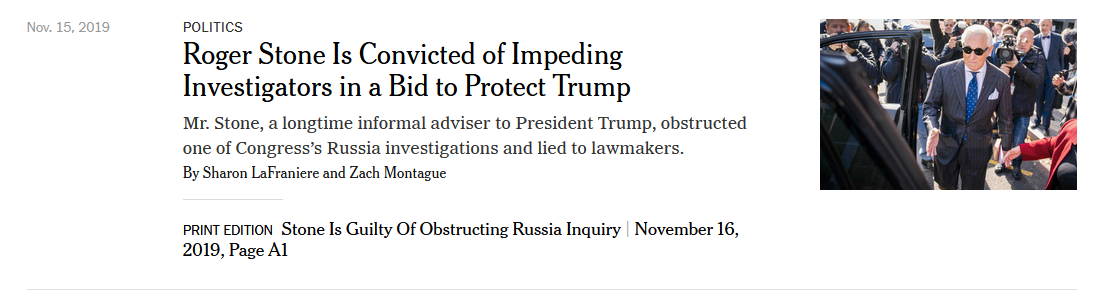
Self-proclaimed rat fucker Roger Stone continues to do what he has always done, fuck rats. He has been well-paid for this act, during his long, dirty career as agent provocateur and political scam artist. He’s come a long way from being the youngest person implicated in the Watergate cover-up. During the witch hunt of his protege Trump, when he repeatedly lied to Mueller’s investigators, he did his best to keep the boss safe. Afterward in federal court Stone continued to play the buffoon (as when he playfully trolled the judge by putting a rifle target on her face) and be as defiant as the law would allow. He was convicted of lying, threatening witnesses and obstructing justice, as a loyal friend will do in an exchange of political favors. At one point experts felt he could face up to fifty years behind bars, the DOJ asked the judge for nine years, before Barr later cut the recommended sentence by a hefty slice of years.
Here is the skinny on the man who made lobbying what it is today by the innovation of working on an electoral campaign and then selling access to and influence with those people when they are elected — a political influence machine that raked in millions during decades of political dirty tricks, with his equally amoral partner, fellow Trump-pardoned felon Paul Manafort.
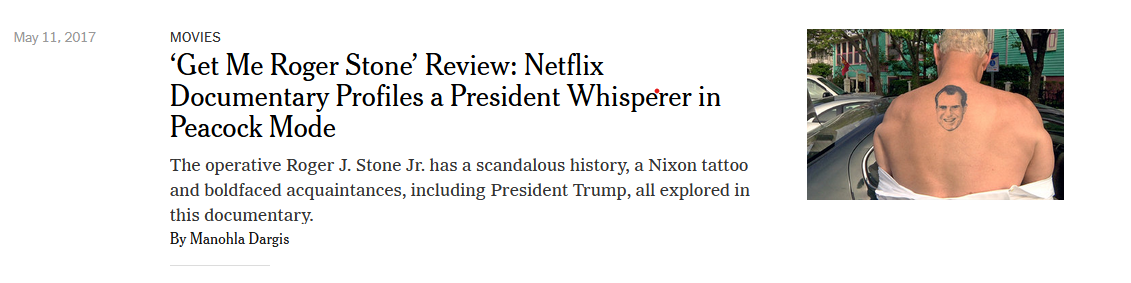
A longtime friend of Donald Trump,[10][11] Stone has been variously described as a “renowned infighter”, a “seasoned practitioner of hard-edged politics”, a “mendacious windbag”, a “veteran Republican strategist”,[12][13][14][15][16] and a political fixer.[17] Over the course of the 2016 Trump presidential campaign, Stone promoted a number of falsehoods and conspiracy theories.[18][19][20][21][22] He has described his political modus operandi as “Attack, attack, attack – never defend” and “Admit nothing, deny everything, launch counterattack.”[23] Stone first suggested Trump run for president in early 1998 while he was Trump’s casino business lobbyist in Washington.[24] The Netflix documentary film Get Me Roger Stone focuses on Stone’s past and role in Trump’s presidential campaign.[25]
Stone officially left the Trump campaign on August 8, 2015. However, two associates of Stone have said he collaborated with WikiLeaks founder Julian Assange during the 2016 presidential campaign to discredit Hillary Clinton. Stone and Assange have denied these claims.[26][27] Nearly three dozen search warrants were unsealed in April 2020 which revealed contacts between Stone and Assange, and that Stone orchestrated hundreds of fake Facebook accounts and bloggers to run a political influence scheme on social media.[28][29][30]
A moment of research reveals a connection between the young Roger Stone and Roy Cohn:
Stone, the “keeper of the Nixon flame”,[51] was an adviser to the former President in his post-presidential years, serving as “Nixon’s man in Washington”.[52] Stone was a protégé of former Connecticut Governor John Davis Lodge, who introduced the young Stone to former Vice President Nixon in 1967.[53] After Stone was indicted in 2019, the Nixon Foundation released a statement distancing Stone’s ties to Nixon.[54][55][56] John Sears recruited Stone to work in Ronald Reagan’s 1980 presidential campaign, coordinating the Northeast.
Stone said that Roy Cohn helped him arrange for John B. Anderson to get the nomination of the Liberal Party of New York, a move that would help split the opposition to Reagan in the state. Stone said Cohn gave him a suitcase that Stone avoided opening and that, as instructed by Cohn, he dropped off at the office of a lawyer influential in Liberal Party circles. Reagan carried the state with 46% of the vote. Speaking after the statute of limitations for bribery had expired, Stone later said, “I paid his law firm. Legal fees. I don’t know what he did for the money, but whatever it was, the Liberal party reached its right conclusion out of a matter of principle.”[4]
The reviewer of Get Me Roger Stone (linked above and recommended) is even more explicit about the connection between Cohn, Trump and Stone, going back decades:
The documentary also sketches a political family tree that could be its own movie and that has Cohn, the chief counsel to Joseph McCarthy, at its head and branches out to include Mr. Stone and Mr. Trump. Mr. Stone wasn’t yet 30 when he met Cohn in 1979. (At the time, Mr. Stone was helping to run Reagan’s presidential campaign.) Cohn served as Mr. Trump’s lawyer for years and, by many accounts, assumed the role of mentor. It was Cohn who introduced Mr. Stone to Mr. Trump; Mr. Stone decided that Mr. Trump was presidential material and, years later, has become identified as one of the president’s outside advisers.
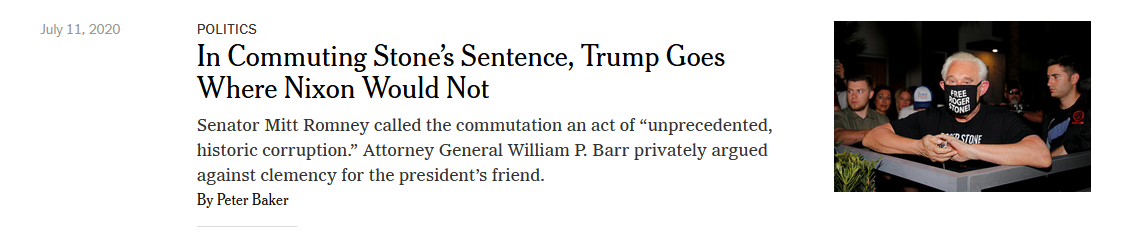
On January 25, 2019, Stone was arrested at his Fort Lauderdale, Florida, home in connection with Robert Mueller‘s Special Counsel investigation and charged in an indictment with witness tampering, obstructing an official proceeding, and five counts of making false statements.[31][32] In November 2019, a jury convicted him on all seven felony counts.[10][33][34] He was sentenced to 40 months in prison.[35][36] On July 10, 2020, days before Stone was scheduled to report to prison, Trump commuted his sentence.[10] On August 17, 2020, he dropped the appeal of his convictions.[37] Trump pardoned Stone on December 23, 2020.[10][38]
Stone, convicted of lying under oath, obstructing justice and witness intimidation, tweeted, shortly before he was to report to prison to start serving a sentence Barr had already intervened to reduce, that he didn’t want a pardon from Trump for his criminal conviction, just a commutation of his prison sentence. Trump obliged. In the end, in an abundance of caution, two days before Christmas, Trump also pardoned his long time adviser and political dirty trickster.
Merry Christmas, Rog!
As for Stone’s work as a highly paid lobbyist:
In 1980, after their key roles in the Reagan campaign, Stone and Manafort decided to go into business together, with partner Charlie Black, creating a political consulting and lobbying firm to cash in on their relationships within the new administration. Black, Manafort & Stone (BMS), became one of Washington D.C.’s first mega-lobbying firms[57][58] and was described as instrumental to the success of Ronald Reagan’s 1984 campaign. Republican political strategist Lee Atwater joined the firm in 1985, after serving in the #2 position on Reagan-Bush 1984.
The GOP’s highly moral voice of conscience in the Senate (this is a VERY relative term) Mitt Romney (now gone silent for months on end, while voting in lockstep with the GOP to thwart Biden at every step) immediately called Trump’s commutation of Stone’s reduced sentence an “act of unprecedented, historic corruption.” And so it was.
But Stone, to his credit, promptly repaid his debt to his friend the defeated president by helping to organize the January 6 Stop the Steal rally/riot, just as he had with a Stop the Steal movement in 2016, anticipating his boy Trump could well lose that election. Rat fuckers will be rat fuckers.
The elderly leaders of our democracy don’t seem to have the collective spine to challenge Trump’s clearly corrupt quid pro quo pardons in court (let’s say just Stone’s, Manafort’s and Flynn’s, for starters), but if Stone tells Congress to fuck off with their subpoena there should be no hesitation to test the unchallenged legality of the House’s power of Inherent Contempt and lock the rat fucker up in a hotel room until he testifies, under the penalty of perjury.
Stephen Fry, well-known author and wit, delivers a short, powerful statement about how dehumanizing language is always used to organize and justify hatred and violence against a targeted group.This language of hate precedes every atrocity.
He gave these remarks at least ten years ago. Well worth considering, as the war on “traitors” continues to escalate
If we are a nation of laws, and nobody here is above the law, then we can only save ourselves from the crisis we are in by the just application of law. The rule of law saved democracy during Trump’s baseless attempted litigation challenging the outcome of the 2020 presidential election, even judges appointed by Trump were required, by the law itself, to rule against a litigant who produced no evidence of wild conspiracy claims or who made baseless claims requiring the suspension of disbelief and the disregard of actual evidence in order to win. Including the obvious fact that many Republicans were voted into office across states on the same ballots that Trump lost and baselessly insisted were subjected to massive fraud and rigging by a bipartisan cabal of traitors and insurrectionists.
Law is a human construct, and far from perfect, but it is also the most perfect thing we have as citizens to preserve any kind of justice, as well as our form of representative democracy itself. If we have a law against conspiring to stop the functioning of government, which we do [1], it needs to be deployed against those who more and more openly believe, in the words a speechwriter wrote for Barry Goldwater, an extremist Republican candidate sixty years ahead of his time in terms of party politics:
“Extremism in defense of liberty is no vice. Moderation in pursuit of justice is no virtue.”
Goldwater, you will recall, was the far-right presidential candidate from Arizona who advocated nuking America’s enemies back to the stone age and lost virtually all fifty states in the 1964 election [2]. He is most famous today for the so-called Goldwater Rule [3], a policy made by the American Psychiatric Association, a voluntary membership organization, that states no therapist may venture a public opinion as to the mental and emotional fitness of a political candidate unless he or she has personally examined the person and the patient has consented to have psychiatric details disclosed to the public.
The Goldwater Rule is not a law, or a rule that is binding on anyone who is not a member of the APA, nonetheless, the media often treats it as a law binding on all psychiatrists, even in the face of a candidate or elected official posing a publicly observable imminent threat to our nation. The rule, which was “doubled down” on by the APA soon after Trump became president, has been cogently challenged by many American psychiatrists recently, most outspokenly Dr. Bandy Lee.
The Goldwater Rule, we are told, applies even when you have a president who publicly shows himself daily to be a petulant, churlish, childish, vindictive, paranoid, attention seeking, megalomaniacal, corrupt, punitive, bullying, illogical, incoherent, amoral, transactional, compulsive liar. Even if this leader deliberately stokes an infuriating lie and organizes a rally and march based on that lie, to inspire a fight to overturn the election he lost, on the day the government is officially taking the ceremonial last step in the peaceful transition of power, and he sends a violent mob down to the Capitol to stop it. The Goldwater Rule prevents any shrink from talking about any of that, in their capacity as a psychiatrist, unless the unhinged elected official himself consents to a session and then the disclosure of a clinical diagnosis. Anything beyond “man, woman, camera, TV” is protected by the Goldwater Rule.Of course, anyone as critical of an American president as I am in this paragraph is clearly suffering from what Germans once called “Hitler Derangement Syndrome”.
There’s no law against going on TV and simply lying about whatever you want. Sad but true, in very few cases can anyone be prosecuted for simply making shit up, no matter how ugly or how likely destructive, and braying about it to the public. There is, however, a law against conspiring to stop the government, which is what the “Stop the Steal” riot did for hours on January 6.
It is frustrating to many Americans that the Department of Justice is so slow and deliberate in regard to holding the organizers of the conspiracy that led to a direct attack on democracy accountable. There is not even any apparent movement in this direction, though DOJ investigations are supposed to be conducted secretly without fanfare. We’d like to see somesign!
The law often grinds on slowly. It seems impossible, for example, that the Fulton County DA has not yet indicted Trump for what appears to be a very clear violation of the Georgia law against trying to interfere with, or coerce others to interfere with, a certified election result. The last act of that concerted attempt to overturn the Georgia election results is a recording millions of Americans have heard, for fuck’s sake, during which Trump violated every subsection of the Georgia law. The theory, I suppose, is that when taking a shot at a dangerous predator, be sure that shot is carefully aimed and powerful enough to actually stop the creature.
The Watergate-related indictments took two years to happen. The January 6 indictments are apparently going to take a while longer to assemble airtight cases for, aggravating though that is while the brazen co-conspirators are freely talking their ugly talk and broadcasting it to their increasingly enraged followers on shows like Steve Bannon’s The War Room.
If those indictments don’t happen within a reasonable amount of time, certainly well in advance of the heavily gerrymandered 2022 election (and full restoration of the 1965 Voting Rights Act by passing the two House bills is also critical, CRITICAL), stick a fork in our democracy, boys and girls, we’ll have Speaker of the House Donald Trump and the immediate censure of every non-white Democrat and traitor Republican in the House. There will also be summary expulsions for enemies of the Speaker, and probably also televised public book burnings, the kinds of things that always precede even worse barbarity.
And, as for the rule of law, we’ll have plenty more proud, angry, armed vigilante boys like Kyle Rittenhouse, free to take illegally possessed assault rifles into combustible situations like an angry protest over the perfectly legal police shooting, seven times in the back, of an American citizen, and then get acquitted in a trial presided over by a seemingly unrepentant Ku Klux Klansman.
And remember, folks, there’s no law against being in the Ku Klux Klan, it’s that American judge’s first amendment right of association and puts him in good stead for a future career as a celebrity opiner for Rupert Murdoch, OANN or Newsmax.
The law to keep an eye on is the one below, 18 U.S. Code § 2384. And if Merrick Garland doesn’t bring some indictments under this law, of the people who were in that war room in the Willard Hotel on January 5th and 6th and the guy who stood to gain the most from the conspiracy, had his co-conspirator’s bills paid and spoke regularly with them during the riot, we all ought to get down on our knees and, in the words of XTC, while we’re down there, kiss our asses goodbye.
[1]
If two or more persons in any State or Territory, or in any place subject to the jurisdiction of the United States, conspire to overthrow, put down, or to destroy by force the Government of the United States, or to levy war against them, or to oppose by force the authority thereof, or by force to prevent, hinder, or delay the execution of any law of the United States, or by force to seize, take, or possess any property of the United States contrary to the authority thereof, they shall each be fined under this title or imprisoned not more than twenty years, or both.
[2]
Johnson carried 44 states and the District of Columbia, which voted for the first time in this election. Goldwater won his home state and swept the states of the Deep South, most of which had not voted for a Republican presidential candidate since the end of Reconstruction in 1877. This was the last time that the Democratic Party won the white vote, although they came close in 1992.
The Goldwater rule is Section 7 in the American Psychiatric Association’s Principles of Medical Ethics, which states that psychiatrists have a responsibility to participate in activities contributing to the improvement of the community and the betterment of public health, but they should not give a professional opinion about public figures whom they have not examined in person, and from whom they have not obtained consent to discuss their mental health in public statements. Wikipedia