Quiet Headline of a Forgotten Story: US gov’t pays Jessen and Mitchell $81M for torture techniques

Our country, long-time opponent of torture, began torturing suspects after 9/11/01.  Obama said it plainly not long ago, and I wince to quote him, “we tortured some folks.”

The torture did not necessarily make us any safer.  There are people, like Dick Cheney, who argue that torture got us actionable intelligence and saved American lives.  There are also people who can almost carry a tune with their farts.

Two enterprising psychologists, Dr. John “Bruce” Jessen and Dr. James Mitchell formed a company that got a $18o,000,000 plus contract to design a torture program for the “enhanced interrogation” of “enemy combatants”.   The two were originally hired on $1,000 a day retainers for these important services.

They were paid only $81,000,000 on that contract before their services were terminated in 2009 by the Obama Administration.   Unsung American heroes they do not deserve to be forgotten.


Putting a bow on the story

The art of persuasion, selling,  winning over, converting, is the art of great storytelling.  We love good stories, live by ’em, we need stories to make sense of a largely incomprehensible universe.   I heard a master storytelling salesman at work the other night at the Democratic Convention, weaving a long, compelling story about his wife.   Former president William Jefferson “Bill” Clinton, considered by many our first black president until one with 50% African blood was elected.

“Also considered the finest Republican president of the twentieth century,” said the skeleton.  

“To hear him tell the story, he and his brilliant wife have always been humble servants of the People, selflessly doing everything they could to make sure the tide kept rising and that the rising tide lifted all boats.  He has that down home Elvis charm, calls people ‘man’ and has a deft touch with humor and pathos.  Blacks loved him when he was their president, he spoke their language to them, played the saxophone.  Shucks, he was a charming southern white boy who was completely comfortable with blacks, clearly liked and even admired ’em.

“Meantime, in the name of compromise (and in the worst sense of the word) he did the bidding of some rabidly bad people, over and over again.   Welfare ‘reform’, his 1994 crime bill*, with three strikes and mandatory sentencing, and NAFTA did more to make things harder for blacks than anything Reagan, a president who clucked at racism, had done.  Not to mention the farcical and emblematic “Don’t Ask; Don’t Tell”.

“I recall we had a chat about then governor Bill Clinton’s return to Arkansas, during his first presidential campaign, to oversee the execution of some brain damaged killer on death row, a shooter who’d turned his gun on himself and blown most of his brains out without actually dying,” said the skeleton.  “Show them the Times article to refresh their recollection, to tell it to those too young to remember.”

Well, we’ve talked about the psychopath test for president.  You don’t qualify to run for the office unless you demonstrate that, among other things, like lying convincingly, you can kill when needed, for the good of the country, of course. Plus, you have many Americans who believe in an eye for an eye, literally, death for those who kill, and they need to be satisfied that their president will unflinchingly see justice done. 

“Kill whoever you like, if you’re the president, as long as you tell the story properly, or keep the killing properly secret like your current president’s kill list.  Admittedly, sometimes the president has to be willing to kill, but much of the time it hurts more than it helps.  Framing the story of the killing is the most important part, if you do that, kill away, man.  

“You remember on TV we used to see those numbers like insanely lopsided basketball scores, the kill numbers they’d show every night during dinner?   US: 19  Viet Cong: 345.   Low score meant you won.  So piles of dead Vietnamese would be added up, and if any of the dead were males between the ages of 15 and 50, you had dead Viet Cong for the tally.  William Westmoreland and Robert MacNamara’s people came up with that body count system.  Great for morale, it told the story, every night, of our irresistibly mounting victory.  What did you guys yell when unfair teams were chosen: slaughter sides!!!

“How about Agent Orange?  You remember that amazing stuff, defoliant, highly concentrated herbicide, I think it was also called Dioxin.  They called the destruction of jungle and crops ‘Operation Ranch Hand’ — how cool is that?  Spray it from a bunch of airplanes and it dissolves all plant life underneath.  Neat.  Except that it may have killed almost half a million civilians and caused birth defects in probably many more than that, plus what it did to many American boys.   Luckily for us, about half of those Vietnamese killed were males between the age of 15 and 50, like the many terrorists we’re secretly killing today in the president’s brilliant and legally complex drone war.  

“These are the hard calls a president has to make, Elie.  Would Clinton have won that election if he couldn’t go back to Arkansas and sign the death warrant for a severely brain-damaged person’s lethal injection?  He probably would have lost his own state, like Gore would eight years later.”  The skeleton looked around, weary.  

“But, look, you started off talking about telling a story and now we’re talking about psychopath presidents.  You know what telling a good story involves?  Seeing the whole story before you start to tell it and not getting lost in digressions that detract from the story you want to tell.  

“You need to have a good beginning, to hook your listener, an interesting story-line that’s easy to follow and a satisfying pay-off at the end.   The story has to hang together as an organic whole.   People have to know why you told the story and everything you need for people to grasp and digest the story should be explained as you go.  

“You should never have to go back and add something you belatedly realize you’ll need for the punchline.   You need to see the whole picture you want to paint before you lift your brush to start painting.

“Which places you in an unenviable position here, telling my story.  What is my story even about?  I was born in poverty, had certain ideals, worked my ass off, had a certain amount of luck, accumulated enough money that when I died my son could take a year off to write my biography.  What kind of story is that?  

“Hey, I got it, here’s your story: the loser’s son, at the end of the final withered branch of a family tree rather crudely pruned by hate-filled Ukrainians, anti-Semitic Poles, Nazis and Belarusians, in his mad hubris, thinking anyone in the world actually gives a shit about another anonymous loser.  The story could actually be about you, you know, the meta-story, with the story of me kind of floating by in the background, like a hallucination.  

“We see the author sitting in an unbelievably depressing rented one-bedroom apartment, with decaying walls, etc. cracked ceiling, bathroom floor disintegrated.  All around are papers, some beautiful, most not, but a colorful jumble that defies description.  Why is he in his underwear in front of a fan at 2 pm? Is this a mental patient, tapping away as he stares at the computer screen with no expression?”

Point taken, I should put on some pants, although it’s 88.3 degrees in here at the moment.   Here’s the story in a nutshell for you, then.

The cards dealt to you were a daunting hand.  You were born poor, Jewish, at the dawn of the Great Depression, less than twenty years before the organized mass-murder of poor Jews.   The human helplessness that is the birthright of every human being who does not get help was laid heavily on you, over and over.  The small town you grew up in was anti-Semitic.  You wore a jacket with a Jewish star on it because your mother insisted, as only a few years later Hitler would insist all Jews do.  Drafted into the army’s air force in 1942…

“Blah, blah, blah, I don’t see a story here.  No hook.  Next!” said the skeleton in the manner of a distracted record company executive forced to listen to his mother’s friend’s son’s demo.

 “Ha! You remember that, don’t you, you rascal, Robbie’s big break, when Caroline got the A & R guy son of her friend to listen to his cassette.  It was like your letter from that nice girl at Farrar, Strauss and Giroux way back when:  I don’t see the hook.  Robbie learned, eventually, to put the hook way up front.  He told you about the ‘elevator pitch’, right, you’ve got to be able to put the hook into them within a short elevator ride, you have maybe fifteen seconds.”

Yep, yep.  And in fairness to the gatekeepers, everyone thinks they have a book in them, that their life should be a book.  Most books, like most lives, and particularly the imagined but unwritten books of most lives, are dull, stupid, vain, too predictably depressing to be bought and sold.   I have to package you and sell you, simple as that.

“What’s your fucking story?  Give me the angle.  What’s your fucking elevator pitch, bitch?”

I was raised by a brilliant, funny father who was full of self-hatred.   He fought me from the time I was a baby and the fight continued up until the last night of his life.  On that night he told me, for the first time, that he was sorry he’d been….

“Time’s up, bitch, we’re at my floor.  Nice meeting you.  If you want to blow me some time, set it up with my secretary.  Otherwise, have a nice day and most excellent life,” said the skeleton, his face as vacant, inscrutable and mad-looking as Andy’s.


NOTES

Again, we’re dealing in a story element, a passing example of how Clinton was the best Republican president in recent history.  For those purposes the 1994 Crime Bill works nicely, it contains some heinous provisions that played a part in increasing American’s off-the-hook, disproportionately poor and black prison population.  But fairness dictates telling the rest of the story, a snippet of which follows, more of which can be read here:

The trend toward increased incarceration began in the early 1970s, and quadrupled in the ensuing four decades. A two-year study by the National Research Council concluded that the increase was historically unprecedented, that the U.S. far outpaced the incarceration rates elsewhere in the world, and that high incarceration rates have disproportionately affected Hispanic and black communities. The report cited policies enacted by officials at all levels that expanded the use of incarceration, largely in response to decades of rising crime.

“In the 1970s, the numbers of arrests and court caseloads increased, and prosecutors and judges became harsher in their charging and sentencing,” the report states. “In the 1980s, convicted defendants became more likely to serve prison time.”

Indeed, this trend continued with tough-on-crime policies through the 1990s as well, but to lay the blame for the incarceration trend entirely, or even mostly, at the feet of the 1994 crime bill ignores the historical trend…

…So while it may go too far to blame the 1994 crime bill for mass incarceration, it did create incentives for states to build prisons and increase sentences, and thereby contributed to increased incarceration.


History, Anyone?

History is a story.  It is woven from an infinite number of facts, fictions and pieces of stories, fervently believed and often in dispute.  Dramatic details tend to become recorded in history, though they are just as easily deleted completely, which may shock you, at first, if you participate, with two hundred thousand others, in a historical moment that is never recorded in the New York Times.

“The New York Times is the first draft of history, Elie,” said the skeleton, who read the paper cover to cover every day of his adult life.  “It also serves the masters it serves, as you know very well.”  

It struck me the other day that the Grey “Lady” is a reasonable voice for reasonable people who are reasonably comfortable.  If that’s your world, they are speaking to you, and for you, and making the objective-looking, well-written  record future historians will pick from.  

“Fair enough, but I thought you came here to correct the historical record, somehow,” said the skeleton.  

I did.  Following up with Azi, who has done a lot of research on family history, I learned that your mother came to the United States, with Gene’s mother Dinsche, on the Grosse Kurfurst, a steamship that embarked from Bremen.   Your brother found this out on Ellis Island, where he presumably saw a passenger manifest that had them leaving Europe on November 8, 1913 with 1,481 others.

According to Gene, who got the information from his mother, she and Chava left Europe on the last ship out before World War I was declared.  That ship, the Grosse Kurfurst, left Bremen again on July 11, 1914, two and a half weeks before World War I began.   The voyage was twelve days, according to Gene, so they and 357 other passengers arrived at Ellis Island (Dinsche, Chava and the other steerage passengers did, anyway)  mere days before the war kicked off in Europe.  The Grosse Kurfurst, as Gene had said, spent the remainder in the war in America, as shown by ship schedules which do not record any voyages until after November 1918.

“Which story do you like better?” asked the skeleton.  

That’s a no-brainer, dad. Then there’s the fantastical theory that Aren, Fishl and Fleishman dashed across Asia, crossed the Pacific, found their way to San Francisco and on to New York City, in 1904.   Wyatt Earp was Deputy U.S. Marshal in Tonopah, Nevada at that time.  How did these three Russian/Polish Jews hightail it 3,000 miles across the prairies and the Rocky Mountains to the slums of Lower Manhattan?  Why would they?  

“You would have recalled this detail if Eli had mentioned it to you.  You know you would,” said the skeleton.

 Azi debunked this for us.  Nehama had told him that Aren came to America on the Hamburg-Amerika line’s Patricia.   He arrived in New York (records show this ship sailed between Hamburg and New York in those years), according to Nehama, on December 25, 1904.   All she knew about his desertion from the Imperial Russian Army on the eve of the Russo-Japanese War was that “the train with the troops went in one direction, we took the train in the other direction.”  The train with troops would have been heading east, toward Japan.  Aren and his fellow deserters went west, to Hamburg.

Interesting,” said the skeleton.

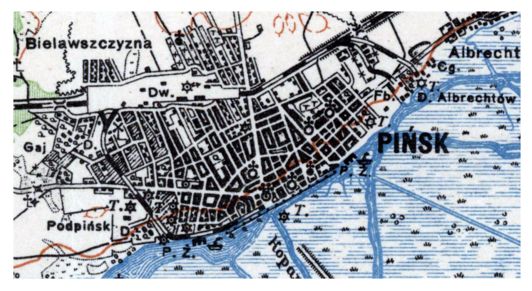
As for Truvovich, Vuvich and Misititch, this is the best clue I’ve found so far, a map of Pinsk from around 1925.  If you follow the main N-S street down to the Pina River at the bottom of this selection you will see, just on the other side, a short ferry-ride away, a spot in the marshes marked with a Jewish star and a capital T.

Truvovich maybe

“Star marks the spot of that muddy hell-hole, you say?” said the skeleton.

Redacting History

I will speak in generalities here, because the particulars are too harmful to discuss openly.  I  understand the irony in this better than most, feel the grotesqueness of it more stingingly than most, I imagine, but there we are.  I don’t want to get into a fight about any of it at the moment.   Pat Conroy lost half of his family after he revealed details of his father’s insane brutality in The Great Santini.  

People who love somebody don’t want to hear that he’s actually got an Adolf Hitler side, and they’ll kill anyone who persists in highlighting the resemblance, particularly to outsiders.    Conroy was dead to his father’s side of the family after publishing that book openly detailing their beloved relative’s monstrousness.  They were furious that Conroy insisted on describing a trip to the E.R. after a near fatal beating from his highly respected war hero father.  

Conroy and his father eventually reconciled, due largely to the immense success of that book and the movie with the charismatic Robert Duvall as the brutal elder Conroy.  Such reconciliations with toxic people who learn from life and actually try to mend their ways are exceedingly rare, however, and matters of extraordinary grace and luck.

The other piece, of course, is that nobody is simply Adolf Hitler, outside of maybe Mr. Hitler himself.   You can portray a difficult to forgive side of somebody while also recognizing many excellent, admirable qualities in that person.  It is not always easy to do, but it can be done.  We tend to view people on a kind of moral see-saw, balancing their good and bad attributes until something tips it one way or the other.   Somebody saves your life, it’s easier to forget the many faults that used to annoy the shit out of you.  

So, while I don’t believe that the truth will set you free, except in rare cases, I know that lies will keep you tied up in knots and make it impossible to ever free yourself.  That’s my point here.  When people are crippled by shame or guilt, they lie, construct alternate explanations, elaborate rationales for why they are not crippled, or why the fact that they’re crippled is of little consequence: pay no attention to those twisted, shrunken limbs, I am Superman!  

Back in Egypt guys working for the new Pharaoh and his dynasty would go into the tombs of the preceding Pharaohs and scrape the faces off the paintings on the walls, literally erasing these once all-powerful god-kings from history.   This is how we do it, homo fucking sapiens.  We live by stories, myths, and whenever necessary, we scrape the previous records right off the walls of history, replace them with myths that serve us better.  

Millions of people killed by the Nazis?  Bullshit!  It was only a few hundred thousand, and they died of disease and insanity, they were subhuman filth, and liars.  There were no gas chambers, no crematoriums.  Six million Jews?   Jew please!  There you go, again, it was more like two million, at most, you lying goddamn Jew.  Ten million Africans killed during the American trans-Atlantic slave trade?  Prove it, bitch. It was no more than a couple of million, and they were mostly the psychos who wanted to kill their captors, plus the slave trade was necessary to the Land of the Free’s prosperity, and, anyway, it was outlawed more than two hundred fucking years ago!!!!  

Not all re-writing of history is bad.  Evil myths need to be corrected, rewritten.  Homosexuality, for example, was long considered a form of deviance punishable by ostracism, beating, imprisonment, even death in many parts of the world, including the U.S.A. (where, in fairness, death sentences were rare, and not strictly legal) until very recent times.  While still persecuted in many places, it is now recognized in many countries as a naturally occurring sexual preference whose practitioners deserve every right to practice, openly, legally and, in an increasing number of places, with marriage equality.   These former deviants now have the same right to love each other, under the law, that heteronormative couples do.  Not bad, not bad at all.

So, leaving aside the generalities of myth, and with sadness, because describing the particular relationship I am thinking of would show more about my father’s life and beliefs than any other I can think of, and because I witnessed 100% of it as an adult myself, I scrape this descriptive relationship off the painting of my father’s life on the tomb wall before I even paint it.  I redact it.  So what can I actually tell you about it without actually telling you about it?  That is what I’m trying to figure out.    

When someone is angry, and they never get to explain the causes, it creates a loop, a kind of insane loop.   They appear to be irrationally angry, since they cannot openly discuss what they’re angry about, it will never make sense to anybody since the cause of it, however reasonable, however clearly understandable, remains hidden.  They cannot seek help, or even sympathy, because they keep the cause of their anger secret, become complicitous with their tormentor.  Repression of a shameful and damaging secret is a route to madness, I’m pretty sure, or at least to an unbelievable amount of pain and misunderstanding.  

I once loaned a large sum of money, my life savings, actually, to a man who expressed great gratitude and promised he’d pay it back quickly.  He did not pay it back, quickly or otherwise.  When I pressed him he admitted that he owed many people money, that I was actually at the end of a very long line, that I’d have to wait, perhaps a year or more, before he could start paying me anything at all.  

I told him I was going to go to the others in the line and tell them about the tight spot I was in and that I needed to go to the head of the line.  He tried to extract my promise not to do that, told me it would be humiliating to him, and an unforgivable betrayal.  I would not let myself be convinced that the stream of steaming piss on my leg was a sudden targeted, body temperature mini-rain storm.   He became very angry about my inflexibility, my self-righteous refusal to recognize the tight spot he was in, what an unbearable position I was putting him in.  

If he had been my size, I’d have bashed him in the face when he started to rage at me.  Being much bigger than me, I just cursed back at him and did what I could to get my money back, which took years and cost me a lot of money.   More than that, it caused a lot of anger and resentment all around.

After this, it was impossible for me to ever see this guy as someone I could trust.  He made a habit of lying whenever he was in a tight spot and was very often caught in these lies, which at least a half dozen times involved the unauthorized transfer of thousands of dollars.   He was never repentant, always made an excuse for why it was the other person’s fault for being a fucking judgmental prig, forced people close to him to keep his shameful acts secret.  After years of this, I was done with him.  How can you keep having conversations with somebody who reflexively says whatever he feels is necessary to get himself out of an untenable position he’s put himself in?   

On the other hand, depending on how this person is situated in the world, it makes things more or less complicated.  I had a friend play peacemaker with his wife and her sister.  The two women had a long simmering rage against each other and the peacemaker’s work lasted a very short time, with ugly repercussions for him.   There are certain toxic types that we simply must avoid, for our own sake, for theirs.  For their sake because “fuck you, you don’t get to poison my life.”  My father considered such people without integrity and therefore without value as human beings and avoided them like the plague they arguably are.

But I have already said too much here, and revealed little enough about Irv, except to say, he was acutely aware of the point where things became toxic with another person, and although he was able to appear civil, and even casual, there was no mistaking the depth of his actual malice, even as he bantered cheerfully with a person he despised.

Redacted and Misdirected

It is very difficult to ever know, let alone fully relate, the complete story about anything.  This is especially true when recalling a parent, relying on memories of your early life, seen through the veil of your own perceptions and in light of how the events remembered affected you, how they played out later.

There are facts, actual events, specific words spoken, which can be shown with some degree of certainty (as with a recording or in a letter or diary), then there is the way these undisputed facts are spun by each party according to their needs and how they play into everything that follows.  When reconstructing our past each of us is, of necessity, an inventor relying on a good deal of conjecture, based on our experiences and prejudices.

“That’s a proper observation at this juncture.  That’s what critical history is supposed to be, the nuanced exploration of historical artifacts, placed outside of conjecture and prejudice, shown in light of the actual effects the artifacts produced and good luck with that enterprise.  Life is much more an art than a science, as I’m sure you’ve noticed,” the skeleton said.

“You were brought up short when your sister was momentarily stunned when you mentioned my keen sense of humor yesterday.   How is it possible, you wonder, that your sister could not remember the many great laughs we had together, even on some of those merciless battlefields where we spilled each others’ blood?”

It was surprising, I have to say, that she had no immediate recollection of your dark sense of humor.  You were almost always a prick, and grimly determined to win every ‘battle’ at any cost, there was no price too high for you to pony up, but you were also, without a doubt, a clever, funny man with a distinct and sardonic wit.  

I reminded my sister of how Arlene and Russ would howl at your tossed off remarks.  I reminded her of Murray Susskind, gasping for breath, completely at your mercy that night he came to dinner.  Over and over he wheezed “oh, that’s funny!  oh, that’s funny!!!!” as he struggled to breathe and howl at the same time.  We thought at a certain point he might die of laughing while trying to explain how funny it was.  My sister barely recalls that.

“Go figure,” said the skeleton.  “Memory is a funny thing.”

I’ll tell you something that’s not funny– crucial things that are never told.   You taught me on the one hand to operate like a critical historian, get the facts, primary sources whenever possible, weigh the competing versions, give credence to the version that aligns better with the agreed on facts.   At the same time, you gave us a very spotty, redacted version of things that was tailored to your need to control every narrative.

“We’re back to the abstractions that were your mother’s twelve murdered aunts and uncles and their entire families?” asked the skeleton wearily, warily. 

That’s the most striking example, yes, but it’s one example.  Look, I understand you were at a loss to tell your nine year-old that he was right to be upset by the shooting of everyone in his mother’s family, not to mention everyone on your side of the family.  This was not ancient history, after all, it had happened about 20 years before I found out about it.  OK, you couldn’t open that painful can of worms, fair enough.   What you did, though, was much worse than just clamming up about a difficult subject.  

“Here we go,” said the skeleton, “haven’t we already had this out, haven’t I already apologized, told you it was unforgivable?  What is it you fucking want from me now?  I’m dead, if you haven’t noticed.”

When you redacted those people from history you felt it necessary to give me something else to chew on.  Your reaction was not to acknowledge an unknowable horror and explain that it was impossible for you to think about what happened to them because the pain was too great; you turned it into a chance to tell your son that he was being an overly dramatic little wimp whining about a few dozen people with his DNA, not one of whom he never knew, who were, tragically, machine gunned into a ravine.  

That’s what I was left with, from the authoritative source that was my father, that I was being the whiny asshole for inquiring, for having strong feelings about, the terrible subject.  That is what is necessary for the reshaping of history, recasting the story completely into a counter-narrative.  You made the story about my weakness, as a narcissistically dramatic nine year-old, not someone seeking to understand an incomprehensible horror you could not touch yourself.

“Well, you were a kid with a hyperactive imagination, subject to nightmares, and that was my sick way of trying to protect you,” said the skeleton.

A sick way, we can agree now.  What was the necessity of making me feel like a weak, melodramatic little turd for asking about the slaughter of our entire family?   It closed the subject once and for all.  Like you were saying: suck on that, asswipe.    

“Well, that’s a harsh way to put it,” said the skeleton, “but accurate, I suppose.  But you are making a larger point, I suspect?”

I am.  The most brutal enemy of the seeker of truth, or at least understanding, is secrecy.  In our origin myth, we the People are an informed populace participating directly and knowledgeably in deciding the issues that effect us all.  In reality, the information we have to base any real discussion comes to us in a carefully controlled trickle and our influence on policy nil.  The record we get access to is increasingly redacted, classified, off limits.  There can be no free and open discussion about facts that are hidden.   

This was the way it was in our house growing up.    You redact something shameful and then, whenever there is an attempt to dig deeper, you bury it in further attacks on the digger.

“Well, I was a master at that redirection, misdirection.  I really was.  Not to pat myself on the back, but framing the discussion, as it took you more than forty years to figure out, is 99% of winning the argument.  That’s why conservatives have spent millions and millions creating terms to frame every debate: right to life, death tax, collateral damage, friendly fire, Second Amendment.   ‘A well regulated militia, being necessary for the security of a free state…” spun, by the brilliant and destructive Scalia, is now an undisputed American individual’s right to keep and carry guns and ‘Second Amendment’ is all you have to say.  Redirection is most of the game, and redaction certainly helps in that, the less real information available, the easier it is to misdirect the conversation,” said the skeleton.

“When you don’t want discussion of something uncomfortable, shift the ground.  It is no longer about a secret kill list that the president signs off on now, launching deadly attacks in dozens of countries by drone, it is about disloyal Americans seeking to endanger national security by prying into these highly classified national security areas.  You see how that works, right?  It’s not about whether killing all these people is right or wrong, whether it makes us safer or increases the resolve of those who hate us, it’s not a question of a precedent an American president can be happy to set for President Trump, it’s about keeping the entire program as secret as possible.  I know I’m preaching to the choir director,” said the skeleton.  

Indeed you are, pop.  I heard a JFK speech yesterday that spoke so eloquently to this very issue.   As to the importance of free and open access to the facts the citizens of a free society deserve to know, JFK said it all, then they killed him.  

The very word “secrecy” is repugnant in a free and open society; and we are as a people inherently and historically opposed to secret societies, to secret oaths and to secret proceedings. We decided long ago that the dangers of excessive and unwarranted concealment of pertinent facts far outweighed the dangers which are cited to justify it.

…No President should fear public scrutiny of his program. For from that scrutiny comes understanding; and from that understanding comes support or opposition. And both are necessary. I am not asking your newspapers to support the Administration, but I am asking your help in the tremendous task of informing and alerting the American people. For I have complete confidence in the response and dedication of our citizens whenever they are fully informed.

I not only could not stifle controversy among your readers–I welcome it. This Administration intends to be candid about its errors; for as a wise man once said: “An error does not become a mistake until you refuse to correct it.” We intend to accept full responsibility for our errors; and we expect you to point them out when we miss them.

The text of this wonderful speech to the American Newspaper Publishers Association is here.   

“Yeah, it was a great speech, justly famous in its day, one more reason the people who loved him so much loved him.  You know, he was fucking all kinds of women in the White House, and the press kept quiet, he was doing plenty of secret things, like all presidents do, but this was a great statement of our democratic values.  JFK was a lot like Obama in that way, off-the-charts rock star charisma, intelligence and elegance in stating our deeply held beliefs,” said the skeleton, watching a red-tailed hawk make off with dinner struggling in its talons.

“You know, Elie, it’s virtually impossible to tell anyone’s story in a way that makes sense.  A man with all of my gifts should have done a much better job as a father.  Instead of using my powers for good…” the skeleton continued to watch the raptor carry his next meal away.

As I told you as you were dying, you did the best you could.  That’s all a person can do, the best you can.  Do we hope to be better than we are?   The most idealistic among us, for sure.  

“How do you keep idealism alive in a world that stomps it lustily with every step?” asked the skeleton.

The $64,000 question, dad.  

“Hey, tell them about my appearance on that game show, would you?”

OK.


Truvovich to Vishnevitz

My father’s mother came from Truvovich, just across the Pina River from Pinsk, as far as I can tell.  My mother’s parents came from Vishnevetz, about 200 miles due south of Pinsk.  

Today the 321 km. can be covered by car in under five hours.  In 1922, the last time any of them where there, the trip, by horse drawn cart, would have taken about thirty-three hours on the dirt roads, assuming they followed the route of the later highway.  The horses would have had to stop every so often, so it would likely be a trip of four or five days.

In any case, it would take a well-calibrated time machine to make that trip to visit anyone in my family.

Screen shot 2016-07-08 at 8.13.54 PM

Looking for Truvovich

“I don’t know why it actually matters where it was on the world map,” said the skeleton.  “It’s gone, irretrievably, and all the people who lived there, outside of Aren and my mother, they were disappeared along with the place itself.  

“You found out the dates the Jews of Pinsk were massacred in those aktions, as the Nazis used to refer to those long days of genetic cleansing, you wrote to Azi about that.  Find the email,” said the skeleton.  

The pertinent part of the email reads:

On 4 July 1941, the Nazis occupied Pinsk. Within a few weeks they established a Judenrat and in the first week of August conducted aktions, murdering about 11,000 Jews by gunshot and burying them in mass pits. The Pinsk ghetto was established on 1 May 1942, and more than 3,600 of its some 10,000 inhabitants worked outside of the ghetto. On 29 October–1 November 1942 the ghetto was liquidated, with approximately 10,000 Jews shot to death. Less than 200 essential workers and others were herded into a “mini-ghetto” in Karlin and murdered on 23 December 1942. When the Soviets liberated Pinsk on 14 July 1944, they found 17 Jews surviving in hiding.

“So, does it make you feel better to know what happened to Chaski, Yuddle and Volbear, if they were still alive, and to any children and grandchildren they might have had?  In those years they would have all been around 60 years old, if they’d lived that long in Truvovich,” the skeleton either yawned or grimaced, it was hard to tell.  He could have been roaring too, I suppose.  

No it doesn’t make me feel better, not really.  For some weird reason knowing that Truvovich was probably on one of these three spits of land divided by the Pina River, on the southeastern border of Pinsk does make me feel a tiny bit better, though I’m sure I could not say why that is.

Screen shot 2016-07-08 at 1.32.21 PM

Man who kills his 14 year-old not guilty

I watched Hillary Clinton give a speech in North Carolina this afternoon, it was broadcast live on MSNBC.   She did pretty well and then gave way to the Campaigner-in-Chief, one of the great campaigners in American history, President Barack Obama.  As Mr. Obama hit it out of the park over and over, smiling, loose, feeling good, interacting smoothly with the audience, there was a constant loop of texts crawling over the bottom of the screen.

This constant flashing of unrelated text and images on the screen during other programming is a relatively new thing that has quickly become ubiquitous.  Advertisers and sales executives realized there was valuable real estate at the bottom of the TV screen going completely to waste.  Now, during many shows, ads for other shows will pop up, little characters cavort, ads and other messages scroll continually.  The modern American attention span is not fractured enough, I suppose, so why not put another 60 penny nail through its nervous system?

As the president spoke there was a scrolling caption about South American authorities looking for a former Guantanamo detainee, out finally and apparently mad as hell and hating somebody’s freedom.  Then this bit that caught my eye:

Father who accidentally shot his 14-year old son at a shooting range will not be charged, witnesses and surveillance video confirm the shooting was an accident.  The boy, apparently an asshole– the father, no intention of shooting the contumacious little bastard in the face and killing him, the kid is dead and so be it.  A well-regulated militia being necessary for the security of a free State, and so on and so forth, witnesses say the kid was shot by accident, so does the video footage.  Video footage does not lie, neither do witnesses.  Case closed.  Stay tuned for details of this purely accidental tragedy at eleven.

I could not help but make the immediate connection to Trayvon Martin, the black kid shot by an armed white man who’d taken it on himself to patrol the neighborhood and confront the kid with deadly force to find out what a black kid was doing in his neighborhood with a bag of Skittles and a cell phone.  The boy was shot after a possible struggle and Skittles were found near the dead boy.  

The boy, we learned, was four inches taller than the man with the gun and, at 17,  was fit, while the young man with the gun, at 5’7″ and 204 pounds, was ‘clinically obese’.  The boy’s blood tested positive for recent marijuana use, and so there’s that.   He is alleged to have used the f-word and not shown this armed civilian the least bit of respect when the white man got out of his truck to confront the boy and “stand his ground” with a handgun, as he was permitted to do under a Florida law underwritten by the Koch Brothers and their ilk, operating under the name of ALEC (American Legislative Exchange Council, you can visit these dangerous, sharp-toothed cocksuckers here; a less self-serving version is here and here with Bill Moyers).  The killer also claimed the kid viciously attacked him and that, in fear for his life, he shot and killed the boy in self-defense.

The killer’s father was a local judge and there was a long period, perhaps a month or more, before charges were brought against the judge’s son for the killing of the unarmed teenager Trayvon Martin.  Martin, in addition to marijuana in his bloodstream, also had been in a fight at school and, additionally, was wearing a hooded sweatshirt, a “hoodie”.  Pictures of him in the hoodie were shown on TV, he did present a slightly menacing aspect in those pictures.  There was an outcry when the man with the gun was not being charged with anything in connection to the boy’s death which had come directly from the barrel of the man’s gun.  The man with the gun was named George Zimmerman.  

The president went on TV during the rising tensions over whether the killer was going to be charged with a crime.  He gave his first speech about race in America, after several years in office.  It was an eloquent speech, as all of his speeches are.  He identified with Trayvon Martin and his family, said he could have been Trayvon Martin, or his son, if he’d had one, could have been Trayvon.  He told everybody to be cool, to wait and see what American justice had to say about the events leading up to the killing of the unarmed boy.

So we stayed cool, we waited and we saw what American justice had to say about the apparently completely justifiable killing of an unarmed boy with a bag of Skittles and, apparently, a big chip on his shoulder.  Zimmerman was acquitted of all charges.

I saw a crawl a couple of years later claiming that Zimmerman had been involved in a second domestic violence incident, allegedly throwing a wine bottle at his then girlfriend and possibly threatening her with a gun, as he had another ex, who declined to press charges.  Zimmerman, in his own home, had every right to stand his ground, though he did seem to lose some of the moral high ground after that alleged beat-down of a third unarmed woman (his estranged wife was in there too).  You can read some sordid details about the piece of garbage here.  Or just wait for the next crawl.

Or just read this, from USA Today:

In September 2013, his estranged wife, Shellie, called 911 claiming he had punched her father and was threatening her with a gun. She did not press charges. Two months later, Zimmerman was arrested and accused of domestic violence by girlfriend Samantha Scheibe.  Scheibe dropped the charges.

(rest of the sordid story)


Guns, Genetically Modified Organisms and Federalism

Should states or the federal government decide whether Americans have the right to own assault weapons and high capacity clips of ammunition?   Should the states or the feds have the final say over whether genetically engineered herbicide resistant crops may be planted anywhere, without limitation?  These are questions of federalism.

Our federal republic is an electoral democracy that balances national and local interests.   There has always been political friction over issues of federalism; does the federal or state and local government get the final say over the laws we live by? Some things are in our clear national interest, others are best decided by the local community.  Everything else we argue about.

The Civil War was fought over questions of national and regional sovereignty compelling enough to fight a war over.  States’ rights and federal government advocates clashed over every compromise in our intricately drawn U.S. Constitution.   In the end, certain fundamental issues must be resolved on a national level.

The newly granted legal rights of slaves freed after the Civil War, for example, were protected by constitutional amendments and federal laws to enforce them.   The Supreme Court soon limited the scope of these federal protections and states were allowed to pass their own laws governing the treatment of former slaves.  It was not until a hundred years later, after a lot of activism, that new federal laws against certain forms of discrimination were promulgated and protection of civil rights became a national priority.  The states are sovereign in many things, but they may not violate a federal law over that same subject matter. 

Federal preemption is the legal term for when federal law trumps state law.  The power of states and localities to act in such cases is preempted by federal law.  Our federal system is based on a case by case balancing of federal and local interests.

After a particularly horrible mass gun slaughter of kindergarten children, a large majority of Americans across the country called for federal gun restrictions. Most Americans wanted, at the very least, restoration of the ban on assault-style weapons, the guns of choice for mass shooters, a ban that was allowed to expire in 2004. This call for national action resounded again recently when a gay nightclub was strafed by a maniac wielding a legally-obtained assault rifle designed to spray dozens of bullets in seconds.

Defenders of the right to bear arms insist that gun control is a States’ Rights issue.  The NRA is a stickler on this point.  State sovereignty supporters decry federal “over-reach” every time federal gun legislation is proposed.

Monsanto corporation, makers of powerful herbicides (they were the makers of Agent Orange) herbicide-resistant genetically modified organisms, and other powerful environmental agents, is currently in federal court arguing that federal preemption should allow Monsanto’s customers to disseminate GMOs without limitation, everywhere in the United States.  

Giant international corporations like Monsanto increasingly argue that their U.S. business interests should be protected by federal immunity from state regulation and are deserving of a federal shield against liability for injuries resulting from use of their products.   Regarding their desire to be shielded from liability, they are like the gun makers, except that where the gun lobby wants states to decide, these chemical makers argue for federal preemption of all other laws.

In most things taking place within their borders, states have broad decision-making powers.   States make their own criminal, business and family laws, levy taxes, regulate most health, safety and environmental matters.  The right of the states to retain all powers not reserved to the federal government is a well-established principle in our Bill of Rights.  The Ninth Amendment reads:  The enumeration in the Constitution, of certain rights, shall not be construed to deny or disparage others retained by the people.  

Last week three judges for the Ninth Circuit Court of Appeals heard a case involving federal statutes Monsanto argues preempt the laws and wishes of every local community in every one of the fifty states. Monsanto argues that state and local government is powerless to protect small farmers and delicate and unique ecosystems from the harms that  genetically engineered crops can cause.

The facts of this case are pretty stark.  Farmers and environmentalists in Hawaii argue that GMO cultivation contaminates their environment.  Many GMOs are engineered to be immune to herbicides, they are cultivated in conjunction with powerful herbicides and pesticides.   Chemicals used with these GMOs contaminate the habitat, soil and water of Hawaii and threaten neighboring farmers’ livelihoods.  The cultivation of these genetically engineered plants introduces toxic chemicals into schools, homes and gardens that, in Hawaii, are often close to farm land.  

 The crops the counties in Hawaii attempted to regulate, with laws Monsanto sued for relief from, are created to be herbicide-resistant, designed to allow growers to spray (Monsanto’s) Roundup and other weed killers (like 2,4-D, a component of Monsanto’s Agent Orange) on the whole field without killing the crop.  Other Monsanto crops are engineered to exude their own pesticides.  The Hawaii laws were also intended to limit transgenic contamination, the spread of the DNA of the genetically engineered plants themselves.

Under traditional American federalism the local community would, barring some overriding national interest, usually have the final say on local health, safety, and environmental matters.  The flora and fauna of the Hawaiian islands are part of a unique and delicate ecosystem and the state of Hawaii is thousands of miles from the shores of the mainland United States. It is hard to think of a better case for States’ Rights than Hawaii seeking autonomy over matters directly affecting its own ecology.

Monsanto argues that the federal Plant Protection Act and other federal statutes prevent the State of Hawaii, or any county or local government, from restricting the use of Monsanto’s genetically modified organisms anywhere in the Hawaiian islands, or anywhere else in the country.

The Ninth Circuit has previously ruled that once USDA allows a GMO plant to be sold commercially, the federal government has no authority to restrict it in any manner, so if the court accepts Monsanto’s latest argument, this would put those crops beyond the reach of any government regulation.

How do we reconcile the case of using federal law to force herbicide-resistant plants and toxic chemicals into every American community, on the one hand, and using a states’ rights argument to block federal action to control America’s unique plague of frequent mass murders by gun, on the other?  A moment then, for the compelling arguments for federal preemption of state and local law in each case.

In the case of guns, the factual argument is immediately easy to grasp.  Guns easily travel from states with permissive laws into states with restrictive ones, and regularly kill people in states with the most stringent controls.  Without federal laws, the regular mass shootings that are a unique and gruesome feature of present-day America will never stop, no matter what heroic steps individual states may try to take to prevent them. 

There is a strong case for why federal regulations are needed to stop these massacres. Only a nationwide law can have any effect on controlling access to highly portable weapons like “America’s gun”, the AR-15, the mass killers’ gun of choice.  These semi-automatic weapons shoot dozens of rounds in seconds, they were designed to allow special forces to shoot their way out of military confrontations with multiple deadly enemies.

What is the compelling national interest that justifies Monsanto seeking federal preemption of the reasonable wishes of citizens of every state, even of an island state with a unique and delicate ecosystem over 2,000 miles from the mainland U.S.?  That is now up to three federal judges, appointed for life, to decide.

Being Right vs. Being Lucky

“You know, Elie, I’ve been thinking about this the last couple of days,” said the skeleton.  

What’s that, dad?  

“You’re spending too much time talking to a dead man recently.  Look, not that I don’t enjoy our conversations, but, I mean, do you think it’s healthy for this chat to be the highlight of your day?” the skeleton turned his head, as though looking around.

You mean as opposed to my mediocre diet, my relative lack of exercise, the less than ideal amount of sleep I get, my solitary life, the lack of a new network of needed doctors thanks to the vagaries of Obamacare, things like that?  

“Yeah, you’re right.  Listen, what I was really thinking about was the need to be right, where it comes from, how it does its idiot work.  My mother, who you learned from Eli whipped me in the face and sealed my fate before I was two, was a powerless, angry woman.  All she had was being obeyed, by anyone she could bend to her will.   I cannot imagine the terrifying shithole she was born into.   Talk about born under a bad sign, the filthy little hamlet off a river outside Pinsk was literally stomped out, rubbed right off the map of the world.  Never existed.

“The Jews who eked out an existence there?  Fuck ’em, who gives a shit?  Poor people, Jews, grind ’em up, pfooo! good riddance, rabbi.  I cannot begin to imagine all the nightmare elements that went into making my mother a little tyrant.  I never thought much about these things when I was alive, for fear of what thinking about them might do to me.   People who claim to love you can use you as a slave?  Your family can just be stomped into the mud without a trace?   What kind of arbitrary, brutal life are we born into?

“That was one reason I loved animals so much, as your mother also did.  I think we transmitted that to you and your sister.  A dog will return whatever treatment he gets, will always give you the benefit of the doubt.   It’s like animals cut to the chase, to the essential thing we all need in life: caring for each other.   It was my pleasure, although I didn’t enjoy it, of course, giving those insulin shots to Sassy every evening.  The dog was a complete sad sack, you remember.  Nobody particularly liked her, she’d hide under the bed, cower from people for no reason.  We knew she had no reason to cringe because we’d raised her from a newborn pup, she never had anyone do anything mean to her.  Still, she was an odd dog, very paranoid.  Your mother said she was mentally ill, maybe she was, I guess it’s possible a dog can be mentally ill.  

The thing was, Sassy trusted me and I took care never to hurt her.  You know, I’d pinch the skin on her back, make a little fold, and the needle was very thin, I don’t even know how much she felt it.  But she seemed to know I was doing this for her benefit and was always very calm and trusting when I’d give her the shot.  I think now how natural it felt to take such tender care of her and could kick myself again for being so unnatural so much of the time, like in those battles you describe around the dinner table.”

Well, there’s nothing natural about being natural a lot of the time, I suppose.  Our society is based on being unnatural, of course, on a false and desperate notion of winning and losing that makes us the best possible, most driven, consumers.  We’re in the hands of cannibals, no different in their essential natures than they’ve ever been, like true believing functionaries of the Nazi or any other ruthless single-minded party.  You mention the need to be right– that’s the only game in town, a town that can, as far as we can tell, be rubbed out under a jackboot with or without notice.

“The white indentured servants made common cause with the black slaves and Indians during the early days of our great experiment in democracy,” said the skeleton.  “It seemed obvious enough to poor whites that they were in the same boat as the other servants and slaves, as well as with the Indians whose land was being stolen by the wealthy whites.   Black and white servants became romantically involved, escaped slavery together, often found sanctuary with the Indians, with whom they made common cause.  

“This caused a major concern for the wealthy new land barons, you understand.   The idea of poor people of all races united and looking for some measure of justice gave the status quo the heebie jeebies.   ‘How to keep everything for ourselves?’ wondered the wealthiest and the greediest.

“You read about it in Zinn’s Peoples’ History, Virginia, in the 17th century, actually put it into law– the white man’s superiority over the Negro.  A white indentured servant got much better treatment than the average African slave.  You couldn’t strip him naked when you whipped him, for example.  When you freed the white man after his indenture you had to give him 100 acres to farm, and a mule, and ten barrels of corn meal, a musket, some money.   Every white servant knew this was coming to him at the end of his years as a common nigger, and he got it under Virginia law even before the year 1700.   The wealthy ‘planters’ created a culture down there that enlisted poor whites to oversee their fellow slaves, where the white man could look down on his inferiors, no matter how low the white man’s station in life.

 “That’s what segregation was all about.  Even the poorest white trash could walk into a bathroom with plumbing, tile on the walls and floor, doors on the toilet stalls.  The Colored bathroom?  Hah, sometimes those creatures would just have to do their business behind a bush.  You know, not every place had a bathroom where a Negro could sit on a regular toilet, wash their hands in a regular sink.   So ‘separate but equal’ was like a hilarious joke told over and over again by winking whites, it was a way of saying everyone got what they deserved.

“The examples are countless.  How does the great democracy, who welcomes the poor and starving of all nations to participate in this experiment in human equality, justify forcing the natives off their land, sometimes in death marches, destroying the buffalo herds that are their sustenance, making treaties they will violate over and over, eventually just killing the fuckers en masse?   Manifest Destiny.  Ask any junior high school student what gave the descendants of white Europeans the right to march over Mexicans, Indians and anyone else in their way and they’ll tell you:  manifest destiny.  

“The phrase was invented by a newspaper man, caught on quickly.  Our destiny is manifest, look, it’s right here, plain as the nose on your face, see?  Destiny is in our hands.  Like a team one game behind with four games to play, just keep winning, that’s all we can do by way of controlling our destiny.

“Being right, it’s all most powerless people get, Elie,” said the skeleton, slowly shaking his head. “The people you talk to, they are all smiling at you as they think ‘he’s a smart guy, he can seem to justify his beliefs, articulate his values… but he’s a loser.'”  

I’ve always been that way, dad, clever with words, able to articulate my values and beliefs.   With those things, and a paid Metrocard, I can get on any subway I like.   We are judged on one scale here, as you know, what we are worth.  And that is measured the only way it can be, in the honest coin of dollars and cents.  

“Well, it’s all most people can understand.  It’s as manifest as Manifest Destiny.  Is it better to be rich or poor?  Ask anyone and you will get the same clear, entirely reasonable answer.  If your goal is something you can show clearly to the world, how much easier is your life than struggling to advance abstractions?  Just say ‘Manifest Destiny’ shoot the savage in the face, force the women and children into an icy river to drown and build your railroad.   People who hesitate, who think too much, people like you… well, what is the point?”  

Ah, you pose a question I cannot answer today, father.  I think I will lie down with that familiar black dog and rest my eyes for a while, as I ponder my manifest destiny.