Nonpartisan 6-3 Federalist Society Supreme Court

The Federalist Society’s reactionary 6-3 majority gets ready to deliver on some of their radical ideologically-driven promises, after demonstrating their zeal a few times already when they had a 5-4 majority (see examples below). Taking no chances on any of these jurists being “compromisers” of their deeply held, often religiously fervent, beliefs, the 6-3 majority was carefully vetted to avoid what happened when some Republican appointees wound up being amenable to compromise in recent decades. As Ruth Marcus wrote in the Washington Post the other day (all quotes are from that essay, linked below):

. . .[O]ver time, and under the tutelage of the conservative Federalist Society, Republican presidents, beginning with George W. Bush and intensifying with Trump, became better at picking reliably conservative justices. There were to be no more David Souters, who turned out to be a solid liberal vote; no more Sandra Day O’Connors, whose background as an Arizona state legislator often inclined her to compromise; no more Anthony M. Kennedys, the pale-pastel conservative named to the court after Ronald Reagan’s first choice, Robert H. Bork, was resoundingly defeated.

Future justices would have judicial paper trails to provide assurance of their conservative bona fides on everything from explosive social issues to government regulation, a topic important to legal conservatives and their financial backers. And so the post-Rehnquist years produced the Roberts court, adding not only the chief justice but also Samuel A. Alito Jr. and, with Trump’s election and Senate Majority Leader Mitch McConnell’s (R-Ky.) stage-managing, three new conservative justices: Neil M. Gorsuch, Brett M. Kavanaugh and Barrett.

source

Even Before McConnell audaciously rammed through a sixth hardcore conservative, a member of a Christian religious cult, for good measure, (a Harvard law professor cited in the article correctly refers to these hardcore “conservatives” as reactionaries, partisan resisters of social change intent on turning the clock back at any price):

The conservative majority notched steady victories. It let federal executions resume for the first time in 17 years. And its decisions dramatically moved the law on religion, simultaneously carving out greater protections for religious freedom and lowering the barrier of separation between church and state. Religious institutions received exemptions from having to comply with anti-discrimination laws, even as states were required to provide equal benefits to religious and secular private schools. In other words, churches could discriminate but could not be discriminated against.

source

The Biden administration, after McConnell orchestrated the reactionary 6-3 majority (and recall, the blocked Merrick Garland nomination would have made the court 5-4 the other way), meanwhile waits for a team of legal experts, appointed in April, to issue a report confirming that it is constitutionally permissible to add justices to the Supreme Court (though apparently Biden has no will to do that [1]). The U.S. Constitution gives no set number and there have been different numbers of justices at different times in our history.

Ruth Marcus gives detailed examples of the “nonpartisan” court in action, from an excellent and chilling essay called The Rule of Six: A newly radicalized Supreme Court is poised to reshape the nation recently published in the Washington Post (graciously gifted to you by the supremely generous Jeff Bezos) about what these highly partisan culture warriors are preparing to do, in this term and for as long as they live.

My only problem with Marcus’s essay is her conclusion that rebalancing the court by adding nonpartisan justices is a “remedy worse than the disease.” Her position is that the left (one could say representative democracy itself) has simply been outplayed by canny partisans like Mitch McConnell and Leonard Leo (longtime VP of the Federalist Society who led the well-funded campaigns to support the Supreme Court nominations of John Roberts, Samuel Alito, Neil Gorsuch, Brett Kavanaugh, and Amy Coney Barrett) who have delivered a solid, carefully vetted, ideologically-driven 6-3 reactionary majority that is now immune to the compromise that rules a 5-4 court.

Marcus seems to urge us all to resignedly strap in for the next thirty years or so as this band of zealous partisans rewrites the Constitution, brazenly, sometimes wildly, for a few generations of unchallengeable right-wing rule. We who are not enthusiastic Trumpists will have to content ourselves with excoriating dissents from the three judge’s powerless to alter any decisions, no matter how wrongly decided.

Here are a few examples from from a long essay, analyzing several grievous decisions by this new 6-3 court, well worth reading.

Months later, with Joe Biden in office, the partisan tinge to the majority’s decision-making became clearer. Having stepped in time and again on behalf of the Trump administration, the court rebuffed a Biden administration request that seemed at least as worthy of emergency intervention. It involved the Trump administration’s Migrant Protection Protocols, better known as the “Remain in Mexico” policy, under which tens of thousands of asylum-seekers had been required to wait across the border, often in squalid and dangerous conditions, as they awaited hearings.

The policy had been put on hold during the pandemic; the Biden administration, on taking office, suspended and ultimately terminated the program. In August, a Trump-appointed district judge in Texas took the extraordinary step of ordering the administration to start it back up. The appeals court declined to intervene. So Biden’s acting solicitor general, Brian H. Fletcher, turned to the justices with an urgent request, arguing that the injunction “imposes a severe and unwarranted burden on Executive authority over immigration policy and foreign affairs.”

The justices had seen this issue before, actually. When immigration rights groups challenged the legality of the Remain in Mexico policy and a different district court judge blocked it from taking effect, the Trump administration raced to the high court seeking a stay. Then, the court, over Sotomayor’s objection, granted the request.

Somehow, when the Biden administration asked for a similar accommodation, none was forthcoming. The trial court order remained in place, over the objections of the three liberal justices. If anything, the interference with presidential prerogative and international relations — ordering a new administration to resume its predecessor’s policy — seemed more severe than when the Trump administration won its stay. It was hard to see what was different here, except that one petitioner was named Trump and the other Biden.

source

Here’s another unsettlingly juicy paragraph from the same essay:

The other conservative justices fumed about what they viewed as the court’s disregard for religious rights [during the pandemic], and over the following months their anger only grew, expressed in acerbic dissents. Then Barrett arrived — and with her, a dramatic change in the law, on Nov. 25, 2020, just a month after the Senate voted to confirm her. At issue this time was an executive order issued by New York Gov. Andrew M. Cuomo, imposing strict limits on attendance at religious services in areas of high covid spread.

Now, the conservatives had a new justice on their team and little patience for deference to state officials who seemed to favor acupuncture clinics and laundromats over churches and synagogues. “Even in a pandemic, the Constitution cannot be put away and forgotten,” the five-justice majority wrote in an unsigned opinion. “The restrictions at issue here, by effectively barring many from attending religious services, strike at the very heart of the First Amendment’s guarantee of religious liberty.”

The case was striking for the public display of hostilities between Gorsuch and Roberts, an unusual glimpse into the tensions that simmered within the conservative camp as well as the internal sniping about Gorsuch, who had arrived at the court without the deferential demeanor of a junior justice.

In a sneering concurring opinion, Gorsuch took aim at the chief justice’s concurrence in the California case a few months before. “Mistaken from the start,” Gorsuch wrote, and it got uglier from there. The “judicial impulse to stay out of the way in times of crisis … may be understandable or even admirable,” he lectured, but “we may not shelter in place when the Constitution is under attack. Things never go well when we do.”

The chief’s response was subtler but no less acidic, remarkable to those accustomed to Roberts’s generally even, above-the-fray temperament. Gorsuch had taken Roberts to task for having “reached back 100 years” to find a supportive precedent, the court’s 1905 decision in Jacobson v. Massachusetts upholding fines for failing to obtain smallpox vaccine.

In reply, Roberts wrote that Gorsuch was the one who was overreacting to a perfectly logical citation. “While Jacobson occupies three pages of today’s concurrence, it warranted exactly one sentence” in the California case, Roberts wrote. “What did that one sentence say? Only that ‘[o]ur Constitution principally entrusts [t]he safety and the health of the people to the politically accountable officials of the States to guard and protect.’ It is not clear which part of this lone quotation today’s concurrence finds so discomfiting.” This was the judicial equivalent of asking, “What’s your problem, dude?”

Even more than the tensions between the two men, however, the case underscored two new realities on the court. First, Roberts was no longer the pivotal player. He had been outvoted.

Second, this new majority wasn’t about to let prudence get in the way of exercising power. Roberts had voted to leave the New York restrictions in place even though, he said, they “do seem unduly restrictive.” Cuomo had redrawn the affected areas, he noted, so that the churches and synagogues that brought the caseweren’t any longer subject to attendance caps. Therefore, Roberts reasoned, the court had no need to issue “an order telling the Governor not to do what he’s not doing.”

The new majority wasn’t buying it. “The applicants remain under a constant threat,” they said. After all, why put off deciding something until tomorrow if you’ve got the votes today?

And one last, especially chilling and consequential ruling about facially discriminatory state election laws that are “merely” partisan and not provably, intentionally racist (foreshadowing the fate of anything that Congress might theoretically achieve, Manchin, Sinema and 9 Republicans permitting, with the stalled Freedom To Vote Act and the John Lewis Voting Rights Advancement Act):

But if one case from the 2020 term epitomized the brazenness of the new majority, and signaled more to come, it was Brnovich v. Democratic National Committee, decided on the last day of the term. This time, in a case about voting rights, the conservatives were united, with Roberts fully on board.

Since his service as a young lawyer in the Reagan administration, Roberts had been a long-time antagonist of a broad reading of the 1965 Voting Rights Act, which he saw as an affront to states’ rights and an unnecessary artifact of what he views as a bygone era of explicit discrimination.

In 2013, Roberts wrote the 5-to-4 majority opinion in Shelby County v. Holdereviscerating Section 5 of the Voting Rights Act, the critical mechanism that required jurisdictions with a history of voting discrimination to obtain advance approval for voting changes — known as “pre-clearance” — from the Justice Department. For decades, this provision safeguarded the votes of millions of minorities — and drove Republicans in the South and other covered areas to distraction. In Shelby County, Roberts led the charge to neuter the law.

“Our country has changed” since the Voting Rights Act was passed, Roberts proclaimed, with arguably excessive optimism. In any event, he assured anyone who might be concerned, “Our decision in no way affects the permanent, nationwide ban on racial discrimination in voting found in” Section 2.

That would wait for Brnovich. Section 2 allows after-the-fact challenges to changes in voting procedures. In a 1980 decision,the court held that Section 2 applied only to intentional discrimination, not to practices that have the effect of disadvantaging minority voters.

In the aftermath of the 1980 ruling, Congress — yes, it was a different era — passed a new, strengthened version of Section 2 designed to make clear the law barred practices with discriminatory effects, whatever the motive. The new Section 2 prohibited any voting practice that “results in a denial or abridgment of the right … to vote on account of race or color.”

For years, that provision had taken a back seat to Section 5, because pre-clearance wassuch a powerful tool. But in the grim aftermath of Shelby County, voting rights advocates sought to expand the use of Section 2.Advertisement

Brnovich was the high court’s first take on this effort — and it did not go well. The case involved two Arizona voting rules: The first was a state policy that disqualified an entire ballot that wascast in the wrong precinct — even if some parts of the ballot, say for candidates for statewide or federal office, were still valid. The second was a law that made it a crime for most third parties to collect and deliver ballots to election officials — what Republicans pejoratively term “ballot harvesting.”

It was easy to see — if you cared to look — how both rules had a discriminatory impact on minority voters, in particular on Arizona’s population of Native American voters. As Kagan outlined in a scorching dissent, Arizona is a national leader in tossing otherwise valid votes cast in the wrong precinct; in 2012, it accounted for almost 1 in 3 of such discarded ballots, 11 times the rate of the nearest contender, Washington state.

And the Arizona rule clearly operates to disadvantage minority voters. In 2016, Hispanic, Black and Native American voters were twice as likely as Whites to have their ballots discarded. Alito’s majority opinion sniffed that this was no big deal — only a sliver of minority voters’ ballots (around 1 percent) was affected. Kagan: “A rule that throws out, each and every election, thousands of votes cast by minority citizens is a rule that can affect election outcomes. If you were a minority vote suppressor in Arizona or elsewhere, you would want that rule in your bag of tricks.”

The ballot collection rule was even more discriminatory. Most Arizonans vote by mail. But access to mail is severely limited for the state’s Native American voters. Just 18 percent of Native Americans in rural counties have home delivery, compared with 86 percent of White voters in those same counties. Getting to a mailbox or post office can mean a drive of up to two hours. Between a quarter and half of Native American households in these communities lack a car, according to evidence before the court. So relying on third parties to collect and deliver ballots was a regular practice for Native American voters — until Arizona, seizing on the opportunities created by Shelby County and the end of pre-clearance review — made it illegal to do so. Never mind the absence of evidence that the practice resulted in fraudulent votes.

In his opinion for the six-justice majority, Alito grappled with almost none of this. As Kagan pointed out, “Except in a pair of footnotes responding to this dissent, the term ‘Native American’ appears once (count it, once) in the majority’s five-page discussion of Arizona’s ballot-collection ban.”

Yet what was particularly astonishing was the majority’s disregard of its own supposed principles, such as careful adherence to statutory text. Alito didn’t merely ignore Section 2 — he engaged in a total rewrite. He invented new tests, all designed to shrink the reach of the law — a law Congress had already revised to make clear its intent to provide broad coverage crystal clear.

How big was “the burden imposed by a challenged voting rule”? Did the state’s “entire system of voting” provide enough other opportunities to cast a ballot? What about “the strong and entirely legitimate state interest in preventing election fraud”? None of this was in the law.Advertisement

Kagan’s dissent pulsated with fury, justifiably so, over the majority’s blithe abandonment of its professed commitment to textualism. “The language of Section 2 is as broad as broad can be,” she noted.“But the majority today lessens the law — cuts Section 2 down to its own preferred size. … No matter what Congress wanted, the majority has other ideas. This Court has no right to remake Section 2.”

No right, perhaps, but all the power. Not a single conservative justice put a limiting construction on Alito’s destructive interpretation of Section 2. The only concurrence came from an even more conservative direction: Gorsuch, joined by Thomas, wrote to say it wasn’t even clear there was any right for private parties to sue under Section 2 at all.

In the uproar over Alito’s majority opinion, the Gorsuch/Thomas concurrence received little attention, but it was an especially dishonest piece of work. To support its unfounded assertion that “lower courts have treated this as an open question,” the concurrence cited a single appeals court case that merely raised the issue in passing. The case was from 1981, the yearbefore Congress rewrote the law, and in doing so made clear that it allowed private lawsuits. “It is intended that citizens have a private cause of action to enforce their rights under Section 2,” the House report on the law stated.

None of this stopped Gorsuch and Thomas. Theirs was no idle observation — it was a bring-it-on invitation for future mischief-making, part of the broader conservative drive to close off access to the federal courts. The offer was eagerly taken up by Texas not many months later, when private plaintiffs sued to challenge the state’s new voting law.

[1] Ruth Marcus, on Biden’s judicial advisory commission:

{Republican] anxiety was evident as summer turned to fall. As the first Monday in October approached, a remarkable number of justices felt compelled to speak publicly in defense of the institution. Perhaps they were rattled by the Biden administration’s commission on the Supreme Court — even though that panel wasn’t intended to do much more than head off demands from the left for radical changes such as expanding the size of the court. Perhaps the polls got to the justices as well. In July 2020, the court’s approval rating stood at 58 percent in a Gallup poll, the highest in a decade; by the end of September 2021, that had dropped to 40 percent, the lowest since Gallup started testing the question in 2000.
source

Yikes

In April 2021, Nathaniel Rakich of FiveThirtyEight noted that “Of the 293 Republicans who were serving in the Senate or House on Jan. 20, 2017—the day of Trump’s inauguration—a full 132 (45 percent) are no longer in Congress or have announced their retirement or resignation.” Under pressure from the former president, the party continues to radicalize, with firebrands like Boebert, Marjorie Taylor Greene (R-GA), Matt Gaetz (R-FL), and Gosar gaining influence.

source

2020 Republican Platform

It’s worth remembering, I suppose, what Republicans pledged to do at the 2020 GOP convention. This was their party platform:

We will continue to enthusiastically support the president’s America First agenda and any attempt to amend the 2016 party platform will be ruled out of order.

Here’s Rupert Murdoch’s Fox article on the platform (Murdoch hired lobbyists Stone and Manafort, back in the day).

The one time self-proclaimed Party of Ideas is now the party of one idea: enthusiastic loyalty to a dangerous, vindictive, lying maniac. What could go wrong?

Contempt of Congress

We sometimes hear that the Republican House voted to hold Obama’s Attorney General Eric Holder in contempt of Congress for refusing to turn over documents relating to a botched operation to get illegal guns off the street. Fast and furious was the stupid name of the bungled operation. The Democratic House also voted to hold Trump’s AG Bill Barr in contempt of Congress. Neither of these AGs were ultimately prosecuted, since the DOJ has a policy against bringing charges against a sitting AG (of course they do…). Even though Barr advised Trump to assert a blanket protective executive privilege (that doesn’t actually exist in the law) that allowed him, as the court cases an appeals slowly proceeded, to block all testimony and document production by all subpoenaed witnesses until the clock was run out (see Don McGahn) and the testimony became meaningless.

I learned that Holder had voluntarily appeared nine times in connection to the long probe into Fast and Furious. He spent hours answering questions, on nine different occasions. That’s how Republicans play — you keep the Benghazi tragedy in front of the American people in probe after probe. Contempt, clearly, can be employed for partisan ends. But what of the clear cut cases?

Trump told his January 6 co-conspirators to dummy up, refuse to obey the legal subpoenas of congress, citing the same fanciful Barr-created doctrine of absolute, perpetual protection against anything that could incriminate a (former) president. When Bannon told Congress to fuck off he had not even a fig leaf of an excuse for his refusal to appear, it was pure, undisguised contempt. Bannon’s opinion is that the Democrats in Congress are illegitimate weaklings who will only prove his point about what a spineless group they are and you can hear him hammer this point home day after day on his podcast The War Room.

The appeal of federal Judge Tanya Chutkan’s ruling that the former president may not assert executive privilege, if the sitting president does not assert it, and particularly if Congress has a compelling need for the testimony and documents, will be heard on Tuesday. Compare this quick hearing to the two year tap dance McGahn and his legal team performed to stall his testimony until it was irrelevant. Yeah, in the end he quietly admitted Trump had ordered him to obstruct justice by firing Mueller, and when he refused, to create a false document stating that Trump had not ordered him to do so, but Trump had already been robbed of his rightful reelection by the time McGahn admitted his former boss had instructed him to obstruct justice, and then lie about it, behind closed doors and not under oath.

Executive privilege may be invoked by members of the administration, the purpose of the privilege is to shield legitimate deliberations about lawful decisions the president makes every day, so there is an argument that it may apply to a then-member of the DOJ like American Eichmann Jeffrey Clark (as a defense against answering certain questions), or Tea Party extremist, Trump loyalist and January 6 co-conspirator (complete with burner phone) and Mark Meadows. Both were in the Trump administration, hard at work thinking outside the box during the Stop the Steal madness leading up to the planned, but permit-free, march to and assault on the Capitol.

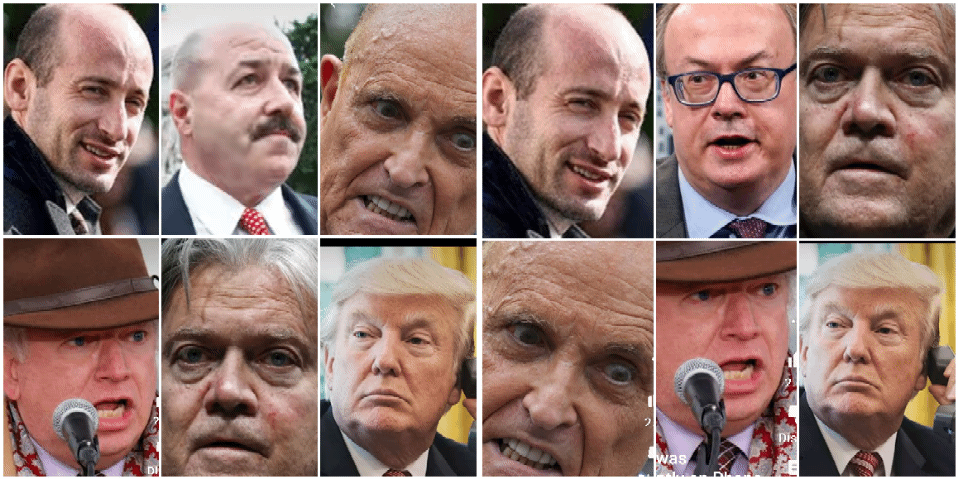
Bannon, however, had not been a member of the administration for several years, not since August 2017, prior to whipping up his audience with the Big Lie and later sitting in the war room/January 6 command center at the Willard Hotel. John Eastman was also not in the administration. Same goes for Rudy Giuliani, Bernard Kerik and several other right-wing luminaries who are poised to show their contempt of Congress, in an act of supreme loyalty to their leader.

Rule of law? Nation of laws? No privilege, not executive privilege, not attorney-client privilege may be successfully invoked to cover up planned illegal activities. There is no privilege that shields participants in a criminal conspiracy. We will see shortly what the appellate panel has to say about Trump’s latest frivolous attempt to weaponize the delay in the legal system to run out the clock, obstruct justice, and protect himself from criminal prosecution. Very exciting.

Words worth heeding

Stephen Fry, well-known author and wit, delivers a short, powerful statement about how dehumanizing language is always used to organize and justify hatred and violence against a targeted group. This language of hate precedes every atrocity.

He gave these remarks at least ten years ago. Well worth considering, as the war on “traitors” continues to escalate

.

In a more perfect union — imagining Rittenhouse public service/truth & reconciliation

Like everything else today, the acquittal of a white teenager who brought an assault rifle to a tense, racially-charged confrontation and wound up killing two people, and dismembering another, while arguably in fear for his life, is a fiercely tribal moment seen through reflexively tribal lenses. Though the injustice on trial in this particular case appears to many obscene, we would all benefit from taking a breath about this particular flashpoint of the long building war between the tribes, before logging it as merely another example of the other tribe’s intractability.

It is undeniably sickening that a white kid who goes to an understandably tense racial justice protest (Kenosha cop would face no charges for shooting an unarmed citizen seven times, four times in the back) with an AR-15, a weapon designed for mass killing in a war zone, (a gun perfectly legal to openly carry under Wisconsin law, if he’d been a year older) and winds up killing two people and destroying the arm of a third, is not accountable to the law in any way, tried in a state that also has a George Zimmerman law. It is an outrage that people like him are free, in many states, to do exactly what Rittenhouse did, fund raise off it and avoid legal consequences. Had he been Black, he would likely have been dead at the scene, a victim of “law and order”. Undeniable. That an unhinged president immediately hailed Rittenhouse as a hero, and the little working class killer’s $2,000,000 bond was quickly raised and paid, and he had an OJ-like team of lawyers who rehearsed and war-gamed his defense with consultants and jury experts, who put him through his paces before putting him on the stand — this white high school kid enjoyed privileges usually reserved for only the wealthiest criminal defendantsan outrageous pouring of salt in the wounds. Compare the outcome to someone who’d done exactly what Rittenhouse did, who hadn’t been able to post bail, had spent a year and a half locked up in prison and was represented by an overworked public defender. There’d be a plea deal and a sentence of years in prison, there is virtually never a trial in the case of someone unable to post bond and hire the best legal team a mountain of money can buy.

There is much to be legitimately outraged about, but there is also a point that has been mostly sliding by — under Wisconsin law, and based on the evidence the jury saw during the trial, their verdict was what the (unjust, racially biased) law provided for.

If we put the tribal lens aside for a moment, (which is a mighty task today, see, for example, the rest of this sentence) we can see that this case is a reflection of the larger injustice in courts bound by laws written by the NRA. These laws are an outrage and a reason to fight to change these gun-crazed laws, but in this particular case there was one killer on trial, not the systemically unjust legal system. The problem with talking about a public trial is that most of us know few of the legal details and the case stands as easy code for everything else. I will attempt to break some of this into smaller parts and look at the verdict beyond the tribal POV.

The kid’s crying on the stand was either the perfectly understandable reaction of a young criminal defendant, under tremendous stress, on international television, facing decades in prison, possibly traumatized by what he’d done (not every kid who supports Trump is automatically a cold blooded killer), the clever act of a well-coached murderer, or some combination of those things.

Multiple things may be true at the same time. Our justice system is the opposite of colorblind — again, a Black AR-15 wielding shooter at that same time and place would likely have been killed by police on the spot, and the shooting justified, forget about any kind of trial by his peers, or anyone else. This pleasant faced white kid, a big fan of cops, was not molested by police after he shot three people and was allowed to leave the scene of the killings with the weapon that did the killing. That by itself is pretty fucking maddening.

The other day I reflexively referred to the biased judge in the case as a Ku Klux Klansman, based on a few seemingly racist comments and decisions he made during the trial, which was not fair of me. I have no way of knowing if Judge Schroeder is a bigot or not. Another way of seeing the clearly biased jurist, with the eyes of the world suddenly fixed on his every word, is as a sympathetic older man, suddenly far beyond his depth, who felt compassion for a kid, already villainized by half the country, facing the full force of the justice system as punishment for America’s original, never addressed sin of slavery and the racism that justified it.

As a frame, systemic racism, as reflected in countless legal proceedings, is impossible to ignore in this case, unless you pretend, as the right does, that systemic racism, like Critical Race Theory (illuminated brightly by the polarizing Rittenhouse case, where a white killer was extended privileges usually reserved for the wealthy and given a fair trial) is bullshit and that making laws banning “CRT will make it — and all claims of racism — go away.

Think of the close to 1,000 enraged white rioters, including armed white nationalist militia members, allowed, by the too-late deployed National Guard, to peacefully go home the evening of January 6th after the sacking of the Capitol, another in-your-face moment for peaceful racial justice protesters locked up immediately, wrapped in a police net five minutes after curfew (in New York City, mind you), or gassed, charged by officers on horseback and shot with rubber bullets on instruction of Bill Barr so the president could be photographed awkwardly brandishing a bible in front of a famous church.

There is another issue in this case, though, a much more straightforward strictly legal issue, which is hard to see in the glare of this moment. It is a much less satisfying way of looking at the case, but no less important.

In light of the evidence presented to the jury did the prosecution overcome Rittenhouse’s self-defense argument?

That is separate from everything else, and really the only relevant consideration in evaluating the justness of the actual verdict.

I heard an analysis of the trial by Glenn Greenwald yesterday, a guy who sometimes annoys me with what seems like a trollishly contrarian view, who made several excellent points, including the one immediately above. The slightly left-leaning side of corporate mass media has framed this trial as a trial of White Supremacy vs. the rest of us who can see the dangers these fearful haters pose — the kid had crossed state lines with an illegally-possessed assault rifle to provocatively confront protesters and rioters because he’s a racist, like many of Trump’s most vocal supporters. Right-wing mass media framed it as spineless liberal puppet prosecutors using an innocent kid who went to protect property in a town near where he lived, shops threatened by BLM violence, to prove a point about their politically correct “wokeness”.

Everyone had a strong opinion when Rittenhouse was acquitted. Few of us had followed the trial in detail, viewing it instead through the glimpses provided by opinionated pundits, in newspaper articles and on “social media”. Greenwald said he watched the whole trial, saw everything that was presented to the jury. Like most other Americans, and citizens all over the world, I saw only selected excerpts, always framed by the presenters. Who is in a better position to evaluate the fairness of the verdict?

The judge, Kenosha County Circuit Judge Bruce Schroeder, suddenly thrust into the national spotlight, may well have behaved like an asshole, I certainly saw several instances of him leaning over backwards to rule for the defense. In one instance he admitted he knew nothing about technology, but told the prosecutor it was his burden to prove the arguably self-evident proposition that enlarging things on a video screen is essentially the same as using a magnifying glass. The only person disputing that was the defense attorney trying to block introduction of the evidence, who also admitted he didn’t understand the technology or its “logarithms”. It was an asshole position for any judge to take — the two of us are uniquely ignorant about the issue so that is your problem, counselor.

But back to the facts and the law. To prove murder the prosecution must overcome a self-defense defense if it is raised. When you see the defense’s video that the jurors saw, the kid’s fear was understandable when you see that he was chased by at least one of the people he killed, a probably mentally ill man who clearly (and, to many, not unreasonably) wanted to stomp the shit out of Rittenhouse, if not kill him with his own assault rifle. You can say, as I would, that Rittenhouse had no business being there, provoked them by showing up with an AR-15, loaded and ready (and the lack of meaningful gun laws here is appalling), but what the prosecution had to prove beyond a reasonable doubt is that when he killed those men he was not actually in reasonable fear for his life.

The gun charge was dismissed because under a Wisconsin law, probably drafted by the NRA and passed with the help of ALEC (the Stand Your Ground folks), an AR-15 loaded with 30 rounds does not fit the strict and restrictive legal definition of a gun that a 17 year-old can be prosecuted for bringing to a volatile street confrontation. Bruce Shroeder may well be an asshole, even a klansman, but the law is the law and in this case there is no avenue to appeal, based on the law, the judge’s dismissal of the gun charges against the kid who came to a scene of violence armed to take on thirty people. The same goes for most of the rest of the judge’s asshole rulings. The problems are with the law itself, annoying as Shroeder’s thumb on the scale for the defense was.

Predictably, Greenwald has been attacked from the left for his conclusion that the jury’s verdict, based on the evidence presented, in light of Wisconsin law, was correct. It is hard, in our angry, moronic times, to make that kind of distinction when half the country treats the kid as a hero and the other half thinks life in prison is fair punishment for what the smug little Trumper did.

I was reading comments under Greenwald’s video, most of them praising him for his honesty and integrity. This comment caught my eye, and for the first time ever, I responded to a Youtube comment:

I wrote asking the guy if he had a source for this. It changes the narrative drmtically, if true. But the comment above, and my reply, are buried in a haystack of thousands of comments and I have been unable to find a reply anywhere. I was hoping for an email notice, but so far, nada. This guy’s comment, a narrative game changer if true, is the perfect illustration of the problem with relying on unsourced (and thus unverifiable) “facts” gleaned from the internet.

As I was walking last night, taking what used to be called a “constitutional”, I had a thought about how productive it would be if we could all take a step back from the reflexive tribal reactions, isolate some of the larger problems and discuss them on a deeper level of understanding. In spite of the seeming impossibility of doing this in a culture of monetized misinformation, it is the best shot we have as a society on the brink of another bloody civil war. I pictured us all living in a more perfect union, a place of actual discussions focused on the real problems and solving them, instead of the zero-sum, adversarial, strictly profit-driven gotcha society we live in.

I thought of the many lessons members of a more advanced society could take from something like the Rittenhouse trial. I imagined an opportunity for real cross-tribal insights. I pictured people like him, instead of being simply judged a murderer or a victim/hero, required to perform public service after his trial, maybe on a panel with Jacob Blake, the man in a wheelchair for life after taking seven police-justified bullets from a Kenosha policeman and Rittenhouse’s surviving victim.

It would be much more instructive than what we have now, this kid as a vicious murderer who went free or a totally vindicated celebrity of MAGA-world, already publicly courted by several of the most angry, provocative and extremist members of Congress, who have already offered Rittenouse jobs he is as unqualified for as they are for their own jobs.

Imagine an alternative reality where the young man is required to spend a certain number of hours communicating to the public what he learned from his experience. His public service would start with help from skilled mediators who could ensure he listened to victims of vigilante violence, and understood the point of view of those at the protest where he wound up shooting three people. He could reflect on what he may have learned from the whole ordeal, how it feels to actually end the lives of random strangers (suppose he really does have regular nightmares about it, instead of the expressed desire to shoot BLM protesters and the smug posing he did right after– would that be a step in the right direction in talking about fucking guns?). Think of the discussion this kid’s court-mandated public speaking could open, in a more perfect union, where everything is not immediately weaponized to threaten and kill the other side with.

This messianic daydream scenario would only work, of course, in a society where honest reflection was encouraged, where truth and reconciliation are valued, where people are seen as capable of learning, evolving and becoming wiser, instead of a ruthlessly profit-obsessed casino where the only move for the people forced to gamble there is doubling down until you’re out of chips.

Democracy on a respirator, but don’t despair, yet

If we are a nation of laws, and nobody here is above the law, then we can only save ourselves from the crisis we are in by the just application of law. The rule of law saved democracy during Trump’s baseless attempted litigation challenging the outcome of the 2020 presidential election, even judges appointed by Trump were required, by the law itself, to rule against a litigant who produced no evidence of wild conspiracy claims or who made baseless claims requiring the suspension of disbelief and the disregard of actual evidence in order to win. Including the obvious fact that many Republicans were voted into office across states on the same ballots that Trump lost and baselessly insisted were subjected to massive fraud and rigging by a bipartisan cabal of traitors and insurrectionists.

Law is a human construct, and far from perfect, but it is also the most perfect thing we have as citizens to preserve any kind of justice, as well as our form of representative democracy itself. If we have a law against conspiring to stop the functioning of government, which we do [1], it needs to be deployed against those who more and more openly believe, in the words a speechwriter wrote for Barry Goldwater, an extremist Republican candidate sixty years ahead of his time in terms of party politics:

“Extremism in defense of liberty is no vice. Moderation in pursuit of justice is no virtue.”

Goldwater, you will recall, was the far-right presidential candidate from Arizona who advocated nuking America’s enemies back to the stone age and lost virtually all fifty states in the 1964 election [2]. He is most famous today for the so-called Goldwater Rule [3], a policy made by the American Psychiatric Association, a voluntary membership organization, that states no therapist may venture a public opinion as to the mental and emotional fitness of a political candidate unless he or she has personally examined the person and the patient has consented to have psychiatric details disclosed to the public.

The Goldwater Rule is not a law, or a rule that is binding on anyone who is not a member of the APA, nonetheless, the media often treats it as a law binding on all psychiatrists, even in the face of a candidate or elected official posing a publicly observable imminent threat to our nation. The rule, which was “doubled down” on by the APA soon after Trump became president, has been cogently challenged by many American psychiatrists recently, most outspokenly Dr. Bandy Lee.

The Goldwater Rule, we are told, applies even when you have a president who publicly shows himself daily to be a petulant, churlish, childish, vindictive, paranoid, attention seeking, megalomaniacal, corrupt, punitive, bullying, illogical, incoherent, amoral, transactional, compulsive liar. Even if this leader deliberately stokes an infuriating lie and organizes a rally and march based on that lie, to inspire a fight to overturn the election he lost, on the day the government is officially taking the ceremonial last step in the peaceful transition of power, and he sends a violent mob down to the Capitol to stop it. The Goldwater Rule prevents any shrink from talking about any of that, in their capacity as a psychiatrist, unless the unhinged elected official himself consents to a session and then the disclosure of a clinical diagnosis. Anything beyond “man, woman, camera, TV” is protected by the Goldwater Rule. Of course, anyone as critical of an American president as I am in this paragraph is clearly suffering from what Germans once called “Hitler Derangement Syndrome”.

There’s no law against going on TV and simply lying about whatever you want. Sad but true, in very few cases can anyone be prosecuted for simply making shit up, no matter how ugly or how likely destructive, and braying about it to the public. There is, however, a law against conspiring to stop the government, which is what the “Stop the Steal” riot did for hours on January 6.

It is frustrating to many Americans that the Department of Justice is so slow and deliberate in regard to holding the organizers of the conspiracy that led to a direct attack on democracy accountable. There is not even any apparent movement in this direction, though DOJ investigations are supposed to be conducted secretly without fanfare. We’d like to see some sign!

The law often grinds on slowly. It seems impossible, for example, that the Fulton County DA has not yet indicted Trump for what appears to be a very clear violation of the Georgia law against trying to interfere with, or coerce others to interfere with, a certified election result. The last act of that concerted attempt to overturn the Georgia election results is a recording millions of Americans have heard, for fuck’s sake, during which Trump violated every subsection of the Georgia law. The theory, I suppose, is that when taking a shot at a dangerous predator, be sure that shot is carefully aimed and powerful enough to actually stop the creature.

The Watergate-related indictments took two years to happen. The January 6 indictments are apparently going to take a while longer to assemble airtight cases for, aggravating though that is while the brazen co-conspirators are freely talking their ugly talk and broadcasting it to their increasingly enraged followers on shows like Steve Bannon’s The War Room.

If those indictments don’t happen within a reasonable amount of time, certainly well in advance of the heavily gerrymandered 2022 election (and full restoration of the 1965 Voting Rights Act by passing the two House bills is also critical, CRITICAL), stick a fork in our democracy, boys and girls, we’ll have Speaker of the House Donald Trump and the immediate censure of every non-white Democrat and traitor Republican in the House. There will also be summary expulsions for enemies of the Speaker, and probably also televised public book burnings, the kinds of things that always precede even worse barbarity.

And, as for the rule of law, we’ll have plenty more proud, angry, armed vigilante boys like Kyle Rittenhouse, free to take illegally possessed assault rifles into combustible situations like an angry protest over the perfectly legal police shooting, seven times in the back, of an American citizen, and then get acquitted in a trial presided over by a seemingly unrepentant Ku Klux Klansman.

And remember, folks, there’s no law against being in the Ku Klux Klan, it’s that American judge’s first amendment right of association and puts him in good stead for a future career as a celebrity opiner for Rupert Murdoch, OANN or Newsmax.

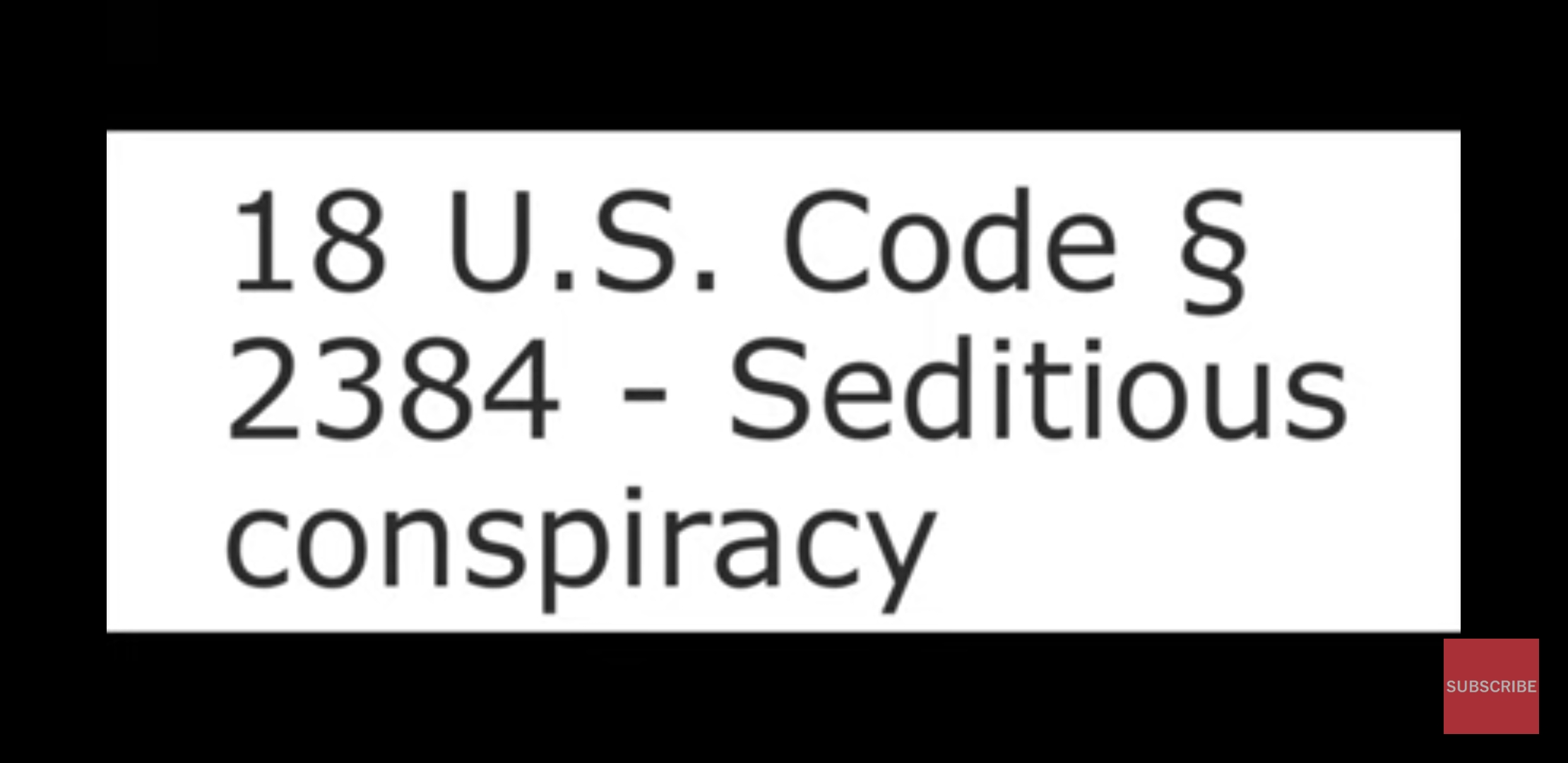
The law to keep an eye on is the one below, 18 U.S. Code § 2384. And if Merrick Garland doesn’t bring some indictments under this law, of the people who were in that war room in the Willard Hotel on January 5th and 6th and the guy who stood to gain the most from the conspiracy, had his co-conspirator’s bills paid and spoke regularly with them during the riot, we all ought to get down on our knees and, in the words of XTC, while we’re down there, kiss our asses goodbye.

[1]

If two or more persons in any State or Territory, or in any place subject to the jurisdiction of the United States, conspire to overthrow, put down, or to destroy by force the Government of the United States, or to levy war against them, or to oppose by force the authority thereof, or by force to prevent, hinder, or delay the execution of any law of the United States, or by force to seize, take, or possess any property of the United States contrary to the authority thereof, they shall each be fined under this title or imprisoned not more than twenty years, or both.

[2]

Johnson carried 44 states and the District of Columbia, which voted for the first time in this election. Goldwater won his home state and swept the states of the Deep South, most of which had not voted for a Republican presidential candidate since the end of Reconstruction in 1877. This was the last time that the Democratic Party won the white vote, although they came close in 1992.

source

[3]

The Goldwater rule is Section 7 in the American Psychiatric Association’s Principles of Medical Ethics, which states that psychiatrists have a responsibility to participate in activities contributing to the improvement of the community and the betterment of public health, but they should not give a professional opinion about public figures whom they have not examined in person, and from whom they have not obtained consent to discuss their mental health in public statements. Wikipedia

Trump does not contest Judge Chutkan’s statement of facts

Trump’s lawyers immediately appealed Judge Chutkan’s recent executive privilege ruling that denied former president Trump’s demand that as former president (defeated only by fraud) that he is privileged to conceal all records of the lead up to January 6 and on the day itself. We’ll find out how that argument goes on November 30th. Judge Chutkan ruled that the public need for solid information about the planning and implementation of the January 6 MAGA riot, which violently stopped the constitutional duties of a joint session of Congress, coupled with the agreement between Congress and the Executive Branch that evidence needs to be seen, means that Biden’s waiver of Executive Privilege claims made by Trump is the last word on the matter. Trump insists he has a right, as the unindictable president at that time, to hide anything that could cause him irreparable harm. It is the same stance Trump, insister on iron-clad, global, lifetime non-disclosure agreements, has always taken about everything. It is a position that appeals to many Americans– you fucking fight them until you win, no matter what.

Although Judge Chutkan offers it as background, to put her decision in context, we should note that Trump’s lawyers are not able to contest any of the facts the judge, as finder of fact, provides in that section of her decision. The only “answer” to her reconstruction of events leading up to January 6 is by reframing everything so that the most important detail is the frame: in spite of everything, the election was stolen! What did you expect the rightful president to do, sit by while it was being stolen?! Chutkan does not even go into the almost hour of detailed lies Trump told that crowd about how the vote was stolen in state after state, to make them madder than hell, in the minutes leading up to the planned permit-free march down to the Capitol. Is this something that needs public attention? You be the judge:

While not material to the outcome, some factual background on the events leading up to and including January 6, 2021, offers context for the legal dispute here. In the months preceding the 2020 presidential election, Plaintiff declared that the only way he could lose would be if the election were “rigged.” See, e.g., Donald J. Trump, Speech at Republican National Convention Nomination Vote at 22:08 (Aug. 24, 2020) in C-SPAN, https://www.c-span.org/video/?475000- 103/president-trump-speaks-2020-republican-national-convention-vote.

In the months after losing the election, he repeatedly claimed that the election was rigged, stolen, and fraudulent. For example, in a December 2 speech, he alleged “tremendous voter fraud and irregularities” resulting from a late-night “massive dump” of votes. See President Donald J. Trump, Statement on 2020 Election Results at 0:39, 7:26 (Dec. 2, 2020) in C-SPAN, https://www.cspan.org/video/?506975-1/president-trump-statement-2020-election-results. He also claimed that certain votes were “counted in foreign countries,” that “millions of votes were cast illegally in the swing states alone,” and that it was “statistically impossible” he lost. Id. at 12:00, 14:22, 19:00.

After losing the election, Plaintiff and his supporters filed a plethora of unsuccessful lawsuits seeking to overturn the results. See, e.g., Current Litigation, AMERICAN BAR ASSOCIATION: STANDING COMMITTEE ON ELECTION LAW, Apr. 30, 2021, https://www.americanbar.org/groups/public_interest/election_law/litigation/.

The United States Supreme Court also denied numerous emergency applications aimed at overturning the results. Id. In response, Plaintiff tweeted that the Court was “totally incompetent and weak on the massive Election Fraud that took place in the 2020 Presidential Election.” Donald J. Trump (@realDonaldTrump), TWITTER (Dec. 26, 2020, 1:51 PM), https://www.presidency.ucsb.edu /documents/tweets-december-26-2020.

He continued his claim that “We won the Presidential Election, by a lot,” and implored Republicans to “FIGHT FOR IT. Don’t let them take it away.” Id. (Dec. 18, 2020, 2:14 PM), https://www.presidency.ucsb.edu/documents/tweets-december-18- 2020. A Joint Session of Congress was scheduled to convene on January 6, 2021, to count the electoral votes of the 2020 presidential election and to officially announce the elected President, as required by the Twelfth Amendment to the U.S. Constitution and the Electoral Count Act.

In the days leading up to January 6, Plaintiff began promoting a protest rally to take place hours before the Joint Session convened. On December 19, 2020, he tweeted “Statistically impossible to have lost the 2020 Election. Big protest in D.C. on January 6th. Be there, will be wild!” Donald J. Trump (@realDonaldTrump), TWITTER (December 19, 2020, 6:42am), https://www.presidency.ucsb.edu/documents/tweets-december-19-2020.

During a rally, he warned that “Democrats are trying to steal the White House . . . you can’t let that happen. You can’t let it happen,” and promised that “[w]e’re going to fight like hell, I’ll tell you right now.” See Donald J. Trump, Remarks at Georgia U.S. Senate Campaign Event at 8:40, 14:19 (Jan. 4, 2021) in Campaign 2020, C-SPAN, https://www.c-span.org/video/?507634-1/president-trumpcampaigns-republican-senate-candidates-georgia.

On January 6, Plaintiff spoke at the rally at the Ellipse, during which he repeated claims, rejected by numerous courts, that the election was “rigged” and “stolen”; urged then Vice President Pence, who was preparing to convene Congress to tally the electoral votes, “to do the right thing” by rejecting certain states’ electors and declining to certify the election for President Joseph R. Biden; and told protesters to “walk down to the Capitol” to “give them the kind of pride and boldness that they need to take back our country,” “we fight. We fight like hell. And if you don’t fight like hell, you’re not going to have a country anymore,” and “you’ll never take back our country with weakness.” See Donald J. Trump, Rally on Electoral College Vote Certification at 3:33:04, 3:33:36, 3:37:20, 3:47:02, 3:47:22, 4:42:26, 4:41:27 (Jan. 6, 2021) in Campaign 2020, C-SPAN, https://www.c-span.org/video/?507744-1/rally-electoral-collegevote-certification.

Shortly thereafter, the crowds surged from the rally, marched along Constitution Avenue, and commenced their siege of the Capitol. 

source

The long moral arc of fucking history

One Sunday late afternoon, three months before my ninth birthday, I was sitting by myself in my parents’ bedroom, at the foot of their bed. I don’t know why I was there, perhaps watching their large TV. It would not explain my memory of hearing the news that Malcolm X had been shot dead in the Audubon Ballroom in Washington Heights from my father’s alarm clock radio. I knew what it meant right away, and it felt like a punch in my young stomach. It was not that long after the JFK assassination and not long before several more lone gunmen would kill other leaders like Martin Luther King, Jr. and Robert Kennedy.

I read today that two of the three men who’d been convicted and jailed — fifty-five years ago — for the killing of Malcolm X (who by then had renamed himself El Hadj Malik el Shabbaz) will be exonerated tomorrow, one posthumously. The FBI, NYPD and prosecutors had withheld evidence that would have likely prevented the conviction of each of the “murderers” who spent decades in prison. The one assassin who was caught at the scene confessed in court and said he didn’t know the other two guys, that they hadn’t been the other shooters. It turns out he wasn’t lying.

The New York Times reports:

A trove of F.B.I. documents included information that implicated other suspects and pointed away from Mr. Islam and Mr. Aziz. Prosecutors’ notes indicate they failed to disclose the presence of undercover officers in the ballroom at the time of the shooting. And Police Department files revealed that a reporter for The New York Daily News received a call the morning of the shooting indicating that Malcolm X would be murdered.

Investigators also interviewed a living witness, known only as J.M., who backed up Mr. Aziz’s alibi, further suggesting that he had not participated in the shooting but had been, as he said at the trial, at home nursing his wounded legs.

Altogether, the re-investigation found that had the new evidence been presented to a jury, it may well have led to acquittals. And Mr. Aziz, 83, who was released in 1985, and Mr. Islam, who was released in 1987 and died in 2009, would not have been compelled to spend decades fighting to clear their names. . .

. . . Representatives for the two exonerated men said that the moment meant a lot to Mr. Aziz, and to Mr. Islam’s family. But Mr. Shanies, one of the civil rights lawyers representing them, said their convictions had a “horrific, torturous and unconscionable” effect that cannot be undone.

The two men spent a combined 42 years in prison, with years in solitary confinement between them. They were held in some of New York’s worst maximum security prisons in the 1970s, a decade that bore witness to the Attica uprisings.

Mr. Aziz had six children at the time he was convicted; Mr. Islam had three. Both men saw their marriages fall apart and spent the primes of their lives behind bars.

Even after their release, they were understood as Malcolm X’s killers, affecting their ability to live openly in society.

“It affected them in every way you could possibly imagine, them and their families,” Mr. Shanies said.

source

We learned, decades after the assassination of Martin Luther King, Jr., that the FBI had been secretly recording King in hotel rooms and had sent compromising materials to him along with at least one letter urging him to kill himself. That’s just the way it was in the USA in the 1950s and 1960s, and the two hundred or so years before that. Racism was out of control, American Blacks were organizing and fighting for civil rights (Malcolm rightly called them Human Rights) and even a nonviolent pastor was considered an enemy of the state by the guardians of American power, since he was seen as galvanizing a tremendous moral force.

It’s hard to untangle how fucked up all of this is, or to overstate that the final crime for which King was condemned to death was his sermon opposing the War in Vietnam (one year to the day before his murder) and his Poor People’s campaign (on behalf of all of America’s poor). Once you stray from fighting for the right to use the same water fountain as whites to criticizing the power structure of the country itself, it is probably time for you to be shot through the voice box by a lone gunman with a shady past.

I try to imagine what it’s like to be exonerated fifty-five years after your life is destroyed, or posthumously. Then I consider that this re-investigation and exoneration would never have happened at all, but for an excellent documentary Who Killed Malcolm X? by a dogged historian/researcher who thoroughly investigated the killing of his hero. Netflix aired the documentary and outgoing Manhattan DA Cyrus Vance opened a re-investigation as soon as he considered the letter from the filmmaker, Abdur-Rahman Muhammad, and watched the compelling film.

I think of the long game of history. In 2060 or so perhaps the final story of the party-line confirmation of deeply divisive uber-conservative partisan Boof Kavanaugh will finally be told, once his forty year reign on the court is done and the appropriate amount of time has elapsed for the release of the thousands of pages of Kavanaugh-related documents the judicial committee was not allowed to see. Citizens, if there any left by then, will also learn the details of the 4,000 tips the FBI received, during a rushed farce of a five-day investigation into allegations against Kavanaugh, tips that went directly to Kavanaugh’s sponsor at the White House, fellow Federalist Society all-star Don McGahn, who promptly rejected them all.

Had these documents been seen, and publicized, had the FBI followed up on any of the tips, or even interviewed Kavanaugh, his friend Mark Judge and Christina Blasey-Ford, the Justice’s fiery, angry, paranoid, hyper-partisan speech in defense of himself as a victim of a cabal of powerful lying enemies would not have won the day.

For now, all we have are the words he uttered that day, after Blasey-Ford’s credible testimony, angrily snorted, slightly unhinged words that should have disqualified him from sitting on the Supreme Court, words he proudly (and unaccountably) told the world he wrote himself:

And this capsule biography of the longtime right-wing partisan, from Wikipedia:

Kavanaugh studied history at Yale University, where he joined Delta Kappa Epsilon fraternity. He then attended Yale Law School, after which he began his career as a law clerk working under Judge Ken Starr. After Starr left the D.C. Circuit to become the head of the Office of Independent Counsel, Kavanaugh assisted him with various investigations concerning President Bill Clinton, including drafting the Starr Report recommending Clinton’s impeachment. After the 2000 U.S. presidential election, in which he worked for George W. Bush‘s campaign in the Florida recount, he joined the Bush administration as White House staff secretary and was a central figure in its efforts to identify and confirm judicial nominees.[3] Bush nominated Kavanaugh to the U.S. Court of Appeals for the D.C. Circuit in 2003. His confirmation hearings were contentious and stalled for three years over charges of partisanship. He was ultimately confirmed to the D.C. Circuit in May 2006 after a series of negotiations between Democratic and Republican U.S. senators.[4][5][2] Two law professors performed an evaluation of Kavanaugh’s appellate court decisions in four separate public policy areas for the Washington Post. It found he had been “one of the most conservative judges on the D.C. Circuit” from 2003 to 2018.[6]

Once this ambitious Zelig of right-wing absolutism (he was involved in each of this century’s most outrageous pre-Trump right-wing stunts– Ken Starr’s most zealous assistant, involved with stopping the Florida recount in 2001, secret rulings for Dubya as White House staff secretary, rewarded by quick lifetime elevation by Bush II– after an ugly confirmation fight) has ruled on countless cases, restricting the rights of workers, voters, consumers, poor women, his political enemies, once all the unappealable damage is summarily done — and bitterly recorded in dissents — our descendants will get to learn the rest of the story of how this entitled partisan warrior managed to get a lifetime appointment to the nation’s highest court and steer that court for decades. I imagine they will feel like the previous generations (and they, themselves) got fucked, just the way those two guys who had nothing to do with the killing of Malcolm X got fucked, and then exonerated, in the long moral arc of fucking history.