How to Never Heal

Pro tip: NEVER, EVER, ADMIT YOU WERE WRONG!

In a world where we all make mistakes, sometimes very hurtful ones, I’m glad to have a disposition that allows me to forgive people. That may sound funny coming from a man who felt he had to cast many old friends adrift over the years, but it’s true. All I need to be able to forgive is a sincere expression of regret when somebody I care about hurts me, their understanding of why I was upset and an assurance they will try hard not to act that way again. Reconciliation can’t happen without truth. If I won’t even acknowledge that I acted badly toward you, when you spell out exactly why you were hurt by my actions, repeated actions in many cases, what hope can you have about the comfort of our friendship going forward? Think about it.

How not to heal: refuse to hear what the other person is concerned with, no matter what, focus on your own counter-grievance, press it over and over. When they complain, tell them they are whining snowflakes, oversensitive, passive aggressive pussies. “I elbowed you in the Adam’s Apple for the fifth time this week — BY ACCIDENT, ASSHOLE, as I already fucking told you!” is an explanation that attempts to bully you into accepting your powerless in the relationship. “I’m not wrong, YOU ARE,” is an asshole’s first response most of the time.

People who are not comfortable apologizing will often “double down” in the sickening gambler’s phrase we all learned during Mr. Trump’s regime. Apology, admittedly, requires a moment of putting yourself in the other person’s shoes, recognizing that you too would feel hurt, followed by an act of humility — contritely asking forgiveness — that makes you vulnerable. Ironically, it takes a certain amount of strength and self-confidence to apologize, even when you know you’ve hurt someone.

Insecure people have a very hard time admitting they are ever wrong, especially when the result of their actions is set in front of them. By reflex they feel attacked, become defensive, counterattack. It is the only play of someone too insecure to acknowledge the possibility of being mistaken. We are living through a prime public example of what I am thinking about in interpersonal terms and it has us at the brink of being angry enough to actually begin murdering one another.

In the case of the many Republican politicians continuing to support the president (many by their silence) in his endlessly repeated lying claims of massive electoral fraud (he made the same claim when he narrowly “won” in 2016, millions of dead people voted then too), they are sticking to their stories [1].

That their story may make little or no sense, less important than having a story. As more and more terrible facts emerge, like sickening details of the violent riot incited by their leader, seen by everyone, the stupid cover-stories about the sudden need for unity, or Antifa, or Trump learning the first lesson of his life, become more and more ridiculous. They simply can’t stop now, not after their tireless, valiant campaign has finally brought us to to bring about this sickening, anti-democratic zero-sum political moment. Now even a violent riot by insurrectionists planned and fomented by the president can be … a… a teachable moment? — a step forward on the road together? They need a story. Any story is better than no story, wait, here we go.

To hold Trump accountable for planning and inciting a riot, inviting an angry mob to D.C. on January 6th to STOP THE STEAL!, sending the stirred up mob down to the Capitol while he instructed federal law enforcement to stand down, in hopes of seeing Mike Pence (so disappointing!!) swinging from the gallows and the heads of his other enemies on pikes (“Hi Nancy, hi Chuck!! Hi, Shifty Schiff! who’s laughing now?”), would– eh, DIVIDE THE COUNTRY! That’s it — yeah, Democrat traitors, look who’s trying to divide the country now, shameless partisan hypocrite zealots!! We’re trying to heal here, you libtard commie fucktards, and you’re… so… goddamn mean and hypocritical — and vindictive! Admit you’d do the exactly the same thing if you had the election stolen from you, or even claimed repeatedly and falsely that it was stolen from you!

As I watch this heart-sickening theater, personal feelings are being vigorously stirred. Two friends from childhood did exactly this move in recent years. One simply by refusing to admit that his reflex to make me angry had anything to do with him, the other by telling me he had no idea why I was upset with him, repeatedly asking for an explanation for why I was so hurt and then attacking me for explaining it in such a brutal way. In short, two smart people incapable of great insight into themselves, unable to behave any better than they did and angry at being unfairly expected to. Each now has the consolation of knowing that I was finally the cruelly self-righteous, heartlessly unforgiving asshole who put an end to a long, beautiful friendship. I don’t begrudge them, it’s all they’ve got.

I was telling a friend recently that I’d truly have no problem forgiving either of them, if they would only own up to what they’d done, and kept doing, that was so hurtful to me, promised to try to do better. If the first guy had a breakthrough in psychoanalysis and called to tell me he realized that he was actually, unconsciously, often trying to provoke me to rage and was sorry about it, I’d be playing guitar with him the next day. The second guy is a slightly harder case, because although he initially thanked me for my mildness in stating my grievance without accusation the first couple of times, he remained specifically unapologetic (he claimed to have no understanding of why, exactly, I’d been so upset) and non-responsive, repeatedly telling me I still hadn’t made myself clear, pushing me for clarification, and then blaming me for clarifying things, which was very hurtful and made him feel terrible! A more complicated kind of asshole than the first guy, still, I’d be glad to forgive him, if he contacted me with even a soupçon of insight into how his actions, and his constant doubling down, had finally aggravated me beyond endurance.

Politics is personal, its roots go back into our formative childhoods. Social scientists have run tests to determine the basic personality types of the typical liberal and the typical conservative. Here’s a test. Take these traits and assign them to one side of the political spectrum or the other: obedience, loyalty, harsh punishment, self-sufficiency, individualism. If you said “liberal” you pass the test. How about these: fairness, reconciliation, mutual help, community. If you picked “conservative”– how right you are!

We embrace the worldview that comports with our upbringing, or sometimes rebel against it hard, like Stephen Miller (whose family, survivors of Hitler, is anti-fascist). If dad taught you that the Bible said “spare the rod, spoil the child” and took every opportunity to not spare the rod, well, you are more likely to have a certain view of the righteousness of harsh punishment and retribution. If mom instilled a conviction that food should be shared equally by everyone at the table, that no-one should ever go hungry, or get less than somebody else, there’s a different fundamental lesson about what is truly important in life.

I knew the families of these two guys I grew up with quite well. The home life of the first was an endless exercise in restraining and repressing very understandable anger. The mother, a woman of great charm and intelligence, is a compulsive (though often harmless) liar and something of a manipulator. The father, an equally charming person, was treated like a rebellious child in their home, and acted chastened much of the time. This daily humiliation was disguised as a deep love that nobody could deny. The second kid was raised by an openly autocratic father and a narcissistic mother who worshipped his uncompromising dad without question. My friends had little chance to learn any life lessons at home but what they did. Both of these boys, as men, endured rough marriages that ended in ugly divorces.

You can understand these unfortunate backstories and, still, it doesn’t sit right (my home life was as bad or worse in many ways), in a world where we can work to gain more insight and change things about our lives that torment us the most.

I am prone to anger, and it is my daily work to get better at not succumbing to it, work I consciously do. One thing I’ve learned is that when you cannot solve an interpersonal problem with someone, it is crucial to simply walk away. That applies in the moment you are getting mad as well as longterm, of your decision to stay in an aggravating arrangement with little emotional counterbalance. To conclude that proneness to anger is simply my nature, and there is nothing I can do about it, would be an abdication of any moral responsibility or agency on my part. What they used to call a “cop out” in the sixties — it’s not me, man, it’s undeniable, immutable genetic-social necessity!

To return to my personal examples of the problem of making peace with people who have lost the ability to see things from your point of view: the first guy will endlessly deny his anger and his unconscious provocations, make it everybody else’s problem that they are so angry all the time — a stance that is, frankly, infuriating. The second guy will do pretty much the same, actually, though in a much more sophisticated way. They will both be right, eternally. And so be it.

It is beyond our powers to change any of that, least of all in someone else, particularly a person who sincerely believes we can really not do anything differently, or better, than we’ve always done. It reminds us of the role our native dispositions play in our outlook, I guess, and whether you’ve had the luck to have at least one parent love you unconditionally.

Back to “politics”, the sword hanging over all of our heads. As the US nears 375,000 dead of the pandemic, it’s clear that the president, who has snapped that he has no responsibility for it, doesn’t care. He cares about overturning a rigged election he has produced zero proof was in any way improper. He clearly DOESN’T CARE IF YOU DIE and he’s not going to address taking reasonable steps to prevent the wild spread of COVID-19, in fact, he’ll weaponize disease prevention itself and insist on super-spreader events like that mask-free tour de force of domestic terrorism he hosted last week then inflicted on the Capitol.

The plain fact that the leader of the wealthiest nation in the world, whose infection and death rates are 5X higher, by population (4% of world population, 20% of infections) than anywhere else, clearly doesn’t care about stopping the spread of this deadly plague, by itself, should be a compelling argument for removing him under the 25th Amendment. It’s depraved, if not outright insane.

Oops, there I go again, angrily dividing this poor, ravaged country!

Back to the promise of the title: How to Never Heal. Focus on a grievance and being the victim. Nurture those painful feelings, no matter what.

In the case of aggrieved Trump followers, let’s take one major strand of their belief system — that the unreasonable, pushy demands of America’s coloreds endlessly claiming racism in America are a crock of crap. Here’s what you do, Trumpie, hit back with history. FACT: the ones who were slaves, the black ones, were freed more than 150 years ago. Fucking get over it! You people are fucking animals, look at you! That’s why we had a phalanx of National Guardsmen in full anti-riot gear guarding the steps of the Lincoln Memorial as you passed by in your protest march — because you are insane, violent savages who will never be satisfied no matter how many rights we give you and you would have attacked even the sacred statue of Abraham Lincoln, the best friend you ever had until LBJ, if given the chance. Nothing will be enough for you, until we are your slaves. Now get out of our way so we can go hang Mike Fucking Pence.

There you go, it is as easy as that. If you are determined to be right, even with a grievous self-inflicted wound, even if it means being a moronic, self-deluding puppet screaming against your own best interests, it is very simple to do. Take the three easy steps again: focus on a grievance, nurture it, justify it, no matter what; repeat as necessary. You can thank me later.

On the other hand, if you want to heal, for some reason, there are a few necessary steps. You have to be honest. You need to honestly discuss the things in the past that have led to the harmful situation we find ourselves in now. You have to acknowledge terrible things that happened (beyond a nonchalant “we uh tortured some folks”, if you know what I mean) and commit to fixing them. You have to listen carefully, be open to all proposals for improving things, if you want to have real reconciliation. If you want to correct injustice you have to first look at it fairly, listen to the voices of those who are being hurt by it, remove from the conversation those who are intent on perpetuating unjust practices.

If you want to be right, of course, just blame the pitiful losers for wanting to be victims when YOU ARE ACTUALLY THEIR VICTIM! You know what I’m saying?

USA! USA!!!!

[1]

The New York Times, channeling The Onion (America’s Finest News Source), reported on its front page earlier today (they removed the headline in the last hour, during updates, so I paraphrase:) Supreme Court Declines to Fast-track Trump Election Case. I was too slow to click on it while it was up, and it can’t be easily found (searching “Supreme Court” on the buggy NYT phone app doesn’t do it) but, seriously– WHAT THE FUCK? What fucking Trump election case?

One from the vault (Sensitive Dog)

One from the Random Acts of Senseless Creativity files. After I thought about this track an hour ago I went looking for it, a journey through a labyrinth of old emails and various digital booby-traps. After a few small wrestling matches with the technology, I was able to place it here, where it can be found easily next time. I was happy to locate it and I’m glad to pass it on.

The underlying track for this is called Dog on a String, composed and performed by Paul Greenstein sometime after the turn of the twenty-first century, if memory serves. This was an improvisation I recorded, back on April 14, 2006, apparently. All parts were played for the love of making the track and for that reason alone.

For me this over-the-top jam captures the thrill of interactive invention — the joy of improvising over a groove you’re really digging.

Our ability to find joy and improvise has been sorely tested in the isolation of this COVID crisis. Mutual, playful improvisation, a vital part of human interaction, a free delight of life, fades during dark times, the habit of playing happily — another casualty of the pandemic. Playing together gives us joy, undeniable but easy to forget, sometimes. This track reminds me of how much fun play is.

Paul’s track was a delight, I greatly love that mysterious, soulful Indian singer, all of Paul’s parts are superb (if several lovely ones were drowned out by the overloud distorted guitar, sorry about that). It is also beautifully engineered, everything is exactly where you want it to be in the mix and the EQ. I’ll ask Paul for the original track, so I can post that beauty for you to hear.

Listening to this track I hear my excitement, the enthusiastic variations inspired by the sheer fun of following a wildly idiosyncratic groove.

Sensitive Dog starts with a dog lover’s question for Cesar Milan, who then considers the best way to interact with a dog who is very sensitive. Odd to say, I couldn’t tell you what key it’s in, I had no idea when I was playing it, most unusual for me, I followed the singer as best I could.

There are suboptimal notes, which I can’t begrudge someone inventing parts over a track he is greatly loving as he plays. If you don’t let yourself be distracted by the mistakes and take in the entire 1:56 as a piece, I think you’ll get what I’m talking about.

My only regret is the mix. If someone had been sitting at the controls (there were no controls, the overdub was recorded off the small amp that was also playing Dog on A String) and adjusting the volume on the distorted guitar, to allow Dog on A String’s many subtle nuances to be appreciated, the track would be infinitely better.

To me, the track is still cool, instant time-travel to a moment of great fun. A reminder of a vital thing, sadly easy to forget during dark days — the joy of carefree play with someone you enjoy. I hope you find it so too.

What are we doing today, baby?

As universally hated Lyin’ Ted Cruz and now eleven other brave Republican Trump supporters in the Senate (the most highly placed members of the Sedition Caucus) call for an emergency special commission to immediately audit undisputed votes in an election certified in every state (and recounted a few times in several) that only Trump the Kraken insists was rigged, stolen, corrupt, fraudulent, a lie, a big fat complete Communist con job, #StoptheSteal! I wonder “what am I going to write about today?”

I certainly ain’t writing about Lyin’ Ted, the despicable guy with the unsexy wife, whose father killed JFK and whose ancestors, people are saying, nailed up Jesus. Fuck him and his vile, seditious crew (note, this may be the first time the wildly unpopular Cruz is the leader of any crew, way to go Ted).

I’m also not going to mention the provision of the National Defense Authorization Act, vetoed by Trump in the first Trump veto overrode by the Senate (never too late to do the right thing, I suppose), that makes it criminal for federal law enforcement agents to cover their name tags while performing their duties or otherwise operating as unmarked, unaccountable thugs [1]. Who’d have thought such a measure was needed in our nation of law?

This was likely one provision of the military budget bill that outraged the easily angered Trump — if former Attorney General Barr says it’s perfectly legal and reasonable to use chemical irritants, batons and a horseback charge by mounted federal law enforcement, with covered name tags, to break up peaceful protests (Washington D.C.) or to have heavily armed, generically uniformed goon squads jump out of unmarked rented vans and grab dangerous anarchist, God-hating protesters off the streets, force them into unmarked vehicles, without identifying themselves as law enforcement (as federal agents did in Portland) who is the goddamned Congress to usurp the massive powers conferred by Article Two?  Fuck that noise, everyone knows Trump wishes he’d been a real dictator, instead of a Twitter dictator. Today is Sunday, a day of rest.

So, like, what do you want to talk about?

Is this an example of you talking to yourself?

Hah, no, it’s an example of you talking to yourself.

You got me there, comrade.

You’ve been noted, around the house, because, during this tyrannical COVID lockdown you no longer live alone in your apartment where passersby in the hall and in the airshaft have no inkling you’re not muttering to somebody else, that you are, in fact, carrying out grunted conversations with yourself…

Nay, that would be YOO, muchacho.

Hah, OK, you got me there! Anyway, she mentioned these grunts I seem to make as being pretty regular, constant, apparently. From the other room she hears the conversational-sounding grunts, she says.

Hmmm, we always imagined that these internal conversations were in your head, my head, our heads.

Well, that’s imagination for ya!

By the way, I admired your restraint above in not mentioning fucking Acting head Homeland Security stooge Chad Wolf, declaring that unrestricted federal military force was necessary in Portland because violent anarchist terrorists were out of control (he used the term “violent anarchists” 60 times in a short speech when he got to Portland), including those hundred or more bitches, the mothers of these violent anarchists, who came out to form a peaceful barrier between unmarked assault-attired federal officers and their fellow citizens. And, you know, got gassed, the wall of mothers.

OK, OK, calm down. “‘No reason to get excited,’ the thief he kindly spoke.”

Yeah, I suppose that’s true. Good to have you here to calm me down sometimes.

Yes, yes indeed, and I wouldn’t have it any other way.

Neither would I. By the way, it was determined by the government office that determines these things that fucking Chad Wolf had been in the “acting” role longer than was legal and that his authority was now being exercised contrary to American law.

Look, you know better than most people, when you’re dealing with childish, irrational assholes with authority accountable only to somebody exactly like them, you just have to cut them infinite slack.

I know, I know…

So?

Fuckface likes “acting” loyalists in charge of everything. “I like ‘acting’,” he said nonchalantly, with his characteristic frankness. They don’t have to be vetted or confirmed, their lack of credentials for the job is immaterial, they are accountable only to his moods, can be used as needed and discarded like the disposable toilet paper they are, you can fire them at will and nobody will even care!

Basta, bastardo!

Right! I did cook a nice variation on Divya Alter’s delicious mixed vegetables in cashew curry sauce an hour so so ago. Came out really delicious, creamy, with a nice mushroom accent.

Let’s not talk about that, you ruined lunch, you heartless fuck.

OK, well, anyway, it was nice talking to you, as always, I have to get on with some random creative pursuit now.

There seems no way to stop it these days.

True dat.

Have a nice day, man.

You too, bubba! Nice talking to ya.

[1]

OK, obviously not “criminal” but Congress stated that federal authorities must “visibly display” their name tags when operating in public. Clearly there is a great deal of play in the word “must”.

Musical Interlude

This early pandemic recording (May 2020) seems a good Christmas offering, something about Tony Bennett, the singer who made this lush pop tune popular back in the Eisenhower days, even before my time. [1]

To me this tune is a great example of a great arrangement, you really can’t do the proper accompaniment without playing the two main parts. The chords are basic and provide a pleasing harmony to the melody. But it’s the line the piano is playing against the chords (a clever arpeggio of the chord), it turns out, that gives the song its swing, its groove. The melody, applied over the top, even loosely, cannot help but be at its most beautiful, set off this way by the other two parts. My Christmas elf’s hat is off to the arranger of this great tune.

To the musically hip, check out a fatal flaw in the underlying loop, every time the top comes around (and dig the riff from Santana’s first album in the bluesy final chorus, and a guest vocal from Sekhnet at the very end).

[1]

“I Left My Heart in San Francisco” is a popular song, written in the fall of 1953 in Brooklyn, New York, with music by George Cory and lyrics by Douglass Cross and best known as the signature song of Tony Bennett. Wikipedia

Reservoir of Rage — and Silence

Rage is a famously difficult subject, which is why I’m trying to take some ways of expressing it one at a time. Reframing, for example, is an essential technique for angrily dominating someone in an argument. Silence, in the face of a friend or family member’s expressed concern, or in answer to a direct request for a conversation, is one of the most potent weapons in the war of rage. It has the virtues of being subtle and deniable (there are MANY reasons for silence), but it is also highly effective, dramatic and deadly, in my experience.

Silence can be a great blessing, of course, like when an overbearingly loud noise finally stops. When quiet descends we feel our breathing calm, we can focus and concentrate. Silence (as opposed to blurting something) can often be very useful when confronted with vexation, it gives you time to gather yourself, deliberate and react more productively. Silence is golden, as those prone to uttering cliches will sometimes say in a quiet moment.

Silence can also be used as the ultimate, uninterruptible, elegant last word in a spasm of rage. One obvious beauty of using deathly silence this way, (to the practitioner), is that it’s the anger expression technique that keeps giving, the silence will continue to irk the other person until they can forget about it and the meaning of the silence itself can always be debated, ill will denied vehemently.

Silence is just silence, the practitioner will insist if confronted, though it might feel like the “silent treatment” to an oversensitive eternal victim type. “… and, you know, though it might well be possible that my silence actually does express my utter contempt for you, you overweening baby, you will always get an unwinnable argument from me about why you are totally wrong to construe it that way. It’s just silence… no meaning to it whatsoever, it’s all inside your messed up head… and typical of you to blame me for the outpourings of your corroded imagination.”

The genius part of this defense is that it’s often true — people fail to respond for many reasons, including being busy, distracted, overwhelmed, truly not knowing what to say. I used to be offended when I heard nothing back from friends I’d send random bits of gratuitous creativity to. Now I understand there is no intention to be hurtful — most people have no experience with a need to feel creative and simply don’t know what to say when someone sends them a thirty second bit of original music. Musicians know that “nice” is a perfectly satisfying reply if they like the thing, but, most people feel overmatched to respond to a drawing sent out of the blue, an incoherent bit of calligraphy, a poem, or whatever the fucking thing is. “Nice” seems mechanical, I guess, something original probably seems in order, and what to actually say to someone who insists on “sharing”– I have no idea.

For our purposes here I am talking about the silence that is a refusal to speak, after being asked to. If you ever experienced this kind of bruising silence, you know what I’m struggling to bring out here.

It is an integral part of the game of rage to always have an argument ready to justify your anger and the actions it caused you to take. (The passive voice, we note, is always good in this case: righteous anger caused me to do this, it was clearly not my choice to be so provoked by you, asshole!)

The argument an angry person makes doesn’t need to be sound or have any chance of prevailing based on what actually took place, the only point is to contest the other person’s right to their feelings. Anger is a zero-sum game — one winner (innocent, 100% right), one loser (infuriating asshole, 100% wrong.) It’s an angry fool’s reductive way of looking at life, but there it is.

This readiness to fight, and the devilish quickness to justify any harsh action, are hallmarks of the perpetually angry person. That raging reflex to deny, no matter what, is what is so infuriating about people addicted to that intoxicating surge of righteousness anger provides. Compulsive Contrarians will fight you angrily, out of an insatiable need to fight, no matter what the cost, to the death and beyond.

To be clear about the kind of anger I’m talking about, it is an unyielding reflex to remain angry and to win the fight. We all experience anger, it is an inevitable part of our condition here as humans. Unfairness, disappointment, bad luck all make us mad. A mark of maturity is being able to keep these things in perspective, to learn to fix what we can and not dwell forever on everything that makes us angry.

The kind of anger that demands the regular harsh punishment of others is an attitude toward life. It hardens into a stance of eternal grievance, a much different, more destructive force than what is released when we sometimes get pissed off at the ordinary frustrations we all have to deal with.

Martin Luther King Jr. famously said “forgiveness is not an occasional act, it is a permanent attitude.We need to be ready to forgive, when the time is right, we have to stay receptive to another person trying to make amends — hence, the permanent attitude. Being ready to accept an apology is a philosophical stance. The same goes for letting go of, or holding on to, anger. We can stay focused on a grievance forever, and act accordingly, or learn to repair what we can and coexist with things that enrage us but that we can do little about, without being mad and ready to fight all the time.

Back to the angry use of silence in situations where dialogue is needed. Political examples of this, the brazen refusal to honestly answer a straight question, for example, are ubiquitous. No point to cite specific cases, there are too many every day, every hour, to start naming. Besides, our current political idiocy is too sickening and bringing it into the discussion is a distraction that will take us off course. I’ll stick to the personal here, keep it clean and straightforward, in hopes of making a point worth making.

The epoch we’re living in now is a worldwide Age of Anger, (or Age of Rage, if ya like a rhyme on yer page) to an extent not seen on this scale in almost a century. Since we’re all forced into offense so much of the time, by news designed to make us angry (and watch the ads [1]), it is best to see anger as the personal thing it always is. Anger is personal, totally, for every person who feels it.

Working to understand our own relationship to our personal anger, and what specifically makes us mad, is probably the best we can do, and a first step toward making our own lives, and the lives of those around us, less contentious. It’s also one of the hardest things to do, especially if you’re prone to getting pissed off. We live in a world of constant provocation at a historical moment when the dial is turned up to 10 all day long (and all through the night).

Here are a couple of examples of angry uses of silence from my life, as succinctly as I can lay them out (I’ve written about each of these vexing kerfuffles here when they happened.)

Let’s recognize first that silence can have different meanings, depending on how we were raised. These meanings determine our feelings about silence and our sensitivity to it. In some households silence may be a proper initial response to a perplexing question. It can indicate respect, the person is thinking deeply about your question and will give a considered opinion after they have thought things through. In another home you’ll be taught that silence as a reply means “never,” the silence about your expressed concern will go on until the next time you bring it up, when it will be answered by an identical pointed silence and so forth, ad infinitum.

Nobody who expresses a concern likes to be ignored (nobody that I’ve ever met, anyway). It is a cruel thing to do to a child (or a person of any age, actually). It amounts to neglecting them emotionally by ignoring their fears, desires, questions and concerns. Is it as cruel as daily beatings, making the child go to bed hungry, humiliating the kid publicly? That depends on how diligently silence by way of response is wielded.

In my own life I’ve come to understand, as a fairly old man, that what I thought of as my father’s relentless cruelty (he made very effective use of strategic silence as a weapon) was in large part his relentless inability to do any better than he did. He was the victim of unspeakable abuse in a home ravaged by poverty, ignorance and rage. He did the best he could, I understood finally, though his best did a good deal of damage. This understanding of my father’s helplessness against his pain and anger came only after a lot of pain and conflict in my own life. My eventual understanding of his limitations erased virtually none of it, but it makes the world make much more sense to me.

As he was dying my father made a seemingly incomprehensible request, asking me to understand that, in a real sense, our long war was “nothing personal”. I thought about this Zen koan for a long time before its meaning emerged. His mistreatment of me had nothing to do with me personally — he would have done the same thing to any child of his, no matter who he or she had been. He was reiterating what he’d said earlier that last night of his life: it had been him, not me, who created most of the intractable problems between us. Our endless war had little to do with me personally.

If I was traumatized, as a young kid, to suddenly learn about the Nazi death machine, by seeing black and white film clips of a guy wheeling a wheelbarrow of jiggling skeletons and dumping them into a pit of corpses (an image that caused me to vomit), and agitatedly asked my father about it, what did I really expect him to say? He was not emotionally equipped to say what he probably wished he had:

“You saw some of the most horrible images in human history and you’re asking a terrible question that the greatest minds in the world can’t really answer. You’ll learn about racism, scapegoating, the terrible violence angry mobs are capable of when whipped up by hate-filled maniacs. You’re right to be upset, especially at age eight when you have no way to put any of this into context. I’m sorry you saw those clips that I tried to spare you from seeing, I know you can’t unsee them, but believe me, a lot of the horror you’re feeling right now will start to fade pretty soon. We humans are very adaptable, you’ll feel much better tomorrow, I guarantee. I understand why you vomited, you were right to vomit. You’re safe now, and we can talk more about this later. As you have questions, just ask and I’ll do my best to explain what I can.”

Instead, frustrated and overwhelmed, my father snapped that he’d warned me not to see that goddamned movie, forbade me, in fact, but I never fucking listen to him, that I’m a drama queen always trying to claim a special right to feel like a victim. He told me angrily that just because many members of our family died (people he referred to as “mere abstractions!”) at the hands of Nazis and their helpers, it gave me no special right to feel in any way like a holocaust survivor, and so on.

He was overwhelmed, upset, not at his best, would have felt shame if I played a recording of what he had said to “console” his young son. Obviously he’d much rather have said something along the lines of the more humane response I set out above. On the bright side for him, it was years before I asked again about the slaughter of at least 15 great aunts and uncles and their entire extended families.

You grow up, reach an understanding of things that hurt you and hope to do much better yourself treating other people well. As Hillel said: what is hateful to you, don’t do to others. As you also learn — it is best to avoid people who can’t do this.

If you send a professional writer friend a piece you talked about, something you hope to publish, pages he said he’d be happy to read and comment on, and you never hear back? Shades of that hurtful silence, especially after two or three follow-ups when you still don’t hear back from him. In the end, if the guy claims you’re the asshole for being upset after only three or four tries for feedback, that anyone but a schmuck would have persisted, that, in fact, he probably did read the piece, likely even replied at the time (it made no impression on him either way, understand) you know the story with him. It’s not personal, in a true sense.

If an old friend offers legal help with a painful legal situation you find yourself entangled in and winds up playing devil’s advocate throughout the aggravating weeks and months, then loses his temper a few times that you keep getting upset, then apologizes, but later feels compelled to tell you he only apologized because you are such an irrationally angry person that groveling was the only way he could get you to calm down — you have learned who your old friend is, on a primal level. He operates within a very narrow empathetic bandwidth, to put it charitably. When he claims to have carefully considered every point you raised about the sad pass things have come to, while responding to none of them (and insisting he’s still been given no clue), his hurt silence is predictable, and finally welcome.

On down the line, I have other examples from my own life but I think the point is made. Again, as the sage Hillel told the man challenging him to put his Jewish faith into a single sentence: what is hateful to you don’t do to someone else. We all know what is hateful to us. It’s a good principle to try our best not do it to others. When we know we’ve failed, we should be quick to express our genuine regret.

When you know your personal kryptonite (in my case silence wielded as a final response to an expressed concern) all you can do is tell the people in your life, when you feel them doing that, YOW! THAT SHIT IS MY KRYPTONITE, please don’t wave it near my face! When they know what hurts you most, they have the final choice about whether they will deploy it against you or not. They will decide what the silence at the end means.

Almost never is that silence the blessed kind that restores calm, unless they are silently figuring out how to take care of another person’s hurt feelings and are going to get back to you.

At the same time, with deathlike silence there is something healthy and refreshing about the way the ugly noise finally stops. In fact, there are few things better, when things have already turned ugly, than the peace that comes when somebody who sincerely doesn’t know how to treat people finally shuts the fuck up.

[1]

Thought for a future post:

The mass media has long known that “if it bleeds, it leads”– all the research has shown executives that a larger audience will tune in to breaking news about violence, murder, mayhem, teased loudly in an alarming headline. The more recent refinement to this theory was among Mark Zuckerberg’s great innovations in monetizing the universal human desire for connection: rage is contagious, spreads like wildfire and there’s fucking GOLD IN THEM THAR FUCKING HILLS!!!

Speaking of rage and gratuitous best-selling violence, I would love to punch that particular noxious piece of shit in his smug, grotesquely monetized face. I’m pretty sure Mark would like it, too. And if not, it will be nothing personal, I assure you.

A dip in the reservoir of rage

Years ago a friend of mine from high school was arrested for swimming in the reservoir up in the Bronx. At the time it didn’t seem fair, to arrest somebody simply for dunking his dirty ass in everyone’s drinking water. After all, the reservoir is huge in comparison to one person’s sweat and funk — they drained it years later and the sanitation trucks parked on its vast, dry bottom looked like tiny matchbox toys. There was a principle involved, I realize now, when cops pulled my hippie friend from the drinking water of everyone he knew and charged him with a misdemeanor.

Arguments can always be made for every possible position, that’s the thing to keep in mind. When you take someone to court, it is not essential that you believe your argument is better than your adversary’s, that you will almost certainly win. All you need is what lawyers call a colorable claim — you know, theoretically it is possible, if the court can be persuaded, to interpret this particular law this particular way to prove — or, if not prove, at least credibly allege — that the person I’m dragging into court is a fucking asshole!

Growing up with an adversarial father, who framed our arguments around the dinner table as a war that my sister and I would inevitably lose (how right he was!) I came to recognize specific techniques he used over and over to browbeat his overmatched little adversaries. A big one was reframing. It is such an important technique, and so ubiquitous in daily life and in politics, that I feel obliged to lay it out clearly today, for whatever use seeing it in black and white may have for you.

Framing an issue the way you want gives you a distinct advantage in any argument since it lets you choose the precise battlefield you prefer to fight on. A good frame provides the instant moral and strategic high ground. It is easy to do. Just tell your adversary “while you may feel that we are arguing over (choose whatever is actually bothering the person) what we are really talking about is (substitute the larger, different, more important issue that you want to discuss).”

You feel hurt by what you claim I did to you? Well, you hurt me much more than I ever hurt you! Do you hear me whining about your incessant, blind, “innocent” cruelty? No, what we’re really talking about is your need to always play the victim, your prudish readiness to be morally nauseated, your petulant penchant for punkish whimpering. Your essential weakness.

You may not “win” the argument, assuming there are dispassionate observers to assign a final score based on the soundness of each side’s claims, as in a high school debate tournament, but, well, there are rarely, almost never, neutral parties who will decide who won or lost a given debate. Much will depend on how well you frame and reframe the discussion, how calmly you seem to argue versus how upset the other person seems. As a general rule, the person who winds up screaming in frustration is considered the loser.

Your adversary will not like having their concern reframed into what you prefer to talk about, not at all. Use this natural aversion to being misrepresented to your advantage. When you see them becoming upset by your framing and reframing you will know you’ve gained the upper hand. In politics this is often referred to as “triggering” — you frame something in a provocative way to get the indignant squeal that proves you’re right. Well, maybe “prove” is too strong a word, in this context, as is “right”, but, who cares? Fuck the enemy, right?

A good preemptive blanket framing technique is to characterize your opponent a certain way and stick to that characterization, no matter what is said. Have your talking point ready — my opponent is a (fill in any derogatory term you like) and frame everything in the context of what that kind of person will predictably say and do. The main thing is to keep hammering this one note hard and steady: what would you expect from a (blank)? If this is done correctly, everything they try to argue must be seen through the lens of a (blank) arguing (blank) because they are so completely, idiotically (blank).

The reservoir of human rage is impossibly immense. We cannot imagine the limits of it. The quiet waters we swim in can easily be sucked into this bottomless reservoir by enraged actors, always lurking nearby. Once you are swimming in rage, the limits of what you may have believed you are capable of will be expanded to things you may later shudder to revisit. Such is our life here, among our fellow “wise apes”. May your better and better ability to not get sucked into anger be a blessing to you, and to the people you care about.

Take Care of Yourself, friend

There are things you love to do. You should do them. When things are at their worst, at their scariest, when life on our planet is teetering on the brink of extinction, it is imperative to remember to cherish the things we love and to do them often.

The people we love too, of course, of course, we have to try extra hard to take good care of them. It is more important now than at other times to show them as much mercy and kindness as you have in your heart, and that goes for mercy and kindness toward yourself too in this terrifying, aggravating time. But what I am talking about now is doing the things that make us happiest, that restore us to ourselves. It is super important now to remember them, and do them often.

I love to play music. I am a good guitar player and a limited, though functional piano player. Few things I know compare to the pure joyful relaxation that takes over once the guitar is staying in tune (cold weather, and sudden changes in temperature, can really mess with the strings), the instrument is warm in your hands and the musical sounds emerge as beautifully as you can make them. Take a beat, if you like, swing another beat against it. It’s probably as close as I’ll ever come to taking off and soaring on thermals, or gliding a mile under a perfect ocean.

The words you are reading now, something else that gives me great pleasure to put together. Obviously, I spend time every day doing this. I am compelled, but, also, I love to do it.

Cooking a tasty, healthy meal, something I’ve always liked to do, has taken on more meaning to me during this lockdown as Sekhnet feels up against the daily horrors and it is a comfort to us both to share a fresh meal that is actually good for us. I am starting to love the whole process of making a pot or pan of something good.

Walking is something I’ve always liked to do. Now that I have arthritis in both knees, it has become a necessity for me to walk throughout the day, to avoid pain. An hour or two in nature, breathing in the trees, is always a beautiful thing. I love certain moments of my long daily walk. There is a time, after walking long enough, when the stiffness and soreness in my knees melts away. The pleasure of sitting on a bench after thirty minutes of purposefully striding along — I love it.

Odd to say, though I’ve always loved to draw, and make all kinds of marks on paper, have always carried a drawing book with me, and several of my favorite pens and pencils, I’ve done virtually no drawing or calligraphy during this pandemic nightmare.

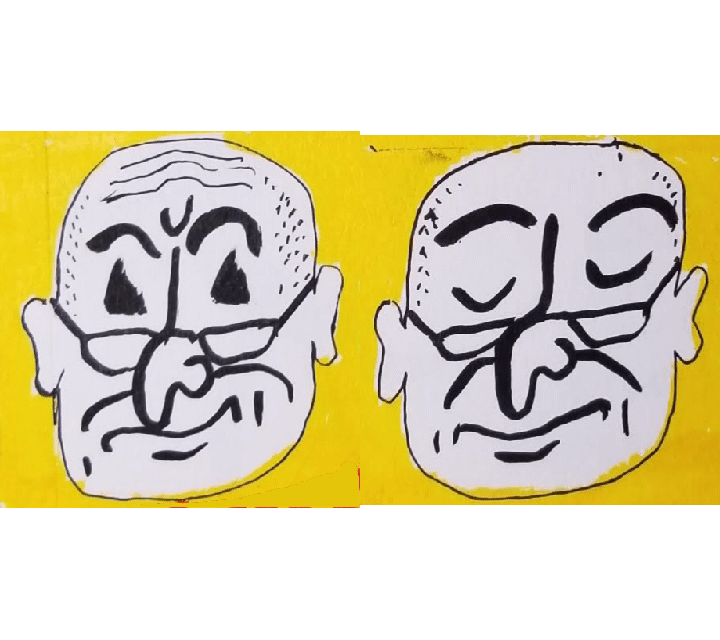
I showed a friend’s super-talented granddaughter how to do simple stop frame animation the other day. Under the mounted camera I drew a simple face and quickly showed her the principle of making animation out of two or more carefully registered drawings (or in this case, two stages of the same drawing).

I explained to her that you can later make the drawing as colorful or detailed as you like, photograph it and add the changes to the animation. (We were working outside in a park, so our art supplies were quite limited). At home afterwards I decided to refine the drawing above to demonstrate this idea to her. You will understand at once, I think, why I decided not to send her the drawing.

Who wants to look into those bizarre, hopeless, death-haunted eyes? Certainly not a sensitive seven year-old who is living through one of the worst periods in recent human history.

Shoot, maybe that’s why I’m not drawing these days. More than in anything else I do, my subconscious emerges most freely in drawings. I can play a stiff version of a beautiful tune on the piano, it’s not great music, but it doesn’t have even a hint of the terror in the face above. Perhaps I’ll try a bit of calligraphy later.

For now, do yourself a kindness. Think of something you love to do, maybe have forgotten about in your overwhelmed concern about the simultaneous and intrusive plagues that are upon us now, and do it. You will thank yourself afterwards, I’m pretty sure. Even if you don’t thank yourself (ingrate!) time is never wasted doing something you love to do.

groove for Plague Mice, collaboration with PG, 5-16-20 (with thanks to Jimi for the bassline)

Final Note on Estranged Friends

Note: the title of this piece is probably about as true as any of Mr. Trump’s assertions — this subject is one my thoughts inevitably return to from time to time [1]. Fascinating and terrible at once, it’s hard for me to keep from periodically chewing on the perplexing mystery of losing old friends. I will try to add a few thoughts to a piece I posted the other day called The Complex Difficulty of Human Affairs.

Zora Neale Hurston, toward the end of her 1937 masterpiece Their Eyes Were Watching God, wrote of two women sitting together under the night sky sharing that “oldest of human longings — self-revelation.” The desire to know and make yourself known to another in an authentic way ideally leads to acceptance — you will know all these things I share and give me similar things in return and neither will judge the other. It strikes me as a profound comfort human beings often seek in a world that is often indifferent, in a life that inevitably ends in death.

It is foolish, of course, to seek this profound connection in every relationship. Mutual self-revelation, on more than a minimal scale, is a rare thing. The good news is that good friendship can be based on many things, without any express self-revelation as such. We know each other by our deeds, our mutual willingness to help, our desire not to hurt. When you need my help, I’m there, when I need a hand, you won’t hesitate to lend one.

In thinking about the end of my long correspondence with Karl, a short, politely worded email about the impossibility of continuing our almost daily writing, I have to think about our very different expectations of life. Also, Karl as part of a troubling pattern over the course of the second half of my life — fatal estrangements. As a friend noted recently, finally putting these terminal friendships out of their misery helps me sleep at night. On the other hand, the mystery of why I’ve experienced so many of these fatalities remains. Is it not better to let friendships that have outlived their lives simply drift away?

It is a mild spring-like day outside, and an argument could be made I’d be better off vigorously exercising out there than rattling the keys here in a dim room overlooking Sekhnet’s garden. We each have our own way of doing what we need to do. I’ll take a long walk with Sekhnet when the sun is low in the sky.

I’ve written about my now deceased former friend Mark and his eternal three act tragedy. Mark, a man with high expectations, was compelled to relive the same excitement, deterioration, betrayal pattern in every relationship he ever had. It was easy for me to see, easy for anyone I mentioned it to to recognize, there were countless examples, stories with the identical dramatic arc. Mark had no insight into his need to idealize, criticize, alienate. He lived an unhappy life and died alone, probably of a broken heart, naked in his chair.

Looking at the many friendships I’ve had over the years, relationships that I no longer have, I must recognize the possibility that I am as blind to my role in their inevitable deaths as Mark was to his role in driving people he once loved away. After all, it is not one person who has angrily attacked me for being angry, or considered himself so intolerably provoked by me that he had to strike back hard, or felt the need to use deadly force to defend himself against a detailed list of “intolerable” offenses I insisted on “resolving”.

It could simply be that the many subtle ways I learned to infuriate my father during our hundreds of senseless fights to the death are something I cannot control. I believe, when I reach my breaking point with someone I’ve known for years, that I’m being logical, fair and humane, that I am presenting reasonable needs calmly; the recipient sees only a death ray. I do not discount the possibility that to them I show every aspect of a raging, over-sensitive asshole, though I also don’t accept that view as necessarily true.

I can also see that the people I wind up estranged from fit a certain personality type, not unlike my father on a fundamental level. They are people who will never back down when they feel cornered, no matter how gently one may have “cornered” them. This kind of casting is a feature of the Repetition Compulsion, placing others into the role of a primal trauma-inducer in an attempt to replay the psychological drama to a better outcome. It’s a game for suckers, that, a game we play unconsciously. I can also see, in hindsight, that over my life I’ve chosen many friends for their intelligence, wit and, often subtle, similarity to my combative father’s desperate zero-sum mentality. We both can’t be partially right and come to an understanding based on compromise of any kind — one of us has to die.

There is a small counterbalance to be had, looking at the subsequent lives of people I could no longer maintain friendships with. Raj and his wife finally divorced, his old friend I fell out with years ago (former husband of a woman I recall as Hitler) and Raj are no longer friends, Pavel told me I was by far his closest friend (before I unfairly accused him of insensitivity when he was only being cooly analytical about my vexing medical insurance situation) Karl lives an isolated life in Poland swallowing anger and serving a strong-willed second wife, etc.

I can look at each of these largely unhappy guys and think — we couldn’t help each other when we needed support the most. It happens. It is not the fault of anything but our respective human natures. The miracle is not that we finally went our separate ways, but that we were friends for so many years.

What expectation do I have of the world? To try to be patient listening to and honestly discussing the worries of my mate, without making her feel worse about things that already bother her. To have her listen to my troubles, without rushing to offer solutions before she’s heard the entire problem. To immediately make amends when I know I’ve hurt somebody. I have to admit, I eventually find these things, when they are missing, intolerable.

What expectations does Karl have of the world? I have no idea, but his worldview seem fundamentally more pessimistic than mine. Life is brutish, unfair, short, I suppose. In his case, it strikes me as a characteristically grim Protestant view of our duties to each other here on the earth. Impossible in the end, perhaps, for a humanistic Jew like me to fully grasp and appreciate, just as my outlook must seem absurd to him.

What expectations does someone who will only offer an apology when forced into it have? It seems they’d be unlikely to expect an apology if they were hurt — though perhaps they would expect it more than most. It is largely futile trying to imagine what is in the head and heart of somebody else, unless they work to reveal it to us. In most cases, the inner lives of others are a mystery.

As we can see all around us, people will construct whatever meaning they need to live as they see fit in our troubled world. A candidate they back can lose an election by more than six million votes and they can honestly insist he didn’t lose — the states that returned majorities against him were in on a conspiracy to steal the office from him. Proof or lack of proof do not come into strong convictions that will cause righteous armies to march — they feel the truth of it boiling in their blood.

So it is with people I’ve been close with, who, in several cases, I have had to behead in the end. They will believe, with the irrefutable proof that I wielded the sword that felled our friendship, that I am a vicious and unforgiving hypocrite who talks about not causing harm but who is as destructive as end-stage cancer. In my estimation, they were not capable of the kind of honesty that is a bottom line in my own life: if someone tells you they are hurt, hear them out before dismissing their complaint as the whining of a weak, corrupt, spoiled, hypocrite bastard.

On the other hand, and, of course, I may simply be a whining, weak, corrupt, spoiled, hypocrite bastard. Something like that is very hard to ever know for sure, no matter how certain we may feel in our bones.

[1]

A murdered darling I couldn’t totally delete, I’d originally added: as a dog returneth to his vomit.

Which is part of that great, largely meaningless, proverb:

כְּ֭כֶלֶב שָׁ֣ב עַל־קֵאֹ֑ו כְּ֝סִ֗יל שֹׁונֶ֥ה בְאִוַּלְתֹּֽו

As a dog returneth to his vomit, so is a fool who repeateth his folly.