Family and Death

You would hope, and often in vain, that in the end love and forgiveness would overcome anger, and that entire families would sober up from their draining focus on past injuries.   My uncle, a fussy, vain and sometimes difficult man, who operated behind a veneer of chirping mildness, is not going to get off his back again, or open his eyes, or from the looks it, squeeze anyone’s hand.

The damage that makes people selectively monstrous is not easy to undo.  My father, whose selective monstrousness did great damage to each of those he loved the most, as great damage was done to him, believed that people can’t change.  Arguably, he changed at the end when he and I had the luck to revisit the issue one last time as I stood by his death bed.

Few people have this luck, my first cousin certainly won’t.  And so we will never know if my uncle, like his brother, would have spent the last night of his life confessing his many regrets, wishing he could have seen the gradations and colors that make life beautiful, instead of the black and white only that simplifies life into a war that is always lost in the end.

Perfect Example of Deleterious Cognition

Deleterious Cognition:  a thought process, activated by a tidbit of true information often better not known or considered, that has harmful effects, causes fear and in extreme cases (and many cases are extreme), paralysis.  There are countless examples, here’s one my stomach and I observed up close the night before last.

I am partial to calamari.  I suppose I’m still at a primitive stage in my mostly vegetarian lifestyle, because, while I can’t justify eating squid and other sea creatures, I eat them sometimes.  They are not mammals, nor even birds, who express fear and other emotions, but the animals of the sea we call seafood surely prefer not to be captured, cooked and eaten.  The late, great David Foster Wallace covers this completely in his superb “Consider the Lobster”, written for Gourmet Magazine.  If you haven’t read it, you really should.

Anyway, Sekhnet heard a disturbing piece on NPR she almost instantly regretted telling me about.   It seems the rings of squid that are grilled, sauteed or deep-fried and served as calamari are virtually identical, in size, shape, texture and even, most sickeningly, flavor, to slices of washed, seasoned pig’s asshole.  Not the hole itself, but the last section of colon.  Yes, I know.  They did a blind taste test, apparently nobody was able to tell the difference, though many swore off calamari after taking the test.

The high intelligence of pigs, and the brutal death camp lives millions live, was one of my main motivations when I decided to stop eating animals raised for slaughter.   Sekhnet, a lover of all animals and a long-time  vegetarian with pescatarian tendencies, was at a farm a vet set up as a sanctuary for abused and neglected animals, and those who had somehow escaped from slaughter.  There is a photo of her shooting with her big news camera as a pig, more than twice her size, leans against her affectionately.  Hard to think of eating something so friendly.

Anyway, properly prepared, sliced pig’s colon is, apparently indistinguishable from calamari.  I ordered the seafood fettucini, which was good, but there was now the troubling question of the source of the calamari that was in it.  Every expert had been fooled, how was I to be sure it was not pig’s colon hiding in the rich sauce among the shrimps and clams?

Sekhnet saw my face and began exploring my pasta.  She pulled out a section of purple squid legs and held it up on her fork reassuringly.  It was unlikely that if they’d used part of the squid the rest would be pig’s ass, but, such is the nature of deleterious cognition that actual likelihood plays a small role and reassurance is easily brushed off.

“Clever of them,” I said to Sekhnet, eating around the circles of “calamari”.  “If I was putting pig’s ass in somebody’s seafood fettucini I’d do the same thing.”  All of this was perfectly true, still, I bravely ate a few hoops of “calamari” after eating the few sections of tentacle.  

Until I ate one particularly thick one that had a horrible taste.  They apparently had not washed this one well enough, it tasted exactly like a pig’s ass.

One side of me felt compelled to reach for the paper napkin on my lap and discreetly expel the clearly shit tasting fake calamari from my mouth.  The more civilized side prevailed.  I was at a birthday dinner, after all, and in spite of having told, moments before, grossly inappropriate real-life tales of bravura farting that made the 93 year-old birthday girl quickly change the subject, I winced and swallowed the section of pig’s colon.  It has been at least four years since I ate any part of an animal as smart and sentient as a pig.

It is much more possible that this was simply a bad piece of calamari, maybe older than the rest, maybe starting to go bad, as they say.  Become a rotten thing, shooting up the town, spray painting graffiti on the walls, pissing on the toilet seat, being a punk.  On the way to putrefaction and in a hurry to get there.  This thought, rather than comfort me, that I probably hadn’t eaten some poor pig’s asshole after all, only made me queasier.  The only question remaining was why I’d swallowed it when my taste buds knew quite clearly it was no good.

The question turned my stomach slightly and the ache there was not allayed by any thought process I could muster.  After a few hours the hard-working digestive juices had done their work, dissolving and neutralizing whatever it was I’d eaten.  What remained afterward was only the question of my susceptibility to deleterious cognition.

“I shouldn’t have mentioned that story to you, you have too much of an imagination,” said Sekhnet hours later when we’d dropped off the birthday girl and I’d told her the rest of the story.  She was not wrong in her impulse, though I don’t like to think of myself as the squeamish type who must be protected from inconvenient or otherwise disgusting truths.  I won’t be listening to the story, which Sekhnet told me to google, but it’s here for the heartier souls among you.
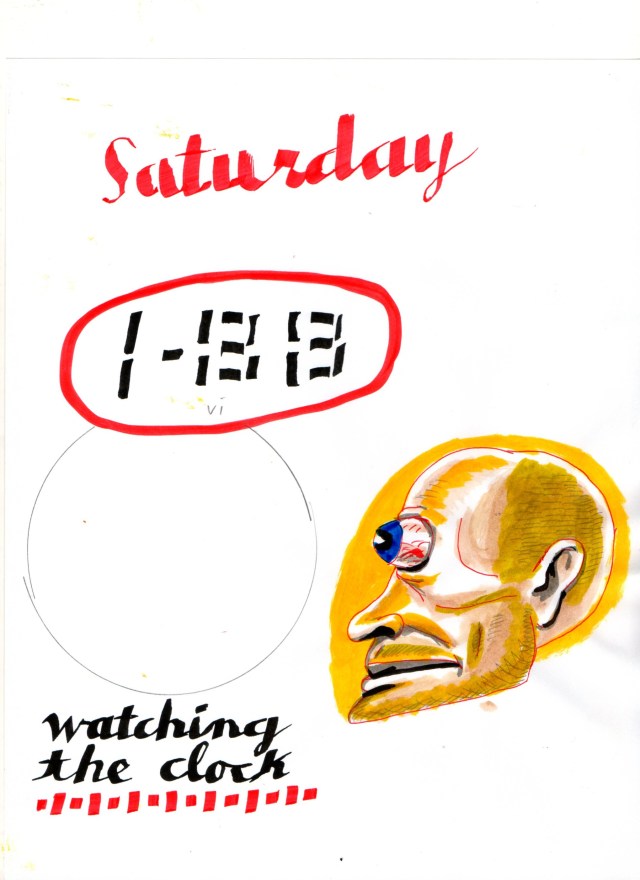

 

Write every day

Today I give myself a generous ten minutes to work out the kinks in my brain.  There are several, and unkinking them is a bit of shallange, chall we say, but no matter.  Our’s is not to wonder why, our’s is to get on the stick.

Get on the stick?  What a horrible image.  What are we, Indonesian shadow puppets?

I could use a good roti canai, now that I think of it.  But there’s the timer, now down below 8:00 and why am I dicking around with images of getting on the stick?  I’m on the stick now, on the clock.  Ten year-old comedienne in neighborhood restaurant the other day:

“what’s brown and sticky?”

Like the thirty times before it we asked what.

“A stick”

Indeed.  The answer is so simple and obvious, once you have it.   Today I am aiming to edit sessions 12 and 13 of the workshop into a more or less flowing 1:30 clip and also to get the Surfing Competition into some kind of shape, see where it’s at, so it can be finished during the next session, to the extent that the kids can refine it at this late date, during the last session, when they will want to do everything but.

Went in there on four hours of sleep last time, might as well have gone in wearing a bee keeper’s outfit with 100 bees inside the mask.  “Eliot, you got bees in your bonnet.”

The child comedienne who stood by our table asked “What kind of bees give milk?”  We were stumped again, and it showed on our faces.

“Boobees!” the kid piped, her mother laughing at the other table.  All so damned obvious, once you know things like where the general keeps his army (up his sleevey) or why 6 was scared of 7 (cause 7 8 9).

Two minute warning, I’m warning you.  Moods will be flipping, I’m just sayin’.  Great reasons to be optimistic as I plan and try to put myself and the organization in position to have some good luck.  A little bit of luck would be very welcome around now, as 1:00 comes and goes on the timer, but even without luck, one must tickle the rock up the steep incline, the slippery slope, the sheer mountain face, the shiny mirror, the … void.

The Little Red Hen


My mother read me the story of the Little Red Hen, probably more than once, for I remember it well.  I can recall the illustrations, if I’m not mistaken we owned a copy of the book, a golden book, with that gold spine.  


The Little Red Hen had a great idea:  let’s make a delicious cake.  The animals were very excited about the cake.  The Little Red Hen went around the farm yard asking “who will help me prepare the soil?”. The dog had other things to do, so did the pigs, the ducks, all the friends around the farm that were so keen on getting in on the cake project, turns out they were just a little busy.  


After the soil was prepared, the  seeds that would grow into the wheat they’d use to make the batter for the cake needed to be planted.  “Who will help me plant the seeds?” asked the Hen, who had never read the story and hadn’t yet any insight into how things were going.   She was met with the series of cheerful mealy mouthed evasions that all children are so familiar with.  


Then the seeds had to be watered, the garden weeded, the wheat harvested, milled, the batter made, the cake baked, etc.  Everyone was very into the cake project, and fully backed the Hen’s plan, it’s just they were all a little busy whenever she asked for help.

By the end of the book the Little Red Hen, who’d done all the work, every step, and never complained, turned into a complete bitter bitch.  “Now, who will help me eat the cake?” she asked sweetly.  I recall my mother’s tone, as the Hen, slightly mocking, but still very sweet, sounding at first like a genuine invitation.
They all were very excited to finally have a chance to eat the cake, which indeed looked delicious in the illustration.  Then the Hen reminded them what a bunch of selfish, Johnny Come Lately pricks they all were and ate the entire cake herself.  
 
Soon, untold in the children’s version but predictable, farmer Johnny cut the Hen’s head off and the farmer’s wife whistled as she southern fried the plump chicken.


“I told the bitch she shouldn’t have eaten that whole cake,” said the dog to one of the ducks.


I think of this story, a story where there is a delicious looking cake at the end. The characters have motivation to help, but don’t.  How would it be if we changed the story a little?  The Hen asks a few friends to do her a favor, she has a theory she wants to test, an educational theory that sounds a little whacky, but the friends want to be supportive so agree to be on the Hen’s Board of Directors, though none are sure what that entails, including the Hen.


Turns out Directors are responsible for overseeing the growth, functioning and well-being of the organization.  They are asked to give of their time, talent and treasure.  None of these directors gives a rat’s ass about the Hen’s theory, really, but they sign on blindly out of friendship to the intelligent but eccentric bird.  The bird then engages in any number of difficult tasks, struggling a few steps up a steep and slippery learning curve, doing the jobs of every person on the board, becoming more and more exhausted and bitter.  She begins writing propaganda about how well things are going, sends it out to the board members who pretty much ignore it, while at the same time tacitly supporting it.

One day the Hen has a bit of good luck, a 24″ iMac is donated to her program by the IT department of a nameless corporation.  She fires it up and the picture is glorious, the student animations will look so good on it.  She pulls one up, it looks marvelous, like watching a movie.  First bit of good luck, sign of things to come.  Encouraging.

 
The next day the Hen excitedly brings a friend to see the iMac in action.  Turns the machine on, but the screen remains blank.  There is no picture, no glowing apple logo like the branded skull on the Jolly Roger.  Dead.  “Why would the IT department donate something that wasn’t intermittent?  One of them would have taken it home when the company upgraded the computers,” her friend points out.


Of course they would have.  That’s how the world is. Now, about that cake.


Shot at the Buzzer

My old cousin Eli used to read a section of the Hagaddah every year that was a crowd favorite.  “What has afrighted you, O, Mountains, that you skip like rams, you hills that you skip like young lambs?”  The poetry in his voice was perfect gravel, a workman’s voice, rough and expressive.   I find myself distracted lately, and to that end I go pull the timer off the refrigerator and give myself five minutes until the buzzer to figure it out.

OK, I bring the ball up court in an arena full of ghosts.  Nobody here, who am I talking to?  A rhetorical question? you ask, rhetorically.  At the half court line, 4:12 left on the clock.  Thinking about long dead Eli, he seemed ancient, yet ageless, at 80, 82, 86.   In the last years of his life  we became good friends as I interviewed him like the host of a popular, immensely entertaining talk show.   Forget about the last time I saw him, in the hospital bed, tied down but barely restrained, brain shut down, eyes unseeing, only the will to fight left, fists clenched, fighting that motherfucker death.

1:40 on the clock, no time outs left.  I look over at coach and see he’s gone too, just two black holes in what used to be his face.  Somewhere a plaintive tone signals the one minute mark is now history, can hardly see the damned basket.   Give me the pill, I got the shot.

Do it, Sarge!  The troops call out, 20 seconds on the timer, 14.  Got the ball, 6 seconds, come on, come on.  Time.

For Shame

To avoid shame, some people lie.  The lie may cause them to feel shame, about lying.  No problem, though, because a lie can be told about lying.   Though this may cause yet more shame, it can’t be helped, which is a shame.