That’s All You Get

The famous definition of insanity, attributed to Albert Einstein, is doing the same thing over and over and expecting a different result.   Many do an unwitting variation on this thought experiment over the course of their lives, never quite understanding why the outcome is so consistent every time.

We are often not really to blame, owing to the enormous variation in types we encounter in the world, and how hidden deeper similarities sometimes are.  The interpersonal variables may be so subtle that it’s hard to see that we are engaged in the same thing we always did.  As Moms Mabley pointed out: if you always do what you always did,  you’ll always get what you always got.    (Though the internet attributes the insight to industrialist/anti-Semite Henry Ford and motivational speaker Tony Robbins, I prefer to picture Moms Mabley saying it).  You may be doing what you always did, but the reaction of the new person may lead you to expect other than what you always got.  Then, when you get what you always got you will shake your head in disbelief at the familiar unwanted outcome.

The subtle nature of the world is responsible for much of this repeating of the same pattern over and over, with the same lamentable result.  Then there is also just plain madness, no small factor in human relations.   How could I have known, for example, that an old friend from High School actually saw me as his father and was furious that, like the smiling, passive-aggressive old man, I just kept making glib jokes and ignoring his need to be acknowledged as an educated man and excellent teacher.   I mean… how could I have known this?  How could I have suspected it?  Even if I had known, what the hell could I have been expected to do about it?

Yet to this fellow, the parallels couldn’t have been more unmistakable:  I had exactly the same  likable and despicable traits of his father, and the final proof, to him, was that, like his father, I withheld my appreciation of the things he needed validated the most.  There was no question to him that I was his father, and that I, so fucking typically, refused to see this must have infuriated him even more.  That I only found out at the end just proved how much like his willfully blind old man I was.

I’ve thought of this several times over the years, being put in a thankless psychic role I had no way to suspect I was cast in.  I only pieced it together after things had become intolerable enough that I had to disentangle the fellow’s clutching hands from my neck and, using my foot for leverage, force the door closed on this madness.   I had a letter from him afterwards informing me that, much as I might want to, I could not unilaterally end our friendship.  “Sorry, pal,” he wrote, “but it’s not in your power.”  I have the quote on my kitchen wall to this day.  It stands as a monument of some kind.  A monument to the barking madness of the world.   This man is a well-respected educator, a father, someone I haven’t been in touch with for decades.  In fact, ten years after his “sorry, pal, but it’s not in your power” letter I had an email from him, a single line:  “isn’t ten years a long time not to say hello?”

“Not in your case,” was but the first of a dozen rejoinders that sprung to mind at the time.  I had fun thinking up replies for a day or two, but left it realizing there was nothing to be gained by firing off some glib line that would only remind him of his infuriating dad.  The only thing that was still in my power was not pissing my pal off, though I knew that hearing nothing back from me would also piss him off.  What is a father to do?

I suppose what I am driving at here is that people can only give each other what they are capable of giving.  Sometimes the demand is unreasonable, even a little insane, as in the case of someone wanting you to do a better job of being their parent than their parent did. Sometimes the demand may be within reason, but the other person is only capable of giving very little.  It is foolish to expect more of them and inevitably leads to disappointment.  An agreement that they will not piss on your leg anymore while insisting it’s raining may be the best you can get out of them.  If this is the case, it behooves you to be satisfied to be at the end of the long, disgusting pissing/raining game and take solace in the dryness of your pant leg.  On the other hand, it also behooves you to realize that, most likely, this is pretty much all you are going to get from this particular person.

It is liberating, sometimes, and lets everybody mercifully off the hook, to realize that’s all you can get.

Making it Right (and the difficulty of anger)

The world is not right, though it will insist it is, bashing you in the face as many times as necessary to prove it.  History does not proceed by justice, the law does not concern itself with trifles, like the American lynching that was winked at for a century after the Civil War.  You get a flawless receipt from every ATM you will ever visit, along with the exact amount of money you ask for, plus applicable fees, yet the same company that makes the ATMs will insist it’s impossible to guarantee the same accuracy in counting electronic votes in US federal elections.  There are a billion examples, literally, more than that if you go inside families, friendships, workplaces.

In a world as insistently corrupt as our own, how does an individual make it right?   We have the serenity prayer, which at times may guide us to accept the difference between truly maddening things we must fight and things that will only madden us.   I have nothing much to offer here, except to consider for a moment the role anger plays in these proceedings.

A friend’s recent reaction to anger caught my attention.  This cheerful, agreeable woman got angry, years ago, over something she took as a slight.  Her unusual show of temper was mentioned recently (note how slyly the passive voice is used) and she became very apologetic about it, almost worked up that we recalled it.   The words angry and mad are used interchangeably, and both are emotionally fraught words.  A stigma is attached to both, and for understandable reasons.  Angry, mad people often do terrible things.  Seeing people out of control, or feeling out of control ourself, strikes terror.

You read the book Everyone Poops?  A delightful Japanese book pointing out the obvious and showing various creatures pooping.  Here’s an illustrated post about it, keeping it classy, as the author says.  We all poop, very important.   It is clear what must be done regarding poop and we do it as often as necessary.   A very good thing it is, too.   We all get angry, and even funnier, we all have a right to be angry much of the time when we feel it.  It’s what to do with the anger that is the perplexing puzzle.    

It often gets turned inward, which goes badly almost every time.  We blame ourself for something as natural as pooping and wind up using it against ourselves– very bad, as bad as not pooping.  It gets barked at the wrong people, also bad, for at least two reasons.  The source of the anger remains untouched and a person who did not deserve blame got barked at.  Very fucked up.  It’s threatening to express anger to someone who can retaliate, so those who can’t or won’t fight back are often targets instead.  Speak truth to power?  Want to get fucked up, go right ahead.  Unless of course, that truth flatters power; power doesn’t mind that.

My old friend was determined, when he became the father of a brilliant and provocative child, to learn not to react to his child’s provocations with anger.  This sounds easy, but try it for twenty years or so, every waking moment, tired and distracted, in sickness and in health.   His mother had not done well in this department, not well at all.  Not many angry people do well in this department.  My friend did the hard work, I am always proud of the job he did in not repeating what was done to him.

We get mad when somebody hurts us in a strikingly unfair way, or in a way they know will hurt us.  This happens.  What we do after that makes all the difference.  I think of that wonderful line I saw at Buddha Bodai restaurant, under the glass on the table:  remain soft spoken and forgiving, even when reason is on your side.  Wonderful advice.   Hard advice, but consider– if you care about the person who made you angry, what better way is there to respond?  If you have reason to be mad at yourself, what better way to speak than softly and with a tender willingness to forgive?

Survival Kit

One essential item in this kit is a sense of purpose, the hearty hope that we are not struggling in vain in a senseless universe.  A compelling reason for our existence.

Reason, that most ticklish, sticky and fickle of things.  How many insane fanatics have brandished indisputable Reason as they committed unspeakable acts?    

“Most insane fanatics brandish Authority, which is different than Reason,” she says, reasonably. 

Not a bad point, actually.  Authority is most often cited based on faith, not rationality.  

“Wait a second,” she says.  “Are YOU completely insane?  Why are you sitting there tapping like a blind man across cobblestones when there is so much for you to do today?”

“Faith,” I say, without apparent conviction.

“Faith in what, pray tell?” she says.

“Faith in the sudden eruption of poetry, a moment of music, faith in the essential spark that animates every moment of elation, faith in imagination,” I say.

“Faith that you are, somehow and in the face of massive evidence to the contrary, not a fool,” she says.

“Yes,” I say, and nod my head to the tapping of these keys.

Irrational to end friendships?

As a child I was dismayed each time one of my father’s closest friends, bright, colorful people my sister and I enjoyed very much, was permanently banished from our lives.   “The fall from grace,” my mother would say, “is swift and absolute.”  People we were very fond of one day just disappeared, and it always aggrieved me.  My father always had his compelling reason why the last straw had been placed on the friendship, exactly how the despicable true face of the formerly beloved friend finally revealed itself.

I argued with him about the importance of forgiveness.  It was not lost on me that this forgiveness would also apply to me.  In my father’s view I had always fought him, even as an infant, when I stared from my crib with dark, accusing eyes even before I could speak.  He made a far less insane case for each of these people he once loved being unworthy of his affections, for the betrayal each had committed.  In only one case did I ever get to hear the other side of the story, and her case seemed at least as plausible and reasonable as my father’s did.  I have since come to write this woman off for much the same reason my father had decades earlier.

The point is, live long enough and you may see things from a previously incomprehensible perspective.   As a child it was unthinkable to me that a person could toss away a good friend and never look back.   As an adult I have done this many times, always in the spirit of not tolerating what I come to perceive as ill treatment or abuse.  It does not please me to say this.   I hold forgiveness high in my esteem, though it’s super-humanly hard to forgive someone who insists they did nothing wrong.  I would rather have all of the friends I once held dear.  In each case, though, I came to the impasse my father had come to during my childhood, the impasse I found impossible to understand then.    

It is the moment when one sees a destructive pattern in the relationship, feels a lack of empathy that quickly becomes mutual.   The other person believes that you are the asshole, you just as fervently believe that they are the asshole.  That you may both be assholes no longer gives consolation to either party.   The air in the closed room begins to stink.  All that remains is a senseless fight in a stinking room or a move toward the door.  Outside the stinking room, walking away, there is little reason for nostalgia or even curiosity about whether the place still stinks.  It’s just time to move forward into the fresh air.

An unreasonable belief in Reason?

“Droll thing life is — that mysterious arrangement of merciless logic for a futile purpose. The most you can hope from it is some knowledge of yourself — that comes too late — a crop of inextinguishable regrets.”
― Joseph Conrad, Heart of Darkness

At least one reader finds these musings I post here a window into a tortured soul.   For me, there is no torture involved.   When I write I experience a kind of peace as I sort things out, comb through things that may be hard for me to understand or digest.   Taking enjoyment or some kind of sustenance from this kind of contemplation is, no doubt, an acquired taste.   A friend recently told somebody he’d rather die than be forced to grapple with his innermost thoughts on a page.  Me, I’d rather grapple with my innermost thoughts on a page than die.  Just me, though.

My friend’s comment got me wondering.   What am I actually trying to accomplish by writing things here?   I don’t promote myself; I put my late beloved cat’s name as the author of these pieces.  I don’t compile them and send them for publication somewhere that might pay me for this work.  I am not connecting myself to a network of like-minded souls.  What the hell am I doing here?

I realized the other day what might be at work, at least in part.   An arguably unreasonable belief in the power of Reason to shine a light on an often irrational world.   Seeing intolerable things, like a political party willing to de-fund the government and hold a nation hostage to an ideological demand while spending billions on a secret torture program, trillions invading countries that pose no threat to the U.S., murdering on a vast scale in the name of old saws like “freedom” and “democracy”, I feel I need to somehow put things in perspective, articulate my position.   The powerlessness one feels can be overwhelming.   So I put my best arguments for that puckish abstraction Reason here.  

That the world is not run by the wise, or even the reasonable, is clear.  In the realm of our personal choices, and in the face of the irrationality of human society, we strive to be smart, to learn from mistakes, to not repeat the unpondered lessons of our personal history.   The most painful feeling is finding oneself in the same situation over and over, what a brilliant maniac friend tagged as the Repetition Compulsion.   It is easier to see in others than in ourselves– doing the same thing over and over: trusting, helping, attacking, saying too much, too little — and finding oneself in the same regrettable place.

In my case, I was raised by fearful adversaries.  Before I had any say in the matter, I was cast as a dangerous opponent.   Puts one on ticklish footing, being cast this way as a child.  After more than 40 years of battles to the death a dying father says “I deeply regret having been so impaired all my life and taking it out on you and your sister.  You were right to try to reach out to me, as you valiantly did for many years; I was wrong to keep myself out of reach.  I was afraid my whole life, seeing the world as black and white, and I see now how impoverished my life was by not fighting that fear.”  You can’ t make this kind of shit up.  The echoes of these painful disconnections reverberate through one’s life, influence our behavior, set our course in life.

So I use the time here to muse, to ponder, to make myself clear, to myself as much as to any reader.   There is probably a line between “therapy” and “art”, I don’t know where it is.   The tools I have are my willingness to muse and my practiced desire to express myself as clearly as possible.  What these things are worth, I cannot say.  They have always been with me and no doubt developed as I struggled to make sense of the senselessness I came up in, to become the capable parent I never had.

It has been shrewdly pointed out that work is the curse of the drinking class.  If we do not work, and we do not drink, what is left, how do we spend our time here?  If we work but receive no payment, what is our work worth?  These are questions one does not often think to even ask, unless one neither works for pay, nor drinks.  Work is the greatest and most universally embraced form of therapy there is– it takes up most of one’s time, sets a schedule, provides clear reasons for action and regular, tangible rewards. including a paycheck.  Work allows one to prioritize things in an easily understandable way that makes perfect sense. Work first, play later. Work hard, play hard.  If you work hard it is important to play hard, and one earns the right to do so.  

Hard work gives meaning to life, a sense of accomplishment, a certain status. On a societal level, lack of meaningful, remunerative work is a main reason countries with massive unemployment, like L. Paul Bremmer’s Iraq, become  powder kegs– men with guns and no jobs, no prospects for accomplishment except for raging against those who keep them from the dignity of a life of productive work.  

Is it unreasonable to believe it’s possible to think one’s way out of a painful cul de sac?   I don’t know.  I only know it is worse to be in a bad situation without hope of an exit.  We dream of a way out, we conceive of it, design it, take our best steps toward creating it — all better things than staring at a wall and seeing only our confinement.


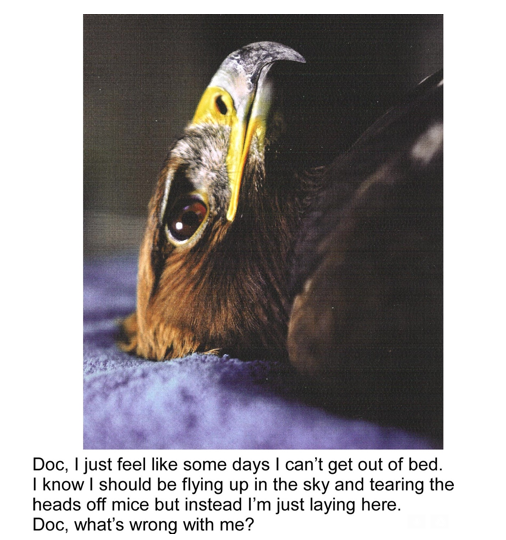
Depressed Eagle

An old friend from High School I’ve seen only a couple of times in the decades since emailed to apologize for being out of touch.  He referred to this blahg as a window into my tortured soul and then supposed he could unsubscribe.  Fortunately for me, he was inspired by the endless scroll of arguably depressing musings here to create and send this, which cracked me up.   May it have the same effect on y’all:


Picture 2

The Bitterest Use of Silence

In my experience, having been sensitized to it young, strategically deployed silence is one of the most effective and damaging expressions of rage out there.  It has the great virtues of ease and simplicity– plus the razor sharp double edged bonus of deniability.   Not all silence falls into this category, of course.  Much of it does not.  But those angry people who feel entitled to their rage can make excellent use of the simple device of saying nothing in return.  The real beauty part, it can be used again as a clever bludgeon if the party put to silence ever whines about it.  “Oh, Boo HOO!  Silence…. oh, dear….”

Here’s how it operates:  take an unbearable pain in your own life.  Maybe it was a mother who, from your earliest memories, regarded you with hatred and whipped you across the face.   Hard to recover from that one.  One will do one’s best not to repeat that in one’s own life, but the cards are stacked against you.  You will have to deal with some version of the following:

My son is brilliant, but he’s got a grievance against me, has been my accuser from the time he was born.   Now he wants my approval.  Let me do the math: not giving him the approval he wants versus being humiliated over and over by an insane and violent mother?   He has a lot to complain about, this pampered, angry boy.   I will say nothing, let him deal with a world as cruel as you like, but one ten times more merciful than the one I managed to survive.

One vice of heavy duty victims is comparing the pain of others to their own and always finding other people’s pain a pale and pathetic wannabe pain.  I was the victim of incest by a beloved family member, you want my sympathy because your boss called you a cunt?   Silence, I say, waiting with a slight smile for that delicious moment when you feebly accuse me of not caring just because I said nothing.

I never got a dime from my parents, nor even the respect of a thank you for the many services I did for both of them when they were dying.   You didn’t inherit enough from yours to make you independently wealthy?  Boo fucking hoo.  Get a job, loser, instead of dreaming you’re special enough to be the change you want to see in the world.

I am the most talented person I know, yet you don’t hear me whining about my lack of recognition.   I go to work, live in the world, do not whine about my creative efforts being unappreciated, myself being unlionized.  And, dude, I am much, much more talented than you.  So, yeah, sue me if I don’t have any comment on your wonderful hobby “art”.  Oh, boo hoo hoo.  Silence…. oh, my… pobrecito!

Etc.

It may seem a small thing to someone lost in a world of anger now, but I have seen my father’s regrets as he was dying.   It was a terrible thing to see a man with all the tools to have been a great friend, a loving father, bereft because he had been unable to separate himself from his pain enough to do either of those things.  Terrible for its own sake and in its timing, because all that was left for him was death, and he had become wise, and grasped the simplest and most beautiful of human truths, too late.  

He may have been putting on a play for me, trying to do me a final favor after decades of putting walls and heavy stones in my way, but I prefer to think his regrets were real.   He had defended himself against his pain as well as anyone could have, heroically, if tragically, since it came at the cost of true friendship and the warm, direct love of those closest to him.  He had deprived himself of the most important things in life, in order to cower behind a brittle sense of invulnerability.

I don’t judge the man.  It’s hard to imagine how anyone recovers from what he was subjected to in a childhood of unimaginable pain and humiliation.  I’m not comparing the pain of being whipped in the face daily with the pain of a father turning his face away at important moments.   I merely note that if you set out to hurt somebody who asks for your point of view, while maintaining that all important sense of superiority, silence is a beauty way to go.

A Few Thoughts on Madness

My only visit to a locked mental ward was to see a friend incarcerated in Elmhurst Hospital in Queens.   When I left I waited for the elevator in a dingy space between the ward for men and the ward for women.  A woman was screaming, part of her face visible behind the medieval looking screen over the tiny window in the metal door.   From the sounds of it she was being tortured while the guards read magazines, ostentatiously pretending not to notice.  It took a long time for the elevator to arrive and the woman begged for my help the whole time.

I’d been visiting a friend who had been committed to this ward for refusing to be admitted voluntarily after a few weeks of increasingly bizarre behavior.  This meant that police with guns came to the suburban house where he was holding court, arrested him as a possible danger to himself and others (it’s unlikely he actually was, though he was clearly crazy) and took him to a room where they held him for several hours as they processed his paperwork and decided what to do with him.   We watched him for a rueful moment through the one-way mirror.   I remember he just sat there, still, and we saw him in profile.

The locked ward in Elmhurst, where the State in its mechanistic wisdom brought him next, was a scary place.  It was more a prison than a hospital, I thought during a short visit before he was transferred to a less restrictive section of the hospital a few days later.  Our friend seemed to hold his own there, pacing, glowering, vibrating with an energy that was disconcerting to watch.  It was an energy that most of the ambulatory men in that large, dingy day room seemed to have.

Before witnessing this breakdown I had a romantic notion about the fluid line between madness and sanity, seeing it more as a social construct involving conformity than a hard line.  I learned that it is, at times, a hard line; there is little subtlety involved when someone is having a full-blown episode of being batshit crazy.  There are plenty of eccentric, pain-filled, maladjusted, tormented, impractical, melancholic, aggressive, self-destructive, absurdly demanding people in the world who nobody would claim are completely mad.   It may be said that most lives, examined for more than a moment, are tinged with irrationality, ruled by destructive beliefs, misperceptions, shifting angers, ill-shaped grievances, avoidance, bottomless sorrows.  Or maybe this only describes the people I have met.  There is always that possibility.  

Anyway, this friend emerged OK, went back to work, continued courting his new girlfriend, soon to become his difficult wife.  Things were fine until a few years later, when I had a series of shrill, early morning calls from the difficult wife demanding that I drive to Greenpoint and take care of my friend, who was barking mad again.

When I arrived at their door she pushed him out, without his keys or wallet, and locked the door behind us.  This woman is vicious, full of self-important opinions, demeaning, demanding, narcissistic, reserving the right to rage.   A thoroughly unlikable person.  Though we got along for fleeting periods of time over the years, I think of her, for shorthand’s sake, as Hitler.  She is certainly as implacable as the famous psychopath.   Although, on that day, after a few minutes with my friend, I realized that she had been pushed to this desperate, if harsh, maneuver.  

My friend was clearly manic; he was cheerful as hell, spoke quickly, his great intelligence swerving the conversation from one difficult to grasp idea to the next. His eyes glittered with a combination of merriness and malice.  He had partially shaved his head, giving him an excellent look for his new attitude.  He was very thin, clearly had not been feeling the need to eat for some time.  I tried to get him to eat something at the nearby McDonald’s, but he wisely declined.

Fifteen or twenty hours later, at my wits’ end by now and realizing that the only help for my friend would come from skilled professionals, I made him a plate of pasta in my apartment.  He agreed that he should eat something.  Then as he sat down he turned to me and said something so provocative, so vicious and uncalled for, so perfectly aimed at my greatest vulnerability, that I grabbed him by the scruff of the neck, lifted him from the chair and slung him toward the door of the apartment, intending to shove him into the hall.  I am not proud of this moment, though neither am I unduly tormented by it.  Every human has his or her limit, and that now forgotten cruel comment as I was trying to get my insane friend to eat something was mine.

He grabbed me by the throat.  I grabbed him by the throat.  It was a moment when raging insanity was about to prevail.  In a moment of inspiration I lurched forward and kissed him, on the lips.   He laughed.  I relaxed my grip on his neck, he let my neck go.  I patted him on the back, told him to go eat, and went into the shower to blow water out of my face and try to regain myself.

A few hours later, somehow, I had him at the mental hospital, this time without police.  No locked ward this time.  He was restrained on the gurney, however, and I recall seeing him in profile spit a Haldol pill into the doctor’s face.  They wheeled him away.  The next time I saw him he was in the hands of a psychiatrist who became convinced my friend had been misdiagnosed as a schizophrenic.   Treated as bipolar, on a long-time regimen of Lithium, he has had no recurrence of mania in the twenty or so years since.

Knowing that Lithium is eventually fatal, he weaned himself off the drug.   He’s been maintaining himself with Zen meditation, achieving a certain clarity that included the realization that one can not live a happy life sharing a home with Hitler.   He finds comfort in cult-like settings, he tells me, and has found a nice group of people he meditates with.  He found a woman there he is very fond of and has a lot of sex with.   His wife broke the window of his rented room in a jealous rage over this and he obtained a restraining order against her.  She somehow got one against him.  The divorce is not going to be smooth sailing, but then, how could it be?

We check in from time to time.   The dispirited period I am going through makes it harder than usual for me to reach out, but we talk every month or so.  He reports that he is mostly content.  I nod, since regular and good sex with its steady flow of life-restoring endorphins will have that effect on a person’s outlook.  

The last time we spoke he was keen to taste the single malt I keep on a high shclf and have been refraining from drinking, being depressed enough without imbibing depressants.  He began singing its praises.  He does not keep it at home, fearing to fall into the bottle himself, but loves to drink good stuff from time to time at the home of a friend. I told him I’d prefer not to drink, and explained why, but later gave him a snort, against my better judgment, which led to having a few myself.  I felt like shit the next day and haven’t touched it since.

Had a call from him the other day, for the first time since.  “B is such a good friend to you,” he said, “he helps you with your business, and brainstorming, and trying to get your apartment shaped up, he hauls boxes of things to Good Will, puts his back into it, really cares about your well-being.  He seems like such a good guy and I feel bad that I’ve made such a bad impression on him.  He probably sees me as a guy who is always sucking around looking for something from you.   Dragging you back into well-worn bad habits you’d just as soon pick up.  To him I must look like Lampwick from Pinocchio, my ears slightly donkeyish as I persuade you to uncork the bottle, pour us just a drop.”

I agreed that this was likely the case, refraining from saying there was a certain accuracy to the image.

“I’d appreciate it if you could let him know that I’m not really that way.  If I ever meet him again, and I hope I do, I’d hate to think he has such a poor opinion of me.  Would you set him straight?”

We talked for a while more, he described the likely end of his period of unlimited sex, how the younger woman was very practically looking for a mate her own age, to have a child with, and how he could probably not hold on to her much longer.  He told me she was compassionately trying to set him up with another woman in the group, and that he had certain hopes for this new one.   He observed in passing that I am depressive.   I described some semi-comical recordings I’d made recently, and an aggravating piece by the often aggravating David Brooks that I had annotated.

“Send them to me!” he said emphatically.  I had stopped sending creative things to him because of his penchant for remaining silent.  We have been over this time and again in the past, my sensitivity to the easy slight of silence, when even “nice” or “ah hah” suffices to break the bitterness.   My father had been severely abused as a child and his cruelty translated often into the strategic, viciously ungenerous withholding of attention or comment.  This regular practice had sensitized me to the chillingly brutal power of complete silence in response to a query or creative effort.  I have stopped sending things to people I rarely hear back from, particularly those who attempt no creative work themselves.   His silence had become conspicuously dependable. “Send them to me,” he said again.  I told him I would and later that day did.

“By the way,” he said, by way of providing an excellent punchline, “I was thinking… if it’s OK with you…. you know, heh…. that I could come by for a drop of that excellent single malt today.  I have a few hours before I have to go see my girl.”

Neither of us laughed then, though it is very droll, if you think about it.  As droll as the silence into which the things he asked me to send him dropped.
Freakshow

If you had a camera in here, recording my steps around this crowded apartment, you would see the steps circling endlessly back to this chair with the excellent view of this computer screen.  To either side of the screen, and in front of the keyboard, drifting piles of beautifully colored ink drawings, like sand dunes seen through a prism.

“Why don’t you shut the computer off and just clear off the kitchen table?” a reasonable voice asks.

The camera would show me nodding, powering the machine down, stepping away from the computer, into the kitchen, looking at the table.  An hour’s work, one would estimate.  Put the blood pressure monitor somewhere, take away the power cord from the macBook, put away the cable for the iPod.   Remove the two wire book stands, collapsed and interlocking, lying interspersed with various small items, most of which, although they’ve been there for years, should be discarded.   Move away the cutting board, unplug the disconnected phone, put the unit in the electronics recycling bag.  

Then just go through that raft of papers, most of which can be thrown away or shredded after a glance. There is even a prize at the bottom of that Crackerjacks box, in addition to a clear work space to prepare food, eat a meal not propped on your lap.  Under those hillocks of papers, hopefully, is the card with the new return address of your old friend’s widow.  You’d like to write back to her, wouldn’t you?

But first, the steps lead back to the computer, power it on again, just a little sit here, see what’s doing, just a moment.  That snow storm, winter storm warning still in effect, what time is it now supposed to hit Queens and when do I need to leave here in order to shovel out from under it without being caught in it?  Etc.

This is all undeniably a bit freakish, and worrisome.  Just a moment’s pondering and I see it is just a fragment of a larger freak show all around.   We leave aside things like $81,000,000 paid to two psychologists to reverse engineer a torture program nobody seems very upset about.  Here there is a car going 75 mph on the interstate, accelerating onto a lane of hidden ice with the thought to go 80 in the HOV lane.  Here is a man issuing periodic and alarming reports from hell, describing a relentless monster wife and an unbearable life, now suffered for over twenty years.   There a man tells his longtime wife that their marriage has been over for a decade and shakes his head at her angry display of shock.   Here a man calls an old friend and complains that he is often seen as using the man, dragging him back into the weeds of bad old habits. He urges his recovering alcoholic friend to intervene, for the sake of his reputation, tell them it isn’t so, that he is a good friend, and then… by the way, if you don’t mind…. if I could prevail on you … do you still have that bottle of excellent single malt?   The examples are too numerous, the exceptions too few… it is all a gorgeous, swirling landscape of barely concealed madness.

There must be some kind of way out of here, said the joker to the thief.  I will just tap here a few seconds more and now …. if you will excuse me… I must be…. on my way.

A Few Thoughts on Friendship

I foolishly tackle a huge subject, attempting to extract a kernel of something here, before plunging into my list of many times put off tasks.

People who share our most deeply held beliefs, or passion for something we love, unless otherwise repellent, are easy to become friends with.  There are drinking friends, and sports friends, and so forth, people we become friends with because of shared interests and good times spent together.  

I have heard there are also business friends, people we meet who can help us advance our fortunes, and these are also cultivated as friends by most intelligent people.  There are other intelligent people who lack even the basics of practical knowledge of advancing oneself in the world, they may be idealistic, but are ultimately a sad and perplexing lot.  

The true friend, whose faults we can always overlook because of the great comfort we derive from their company, is extremely rare.  Humans are fucked up, take a look at history, an unending scroll of rage and violence stained with blood and shit and scattered with torture devices.  It is a miracle that we can find true friends, given the terrain, but it is also our greatest blessing to find a kindred soul.

Some Greek, possibly Socrates, maybe Aristotle Onassis (it was Plato, actually), divided people according to the preponderant part of their natures:  Appetitive, Glory Seeking, Truth Seeking.  All three parts comprise each soul, but individuals are driven by the dominant part of their nature.   Just societies, this opinionated Greek opined, are ruled by that minority who seek truth, fairness and goodness above all else.  

Our society is dominated by the ravenous appetite, and a love of out-sized glory, and the easiest thing to do with the meek ones who seek slippery abstractions like the common good is to mock and piss on them.   You know what I’m saying.  Bring Jesus back and pious billionaire Christians would instantly crucify him again, secretly, and destroy all traces of his visit.  

And here we have the beginning of the rub that has been rubbing me for some time.  How difficult it is to strive towards our higher nature without judging those who hold themselves to a more general standard.   Nothing is more insufferable than a person who takes their virtue seriously.

I think back to a few I’ve considered friends, who revealed themselves, over time, to be driven to dispute, wrestling with their demons, given to outbursts of anger followed by lack of remorse or apology, incapable of refraining from hurtful behavior, while feeling virtuous.  Like everyone else who has ever acted, feeling completely justified in their actions.

The retired judge who speaks convincingly of an abiding plague of our times: honor anemia.  People’s contributions are slighted by lack of recognition, which is demoralizing, he points out.  The few who are honored are often the least deserving.  The man speaks the name of his own syndrome, an abiding and deep seated lack of respect, like Rodney Dangerfield but without the laughs.  And behind that honor anemia lurks the virtue he believes in himself to be unassailable, no matter what else the facts of his life may have to say about the exact nature of those virtues, and a rage to defend these self-perceived virtues to the death.  One may continue to be friends, as long as one accepts the playing field– certain buttons will set off explosions and woe unto the person who presses these buttons.

The former leftist, now a politically independent defender of Sarah Palin, who cannot restrain herself from sending political diatribes blaming liberals for terrorism, murder of police and every other plague of our divided, bleeding society.  A woman of otherwise considerable insight, she has promised time and again to refrain from provocations on politics.   Blacks (and many others) are upset because young black men, unarmed, are regularly killed by the police, in numbers disproportionate to their numbers in society?  Her reply is quick: what about all the black on black violence? How come, she asks, guilty white liberals show so little concern over that?

You are insane, friends tell me, to have a correspondence with this woman.  How many times has she promised not to send you political emails?   How many times has she failed to honor that promise?   What do you call someone who promises one thing and does the opposite?  Let’s not call names here.  It is true, though, I am insane to believe this person is a friend, no matter what other good things I may share with her.

“I can’t help it.  I know it’s wrong.  You are so gentle, trying so hard not to get angry.  You are admirably walking on the high road.  I applaud what you are doing, the great progress you have made.  But I can’t help it, once in a while, I just… I know it’s not right, but I have to give you a bloody nose.  It’s not you, it’s me, I know, and I pray you will forgive me.   I have tried to get insight into my rage, my isolation, my fear, my hatred.  The best I can make out is that I value a meek friend like you I can bloody and dependably be forgiven by. You restore my faith in mankind, a pretty unredeemed bunch.  You understand, don’t you?  Please….”