Fear — and the optimism bias

Entrepreneurs, we learn, often have an optimism bias.  This bias tells them that, although there are dozens of practical reasons they will not succeed, and actual odds they can study anywhere that predict the overwhelming likelihood of failure, that there is a very real magical chance the thing will fly.   Without that optimism, why go to the track day after day betting on the same flea infested long-shot nag?  

Seriously, without the bias toward believing that the unique and excellent business plan will succeed, in spite of the probable impossibility of success, no entrepreneur would take the risky leap.  

It’s true, of course, that most entrepreneurs don’t gamble their own money, that would make the risk even more foolish.  If they can transmit their optimism about the idea, make their excitement infectious, people will give them money.  Entrepreneurs generally promise a nice monetary return on investment, the nicer the return, the better, and the more angels who will flutter in to ante up, but there are other returns a purpose driven enterprise can deliver.

The reason I am thinking about this is my own flickering optimism bias.  I heard the term ‘optimism bias’ just now for the first time, on a TED talk, and recognized it immediately as a feature of my current life.  I have to believe that, in spite of the darkness surrounding this worthwhile program of mine, from lack of partners, to general incomprehension and lack of interest, to my lack of knowledge of essential areas of creating a business, down the line, that there is a light switch on the wall somewhere.   When this switch is turned on the program, already worked out and smoothly operating, successful 100 out of 100 times so far, will be seen for what it is– the simple, fun educational playground I have created.

But like I say, my optimism bias flickers.  It becomes a “they’re right, I AM fucking insane” bias quite regularly.  I feel mad a certain amount of the time.  Here’s representative snapshot of this fight between biases.

I know now that I have to make this program tangible, package it smartly to turn it into a salable product.  I need to put it into palpable form that gives a taste and feel of the thing in action.  I have to create brochures, film clips, books, pitches, tangible things that quickly and colorfully conjure its excitement, lay out its potential, entice people to get involved.  Make principals realize how it will make them look like instant innovators,  putting original animation made by third graders on their schools’ website.  Make administrators want the program for the glory of their district, make social work students want to get involved in facilitating the workshop, for a decent fee, to write grad school papers on social dynamics among different aged children, lure a grant writer who is also a painter or musician.  Do a few of these things well and … the thing could be up and running in fairly short order, no matter the remaining challenges.

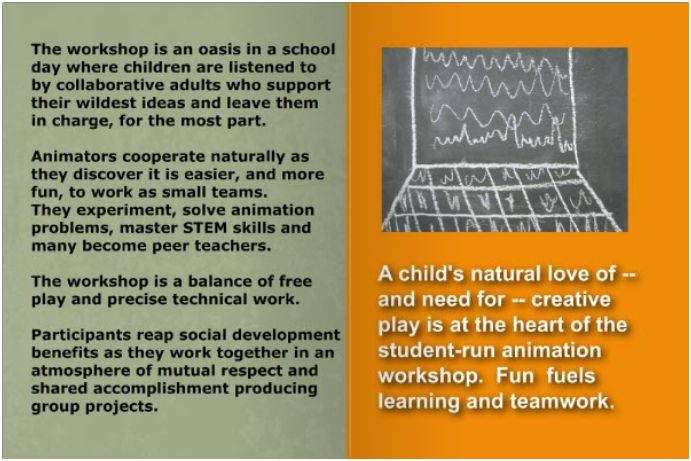
So I have put together a little photo book to show people, let them hold in their hands, flip the several thick pages of, get a quick sense of what the workshop is about, why it’s unique, why they should be a little bit excited about it.  I figure I’ll send this book as a thank you perk to the generous people who donated money in the December 2013 crowdfunding campaign. They have not heard from me or the program in a while and some may actually be excited by the colorful little book, glad to see their donations have gone to something positive.  

I’ll include a short personal thank you note to each one and invite them to check out the redesigned website.  A few will even click and see a moment of animation.  All to the good. .The books are a little expensive, but they’re nicely made, feel good in the hands, they’re cool objects filled with childish creation.  If you go for that kind of thing, you will like them a lot.   

Most of the dozen or so who’ve seen them so far have thought them cool, even beautiful, and agreed that they convey what the program does in a very short form.  These are  things I did not have before I struggled to create this book: a nice looking, concise evocation of the program.  The prototype is cool, even if most of the people who get the finished book will flip through it and be somewhat confused by what the heck it means, why I went to the expense and took the trouble to send such an oddly elaborate thank you note.  

Many people are not engaged with the creative impulse very much, if at all, and so the magic in the book will seem like nonsense to them.  The true biggest selling point of the animation workshop not the animation, which is actually a bi-product.  The real value of the workshop is that it provides a thick slice of time in a kid’s day when all that is asked of them is: have fun, create something cool, don’t bother anyone else.  They are surrounded by art supplies, lights and cameras, they create the action.  Machines are waiting to help them turn their wild actions into animation.  They learn many things at the same time, but that comes along with the free exercise of their imaginations and they hardly notice it.  The workshop is literally a model of John Cleese’s creativity lab in action.

His five guidelines come to mind:

place:  have a room where you go to be creative.  Leave the rest of the world outside.

time:  take some time to leave life’s distractions outside of the room.  Get into play mode.  Kids are better at this than adults, obviously.

time: a block of time, 90 minutes is ideal, to play, with no eye on the clock (adults are there to keep track of that) and no thought of anything besides having a good time.

good cheer: no voice of reason in the room telling you why your idea is stupid, won’t work, is amateurish, why you stink, suck, bite, why others do it better, why mine is better.   Without that asshole in the room, people having a good time making up wild stuff often find themselves laughing.  Laughing is a good and healthy thing, most would agree.

A time to end: play cannot go on forever.  There comes a time to wrap it up and leave the excitement where you can pick it up next time.

OK, so here’s that snapshot I mentioned before of my optimism bias in mid-flip.  

I show the book to several people who either praise it in some way or nod that it’s good. Some don’t want to hurt my feelings, of course, one or two may really not get it, but everyone generally conveys that it’s a good job, that the book itself is nicely done.  

I have one friend who doesn’t really understand why I am not concentrating on fundraising, who sees me cowering, hunkered down in a molasses-like marketing mode, writing pages like this instead of taking the actions needed to succeed.  I can only assume he’s thinking those things, based on things he’s said and confusion he’s expressed about my sudden interest in creating these books.  I show him the book.  He flips the pages, says it’s well done but expresses confusion about what I’m going to use the book for.  I tell him, but it seems to make as little sense to him as the previous time I mentioned it.

His comment stays with me.  I can explain it to him again, try to persuade him, but it’s raining, and time to say goodbye, and he’s looking for a cab.  Afterwards I’m thinking– sheez, he’s probably right.  What the hell am I thinking about with this fancy book?   

Here is where the optimism bias yields to pure, unreasoning fear.  I see myself, in light of that one confused comment, cowering, not concentrating on fundraising, hunkered down in a molasses-like marketing mode, writing pages like this instead of taking the actions needed to succeed.  

The snapshot is also another illustration, if one was needed, of the importance of hearing and really being heard.

Granted

That you have, with increasing cunning, greatly limited the chances of any but a few for having anything like that prosperous life advertised constantly on TV, movie, smart phone.

Granted, you have planted bitter hopelessness in the lives of millions, while smiling and taking bows, and praising your own exceptional greatness and generosity.  

Granted some of your most generous ilk made $45,000,000 last year, mostly in speakers’ fees, speaking off the cuff, and you are very droll and charismatic.

Granted, those fated to have almost nothing will get ever less and the three hots and a cot in a privatized facility will begin to look good as a free alternative to grad school.  That or going for the glory and ending in a hail of bullets.  

Granted, a family of one cannot actually live on $400 a week, but that is way too much to expect successful people to pay for unskilled, menial help.

Granted, the rantings of one silent, solitary voice here don’t amount to a hill of beans in this crazy mixed up world.

I don’t know where this song comes from, I certainly don’t recall choosing it among all the songs in the world.  But while there is breath here to sing it, sing it I will.

The Limits of Pretending

We can always pretend.  Pretending is cool, it’s part of playing.    Make believe things we dream up can be sweeter than real ones.  Pretending is fun, unless it turns into a somersault try that falls flat and leaves the attempter in a body cast.  Then it becomes hard, and probably unhealthy, to pretend nothing harmful is at work.

Pretending, I should say, is not the same as believing that a dream, worked towards steadily and at times inspiredly, can be made real, in spite of the odds against it.  

Let us stipulate, for purposes of this post, that pretending is different than pursuing a dream, even if that dream is extremely unlikely ever to become a reality.  Pretending is knowing the thing can never be real, and acting as though it’s real anyway.  It can be tricky to tell the difference, sometimes, but pretend is make believe, based only on something better that we’d rather see than the thing in front of us.  

A wise man said the greatest miracle of human existence is that we all carry on like we’re never going to die.  This is a kind of pretending most of us do much of the time.   Not only is every one of us, merely by taking breath, getting ready to die, but every creature any one of us loves or will ever love — their death is a certainty.  We ignore this, or pretend it’s not so, because to have life’s evanescence before us at all times would make life too painfully sad to endure.   We live in spite of the certainty of death and our lives are given a certain urgency by the intermittent knowledge that we are hanging here by spider webs, taking part in this miraculous and fleeting world at the whim of fate.

We might often do better to pretend we don’t see certain things.  But there is a limit.

When a pattern emerges, becomes predictable, harmful, hard to ignore– pretending it is not so can become difficult.  It can also be unhealthy.

“Oh… here we go…” groans the wary polemicist.

I say again — we can pretend the first time that we did not hear the hurtful words, the ringing unsympathy, the lack of generosity.  It might help to ignore something ugly the first time.  It might have just been a bad moment, better to let it pass.  We can pretend a second time, too, twice could just be a coincidence.  But the limit eventually comes.

“It comes to you, oh, judgmental and punitive one,” says the reflexive arguer.

It comes to every one, my friend.  It comes when the limit of patience and ability to pretend is reached.  It comes when the sore nerve is probed again, seemingly for no reason but to get the reaction.   To pretend the sore nerve has not been probed again?  To what purpose?

Unbreakable

Sitting on the floor of my bedroom in the house where I grew up, my sister and I listened to a long-playing record we liked very much.    It was about Abraham Lincoln and was called something like Freedom Train.   

These big round monophonic discs were called LPs and were made of something stiffer and heavier than the vinyl that records would later be made of.   The record revolved on a turntable where a needle at the end of an arm drew sounds from its grooves.   The sounds magically came out of a little speaker in our record player, which folded up into a box when not in use.

We listened to this evocation of the Great Emancipator, flipped it over, heard the other side, also excellent, and were discussing whether to hear it again.  I must have just learned to read.   I puzzled out several unfamiliar words on the label of the LP.  One of them was “unbreakable”.  I was amazed to read this.  My sister, too young to show real surprise at such a fact, looked on with interest.

I took the LP, held it in the flat of my hand and turned my hand over. The LP fell the short distance from my child’s arm to the wooden floor and broke into five or six pieces.

I don’t remember my parents being particularly mad when they found out what happened, though they never replaced the LP.  My mother may have shook her head with a wistful expression.  The expression would have said “oy, welcome to the world, my son.”

The internet is a great resource

Whatever else it may be, the internet is a great resource.  I seldom write something about any fact without verifying what I can with a search on the internets, as our plain-spoken former president used to call the internet.

A moment ago I wrote a phrase that referred to “the mobius strip of our DNA”.  I was picturing the double helix and it looked in my mind like images of mobius strips I have known.   There seemed to be a disconnect, an element of physical impossibility in the blueprint of life being the mathematical abstraction of a twisted oval with only one side. I checked to see if DNA actually was a mobius strip.   I didn’t want to say it was, if it wasn’t.  A quick search turned up this wonderful answer:

Best Answer:  Although bacterial DNA is indeed circular and twisty, the main difference between it and a Moebius strip is that in order for the bacteria to reproduce, it has to be able to separate the two strands and give the two strands to its two “children”.

Consider a zipper as an analogy. Take a long zipper, remove the “pull”, and sew the ends together to make a circle. If you sewed it together without any twists (bacteria have an enzyme that de-twists the DNA during replication), when you pull the sections apart you will get two “half zippers”. This is what the bacteria does. After it gets two “half DNA’s” it has enzymes that use each of the halves as a template to synthesyze the other half. With your zippers, it would be like taking the half zipper and then fitting loose teeth into it – you would end up with two whole zippers where there was originally only one.

Now if you sewed your original zipper together with a half-twist, like in a Moebius strip, when you separated it apart you wouldn’t get two half-zippers – instead you would get a single half-zipper that was twice as long as the original zipper. This is no good to the bacteria. It wants to give each of its children a copy of its DNA. If its genetic material was like a Moebius strip, one of its children would get a double dose of DNA, and the other would get nothing, and die.

The similarities the article tries to draw between Moebius supercoiling and human consciousness are just plain loony. It’s an absolutely meaningless comparison. Anybody who uses the terms “isomorphism” and “limnocentrically” in the same sentence is not to be trusted.  [emphasis mine].

Dig it.

Lest the tone of these posts tend to bring you down

I strive to make this blog more than a compendium of carping cavils, a cellar of acidic whines, a half-full glass of luke warm dysphagia with a dyspepsia chaser, despite an often robust appearance to the contrary.  

We all have our complaints, which sometimes must be shouldered out of the way before better things can come in to play.  Some of these posts are just grunts I put my shoulder into, to allow me to do something more productive.   Sometimes setting some galling absurdity into a few short paragraphs helps me move forward, though I am always happier when a post can help someone else move forward too, or allow some gentle, or even vicious, reader to pause and consider something from another perspective.  

It is a blessing to recall, when pressed, the blessing of all this; the gift of life.  The senses that sense, the limbs that work, the interactions with those we care about, the things we love to do.  Life is hard and grim, or easy and fascinating, partly depending on what we are undergoing and partly the result of our perspective.  

We learn now of a happiness gene, some people born genetically predisposed to feel good, be chipper and positive.  These types are apt to burst into song, because of the presence of a gene on their twisted coil of DNA.  We have long known of a predisposition to melancholia and other qualities that drag on the spirit.  A happiness gene, there’s a delightful fucking thought!  God bless the happy.

The narrative of a successful life is constant and pervasive: it is a busy life filled with tangible and regular achievement.   Hardly time to sit down in this tightly programmed life, let alone brood, and certainly not about problems well beyond your power to help solve.  On the other hand, those too busy to brood… I don’t know about them.  

Seems to me a person who doesn’t have time periodically to ponder things outside their own life is missing something.  On the other side, a person who has only time to ponder is clearly not doing enough with their life.

It’s possible that I have mastered nothing but the art of rationalization.  I have found the thing I most want to do with my life at this point:  be in a room full of kids who don’t have a chance and watch them excited about feeling like they have a chance.  Becoming a finger pointing to a world of creative possibilities.  

By the time these at-risk kids are grown up, if they make it to adulthood, water might be too expensive for them to afford anyway.  The oceans may have reclaimed cities everywhere, the world might be more like Mad Max than anything else.  The odds are clamorously against anyone who does not avail themselves of every advantage their life offers them.  The odds are always tilted against fairness and decency on any kind of large scale, particularly with a multiform mass media megaphone droning “fuck them!” 24/7.  Self-interest and the profit motive rule the world, Mr. Fucking Ahimsa-face.

“Slaughter sides!” screams the skinny kid on the team of losers, looking at the muscular, athletic giants chosen for the other side.

“Yeah, you got a problem with that, squirt?”  A game’s a game.  The game must be played, the hand dealt must be smelt.   

“The one who smelt it, dealt it.”  False, but at least it’s got a bouncy rhyme.

I’m rambling a bit here, and have to get back to my busy schedule, time is money and chop chop and all that rot, but take a few seconds to breathe one deep breath and let it out slowly.  

Seriously.  Take a moment and breathe, just once, deeply.

I’m doing it now. 

Nice.   Few things compare to that, my friend.  

Now, let’s take a quick look at some accidental, if minor, delight, provided by our friends in the world of professional sports.

While checking in on Tanaka’s and Scherzer’s pitchers’ duel yesterday, I noticed this, at the bottom of the box score.   I thought this was very nice of them, and a kindness you don’t often see in the macho world of sports:
Picture 3

Patient Protection and Affordable Care Act Update

I have been getting calls, and now collection letters, regarding an unpaid $81 toward a discounted $131 deductible (a savings of $119 over the list price!)  from a quick pre-colonoscopy consultation I was required to have last October.  I’d been told the procedure was fully covered as preventive care, except, apparently for the visit to the gastroenterologist to shake his hand and give his receptionist my $50 copay the week before.  There were also a few hundred in fees, it turns out, because a polyp had been sent to the lab for analysis.  Lab fees, obviously, have nothing to do with the preventive procedure.

“Why am I required to pay $100 by check on the day of the procedure if the procedure is fully covered by the premium I pay every month?” I asked the woman at the hospital.  She didn’t know, but the procedure would not be done without the payment.  I paid.

Fast forward eight months, calls to the insurance company regarding charges, conversations with the doctor’s office.   Eight months of demands and threats and finally another letter from a lawyer who specializes in collection.    My position is that I’ve already paid the $81 in the form of that $100 check nobody can seem to justify.  

Out of the blue, yesterday, another envelope from the hospital.   Without any explanation, a check, written out to me, for $100.

cold breeze in Cyberia

Facebook, which we’re told is indispensable for any business or would-be business, allowed me to quickly set up a page for my would-be business.  I had a kid managing it for a while, then it went fallow for a year or so.  I was able to update it when I wanted, but didn’t do it often.  If I’d managed to whip up excitement among 10,000 followers it would have been much easier to raise money through crowdfunding, but I had a few dozen and the effort of raising its facebook profile felt mostly wasted while I needed to work on so many other things.

I got a notice from Facebook a few months back informing me I wouldn’t be able to manage or administer the page I’d put up unless I signed up for a personal page.  I did this with reluctance and had “friend requests” from a few dozen people, some I’d known decades back.  

A friend request, it strikes me now, is such a poignant thing to call this transaction.   “Will you be my friend?”  cue visual of adorable little bear, bashful and wearing some kind of cute hate.  

Since I’ve set up my personal page I’ve been unable to post on my own business page, despite having done what facebook’s instructions had told me to.  “You do not have permission to do this,” it tells me.  Or, it lets me post something as a visitor, with my own first and last name visible. 

Taking a break from other things, I had an idea for a work around.  Create a new email address “loves to draw” or “dances with voles” and make that person an administrator.   Then “animation rules” could post to the page, instead of me personally, with my birthday 58 years ago also displayed.  It took only a few moments to find the “settings” tab referred to below and I set off to follow these seemingly simple instructions:

How do I give someone a role on my Page?

You’ll need to be an admin to give someone a role on your Page. If you’re an admin:

  1. Click Settings at the top of your Page.
  2. Click Page Roles in the left column.
  3. If the person is your Facebook friend, begin typing their name and select them from the list that appears. If the person isn’t your Facebook friend, type their email address.
  4. Click Admin to select a role from the dropdown menu.
  5. Click Save and enter your password to confirm.

Page Roles never came up on that settings page.  The left column, yes.  The next step I needed to follow?  No.   Must mean I am not an admin.    

Sekhnet, who has never been on facebook, suggested I call someone at facebook for help.   A friend who is active on facebook laughed, as I would too, if I were not busy gathering my coat around my neck as the cool breeze from the Cyberian tundra whips in.

The Case for Madness

A slam dunk, really.

Hire an accountant to do a complicated calculation that needs to be clearly explained to the vulnerable person on the other end of the complication.   The guy compiles three completely different sets of numbers, using incorrect percentages, a useless and confusing chart and an inaccurate letter, addressed to a name he himself has invented, explaining nothing.  $675.  Send an email explaining the problems, asking him to get back to you when tax season’s over.  

Two weeks later: another bill for $675.  Write and mail a letter patiently and concisely explaining the insufficient work and the impossibility of paying the number this fellow has pulled out of his ass.  Wait a month.  A third copy of the same bill arrives.  

“I told you he’s senile,” reassures Sekhnet.

Bills keep arriving for the useless visit to the distracted physician’s assistant.  These bills have been approved by the insurance company pursuant to the Patient Protection and Affordable Care Act, often called Obamacare.  That twenty minutes sitting as the PA asked no relevant questions and cluelessly searched google for a symptom she’d never heard of:  $507, patient’s responsibility.  

“Go talk to the ombudsman, that bill is ridiculous, even if it’s legal,” says Sekhnet.

Your childhood friend, in the role of peacemaker, winds up raging at you.  Now you have to make an appointment to patiently discuss whatever the fuck that was about.

These are, of course, trifles and not arguments for going mad at all.  They are mere annoyances, payable by cash, check or credit card, even for someone on a fixed income.  They may be symptoms, signs of a demanding world grown aggressive, but not, even with ten of their close cousins, arguments for the Laughing Academy.  

The Laughing Academy I’m thinking of, by the way, is not the Ivy League kind where even Freshman can find sexual relief from the staff.   The madness I’m thinking of has no real upside, except the end of trying to make sense of the senseless order of business we are constantly attending to.  And, of course, it’s crazy not to consider the downside of going mad, isn’t it?

You complain that nobody listens to anybody.  It’s like being trapped in that famous one-frame cartoon where the response is “I’m sorry… I wasn’t listening.  Were you saying something?”   Nobody listens to anybody, as a rule.  Just life in our energetic, go-go-go, do ‘im, Sarge, society.  We are too busy achieving, striving, we all have troubles,  here’s a quarter, go call somebody who might actually give three rat’s ass hairs.

You know the deal.  So you take all your time, skill and money, invest in a nonprofit you dream up dedicated to carefully listening to doomed kids, letting them demonstrate their wild creativity.   You’ve never run a business, it’s true, but this one is so needed in the world, so intuitively reasonable, so simple, and it works, can help so many little wretches — how can it not get up and run itself?  

You may not want to know it, brother, but you are more than halfway to the public wing of the Laughing Academy, a smelly subway car you can use as your living room, until the cops eventually take you in for smelling too bad.

I still take a shower everyday, and shave five or so times a week, but the case for madness, never weak to begin with, is becoming stronger by the day.   I can feel it dribbling a basketball on my skull sometimes, angling for a circus shot.  I imagine it, at the buzzer, soaring over the distracted seven-footers between it and the basket, and while they check their smart phones, slamming the rock through the net as time runs out.   

“Game time!” it whoops, harmonizing maniacally with the sound of the buzzer.