When a goat calls, be glad. It is cool that animals can talk and wonderful when they pick up the phone.
An error does not become a mistake until you refuse to correct it, somebody said, correctly.
When a goat calls, be glad. It is cool that animals can talk and wonderful when they pick up the phone.
An error does not become a mistake until you refuse to correct it, somebody said, correctly.
Went back to buy the guitar today. As I passed through the main room there was a quiet vibe in the electric guitar section. A young woman played quietly with a phone propped on her thigh, maybe jotting down a song idea. A guy, who looked, with tattoos and serious Scottie Pippen profile, like a possibly dangerous gang member, was playing some meditative lines that brought Jerry to mind. A few other people played, thoughtfully, none of them too loudly. I reproached myself mildly, perhaps I’d been too harsh the day before about those exhibitionist wankers I pictured driving themselves into dividers.
Into the acoustic guitar room where a guy was checking out a booming electric acoustic bass. I took the guitar into the other room, with the acoustic amps, and slid the glass door closed. An introverted kid with dark hair dyed blonde on top sat facing the wall, a big acoustic/electric guitar plugged in. The kid played some interesting open chords, paused as I got in tune. I played for a moment and the kid started again, an open chord the young guitarist could not have spelled. The raga bass note was D and it was not hard to find things to play that complimented the kid’s strange chord changes.
The notes you finger on the strings form harmonies, chords. Some are basic ones every beginner learns, G, A, D, Dm, E, Am. You can spell these chords by naming the notes you finger: G-B-D-G-B-G forms a simple G major chord, spelled 1-3-5-1-3-5, the places of these notes on the G major scale. You can make the harmonies fancier, and weirder, by changing a note or two of a familiar harmony. You can also change the voicing, the order of the notes. A G chord can be played with a B, its third (a strong harmonic partner) on the low string. Lower that B one fret to a Bb and you have a cool fingering of a G minor chord, with the minor third in the bass. You can add notes to harmonies, subtract notes, play open strings that give unusual sounds — there are many possibilities. Jazz guitarists can tell you that you have fingered an inversion of a C6-9 chord, called that because the notes added are the sixth and ninth degrees of the C major scale, but many guitarists, particularly young ones, just find cool sounding chords and mess around with them up and down the neck.
These odd chords and eccentric invented voicings are among the first amazing things creative young guitarists discover, and this young player was working with these ideas as I was checking out the guitar I was going to buy. The young guitarist was not insistent, in fact was somewhat reticent, but from time to time some of those odd chords would flower into the air from the amp, a rhythm would be tapped out. I’d catch a chord and bend a bass note along to it, let it shimmer, then play a little run ending with the flavorful riff from Norwegian Wood. It sounded good to me, this interplay, and it felt good, too. There could not have been a greater contrast between this interactive guitar player and the showy jacked up masturbator of a few days earlier.
I lingered, checking out the guitar, listening to this kid’s ideas, adding notes and ideas of my own. The guitarist was making musical sense, there was logic to the choices and a sensibility, a poetry, that made it easy to follow. Most importantly, he left generous patches of silence among what he was playing, inviting oxygen-rich spaces where music can breathe and grow.
It put me back in time to when I was first learning the guitar, the magic feeling when something accidentally turned musical. I thought of my friend Paul, a young man who couldn’t spell even a simple chord to save his life (and once, when his life literally might have depended on it, he couldn’t be bothered to learn to spell) but who is probably the most intuitively brilliant and inventive guitarist I’ve ever met. He’d stumble on a chord shape he loved the sound of and would soon fashion a song out of it, then another, then five variations on that. I remember his beautiful solo arrangement of By The Time I Get To Phoenix, a song that caught his fancy, though he couldn’t have told you the key or the names of any of the chords he was playing.
This kid in the acoustic guitar room was no virtuoso, but he played with great taste. The way he lovingly took a sound and played with it reminded me of Paul, of my own early experiments with guitars. I could have played there until the store closed, the guitar was nice to play, the room was air-conditioned, the amp had a great reverb, our levels were perfectly adjusted so we could hear the nuances of what each of us was playing. I suppose we played for about an hour.
I got up, unplugged my new guitar and bought it. As this was going on the kid left, head down, eyes avoiding everyone else’s. I wanted to say “hey, you sounded good. It was a pleasure playing with you.” It would have meant a lot to the kid, I think. My reflexes were too slow. I said nothing to the kid, but I note here; things may be horrible sometimes, but without warning, the opposite may also be true. Be alert for the small miracles that make the rest of this worthwhile.
The pursuit of excellence for its own sake is regarded as idiocy in a society that values only the creation of value– that is, the creation of the dough re mi — money you can buy things with. Things are given value according to how much they’re worth — in dollars and cents. Nothing could be more basic and immutable than this first law of the marketplace, no? Why bother to write clearly, if not to hone your craft for money? Why be meticulous about playing in tune, and in time, if nobody is paying — if, in fact, nobody is listening? I am listening.
I was checking out a guitar yesterday, a 3/4 size Martin that felt good in my hands, sounded good. I’d been thinking about it, realizing I’d probably have to buy it, even though it’s not really made of wood. “How does it sound amplified?” I asked the kid with very long hair. He handed me a cable and led me to a room with padded stools and amps.
“It sounds good,” he said. He was right. Damn, it sounded very good. I began to play, now with a pick, now using fingertips to pluck the chords of One Note Samba; I strummed with my thumb, with the pick. A nice rich, round tone. The pleasure of playing this little guitar was considerable, my hands relaxed, playing things they’d played enough to play smoothly, improvising, checking out the harmonics.
Somebody came into the room after a few minutes and began to play another guitar. At first I was annoyed at the intrusion, but when I realized the guy was playing a straightforward thing in E, I played in E, some fills, a couple of chords. It was OK, I could continue to check out the guitar. My back was to the guy, he’d sat behind me. He soon got very ornate, playing a fast, elaborate finger-picking piece that was tricky to follow. He turned up his amp.
It was quickly obvious that this was the common exhibitionist wanker in a guitar store, there are dozens of them, wailing away, fancying themselves gunslingers, striving for supremacy, the spotlight, the admiration of their flailing peers. If you walk through the main room of any guitar store there are many of them, bashing away at guitars, in every key, in no key, with varying degrees of skill, playing over each other, all of them way too loud. The cacophony is unbearable. They get into cars, if they have them, tailgate, ride the horn, pass on the shoulder cursing as they go, spin out of control, ultimately wind up totaling their cars into a divider. On a good day.
I never turned to look at him, unplugged the guitar and brought it back to the salesman. I’ll buy it tomorrow, I decided, when I’ll be in the neighborhood next.
In the subway on the way home I am fleshing out an idea that struck me while walking across 18th Street. I’d paused to write: reading is magic, think about it. Marks on paper tell you what I’m thinking.
Picture that animated. That’s what I was doing on the subway. I drew a pen, took a brush and painted a shadow under it. The train swayed, jerked, but I have always written and drawn on trains, am an experienced surfer that way. It is a very rare stroke that goes wrong for me on a train. I soon had a 3-D looking calligraphy pen drawn on the page. I made a note to animate the drawing and then cut the pen out. I’d take the cut out pen, dip it in a drawing of an ink bottle, the cruder the better, and write the words, in stop-motion, as though they were flowing from the moving pen:
Reading is magic, think about it. Marks on paper tell me what you’re thinking.
True. A simple but powerful illustration of the amazing human invention of writing and reading — communicating anything you can think of to express using combinations of 26 symbols. Also a powerful evocation of the potential of animation to get kids interested in literacy. I drew in my book for about ten stops, was pleased and shut my eyes. It felt wonderful to shut my eyes on that air-conditioned train.

Inevitably I had the second thought, which caused my eyes to open and which I began to note on another page — in black and white.
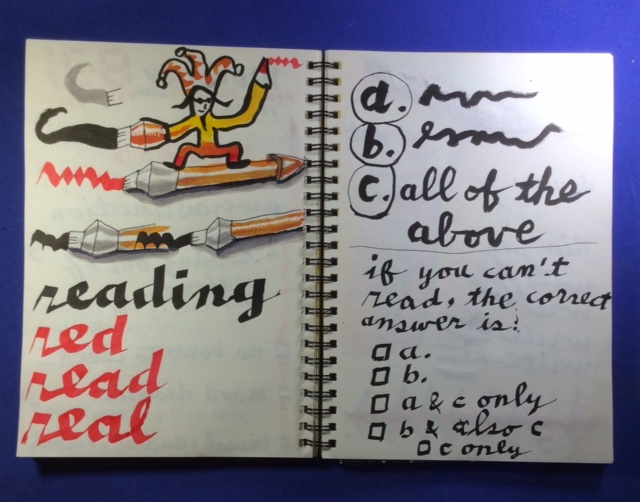
We do not, as a society, give a fuck if you can read, have a rich mental life, consider ideas and solutions to problems you might not have imagined. We do not, as a society, give a rat’s ass if you can write, beyond clicking a box assuming liability for any and all debts incurred in the course of your dealings with our corporation.
Our society does not have work, or any productive use, for a good chunk of its people, tens of millions of them. The young versions of these unneeded people are sent to schools to prepare them for a life where they are not needed. The lesson many of them learn clearly is: fuck you, asshole, bend over and spread your cheeks. Lift up the nutsack. Cough.
Life’s work: knowing this, all of it, and living calmly and productively, doing everything your talents allow to inspire, give hope, make a small ripple of change. Death is waiting for you anyway, why be aggravated by the many aggravations this life dispenses so generously for free?
It’s wrong to abuse people gratuitously, or even trying to be funny. There, I said it, fuck you. Seriously, there is most often no humor in abuse, no matter how otherwise witty. Abuse masquerades as humor to apply the talent for malice, seizing a jocular tone to wield the lash with the deniability of “only kidding… Jesus, stop being such a pussy.” A “roast” on TV can be occasionally funny, it’s all in good fun, blah, blah, but a roast in real life is rarely fun for the roastee. It is uncomfortable for most people to be put on the spot.
If I put you on a spit and turned you slowly and lovingly over the flames, basting you with your own juices to keep your skin from burning, no matter how otherwise hilarious my patter was while doing this, I know for a fact you wouldn’t find it all that adorable. We do this to each other from time to time, and it’s no joke, it’s a sign something sick is going on.
Not to be all judgmental about it, but when someone who has just been kicked in a delicate place is crying, the most humane first reaction is sympathy, not a smirking admonition not to be a pussy. “Everybody gets kicked there, whiner. Stop fucking crying and finish listening to my problems, asshole. I have problems too, you know. I kneed you by accident, ACCIDENT– pussy.”
I am thinking about this because when being polite is the only reason for doing something, against many good reasons for not doing that thing, experience teaches that it is a mistake to do the thing out of politeness. Being polite is a good thing, especially with strangers and potential assholes, and politeness has an important place in civility. Being polite as the only reason to do a thing? A weak ass reason indeed, and almost weightless against any reason not to do the thing at all.
Years ago, after an unhappy, brilliant, talented, witty and often abusive friend turned her abuse on me at a particularly bad time for me, I replied to her hurtful email with a long explanation of why I’d been so hurt by it. She declined to respond to my wimpish complaint. I never heard from her again. It was the quiet whimper at the end of a long, troubled friendship between two damaged people.
A year or two later, her husband’s mother died at 99 or 100. The old woman had been severely demented for the last decade or two, and when she finally died, the husband’s sisters began screaming for him to do something. He jumped up and applied mouth to mouth resuscitation to the dead woman, until, presumably, nurses intervened.
Sekhnet and I spoke to him shortly after learning, by email, that his mother had died. He was very grateful to us for a long call that gave him some comfort. I had nothing against him. In fact, it had been a source of stress and pain to watch him severely verbally pummeled by his unhappy wife every time the four of us got together. I always took his side, tried to pour some humor on the ugly situation, distract the wife from her assaults. Sekhnet was also very troubled watching this brutality at every meeting. When the woman turned that same whip on me one time too many, I was not having it. That was the end of our long, troubled friendship. Against my better instincts, I yielded to Sekhnet’s persuasion that I attend the wake in Chinatown. It would mean so much to our lapsed friend’s husband who had just lost his mother, she convinced me. Sentimentality and a misguided sense of duty and kindness triumphed over Reason and self-interest.
I have never had a reason not to regret going to that wake. I rushed from something I needed to concentrate on to be there, and needing to rush off had distracted me from the important thing I’d needed to focus on. I stood in line to have a meaningless hug from my former friend who made a smiling, breezy comment, only gently barbed, and it was the only exchange we had. Her husband thanked me several times for coming, and even took a moment, at a family dinner after the wake that I should also have not been persuaded to take part in, to find out if I was still trying to do that ridiculous animation business with kids.
I have never had a reason to think I did the right thing going to that wake. I did the wrong thing, for myself, thinking it was the right thing. Lesson learned, and now I move on slightly wiser.
Politeness for its own sake? Complete fucking lying bullshit.
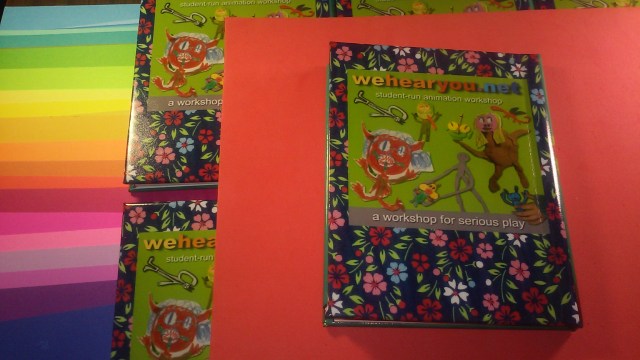
colors and books sent as colorful thank yous and updates

Want to see some beautiful and delicious tomatoes and peppers grown on a little backyard farm on the banks of the tranquil Grand Central Parkway? I thought so.
(turn down volume a bit for best results)
One of these rare glimpses of a deep and fascinating universe living inconspicuously within a friendly person passed and greeted many times in the hallways of the NYC Housing Courts over the years. A great short interview very much worth checking out.
Although I ate chicken, steak and hamburgers often during my childhood, and particularly loved fried chicken, flank steak, deliciously marinated, and burgers char-grilled over coals, I have been a vegetarian now for seven or eight years. As they say, just because you’re a vegetarian doesn’t mean bacon stops smelling delicious. The smell of burgers on a charcoal grill still gets to me, though I haven’t eaten one in years. Same for pastrami (a childhood delicacy) and barbecued brisket (which I discovered very late in my meat eating life), damn that stuff smells delicious. As for my vegetarianism, a friend corrects me, I am a pescatarian, since I eat fish a couple of times a week.
I zestfully ate the lean muscle of many animals over the years, what we call meat, but was always squeamish about eating internal organs, feet and necks. My mother loved to gnaw on a neck, or chicken feet, working her way around the tiny bones and sucking out the marrow with a smile of pleasure; I’d watch in horror. Squeamish is defined as a “prudish readiness to be nauseated” and no Victorian lady was ever more ready to recoil prudishly than I was from the smell of a calf’s liver frying with onions. The odor would literally sicken me and drive me from the house.
Why did I stop eating meat? I heard Michael Pollan on the radio, a long interview on WNYC, I think he was speaking to the gourmand Leonard Lopate, a man who will seemingly try any food. Pollan described something I’d witnessed as a teenager and was able to ignore at the time: animals we eat are raised in death camps not much different in spirit than places like Auschwitz.
Yes, this was an uncomfortable fact, and I’d seen the brutal treatment of tiny chickens and turkeys on kibbutz in Israel, but then Pollan described the intelligence and suffering of these meat animals and I looked over at my cat, a handsome carnivore, and he seemed to nod. Pigs become very depressed, they are much smarter than dogs, smarter than cats. They have to be restrained and drugged to stop them from freaking out in the weeks and months before their painful slaughter.
Delicious, yes, but also way smarter than this cat I like very much. The cat has a personality, preferences, moods, a certain brutal sense of humor. I will cry when he dies, hopefully many years from now. Sekhnet will be inconsolable, she cries at the thought of how inconsolable she’ll be. I suddenly could not eat pork, delicious as it is. Or cows for that matter, large gentle animals who, raised by the millions for meat, are big players in global warming with their ruminant farting. Human love of burgers has incented (as the capitalists now say) the destruction of the Amazon jungle, the earth’s lungs, for grazing land for cows. They say a vegetarian who drives a Humvee has a smaller carbon footprint than a bicyclist who regularly eats cow. That is another matter, also important, but it was the idea of the terrible lives these sentient animals raised in industrial death camps lead that instantly made me unable to eat meat.
I recalled the way we chased down baby turkeys, sometimes they were kicked, take four or five in each hand, upside down by the feet, pass them to someone with a pair of clippers who’d snip off their beaks. A spurt of blood and they’d be passed to someone with a syringe who’d shoot them full of antibiotics, hormones and who knows what else. Then they were thrown into another section of the enclosure with their squawking, blood spattered colleagues. I have a vivid memory of these birds, all with blue eyes, suddenly turning into a friend of mine, a beautiful girl with blues eyes. I excused myself and went into the bathroom to write this up in my journal. I was eventually rudely called back to work in the turkey coop. There were thousands more turkeys to get ready for meat and I was a needed volunteer. Eventually, decades later, after hearing Pollan’s description, I had to stop eating birds too.
This does not make me highly moral, of course. Hitler was a vegetarian for the last fourteen years of his hideous life. He gave up meat in penance for his part in the death of the young niece he was obsessed with. The only woman he ever truly loved, he said later in his life. At twenty-three Geli Raubal finally shot herself in the lung in 1931, with Hitler’s gun, during the last leg of Hitler’s marathon to power. Who could blame her? Hitler was obsessed with her, jealously kept her virtual prisoner in his apartment, and though we may like to think of him looking at her through a bathroom keyhole and jerking off, her nauseated face as he rubbed against her sometimes, it is probably just because Uncle Hitler was fucking Hitler that she chose death over life in the end. In any case, when he snapped out of his depression and got back to his life’s work, he gave up meat.
So, although I can’t eat meat these days (fish, a hypocritical compromise) I’m not on a moral high horse about it. I’m on a moral high horse about many other things, of course. I also wish people would stop eating so much increasingly poisonous and earth-damaging meat, but enough on that.
Toward the end of my mother’s long death from endometrial cancer she lost a lot of weight. She had always been very heavy, but after my father’s death, nibbled at by cancer, she lost most of her excess weight. “The widow’s diet,” she called it, a lost interest in cooking and eating, for the most part. She was almost gaunt by the end.
A few years before she died we were driving in her Cadillac in sunny south Florida and she suddenly said “I feel like Golden Corral all of a sudden. Do you want to go?” I was hungry, and she expressed so little interest in food, that I immediately I swung the car toward Golden Corral and we got our trays and giant plastic cups.
Golden Corral is a large scale buffet with many stations. It’s possible to eat semi-healthily there, if one sticks to three or four foods, but that’s not why people go there. My mother was thinking of fried chicken, macaroni and cheese, a bunch of other things I wouldn’t necessarily put on my plate. I had not yet heard Michael Pollan’s description of the suffering of animals raised and slaughtered in Auschwitz and I took some fried chicken along with some side dishes.
I’d had a tasty steak there a few weeks earlier, and I took a thin well-done steak as well. I did not notice the tell-tale onions. My mother ate the chicken happily for a moment, and then pretty much lost her appetite, the cancer was all over her and probably had something to do with it. She watched me eat and asked me how I liked this, wasn’t the macaroni and cheese good, and so forth.
I sliced into the thin steak, took a morsel on my fork, put it in my mouth and chewed it. It tasted funny, it tasted bad. This was not the tasty steak they’d served for dinner a few weeks earlier, this was some kind of horrible lunch time meat.
“It’s liver,” I said right after swallowing it, with a nauseated face that made my mother laugh.
“It’s not liver,” she said dismissively. For some reason I’d swallowed the foul tasting dark meat and I was feeling sicker by the moment. A waitress passed by. I asked her if it was liver.
“Yes,” she said with a big smile, “isn’t it delicious?” I gave her the expression of Woody Allen about to go into the MRI. My mother laughed again and told me to grow up, that it wouldn’t kill me. I wasn’t so sure.
Not long afterwards I heard Pollan describe the torment of literally tens of millions of animals raised in factories to be killed so we might cook and eat them and I could finally stop worrying about eating liver.
It turns out that, sure every rat in a cage with a button to administer an instant orgasm will die with his or her paw on the button, and that same rat, alone, will prefer drugged water to plain, until death, but this may not prove much about addiction. These are rats in solitary, they behave differently than rats in a Rat Park where they have good food, a social life, best friends, sex, exercise, rat toys, treats, things that rats really dig. The rats in the Rat Park drink the regular water because they’re thirsty from having fun, they are not looking for the drug water to take them out of their dreary, isolated existence in solitary confinement.
Turns out, as TED speaker Johann Hari makes a good case, that drug addiction is a response to misery and isolation more than a genetically hard-wired disease, chemical problem or moral weakness. I always love those who can hold their liquor pontificating about sobriety and the need to punish people addicted to arbitrarily illegalized drugs. We live in a binge and gorge and hoard-more-than-we-can-use society where we are marketed to all day long to stoke our longing for newer and better things to buy and have — hard for me to see the kid getting high as a criminal. The TED talk on this was very well-done.
I like TED talks, many of them are great, few of them are not at least interesting and well-done. But there is a sinister side to the silently corporate sponsored TED events that makes me want to say, and I hope you will forgive this outburst, “suck my ass, TED!” Check out the price of admission, once you apply for your ticket:


Yes, that’s $8,500. Put up or shut up, yo. Nobody’s holding a gun to your head.
“So are you working hard? Busy?” asks one of my few living cousins, now in her ninth decade. She means, I suppose, ‘are you still delusional?’ I tell her cheerfully that I’m working hard and busy, I describe the marketing and this week’s well-received unveiling of the new pitch I’ve been working on all summer. I explain breezily that I’m currently focused on marketing, a necessity my team would have been working on all along, if I had a team. The program itself runs very smoothly, done over 100 times now all over, without a glitch. She likes this, a retired teacher, does not sneeze at it. Tactfully avoids asking if I’ve made a dime in 2015, usually her husband’s second or third question.
“Still working alone?” she asks, and I cheerfully tell her that, except at the sessions themselves where I have assistants, yes, still delusional.
“And how is Sekhnet?” she asks cheerfully, and we’ve successfully negotiated the minefield of my difficult mission. Now we are in the lush backyard farm that farmer Sekhnet lovingly tends for hours every day, before and after her long hours at work. I can see that colorful oasis spread out under the window. A paradise of color and deliciousness, brought forth from the dirt.
Then, after talking about the organic fruits of this magical garden, and the health it brings, we’re on to raccoons, possums, feral kittens. They have them too, in New Jersey and the Berkshires, plus a litter of baby skunks and their mother. Luckily for everybody the mother skunk took her babies and left the garden after a while, there would be no need for any violence against them, just as the exterminator had predicted.
Downstairs almost all the components for garden fresh sauce are prepped, waiting in their metal bowls for the first pop of garlic in the olive oil and then the sauce making begins. Sekhnet is out buying onions, we’ve used up the ones she grew this season. I have to go down and pick some fresh oregano (delicious), chop it, get it ready for the sauce. Two large bowls of perfectly ripe tomatoes, red, yellow and green, all zipped out of their skins, wait patiently for the Saucier to begin.
Life moves at its own pace, if you can walk calmly and excitedly with it, you’re blessed. Ideas take time to germinate, must ripen into action. At least this is what I have been philosophically brushing into my drawing book lately. If you are in something for the long haul you must develop a philosophy that helps and doesn’t hurt your chances.
That said, I need to get a few hours in punching the heavy bag of revising the pitch, starting on the next one, much shorter and sweeter, showing the fun and the therapeutic value of working in a creative team helping each other animate ideas, still objects miraculously taking life on a colorful screen while cancer waits impatiently outside, ready to continue its assault, pissed off to be outside waiting to return to the center of the merciless universe.
A good thing, I believe, keeping that killer waiting in the hall for a while as kids and their families get a break, play, have some goddamn fun. Now I just have to sell the excellent means I’ve invented to do that.

