My Father’s Laughing Attacks

My father was prone to fits of laughter so strong he’d turn fire engine red as he howled and struggled for breath, wiping tears from his eyes.  These fits didn’t come over him very often, but he was susceptible to them for his whole life.  Some of the things that made him laugh this way didn’t have that effect on the people around him, but some of the things that cracked him up made my sister and me laugh too, and our mother.  

I have inherited this proneness to the laughing fits.  Sometimes I will try to explain why I am laughing so hard to someone, but it’s almost always impossible and it often makes things worse for me.  For one thing, my voice goes up a couple of octaves and I gasp to speak in a voice that sounds like I’ve just gulped helium.  For another, it’s a struggle to breathe, laugh that hard and make a subtle point at the same time.  I just have to ride them out, as my father generally did.  

One of the features of his fits was the breathless repetition of a partial phrase, repeated a few times, a fragment of an explanation of what was so funny that he was powerless to convey as the laughing fit gripped him.

One of the things my father was known for, around the dinner table especially, was an unfortunate ability to fart seemingly at will.   He’d often announce the imminent threat with the phrase: “prepare for … gassing!”  We’d brace ourselves.

“Irv, don’t you dare!  I’ll divorce you!” my mother would threaten, pointing at him with a serious look on her face to show she wasn’t kidding.   My sister and I would protest angrily too, but our indignation only egged him on.  

The tension wouldn’t last long, my father would smile and let out a loud blast. We’d all recoil, my sister, who sat next to him at the table, would move limply out of the way and my father would head down to the bathroom, chuckling.  

He’d sometimes tell us to prepare for gassing from the door in the kitchen that opened to the stairs to his basement bathroom.  After he said this he’d wait at the top of the stairs, poised, regarding us over his shoulder, shooting us an ominous look before impishly delivering his payload and heading down to the bathroom, smiling. These were the times, in the tense moment before my father made good on his threat, when my mother would call him a pig and snarl about divorce.

“Do you do this with your friends at work?” my mother asked him disgustedly once.

He started to laugh.  As a matter of fact, just the other day he’d been riding out to a high school in the ass end of Brooklyn with Phil Trombino.  I think he may even have warned Phil what was about to happen and Phil probably told him it was nature and what the hell, make yourself comfortable.  

“It was a cold day, so the windows were up, the heat and the defroster were on, and Phil was driving, and I let out a hot one.  It was a pretty bad one.  And Phil almost crashed the car into an oncoming truck.  He began pawing at his eyes,” my father started laughing, began to lose it, and with difficulty he said “he was… he was… pawing at his eyes, and Phil said…. Phil said….’man, Irv… you’re powerful!”  And he dissolved in a fit of laughter that lasted a while.  The rest of us laughed too, as much at his helplessness in the face of the story as at the story itself.

I still have the image of poor Phil Trombino pawing at his eyes.  “He was pawing at his eyes,” my father kept bawling as he hopelessly tried to pull himself together.

Trombino’s Broken-Hearted Teammate

Somewhere in his travels between Class A, AA and AAA ball, Phil Trombino had a teammate from Puerto Rico, or maybe the Dominican Republic, who grew more and more depressed as the season went on.   Trombino comes down to us as a big guy with a big heart who was always ready to help, and seeing his teammate so depressed, he took him to breakfast and tried to cheer him up.

“It’s no good, Phil, I have to kill myself,” the ballplayer said.  “My wife’s got a new man, she don’t love me anymore.”

Phil asked how he knew this.  Did he hear it from his wife?

“That’s the problem, my wife don’t send me one letter since I come here,” said the disconsolate man. “I write to her every day. Every day, Phil, and  I beg her but she don’t write.”  Phil pondered this.  

As they left the diner his teammate pulled out a letter to his wife, stamped and ready to go.  “I write to her one last time,” he said, “she don’t write back to this one, I will jump under a goddamn bus.”

He walked over and dropped the letter through the slot of a tall red receptacle.  Phil began to smile.

“You been mailing all your letters home from there?” Phil asked.

 “Every day, I send her a letter in there every day, Phil.  No letter from her, not one!”

Phil put a large hand on his teammate’s shoulder and began to laugh.  “Well, you can stop worrying, man.  Your wife still loves you.  That’s the garbage can.  You’ve been putting all your letters in the garbage can, your wife hasn’t had a single letter from you.  That blue box across the street is the mailbox, man.  This here is the garbage can.”

History does not record the reaction of the long ago teammate, but my sister and I had a good laugh, along with our mother.   And, clearly, I never forgot the bones of this old story my father told us once over dinner.


Primary Sources– Phil Trombino

I decided to use Phil’s name for at least two reasons, I realize now.  It’s a cool name and it recalls a couple of funny stories my father told my sister and me about his colleague and friend, Phil Trombino.  

I have nothing but good things to say about Phil, who I don’t believe I ever met in person or spoke to, so there is nothing for anybody to fear when I use his actual name.  

It’s a different case with the blond, folk-singing member of MENSA who became my father’s deathly enemy after their close friendship ended and she moved out of New York.   His story was that she was pathologically competitive, had this insane need to be right no matter what, and this became especially, and maddeningly, intense when she was wrong.  

Her version is that my father and Gladys set her up to publicly humiliate her, at the end of a long campaign of conspiracy and sabotage by my father and Gladys.  Gladys, a colleague at the Human Relations Unit and a beloved friend, and my father were, for many years, thick as thieves.

I have good reason to believe both of these stories.  I have stories of the former folk-singer in her later years, we were in touch not that long ago, but I would not want her name dragged into this Book of Irv.  I’m fairly sure she wouldn’t either.

I would also not use the unique and colorful last name of his good friend Harold, who put a price of $75 on their long affectionate friendship.  Harold and Irv were really the ideal, dark-humored brothers neither of them had ever had.  In addition to having a keen sense of humor and a deadpan style, Harold was held up to my sister and me as a living genius.

“He’s literally a genius,” my father explained it to us once.  “He can speak, read and write about six languages, all very well.  He’s a licensed electrician, can wire and build anything.  He flies an airplane, he can take a plane’s engine apart and put it back together.  He built that house they live in and he installed all the plumbing.   He’s a wine expert.  And he plays several musical instruments.”

“Violin, cello, piano, banjo, mandolin, ukulele, organ…,” my mother said, beginning to count them off,  “he plays about ten instruments, maybe more.  Saxophone also, I think, and clarinet, I think, and flute.  Yes, I’ve heard him play the flute.  He’s an excellent flautist,” added my mother.

Excellent player, genius, droll and likable fellow, but after putting a price of $75 on my father’s friendship nobody ever talked about him again in our house, that I can recall.  Except in the context of a great memory my sister and I have about his son’s hilarious and completely off-beat joke, I don’t think his name ever came up again at the dinner table where, in the old days, we’d see him from time to time when he’d stopped by the house in the car he rebuilt himself to drop off a book for my father or just say hello on his way out to the Island. 

Harold’s probably gone by now, he’d be over ninety if he was alive, but just the same, the way things ended with him and my father, it would only be hurtful to Harold’s family, if they ever read this, to learn the details of the ugly end without a chapter about the years of their great friendship, years I know little about, since I was too young to witness any but the last few.  My sister and I loved Harold and enjoyed his family.  We have a few hilarious memories of times spent with Harold, or Harold’s kids.

But Phil Trombino, I found it impossible not to type his name  when I mentioned the Italian member of the Mod Squad at the Human Relations Unit.   I did a google search, and his name popped right up.  Phil did play minor league ball, for seven seasons, it turns out.  Now I had a primary source.  Suddenly we learn that he was born in 1947, so he must have been a kid when he worked with my father.  “You could look it up,” as Casey Stengel used to say.  In 2016, of course, you can look it up, and it takes less than a second.  I went to look at the back of his baseball card.  

Phil Trombino was a lifetime .309 hitter as a minor league first and third-baseman and occasional outfielder.  He played in the minors from the age of 20 to 27 or so.  His last year in professional baseball was the year I graduated from High School.

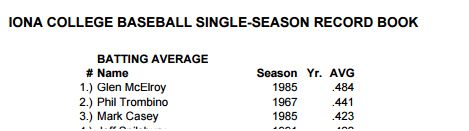
This is what got me wondering about the time frame of the Human Relations Unit. The summer that I was eleven years old, prime time for the Office of Intergroup Relations, I would think, in 1967, Phil Trombino was the starting first baseman for the Iona College baseball team.  That season he hit .441, setting a school record that stood for years.  To this day it’s the second highest season average ever compiled by an Iona College baseball player.

Phil Trombino school record


The Mod Squad

Most Baby Boomers will remember a TV show called “The Mod Squad” that ran in the late 60s.  On that show three rebels with criminal pasts, a blond hippie chick, a black revolutionist and an angry young white man, were drafted into a tight-knit undercover crime fighting squad where they could use their smarts and street cred to bust bad guys.  The black guy, played by Clarence Williams III, used to whip off his sunglasses, shake his head with its large afro, and defiantly pronounce his name:  Leeen-KAHN! during the opening of each show.  Lincoln “Linc” Hayes, what a cool guy he was.

Around this time the NYC Board of Education launched its own Mod Squad.  They had the blonde hippie chick, a member of MENSA who played guitar and sang protest songs in a high, pure voice.   They had a couple of angryish Black men and women and a few Hispanics who talked like their hermanos from the streets.  There was a young Italian guy named Phil Trombino, very funny, a former minor league ballplayer.  There was a big Jew with longish hair and bushy “mutton chop” sideburns, who always said exactly what was on his mind, who had your back, no matter what, and who was regarded by the rest of the Mod Squad as a no-bullshit character.

The big Jew quickly became the leader of the sensitivity and role playing sessions the outfit conducted with troubled high school gang leaders.  His plain-spoken style, understanding of the underlying issues and quick wit facilitated dialogue.  He was a fan and skilled practitioner of the old Black game he called “the Dozens”– cutting contests in which the participants made fun of each other brutally and personally and the winner was the guy who got the biggest laugh from his put down.  “If you grin, you’re in,” he explained.  Laugh and you’re next, fair game, let’s see what you got.

He was quick to spot bullshit during the training sessions he ran, and when he did, he wouldn’t hesitate to call it.  “Dass some shit,” he’d say, with a sneer.  He’d come home at night, after a few days with the rumbling “brothers”, and the other “bad actors” he’d worked with, and bring the street to the table with him.

“Dass some shit,” he’d say, when I pushed away the plate of whatever it was my mother was trying to make me eat.  He’d quiz my sister and me about the meaning of the street lingo he’d picked up at these sessions.  We generally had no idea what these bizarre phrases could be referring to.  “As they say in the street,” was often added to the things our father said at the table.

“The language they speak in the ghetto is a constantly evolving insider language, it changes very fast, so that you have to run the streets, with an ear to what’s happening right now, to have any idea what the insiders are talking about.  It’s a hipster language designed to exclude squares and act as a code to bedevil The Man,” he hipped us.

I could see that.  “The only power they have, most of these kids, is the power to create their own style, to create a sub-culture.  The underclass always creates what’s hip, then it gets co-opted by the retail establishment and used to sell product.”  Soon enough we began to notice this all over.  McDonald’s, purveyors of death to millions and destroyers of the lungs of the planet in the Amazon, was called Mickey D’s on the streets of many poor neighborhoods.  It wasn’t long until Mickey D picked up on it, called themselves Mickey D, to show they were hip, you know, down with the niggas in the hood, you understand, bringing and slinging that delicious shit.   The advertising motto that helped them sell a few billion more burgers and fries was a slightly more marketable version of “I be loving me that shit all up in here, yo.”

I don’t know how long the Board of Ed Mod Squad was in business.  I was just a kid, at an impressionable age, and it made a big impression on me.  Here was an honest, no-bullshit approach that seemed like it could work to really change the world for the better.  Have kids from groups who were fighting each other meet in a neutral setting where adults, who were not squeamish about telling an asshole kid to sit the fuck down and listen to your colleague, or discuss the origins of the word “motherfucker”, could, with humor, understanding and frankness, get them to see that they had much more in common with each other than they had reason to fight.  If this was ever done on a large scale, all poor people would realize the folks they should be organizing to fight were not other poor people, but folks like the powerful folks who could unblinkingly say on TV, “frankly, we tortured some folks.”

Like all human institutions, and many of our more noble experiments, this short-lived Board of Ed innovation appeared, in retrospect, to have been doomed from the start.  The violence escalated year after year, as these gang members fought each other before being drafted into a senseless, endless war thousands of miles away.  American society itself was increasingly violent, it didn’t really give a rat’s rump about what poor people needed, young people, anybody. The government sent the military against protesters, continued putting people to death, incarcerated them in larger and larger numbers for smaller offenses, sent them to be maimed in wars that made sense only to the industries and individuals who directly profited from them.  The poor were subjected to this violence disproportionately, but that’s always the case.

“During the Civil War, if you had the cash, you could get out of serving in the Union Army by paying $300,” my father informed us.  “You could also hire a substitute to serve in your place, some poor bastard who had no other options.  Do you think the sons of the rich were rushing off to die in trenches during the worst carnage of that war, once it became clear what the nature of it was?  A few, maybe, at the start, seeking glory, but most of them?  Their lives were far too valuable to throw away charging up some muddy slope in Georgia.”

It has always been so.  One last thing about this Mod Squad for now: my father, who was at one time best friends with the blond haired Marxist WASP with the beautiful singing voice, came to truly hate her after a couple of years.  She actually left New York City in the aftermath of their falling out, which she saw as a traumatic betrayal.  The Human Relations Unit, and its Office of Intergroup Relations, (for which my father was Coordinator of Pupil Programs) soon went the way of the Dodo bird and ten thousand other unique and cool species since.


Getting the Bigger Picture

My father once, while grudgingly giving in to my demand to put up a few hundred bucks for the last two credits I needed to complete my course work for my New York State Teaching Certificate many years ago, took the opportunity to sum me up unflatteringly.

“I’ll give you the two hundred dollars,” he said smartly after my long argument, “but I have to tell you, I find it pretty pathetic that a 37 year-old man has to beg his father for two hundred dollars because his unemployment ran out after he lost yet another good job.  You have never been able to hold a job.”  He went on in this way for a long lung-full.  

Not only was an adult man begging his father for money pathetic, he pointed out, but also several other very pitiful things about my life needed some prompt attention.  The saddest part, of course, was that I was so willfully blind to all my faults, no doubt even considered them virtues.  I avoided seeing myself as I really was because I surrounded myself with yes-men, sycophants, and a series of pliant and confused women who gave me what I wanted until they too, for obvious reasons, had to get the hell away from me.  He softened these hard truths with a few words of consolation.

“Look, I’m your father, and I’m always going to tell you the truth your friends are too spineless to tell you,” he said.

I was a grown man, and as he spoke I recognized this for the sharp-smelling hostile weasel shit it was.  It would have been easy enough to turn it all back on him, but I decided to wait a few weeks, since it was close to Yom Kippur, the Day of Atonement, and I knew it would make for a good discussion before we broke the fast.  Also, for one of the few times in my life, I was being practical first.  Let me get the check, pay the tuition, I reasoned, then we can talk about the nature of deeper truth.

It would be another fifteen years or so before the old man died, now almost eleven years ago.   The math somehow doesn’t add up to my current age as I do the math in my head now– 37 +15 + 11.  Somewhere I’m off, because the sum should be 59, not 63.  The timing of the course work was when I was 36 or 37.  The Yom Kippur talk was at least a year or two before I ever thought about applying to law school.  The point is not to get bogged down with the particulars.  It was more than 20 years ago, in any case.

I met him after Yom Kippur services at Hillcrest Jewish Center, as was my custom.  I always fasted, except for that year Seth Nagel urged me to leave Junior Congregation with him, and took me to King Yum, his treat,  straight from services, the two of us in our suits, Seth gleefully polishing off a big plate of pork, me hedging my bets with a small bowl of wonton soup, a couple of shavings of pork floating on the top.  Outside of that time, I always fasted, my sister always fasted, we both fast on Yom Kippur to this day.  Our mother didn’t fast.  My father was the only one who went to services and it was my custom, as evening approached and bad-breathed Jews weak with hunger hurried out of the shul, to meet my father in front of Hillcrest and walk him home to break the fast together.

We walked along Union Turnpike in the fading light, then turned to walk up the short hill to our house.  I don’t recall what we spoke of as we walked.  I remember that we sat across from each other in the living room, my mother in the kitchen, delicious smells coming from there, as I told him what I would no longer tolerate from him.

“This is the day when God supposedly seals the Book of Life, having inscribed the coming year in light of the psychic accounts left open and the ones settled.  I know you’re not big on apologies, and I don’t expect any.  I just need you to understand that I’m not going to tolerate your hostility disguised as fatherly advice anymore.  If you persist in that, we’re done, I’m gone.  I’m glad to hear any advice or wisdom you might have to offer, you just have to filter out the hostility, I’m not having any more of that.”

The old man looked sullen, and you could see in the way his eyes got tight and shifted that he was preparing himself for a mighty battle.  He opened with a familiar gambit.  “I don’t even know what you’re talking about,” he said, doing a decent impression of Clint Eastwood.

“I’ll give you a very recent example.  When you agreed to give me that money for the course at Lehman, and thanks again, by the way, you took the opportunity, as you said, to tell me all the hard truths about myself that my ‘spineless’ friends are too worm-like to tell me.” 

He braced himself, glowering and listening.  I went on to lay out all his criticisms.   “Now, even assuming that all those things are 100% accurate, and let’s say they are, what percentage of my total being do you suppose they represent?  20%? 30%?  Why not say 50%?  Do these faults cancel out the better half of me?  Do you suppose they cumulatively outweigh my compassion, sense of humor, readiness to help, my honesty, my defense of the bullied, my general decency, etc.?   Do they negate my talents or the way I try to listen and be the good friend I am to my invertebrate friends?”

I saw he didn’t have anything to say that made too much sense, so I closed.   “Whenever I put myself in a vulnerable position, whenever I ask you for anything, no matter how small, you can’t resist serving up the thinly disguised hostility.   We’re finished with you trying to reduce me to the sum of my faults.  I’m done with it.   The collection of my worst attributes is not the totality of my life.  No more.”  

Needless to say, he didn’t like any of this.  He wasn’t going to agree to stop doing something he’d never admit doing anyway.  He answered all this with a heavy hammer, the tongs gripped tightly in his other hand.  I met the hammer blows with my shield, held at the end of a strong, determined arm.  I pushed him back.  He hammered.  The meal to break the fast was ready to go, but my mother stayed in the other room, quietly, within earshot, listening.   I don’t remember where my sister was that Yom Kippur, probably with her husband somewhere.

“You know,” said my father crossly, “the real thing we should be talking about is your terrible fucking temper.”  He’d thrown a bolt of lightning at my shield, my response was a half smile.

“That’s a funny thing to bring up now, and I don’t see how it’s related to what we’re discussing,” I said.  

“Oh, is it funny?” he asked, “you’ve always had a raging temper, that’s something you find funny for me to bring up in the context of this angry outburst of yours?

“Well, I do have a temper.  So do you.  Why you are mentioning it now is a bit mysterious, unless you’re just trying to change the subject,” I said.  

“Would you agree that you’re a man of more than average intelligence?”  I asked him, taking a page from his Socratic book.

“I suppose,” he said, setting himself, “though I don’t see what that has to do with anything.”  His eyes began to move more.

“Well, would you agree it’s frustrating to have to explain something simple to someone of more than average intelligence several times, in several different ways, and have that person insist, no matter how clearly you present it, that they have no idea what you’re talking about?  Wouldn’t that frustrate most people?”

He grudgingly agreed it would, though he continued to insist he didn’t see my point.

“Well, I’ve just restated the exact same thing to you three or four different ways– that I will no longer accept your hostility crudely disguised as part of your fatherly advice- – and throughout this long, strenuous conversation you keep pretending not to know what I am talking about,” I said.

“And your point is?” he demanded, about to lose.

“Do I appear angry to you now?”

He gave a low growl, cornered as he knew he was.

“So why the hell are you bringing up my anger?” I said.  A moment later he agreed to do his best to filter out the hostility when giving me fatherly advice.  We sat down to break the fast. 

And for the next ten years or so, he was as good as his word, with a marvelous and terrible punchline waiting, for exactly the right moment, to spring out like a leprous lap dancer from a bachelor party cake.


Pushing Through Difficulties

Pushing through difficulties is tough sledding, for everyone, but more so for those prone to frustration and helplessness.  There is a genetic component to optimism, I would think; some are born with more of what scientists have recently identified as the “happiness gene.”   But much of our “can do” or “can’t do” attitude comes from the examples we had during our upbringing, the experiences that formed our characters, no?  

My father, for example, was raised in poverty by an extremely passive father and a mother who was in a constant rage.  Neither one was a role model for pushing through difficulties to solve life’s inevitable problems.  So, the constant example I had from him, who had his powerlessness and pessimism reinforced over and over as a kid, was, when something frustrating happens, vent Tourretically.   To his credit, he wasn’t a hitter.  But his outbursts of verbal rage were epic, and frequent.  Mostly, though, especially outside the home, he kept this predisposition to frustration and hopelessness inside, or mostly inside.

 His psoriasis was one manifestation of the difficulty of dealing with undigested anger.  He had a severe case of this scaly skin condition.  The skin over most of his body was red, scaly and itchy and he’d often scratch it.  The flakes would fall off his arms, his back, his legs and gather on the floor and other surfaces.  This led to frequent sponging, sweeping and vacuuming, by my mother and by him.  I will never forget the smell of the vacuum cleaners, which got hot sucking up these large, translucent, greyish-white flakes.  They smelled like a mixture of strained machinery and burnt skin.  

My father’s psoriasis periodically got so bad, his skin painfully cracked and bleeding, that more than one winter he had to be hospitalized.  In the hospital, with enforced rest, therapeutic treatments including sun, tar baths, cortisone shots, being slathered with balms and wrapped in plastic, and presumably massages, he would recover enough that his skin would heal and stop bleeding at the cracks.  His psoriasis was a torment he endured for most of the years my family spent together in that little house in Queens.

He was from that rugged Greatest Generation of men who didn’t seek the help of people with degrees in psychology.  Psychiatrists were for weak, self-pitying neurotics, as far as my father could see.  It was part of the job of a man to be a man and not whine about his troubles.  Psychiatrists and other therapists could do nothing for a man who wasn’t a man to begin with, my father contended.  That my uncle, his high-strung little brother, had been in psychoanalysis for many years, and remained sadly unchanged, only proved his point.  

My father’s view of therapy was not uncommon in those days.  In fact, I still see examples of the old stereotype about shrinks being the craziest and most troubled among us when I look around at some successful therapists I know.  Still, it seems to me, there is no substitute for gaining insight into what torments you if you hope to move forward in your life.

 “You are hilarious,” says the grinning old skeleton who was once my father, “you’re the prefect person to show others how gaining insight helps you move forward in your life.  Your life is a perfect roadmap for how to gain insight and move forward in the world, isn’t it?”  

“Let’s review.  You thought you’d be an artist, but you were too pure to play the only game in town if you want to be a successful artist: getting rich people to buy your work.  Rich people have always decided who the real artists are and who are just pretentious hobbyists.  Is that fair or good?  We can agree that it’s neither of those things, but unless you want to be a tortured soul like St. Vincent Van Gogh, mythically alternating the unfulfilled agony of your daily life with short bursts of rapture as you paint, and then dying in misery, abjectly unappreciated for your life’s work, you’d better learn to make rich people respect you and buy your work, hang it in museums.  That’s what you have to do if you want recognition as an important artist.  I agree this is an odious prospect, but that’s what being an artist is and has always been.  And, deep down, you knew that, and later, not so deep down.”

“Too much time on your skeletal hands these days, dad,” I say.  

“Glib,” says the skeleton.  “Anyway, you persisted in the artist dream, in the end you made a few short films, even had a couple of modestly sized audiences give you generous applause, until you hit a wall at around thirty years old.  You remember that, don’t you?”  

Indeed I do.  The world became grey, and tasteless, and dull.  I endured the dark days, which seemed endless, and played guitar at night, when I felt the weight lifted slightly after the world went to sleep.  Drawing music from the guitar gave me my only comfort, and small, life-sustaining whiffs of the mysterious creative force that is the source of life.  I didn’t draw much, but each of the few drawings I have from that six months or so is memorable.  

“Nobody’s saying you don’t have the talent to be a professional artist,” says the skeleton more quietly, “but it takes a certain temperament to compete with everyone else who wants that great honor, the plum job of expressing your feelings and getting paid and admired for it.  The successful artist must be lucky as well as  doggedly determined to put one’s work in the proper format and do whatever it takes to win the support of the rich people who will decide how much your work is really worth.  Kings, Dukes, Popes, the rich traders of Amsterdam, the Robber Barons, these have always been the arbiters of the ‘value’ of paintings, drawings, ideas, the artists themselves.”  

“I understood your dilemma, it’s not that I didn’t get it.  You can look at it from a Marxist perspective and say artists who make a living and gain fame in a capitalist system must agree to commercialize and brand themselves, have their work commodified, publicized, monetized and valued according to what the curators, tastemakers, and art collectors of the capitalist art market decide. You won’t get much of an argument from me seeing it that way, but, though you win the hypothetical argument with a now sympathetic dead man, unless you accept those ground rules and play by them, you also will never make a living, especially in a culture as unabashedly commercial as our’s is.”

“But, think about it, it has always been this way.  If the Emperor liked your work, you were made a member of the wealthy class and painted likenesses of the best of your time.  If you drew ingenious cartoons that showed these vain, avaricious, self-aggrandizing, exploitative pricks for what they really were?  Off with your head, you know.”  

“Then we have your short-lived teaching career, idealistic, loved by kids and their parents, mostly admired by your peers, but you couldn’t deal with the frustration of working for a series of all-powerful imbeciles.  Look, I dealt with the same frustrations when I worked for the Board of Ed, but I had a family to support, you and your sister, and I couldn’t afford to walk away, to tell one boss after another to fuck off.”

“You know, that’s the piece you never got, that you have to eat a lot of shit to live a life of integrity.  Is being subjected to arbitrary edicts from incompetent supervisors what you imagine when you dream of teaching?  Of course not.  Does obedience to the sometimes ridiculous orders of those ambitious former teachers who escaped the classroom to obtain more money, and power over their former peers, have anything to do with being an effective teacher?  No.  But if you want to keep your job, put food on the table for your family, have health care for everybody, and a pension, you learn to just be a man about it, be stoic about being treated like an asshole, for the most part.”

“I can say the same about your decade practicing curtsying to sometimes asshole hearing officers in the Housing Court.  Did you not finally have an outburst there too?  Of course, the young man in the robe could not criticize your performance or conduct as an attorney, but he did force you to defend your actions as a dog he kicked as hard as he could in the ribs, the face, the stomach.  Couldn’t stand it, could you?”  

“No, dad, I couldn’t stand it.”  

“And then, when your mother died and you inherited enough to live on, modestly, for a few years, you decided to combine your first and second loves, didn’t you?  An idealistic and fairly ingenious program for fostering collective creativity and optimism in the doomed children of the damned.  You worked very hard on turning the idea into a real program, and, I have to admit, for one person working on your own, you really did sort of impressively prove how well your theories could work in practice.”

“But there’s an unscalable distance between having a great idea that works and being able to get funding to sell it, isn’t there?  Trying to scale that impossible incline is a great and very satisfying job for a man living at 167% of the poverty line, with no connections to anyone who could actually help advance the cause, no?”

I can’t argue with any of that, nor could I have said any of it better myself.  

“The worm doesn’t fall far from the old apple tree, eh?” he says with a wry grin.

“Look, I know what you’re talking about and, although it pains me as your father to see the struggles you must go through to try to live a life of integrity, I actually appreciate what you are trying to do in quixotically painting this nuanced, three-dimensional portrait of me, of not reducing me to the monster I often was, in many ways.  Of course, we are both well aware that, by being afraid to face my own demons, I put many of those obstacles in your way, in your sister’s way.  And, as you recall, a few hours before I died I admitted as much and told you how sorry I was for doing that to you guys.”  

“Still, I stick by my point that a man has to be a man and not a whining worm, if you know what I’m saying.”

This reconciling of irreconcilable truths is the hard part I began this piece thinking about.  You can learn the lay of the land by heart, look at it truthfully, understand the failings, contradictions and missed attempts– and learn something from it, in spite of everything.  That’s my belief, anyway.  It’s fucking hard, without a doubt, to gain truly useful insights, but it’s a struggle that’s worth waging.  The alternative, to me, though much easier and infinitely more common, is worse.

It seems to me the danger of not struggling to understand is that you’ll eventually abandon all your ideals, one by one, and lower your expectations about your world and the people in it.   Sham democracy and grotesquely unfair rule by the most ruthless and greedy of the top tier of the top 1%?  Just the way the world has always been.  Centuries of racism at law, unappealably justified by learned justices who’ve been elevated to the highest court in the land and, in recent decades, claiming to be the impartial “color-blind” referees of our “post-racial” society ?   Par for the course, baby.  You want Justice, do you?  Here you go, rascal, suck on the way things have always been, will always be.

The eventual difficulty of selling this manuscript as a book, no matter how well I might eventually manage to rake together these reflections of my father, his world and beliefs, no matter how elegantly I may succeed in turning it into a compelling and life-affirming tragedy, has not stopped me so far from trying.   I have come to the hard part too, having focused for weeks on sympathetically telling the story of a kind, humble and humanistic man who, also, in a moment of weakness or two, actually set fire to his children’s lives.  A man who, though he loved her deeply, in a way nobody could doubt, was also consistently cruel to his wife, our mother.

I heard a quote from Pat Conroy yesterday, a writer I’ve never read but think I should read now, who died recently.  He said he wrote to explain his life to himself. 

“Bingo!,” I thought, for there is really nobody but the self better situated to explain that life to the person living it.  Those given to honestly delving into the materials of their own lives can learn important, perhaps life-changing, things.  That being said, making useful sense of one’s life is one of the hardest things imaginable.  It also strikes me as the single most important work anyone can do, if life gives them the chance to put in the time.

That difficulty of looking too closely at ourselves is one of the main reasons so many run, full-tilt, full-time, as hard as they can, to be as tired as possible after a day of striving, and hit the hay hard, practical about the need for strength for the next day’s run.  I try not to judge them and I don’t fault them.  For one thing, running full-time leaves little time or energy to consider things that can disquiet a person’s soul, but it’s never been for me.  

That being said, let’s see how I do telling this story, as I continue trying to push through the hard part, and selling you the heart of it, here.


Reducing Someone to the Sum of Their Faults

Many people, I’m fairly sure, engage in this reduction– once the sum of the faults becomes heavy enough to outweigh the endearing qualities.    When the balance falls to mostly aggravating, or destructive, our tolerance for the peccadilloes, which may have once even seemed mildly amusing, will disappear.  

When our tolerance goes, the view of their better nature tends to also disappear.  It’s common sense to avoid people who become hostile where they were once sympathetic.  At the same time, it seems wrong to reduce a person’s complex humanity to the sum of their faults, even as this reduction sometimes can’t be helped.  

A funny friend, who also has a sadistic side, one day laughs too loudly when your child falls comically and lands breaking an arm.  It doesn’t have to wipe away all the good qualities of that friend, but it can.  That ill-timed donkey bray, which the friend can’t stop even when the kid is writhing in unmistakable agony, becomes a last straw if enough other straws have already accumulated.  Hard after that to see that funny friend the same way.  Especially once you add in the reflexive sarcasm, the times you loaned them favorite books and tools that went missing, the time they forgot a solemn promise, leaving you in the snow, with wet socks and a dead cell phone, to trudge a long, icy way back to civilization to figure out plan B.

It is tempting to reduce people to caricatures sometimes.  The media does this constantly in their maniacal sorting of winners and losers.  The world is so complicated, so fast, so relentless, that the islands of calm understanding that we hope our friends to be are very vulnerable places.  A good friend’s faults we can most often overlook.  An asshole’s faults are impossible to ignore or tolerate. Reason and understanding only take us so far, then the real action starts.  Emotions come into play, and, as my friend’s father, Ralph, used to say “let the games begin!”

My father was famous for cutting off long time friends.  “The fall from grace,” my mother used to say, probably quoting some famous source only she and Google now know, “is swift and absolute.” (see FN, at foot)  She said this in reference to people we were delighted to spend time with, close, dear friends of my father’s, of the family, who were often at the house, laughing, and who fell, in a lightning flash, into the darkness of silent oblivion.

I used to try to argue my father out of some of these death sentences, although, as an adult I wouldn’t reverse any of the several I’ve found it necessary to hand down.  My father insisted that I didn’t understand (I actually didn’t at the time) and he was always angry when I tried to play peacemaker.  

He explained to me once, through clenched teeth, that Harold had put a price of $75 on their friendship.   He gave me the details of this last straw, which certainly would have weighed little without the many precursor straws piled on over the years of their witty, fraught, slightly competitive friendship.  

Shame played into this estrangement too, as I suspect it often does.  My grandmother moved and, in getting rid of things she couldn’t bring with her, sold her Chinese style furniture, lamps and little tables and cabinets, to Harold, who admired the things.  He bought the lot for $75.  Then he had buyer’s remorse, told my father the stuff wasn’t worth $75, wanted his money back, would return the things.  

My father told him that Yetta, the beloved mother-in-law he always called “Mom” (or “Grandma” to my sister and me), had already moved to Florida and she wasn’t going to take back the Chinese junk.  There was no place for her to take it back to, anyway, even if she wanted to.  Harold, apparently, would not relent. After an increasingly bitter argument my father paid him back the $75, put the Chinese stuff in the attic (this would prove a fatal mistake) and probably told Harold not to hurt himself when he shoved the bills up his ass.  

I agreed this was fucked up and petty behavior on Harold’s part, but hardly grounds for his beheading.  Then my father gave me the punchline that had sealed cheapskate Harold’s fate, caused him to lop Harold’s head off with no apparent emotion. 

“Grandma went up to the attic for something and came down with this weird look on her face.  She asked me why the things Harold bought from her were in the attic.  He said he loved them, my beautiful things, what are they doing covered with dust in your attic, Irv?  I didn’t know what to tell her, and you should have seen the look of hurt on her face.  I made up some feeble story she didn’t believe, about Harold having his floors done, asking me to store it, trying to put a good face on it, somehow.”  This was the emotional blow that put the final seal on my father’s newly found hatred of Harold.

 “It wasn’t hatred, you still don’t seem to get it.  I didn’t hate any of them.  I was just done with them, as they were with me.  The friendship was already dead, I was carrying a cadaver of a friendship and the thing was starting to decompose.  I got tired of the stink of it, and then there were the vultures overhead, swooping, beady eyed and very determined.  You know what a vulture’s beak can do to a man’s shoulder?” asked the skeleton under the hill in Westchester.  

I’ve since come to understand all of this all too well.  Friendships seem to have life spans, periods where the mutual benefits make everything cool.  Real friends for life are very, very rare.  If you have even one or two, count yourself very lucky and take care to give the friendship water and light.  I understand how a series of sympathies withheld erode a friendship until there is nothing left but the formalities of wrapping the stinking thing up and tossing it.

Still, there are a couple of scenes from my father reducing people to the sum of their faults, something he often tried to do with me over the years, that haunt me. I am thinking of one with a couple, the parents of my best friend in elementary school, that culminated in a scene so cinematic it is almost biblical.  

Not only was this couple the parents of my best friend at eight, nine and ten years old, they became very close friends of my parents.  The families spent a lot of time together, knew each other very well.  We spent a lot of time at each other’s houses.  In some families we would have called each other’s parents “aunt” and “uncle”.  My parents were very good friends with my friend’s parents.  I won’t stop to paint the detailed portrait of that friendship, but it was deep and mutual.  They remained friends for decades, even as my childhood friend and I went our own ways for ten years or so, met and renewed our friendship during the college years.

Fast forward now over the decades.  The mother, a very active and dynamic woman who often told her long-suffering, droll husband to stand up straight (this tic, and the husband’s perfect facial response each time, delighted my father, who often barked out the line to us after a visit) was constantly in motion, visiting the sick, tutoring, counseling, offering her warm presence wherever needed.  My sister and I loved her.  

My mother had a major operation and was laid up in nearby Long Island Jewish hospital for a week or so.  My father was peeved that their friend apparently hadn’t found time to visit my mother.  I think that was the start of the end of things. Then, while my mother convalesced at home, five blocks from the home of this couple, the friend apparently hadn’t found time to stop by and see how my mother was doing.  I can’t confirm these details, but that was my father’s perception.  I don’t recall my mother contradicting it, though she was much more philosophical and didn’t seem to hold any kind of ill feelings about it.

“I was at the restaurant all day, your mother was alone.  You mean to tell me she couldn’t have stopped by with a bowl of soup, she couldn’t check in on her way home from any of her hundred missions of mercy to see how your mother was doing?  It made all her running around to heal everybody strike me as complete bullshit, she lived five blocks away and couldn’t find a few minutes, even once, to see how her old friend was doing?”  I had no answer, and it was a rhetorical question anyway.  

My friend got married and lived near where we all grew up.  His parents had retired to North Carolina.  My parents had become “snow birds” (a phrase hard for me not to reflexively translate to ‘shit birds’ somehow) commuting between Florida and New York to have the best weather of both worlds.  His parents had long rented the house my friend had grown up in.  My parents owned and hadn’t yet sold my ancestral home.  It was natural, since the house was empty all winter, for their friends to stay there on visits to their son and daughter-in-law, and soon, their first grandson.  They stayed in the otherwise empty house a few times.  

My father, down in Florida, began to chafe each time they spent a few days there. I’m not sure exactly what this was about, but I know he felt used, and manipulated into agreeing to let them stay.  My mother asked him what the big deal was, pointed out how convenient it was for their old friends, how little a thing it was for him.  Truly, I never saw what the big deal was either.  I don’t know what, if anything, brought it to a head, but I got a call from my father one night, when their old friends were at the house, asking me to drive over and tell them the free ride was over, get the keys back from them.

I’d drive over periodically to check in on the house during the winter, make sure the boiler had water in it, the pipes were OK.  It was not a tremendous inconvenience to drive out there, but I truly didn’t get the urgency to evict them on this particular wintry night.  I argued.  My father argued.  “Is it my house?” he asked me, and the rest followed from that.   I gave up the argument and drove out to the house.

It was well after dark when I arrived.  Caroline (the reader will note that I’ve hesitated to use her actual name so far) came to the door and put a brave face on it.  My father had already called.  I was sheepish as I told her, and Ralph, another adult I thought of as my friend, that I honestly didn’t understand what this was about.

“No, no,” said Caroline, “I get it completely.  Look, it’s his house and he doesn’t want us staying here anymore.  It’s not hard to understand. He’s right, it’s his house, and, I mean, I wouldn’t do this to my good friends, but he has every right to do whatever he wants with his house.  There’s nothing to understand.”  

Ralph was carrying their bags out to the car, I followed him out.  Snow was beginning to swirl in the air, it was already sticking to the dead grass and the cars. I urged them to at least stay the night, there was absolutely no reason to drive off into a snow storm.  It couldn’t possibly make any difference if they spent the night, headed off the next day.   My father was being a punitively judgmental asshole, the timing was arbitrary, unreasonable.  There was no reason for them to drive off into the teeth of a snow storm.

Caroline shook her head there in the driveway, as the snow fell. “No, your father is right, we really are bad people.  You know, he feels we’ve been using him, and I understand that.  He feels like he has no say, and he’s been uncomfortable the whole time, and I’ve kind of steamrolled him into this, because it’s so convenient for us… and, of course, we’d do it for our friends, you know, we’d let our friends stay, the house is empty anyway, nobody’s using it, we’re not harming it in any way, but that’s his prerogative, none of us has a right to judge him for exercising it…”  

In my dramatic memory she is crying as she delivers these lines, though I know she wasn’t, she was putting on her usual brave face.  Ralph, standing now on the passenger side of the car, was silent as Caroline protested about what bad people they were, what a righteous, if slightly misguided, man my father was.  

My entreaties were in vain, I hugged them both, took the keys, Caroline slid into the driver’s seat and I watched them drive off down 190th Street as the gathering snow continued to swirl.


(FN)  Google gives us this paraphrase, supposedly from a 1995 poem– probably not the source of my mother’s comment, which she made as early as 1968:  The fall from grace is steep and swift, and when you land, it does not make a sound, because you are alone. ”


Truthfulness vs. Lying

The truth will not set you free, regardless of how inspiringly that phrase is emblazoned in the stone face of the hellish high school visible from the Harlem River Drive.  The truth is a slippery thing, and shape shifting, and notoriously amenable to conflicting interpretations.   Nonetheless, my father clung to the central role truthfulness plays in having integrity and hated liars wherever he encountered them.   One thing is equally true: a lie will not set you free either, even as it may get you off the immediate hook.  Put me on the side of honesty, please.  Tell me the truth and I won’t lie to you in return.

The truth may sometimes be hard to spot, but much of the time it is clear when a lie is a lie.  So somebody who resorts to saying things they know to be untrue, with some other consideration taking precedence over being honest about the thing they know to be true?   A moral weakling, a weasel, a contemptibly  unskilled spinner of truth, a person without integrity.  This was my father’s view.  Although my view is a bit softer, I have a hard time with people who resort to lying to protect themselves or their beliefs.  A lie is generally used to end the discussion, honesty invites conversation.

It is one thing to look at an ugly baby, at the mother’s expectant face, and gush “I love that hat!  What an adorable baby hat!”  That will get a smile from mom, as the baby regards you with a gas face, that disgusting expression an ugly baby will fix you with sometimes.  

It will be good enough, no lie, truly a cute hat, no feelings hurt, and, to me, it’s far better than saying “Oh, what a cute little baby!  Not ugly at all!!!  Oh, God, I could just die from the cuteness!  So cute!!!!”

OK, you will say, I am going way overboard to make my point. Fine.  It’s a subtle point, though, because, to paraphrase war criminal Donald Rumsfeld, there are the lies we know we are lying about, the lies we lie to ourselves are not actually lies, the lies we don’t know are lies and the lies that don’t realize they themselves are actually lies.   There are levels of this lying business.  Sometimes it’s a good thing to tell a little white lie, little black child.  It’s true.  To avoid hurting someone’s feelings, lie a little, it’s not a bad thing.  

“Do you like the succatash?” your hostess will ask expectantly, gesturing toward the foul smelling mass on your plate.

“My, what a beautiful plate and it goes so gorgeously with the place mat and the table cloth!” won’t help in this situation.  Only a real lie will.  

So you will say, seasoning your lie with a dash of truth “I don’t usually like succatash, but, as succatash goes, this is as good as any I’ve ever had.  Bravo, brava, bravissima!”  It’s a decent thing to do, to exert yourself a little bit to make someone serving you feel a little better about well-meaning, if shitty, service.

The lies I’m talking about are as troubling to me as they were to my father.  You ask a straight question, you get a crooked answer that has all kinds of internal contradictions and ramifications it is often better not to even think about.  “Were you there?” you ask.

“No, I wasn’t there, I didn’t get there until the following week,” comes the answer, the person looking down and to the right before speaking, to access the creative lying sector of the brain.  (I know this tell because of an internet comment I read the other day, under a video of George W. Bush giving an ambiguous answer about events on 9/11).  

“No, I wasn’t there until the following week,” will leave a deep chill in the room, if you had seen the person there the night in question.  An even deeper chill if you saw the person see you see them there, at the place they now say they weren’t even present.  You will move on, if you have decent people skills, filing away the important fact that the person you are talking to is capable of lying to your face.

After the liar left my father would turn to me and say “who you gonna believe, darling, me or your lying eyes?” and shake his head.

“Jokes that killed vaudeville,” I’d say and he’d shake his head some more.

My father instilled this quest for truth and honesty in his children.  It’s an admirable thing and something I’m grateful for, regardless of any problems it may also have caused me.  It is far easier, after all, to run along believing the common myths we all live according to,  myths that form our view of what is true, and right, and decent.  

Emotions, all successful politicians, advertisers and entrepreneurs know, are much stronger and more convincing than facts, no matter how indisputable those facts may seem to be, no matter how indisputable those facts may even actually be.   And when it comes to emotions, things not based on logical analysis, who’s to say what’s really true and what isn’t?  What’s true is what you feel, which is also true.

In the case of America in 2016, part of our truth is that a young man who makes a billion dollars now faces an even bigger challenge:  how is the young genius going to monetize that move to make some real money and stay at the top?   It seems a petty detail, and a perhaps grotesque example, but I can’t get it out of my head.  

Young David Karp was once an intern to a bright, likable millionaire I talked to once about my student-run animation program.  Karp built Tumblr, I think it was, and, on the day I was meeting with the art loving animation entrepreneur, had sent a car to pick up the man I was talking to.  The limo was to take his former mentor to the press conference, where Karp would sit next to his smiling friend and take questions about selling his baby for a billion dollars.   I recall googling Karp and reading how the business press was all wondering how Karp was going to keep his edge as a genius cutting-edge entrepreneur going forward.

Now, you can google Karp yourself (here you go, don’t exert yourself) and see that once again, I am distorting things for my own ends.   Karp’s net worth is only 200 million or so.  He didn’t actually make a billion as I claim.  Who’s the lying distorter of the truth now?

This is prickly terrain, I’m telling you.   I have taken on a mighty task: to tell the truth, in as sympathetic a way as I can, in giving you a portrait of the tragic, destructive, inspiring character that was my father.  Irv was like Zelig in many ways, you can look back at his life which spanned much of the twentieth century and reflected so many of its important struggles:  his youth of dire poverty, even by the standards of The Depression, the abuse he suffered at the hands of a probably psychotic mother, his army service in Germany after the Nazis were defeated, his college years and the powerful vision of Social Justice he carried forward for decades, his involvement in the Civil Rights struggle, integration, making peace between warring minorities, leading a youth movement devoted, in part, to justice in the Holy Land.    His keen, dark sense of humor (very, very hard to conjure, I can tell you for sure), his great intelligence and capacity for empathy.

And then we turn the page and he is metaphorically flogging both of his young children with a live, hissing cobra.  The daughter is terrified, phobic about even tiny, cute snakes, the son is filled with confused rage, what the fuck is my father whipping us with a live hissing cobra for, what the fuck?   I mean, seriously, what the fucking fuck? 

Now turn the page and we have him lovingly tending to one of the terriers, teaching his children to be compassionate, and merciful, and truthful.   Cracking them both up with a line so darkly personal they could not even explain the humor of it to anyone raised without the ear for it.  

I am taking my example from what Jane Leavy did so beautifully in her biography of the Mick, trying to give you both of these things at once. Why am I trying to do this?  God help me, I am trying to get to the truth.  I really am.

Honest Irv

My father put a great premium on honesty and had a visceral hatred of liars.  I have inherited this to some extent, this quixotic quest for unflinching truthfulness and distaste for a lie.  Knowing that someone is lying inserts a bone crosswise in my throat sometimes.  

At the same time, I understand that people have many reasons for lying.  Sometimes they lie to protect somebody else, other times it is out of desperation to conceal their own shame.  There are many reasons, and styles, of lying.   My father, impressively honest as he also was, was a great stylist in this regard.

“Ah, there we go,” says the skeleton of my father, his smile bitter now, “there’s the Elie we all know and love!  ‘My father was a great stylist of lying, though he loved the truth.’  You want some truth? You are doing what you’ve always done, trying to cut out the middle man– going straight to the two or three people you’ve found who will tell you how interesting and important what you’re doing is, applaud your high-minded ‘work’– honest work which nobody will pay you for because you’re too good to let anyone put a price on it…”

Nice try, dad.  This is called the Voice of the Internalized Victimizer, as I learned from that maniac I went to law school with.   I leave it here as an example of your technique of reframing.  

It’s like the story CBS ran about former president George Dubya Bush avoiding military service in Viet Nam by participating, sort of, in that rich boy opt out his dad got him into, the Air National Guard he went AWOL from.   Defenders of Bush proved the documents CBS ran were fake, the so-called news a scandalously unsourced overreach by the desperate ‘liberal media’ to try to discredit a great American family– end of story.  Commies trying to bring down a true American patriot by claiming he was a rich boy draft dodger who also dodged a physical because of his regular cocaine use.  HOW DARE THEY!  They are the ones who should be publicly shamed, not a good Christian man like our excellent president.  

The truth or falsity of the story, never actually denied by Bush’s people, was beside the point, the point was: THEY LIED.  We proved the documents were fucking fake, suck it!

“Ridiculous comparison,” snorts the skeleton.

Sure thing, pops.  Yet, I am carrying on a grudge you began decades ago, have kept it going for more than ten years since your death.  The person, a reflexive liar, and I have not exchanged more than a dozen words in that time.  It is a matter of some delicacy, not to mention who he is, though it will also be clear.

“Well, he’s the perfect example of why somebody lies– to cover their shame, to justify themselves, to manipulate and mislead, to gain some imagined moral high ground,” says the skull that once housed my father’s impressive brain.

All true.  It hurts to think of the influence this liar has over people I love and care about, as it must have hurt the old man.  I could never be as categorical about writing off this liar, until after my father died, and I saw some examples of this fellow’s habitual dishonesty too hideous to ignore.  You will want details, I get it, and it’s a hard dance I’ll have to do to provide them, but I’ll try, in illuminating the difference between an outright liar and a brilliant and honest reframer like my father.

Take the example of my mother’s twelve aunts and uncles taken to a Ukrainian ravine by anti-Semites and shot in the back of the head.  My father didn’t dispute that this happened, and yes, that it had happened only thirteen years before I was born, and that they were a few dozen people out of millions killed in the world’s most efficient genocide up to that time.   Arguably an eight year-old learning about all this might be upset, OK, fine, fair enough.  That much was all beyond dispute.  But let me put it in a frame for you, my fretful son.

“We never knew these people.  None of them ever came to the United States.  They were abstractions.  You are getting upset about the deaths of people you never even heard the names of because you are one of these kids who wants to feel like a victim, you have a grandiose vision of yourself as some kind of participant in world history.  These people you are mourning were abstractions, do you get it?”

Holocaust denial without the denial, a denial too upsetting to marshal any arguments against.  Had I been able to take a step back from the unspeakable, even if well-meant, betrayal of his response I’d have had several excellent questions for him.

Grandma never knew her siblings?  Really, dad?   Pop didn’t know his siblings, his parents, his nieces and nephews?  Really?  Oh, when you put it that way, Dad, you’re right, none ever came to the United States, I am just a whining little bitch trying to make myself feel important.

My sister’s husband is a very opinionated man.  Well-read, with a good memory, he loved to argue with my father, about virtually anything.  He described my father as the most able fencer he’d ever met, by far the most skillful arguer he’d ever encountered.

“Your father could lay on the couch, watching the football game while reading the paper, and he’d,” and my brother-in-law made nonchalant fencing motions, the swordsman still reading his paper.  

“You know, you could attack him from any angle and he’d just,” and he pantomimed an easy parry, carried out with a yawn.

“I never saw anything like it,” he concluded, “he’s in a class by himself.”   For some difficult to grasp reason he continued to attack the old man, who always easily defeated his most spirited charges while lying comfortably on his back, on the couch, without bothering to sit up straight as he flashed his rapier.

“Nicely done,” says the skeleton.  “where you’re going in this piece reminds me of that great moment from a Boy Named Sue: ‘Now you just fought one hell of a fight, And I know you hate me and you’ve got the right to kill me now, and I wouldn’t blame you if you do..'”

Nah, man.  Skeletons should keep their rictuses closed when the living are trying to describe what they were like when they still carried the skin, muscles, organs and nerves around.

I will ponder this further, and try to describe this dynamic more fully, without, somehow, blowing everything up.

My Father Would Have Loved This

A few months back I learned about an on-line sort of Reader’s Digest for baby boomers.  A friend, who doesn’t need the money, makes some nice pocket change writing short, snappy pieces for it and suggested I do the same.   I sent in three pieces, all were accepted for payment and publication.   Then the third was unaccepted, leaving a lingering bad taste I can’t seem to rinse out.  

The lingering bad taste came on, with accompanying smell, when I learned, on following up, that, yes, he thought the piece was beautifully done, but… funnily enough, and he could have sworn he’d written to tell me, possibly a tad too personal for a website that sometimes features pieces about being raped as a girl and other traumatic subjects.  Mine was an amusing anecdote about something colorful my mother had said that summed up her personality and her view of religion.

On the same day he also rejected a fourth piece, about a Family Secret, a subject he’d suggested, for being “strangely unmoving”.  The Family Secret was the murder of my mother’s twelve aunts and uncles along with everyone else in her family who had remained in Europe.  I suppose it was strangely unmoving, in the sense that it was strange that he was unmoved, even stranger that he would tell me so.  You can be the judge of just how strangely unmoving it was, if you’d like. 

Actually, my father would have probably loved this in a way: another piquant example of the arbitrary assholishness of the world, another marginally competent fellow in charge of deciding who shall get $250 and “published” and who shall get a lame opinion about why he changed his mind.  But that’s not the reason I mention the editor (this whole digression will be my pleasure to delete without a trace in the rewrite).  

He sends an email from time to time with news of a new “franchise” he is considering, like Family Secrets.  “Better Late Than Never” was one: first doing something at an age much older than most people and the wonderful ironies and complications that it hopefully entailed.  If he ever comes up with the franchise “Times I Dealt Gracefully with Complete Assholes”, I have a perfect one for him that  I could whip up in a few minutes.  

Anyway, the “franchise” thing stuck in my mind when thinking about vantage points from which to show you my father’s unique personality:  “Things My Father Loved.”

“Elie, tell them about my brother’s funeral,” says the skeleton of my father with the grin that is now, in the manner of all skeletons, his only facial expression.  

“That will require a lot of background,” I tell him.  

“Hey,” he says, “I’ve got nothing but time.  And thanks to my industriousness and frugality, you don’t have to rush off to work today, for the time being, anyway, so you have time.  Give them some background.”

My father and his brother had a strained relationship, until the last day and a half of my father’s life, when two brothers were rarely closer.  My father was much larger than his little brother.  My sister and I noticed the way our uncle always cringed around his big brother.  It seemed my father had probably done many mean things to Uncle Paul all through childhood.  

The crowning achievement of this sibling cruelty was probably the act of sadism he cheerfully recounted more than once for his children decades later.  Here’s an account, snipped from an unsent family piece, that I wrote recently for (and never sent to) the jerk-off with the $250 a pop on-line magazine:

Our father shared very few stories from his difficult, impoverished childhood, but one we both remember is a time he recalled fondly.

“I stuffed my brother’s mouth with raw chopped meat one time,” he’d say with a smile and a little chuckle.  

We pictured the dreary house they grew up in, a vignette out of a nightmare, some dim kitchen or dining room, dust motes dancing in the eerie light, nobody home but the two of them.  For a family living in dire poverty, a mouthful of raw chopped meat was a big deal.

It seems to have been worth the ass-whipping he must have received from their mother, who bemoaned the “seenas cheenam” (senseless hatred) between her sons. She didn’t understand how there could be hatred between the large son she whipped in the face and the little, sickly one she doted on.

Both sons emerged from their difficult childhoods with raging tempers.  They had markedly different styles of hiding their ready rage.   My uncle’s camouflage completely fooled my sister and me for many years.  Our father’s workarounds to his temper tantrums didn’t fool us since his anger was so well-known to us.  We saw it up close virtually every night at the dinner table, saw it in its many colors, shades and gradations.  

My father, in polite company, typically masked his anger in a killer sense of humor, barbed asides, dark observations and pointed ironies deployed in sometimes dazzling fusillades.  

My uncle, who had a corny sense of humor and laughed easily, with a distinctive high pitched, scraping laugh, not unlike an inhaled cough, seemed like a mild- mannered man.  He was not, as my sister and I would learn later in life when he went absolutely apeshit during a Passover weekend we attempted to spend in his house.  

My mother always disliked my uncle, a vain, slight man she considered a tyrant and a condescending bully.  My sister and I got a long, bracing view of this side of him for the first time when we were both adults.  Deciding to leave early to avoid further exposure, we got in the car instead of staying for another hellish dinner.  

I took a small bag of garbage from the car and went to dump it in one of my uncle’s garbage cans before we left.  He clamped a hand on the lid.  

“Take it with you,” he said.  

I turned without a word and took the garbage bag back to the car.  My sister and I laughed about it as we hurried the hell away from there.

At some point my father spent a couple of days at his brother’s home outside of Washington, D.C.  

“How’s my uncle doing?” I asked him afterwards.  

“Let’s just say … he remains unchanged,” said my father, in as good an example of his style as I have ever scrawled on the side of a telephone doodle.

Among my father’s papers was a letter he’d written to The First Hebrew Congregation of Peekskill.  It was a beautifully composed request, written on behalf of himself and his brother, to continue paying the special out of town member rate.  

The Congregation sent them bills every year seeking the full dues that all members paid.   These dues paid for the Hebrew School, construction of the large new facility, upkeep of the new building, and the small original building, salaries for everyone employed there, possibly a gym and pool, as well as maintenance of the small cemetery.  My father and uncle had been out of Peekskill since graduating high school, and had continued paying dues for the fifty or more years since from wherever they were.  They paid the dues in order to keep their graves paid for.    My father had received, as had my uncle, as both apparently did every year, a bill for the entire several thousand dollar annual membership.

“I realize the financial hardship that giving discounted fees to many out of town members might impose on the Congregation,” wrote my father toward the end of his well-constructed plea for fairness.  

“In speaking recently to Lisa Gagliardi, I learned that my brother and I are the only two such members.  In light of this, I respectfully submit that the $300 out of town dues we have been paying for many years be accepted as payment in full for 1999.”

My uncle had a stack of such letters he’d written in a folder in his file cabinet when he died. The last were written after my father died, on behalf of him and my mother.  

Their first cousin Eli, a man of famous temper, had dealt with this issue of out of town dues more directly, and with greater success.  At 85, sick of getting these bills every year, he picked up the phone to yell at the rabbi.  When told the rabbi was busy and asked by the receptionist if someone else could help him, Eli exploded.

“Yeah, tell the rabbi he can bury a fucking dog in my hole, for all I care.  I paid dues for more than sixty years since I left Peekskill and haven’t set foot in the shul more than a handful of times in all those years.  I’ve paid my fucking dues, bub.  I’m done.  Tell him to do whatever the fuck he wants with my grave.”  He slammed the phone down.

Eli quickly got an apologetic call back from the rabbi’s personal assistant.  Of course they appreciated his long payment of dues for a facility he never used, of course he’d more than paid for his grave, many times over.  He was in fact their senior member, the man with the longest standing as a dues paying member.  They apologized to him and waived any further dues from him.  He skated for those last few years, until he was buried one sunny spring day in the grave he had paid for many times over.

My father and his brother were more civilized men, professionals.  Hence every year they made their neatly typed written requests, later granted, to pay $300 a year instead of the full active membership dues demanded.

I note here that Eli’s best friend from Peekskill was a man named Benny Peritzky.  Peritzky was the town’s kosher butcher.  According to Eli, Peritzky,  a heavy drinker and something of a hell-raiser when young, was very learned in Jewish law. He could have been a rabbi, Eli told me once, he had everything but “smeecha for rabbunis” — the certification that new professional rabbis receive from a board of professional rabbis.   Benny Peritzky’s grave is not far from Eli’s in the same cemetery where my uncle and father are buried.

My father’s death, though long in the making, came upon him suddenly– he got his sentence six days before it was carried out.  My uncle spent the last year and a half of his life in a wheelchair, after a stroke.  He was in and out of hospitals, with infections, and pneumonia, and all kinds of terrible complications from being an invalid over eighty.  My aunt, teetering on the edge of dementia, did her best to care for him, visiting him every day, eventually moving into an assisted living apartment with him.

“You do realize you could probably tighten up this story quite a bit,” observes the wry old skeleton wryly.  

But I also know my father would relish this small detail about his brother, which I am setting up, something that occurred a couple of years after my father’s death.

My uncle was always a fastidious and demanding man.  For years after he retired from the Civil Service he would put on a crisp shirt and one of his dozens of expensive ties every morning, and a suit, along with meticulously polished shoes he kept on shoe trees when not on his feet.  Although confined to a wheelchair and living in a hospital and then an assisted living facility, he still wanted to be dressed impeccably, even if it was in sweat pants and a t-shirt.  

The staff at the hospital were not as exacting when it came to the attire of patients confined to bed and wheelchair.   My aunt, more than passingly demented by then, did her best to keep his laundry clean, sorted and folded, toting it home several times a week and bringing it back in neat stacks.  

“I’m worried about your aunt,” my uncle told me when I visited him in the hospital.  “She really can’t live alone anymore, and I’m not able to take care of her or do much from here.  I have to figure out what to do, she’s really not capable of taking care of herself anymore.  I’m afraid something will happen to her, alone in that house.”  

I nodded, had seen troubling evidence of my aunt’s deterioration.  A moment later my aunt walked into the room and my uncle jumped straight on her back, wheelchair and all, about the laundry.  

I opened the drawer while he raged and saw perhaps a dozen neatly folded t-shirts in there.  He was attacking her about the latest batch that she hadn’t managed to do yet.  Their son, a long-suffering fellow of considerable wit, who was standing next to me at that moment, later proposed this epitaph for his father’s grave stone: “Where the fuck are my 10 t-shirts?” 

Soon enough my aunt and uncle moved together into an assisted living facility in Bethesda.   Not very long after that my uncle passed away during one last trip to the hospital.  I helped my cousin with details for the funeral.  

He called to tell me the rabbi had told him, during the call to arrange the funeral, that they could make no funeral arrangements until he agreed to pay his father’s delinquent dues for the current year to the First Hebrew Congregation of Peekskill.  I was more outraged by this than my cousin was, though the outrage of it was certainly not lost on him.

“I told him I would put it on the credit card before the funeral,” my cousin told me with impressive maturity.  “He also asked me if they could bury my father with a pallet of worn out prayer books.  Apparently Jewish prayer books need a proper Jewish burial after they die.  He told me it’s considered a great honor to be buried with worn out prayer books.  I told him it was fine, that my father would love it.”  

The funeral was one of the saddest I’ve ever attended.   It would have made my father weep, to be there.   The surrounding ironies would have given him a grim, satisfying, delight and that’s the reason I present them here: to illuminate my father by something he loved, something twisted in a way he would really appreciate.  

The extreme cold at the cemetery, where the grave had been dug, the pallet of old books, the fresh snow, the seven mourners around the grave, including the rabbi– all very depressing.  My cousin escorted his mother, by then quite dotty and shaky on her legs, up the long slippery hill to the grave.  

The service was not long, the remarks by my cousin were short, my own were much shorter.  My uncle, I said, had been my inspiration for being an uncle to my niece and nephew.  I didn’t add that I hadn’t seen or talked to either of them for an unconscionably long time.

As the books and my uncle were buried, and my aunt gripped my cousin’s arm for the slippery descent to the car, I took the rabbi aside.  I told him how wrong and hurtful he’d been to bring up the one late dues payment by my newly deceased stroke-victim uncle.  I mentioned the brutality of the insensitive timing, putting this matter to a son who’d just lost his father, a man, by the way, who’d dutifully paid his out of town dues every year for more than sixty years.  

The rabbi began to explain that it was the policy of the Congregation, that they told him to do it, that he was only following orders.  I shook my head and watched as it quickly dawned on him how lame the excuse sounded, and how similar to Eichmann’s.  He appeared to be truly aghast and apologized to me.  I told him it was my cousin he owed the apology to, and he hurried over to talk to my cousin.  His body language was very humble.  My cousin later said it had been a very sincere apology. 

Here’s the punchline for my father.  He would have loved it and I hope it was worth the old skeleton’s time waiting for it.  

As my cousin was driving his mother back down to Bethesda he got a call on his cell phone, somewhere on the New Jersey Turnpike.  Benny Peritzky’s son, a senior member of the board of First Hebrew Congregation of Peekskill, a man he’d never met, calling to tell him how sorry he was to hear about his father’s death.  He remembered Paul, he said.  He was also calling to tell my cousin he was sorry about the rabbi’s unfortunately timed mention of the unpaid dues and to give, as a token of the Congregation’s apology, a $25 discount on the final year’s dues.  They would refund it on the credit card charge, he said.

“Wow, $25,” I said, “that’s generous.  Almost ten percent.”  My cousin and I snorted about the whole hideous business.   The darkness of the whole thing would have tickled the old man, who would have savored every grotesque detail, even as he no doubt would savor them now, if he could, grinning in his chilly grave at the very top of that same hill where his brother is buried.