Thwarted Transparency

The reader should keep in mind that Irv Widaen put an uncommonly high value on honesty.   It’s hard to imagine him ever telling a fib, for example, much less calculating a lie to evade having to speak of an uncomfortable true fact.   Honesty was his trademark, he was going to tell you the truth no matter what the cost, since honesty itself was a rare and precious thing.  My father always spoke his mind and could articulate multiple sides of most issues.  He liked putting every available detail on the table for discussion. He had no respect for those who deliberately distorted the facts.

He didn’t need to lie because he was adept at reframing any conversation to his needs.  This way he could remain scrupulously honest without talking about anything he didn’t want to talk about.

You will read of times when my father seems to have been dishonest.   There is no contradiction with his basic honesty in this, though it’s complicated.  

For example, when his eight year-old son came to him with tearful questions about what happened to Grandma’s six brothers and sisters, and Pop’s six brothers and sisters back in Vishnevitz, and their parents, my father did not solemnly lay out what was known of the terrible story.  Instead he angrily told his young son to stop being melodramatic, that nobody knew any of those people, that they were abstractions, that the real problem was that the pampered boy, for some insane reason, wanted to feel like a victim, a childhood victim of the Nazi extermination in the Ukraine and Belarus when in fact he was only a middle class American drama queen who never knew any of these faceless, nameless people, people who disappeared into that night and fog thirteen years before he was even born.

It’s easy to think of this evasion as an act of dishonesty, a betrayal.  I’ve come to see it also as an expression of my father’s disability, his inability to do otherwise.  You can picture a father quietly telling his child:  the parts of Europe where our family comes from had a long history of anti-Semitism;  in the winter of 1942 into the summer of 1943 followers of the mad Adolf Hitler marched into the areas where we lived and killed everybody.  That’s why we fought World War Two, to kill Hitler and his mad ideas.

My father wasn’t able to say something like that. Or perhaps he said something like it, in one clipped sentence like that, and maybe I forced him to say it again, in two sentences, and it was only when I persisted beyond reason that he chided me for being a self-pitying little pussy who just wanted to feel like a victim.  

Someone who’d been raised by tender parents would have instinctively drawn the child close, said he understood how upsetting this terrible true story was, petted and comforted the kid.  My father, raised with his mother’s lash across his face and a father who was a ghost of a man, was never given these human tools.

At eight I was a little young to be an astute historian.   The only notes I took in those days were in the form of disturbing drawings.  Some of them, I recall, scared the shit out of my mother.  The secondary source in my memory recalls only the bad reaction of the overwhelmed father pushed to his breaking point by his anxious young son.

It is easy to see this now:  my questions hurt him too much, frightened him, left him feeling powerless, desperate, angry.   I get that now, though it’s taken more than fifty years.

ii

The personal, of course, is political.   Consider the powerlessness, desperation and anger of the average American voter right now.  Those who voted for the president are disgusted about how little respect the bad people in the media are showing their guy.  Those who voted against the president are despondent that it could have come to this sorry pass in America.

Truth is the first casualty of war.  “Truth” is now seen by most Americans as synonymous with Point of View.   Coming to this opinion is simple if you live in the right Social Media echo chamber, and we all do.  The same set of facts now automatically leads to two sets of irreconcilable opposite “truths” that trolls will endlessly goad each other about.  

If the president in the blue hat orders the killing of far-away strangers based on a high-tech remote surveillance and profiling process, and you wear a blue hat, you’re unlikely to press for an investigation into possible war crimes when innocents are blown to bloody shreds.  If the president ordering the extra-judicial executions is wearing a red hat, the man in the blue hat might get up on his hind legs about these high-tech assassinations that are radicalizing more and more of the world against us.

There are, still, true things.  There are things as they exist beyond spin, beyond their commercial and political uses.  Facts: where I was born, what day, what year.   Facts: what I ate today, what I drank.  Likewise in the world: if it is raining, what Cairo’s average temperature was each of the last thirty years, whether there is a law against racial discrimination in America.  

Fact: the United States has the highest infant mortality rate of any wealthy industrialized nation.   The political is also personal. 

My father was the second child born to his tiny, red-haired, angry, religious mother.   The first was a girl who died either in childbirth or immediately afterwards.  This would have been in a tenement slum or a filthy, crowded maternity ward on the impoverished Lower East Side of Manhattan in 1922 or ’23.  

I wonder if my father ever thought about this tiny, dead sibling he never knew.  I doubt it. Speculation on such things takes you quickly beyond the realm of fact.  In these pages I have tried to stay as close as I could to the facts I knew and limited my leaps of conjecture to things that were truly unknowable, like the nature and extent of my father’s love affair with the amorous young Christian widow in Connecticut.  

The photos suggest they saw each other over the course of many years.  I never heard my father mention her, I never heard her name.   I have Eli’s quick story about breaking up that love affair and a total of three suggestive black and white photos of them together, found after Irv’s death, in a shoe box of miscellaneous photos.  In one, they are captured wrestling on a picnic blanket and I’ve never seen my father look happier (the photo is  here, at bottom of page).  Or, here:
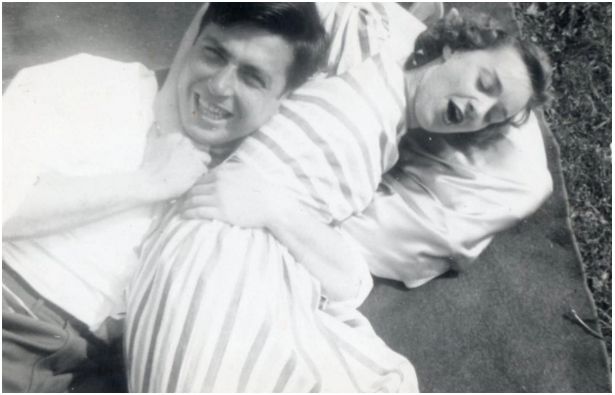
Irv and his shiksa.JPG 

One photo appears to be from before the war, in the summer of 1941, when my father was 17.  He is skinny, in a white shirt and tan pants, sitting jauntily on the railing of the porch next to his landlady/lover.  In another he’s clearly a college student after the war.  The skinny boy in the first picture, renting a room in her Connecticut house, pumping gas to pay his bills becomes, over perhaps ten years, the happy, round-faced young college graduate in the last photo.  The woman appears to have made the long trip up to Syracuse to see him.  The graduate wears the optimistic expression of a young scholar heading to an elite graduate school and his life of ideals beyond.

iii

A couple more details about this impulse to thwart transparency and why this thwarting bugs me so much, personally and politically.  

Reframing was my father’s favorite technique — if you aggressively pursued some matter with him — ju jitsu! — shift the ground of the conversation to a pointed interrogation about why anyone would pry into such things in the first place, or whatever will make the person most uncomfortable.  Put the inquisitive fucker on the defensive, there’s no defense like a good offense. It’s kind of like a mini filibuster, just keep talking, run out the clock.  You can see virtually every politician today do this maneuver when in a tight spot, spout prepared talking points about something utterly unrelated to the question asked.  This tactic is most often coupled with an indignant attack on the character of the person asking the uncomfortable question.

The logical extension to this technique is to preemptively vilify and delegitimize the truth-seeker.  If the truth is disquieting, shameful, criminal, best to be circumspect about it, have others respect the secret.  Indiscreet persons shall be blamed and attacked immediately.  You can bet your nest egg that someone is making a lot of money on the deal if it is disquieting, shameful, criminal and ongoing, and you’d be wise to dummy up.

The personal is political.  Bradley Manning tried to report the evidence of probable war crimes by Americans that he was seeing on his computer screen night after night.  When he made the evidence public, after being silenced by his superiors, he was made to pay a steep price: prosecution as a traitor to the United States of America.   Before his court martial they kept him naked in an outdoor cage, to show he was no better than any other terrorist and just as guilty under  a statute that does not allow arguments about intent.  

The main thing here is punish the leaker, don’t worry so much about the crimes exposed, no need to probe into those.  The probe would likely lead to good, patriotic people being punished for well-meaning mistakes made in the fog of war.  The news cycle will focus everybody’s attention back on the real malefactor.  Make sure everyone knows the fucking illegal leaker is the traitorous enemy, not the people nonchalantly killing in the leaked videos.  Our new president, like our previous one, focuses on these fucking illegal leaker felons, understandably.

In family life, if someone considers a fact embarrassing, say a divorce nobody mentioned to the children, or quietly sitting on tens of millions of inherited dollars, or some other ticklish thing, it is a fact best left unspoken.  If you mention the taboo fact in any context, you are a betrayer of shameful secrets, whether you understand the shame or not.  

In a family conversation about bankruptcy, for example, if you mention that so and so once declared bankruptcy, and his adult children, who are there,  don’t know about it (they were kids at the time), you may have unwittingly whacked a hive of wasps in front of some fast tap-dancing in the family room.  

“Dad never declared bankruptcy!” mom will quickly, falsely, assure the children, giving the urgent eye-bugging, throat slashing sign for you to clam up.   Picture the look you should try to have on your face when the adult children look at you next. 

Transparency is an ideal that our culture of constant selling and spinning makes difficult to uphold.  You can’t have a real discussion, effectively explore options, solve problems, without free access to all the pertinent facts.   Forget about the uninformed populace of a democratic republic having anything like democracy without access to what their elected officials are doing in their name, without informed public debate.  

For reasons that should … be obvious… much as transparency is to be desired, the plain facts, set out, just like that, would be… in many cases, too destructive.   You can hear our thoughtful former president B.O. carefully dancing out that explanation.   National security. Sovereign immunity.  State secrets.  Classified.  Espionage Act, no defense against treason based on your actual motives in disclosing.

After all, some of our wealthiest, most lucrative corporations have staunchly guarded trade secrets that are worth billions.   And if it’s not technically a trade secret, it should be, particularly if certain demographics would be outraged, and we’ll continue to treat it like one.  

As I have noticed so often, opacity and misdirection are all that’s needed for every form of mischief and corruption to flourish.  The worst among us love it when no difficult questions are asked.

stage-managed liberty

“When you have stage-managed elections with the public relations industry determining what words come out of people’s mouth, candidates decide what to say on the basis of tests that determine what the effect will be across the population, somehow people don’t see how profoundly contemptuous that is of democracy”

Noam Chomsky to Bill Moyers (here)

In Fairness to Barack Obama

Let me try to be fair, for just a moment, then back into the trenches, snarling.  No, that sentence betrays too much, doesn’t seem fair, or balanced.  Let’s wind it back a bit, shall we, make it a little more personal?    

I voted for Barack Obama twice.  The first time I was actually optimistic that he might be the capable agent for overdue change he presented himself as.  The second time I voted for him on the theories of “fool me twice, shame on me” and the old chestnut of casting a vote for the lesser of two evils.   Evil, surprisingly, has become a relative thing in our desperately polarized society.  Mel Brooks’ genius definition of tragedy and comedy comes to mind: tragedy is when I break a fingernail, comedy is when you fall down a manhole and die.   Evil is now seen as who is doing what to whom and how does it affect me directly?  

We have been living for a while in increasingly partisan echo chambers.  In one chamber we find it absolutely sickening that obstructionist politicians can brazenly ignore their Constitutional duties when it is politically expedient and offer ‘explanations’ that sound startlingly like “we don’t have to do shit because this illegitimate Muslim non-American is a fucking ‘n-word’.”  This was the position publicly stated (sub silento, as they say, dog whistled) by Mitch McConnell and other prominent Republicans when Obama took office: our goal is to make him a weak one term president who can’t get anything done.  True we can’t lynch him, but we can certainly fuck him up and erase any legacy he tries to leave behind as soon as we get rid of him.

In the other echo chamber there is little question that Barack Obama was an insidious Kenyan-born Muslim intent on destroying America at all costs.   There is no doubt that he is a Negro, the son of an African from Kenya, that’s something even Hussein Obama himself cannot deny.  Many who hate Obama are undoubtedly racists, others are just, to be fair and charitable, skeptical of any Democrat who speaks well, appears thoughtful, ponders nuance, displays charisma and does not openly support the urgently needed policies they hear called for on talk radio during a time when terrorists are killing one out of every five Americans on a daily basis and violent crime plagues our once-great nation as it is overrun by hordes of threatening non-white aliens.   To be even more fair, some in this right wing echo chamber are just decent wealthy people who reasonably fear a loss of income from any policy that protects the weak at the expense of the wealthy via marginally higher tax rates.    

The divisions in our country, and the deep corruption of our pay-to-play lobbyist-driven political system, resulted in the election of a vain demagogue who seems completely unencumbered by principle, outside of increasing his own wealth, fame and power.  During the presidential campaign he promised to repeal and replace Obamacare.  He promised to create a terrific health policy that would protect every single American, not including, of course, the millions at his own rallies that will be without health care once he rams through the urgent repeal of Obamacare and restores large tax cuts for the rich.  While giving no specifics, he assured the gullible that his plan would cover all Americans, cost less and deliver much better health care.  He often ended this promise, like so many honest people reflexively do, with the tagline “believe me, believe me.”

I don’t like to think we live in a stupid country.  I prefer to think we live in a cynically manipulated country.  There’s a lot of money in cynical manipulation. The genius of America, if I may modestly say so, has long been cynical manipulation.  Look, we had this great continent with vast natural resources and incredible wealth.  There were savages living on it, attacking our settlers, impeding our ability to exploit all this wealth.  Manifest Destiny, et, voila!    

I don’t like to think we live in a country that could easily return to a lynch mob mentality, even with the increased crowing of White Supremacists and the recent surge in hate crimes.  I prefer to think we live in a country where, during desperate times, the homo sapiens fear and rage-driven instinct to mass violence sometimes understandably occurs.  Americans are no better, or worse, as a group, than the far away brown people we kill by remote controlled drones.  Americans are fair people, to the extent anyone can be fair in a world like ours.  

The plan the Republicans have slapped on the table to replace the conservative, corporation-friendly health care compromise that critics called Obamacare and vowed to repeal over and over while our nation was ruled by that tyrant, should not pass the sniff test.  It includes billions of dollars in ‘tax relief’ to the wealthiest 2% while cutting millions of low income Americans off health insurance, or making it completely unaffordable for those who had no option before Obamacare.  

In a better world somebody would just buy some TV time, invite Paul Ryan into a pay-per-view boxing ring, and simply whip the snot out of that snotty intellectual, settling the matter once and for all.  Ryan is an intellectual in the same way that a four foot tall man is a giant in Lilliput.  He read at least one very long book, a novel he bases his political philosophy on.  That he is driven by principle is reflected in his ongoing refusal to cooperate with Mr. Trump, the candidate he thoroughly repudiated during the campaign. 

I began this piece in fairness to Obama.  Here is that fairness, the PPACA is better than what existed before.  The PPACA is a deeply flawed compromise that left greedy corporations in charge of most of health care, sure.  But in fairness, it contained a few good and long-overdue things; eliminating the obscene ‘pre-existing condition’ insurance loophole, extending affordable health insurance to millions, focusing on cost-saving incentives based on preventative care, saving the lives of some of the thousands of Americans who still die every year for lack of affordable medical care.  The big flaw was that it left the gorged, rabid foxes in charge of the henhouse, but we can’t let the perfect be the enemy of the demonstrably better than complete shit, can we?    

Americans like the ACA, particularly those who were uninsured before the law took effect, even if many raise their torches and pitchforks and scream for the overdue repeal of tyrannical Obamacare.  That’s OK, at Tea Party rallies Americans angrily held signs telling the government to keep their evil hands off Medicare.  

I don’t like to think badly of my fellow Americans.  I am counting on the stink of this bill, hastily prepared and designed to give money back to the richest Americans who the Kenyan Muslim simply mugged like the common criminal they always said he was, to ensure it does not get out of the House of Representatives.  There are political maneuvers available to a party that did not hesitate to shut down the government when that Negro president insisted on trying to be the president, but the backlash should be too much to allow their use.  

On the other hand, the spineless opposition party is mostly blowing bubbles of saliva so far, and making those humming sounds you sometimes hear in a Special Ed class.  Don’t forget, they depend on the same billionaires who supported Trump for their reelection campaigns.   I guess the odds are 50/50 this big winner gets to win again.  Who among us will be surprised if a few million losers lose again?


Book Idea page 2

The devil, of course, is always in the details, and the pertinent one is always waiting, to do its damnedest at the most perfect possible moment.   As my mother drank coffee in Queens and waited for me to take her to lunch there was one devil waiting to emit a sulphurous “kitchy koo!”.  In hindsight I should have been expecting it, although ‘should’ has always been a dodgy word in the courthouse and hindsight is hindsight.   I tell mother and son something to this effect as I describe the court’s intention in creating the Guardian ad Litem program.   A little history can be found here.  

The short version is that the right to counsel is only guaranteed in criminal cases where you face the jeopardy of imprisonment for  a year or more if convicted.   The right of an indigent to have a court-appointed lawyer was an innovation of our Constitution, but it covered only those threatened with prison time.  The Framers, who some hold in the same reverence religious Christians reserve for the authors of the Gospels, did not foresee a time when millions of Americans would live in rented homes that could be taken from them for a variety of infractions, forcing them to join the vast invisible army of the homeless.  The law, in its majestic equality, regards as a trifle the right of rich and poor alike to be defended against homelessness, to echo Anatole France.

I described how New York City paid a lot of money to the family of Eleanor Bumpurs, a woman who was killed, in effect, for being mentally ill and owing less than four hundred dollars in subsidized rent for her public housing apartment.  She was riddled with bullets at her front door when she reacted to armed NYC officials by raising a large kitchen knife.   The tragedy got a lot of media play.  The new Housing Court, bastard step-child of the New York City Civil Court,  decided that protection was needed for tenants like Ms. Bumpurs.  It was an excellent decision.    In the early years, lawyers did most of the Guardian ad Litem work.   This had the effect of providing capable court-appointed lawyers for indigent, vulnerable tenants facing eviction.  

I see the college kid nodding earnestly, like he’s acknowledging this is God’s work. His mother raises her eyebrows and nods encouragingly too. I quickly disabuse them of this God’s work business.   I explain that the reason I call it Piss Boy work is because some Housing Court judges, hearing officers really, with jurisdiction only over who has the right to possess disputed parcels of rental property and enforcing certain codes about the conditions in that property, view the court-appointed lawyers on the list who stand in the shoes of tenants as hamstrung losers lacking ambition.  Those judges sometimes treat the Guardian ad Litem accordingly.

Any lawyer making a decent living would not put himself on the list, certainly not for more than a case or two a year.   Anybody with any ambition would not appear regularly to stand in the filthy, worn shoes of New York City’s most vulnerable tenants, and the canny grifters who sometimes pose as those tenants.  What could be said of a subsistence lawyer appearing exclusively in this low and ill-paid role?   Whatever one might say about Housing Court judges, most of whom are fine people, each had demonstrated determination and ambition or they would not be on the bench.  

Civil Court Judges in New York City are chosen by the Democratic party machine, like in the days of Tammany Hall.   A certain political background is required, and making connections of a certain kind.   I carried the piss bucket long enough to see several court attorneys, and even a Legal Aid lawyer I’d shot the shit with a few times, suddenly attired in robes, sitting on the bench, smiling graciously as I said “congratulations, your Honor,” the first time I saw them as judges.  

Once in a while one of these smiling political appointees would show another side, the dog kicker side mentioned earlier.  A judge can’t generally get away with openly kicking an attorney appearing in front of him in his role as an attorney.  Attorneys are careful not to cross the line where they can be kicked.  There is no such line for the Guardian ad Litem (GAL), one learns belatedly.   Cross a line or not, for the GAL a cranky judge gets a free kick.  Just part of the game.

So, anyway, Josh and I finish writing up the stipulation.  It provides that the landlord will wait thirty days to serve the eviction notice, and will inform the GAL before he does, and the landlord will not contest an Order to Show Cause, meaning more time will automatically be granted, if needed, for APS to take the only action available, while the GAL serves the marshal with papers halting the eviction.  The terms were generous, Josh was a decent guy very familiar with the drill.  

It was the best deal anyone could hope for in the situation.  The aged tenant in question didn’t have much of a leg to stand on.  To put it more accurately, he had no leg to stand on.  He was an illegal alien who lived in the apartment with several adult family members, all indigent, none of them able to get any kind of public assistance.  They owed the landlord something like $13,000 at that point.  APS was going to apply for a guardian of the person to figure out how to relocate the old man.   The application for the guardian under Article 81 of the New York Mental Hygiene Law….

“You’re shitting me, there’s a New York State Mental Hygiene Law?” said the woman.

I shit you not, ma’am, a clean mind is a good mind in New York State.  Anyway, the Article 81 filing in Supreme Court would stay the eviction proceeding in Housing Court for up to a year, put it in a deep freeze, while they determined if the old man was legally incapacitated under New York State law, appointed a guardian of the person and that person, or agency, figured out the details of the impossible.  Josh was consenting to all this instead of pressing the judge to get justice for his client the landlord.  It was 11:15 and my mother was waiting for me in Queens.  I was glad to be almost done in court, it was well-worth agreeing to petition the court for more time for the inept APS to act.    

Except that on this early summer day the young judge in this particular courtroom, an ambitious former court attorney who had jumped several more senior candidates on the list, was performing for several law students who were with him on the bench.   The stip Josh and I had signed gave him the chance to demonstrate how a judge went about his business in a GAL case.  His court attorney informed Josh and me that the judge intended to allocute the stip. Meaning we’d have to wait to be called so he could read aloud on the record, allocute, what we had written and signed.  

Generally allocution is only done in a case where one party needs the agreement explained to them by the judge so that everybody’s ass is legally covered against the charge that the unrepresented party had been tricked by the other party’s lawyer into signing a deal they did not understand, an agreement against their best interests.  No matter that this agreement was written and signed by two attorneys, and that it was the only possible deal, outside of immediate eviction, the judge was doing it the way it should, technically, be done, since one of the lawyers was playing the part of a non-lawyer.  The Court Attorney asked us to take a seat and brought the file up to the judge.  

I later had the occasion to learn that this young judge had been admitted to practice law the same day that I had been, April Fool’s Day eight or nine years earlier.   We’d taken the oath in unison in the impressive old Appellate courthouse off Madison Avenue, then headed in opposite directions, him to court attorney and judge, me the other way.  

I was also informed that he’d been one of “Shelly’s boys”, a protege or personal friend of Sheldon Silver, then Speaker of the New York Assembly, a powerful New York Democrat who a few years later would fall steeply from his powerful position as kingmaker in New York State politics and wind up disbarred for his multiple felony convictions.  As far as I know the disgraced Silver is still free on bail waiting to appeal his long jail sentence, as befits a powerful corrupt man convicted of using his position to steal millions.  Silver’s fall was a dramatic one, well worth a footnote [1].  

All I knew at the time was that this seemingly mild-mannered and bespectacled young judge was seemingly mild-mannered and wore glasses.  I had no idea, as I sat next to Josh on that long wooden bench, how much shit was poised to hit the fan, nor how hard and far flung that shit would spatter for the humble Piss Boy.

(stay tuned for part 3)

[1]  from Wikipedia:

Silver’s trial lasted for much of November 2015.[43][44] On November 30, 2015, a unanimous jury found Silver guilty on all seven counts, triggering automatic expulsion from the Assembly.[45] The New York Supreme Court, Appellate Division, which handles judicial and attorney misconduct, affirmed his automatic disbarment for felony conviction.[46]

On May 3, 2016, federal judge Valerie E. Caproni of the United States District Court for the Southern District of New York sentenced Silver to 12 years in jail, and ordered him to pay $5.3 million in ill-gotten gains and $1.75 million in additional fines. Silver received two prison terms: 12 years for six criminal counts against him and 10 years on the seventh, to run concurrently.[47][48] As of January 2017,[49] he remained free on bail, pending an appeal based on the U.S. Supreme Court‘s decision in McDonnell v. United States that reversed the corruption conviction of a former Virginia Governor.[50]

Personal life

Silver and his wife Rosa, a former special needs schoolteacher, have four adult children.[51][52] According to court papers unsealed during the sentencing phase of his trial, Silver was alleged to have had two extra-marital affairs, both of which were connected to his Albany position.[53]

By the time he became Speaker of the Assembly, he was known to play basketball with other high-ranking officials, including former Governor Mario Cuomo and former Comptroller Alan G. Hevesi.[54]

Two weeks after Silver’s criminal conviction, his son-in-law Marcello Trebitsch was sentenced to prison for a separate multimillion-dollar crime, also prosecuted by Bharara’s office.[55]


Book Idea

You don’t sell the biography of an unknown man, part scholarly idealist, part monster, as a first book.  Complicated book, complicated story.   How do you give the elevator pitch?  It’s about how much a person can change, how much a person can take, what finally breaks a person, how much we can truly forgive.  It’s about history, and the constant, maddening spinning of what children think of as fact.  It’s about taking a year, or a decade, or several decades, to digest something that is indigestible, although experienced in some form by millions.

We’d better be going to a very high floor in this elevator if I’m going to finish the pitch.  If it takes more than twenty words to summarize, you lose the sale.  If you can’t sell it you don’t get paid.  Simple.  Keep it simple.   The man was a monster who never gained monetizable notoriety for it, died recanting his monstrousness to the son who forgave him.  Fuck it, too simple.  So here’s a book idea for a first book, the better to sell what would become the second book:

Man trying to take care of his dying mother long distance, speaking to her daily from New York.   She hates it in Florida, especially now that she’s a widow.   The man works as a Piss Boy in the New York City Housing Court, carrying the piss bucket for judges, who are actually, technically, hearing officers in black robes.    Death is taking its time with the old woman, has been toying with her for decades.  A million cancer cells when they opened her up, the remission, unfortunately, not as complete as they assured her it was when they gave her the five year clean bill of health a few months earlier.  It is now two decades after they found those million cancer cells, husband and nineteen year-old poodle both gone, the mother’s death the leisurely hobby of an inconstant cancer.  

I am walking up the long hill from the train station by the river, in a river town ten miles north of New York City.  It is a warm late June day, in fact it is a hot, sunny day, the sky perfect for a picture postcard of the town.  I am walking to the home of old friends for a party celebrating their oldest son’s graduation from college.  I talk to my mother on the Motorola Razr as I climb.  I do not notice my Hawaiian shirt becoming wet with sweat, or that my cargo shorts are also getting wet, as are my socks.  I amuse my mother a few times, and as it is a long walk up the steep, winding hill, and this conversation is the highlight of her day, I am not in a hurry as I make my way up the vertical sidewalk. 

Arriving at the party I bid my mother goodbye, snap the phone shut and am greeted in the yard by an old friend who hugs and kisses me before recoiling.  “Oh, God, all the make-up just ran off the side of my face!” she says, her face dripping on one side, and I notice, for the first time, that I am soaking wet.  It is like I’ve just emerged from long swim in an ocean of sweat.   I am soaked to the skin, down to my socks.  My host hands me an icy mixed drink in a tall glass, tells me to drink.  I do, it’s delicious.  I shake the graduate’s hand with a wet hand, probably hand him a damp card with a check inside.  I head inside out of the sun, a second tall, iced mixed drink in my hand, and within a minute, everyone in the room is gone, suddenly excusing themselves.  

Two people remain, a woman in a chair and her college aged son, on the couch.  The woman asks me how I’m doing, and as my host hands me a plate of food and a third drink, I begin, in a  twisting torrent, to tell the woman and her son exactly how I’m doing.  The intertwined stories come out in a flood, my mother’s slow wasting death, my many trips to Florida, my mother’s recent two week stay in New York, during which I had to tend to a backlog of my cases in the court.  How, in hindsight, it had been a mistake to bring her back to New York with me after a two week trip to Florida, how I should have taken a break as all my friends suggested, the call from my mother shortly after my birthday, a few days after our month together, complaining bitterly that I don’t love her because I sent her away just before my birthday.  I took a fork full of food, and described my work as a Piss Boy, and the recent, infuriating threat to even that livelihood.  The woman and her son found this funny.

Well, obviously, I said, I don’t find as much mirth in it as you seem to.  Most of these judges are OK, but from time to time, always at the worst possible moment, one of them will insist on pissing into a bucket that is already gleaming right along the line of the brim with the collected urine of a dozen other jurists.  “Your Honor,” you will say, “give me just a moment to dump the bucket, I’ll be right back.”  Making this request is not really an option, of course, for someone designated piss boy.  Then I explain about the designation.  

“I thought you were a lawyer,” says the college boy with a smile.

I tell the boy that I am, and then recount the story my mother tells of a man she had some business with.  She’d asked my legal advice, and I’d given it to her firmly and simply as I could.  I told her exactly what she needed to tell him.  She somehow told him exactly the opposite of what I’d coached her to say.   She protested that her son the lawyer had told her to say exactly what she had said.   “Your son must be the dumbest lawyer in New York,” said the man, not unreasonably.   Now, in the context of that story it’s up for debate, in the context of my life story, he has a pretty strong case.

I described how virtually all of my work is standing in the shoes of tenants deemed unable to adequately defend themselves against eviction.  I am in court not as their lawyer, but as them.  They have already appeared in court and the judge has decided, or an inept agency called Adult Protective Services has moved the court, in the manner of an implausibly costive bowel movement, that the tenant cannot effectively advocate for themself.   It may be because of some mental problem, or a strong personality quirk, or physical infirmity, advanced age– it just has to be an articulable suspicion that the person needs someone else to play the part of them for the legal proceeding that could render them homeless.

So, at any given time, I am standing in the broken backed, smelly, perforated shoes of twenty or thirty such poor devils.  I’d say 75% truly need the help, and appreciate it, and the other 25% are professional grifters who get thousands in back rent paid on their behalf every few years so they can spend all their money on booze, or prostitutes, or whatever it is that makes their lives worth living.  One crazy old guy lived with a crack addicted hooker and the two of them, for whatever reason, moved their bowels into plastic bags that were left all over the vermin infested apartment.  In court, the part of this insane bastard, who was not required to show up in court at all, was played by me, over the course of many months.   My pay for this court-appointed role play was a flat $600, whether I appeared once or a dozen times.  Most often I had to show up at least four or five times.   

As a result of this quirky system that required me to do an ongoing tap dance while the overwhelmed agency dithered, and the interminable delays in Adult Protective Services providing services, which caused me to appear month after month after month on most of these sad cases, some judges regarded me with a certain distaste.  Articulate, capable and despicable.  In the way that certain bitter people come home after a bitter day and kick their cringing dog, lawyers that were in my line of court-appointed work were available for booting, whenever the pressure mounted on certain of these judges, those least endowed with what we think of as judicial temperament.  

“Why would you kick a talking dog?” I wondered, slowly shaking my head as I finished my plate of food and polished off that third strong drink.

The college lad, a bright and engaging young man, was waiting eagerly for the rest of the story.  The woman also looked with a bright and interested expression, and so I continued, describing my mother waiting for me for lunch, as I rushed to Manhattan Housing Court to tend to a half dozen cases.  In the ordinary course of things I’d find the landlord’s attorney, we’d scrawl an agreement called a stip, short for ‘stipulation’, setting forth the reason we needed to come back four weeks later, and one of us would file the stip in the courtroom where the expedited special proceeding was making its snail-like progress, complete with slime trail.  

I’d put all my Bronx cases off for the same date, all of the Manhattan ones, all of the Brooklyn ones.  On a good day, I could find everyone I was looking for, get the stips filed, and be out of the courthouse in an hour or two.  On a bad day, I’d encounter some asshole who would not agree to my reasonable terms and demand a hearing in front of a judge.  There was rarely a time the judge did not agree to postpone the case again for Adult Protective Services (APS) to complete its laggardly work.   In cases where the judge’s impatience for maddening APS got the best of her, I’d be forced, a week or a month later, to write and serve an emergency motion to the court to stop the marshall from proceeding with the eviction.  I wrote dozens of these over the years.  

My mother was waiting in Queens as I dashed into the city to take care of my cases. It was on something like day 25 of my 29 straight days with mom.  My mother was needy, she was dying, she was lonely.  She would be dead less than a year later.  I was the light of her life, if such could be said.  She was waiting for me to take her for lunch.  I had two more cases to adjourn and I could head back out to Queens.  It was around 11:00.  

Things were looking good, no tenants were in the picture and I’d disposed of the first four cases quickly.    I didn’t have to wrangle with the Giant Squid, the brilliantly insane tenant in the Bronx who hadn’t paid rent in a decade and who would eventually sue me personally.  I wouldn’t be accosted by the carping, annoying Paul Small or bellicose retarded George who insisted on his right to smoke crack and enjoy the company of prostitutes in the apartment at his deceased mother’s nursing home, and who would file a blank disciplinary complaint against me with the First Department after I prevented his eviction and settled his case. The First Department takes such complaints seriously, even if blank.  

It was around 11:15, Josh, my friendly adversary, and I were signing the stip and one of us would hand it in.  I just had to run down to the NYCHA part on the first floor and that would be quick.  Then, out the closest door, a dash to the train and I’d be on my way back to Queens and my impatiently waiting mother.

(to be continued)

Medical Care American Style

At the risk of coming off like Lenny Bruce obsessively reading from his trial transcripts, as his legal ordeal continued and his heroin use spiked, I have one more, hopefully quick, take on the crisis in American health care.  Tying health insurance to a full-time job with a reasonable wage (and creating as many loopholes as needed to avoid offering health insurance at all) is part of American Exceptionalism, like the wonderfully acronymed COBRA that can be purchased by those fired from jobs to continue to have full-priced health insurance.  Tying health insurance to full-time work guarantees America a fairly docile work force since, if you lose your job you can’t afford COBRA and you’d better not have any health problems.  It also allows the nation’s largest private employer, Walmart, to employ a vast non full-time workforce it does not have to offer health insurance to.  Luckily for those employees, many are so minimally paid they qualify for Medicaid, a government plan for poor people paid for by all other taxpayers.  

While the zealots of the majority Freedom and Liberty party vote on party lines to gang bang and strangle Obamacare, with a much better, if very hastily drawn, plan that ensures the rich will get richer and the weak, ill and lazy will no longer be able to exploit the Kenyan Muslim’s overly generous health care plan, I am beginning to try to straighten out hospital bills for a brief mid-November stay, bills I began receiving between Christmas and New Years.  As the bills came in I was still wrestling with the giant anaconda of the New York State of Health Marketplace and its mandate to reapply for insurance between the week before Christmas and two weeks after New Years.  If you have never experienced that ‘marketplace’, God bless you, and be extra nice to your boss.

Last summer my new Obamacare doctor flexed his muscles to show me what a healthy heart muscle was like and then let his arms droop to show me what my dilated left atrium, one of the four chambers of my heart, was like.   He promised to refer me to the cardiologist who was to set up a practice in his office in the next few weeks and told me not to worry as long as I had no chest pain or shortness of breath.  Not long after that I had chest pains while riding the bike up a hill and decided to wait to see the cardiologist before staying in shape with biking.  

In fairness to my doctor, I only followed up about the new cardiologist a handful of times over the next few months so he is not 100% to blame for the escalating untreated concern about my heart that I was having.  Following Sekhnet’s alarm and this doctor’s advice, one November night I checked into the nearest Emergency Room with enough symptoms and risk factors that they admitted me to the hospital.  

Of course, because the ACA allows doctors, hospitals and insurance companies to opt in and out of the plan, the hospital I went to, and the doctors I saw there, were under no obligation to accept my insurance.  As far I knew, under the PPACA, Emergency Room visits were covered, then again, my fully covered colonoscopy a few years earlier had left me with hundreds of dollars in medical bills– lab fees, they insisted, were not covered, nor the almost $200 for the mandated pre-visit to the provider who performed the colonoscopy, according to the lawyers letters I received.  

After a brief overnight hospital stay and a stress test the following afternoon I was cleared for strenuous exercise and have been working myself back into some kind of cardio health so I can do the 40 mile Bike NY ride with friends in May.  

My follow-up with the cardiologist on December 15th was abruptly cancelled mid-exam.  There was some question, the unethical cardiologist explained, about his getting paid by my insurance carrier for the visit.  Walking back home on that frigid day I stopped by the hospital to let them photocopy front and back of my insurance card.  I wanted to be sure they had the current insurance information correctly in their system, since I’d been obliged to change insurance, and doctors, multiple times in recent years.   I followed up with the hospital’s offsite billing department and was told there were no charges pending.   A week later a blizzard of bills began arriving.    

I’d estimate there are now more than two dozen bills, some explaining what they are charging for, others less exact, others threatening me with legal action for unheeded second and third notices.   I finally called yesterday about a bill for $810, the cost of the stress test.  At the bottom of the bill was printed BCBS Health Plus, the name of my insurance carrier and plan.  The woman at billing asked for my ID number in that plan, a plan I no longer have.  I read it to her.  

She checked her computer and told me no bill had ever been submitted to the plan typed at the bottom of the bill I was holding.  She told me she had just submitted it and that it would take four to six weeks to hear back from the insurance company.  She also informed me that her office did not deal with Emergency Room or other hospital bills, only physician’s services, and gave me the number for another office.   In the meantime there was nothing she could do to keep the automatically generated doctor’s bills from being sent to me.   She suggested I just ignore them until I heard what BCBS had to say.  

I will do that, as I will ignore the letters from the hospital’s lawyers informing me of their collection efforts.

While I wait to see what these lock-stepping bullies in Congress decide to do to give the very best health insurance to our nation’s most vulnerable citizens.

God bless these exceptional United States!  God bless us a lot.

New York Minute

It was a Friday,  late afternoon.  I’d struck out signing up to get a tax transcript online for my eventual appeal of NY State of Health Marketplace’s mistake, which is currently costing me $220 a month.  “Incorrect phone number” the moronic IRS robot told me before shutting down the session for the fourth time.  I finally gave up and went out for a walk.

Heading up crowded Sixth Avenue in a foul mood it didn’t escape my notice that everyone was out of step.  Three or four across, staring at tiny screens, stopping suddenly, veering, lurching.  After a half mile of this I burst around a small crowd of lollygaggers, hit my foot on an uncommonly high curb cut, and fell loudly on to the sidewalk, on to my palms.   The sudden loud noise was exacerbated by my heavy coat, which I’d been carrying, slamming loudly next to me, books and metal phone chargers slapping the ground.

I was surprised, and embarrassed, but otherwise unhurt.  I saw the feet and legs of people who’d stopped to help.  “I’m OK, I just tripped, I’m fine,” I said calmly as I started to stand.  The woman who’d begun to scream as I went down kept screaming.  “I’m not hurt, I’m all right,” I continued, as the woman continued to scream. 

She screamed like a woman in a horror movie, screamed for all she was worth.  At the time I was thinking “what an asshole…” but now, a week or two later, I realize she was screaming for all of us.

History and the Serenity Prayer

Watching the Ken Burns masterpiece The Civil War fills the curious mind with questions.   Brave men, pawning their own lives in the cause of bravery, charging against superior numbers in hopes of taking a hill.   Is this the greatest use of courage?  We are told it is, over and over, the ultimate sacrifice under inhuman conditions.  They may have been fighting for a despicable cause, people on both sides concluded, but you have to admire their courage.   You follow the details of one futile slaughter after another and, horrible as each detail is, you actually do have to admire their courage.  

Once black soldiers were allowed into the Union Army, after, midway through, the war was rebranded into a war to end slavery, the tide of the war began slowly, inexorably turning toward the Union.  Black soldiers fought for freedom, literally.  Eventually the Confederate side offered blacks freedom in exchange for military service.  

The Confederate army never stopped slaughtering the black troops at the end of a battle when the Union men who were not black were allowed to surrender.  Picture the bravery of a black soldier, facing death in battle and then certain death if the battle was lost.   Other Americans, captured as prisoners of war, were subjected to an American Auschwitz.  In the starving South the care and feeding of Yankee prisoners, men the Union stubbornly refused to exchange for Rebel prisoners as long as surrendering black soldiers were butchered, was an afterthought.  

After the war Henry Wirz, commandant of Andersonville prison, became the first American (though Wirz was born in Zurich) tried and executed by America for war crimes.  Almost a third of the 32,000 prisoners of war in the unsanitary open air prison died in a little over a year of the prison’s operation.  Wirz reportedly complained about the deadly conditions at the camp, but then did his duty.  Ken Burns’s narrator adds this after a shot of Wirz hanging by the neck until dead:  he pleaded he had only followed orders.  

Wirz was tried and executed, Wikipedia informs us, at the federal prison that later was demolished to build the present day Supreme Court.

We look at history with some hope of learning from its tragedies. One pretty good working definition of insanity, after all, is doing the same thing over and over and hoping for a different outcome.

I read this just now, on the second page of an introduction entitled Roots of Empire: “War is a Racket”, and it speaks as well for me as it did for the authors of The Untold History of the United States, Oliver Stone and Peter Kuznick.  The most obvious questions remain unasked much of the time. I will now practice my transcribing skills:

Why do such a tiny number of people– whether the figure is currently 300 or 500, or 2,000– control more wealth than the world’s poorest 3 billion?  Why are a tiny minority of wealthy Americans allowed to exert so much control of U.S. domestic politics, foreign policy and media while the great masses see a diminution of their real power and standards of living?  Why have Americans submitted to levels of surveillance, government intrusion, abuse of civil liberties and loss of privacy that would have appalled the Founding Fathers and earlier generations?  Why does the United States have a lower percentage of unionized workers than any other advanced industrial democracy?  Why, in our country, are those who are driven by personal greed and narrow self-interest empowered over those who extol social values like kindness, generosity, compassion, sharing, empathy and community building?  And why has it become so hard for the great majority of Americans to imagine a different, we would say a better, future than the one defined by current policy initiatives and social values?  These are only a few of the questions we will address in these pages.  Although we can’t hope to answer all of them, we hope to present the historical background that will enable readers to explore these topics more deeply on their own.

Well asked!

Let us briefly tickle, if not tackle, just these last two.

Why, in our country, are those who are driven by personal greed and narrow self-interest empowered over those who extol social values like kindness, generosity, compassion, sharing, empathy and community building?  

This is a fairly easy one, our country defines people in the first category, if they, or their ancestors, have succeeded in acquiring enough wealth, as winners.  The second category, very nice people though they well might be, are mostly losers who did not inherit and cannot amass great fortunes and therefore often engage in dewy-eyed class warfare against the winners.  The American Dream is about winning, not losing, asshole.  Check out the giant winner we have in the White House now, if you doubt that.

Now we come to their thorniest question, and one that underlies many of the others:

And why has it become so hard for the great majority of Americans to imagine a different, we would say a better, future than the one defined by current policy initiatives and social values?   

I think this great failure of collective imagination is the direct result of the other values and practices cited above.  American society is organized to put winners on pedestals and to keep the tens of millions of losers invisible, or, if they insist on trying to make themselves visible, vilified.  After all, the real problem is not that we can spend trillions to prosecute faraway wars that fly in the face of evolving international law while so many in our country are in want, but that we have a savage class of human predators stalking the streets of our impoverished ‘inner cities’ and making things unsafe for the rest of us.  You see how easy that sleight of hand is?  

History, it is said, is written by the winners.  It is hard to imagine the alternative to the official story and what we cannot imagine we cannot aspire to.  We are sold the crippling myth that there are but two ideologies in the world — Free Market Capitalism and Communism.  Communism, it was proved over and over, does not work, particularly if the Free World declares unending war against it.  The Commies who flourished were as corrupt and ruthless as the Captains of Industry here, men who sometimes became great philanthropists at the end of lifetimes of ruthlessness.  The fucking Koch brothers are patrons of the arts and science, in addition to shrewdly buying political influence coast to coast to increase their already beyond obscene wealth.  

By creating this false dichotomy of Freedom vs. Totalitarianism our elites have been able to convince us of our exceptionalism in a way that forecloses the bigger argument: is this really how we want to be exceptional?  For having the most people on earth in prison for nonviolent crimes?   For having more children in poverty than any comparably wealthy nation?  For electing a man who is making America a laughing stock, if also a terrifying one?

The oversimplification of reality presented in the consolidated, corporate mass media would make a very stupid person blush, but we are exceptional that way too.

Saddam Hussein was Hitler, we had a moral duty to liberate his people from him, even if it cost millions of Iraqis homelessness and forced migration, and countless thousands of Iraqis their limbs and lives.  We are just that kind of exceptional nation.  Don’t forget to tip your veteran on the way out.

Memory– Vishnevitz

The surprisingly thin canvas of the large painting eventually had a triangular rip where a long nail had pierced it.  It was a framed painting that hung in the basement of our house in Queens, by a wire attached to its back.   The walls of the basement were wood, installed in vertical strips, by a guy named Hymie in the years before I had any memories.  I was told Hymie did the work, though I have no idea who Hymie was.  The painting hung on a large nail driven into the wood.  It was no doubt this nail that gouged the painting toward the end.  I may, as a teenager, have had something to do with that inadvertent rip.   

The painting had belonged to my grandmother, had hung over the couch in her living room in Kew Gardens, Queens.  When she and my grandfather moved to Miami Beach, the large painting was moved to our basement.   I remember my grandmother once smiling at the painting, already in our basement, and looking at me and saying that’s exactly what her home looked like, the painting was exactly Vishnevitz.   I  can picture that smile today.   

The painting was of a wide dirt road, surrounded by huge, lush trees.   There may have been a wagon traveling through it, I think there was.  What I remember are the lush, leafy trees, painted toward the glorious end of an early summer day.  It was an idyllic painting, an idealized homage to nature and the goodness of the universe.  I didn’t particularly care for the sentimental painting, but my grandmother clearly loved it.    Though it was painted, sold and purchased in New York, it was the best, and to my experience, only, souvenir of her home town, Vishnevitz in the Ukraine.    

The letters from Vishnevitz stopped coming some time in 1942, when Einsatzgruppen and local anti-Semites began collecting the local Jews in towns like Vishnevitz.   All I was ever told was that the letters had stopped coming, those unanswered letters stood in for the rest of the untellable story.  It would be fifty years before I stumbled on the Vishnevitz Yizkor book, on-line, page after page of narratives from survivors of the torture and destruction of the writers of those letters that stopped coming.  The details are horrible, every one of them.    

Watching Ken Burns’s documentary on the Civil War, a 1990 masterpiece, I learned of the massacres of surrendering black soldiers.   Ulysses S. Grant demanded this practice stop, that the Confederates treat black prisoners of war as both sides treated white prisoners of war.  Confederate president Jefferson Davis refused.  Grant stopped prisoner exchanges with the South.   As a result, prisons began overflowing with American prisoners on both sides.  One notorious Confederate prison camp, Andersonville, designed to hold 10,000 prisoners, soon had more than 30,000.   The commandant, a German-Swiss fellow, turned the place into an early version of Auschwitz.  More than 10,000 died of starvation and disease in a short time, the rest only wished for death. 

Ken Burns does the Ken Burns pan up a photograph of the skeletal body of a survivor of Andersonville.   Every moment of the pan is horrible.  A narrator reads an account by a southern woman.  She is sure of God’s terrible vengeance against the Confederacy for this crime of reducing humans to living skeletons.   Americans did this to Americans.  

Down that idyllic dirt road, through the lush, beautiful forest, we are just outside Vishenevitz in 1920, when Yetta, my grandmother was an idealistic, ambitious young woman.  In the war after the Russian Revolution Yetta’s family had housed cossacks, Bolshevik cossacks, men who had behaved like perfect gentlemen, according to her.  They hung blankets down the middle of the house to leave the family some privacy.  Perfect gentlemen, of course, do not rape the young women, or the older ones either, as many other cossacks were known to do.  These gentlemen cossacks were idealists, they inspired Yetta and her generation to envision a world of brotherhood among workers who threw off the yoke of oppression that keeps everyone killing each other for the war profits of a few cynical rich people.

“Why are you writing this, man?” asks a disembodied voice, possibly the driver of the wagon in the lost painting.  “Why don’t you call friends, make a plan, enjoy this bracing, sunny Sunday of your life?”    

I have no good answer, except that I saw the painting in my mind, with its triangular rip.   Through that rip the rest followed, as naturally as overturned Jewish gravestones followed the election of a presidential candidate endorsed by the Ku Klux Klan.   The founder of the Klan, a self-made millionaire who made his fortune in land speculation and slaves, was also a self-made general of undeniable military genius.   He led small bands of men against large armies and inflicted terrible damage as thirty horses were shot out from under him during the course of countless battles.   He killed 31 men in hand to hand combat and figured he came out ahead in that count of killed horses and killed men.  

“Why are you writing this, man?”  

One day the letters from Vishnevitz just stopped.

Legislative Fix

We often complain about problems, with little ability to do anything about them.   This is particularly true in the area of politics, which while always local, is increasingly controlled by psychopaths, many of them not even persons, except in a convoluted legal sense, thousands of miles away.  I don’t want to get started on this issue of local sovereignty, because I have a large fish to try to figure out how to fry (proposing needed legislation for the publicity hungry AG to propose), but just a toe-dip into it before I begin.    

When the slave states seceded from the Union in the months before Lincoln was inaugurated, their issue was “states rights”.   In many areas; criminal law, family law, business law, each state is its own sovereign, by the design of our republican government.   Under our law community standards govern many things, like what is or isn’t pornographic. [1]   This is why the federal government had to step in after the Civil War to ensure community standards weren’t imposed on people who had been slaves a year or two earlier.

The “states rights” argument has most often been used by right wing types to claim exemption from federal meddling.   “We know best how to handle our own damn Negroes and don’t need you meddling liberal troublemakers coming down here telling us how to treat them,” as indignant southern states rights advocates said for decades, while standing on the same principle to prevent debate on federal anti-lynching laws.   

Of course, now that we are living in an open corporatocracy, certain universal rules are required for maximum profit.   The doctrine here is called “federal pre-emption”– on certain extremely important issues where a uniform national law is necessary, federal law preempts the wishes of the state and locality.  

Organic farmers in local communities, for example, had better shut up about pesticides and pesticide-resistant genetically modified crops, because the Supreme Court is about to sign off on Monsanto/Bayers’ right to sell their products everywhere with no interference from local bigmouths.  Same goes for marijuana, your local preference for a moderately harmless drug of choice has nothing to do with Nixon’s 1969 federal classification of the drug as a dangerous narcotic with no medicinal uses in his infamous Controlled Substances Act (“CSA”).  The CSA allows federal prosecution of pot smokers and the arguably arbitrary imprisonment of countless Americans in a decades’ long war against “Drugs”.   Same goes for anything we say it goes for, ass wipe.

One right-wing, states’ rights objection to the conservative private industry-protecting Patient Protection and Affordable Care Act is that the federal law mandates the purchase of health insurance by millions of newly eligible citizens.   Takes away the right of the local government to decide how best to protect its disposable class of asshole citizens too stupid to have corporate jobs, or public sector ones, that provide health care.  

But enough of the critique of the easy to ridicule right-wing, I’m here to propose legislation to fix a specific problem: 

that NYS insurance companies routinely deny healthcare services to mandated low-income health insurance buyers utterly unprotected by New York State law, in spite of the fig leaf of administrative supervision by the Department of Financial Services.

Just before New York State adopted the Patient Protection and Affordable Care Act (“PPACA”) it abolished the New York State Insurance Department and removed all traces of oversight from the New York State Department of Health.  The functions of these agencies were merged into the New York State Department of Financial Services.  This agency has sole responsibility in New York State for oversight of health insurance companies, as well as all fraud investigations related to consumer fraud against insurance companies, and all complaints about the practices of financial institutions, banks and brokers.  

Everything but, according to a fraud investigator for the Department of Financial Services, who referred me to a non-responsive phone tree number, investigations into colorable fraud committed by insurance companies against mandated health-care “consumers” in New York State.

Granted, the PPACA was written by health industry insider Liz Fowler.  It is only sensible that it tilts toward protecting industry profits over the rights of individual patients.   In light of this, it is a grave oversight, and a direct threat to the health of its most vulnerable citizens, that New York State does not have an independent agency dedicated to resolving the countless daily denials of purchased health care services. The need for this agency is particularly acute now that we have a president determined to eliminate most government regulation of private industry.

A health insurance consumer in New York State looks in vain for a forum where these complaints can be adjudicated.   At minimum a well-staffed Ombudsperson’s office should be created– and the 800 number prominently displayed on the New York State of Health Marketplace homepage.  Consumers of mandated health insurance in New York State should not be subjected to the arbitrary abuse of power by unaccountable private corporations whose primary business is increasing their profit margins.  

Proposal: create an agency dedicated solely to enforcing the rights of defrauded health insurance consumers in New York State.  

I mean, seriously, dude, how hard would that be, in the looming age of Trumpcare?


[1]  The Supreme Court recognizes that what is titilatingly pornographic to a hipster from Brooklyn might actually induce vomiting in someone from Kenosha, Wisconsin.