Demonology

Take a pain that is too great to bear, it is a doorway for demons to walk through.  In my father’s case I learned of his primal pain accidentally.   I was over forty when his beloved, seventeen years older first cousin Eli turned the light on in the dark room that was my sometimes cruel father’s inner life.   Eli witnessed the scene, more than once, when he was a teenager.  He described it to me almost seventy years later.  His beloved Aunt Chava, who loved Eli to death, raising a heavy, frayed cord from her steam iron.   She’d snatched it out of the drawer next to the head of the table where she sat.  In a rage, my tiny grandmother brought it down furiously across my two and three year-old father’s face.

“Seriously, Elie, how do you recover from something like that?” said the skeleton of my father, with a sorrow to rival Eli’s when he told me the story. 

“After a while all she had to do was rattle that drawer,” Eli told me with infinite sadness.  “And your father would….” and he did one of his beautiful pantomimes, this one of a terrified child, eyes cast to the ground,  shuddering in terror.  

“You understand now that one doesn’t ever recover from this,” said the skeleton of my father.  “And, obviously, I could never speak of it.   Certain things are too fucking painful to talk about.”    

I found myself in my room as a kid, confused and agitated by the violence I’d just been exposed to, generally over something relatively trivial.  I didn’t drink my milk, a liquid I always hated.  My mother believed that if a child didn’t drink four glasses a day their bones wouldn’t form right, they wouldn’t grow up strong and tall.   We had battles over drinking milk from time to time.  My father would chime in with his famous prediction “you may win the battle, but you’re going to lose the war.”  It was the voice of experience talking, just not the kind of experience you could build a healthy outlook on.  

In my room I wrote, I drew, I learned to play guitar and then keyboards. Honing my powers of self-expression became an obsession of my childhood that persisted into my adulthood.   It simply could not be that this was the sum of life and the last word — endless war against insane adversaries with no appeal to a non-insane higher power.  My mother wanted the best for me, so did my father.  They had other troubles, their own childhood demons, that often turned wanting what was best for me and my sister into a war.   We grew up, my sister and I, in a war zone.  The alliances were constantly shifting.   Once in a while my sister or I would hit with a line at our father’s expense too funny for our mother not to laugh at.  Her laughter was the ultimate betrayal of my poor father.  

“Sure, side with them, Evvy, they’ll be dancing on your grave,” he’d snarl, from his corner spot at the kitchen table, a spot between a counter, my sister and the refrigerator, where he was trapped.   For the record, my sister declined my invitation to dance on our father’s grave as we walked from his grave after his funeral service.  

Demons caused by unresolvable childhood pains lead people into cults.  Sometimes the cult is a cult of one.   It can be someone just like mom, or dad, or whoever our psychological weakness draws us to.   Membership in the cult confirms, on one level, what our demons tell us, that we have no right to anything better.   Anyone who proposes any alternative to the cult is seen as an existential threat, a deadly enemy to be avoided.  

I was determined, as a boy, scribbling in my room, to learn to communicate well enough to do battle with my demons.   My sister always maintained that I had it worse, because I fought back against our father’s bullying.   I don’t know which of us had it worse.  I do know that I am thankful now for the thousands of hours spent learning how to sort through my thoughts and feelings and set them out clearly on a page.

“So it says here that your recent notes on your father’s life are now almost 900 pages long,” says the imaginary shrink, eyes twinkling, lids twitching slightly.  

“Was your father also a brutal prick, doc?” I ask, studying his shifting face.

 “We are not here to discuss my father,” says the psychiatrist, composing his face.  “I have a very successful practice and a very good life.   We are here to discuss your failure to thrive.”  

“You know, doctor, my failure to thrive is not the thing that troubles me the most about my life.  I don’t have a house, or a car, or an expensive guitar, or even a livelihood at the moment, but those things cause me little pain.”  

“Then why are you ponying up the $50 copay on your shit silver insurance plan to see me every week?” says the doctor acutely.  

“It is my sense of powerlessness, doctor.  The sad fact that, in spite of insights I may have gained wrestling with some very energetic demons, I am unable to help anyone else.  Maybe we can never help anyone else, except by listening attentively and responding as directly as we can to what they’ve expressed.  My sorrow is largely about my inability to be a moral actor, except in a very, very limited way.”  

“I’m sorry, our time is up,” says the doctor.  

“What are you talking about?  I’ve been here less than five minutes.”

“That’s what you say,” says the doctor.  

This is the kind of shit I’m talking about.  That moment where it doesn’t matter who is telling the truth, who is lying, who is right, who is wrong.  That disorienting feeling of in-your-face unfairness, instantly releasing chemicals designed to help us fight or flee, when external reality fades completely in the face of an arbitrary power, exercised brutally.  This flood of cortisol and adrenaline overflows from our earliest experiences of vicious unfairness.  

“That’s why they call us demons, motherfucker,” says a demon cheerfully, “we exist outside of time, outside of objective reality, our power is undiminished by the passing of years, even decades.  We retain the power to fuck you up any time we like.  Kind of sucks, doesn’t it?”  

I can easily picture my father’s shifty-eyed expression whenever I came close to cornering him in one of his infallibly presented flights of hectoring illogic. It’s related to the implacable look this demon is giving me, but he adds a mirthfulness my father never had when attacking.  It is a mirth, in the face of my suffering, an overbrimming satisfaction in seeing me suffer, that makes any desire to flee vanish, now the chemicals are all urging me to fight.  

“It is, in fact, my face,” says a former close friend, veteran of several stays in mental wards.  True that, my brother.  It is a facial expression that provokes rage.  It is the face of someone determined to provoke violent emotion, no matter what the cost.  It smiles at your pain, mocks your anger and it comes from a bottomless well of self-hatred.  

“Yes it does, bitch,” he says with that maniacal grin, smug as a pedophile priest untouchable by any law, “that’s why they call us demons, son.   Now, if you would stop crossing your legs so we can get back to work…”  

Demonology is not a short talk, but I am done with it for the moment.  I also know that defeating demons can rarely be done alone, no matter how well we manage to set the issue out before us, before a reader, even for a jury of our peers.  Was my father a monster?  He believed so as he was dying, to some extent.  He feared that he’d lived as a monster, at least.  There is some evidence to support that fear.

A book about a monster is not as interesting to me as a book about a highly moral man who, in spite of his deeply humanistic values, inflicted terrible pain on his loved ones.   That book, if I could put it into your hands, on to the shelf of your local public library, would be a fucking demon.


The Business Judgment Rule

A quick google search will turn up everything you need to know about the Business Judgment Rule, a firm rule of American law.  The highest authorities agree — a court should not substitute its judgment for the judgment of a business making a good faith business decision.    

Economists teach us about externalities.  Externality is an extremely nice, bloodless, abstract term for something that may be otherwise quite hideous. An externality is a cost that is not originally figured on, an unforeseen expense associated with bringing a product to market, a downside to be calculated in determining the bottom line.

A factory makes batteries in a land where labor is cheap.  Not only is labor cheap, there is no regulation against dumping factory waste into the local water system.   Getting rid of toxic chemical waste safely is expensive, as every factory owner in America knows.  If the corporation can just dump the chemical waste in the river they can save a ton of money, make higher profits.  It’s win-win.  Cheap labor force and no health or safety regulations. Huge profit vectors.

The rash of cancer deaths in children downstream in the river valley where the factory is located is an externality.  It is arguably an atrocity, a sin, certainly a public relations nightmare, but its monetary cost is also, like any other business expense, something to be reconciled on the corporate balance sheet, after it is resolved by the corporation’s legal department.  In practice, the families of the dead children, being in dire poverty, will settle the wrongful death cases for rupees on the dollar.  The life of a dead poor kid is about as cheap a life as you can buy.   The cost of paying the parents of these dead children is an externality, as is the death of the children themselves.  These are not intended consequences of the business policy, they are a kind of unfortunate price paid for the business decision made to maximize profits.  

The Supreme Court ruled that a corporation has only one legal responsibility: to provide profit for its shareholders.  The corporation was elevated to personhood, and lately given an unlimited voice in American elections by the Citizens United ruling, but the sole legal duty of the corporation remains, as the Supreme Court decreed many years ago:  to make maximum profit for shareholders and executives. 

People die as a result of corporate policies.  An externality.  Business judgment rule.  Unfair practices are committed routinely, business judgment rule.  The courts will not substitute their judgment for the judgment of those running a business.  It is fucking hard to run a business, Jack.  Let those with the expertise, the vision and the genius, folks who actually run the business, make the business judgments.  We owe them at least that much, Business Judgment Rule.   God bless America, its flag and the republic for which it stands.

Take it like a man, Madam

Years ago, as a disaffected undergrad at City College in Harlem, I enrolled in a course in the Women’s Studies department.   This was around 1979 and I was the only male in the small seminar course.  The professor was a brilliant woman named Joan Kelly-Gadol.   I remember her referring to a movie or a book by the title above.  The clever and evocative phrase stuck with me, apparently.  

As a side note, Joan Kelly (who, Wikipedia informs us, began teaching at CCNY in 1956, the year of my birth) died young, of cancer while I was still a student at City College.  She was a historian and the college instituted a prize named for her, to be given annually for best research paper by an undergrad in an elective history course.  I may have been the school’s first Joan Kelly Prize recipient when my history professor, the equally brilliant Walter Struve, submitted my paper on The Nazis vs. Degenerate Art on my behalf.  I realize now I was probably the first winner, since the prize was awarded in 1982, the year of her untimely death, and my last year at City College.

“Take it like a man, Madam,” says the overbearing person doing something that should not be done.    

“Should is not a word one should use,” stresses the overbearing person. “What you should do instead of sanctimoniously invoking morals and ethics, those two amorphous, infinitely flexible man-made constructs, is shut the fuck up and take it like a man, Madam.”  

Words to the wise:  take it like a man, madam, whatever it is.  Whimpering only makes it more humiliating.  If you have lived in this world any significant length of time, you will know exactly what I’m talking about.

Your Dream vs. Demons

In your dream you can get to a place in your life where you are mostly content. Everything is good, the sky, the water, the music, the company, the smell of cooking.  You are doing something you like, take pride in, have mastered, get paid a fair wage to do.   You are no longer subject to childish hurt and rage.  You have arrived in your mature form at last, relaxed, present and ready to enjoy the final chapters of your life.

It is not a crazy dream, although the individual iterations of the dream can be eccentric.  There are a hundred ways this dream can be twisted by the workings of the world, by our own spirits, by luck, by accident, by fate. There are many factors in this irrational world that are beyond our control: the constant maddening reality that things that make perfect sense are often impossible to put into practice.   This aggravating feeling pervades human affairs.  Commies wonder why everyone can’t share in the world as equals without exploitation, Reactionaries wonder why there is any controversy about the justice of the superior few exploiting their superiority to own everything.  People feel entitled to things and their bitterness when these things are denied can be without end.

I have a friend who wakes up tormented from time to time.  There is a voice in her head carping at her, a merciless voice familiar to many of us who were raised with some kind of cruelty instead of what children need.  I have another friend who recently woke up shuddering over horrors he’d seen in his sleep.   We discuss these things with each other because it gives some small measure of comfort to speak of these demons out loud to someone who listens with sympathy.

It is a great blessing to have a real friend.  Many people have not mastered the art of friendship.  Being a good friend requires a certain amount of diligence and work.  Friendship, at times, is not for the faint-hearted.  Look around at the challenges we are all up against in this brief curtain call before death.   I have friends who are in constant despair, looking at America in the age of the impulsive Twitter President, energetically serving himself and powerful, inhumane forces.  The solution of several of my friends to life’s challenges is to work hard and run pretty much non-stop, to pause is to have time to ponder, and pondering can lead to terrible thoughts.  As long as they stay productively busy they feel they are not sitting ducks to be confronted by life’s torments.  Busy, active people tend to go to sleep early, worn out and snoring hard by the time the late night comics come on.  I’m not really one to opine on this particular subject, almost everybody goes to sleep early compared to Nosferatus like me.

This world is a struggle.  It is a miracle, full of indescribable beauty, grace, kindness, collaboration.   It is also a curse, plundered by the greediest, those who have no hesitation to kill in order to control it all.   There are Howard Zinn’s fugitive moments of heroic group action, and we must remember these rare, inspiring episodes.  These times of unity are human beings at our greatest, standing together to confront a monster and sometimes forcing the monster to back down.  It is not possible to be brave all of the time, but it is always possible to be brave.  We have moments when our puny species rises to do heroic things.

I was thinking of a brief chat an old friend and I had in passing the other day.  She decided to visit her therapist to get help figuring out why she is not advocating for herself, selling her best, brightest idea and having the pay day she deserves.  In this dream, it is her inability to fight for and achieve recognition that is the defining failure of her life.  If she fought successfully and got recognition for her talents, she would have conquered her demons and could live a happy life, unvisited by them.  I imagine that is the theory, we didn’t discuss it for more than a few seconds.  

I was thinking some more just now about that dream, fixing unhappiness by achieving a goal that measures one’s accomplishments against the pros,  in contrast to the simpler dream of living a demon-free life day to day, independent of the judgments of the world of commerce.   I often feel the gnawing of writing every day for no pay, sometimes writing things I feel could be helpful, or contribute positively to the public discussion, and regret they will never reach more than a few people.  I would be happier getting paid, reaching more people, certainly.  I can relate to the feeling that this would be a major life change for the better.  I am, on some level, working toward that goal.  I should probably see a therapist about my slower than snail-like progress.  I just wonder how much it would really solve on the deepest level. 

There is nothing objectively bad about my old friend’s life.  She leads a good life, helps many people, has a wonderful family and a comfortable home at the service of their many friends and their extended family.   Yet, because childhood pain has no expiration date, nor any adult explanation that can neutralize it, she sometimes wakes with an evil spirit casting a cold shadow across her soul.

The dream: if I accomplish this public success, my life will have meaning and I’ll be relieved of the grief of waking each day as a fungible drone, doing the meaningless yet demanding work of a million other fungible drones.   That is not really the best dream, I think, though it is certainly a large part of the American dream– to be recognized as the unique, important celebrity/culture creator/brand I actually already am.  

The dream is to wake up each day without ever being oppressed by life-sucking dread, I think.  The demon is not conquered by looking without, there is no extrinsic cure, it seems to me.  I think demons must be seen as intrinsic to our particular psyches — you have to corner them in your own soul and make them leave.  They are crafty, they are mean, manipulative bastards, that’s why they’re demons.  But at the same time, they are only demons.  With courage and the right help, as my friend and I have both learned, demons can be put back in their place.


(Thanks to an old friend for editorial input on this post)

Why the poor die young

We are, every one of us, subject to stress.  Some of this stress, if prolonged and unrelieved, will kill you.  It does this by raising the blood pressure, causing unhealthy eating with its associated health problems, providing the random stroke here and there.   Death by stress, the kind that makes us feel utterly powerless, is the death of a thousand cuts.   Multiply the cuts by five if you are poor, because they will come at you at a fairly vigorous rate.  

The life expectancy for poor people is shorter than for affluent people.  The way poverty kills is as interesting as it is sickening.   I have been learning about it daily as I try to get the medical services I buy insurance to help me pay for in the wealthiest country on earth.    

I must point out that I am not poor, though I have no steady income, or unsteady income either, for that matter.   I am not a candidate for pity or sympathy, my subsistence life is a matter of choice based on my priorities.   In 2010, when my mother died, I inherited enough to live for a few years while focusing on the program I was trying to get into public schools.  The money was not enough to retire on, but it was enough, if I lived frugally, to keep me afloat until I can figure out how to make a living.  Fortunately for me, I have never coveted most of the things that money can buy.  I own virtually nothing, beyond the mountain of boxes of paper I am too weary to sort through.  

I am aware that a case can be made that I am living the life of a mad person.  As is true of my kind, the idea that I may be living the life of a mad person does not unduly bother me.   The life I am subjected to, constantly, for living on an income less than 200% over the artificially low poverty line, on the other hand, bothers me continually.   It is the bitter taste in my mouth I often wake up with.

Today, for example, I woke to this note from a lawyer who was helping me on my “appeal”, congratulating me on the overturn of New York State of Health’s January 9, 2017 error that forced me to pay double the legal rate for my monthly premium.  I will now, or at some point, be paying the legal amount for health insurance, based on my taxable income, rather than the full amount.

You won, congrats! NYSOH has 30 days to comply by redetermining your eligibility for tax credits. Provided they do so, you should expect to start paying a lower premium – my guess is for September.

It makes no difference that this redetermination takes, literally, about five seconds using their own on-line calculator.  They have thirty more days, under some obscure federal law regulating the exact parameters of how agencies may fuck with poor people.   You can’t reasonably expect a simple error to be corrected in less than 170 days– not if you are powerless to threaten legal action.  

I read this email as, directly above my bed, an hour before my alarm was set to wake me, the woman recently sprung from the lunatic asylum began caterwauling her imagined vocal exercises.   A dog, hearing this shrill, tuneless whine, began to bark in protest.  I listened to my voicemail.  

It was not the promised call back from the nephrologist’s office I have been waiting for, but a detailed demand from the office of the dermatologist I will see on Thursday about the form of referral I must have sent to them to avoid paying the full, uninsured price for the visit.   A paper referral, like the one I brought to the nephrologist at the same hospital, will not do, the message informed me.  It must be electronic and it must contain the dermatologist’s full name and NPI number and other information, which is recited in detail.   The message ended by giving me a fax number for my primary care doctor to send the “electronic” referral to.

I thought of the stack of medical bills on my kitchen table.  It is a large stack. The bills from the first months’ visits and tests for my kidney disease are close to two thousand dollars.  This is no problem, my deductible is two thousand dollars.  The bills from the hospital demand a number fifty percent higher than the number my insurance company tells me I’m responsible for.   Somebody is right, somebody is wrong, it is up to me to figure out what I actually owe and to pay the proper amount.  Overpayments will not be refunded.  

It is the accumulated devilish details of one’s powerlessness that kill a person. I could whine on in this vain as the hysteric upstairs continues to keen, but it would be less than pointless.   I want to lay out exactly what it’s like for the poor person receiving any government benefit— or handout, as it is often phrased.

 We live in a country where the law permits a billionaire to take an enormous tax loss in a given year, like our president did when he lost $919,000,000 one year, and pay little or no tax for decades as a result of that enormous loss.  It’s a good deal for a very wealthy citizen, no question.  The tremendous saving is well worth the fee you will pay to the tax attorney to set the legal scheme in motion.

If you are not wealthy and receive any sort of government benefit, on the other hand, you will be subjected to more stringent requirements.  You will have very tight deadlines to comply with these requirements.  Miss any single one and you will be removed from the program with little or no right to appeal.  These things are absolute.  

If you are disabled and get a subsidy toward your rent, and you receive a notice to attend a face to face meeting to redetermine your eligibility, or even if you don’t receive it but the agency has prepared such a notice, you will lose your benefits for failing to attend the face to face.  I was involved in many cases in housing court where this happened.  It can take a year or longer, if ever, to have these benefits restored, provided a skilled advocate exerts herself heroically enough on your behalf.   You know this is fair, because you are a fucking loser.  

OK, we all know it’s not fair.  But de minimis non curat lex— the law does not concern itself with trifles.   Your paltry little housing subsidy is nothing compared to the millions a wealthy person stands to save by shrewdly using the tax code.   You will be homeless, with nobody to blame but yourself.  What do you want the rest of us to do?   Be realistic.  We are in an existential war against Terror while politically motivated alarmists are trying to convince us that strip mining the earth and burning everything we find is harming the earth beyond repair.  

Who are you going to listen to anyway, the wealthy, telegenic personalities of the mass media or some artificially poor fuck whining on a blahg in an attempt to drown out the howling of a mentally ill woman upstairs?  Besides, I am reminded that it is summer, time to relax.  Why do I allow myself to get worked up like this?  Jesus.

More Plain Language

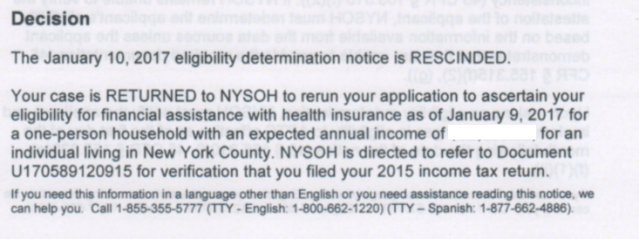
This is the punchline of the decision from NYSOH (one wonders who it is returned to, since the decision itself came from NYSOH) regarding my vast overpayment of premiums since February 1, 2017:

Screen shot 2017-07-10 at 5.45.04 PM.png

Meantime, in an effort to get a second opinion on treatment for my kidney disease that does not involve an every other month three day infusion of intravenous steroids during a six month immunosuppressive regime, I found an internist who is also a nutritionist and holistic practitioner.   To get insurance payment for a second opinion from this out-of-network doctor requires prior authorization from the insurance company’s Medical Management Office, the outfit that determines if medical necessity justifies payment to an out-of-network doctor.   The doctor’s office must call to get this prior authorization.  I passed this information on to the doctor’s office and they told me they’d call to get the prior authorization.

Got a call back a short time later from Mary Rose, the office manager.  She was told by the Medical Management Office that my insurance policy does not cover out-of-network medical services under any circumstances.   I called the insurance company and was assured, again, that in a case of medical necessity, my insurance would cover the cost, or some unknowable part of the cost, of seeing an out-of-network doctor.  The doctor just has to call to get prior authorization.  I described what the doctor’s office was told: that I am not eligible for out-of-network coverage.  “That’s because they didn’t get prior authorization,” Jasmine told me unhelpfully.  

I am an attorney.  I am somewhat articulate.  I have long experience in not having strokes, even under brutal and gratuitous pressure.  I described the freedom of insurance companies to commit fraud in a scheme where there is no meaningful government oversight of their activities.  Citizens are mandated to buy private insurance, and are instructed to pursue all grievances about denied services with that private corporation that has denied them service.  It is a perfect cul du sac.  Services can be legally denied for a variety of reasons under the law:  an incorrect NPI number or a transposed CPT code or any other legitimate business reason.  I went on for some time about the lack of remedy for screwed insurance consumers and how tempted I was to put this case in front of a Supreme Court judge under NY State’s Article 78.

Jasmine was very decent about the whole thing.  She told me she’d be extremely frustrated too, in my position.   That human admission was rare, and no small thing.   She spoke to yet another supervisor, a third, called me back and spoke to Mary Rose at the holistic doctor’s office.   She walked Mary Rose through exactly what she needed to say to make my case that this second opinion was a matter of medical necessity for the Medical Management Office.  It was good of her.  In the end we wished each other a very nice day.  

It almost made me forget that my fourth attempt to get an appointment to see the nephrologist highly recommended by Sekhnet’s long-time doctor failed today.   Jinza the office manager still had to speak to the doctor I’d lost confidence in, and to that doctor’s supervisor, the one I’d been urged to see, before she could allow me to make an appointment.   This has only been going on for two weeks, and it is a mere ten days since my former nephrologist emailed to say she’d instructed the front desk to make an appointment for me with her colleague, so why am I being such an angry fucking pussy about it?   That’s the $64,000 question, doc.

Plain Language

When I went to law school, more than twenty years ago, there was a big emphasis on plain language.  Lawyers should write as plainly and clearly as possible.  In the old days, we were told, scriveners, who wrote legal papers for lawyers, were paid by the word and so they laid the words on with a trowel.  This practice led to unplain, exceedingly excessive language, writhing, modifier-laden legalese, language embellished, decorated, complicated and modified, as needed, or sometimes not, according to long custom, by a dozen redundant, recursive, tautologous synonyms encompassing a dozen finely calibrated shades of meaning, foreshadowing, portent, legal significance, modified ambiguity, standard boiler-plate ambiguity, ambiguousness intended and incidental, anything to the contrary notwithstanding.   Reading legalese is generally a huge pain in the ass– take a glance at our Constitution or any on-line contract you must accept before getting web-based services.   “Plain language!” we were told, “the law now requires anything a consumer will be bound by to be written in plain language.”

 That was some precatory, aspirational, academic shit, apparently.  We were also taught to use the female pronoun instead of him and his when speaking of general things.   It was a fairly liberal school, I suppose, even though it had its share of rigid sociopaths on the faculty.   There are, I need not point out, rigid sociopaths on every shade of the political spectrum.    

I am thinking about this because I just got a determination from the New York State of Health appeals unit.  It is seven pages of fairly spare legalese that concludes with the determination that NYSOH must rescind its notice of January 9, 2017 and reconsider my case in accordance with the law.   It does not say, anywhere in its learned pages, anything that someone without a background in the law can understand as a clear, five and a half month belated, reversal of NYSOH’s clear error.   An error, moreover (to use a word beloved of scriveners everywhere) that anyone on the NYSOH website can verify in less than five seconds.  

It was only a four and a half month wait for the appeal and then, a speedy 30 days for the determination to be written up and sent out.  I have only been required to loan a large corporation about $1,250 in that time and I am told it will come back to me some time next year when I file my taxes, since I was entitled to what the decision refers to as the APTC, payable on my behalf towards the monthly premium of the QHP.  The subsidy, in other words.    

Rigid sociopaths are currently dickering about the quickest way to dismantle the conservative think tank-born, health care industry-friendly health insurance plan that bears the hated secret Muslim president’s name.  These are some dangerous, cynical, amoral motherfuckers doing this dickering.   Obamacare is bad in many ways, very bad in some ways, but it is a step forward, although not necessarily in the absolutely right direction since it leaves ravenous foxes to supervise the hen house.  The plan these dickheads are trying to push through will be a disaster for millions.  It has a 12% approval rating among the citizens of this nation of poor bastards, which is why it was initially kept secret and why its advocates are refusing to allow public debate on the punitive details of the new bill.

The Republican plan, in fairness to them, while hurting the poor and lower middle class, will greatly benefit the rich.  Who can blame the rich for trying to get richer?  It’s only natural.  

Like trying to repeal the hated DEATH TAX, another long time dream of America’s greediest.  Check this number out– I don’t know why it is not more widely known.  The so-called DEATH TAX affects the top 0.2% of our great, gullible, lynch-mob republic.   For those of you not good in math, that’s 2 estates out of every 1,000.   I don’t know about you, but that number of people affected by the so-called DEATH TAX, the top 2% of the top 1%, gives me goose bumps.   

Have a groovy fucking day, y’all.

Fighting Monsters

Monsters inspire terror, which makes our fear of them unreasoning and debilitating.  We know this crippling terror from early childhood, and it is terror without chronology, just as fearful now as when we were first gripped by it.  We need to remember that monsters must be fought, and that they can be beaten.  It takes organization and courage, the kind of courage we give to each other during a long fight.  Monsters become monsters because of their own bottomless fear, which is something that can be used against them.  Monsters are bullies, and we all know all about bullies.  We have defeated monsters in the past, though it has sometimes taken a grotesquely long time.  

There was a time here in our great democracy, for around a hundred years, when states that favored lynching did nothing to stop the practice.   Lynching was considered an exercise in liberty,  enraged citizens dragging someone they suspected of heinous crimes to a tree, torturing them and hanging them by the neck until dead.    Souvenirs of the lynching were sold, body parts, post cards. For daylight lynchings, people brought their children to watch the spectacle, it was an early form of reality TV.    There was a good reason Southern Democrats in the Senate repeatedly filibustered federal anti-lynching bills.   They were racists playing to the racists they represented, racists who would have considered a federal law against lynching a betrayal.

The example of lynching is old, of course.  We no longer regularly lynch people here in America.   At least not with a mob and a rope.   In other places, sure, the equivalent can still be done routinely as a matter of foreign policy.  Trump sells $110,000,000,000 in high-tech weapons to the warlike Saudis who will use them against the children of the poorest country in the Middle East.  Obama sold the Saudis about the same amount of weaponry, as Dubya did before him, and Clinton before that.

It is merely the way business is done and there is no morality attached to it.  If a business is very, very lucrative, a way will always be found to sell the product and make a ton of money.  It happened for decades with cigarettes, even after their role in lung cancer and other disease became well-known, it is still going on full tilt with fossil fuels, extracted from the earth in more and more destructive ways.  If the product is, say, cluster bombs, or white phosphorous (which burns flesh to the bone), both widely considered a war crime to drop, and we make them here, and sell them to third parties — well, it creates good jobs for good Americans and generates massive profits for the company that makes ’em, and for the shareholders.  A lot of winners, a few losers, but that’s life.  

The problem, of course, for those of us who would fight monsters, is that we live in a world where countless monsters walk among us, ubiquitous and seemingly untouchable as the zombies on TV.  Is the biggest monster catastrophic Climate Change, which, in the United States, alone among the nations of the world, has a powerful, motivated, very wealthy lobby convincing the credulous that, in spite of impressive evidence of change, no change is even happening?  Is the biggest monster Martin Luther King’s three headed monster of racism-militarism-poverty?   That was the in-your-fucking-face monster that made it necessary to kill King.  Is the systematic dismantling of all programs to protect the public, well under way by the extremists who are now mainstream Republicans, the most immediately threatening monster?  

Or is the most dangerous monster a relatively small thing, like the deliberate appointment as Secretary of Education of a hereditary billionaire ultra-conservative Christian fundamentalist who has never set foot in a public school?   Or the appointment of a man who sued the Environmental Protection Agency more than a dozen times to head the agency responsible for protecting our air, water and soil?  Or is the appointment of a Supreme Court justice to the right of the extreme rightist Antonin Scalia the biggest monster?    

These are all gigantic monsters well beyond the immediate ability of even a well-organized, disciplined group of people to fight.  Our laws have allowed each of those things to take place and they cannot be changed until a massive citizens’ movement and a future election change the political landscape.

I can think of only one monster that is within my reach to take a poke at: unaccountable corporate health care in New York State.   While the complete lack of government regulation of the practices of health care  providers in New York State does not affect anyone I know but me, it affects the health and lives of hundreds of thousands, if not millions, of New Yorkers.  Let me take a long-delayed swing at this monster for a few moments, in the interest of finishing my stalled letter to the pugnacious progressive Attorney General of New York State, an official who also proposes legislation and advocates for it.

Dear Mr. Attorney General:  

At this moment when an American’s basic right to affordable health care is in jeopardy, I write to alert you to a consumer health emergency in New York State.  New York State has no government forum where a patient denied health services can have a grievance heard, even if that grievance is a matter of life and death.   I speak of my own experiences, which I’m certain can be multiplied by the experiences of tens of thousands of low income New Yorkers, many of whom cannot advocate for themselves.  

I write to urge your office to recommend a regulatory scheme to the legislature. The regulators would be able to quickly adjudicate matters like the denial of services by a cardiologist to a pre-approved patient recently released from a hospital for heart issues.   At present a patient’s only appeal is to the insurance company, a company that has multiple legal grounds to deny claims (incorrect NPI number, transposed CPT code number, etc.)   At the very least an ombudsman’s office is needed to supervise these widespread, unappealable, regularly occurring corporate abuses.  

This letter will provide a road map to the empty shell of the regulatory scheme currently in place in our state.  I will also provide examples of colorable fraud from my own health-challenging experiences.

As a self-employed New Yorker, I have purchased private insurance in New York State for over a decade, at first under the Healthy New York program and, since its abolition, under the Affordable Care Act (“ACA”).  When the State adopted the ACA it merged the consumer oversight functions of the Insurance and Health Departments (along with several other disparate agencies) into the Department of Financial Services, a department that does not investigate frauds against consumers.   

I am not writing to complain about the sometimes arbitrary costs of health care under these programs, but to draw your attention specifically to the lack of any kind of due process for New Yorkers who are denied needed medical services.  A New Yorker’s only appeal under current law is to the company who has denied the medical service.

As a matter of fact, now that I have written these words, I am going into the other room to fuck myself.  With all of the other pressing problems your office is vying with at the moment, it is hard to imagine that the death of a few more or a few less low income people, people who die disproportionately under our current health insurance scheme, amounts to a hill of beans in our publicity-driven world.  An impeccably reasoned posthumous letter, I am sure, would hold greater moral clout than the letter I am struggling to complete now.  I am, therefore, working on getting it to your office later, rather than sooner.   I will put the finishing touches on it from my hospice bed, assuming I am still able to secure one. Have a very nice day!


Moral Exemplar, Part Two

A friend, after a depressingly detailed lunchtime conversation about the current state of American affairs, begged me to tell her one positive thing.  I promised I would, and bought time by heading to the bathroom to think of something.   I smiled when I got back to the booth and spun out this idea.  

We’d both been lamenting the lack of a community of fellow actors to interact with.  The isolation one feels in the social media echo chamber can defeat all thoughts of positive group action.   This is partly by design: demoralized individuals in their private echo chambers are unlikely to act in concert in the face of tyrannies small or large.   How about this idea? I asked.  

I go to my local library and speak to the person in charge of assigning the public room there.  They have language lessons, computer classes and book clubs there.  I’d propose to run a six week animation workshop open to all ages.  I’d show her my thirty second demo on my fancy new phone.   Children must be accompanied by an adult (one adult per three kids) senior citizens are cordially invited along with anyone else who likes interactive creative play.   Session one everyone signs in, animating their name and learning the basics.   For session two, we animate various emotions, using faces and body language.   The remaining four sessions are devoted to producing a group message to the people in power.  

“Ooh, I like that….” said my friend.  

I agreed it was kind of subversive, having a group of random strangers acting in concert to make an animated one minute message to the unaccountable powers that be.   I already have all the materials and equipment packed up and ready to carry over to any room the local library can spare.   How about if we produce something really moving, narrated by children and old people?   The library puts it up on its website.   Say it goes viral?  

“That’s a great idea.  Are you going to do it?” she asked.  

“Probably not,” I said, stating the obvious.

Frederick Douglass on July 4th to the slave

The great James Earl Jones reads a short section of Frederick Douglass’s powerful 1852 speech.

To drag a man in fetters, into the grand, illuminated temple of liberty, and call upon him to join you in joyous anthems, were inhuman mockery and   sacrilegious irony.  Do you mean, citizens, to mock me, by asking me to speak today?  …What, to the American slave, is your Fourth of July?  I answer.

Rebroadcast by Amy Goodman here.   The entire speech is here.