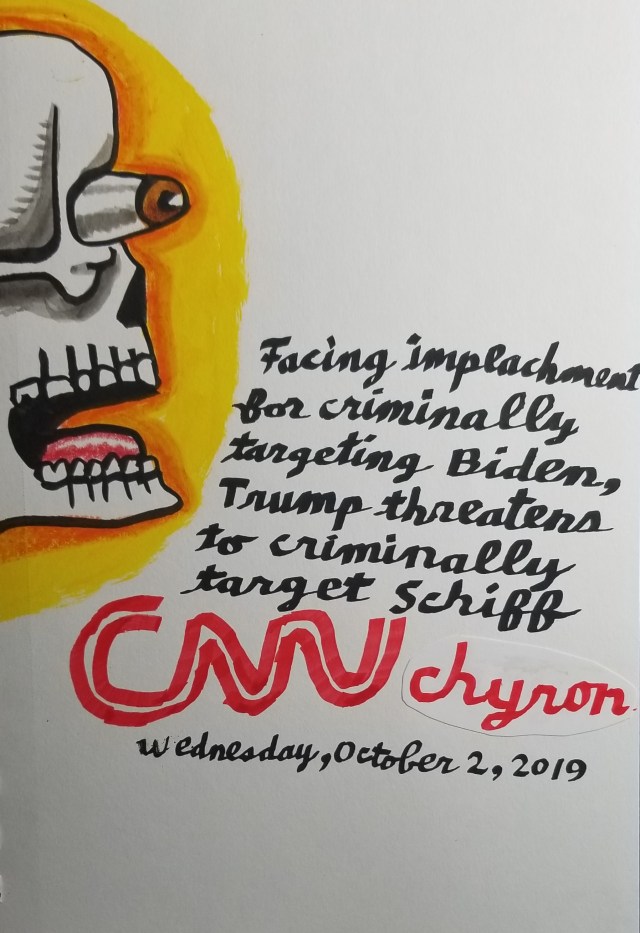
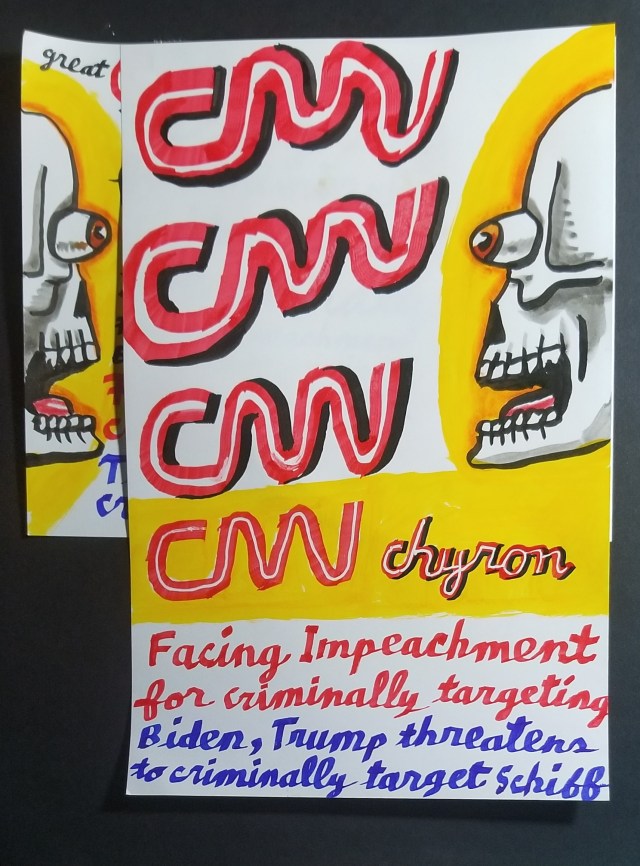
George Conway makes a strong case for the president’s unfitness for office

What I’ve read about him makes me no fan of George Conway or his worldview.   He’s a corporate lawyer, for starters, an expert in “corporate ethics” — whatever that might be.   Conway is an enthusiastic participant in Federalist Society galas who celebrated the appointment of the unimpeachable Boof Kavanaugh.  He’s a partisan right wing Free Market conservative.   That he is the husband of shameless alternative-fact spouter Kellyanne Conway, one of Trump’s most ardent loyalists, is not a fact (alternative or otherwise) in his favor, from my point of view.  

Yet George Conway has long been publicly critical of the reality TV president’s regular excesses.   I suspect a lot of Conway’s opposition has to do with the damage the volatile, conspiracy mongering Trump is doing to the right-wing brand.   Hard to defend liberty from government tyranny when the front man for your cause is acting like an unhinged government tyrant.

Recently Conway wrote a long article for The Atlantic entitled “Unfit for Office” with the subtitle: Donald Trump’s narcissism makes it impossible for him to carry out the duties of the presidency in the way the Constitution requires.   You can read it here.

I have to give it to the man, it is a very well-written, thorough and compelling case that states the obvious in painstaking detail, with hundreds of illustrations.   As he points out at the start: you don’t need to be an orthopedist to know that when a man’s foot is violently twisted at a hideous angle to his body, a loud snap is heard and the afflicted man is writhing in agony, unable to sit up, his leg broken in a grotesquely unnatural position, that the guy has a serious medical problem.   Same with the president’s clear pattern of lying, attacking, bragging, blaming, erratically changing course, compulsively doubling down.    

Malignant Narcissist?   Who knows.   Trump is clearly unfit to be a corporate CEO, (this person is a fiduciary in Conway’s world), or even the manager of a Burger King, let alone the president of the United States.  That much is pretty clear to the 60% of American voters who have never supported him.

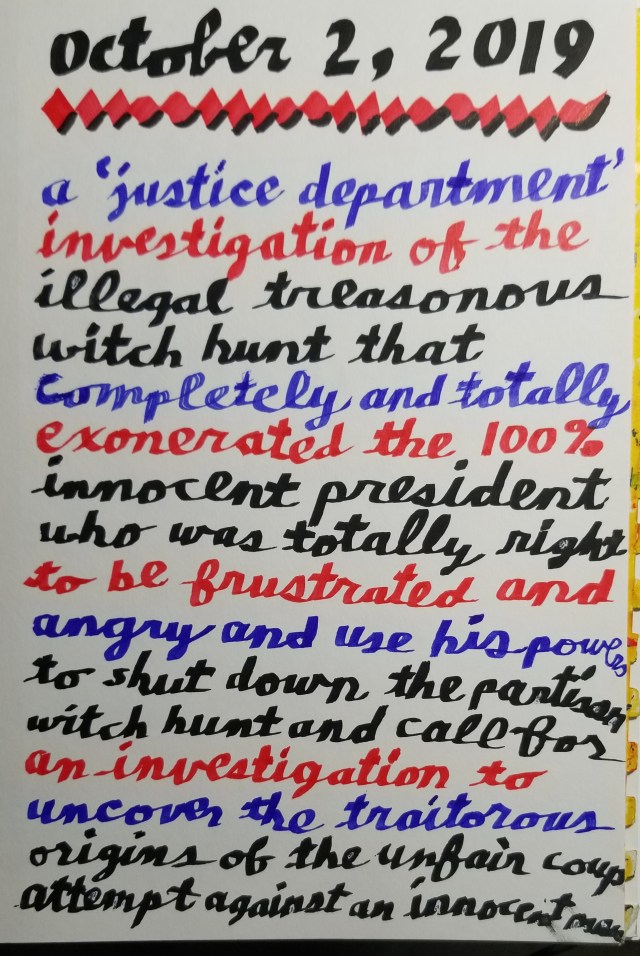
Conway didn’t mention the murder and dismemberment of American resident journalist Jamal Khashoggi, the grisly hit ordered by Jared Kushner’s good buddy Mohammed bin Salman, or Trump’s nuanced embrace of the ever changing lies the Saudis kept spinning when the shocking story was front page news for a couple of weeks.   If Trump had his way, the man who wrote these traitorous, treasonous, fake words would meet a similar fate, no question about it:

(4) Requires excessive admiration? Last Thanksgiving, Trump was asked what he was most thankful for. His answer: himself, of course. A number of years ago, he made a video for Forbes in which he interviewed two of his children. The interview topic: how great they thought Donald Trump was. When his own father died, in 1999, Trump gave one of the eulogies. As Alan Marcus, a former Trump adviser, recounted the story to Timothy O’Brien, he began “more or less like this: ‘I was in my Trump Tower apartment reading about how I was having the greatest year in my career in The New York Times when the security desk called to say my brother Robert was coming upstairs’”—an introductory line that provoked “‘an audible gasp’ from mourners stunned by Trump’s self-regard.” According to a Rolling Stone article, other eulogists spoke about the deceased, but Trump “used the time to talk about his own accomplishments and to make it clear that, in his mind, his father’s best achievement was producing him, Donald.” The author of a book about the Trump family described the funeral as one that “wasn’t about Fred Trump,” but rather “was an opportunity to do some brand burnishing by Donald, for Donald. Throughout his remarks, the first-person singular pronouns—I and me and mine—far outnumbered he and his. Even at his own father’s funeral, Donald Trump couldn’t cede the limelight.”

The (4) Conway refers to here is one of the nine diagnostic criteria for the most extreme form of narcissism.  They are listed in the DSM (the American Psychiatric Association’s Diagnostic and Statistical Manual of Mental Disorders), the authoritative text that psychiatrists, psychologists and insurance companies use to determine who is clinically nuts and what exact shade of pathological nuttiness they suffer from.  

I adopt this cute form because the DSM is far from a definitive masterwork of the healing arts, particularly in the tricky, mysterious, value-laden, fluid field of mental health disorders.   In the first edition of the DSM (they are up to version 5 or 6) homosexuality, for example, was considered a mental disorder.  It was listed in the DSM as a “sociopathic personality disturbance” for more than twenty years.    Still, Trump’s nine for nine on the Diagnostic and Statistical Manual’s list for Malignant Narcissism is impressive.   A clinician only needs five of the nine to make the case, write the code, prescribe the pharmaceutical, have the insurance company cut a check.  

Conway makes the point that we don’t need a clinical diagnosis to see the problem with having somebody like this as the most powerful person in the country.   Every day there are numerous examples of his unfitness for office.   I guess, given the circumstances, Conway would prefer the more dignified Mike Pence as president. Pence may be a pious, rigid yet supremely ambitious conservative fanatic (with enormous talents as an ass-licking sycophant) placed in public position by the cynical Koch machine, (like Mike Pompeo and Mick Mulvaney), but at least he’s not an embarrassingly loud-mouthed imbecile who threatens to destroy the carefully cultivated, expensively promoted right wing brand.  Conway:

The diagnostic criteria offer a useful framework for understanding the most remarkable features of Donald Trump’s personality, and of his presidency. (1) Exaggerates achievements and talents, expects to be recognized as superior without commensurate achievements? (2) Preoccupied with fantasies of unlimited success, power, brilliance? (3) Believes that he or she is “special” and unique and should only associate with other special or high-status people?  That’s Trump, to a T.  As Trump himself might put it, he exaggerates accomplishments better than anyone. In July, he described himself in a tweet as “so great looking and smart, a true Stable Genius!” (Exclamation point his, of course.) That “stable genius” self-description is one that Trump has repeated over and over again—even though he has trouble  with spelling, doesn’t know the difference between a hyphen and an apostrophe, doesn’t appear to understand fractions, needs basic geography lessons, speaks at the level of a fourth grader, and engages in “serial misuse of public language” and “cannot write sentences,” and even though members of his own administration  have variously considered him to be a “moron,” an “idiot,” a “dope,” “dumb as shit,” and a person with the intelligence of a “kindergartener” or a “fifth or sixth grader” or an “11-year-old child.

If that’s not high treason, yo, what the fuck is?  It’s fucking BullSHIT!   SAD!!!   Good thing Mr. Trump has Mr, Giuliani and Mr. Barr on speed dial for exactly this kind of traitorous treachery.  USA!   USA!!!    

Read the article and tell me George Conway is wrong about Trump’s unfitness for the office he holds in his short-fingered, vulgar hands.

Our lives, after death

Yesterday I guided a dead former friend’s older brother to the favorite lake of the departed, a lake he’d swim in for literally hours at a time, a place I’d hiked to many times over the years.   Sunny and cool, it was a perfect day to carry Mark’s ashes up the small mountain and scatter them in a beautiful lake.   

The trek also gave us six hours to talk, and remember, and flesh out more details of a convoluted, vexing, largely miserable life.  Made me think about what’s left of each of us after we die — the impact we had on the people closest to us.    You can see the last of Mark’s mortal remains in the grey splotches at the edge of the lake at the bottom of this photo:

20191004_150114.jpg

Mark had many good people in his life at various times, though virtually nobody by the end.   His brother was one such person, but they had a falling out three years earlier, hadn’t spoken since.   His other brother never broke things off with him, but was quite dismissive.    His ex, who he rejected after she was insufficiently moved when his 98 year-old mother died suddenly, is a good and generous woman who hosted Mark’s brothers for two weeks as they tried to put the dead man’s affairs in order.   His favorite cousin, a beautiful spirit twenty years younger than him, a kindred soul he loved and wrote long. soul-baring letters to (until the family intervened to let the adult know they thought his flourishing quasi-romantic correspondence with a teenager was inappropriate) — they’d finally had a fatal falling out too.   Me and him?  At one time best friends, but for years estranged, finally virtual enemies.  I literally cannot imagine what the guy’s laugh sounded like, I hadn’t heard it in that many years.  All I can recall of him now is his churlish glare.   Nice legacy.

I’ve discussed him with several people who knew him pretty well.   We are hard pressed to recall any  unreservedly fun times with him (though our Corsican friend — among the first to repudiate him after three brutal strikes — shared some fond memories).   What we all recall is the familiar three act play he was compelled to act out over and over.  Act one: new person or thing — amazing, the best, the ultimate! Act two: warning signs of imperfection, Act three: traumatic, unendurable betrayal.

Mark was demanding, famously so, of all of us and of himself as well.   He was a perfectionist continually disappointed to be living in a world of fallible hacks where perfection is almost never seen.   He always sought the highest expression of perfection and was continually disgusted to find only the sorry human equivalent — flawed people, disappointing, aging, doomed to wither and die.   Old age depressed him terribly, though he was completely crushed when his mother died before she was even a hundred.

I learned two truly terrible things yesterday, one on the ride up, the other almost at the end of our hours together.  Each with a horrific image to go with it. 

Mark had a business, selling food made in a dirty commercial kitchen his friend the inspector gave him a pass on.  The new inspector was less inclined to overlook the black mold, the filthy deep fryers, the unwashed ventilation hoods, the old worn counters the pad thai and breakfast burritos were made on.  Mark’s workers were badly underpaid, all of them, and when they worked overtime they were never paid extra, as the law requires.  He was able to get away with making them work 12 and 15 hours days (when necessary) because the workers were for the most part undocumented or otherwise vulnerable to coercion.

His two longest tenured employees, a Salvadoran couple who had worked for him since 2002, made a claim, shortly after he died, for unpaid overtime since 2002.   He had sponsored them for green cards and so they owed him, but now they were demanding their due.   As part of a settlement, Mark’s brothers paid them severance of about a year’s wages and let them take what they liked from the kitchen and from Mark’s house.  They pulled up in a pickup truck and filled it at least twice.   They cashed the checks the brothers wrote for them after they signed the release, then started a lawsuit  for the back wages since 2002.

Horrible image number one, right out of Ebenezer Scrooge’s Christmas eve nightmare conducted by the silent, terrifying ghost of Christmas future.  After Mark died, people he’d openly exploited for years, people who justifiably hated him, gleefully rummaging through his possessions looking for things of value.   All of the things he collected, cherished and loved, fingered and pocketed by people intent on recouping something from a man who had taken ruthless advantage of them.   I can imagine faces beaming maliciously as one of the defrauded holds up some cherished object that could be sold for $300.   $300 they’d been cheated out of by nickels and dimes over countless long days in a filthy job.

The final horrible image was of his last moments on this earth.  I learned of this toward the end of our trip yesterday and it is maybe the worst of all. 

Mark lived with an apparently lovely young woman, a Muslim from Morocco, a religious woman.   They’d been together for four years, since he’d hired her, and it was unclear what the nature of their relationship was.  She did not consent to be photographed, she was very religious.   She wanted to marry Mark, but only if he converted to Islam.   Mark was never going to convert to anything.  And so they lived together in Mark’s cluttered house, though one can only imagine the details of their arrangement.  Shades of the Salvadoran couple in that she had no legal status in the U.S. and she lived under Mark’s protection, to a large extent.

His housemate had called at 5:30 to tell Mark she was on her way home.  He said he’d see her soon.   At 6:00 she arrived to discover his naked, dead body.  

The moment of his death.    Naked in his computer chair he was following his new practice for achieving perfect clarity.   The theory has been popularized by “Ice Shaman” Wim Hof, teaching practitioners to push past boundaries to a fuller existence.   Part of it, apparently, requires teaching the body to go without oxygen for longer and longer periods.  After a round of deep breathing, you hold your breath for as long as you can then rush into an ice cold shower (or plunge into an ice bath) where you breathe for your life and emerge feeling energized, with no further need for caffeine.  Mark, over the course of several months of diligent practice, was apparently up to four minutes without oxygen in his quest for perfect clarity.  This theory was exactly the kind of dramatic shortcut to enlightenment that greatly appealed to Mark.

Try holding your breath for as long as it takes to read this next paragraph (I’ve already had two or three lovely, life sustaining breaths myself) and see if you can follow the logic of striving for perfection this way.   After a short interval without oxygen you feel a desperation to  breathe (you’re at about ten seconds now).   You must resist this desperate feeling as the mortal weakness it is (I made it this far holding my breath, but hold on to the end, you can do it!) — put all thoughts of an oxygen deprived brain out of mind.   After a time your lungs feel like they might burst, but pay no attention to that, the theory demands you exceed what you falsely believe to be your limits.  Your heart may begin screaming, twisting in your chest, no worries.  Nothing to fear but fear itself, and the rewards are fantastic.   (30 seconds, come on, come on, you can do it…)  Two minutes and twenty seconds, let’s go for two and a half.  Now we’re up to four.

In fairness to Wim Hof, and the many who swear by his techniques, Mark’s death probably had much more to do with Mark’s rejection of science and doctors than it did to the health enhancement techniques Hof advocates.  Mark apparently hadn’t been to a doctor in years.   He was overweight, aggravated, fighting with everybody.   His arteries may have been only a hairsbreadth wide when he began this demanding regime of holding the breath and plunging into ice water.

Picture the unimaginable horror of the devout, modest Muslim woman, finding her beloved housemate naked in death.   The medical examiner noted that the discoloration on the skin over the naked cadaver’s heart was a clear indication of death by heart failure.  There were other signs as well.  The heart apparently gave out.  It was not a stroke, the signs would have been different, reflecting some terrible agony at the end.  

In the end this man who stubbornly refused to believe, in spite of a lifetime of evidence, that the world was a viciously unfair place, where the ecstasy of perfection was at best fleeting, where betrayal by anyone you love was inevitable, where all flesh withered and people aged and became grotesque, might well have held his breath until he died.

Repentance and Atonement

It may seem churlish, arch and dickish of me to bring this up, especially during our Second Civil War here in the land of the conditionally free and the home of the transactionally brave, but a sincere apology is a powerful thing, a force for peace and reconciliation.   Sad to say, as Sir Elton sang it, in words probably written by Bernie Taupin, ‘sorry seems to be the hardest word’.

I think about this each year at this time on the Jewish calendar, during the Ten Days of Repentance.   We are supposed to use this time to honestly review our actions of the past year, find acts we regret, times we were wrong, seek out, apologize to and make amends with the person we hurt.   

It is a beautiful and very humane idea.  It is a caring thing to do for people we care about.   It is a hard fucking idea, to make yourself humble and vulnerable, especially when the hurt was mutual, where you feel like the other person also  acted like a jackass.  Too hard for most of us to sincerely apologize because, seriously, the world has probably been meaner to us than we were to some provocative asshole who desperately demanded whatever we might or might not have done to them.   

This self-justification is the working of anger and its first cousin pride.  These emotions have one demand: I am right and you are an asshole.   It’s a zero-sum emotional landscape.   While I am angry at you, my friend, you are a fucking piece of shit and I have a hundred reasons why.   Deny it, go ahead, it only makes you more despicable, unredeemable, deserving of my wrath.     

I realized the other night that in my understandable desire to have someone stop talking aggravating shit to me, I went too far.   I didn’t stop to consider that this old friend’s sudden rage might have indicated he was having a serious problem or something.   He attacked like a petty prosecutor, he doubled down when I tried to explain, when I  asked for the benefit of the doubt.  His final email came back lightning fast and really got under my skin. 

I waited a few days, removed some expletives from my reply and methodically,  surgically, wounded his pride to shut him up.  The hideous noise stopped, peace, end of story.   

I can rationalize my hurt, my anger, 100%.   The guy acted like a world class jerk, no question.   Yet, look, I was also very harsh to him.   Those are two different things — his acts and mine, and we are each responsible for our own.   I was wrong.   I erred on the side of hurting him too much, to guarantee he would have no reply.   His timing had also been bad, his instant double-down on his anger came back right before my birthday.   A self-righteous, superior, stupid stream of steaming shit, right in my inbox.   I needed to make it stop.   

Did I need to cut off both of his arms and legs, and his head, to make sure he couldn’t respond?   It felt like I needed to at the time, to be sure, but now I can see a range of choices I didn’t consider, much more productive ways to proceed.   I did the one thing that would guarantee the quiet I needed, though it also ended not one but two friendships.

Was I wrong?   Arguably not.  Still, did I need to be so harsh?  Probably didn’t need to be so harsh.   So I sat down the other night to write a letter apologizing for my role in our titanic, fatal battle of the assholes.   No point arguing over who was more at fault, we were both hurt and angry and lashing out. 

I did something I now know was wrong and I am sorry.   Sorry I was so viciously hurtful, what I did would have hurt me, would have hurt anyone.   It cost me two old friends, and I was wrong to offer no way back from our dumb fight over nothing specific.

Writing that letter while refraining from justifying myself cost me blood.  As I was writing it I had to keep separating what I had done from the several strong provocations.   You may well have provoked me to want to punch your lights out, but I can still regret punching your lights out.  It does not accord with the way I want to live — being provoked and lashing out in return, I try to do better.   

Maybe it’s impossible to be friends with an insecure, competitive person who turns out to be a cheap-shot artist when it comes down to it, still, my reaction to even a cheap shot is my choice.   I chose wrong by calmly and methodically cutting this guy’s limbs and head off.

I spent a few hours writing the letter of apology.   I think it was a decent apology.   I have no expectation that it will change anything, and I wrote as much, but it was important to me to seize this important, widely neglected religious obligation to try to make peace instead of war.    I went to sleep and had troubled dreams.

I had been challenged, by a gang of Thai toughs, to body surf down a steep flight of stairs and, for some reason, I’d accepted the challenge.   A Thai tough had put on a motorcycle helmet and, when I wasn’t watching, supposedly tobogganed  down the steps on his belly, arms outstretched like superman.   I stood at the top, having accepted their challenge, and had many second thoughts — though there was clearly no way out. 

I asked for the helmet.  The owner of the helmet refused, handing me a soft stocking cap instead.   So soft I stood there petting it, a really beautiful material.   I put it on, stalling, not quite sure how I’d wound up in this untenable position.   I told them I needed to go next door.

Next door, in the bar,  I ran into a girl I used to know.   I told her about my predicament and that I had to go back and body surf down this steep staircase next door.   Instead of talking sense to me, or urging me to flee, as I was out of the presence of the toughs, she told me she’d go with me, that she had to see this.   She accompanied me next door, back to the top of the stairs, where she took a seat on a long bench with the Thai toughs (why were these toughs Thai?  No idea) and waited for me to make my injurious descent.   What the fuck, I thought?   I continued to stall.

I stalled long enough to wake up from this dream.   When I did, my first thought was that letter of apology I’d written to a person who had already told me that my previous two apologies, while sincere, were beside the point.  A person incapable accepting an apology and of apologizing himself.   I was angry about bending a knee to someone I still thought of as a petty tyrant, a giant two year-old.    

I understand:  you don’t apologize for the petty tyrant’s sake.  You apologize for your regrettable, if arguably justifiable, overkill.   You apologize to remind yourself to try to do better next time.

You apologize for the way your taking of the high road (no cursing, no outward show of hurt or rage) was nonetheless dismissive, vicious, and reduced the other person to sputtering, silent rage he could only take out on his wife. 

You apologize for the sake of the wife’s feelings, and because you probably didn’t need to remove all four of the guy’s limbs, and his head, no matter how loudly and aggressively the angry tough guy may have demanded it.   

You apologize because it is the right thing to do, because the world is better when people try to make peace than when they hold ugly grudges.  Even if it makes you feel like you are giving in to a smirking bunch of asshole bullies who wait for you to break a limb or two, or perhaps your neck, as you try to keep your word.