I grew up believing that my father’s name was Israel Irving Widaen. Apparently this followed the traditional naming scheme for a Jewish boy back then. The given first name, I learned today, was designated his shem kodesh, or holy name, the name used to call a Jew to perform religious duties. You’d be called by this name to read from the Torah, for example. The second given name was the secular name, the kinnui, used every day, hence: Irv Widaen. He told me his name was Israel Irving Widaen, signed his name I.I. Widaen, or sometimes Israel I. Widaen.
I don’t know when I discovered this, probably while worrying over the inscription on my father’s grave stone, but his given shem kodesh was not Israel (Yisrael) but Azriel. It rang a bell, I’d heard older Yiddish speaking relatives sometimes refer to him as Azrielkeh (little Azrael).
Interesting side note, Azrael, or Azriel, Jeeves informs us, is often identified as the Malach Ha-Mavate, the Angel of Death, in the Hebrew bible.
Israel, Azrael, Iceberg, Goldberg… what is in a name? I don’t know. My father’s father had come from somewhere in Eastern Europe, as a very young boy, with the name Eliyahu (something) Widemlansky. The boy’s name was quickly cropped, American-style, to Harry Widem. There is an extended Widem family living in America today. When I was a kid I met Harry’s half-brother Harry, a widower (or possibly divorced) and his brother Peter, who lived on a farm with his wife Elsie. They lived in Connecticut, as I’m sure some of their offspring still do.
Uncle Harry, I recall hearing, from Eli, had a leg amputated later in life and was possibly dying from the same horrible disease when, depressed and at the end of his rope, he walked into the Connecticut River one icy winter day during my childhood and drowned himself. He was a big man, physically imposing, maybe 6′ 4″, who once worked for Isaac Gellis, purveyors of kosher delicatessen meats. I know this because the one time I remember meeting him he gave me an Isaac Gellis pencil. I began drawing with it immediately. I remember the logo on the oversized white pencil had a cool Hebraic flair. I remembered correctly:
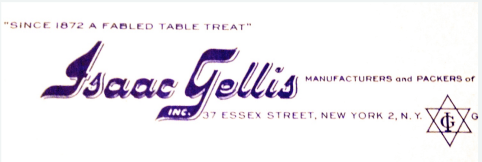
My father could have just as easily been Azrael Irving Widemlansky. His brother was Paul Widem, called by the diminutive Pesachl by his mother. My father was Israel Irving Widem all through his childhood, is recorded by that name in his 1941 Peekskill High School yearbook. That was his name until his first drill sergeant in the U.S. Army addressed him as Private Widaen. He tried to object but the leather-lunged instructor told him he was a maggot and to shut his goddamned mouth. At some point he was promoted to Corporal Israel, as the southern boys called him, and later sergeant, as I recall, but kept the name Widaen at the end of the war.
The misspelling resulted from his mother’s hesitation with English, a language she appears never to have mastered. When she gave birth on the Lower East Side in 1924 she was asked the spelling of her last name. Widem became Widaen on my father’s birth certificate, as the nurse rendered it, though that spelling didn’t come into play until Selective Service used the name on his birth certificate to draft him into the Second World War. I suspect Israel/Azrael might have been a similar deal.
His story was that all of his GI Bill benefits were under that name and that he was told a name change would hold up going to college by a couple of years. I doubt the whole truth of this story now. The Widem side of the family, outside of my uncle, his wife and their two kids, was rarely mentioned during my childhood. I recall meeting my father’s uncles once or twice, a cousin or two, and then– nada. I don’t know how many Widems there are today, or where any of them live.
I recall a kid named Curtis, a cousin I met when I was maybe eleven. Curtis was a few years younger than me, and he also loved to draw. We sent drawings back and forth for a while after I met him. I remember my father referring to one of his generation of Widems as an arrogant asshole. That was many years before my father died. My uncle and first cousin were the only Widems at his funeral. My more gregarious uncle (a meek-seeming tyrant, as it turned out) was also not in touch with any Widems.
The family I know, and a very small group it was, were the Gleibermans, the descendants of my father’s Uncle Aren. If not for Aren going AWOL from the Czar’s army during the Russo-Japanese war, boarding a westbound train with two fellow Jewish deserters while the rest of the army went East, there would be no Gleiberman relatives of mine in America, or anywhere else. Aren, in America since 1904 or 1905, survived the slaughter of the rest of his family back in Europe, as did his youngest sister Chava, who he sent for on the eve of World War One. Of the rest, there is no trace, although I learned the names of my grandmother’s siblings who were left in a muddy hamlet south of Pinsk: Volbear, Yuddle and Chashki. Of these people there is no trace.
My father was ashamed of his father. Eliyahu was a cipher. Alone of my grandparents, I have no idea where he came from. He was illiterate, I learned as my father was dying. Hours before his death my father described his father more completely, and more charitably, than at any other time. His full description is as follows, “my father was an illiterate country bumpkin completely overwhelmed by this world.” Eli described his mysterious, deadpan face as “two eyes, a nose and a mouth”. The picture speaks for itself.
It’s not surprising that my father accepted a new name, a neologism unknown in the United States, as per my bureaucrat uncle’s exhaustive search of the Social Security database. My father did not want to look back at his former life, he did not particularly want to be associated with his father’s family, though he stayed in touch with his three cousins on his mother’s side, the Gleibermans.
I was thinking of my father’s mother, my grandmother Chava. All I know of her is that she was barely five feet tall, had red hair (and according to Eli had been a beauty), was very religious and had a famously violent temper. I learned that she had regularly whipped her infant son, my father, across the face with a heavy cord. She also called him “Sonny”. I conclude from these things that she was an enraged psycho of some kind. But I envisioned her life today from another angle.
Eli told me she had fallen in love with a Jewish post man, while living with and working for her older brother Aren and his second wife in Peekskill. According to Eli, this red haired Jewish postman was smitten with Chava, and Chava liked him. Also according to him, Aren and his wife busted up the romance. “She didn’t want to lose her slave. Chava was indentured to them, paying off her passage from Europe as their live-in maid, and she told my father to get rid of the postman. He did.”
Years later a marriage was arranged by Aren for his little sister, now on the verge of becoming an old maid. The groom was a man without prospects, Eliyahu Widem. As the punching bag of his father’s second wife, he had learned to duck and keep all expression off his face. That was about it, from what I can tell. Chava found herself living in a rented hellhole on Manhattan’s teeming, disease and crime-ridden Lower East Side, married to a cipher.
Her new husband drove a herring wagon, the horse clopping from store to store. When the horse stopped in front of a store, he’d get down and wrestle a barrel of herring inside. When the horse died he went out with a new horse. The new horse had no idea of the route, neither did my grandfather. When he returned at the end of the day with a wagon full of herring barrels he lost that job.
At some point in the story Chava delivered a still-born girl, or perhaps the infant girl died after a few days. I can picture the dark, scary tenement, and Chava’s depression and mounting desperation. I can imagine her, a year or so later, naming the new baby boy, a huge newborn who must have been a difficult birth for the tiny, terrified Jewess. I can picture it now. “Israel, Azrael, Widem, Widaen, I don’t give a fuck. As soon as this kid can stand on his own legs I’m going to start knocking him down.”
And she did.
 gratuitousblahg
Great stuff, a very rewarding read.
Thanks, DD. Just saw this comment.