Trump’s top ethics lawyer appears to have tampered with witness

Stefan Passantino

You don’t have to say you remember things that might hurt our friend’s case. You can always just say ‘I don’t recall’, even if you do remember. That’s not perjury” advised a lawyer working for Trump’s Make America Fully Nazi PAC, allegedly.

This allegation was raised in the last January 6th committee hearing the other day. In response the lawyer involved, Trump’s former ethics advisor in the White House, still working for the big guy, was scrubbed from his law firm’s website. The guy’s a partner there and his law firm cut him loose immediately, based on this explosive allegation of professional misconduct and criminality, which, of course, does not become a fact until the jury finds that he did what he is accused of. Although, of course the words “Trump’s ethics lawyer” speak for themselves, loudly and with very bad breath.

Zelensky asked for “bicameral and bipartisan support”

Good luck with that ask Mr. Zelinsky, but excellent speech, man.

I’m sure that Trump and the party of Putin in America is not very happy about this little Jewish lawyer/ comedian/president’s speech in Congress. It’s amazing that the GOP seems to be taking the side of the aggressor in this war-crime ridden war for territory and domination of a sovereign neighbor. Or maybe not so amazing, considering everything else the party of violence stands for

Repetition Compulsion and me

A longtime friend, Mark Friedman, was the most dramatic example I ever met of someone with a repetition compulsion. Psychologists tell us that the compulsion to repeat the same painful pattern over and over is an attempt to resolve some injurious conflict that tormented us in our childhood.

In Mark’s case, as near as I could figure it, it had to do with feeling that his father never respected him, and that his mother could not love him enough to compensate for this. The primal wound he suffered is somewhat subjective and I don’t want to sound judgmental, but that he was compelled to repeat the same three act play throughout his tormented life is something I saw up close for many years.

The shape of the story was always the same, the three act tragedy identical each time.

Act one was great admiration, enthusiasm and pure enjoyment of a person who was finally able to provide everything he’d been looking for. This person was cool, smart, funny, ingenious, talented, charismatic and a great friend, the very best person he’d ever met.

During Act two cracks would predictably appear in this exaggeratedly perfect facade, which would become increasingly worrying to Mark.

Act three was the final, unforgivable betrayal of Mark, which happened every time as regularly as the sun rises and sets each day.

I don’t know of another case of repetition compulsion as dramatic as Mark’s. It was so clear to see, and so frustrating to me that as otherwise smart as he was he simply couldn’t see it. He’d get furious, in fact, if you pointed out any similarity in his crashed relationships. That, as much as anything else, was the cause of our final estrangement. Which, of course, fit the pattern, betrayal by his trusty longtime best friend was dictated by the three act structure.

While Mark’s self-destructive pattern was easy for me to see, the compulsion is much harder to recognize in oneself. Why was it that I was always attracted to smart, tormented, bitter, angry, darkly — sometimes sadistically — funny people throughout my life?

It was an attempt to work out with them what I could not work out with my own smart, tormented, bitter, angry, darkly — sometimes sadistically —  funny father. In the end each of these relationships ended in a bitter falling out that I tried, sometimes for years, to prevent.

The lesson that was so hard for me to learn was that these people I cared about so much were literally poison to me because they could never give me what I was looking for, what I tried so hard to give to them — the benefit of the doubt, empathy and friendship.

Without empathy or the benefit of the doubt we don’t really have friendship. If somebody is incapable of these crucial things, out of their own injuries, we often won’t notice it until conflict arises. They say conflict reveals character, and it’s true. Under pressure things you can’t see when everything is fine will squeeze you to death. While everyone is laughing together it’s easy to feel like great friends.

And it was this laughter, this often dark, cruel humor, that bonded my father and me in between our long sessions of brutal combat. These moments of shared laughter were a great release, a relief, as well as providing the giddy hope of finding any kind of understanding with my supremely difficult father.

So these sardonic characters who were my closest friends for many years shared this bond of black humor with me and made me feel I’d found indispensable friends and was not doomed to interminable, senseless mortal combat.

It has taken decades for me to finally learn this sadly simple lesson: just because somebody smiles wickedly and laughs at your sense of humor doesn’t mean that they are your soulmate. Funny as it may seem reading these dry, serious pages I post here, I am a very funny motherfucker and make many people smile wickedly and laugh. It has taken me half a century to untangle reactions to my sense of humor from the deadly limitations of some of my onetime closest friends. Droll, eh?

End of the line

I’ve had this kind of conversation before. Every time it is the saddest imaginable conversation, because at the end, in spite of great affection, both parties will be dead to each other. Alive and walking around in the world, and doing acts of kindness, and trying to be the best they can be, and dead to each other.

We don’t come to this kind of final conversation lightly. First of all, we have to care enough about the other person to extend them the final chance to avoid our mutual deaths. The average jerk who acts like a jerk and hurts us in a jerky fashion does not get this kind of final discussion. We just write them off, smile when we see them and avoid anything of consequence with them. But with people we deeply care about, who have deeply hurt us, it sometimes comes to this final conversation.

Personally, I tend to avoid starting these conversations once I’m fully aware of the hideous terrain we are both stuck in. Once the other party insists that nothing you have said changes anything, you are pretty much done. Words at that point have no ability to change the emotional reality that makes it impossible for us to continue as friends. In fact, if you express yourself clearly you are only making the wound deeper by seeming to blame the other person for being heartless, clueless, unforgiving, unyielding, rigid, needy, childish, etc.

The outline of this talk is always the same. The person calling will say they love you, that they have taken about all that they can take, that they have tried their best to be your friend and give you what you need but nothing they have done has been enough for you. They will place it on you, pronouncing the final death.

After all the aggravation, the soul searching, the health threatening stress of trying to find a mutual solution with somebody who is unable to overcome their righteous anger, their inability to forgive, words are of limited use. That said, it is good to remain honest until the end.

Trust me, you will get no acknowledgment of your honesty, and truly it means nothing in that moment. But you remain true to yourself by not pretending that all of your hard work has produced any tangible result. It is time to put down the cadaver of an old friendship you were carrying, alone, in hopes of a miracle.

I find that at the very end of these talks sometimes a last precisely calibrated insult can be very helpful in allowing your dear friend to permanently write you out of their life. At that moment, it is the least you can do by way of mercy.

MAGA justice

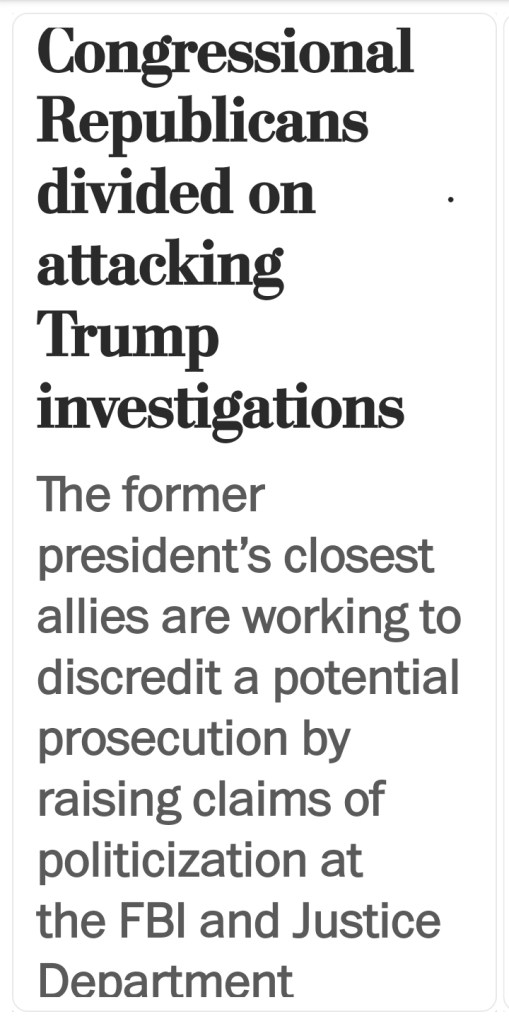
“We’re focused on how political our Justice Department has become — they’re making decisions on a political basis, we’re going to look at all that,” [Ohio rep Jim] Jordan said in a November news conference. “We’re concerned about anything that is being done in a political fashion at the Justice Department.” . . .

. . . Jordan’s counterpart on the House Oversight Committee, however, recently said in a CNN interview that following up an investigation into classified documents found at Trump’s private club and estate in Florida “will not be a priority.” Incoming chairman James Comer (R-Ky.) has been conducting the minority party’s own investigation into the August search warrant executed at Trump’s Mar-a-Lago estate, but he has indicated he favors prioritizing investigations examining Twitter’s handling of reporting on Hunter Biden before the 2020 election and the origins of the coronavirus.

https://wapo.st/3HHK6H6

Then with the same level of seriousness and shrewd analysis of what is in the best interest of Justice, the article ends with this blurting from the disgraced former president, our recent 2 year-old in Chief.

“Under the Presidential Records Act and the very well established Clinton Socks Case, the raid of Mar-a-Lago by the FBI, and the taking of documents and many other items, was ILLEGAL,” Trump said Friday on Truth Social. “Everything should be returned, at once!”

What it means to be unforgiving

Being unforgiving means you cannot let go of your hurt and anger, even after someone does their best to make amends. Even when someone expresses sincere regret for their harmful actions and humbly asks for your forgiveness, you can’t forgive.

This kind of angry person, who tends to live in a zero sum world of winners and losers, cannot forgive themselves, cannot calm themselves when they’re upset, have not learned to sit with strong, painful emotions and wait until they are calmer to try to resolve a conflict. Unregulated anger is destructive, it arises from pre-verbal fears and shame and it extends to an inability to forgive.

Holding on to anger is a maladaptive way to try to feel righteous and superior. This type, with its unhealthy bent toward indignation and rage, is clueless about how to resolve conflicts with others and within themselves.

When you think about it, it’s pretty clear that you have no obligation to forgive someone who hurts you and blames you entirely for making them hurt you. When no apology is offered, hurtful behavior is never acknowledged, your obligation to forgive disappears. That is not being unforgiving, it’s health, common sense and what’s best for yourself and other people that you love.

Those who can’t forgive, no matter what? Dangerous, wounded, supremely destructive motherfuckers. We might well feel very sorry for them, if we care about them, but not being able to forgive their eternal blaming anger does not make us unforgiving.

This type will force her mate to kill his best friends, and her mate will do it because he feels he has no choice but to become enraged at his best friends and kill them. Otherwise he will be derided forever as a contemptible weakling. The alligator he is wrestling with will point toward his more sympathetic friends and tell him that they are the vicious alligators and if he doesn’t fight them to the death he’s a pussy.

As long as he stays angry, he will never have to to be tormented by his own immature, self-harming actions, which is the greatest blessing to this eternally trapped poor bastard type.