GOP Narrow Framing, personal anecdote

As former president Trump’s legal team and his party begin to argue that it is unconstitutional to impeach a president once his party has run out the constitutional clock on an impeachment trial, and that anything the president might have said that made certain irrational people act violently against elected officials, even if seemingly in response to his exhortations, was within his protected First Amendment right to free speech, I have a personal anecdote that is directly on point. I’ll try to set it out in a flash for you.

When I was thirty my younger sister got married. I was the best man. There is a photo of me in my rented tuxedo making my ironic, prophetic toast welcoming my brother-in-law to the family. Behind me in the photo the caterer, also in a tuxedo, if I recall correctly, is glaring at me. Not a fan of irony, perhaps, I don’t know. A short time later the caterer was pounding me with his fists, trying to bash my face in.

Afterwards my parents took the caterer’s side in this dispute. My disrespect toward the caterer had, understandably in their view, justified the caterer in his strong conviction that I needed to be punched in my smart fucking mouth a few times. This fight, clearly, took place long before I began trying to practice a form of ahimsa, consciously refraining from harmful actions as much as I can.

In my own defense, I had no idea the caterer was an off-duty cop. Had I known perhaps I’d have chosen a less inflammatory way of telling him to buzz off than the one I used. In hindsight, I see how disrespectful it was of me to tell the officer to suck my dick. I’m still, more than thirty years later, not certain it gave him the right to physically assault me, but that’s not our concern here.

A few days after the wedding (the party was amazingly not interrupted by my loud fist fight with the cop, the band drowned us out) my parents were still in a rage because, in their view, I had deliberately tried to ruin my sister’s wedding. I was angry too. It seemed to me too evident to dispute that the caterer, at the moment he began trying to bash my face in, was at least as culpable as I was in the ugly confrontation. My parents disagreed. It had been 100% my fault, no question. The caterer was a lovely man, I was a violent, enragingly provocative thug, as they told me several times. After a few days of a sickening stand-off I went to confront my parents about this, to try to set the record straight.

They were defensive, sticking to their guns. I was a provocative, irrationally angry, violent-tongued person. I had no right, in any universe, to tell the nice man to suck my dick. My explanation, whatever it was, was beside the point. Once I said that to him he was within his rights to charge me, get me up on his hip and begin throwing punches into my face as hard as he could.

My explanations bounced off my parents like Jewish space lasers off a kryptonite force field. Like the caterer’s punches to my smart face, which landed on my forearms as I continued to provocatively curse at him like the pugnacious potty mouthed asshole I’d always been.

Nothing I said could make them see any part of the unfortunate confrontation any differently. My father was mostly quiet, letting my mother do most of the heavy lifting. When he finally spoke, it was to calmly deliver the death blow to my arguments.

“You’re leaving out the most important part of the whole thing,” my father said confidently, holding the trump card that would cancel out all of my arguments. I walked into his trap.

“You had no right to be in the kitchen, so whatever happened after that, was completely your fault,” said my father with icy calm.

Talk about narrow framing.

I had permission to be in the kitchen, from the caterer himself, earlier in the evening, when he told me to just go into the kitchen to get something I’d asked him for.

No matter. You had no right to be in the kitchen.

There is nothing like a stubbornly narrow frame to frustrate an adversary. Frame any issue in a narrow enough legal strait jacket, and hold fast to that framing, and you can eliminate any discussion of the facts, the merits, drama, nuance, culpability, incitement, escalation, etc. from any story.

Did the president stoke escalating anger by constantly lying about a stolen, fraudulent election for months, invite his followers to a wild rally to #Stop the Steal on the day the election was going to be officially certified, exhort them to go down to the Capitol to STOP the STEAL, to TAKE THEIR STOLEN COUNTRY BACK? Did he watch the riot on TV for hours, refusing to take panicked calls from the locked down Capitol, before reluctantly allowing the National Guard in to restore order? Did he finally tell his rampaging followers to go home now, that they were right to be angry about the stolen election, that he loved them?

All irrelevant, you see. Our position is that it is clearly unconstitutional to hold a trial for a president who has already left office. Y’all know that. Y’all know that! Even if you somehow twist it and get a 51-50 vote that the constitution allows this outrage, you’re punishing free speech in an insane, partisan political stunt motivated by irrational hatred for an innocent man whose only “crime” was making America great again!

After my father pulled his Bill Barr-like parlor trick with the flimsy trump card that he claimed foreclosed all further discussion, I grew more frustrated. I laid hands on my father with violent intent for the only time in my life. Actually, I laid one finger on him, smartly across his nose, to demonstrate the difference between verbal assault and a physical one.

The cop caterer was perhaps within his rights to tell me to eat shit and die, or to go fuck myself, or that I should suck his dick, but not to start grunting and trying to punch me in the face over and over. My father was unconvinced by my demonstration, though he was now outraged too, began bellowing threats from his couch, and as my mother screamed “suck my dick! suck my dick!” over and over I took my leave of my unreasonable, angry parents.

This pathetic scene is basically what is going to be playing out in the Senate the next few days, by all appearances.

Encourager vs. Discourager

How we respond to others is an often subtle art, though it can make a big difference. The word “courage” is embedded in the two effects our responses have on others. We can either encourage or discourage by our reactions. We often react by reflex, but it is something we should be aware of doing better at, it seems to me. Personally, when it comes to people I encounter, I’d usually much rather encourage them than discourage them. I have been discouraging many times over the years, by simply not thinking before I comment, something I’ve become more aware of as times goes on.

I wrote yesterday about Friedman’s devastatingly discouraging remark at a hard time for me. In his defense, he was at his wits’ end when he said it. Walking with his best friend, an affable guy with a gift for gab, who had become a shambling, monosyllabic zombie, he found himself bereft. He was reaching out to his old friend, trying to help, and all his always talkative friend could do was grunt the occasional noncommittal syllable. Of all the people he could imagine this happening to, I was the last of them. He simply said what he felt, what anyone likely would have felt at that moment.

For purposes of that understandable remark, we don’t need to consider that Friedman, by his unhappy, critical nature, was a reflexive discourager. He was a perfectionist and a control freak, very demanding of himself and everyone else. Few things were what they were supposed to be in his world. For one thing, he was extremely sensitive, and talented, and sang his clever, musically ambitious songs, (in a painful voice, granted), from his heart. The world needed to hear his take on things, he believed. The world, it turned out, didn’t give shit one about what was in his heart. If you don’t get what you need from the world, why give it to anyone else?

I have always consciously tried to encourage people, especially in creative endeavors. There is always something good to find in any work of creation. Don’t like the song the songwriter played for you? “Wow, I forgot what a great voice you have,” is not a bad thing to say, it gives the singer a little boost. It is so easy, while being honest, to unintentionally discourage somebody. “Eh, that song didn’t do anything for me, not your best work, it doesn’t swing, the melody is weak, there’s no hook, it’s… eh,” while truthful, is like throwing yer proverbial turd in the old punchbowl. It is an honest but discouraging thing to say that probably doesn’t need to be said, in most cases.

My mother, in her later years, took up acrylic painting for a short time. She went to class with a photo and came back after every session with a finished painting from the photo. She mentioned that she was by far the most prolific painter in her class, many were still working over their paintings from the first week while my mother had already completed many. Her paintings were pretty good. A few evoked her deep loneliness in a very profound way. There is one in particular, of a fat seagull sitting alone under a stormy grey sky, the turbulent ocean reflecting the gloom in cold, grayish green, that is a powerful evocation of her existential aloneness. I actually love that painting, which is now owned by her granddaughter, who was obviously also moved by it.

When I visited my parents in Florida during my mother’s painting frenzy there were several of her paintings, framed and hung on the walls. She showed them to me, her artist son, and asked me what I thought. She never let me forget my unenthusiastic reply, which she always recounted as a damning “eh…” I didn’t take a second to think, apparently, that a kind word from me about her work would have meant a lot to her, possibly encouraged her to continue painting, if she wanted to. I honestly had no feelings about most of the paintings, painted faithfully from fairly pedestrian magazine photos, but I could have walked the entire apartment and stopped before the painting of the fat, lonely seagull under that cruel sky. I could have said “wow, I love this one, it does what a great painting is supposed to do — it makes you feel. I can really feel this poor bird’s loneliness.” Instead, I apparently said, of all her artistic efforts, “eh…”

Sekhnet is an amazing artist who rarely finds time to draw or paint these days. Since her retirement she has been super-busy with dozens of things which leave her little time to draw, something she loves to do. I recently took a mat knife to a watercolor block and made us a pile of 4 X 6 postcards, with a sheet of postcard stamps next to it. I painted a couple and sent them to her, which got her thinking about returning the favor. Over the course of a few days she drew, and embellished, a delightful, whimsical beastie of some kind on one side and, on the other, in pale colors, wrote a greeting. When I got it (during a brief layover at my apartment) I snapped a photo and wrote: perfectly timed! I also noted that I loved the beast.

“What about the other side?” she asked. Sekhnet has a thing about too much white on a drawing. We disagree about this sometimes, but it is a constant critique of her’s about drawings I present to her: too much white space! She left too much white space on the message side of her card, and, acknowledging this, wrote, in tiny letters, “too much white space!” There was, in this case, objectively, way too much white space. In addition, the color had been applied very tentatively, so that the space that was not white was washed out. Not only too much white space, too little contrast, too little to otherwise catch the eye. Still, my unenthusiastic response miffed her. She found it discouraging that I would point this out, when she asked me what I thought of the flip side of her postcard. “No more postcards for you!” she immediately threatened. A threat I have no doubt she’ll make good on.

Decades ago, when I was teaching third grade in Harlem, I had a student named Gerald Davenport. We did a unit on poetry and the kids all submitted their original poems, which I typed out and printed up in a little booklet they all got a copy of. Gerald’s disappointment in not having his poem, which made no sense to me at the time, included in the collection haunts me to this day. Several times afterwards he asked me, poignantly, why I didn’t put his poem in the book with the rest. Each time I had no answer, except that I had been an unthinking asshole, which I was not able to really express, except by telling him each time that I was sorry, that it had been a mistake. The mistake was being an unthinking asshole who accidentally discouraged a kid when he could have instead easily encouraged him. Food for thought.

Jeff Bezos — GENIUS monetizer!

I wrote this sometime last week and forgot about it. Since then Jeff Bezos stepped aside to let his handpicked successor, the sassy Mr. Jassy, become CEO of the world’s most lucrative business. Bezos, perhaps the greediest prick in the world, has become my image (along with supremely smug Facebook boss Mark Zuckerberg) for what’s wrong with the neoliberal “Free Market.” Like philanthropist/monopolist Bill Gates, these guys have made a career of crushing or buying out anyone seeking to do anything similar to what they did. As they went, an army of lawyers fought anti-trust lawsuits and brought other lawsuits to crush as many people as necessary to maximize their already unimaginable wealth and power.

And again, the personal is political. Think of any tyrannical personality type you have known. Were they ever generous? In my experience, taking from you, making you surrender something, is as important to them as whatever they gain. Bezos, with his $70,000,000,000 (Billion) in pandemic profits, has long refused to let his workers unionize. Why should unskilled workers making a generous, voluntarily paid $15/hr. in warehouse sweatshops tell Bezos how much personal profit he can make from the genius money machine he built exploiting the laziness of American shopping addicts? It’s unAmerican! No Robber Baron would have stood for it, neither will Jeff.

Here’s what I wrote the other day:

A friend, given the option to give a gift subscription when she purchased one, signed me up for a Washington Post digital subscription. I’m glad to have another news source on my phone, particularly one that, like the NY Times, breaks important investigative stories from time to time.

Whatever else we may say about these newspapers and the status quo enforcing beliefs of their wealthy owners, they occasionally do very important work. I installed the Washington Post app on my phone, which buzzed at 9:18 pm to alert me to important “breaking” news, to wit:

Very important to have this crucial, aggravating news beamed to me at 9 pm, with a notification beep to interrupt whatever else I was using my phone for, in case I missed the earlier news conference during which Nancy Pelosi reported her discomfort serving with House Member “enemies within” who actively support the former president’s baseless conspiracy theory about a stolen election and his attempt to violently nullify the stolen election

For some reason, the Washington Post reports, Pelosi had no healing words towards her colleagues who staunchly oppose Trump’s impeachment (on transparently bogus “constitutional grounds” mind you). Pelosi is upset that several of her most extreme and defiant Trumpist colleagues appear to have been involved in the planning and support of the violent insurrection, in addition to mockingly spreading COVID-19 to colleagues during the siege and lockdown, refusing to wear masks until a fine was eventually imposed (to be taken directly from their paychecks), and who now refuse to go through a metal detector put in place to prevent handguns from being brought to the floor of Congress by these same violence-defending extremists.

Who would have known any of this without that innovative genius Jeff Bezos and his state of the art Artificial Intelligence? Jeff Fucking Bezos, among the greediest and most selfish pieces of shit on the planet, shining a light into the darkness where democracy has slinked off to die. (“Democracy dies in darkness” was a Bezos innovation after he bought the newspaper).

Leaving no space unmonetized that can enhance his “brand” and increase his already obscene wealth, at the expense of everyone else, Bezos tirelessly soldiers on. His cause? Being the first man to a trillion dollars in personal wealth. Hopefully I can opt out of these “notifications”– though knowing the thoroughness of the obsessive control freak Bezos, probably not…

WaPo zombie executive editor being interviewed by a zombie journalist on the Clinton News Network:

Now do you see what Trump is talking about?

Back to February 8th:

There was a nice article in today’s New York Times that gives some more insight into the calculating, predatory business practices of this great man who has stepped to the side (as the shit seems likely to hit the fan for him and other billionaire tech anti-trust law evaders) to spend more time on his “philanthropy” (I wouldn’t be surprised if he donates $1,000,000,000 to causes near and dear to him!) and his plans to monetize space travel.

While Amazon has always been a super rapacious company with tentacles in everything lucrative, why dwell on the small stuff, like the media smear campaign Bezos’s public relations department launched against a worker seeking health safety measures in the warehouse where he worked when the pandemic was first raging out of control? After Amazon fired they guy they set a media hit team after him to discredit the loser malcontent in the eyes of the public. It’s not like 20,000 Amazon workers came down with COVID-19 due to the highly infectious work conditions. Oh wait, that’s the number the NY Times reported today. Hey, shit happens, we’re all humans…

The personal is political. Would you expect generosity from Jeff Bezos? Only if he was able to bask in the gratitude of the recipient, I suppose. But generosity like acknowledging that his vast fortune is built on the hard work of his underpaid workers, subject to his whims about what is best for them? Not bloody likely. I’ll take my multibillionaires with a little more concern for the people they exploit.

Fuck off, Jeff, and thanks for the considerate notification beeps you keep sending to my phone alerting me to things I already know.

The importance of a word of hope in dark times

I forgot this one important chapter from my short piece about the life and death of a supremely unhappy man, The Book of Friedman. It might be the most significant and illuminating snapshot of the whole sad story. A reminder of forgotten hope at a terrible time is a great gift to give somebody, just as a sincere expression of premature doom may be about the worst thing you can offer somebody in trouble.

As a boy I believed I was destined to become a great artist. I always loved to draw and I was encouraged in this dream of immortality by my grandmother (who dreamed of my worldwide fame, which would surpass her first cousin’s, internationally known sculptor George Segal) my mother, and to some extent by the grudging respect for my talent that my natural born enemy, my father, often showed. My mother foolishly (she was proud, I guess) told me that my IQ was a ridiculously high number and that, therefore, it followed that I had all these limitless interests and talents. I was going to cure cancer, my mother predicted, while never explaining how my drawings would do that.

It was all largely a crock of shit, of course, as I would soon learn, but it pleased me as a young man to believe that being smart, sensitive and talented meant something more than a lifetime of “underachievement” and a number of friends holding sullen, mounting grudges that burst into inexplicable rage from time to time. An oversimplification, obviously, but I don’t want to linger here setting the stage for this illustration of the power of a word from a friend at a crucial time.

My old friend Friedman, as you may recall, lived an endless repetition of the same three act tragedy for the entire time I knew him, more than forty years. Act one was great admiration, excitement, hope, joy, giddiness. When he discovered something he found amazing, he adored it with all his might, placed all of his hopes for happiness in it.

When he found a long-haired kid two years younger than him who truly seemed not to give a shit, who had a quick, dark sense of humor, seemed open to the world and infinitely curious while finding the absurdity in everything, he was hooked. I was the object of his great admiration and I, in turn, basked in the admiration of this quirky, very intelligent two years older guy who could drive a car. The friendship worked well for both of us in the early days. I had one concrete benefit at the start, he taught me to drive and I would tool around Ft. Lee, New Jersey in his parents’ Dodge Dart.

We started playing music at the same time, we were fledgling guitar players together. Our band, Stifled Sweat, recorded its first album a few weeks later. It was a heady adventure, making anything we could imagine become some kind of cockeyed reality, “two minds working as one” (the name of our second album, I think).

Soon, unbeknownst to both of us, we began the longest and most convoluted Act Two in Friedman’s life of a thousand identical three act tragedies.

Act Two, you will recall, is the nagging inkling of disillusionment phase of the play. Cracks begin appearing, warts, enlarged pores, spider veins, hairs in the wrong places, signs that the perfect, beloved object may contain some imperfections. For a man who’d come to be increasingly haunted by signs of aging, of death, seeing these flaws created great tension in him. Imagine his horror to discover that it wasn’t that I didn’t give a shit about anything and quickly found the absurdity in everything because I was naturally cool, it was mostly that I was trying to escape from tremendous pain I could hardly understand and I had no fucking idea how to make hurt less.

Far from being the cool guy he thought he’d found, I was insecure, uncertain, sometimes brutal. The adorable, perfectly self-contained kitten he’d adopted was shedding his fur, and skin, and there was some kind of formidable snake emerging!

As an older man, I can now easily see that this was Friedman’s problem of perception and expectation and had little to do with who I actually was or even how I seemed to be. Nothing in his expectations of me or his perceptions of me had that much to do, really, with who I was or what was in my heart and mind.

At the time, though, Friedman’s constant disappointment in me for not being an actual mythically “cool guy” was a source of great mutual bitterness. The more shit he gave me about not being a cool guy deep down, the cooler I’d be. You want cool, bitch? Here you go. It’s the kind of stupid back and forth certain young people get into, particularly young men, I suppose. He lamented that he lacked the unhesitating certainty and killer instinct of Isaac Babel’s brutal, grimly cool cossacks. I became a cossack.

Anyway, as my thirtieth birthday approached (we covered about 16 years in the previous few paragraphs), I struggled to reconcile my view of what the role of an “artist” was (smart social critic) with the widely accepted view that an artist is someone celebrated for their vision, their inspired works displayed as marvels in the world’s museums, someone famous, popular, sought for conversation by media types, prized for wit and insight into human affairs, whose bravura scrawl on a restaurant table cloth is gratefully accepted as full payment for a lavish meal for ten at the most expensive bistro in Paris.

A crock of “poop” I picked up somewhere that was suddenly much too heavy to carry, especially as my recognition of class conflict and the injustice of wealth inequality became more and more acute. So the wealthy art-collectors/speculators decide who is a great artist and who is just a pretentious, agitated schmuck with unrealizable ambitions? I griped about this to an art teacher once at City College and he shrugged. “When has it been any different? Every artist we remember today had a wealthy patron. You want to get paid? You work for the rich.”

To resolve this tricky conflict I did the only thing possible. I had a kind of nervous breakdown. I’d made an ambitious super 8 mm movie that had been enthusiastically cheered by an audience of a hundred or so people I assembled in an auditorium on the Lower East Side. I was riding a bicycle, making deliveries, to make money while I dreamed of an even more ambitious movie, this one starring me as a misunderstood, highly sensitive antihero based loosely on Bruce Lee.

I was hit by a car while cutting across several lanes of traffic diagonally on Fifty-Seventh Street (ironically in front of one of the city’s most prestigious art galleries). The guy grazed my handlebars, spun the bike, I wound up breaking an arm. Waited at the scene with the driver, as I’d learned from experienced colleagues, until an ambulance picked me up.

Even though it had clearly been my fault, the driver’s insurance company was on the hook. A few months later some shyster got me a few thousand dollars from the driver’s father, or the insurance company or whatever.

This money was going to be my big break. I was going to go to Israel to visit friends and drink fresh carrot juice, then travel East a bit (most of the route east of Turkey was by then already an Islamist hotbed I probably couldn’t have navigated). When I returned to New York I was going to make this movie with the remaining four or five thousand dollars from the bike accident. That movie was going to be my calling card, the artistic statement that would vindicate everybody’s expectations of me as a great artist (and possibly also cure cancer).

I found it harder and harder to make decisions. My arm had healed, I didn’t need to work, yet I hesitated making plans to travel. I needed shoes, went to a shoe store, spent two hours trying on shoes, agonizing, left without a pair of shoes. The same thing happened everywhere. Soon my wit turned against me, as soon as I thought of something funny to say a harsh voice in my head would angrily tell me how stupid the crack was. I had trouble sleeping, I had trouble staying awake.

I’d promised a friend he could sublet my apartment while I was traveling. He’d made plans to move in. Then I told him I wasn’t sure what I was going to do. He was pissed, I told him I’d call him back.

“Look,” said my father, “it’s not fair to jam up your friend Brendan because you can’t make a decision. You’re planning to travel, so get out of your apartment and while you make up your mind, you can stay here.” I agreed, making the worst mistake in my life to that point. Brendan moved into my apartment for six months and, at twenty-nine, I was suddenly back living in my parents house, a place I hadn’t lived since I was seventeen. I soon found myself too paralyzed to do anything.

Dark days followed, the darkest of my life so far. I won’t linger trying to describe the pain of those interminable days as I became more and more comatose. I went into the city twice a week to talk to a shrink of some kind. She knitted her eyebrows with great concern. I’d walk to a friend’s place near her office, sit on his couch and immediately fall into a deep sleep. To me my waking life felt like Jimi’s line about “living at the bottom of a grave.”

The shrink eventually diagnosed my state as some kind of dysthymic disorder [1], not even full blown depression. I was too numb to be scandalized by this weak tea diagnosis. One thing that stayed in my mind at the time, as I read William Styron’s account of his own period debilitated by depression, was that the duration of a depressive episode was the same if you took medication or not. The shrink concurred. I opted out when she offered me pills.

One icy night I found myself walking with Friedman, down by Battery Park. It was freezing cold, thick sheets of ice all over the ground, and we were shuffling around this desolate park on the edge of the abandoned business district, by the river where it was even colder than everywhere else. In the distance the Statue of Liberty’s brass brazier was frozen in the harbor. Walking there was like being in hell. Physically and psychologically acutely uncomfortable, though fortunately for me, I was warmly dressed and mentally numb. What we were doing there I couldn’t tell you. Presumably Friedman had driven us there and parked his van, we got out and started to walk in this frozen hellscape. It was all the same to me. Friedman turned to me at one point and said the words this whole thing has been the frame for:

“Of all the people I’ve ever met, you’re the last person I ever thought would end up like this.”

The words he delivered with such sincere disappointment and conviction hit me hard. The compliment of the first part was totally lost on me. I’d ended up like this. Fuck. I don’t recall anything in those six months that hit me with anywhere near the force of that sad conclusion by a close friend.

A few weeks later a friend, finding out I was back at my parents’ place, invited me to live in his spare bedroom on West 163rd Street. He had a four track tape recorder in that room and a couple of nice guitars. I wrote three or four of the better songs I ever wrote, recorded them. I still couldn’t sleep, and couldn’t stay awake, and couldn’t really carry on a conversation, but this was a much better arrangement while I waited to get my apartment back in June.

In the spring I went to a party, in the former painting studio of my teacher and friend Florence. There was a girl there, cute, dark eyes, dark curly hair, caramel colored skin. She was wearing a white peasant shirt, open at the neck and bare tan shoulders and every time she passed I somehow tried to look down her shirt. When she was leaving she asked me to call her. I looked at her blankly “how.. uh.., can I call you if … I don’t … have your number?”

She seemed to find this charming, gave me a little laugh and a winning smile, bent to write her number and as she did I finally got a look down her shirt. Fuck me. Within a week we were having conjugal visits. Life was worth living again. Not perfect, but, shit, it never is. Still, I was very glad I hadn’t wound up like that. I was the second to last person who ever thought I’d end up like that.

[1]

A mild but long-term form of depression. Dysthymia is defined as a low mood occurring for at least two years, along with at least two other symptoms of depression. Examples of symptoms include lost interest in normal activities, hopelessness, low self-esteem, low appetite, low energy, sleep changes, and poor concentration. Treatments include medications and talk therapy.
Reminder: this too shall pass

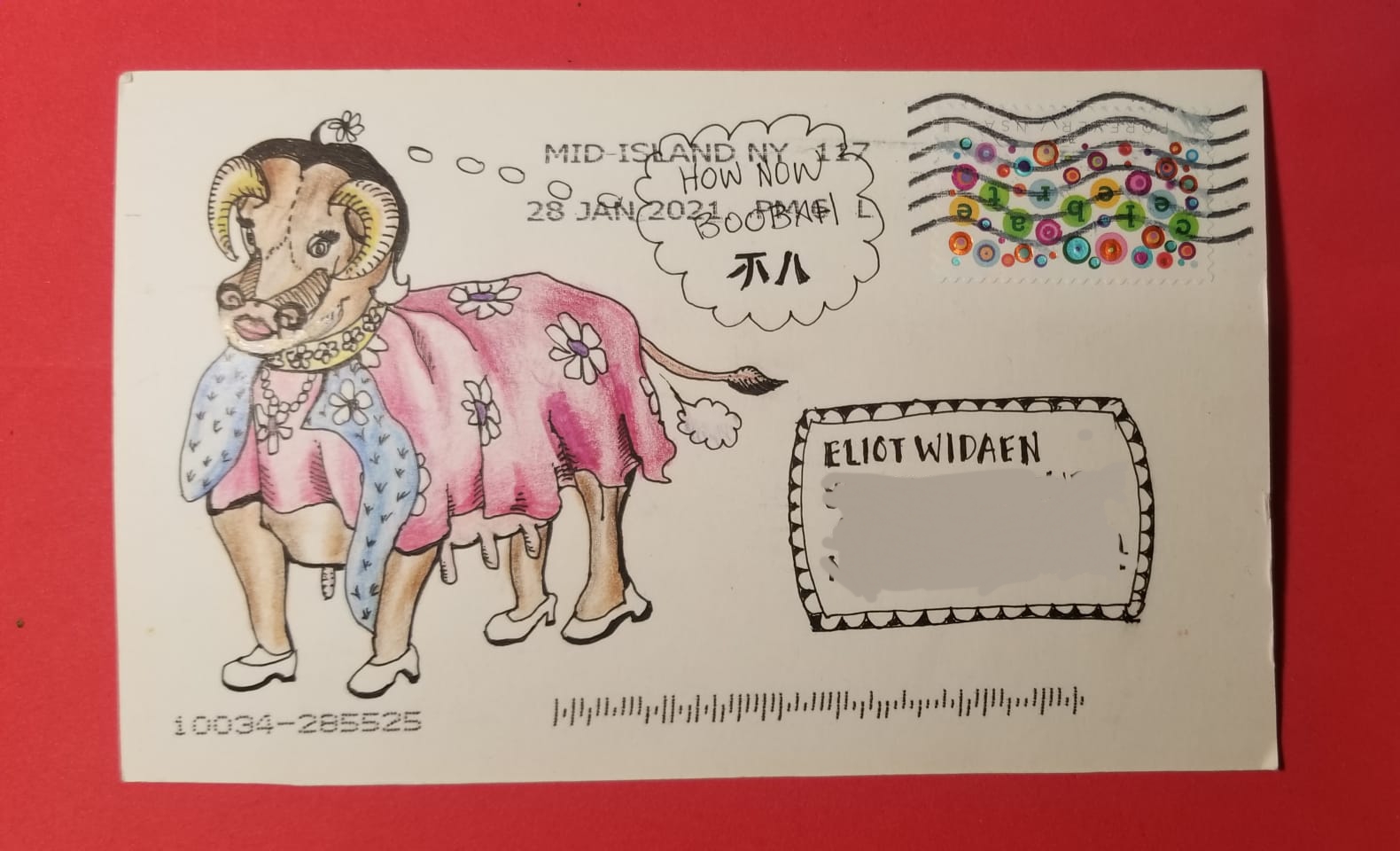
This is the view from my desk, out the window of the room where I am tapping out these words. Our bodies were just about recovered from the last strenuous session of countless lifts of shovels heaped with snow, a few days ago. Woke up a few days later to Groundhog’s Day, the movie. Got to say this for the snow, it’s beautiful this time. The last batch did not sit so perfectly on the branches of the trees.

It’s easy to forget, when you are faced with the forced lifting of something heavy, that this is not your life, or your fate. It’s a few hours, a day, a week, a month, a season. In the case of 2020, a year. In the case of the last four years, a few decades. Everything passes.

It’s easy to forget how odd and disorienting it is living through a deadly, airborne plague. It’s actually hard to remember once common things, like sitting in a room with a bunch of people you like but don’t see often, somebody cracking wise and everybody laughing. It used to happen all the time, the odds say it will happen again before too long.

It is not easy to remain philosophical during catastrophic times, though remaining philosophical is always a good thing to do. Yes, we are living in an age of worldwide insecurity, terror and rage — an age of terrible suffering on a massive scale. Yes, many millions around the world are freaking out, getting unreasonable, desperate, violent, authoritarian. The terror and rage is somewhat understandable, given the circumstances. This is a challenging epoch we are in, a bad patch, historically bad times. Unreasonableness has become the rule in many places. That doesn’t make it right, of course, but the reasons for it are pretty plain to see.

I usually chalk it up to the insatiable desire of a few entitled people, with the means and the power, to have, literally, everything. Pursuing this urge to have everything requires convincing millions that this arrangement — 1,000 for me, 1 for the rest of you suckers to share — is what nature intended. This convincing has never been easier to do than during this age of mass, instant “social media”. It may seem like a simplistic premise, but the unsatisfiable greed of those few in position to do either great good or terrible bad, explains much of the misery in the world.

I think of it like the old story of the fisherman’s wife and the magic fish, a parable about the inevitable misery that comes from an irrational, insatiable desire to have everything. A former girlfriend’s guru compared this unquenchable urge for ever more to a deer chasing a mirage of water as it dies of thirst.

The fisherman, a poor man, catches a remarkable looking fish. The fish speaks to him, telling him that if he shows mercy and throws him back that he will grant the poor fisherman any wish. The fisherman puts him back in the water, telling him this wish is too important to make by himself, that he must consult the wife. The fish tells him to go talk to his wife, promises to wait.

The fisherman talks to the wife, goes back to the fish. Tells the fish they want a beautiful house, with indoor plumbing and heat. The fish says fine and when the fisherman returns to the hovel there is a beautiful house, with indoor plumbing and heat. The fisherman and his wife celebrate.

Of course, it’s not long before the wife becomes dissatisfied with what now seems like a modest wish. “Go back to the fish,” she tells her husband.

When he returns it is drizzling. The fish agrees to turn the beautiful house into a magnificent castle. The fisherman returns to find the beautiful home is now a majestic castle.

It soon dawns on the wife that a castle without servants is not a very good deal. “Go back to the fish,” she says. Now it is raining hard as the fisherman conveys his wife’s request to the fish. The fish seems a little impatient but provides the servants.

You can see where this story is going, and where my analogy is going to go right after. Each request for more — soon it is power the wife wants, she needs to be a duchess, then a queen — is accompanied by worse and worse weather. In the end the fisherman is standing at the end of the dock in a raging hurricane, waves splashing around his legs, telling the fish sheepishly that his wife is no longer happy being the queen, she wants to be God. “Go back to your wife,” thunders the fish.

When the fisherman finally gets back home the wife is furious, dressed in her old rags in the original hovel.

We have people among us who are the fisherman’s insane fucking wife. Their voices are much louder, their breath much worse, than the rest of us. Depending on your prejudices you know who these people are. I am thinking of particular people, or corporate “persons,” owners of vast wealth who literally feel they are entitled to all the wealth in the world. This is a long discussion, perhaps, and this post, about remaining philosophical during challenging times, is not the place to make my case. If $100,000,000 is not enough to allow you to enjoy your life to the fullest, is $100,000,000,000 going to somehow help you in that regard? Just asking.

We have a certain amount of choice about certain things that torment us. We can exercise this choice to reduce the irrational urges we are all subject to sometimes. An undisciplined boy millionaire who craves respect and attention grows up to be a young adult “playboy” who brags in the media, like a comic book hero, about being the greatest winner in Gotham City. Then he needs to be at the top of the Forbes wealthiest list. Being rich and famous is not enough to fill his bottomless emptiness, of course. “Go back to the fucking fish, you fucking fucks,” he tells his lackeys. Being the president, of course, is not quite the same as being the king, or God. “Go back to the fucking fish, you worthless pieces of shit!” he thunders, as he sends a mob to decapitate the government he is about to lose control of.

It’s not just him, of course. There are a few thousand just like him. There’s a genius who makes $70,000,000,000 during a pandemic and tells his workers (and the independent contractors whose tips he steals) to suck it up and get back to work and if they don’t like the conditions — fuck off and die. There’s another guy who makes a similar bundle, stubbornly (and counter-factually) arguing that Americans are smart enough to decide for themselves whether one of the two major political parties is run by a cabal of Satan worshipping child raping cannibals. Just because millions of people hear this arguably extreme claim hundreds of times a day, on his platform, it is not, legally or morally, his concern. While literally billions of people live in desperate poverty, a shitload of the world’s wealth is in the hands of a fairly small group of super-wealthy guys who are unaccountable to anyone but the shareholders. We live in a hyper-competitive society that has only one true value — the bottom line.

People of good faith can argue both sides of this proposition about systemic unfairness, I guess. There is nothing inherently wrong, perhaps, with one person having more wealth than can be spent in a thousand lifetimes while millions of others live precarious lives, bundling ragged, hungry kids into their outdoor beds, while tens of thousands die deaths every year that could have been prevented, if only they could have seen a doctor, in the wealthiest nation in history. It is an abstract question of morality, perhaps, whether we just have to accept injustice as the way it is and has always been, no matter how vicious it sometimes is.

Those are arguments for another day. Discussions, really. If we are arguing about these general principles of fairness and mutual responsibility, the day is already lost. If Reason cannot guide us to be reasonable, it’s set and match. It may be set and match already, only time will tell, though the odds at the moment say that we won’t be meeting in a death camp (worst case scenario) but rather in a room full of people we like where someone will crack wise and we’ll all be laughing again (one of the better case scenarios).

To the extent you can, be of good cheer. Remember, this too shall pass. Here, it’s almost time to gear up and get to shoveling again, if only to dig out a couple of our feral cats trapped out back in this winter wonderland.

Belief Trumps “facts”

From my father’s “jokes that killed vaudeville” collection — husband of wife who catches him busy in bed with a prostitute — “who are you going to believe, darling, me or your lying eyes?” Our most recent former president mirthlessly cracked the same “joke” when he told his followers: “don’t believe what you see and hear. Believe me, (for I cannot tell a lie.)”

Actually, it was more explicit than that. Trump’s lies were the entire point of the exercise. If you lie enough, consistently, brazenly, steadily, no matter how many times you are caught– well, then you WIN. Lying is not a crime unless you’re stupid enough to take an oath not to commit perjury. The so-called truth is nothing but a thing that weak, stupid losers cling to because they suck!

As every pious Christian knows, if you believe, you go to heaven. If you refuse to believe, it’s hellfire for eternity, sinner.

The most dangerous legacy of Tump is the now common and mainstream elevation of irrational beliefs to irrefutable debate points superior to demonstrable facts. The patriots who spontaneously stormed the Capitol a month ago honestly believed a powerful cabal of corrupt Jews, Blacks, Muslims, Mexican rapists, predatory transsexuals, child molesters, Satanic child cannibals and others had stolen the election to illegally take over the government.

Trump didn’t invent the Big Lie, of course, the Nazis did, and demonstrated its dependable value to politicians willing to use it. We’ve had our American version of it here for decades. In televised debates we had decades of a scientist, representing the overwhelming consensus of virtually every climate scientist vs. a paid public relations spokesperson working for the oil company who did the original research on global warming, promoting “climate skepticism” and so on. Who did better, the pencil necked egghead with his “facts” or the impeccably prepared paid spokesman with his even more compelling focus-group tested “beliefs”? We report, you decide.

Trump didn’t invent the maddening “I know you are but what am I?” technique, but he turned it from n-word laced bar room muttering (and these boys don’t mince that “n-word”, son) into a mainstream springboard for actionable reality. Looking back, the end of the Fairness Doctrine in 1987 was a death knell to fact-based reality — broadcasters no longer need to give equal (or any) time for someone to refute even the most radically insane, inflammatory, lying position expressed at length on commercial media.

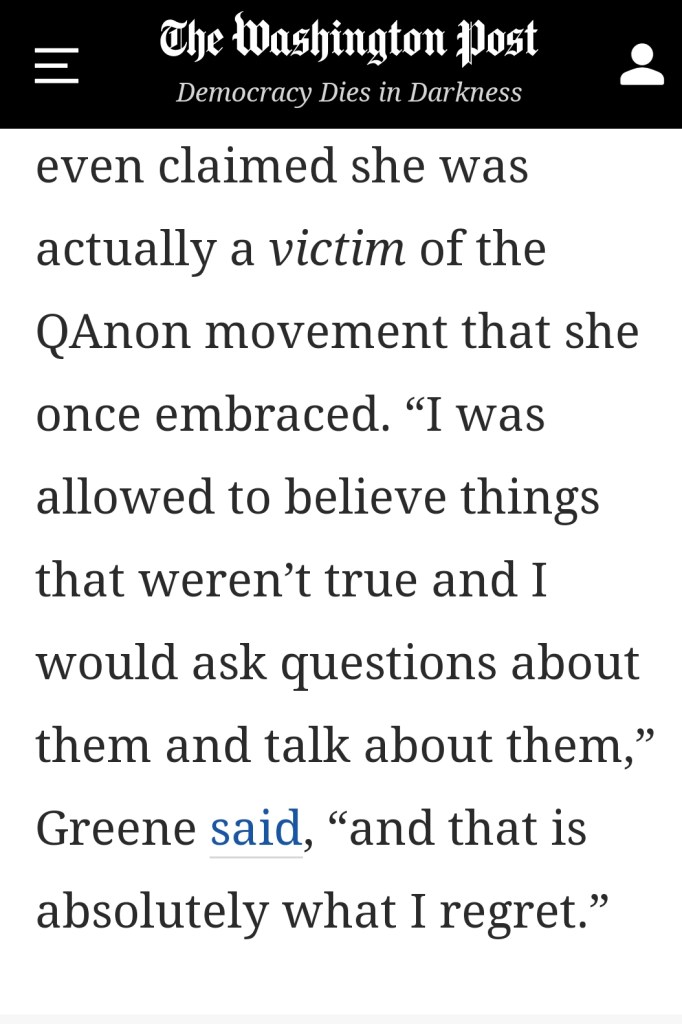
Which brings us to Mitch McConnell’s “loony” Republican It-Girl Marjorie Taylor Greene [1], who got a standing ovation from 199 of her fellow-traveler colleagues in the House after she courageously admitted, during a Republicans-only session, that there had been a terrorist attack on September 11, 2001 after all and that the dead children at two of our most infamous recent school massacres were not paid crisis actors. The same day she tweeted that she will never back down and claimed to her GOP colleagues she is being “crucified” (like our Lord Himself) for things she may have said or written long ago, things she — well, in her beautiful phrase:

The seamless incoherence of these new American folk heroes is what I love, if I may ironically use that overused l-word. Greene regrets that she was allowed to believe things that weren’t true? Already we have a menacing scapegoat waiting in the wings– WHO allowed her to believe these regrettable things (probably powerful fucking Jews, no?)?

Or did she regret that she “would ask questions about them and talk about them?” Better, after all, to keep a secret conspiracy theory secret until the perpetrators of the vast Satanic child sex cabal are all caught and publicly executed…

She added, to be fair and balanced while expressing her regrets, that the media is just as guilty as Q-Anon of spreading “truth and lies to divide us.”

Of course, it’s possible that the self-proclaimed “worst nightmare” for the unAmerican Democrat [sic] child blood-drinkers is simply lying about her “regrets”. She repeated incendiary lies throughout her campaign, has repeated them since becoming a member of Congress. She expressed “regret” to a standing ovation of a Congressional cohort that insisted in a huge majority (and these players never recant), that Trump had every right to break over two hundred years of precedent to refuse the peaceful transition of power by hotly contesting the certification of a stolen election he had actually won in a landslide.

Her party (with only 11 dissenters) defended her from this attempted crucifixion, after her expression of, eh, regret (not a bone of regret thrown to the fucking Jews who operate that giant, deadly space laser that started the deadly fire in California. Personally, I’m not satisfied with her “explanation” but we rarely are, people like me…).

Meanwhile, Liz Cheney (R-Wyoming) who unforgivably stated what is obvious to most Americans:

“On January 6, 2021 a violent mob attacked the United States Capitol to obstruct the process of our democracy and stop the counting of presidential electoral votes. This insurrection caused injury, death and destruction in the most sacred space in our Republic.

“Much more will become clear in coming days and weeks, but what we know now is enough. The President of the United States summoned this mob, assembled the mob, and lit the flame of this attack. Everything that followed was his doing. None of this would have happened without the President. The President could have immediately and forcefully intervened to stop the violence. He did not. There has never been a greater betrayal by a President of the United States of his office and his oath to the Constitution.

“I will vote to impeach the President.”

escaped censure, and being stripped of her position in the House, by her party in a secret vote.

Here are a few of Marjorie Taylor Greene’s 199 defenders in the House defending the rising Republican star:

…On Thursday, House Republicans rushed to her defense. “We’ve all said things we regret,” said Rep. Jim Jordan (R-Ohio), top Republican on the Judiciary Committee.

Rep. Chip Roy (R-Tex.) protested the proceedings by forcing a vote to adjourn. “We shouldn’t be wasting the time of this body attacking a member of this body,” he said.

Rep. Tom Cole (R-Okla.) disowned Greene’s rhetoric, but what he really found “sad” and “unprecedented” was that Democrats weren’t giving her “due process.”

Rep. Ted Budd (R-N.C.) informed Democrats that “today is really about one party single-handedly canceling a member of the other party because of something said before that member was even elected.”

source

The beauty of any intractable asshole is their total refusal to ever admit they did anything to make amends about. Greene got into office, and achieved superstar fame, by spouting hate and unapologetically appealing to violent anger. She is currently the Republican party’s victim-in-chief, carrying the heavy cross of her idol, persecuted martyr Donald J. Trump. How did she do at the news conference afterwards?

Republicans defended Greene with absurd parallels. They attacked Rep. Ilhan Omar (D-Minn.) for past anti-Semitic statements — omitting the crucial distinction that Omar, after Democrats roundly condemned her words, said, “Anti-Semitism is real and I am grateful for Jewish allies and colleagues who are educating me on the painful history of anti-Semitic tropes. … I unequivocally apologize.”

Greene, by contrast, remained unrepentant. On Friday, she held a celebratory news conference, again refusing to recant, or apologize for, her violent and anti-Jewish words and gestures.

Would she apologize for advocating the execution of Pelosi?

“I don’t have to,” she said, calling for the journalist to apologize instead.

Would she disavow her endorsement of putting “a bullet to the head” of Pelosi?

Accusing the questioner of lying, she replied: “That’s your problem and that’s how we end news conferences.” She walked away.

source

Jesus Christ, we Jews and Italians are so fucking unforgiving! Every threatener of gun violence to defend liberty would do the same if she was confronted by a lying journalist. Who among us has not wanted to shoot a nosy enemy reporter in the fucking face? I mean, let he who is without sin fire the first AK-47 burst into a crowd of paid crisis actor kindergarten kids. As for repudiating even our ugliest statements? Not my problem. After all, “we’ve all said things we regret.” Take a cue from Jesus, fuckers.

Here is a fun, fact-filled account (by Crooked Media) of the near unanimous Republican defense of their It-Girl, popular intractable hate-monger Marjorie Taylor Greene.

[1]

Greene has endorsed the killing of numerous high-profile Democrats. She helped moderate a Facebook page featuring death threats against them. Just before the election, she declared that if Democrats won, it would destroy “freedom,” which can only be won back “with the price of blood.” Greene also helped instigate the insurrection, heralding the event as the GOP’s “1776 moment.”

Greene did condemn the assault after it happened. But, importantly, she has since kept on feeding the ideology that inspired it.

In an extraordinarily deranged Twitter thread, Greene said that the Democratic caucus is “filled with” lawmakers who “cheered on” the destruction of cities, sleep with “our greatest enemy” and are out to “destroy Republicans, your jobs, our economy, your children’s education and lives, steal our freedoms, and erase God’s creation.”

Let’s not mince words: This is a veiled exhortation to supporters to keep up the violent warfare against Democrats. If the threat Democrats represent is as she depicted it, what else could possibly constitute an adequate response?

source

Marjorie Taylor Greene’s impressive Gerrymandered victory in November 2020

My first question is, obviously, how the hell did she know about our deadly space laser? Is nothing sacred?

I was curious to find out more about the wide margin of victory Trump’s “future Republican star” enjoyed in becoming a Representative from Georgia’s deep red, eight year-old 14th District. She won in a landslide, it turns out, crushing her opponent by 50 points.

I read a long, sad piece about her idealistic Democratic opponent, 35 year-old political novice Kevin Van Ausdal, which describes how he was literally broken by the onslaught from the fierce Taylor Greene and her militant, threatening supporters [1]. It made me curious about who she wound up running against in November 2020. Wikipedia fills in the details:

Greene finished in first place in the primary election and faced John Cowan in the runoff election.[21] Greene defeated Cowan to win the nomination on August 11. Greene was considered an overwhelming favorite to win the seat in the general election, as the 14th typically votes heavily Republican.[22] The 14th has a Cook Partisan Voting Index of R+27, making it the 10th most Republican district in the nation and the third most Republican district in the Eastern Time Zone. Among Georgia’s congressional districts, only the neighboring 9th district is more Republican. Since the 14th’s creation in 2012, no Democrat has won more than 30 percent of the vote.[23] Trump carried the 14th with 75 percent of the vote in 2016, his eighth-best performance in the nation.[24] On the day after Greene’s runoff victory, Trump tweeted his support for her, describing Greene as a “future Republican Star” who “is strong on everything and never gives up – a real WINNER!”[25]

Greene was expected to face Democratic IT specialist Kevin Van Ausdal, but he withdrew from the race on September 11, 2020. This left Greene unopposed for the general election, though the district is so heavily Republican that any Democratic challenger would have faced very long odds.[26][27][28]

On September 3, 2020, Greene shared a meme to her Facebook page depicting herself holding an AR-15 style rifle next to a collage of pictures of Democratic representatives Alexandria Ocasio-CortezIlhan Omar and Rashida Tlaib. Greene claimed that it was time for “strong conservative Christians to go on the offense against these socialists who want to rip our country apart”. The caption underneath the images read “Squad‘s worst nightmare.”[29] House Speaker Nancy Pelosi described the meme as a “dangerous threat of violence,” and Omar demanded that the meme be deleted after claiming it had already triggered death threats.[30] In response to questions from Forbes about whether the meme was a threat, a spokesperson for the Greene campaign called the suggestion “paranoid and ridiculous” and a “conspiracy theory”.[31] Facebook deleted the meme the following day for violating its policies on inciting violence, prompting Greene to claim that Democrats were “trying to cancel me out before I’ve even taken the oath of office”.[32]

source 

Kevin Van Ausdal, who withdrew as a candidate on September 11th (out of fear of violent extremists and horror at how ugly the campaign had become), got 25% of the vote two months later, from Georgians who simply wanted to vote against Taylor Greene.

So the future Republican star won by a whopping majority, about as large as Trump’s landslide margin in Georgia’s 14th District back in 2016.

On the other hand, she ran unopposed in a beautifully gerrymandered district that had always voted at least 70% Republican since its creation in 2012. America the beautiful, y’all.

[1]

My apologies for this link, which will probably lead to a paywall at uber-capitalist Jeff Bezos’s Washington Post. It was a fine article, but Jeff, who made $70,000,000,000 so far during the pandemic, does not leave a penny on the table, as he proved again by taking the tips of gig workers (“independent subcontractors”) hired to make deliveries for Amazon in their own vehicles, and using the confiscated tips to pay their “salaries”. Cost him $61,000,000 to settle that case, about a dime to Jeff — (plus, not to worry, not a penny came out of his pocket). Leave me a comment if you’re interested and I’ll send you a copy of the article, cut and pasted, subject to not getting a restraining order from the world’s greediest genius/predator...

Here’s a taste, from the link above:

But they all agreed that ignoring Greene was not an option, so they began drafting the statement and emailing versions to Kevin, who kept suggesting revisions that made it softer, thinking he had made it harsher.

“He needs to be ready,” Vinny told Ruth on one of their daily video calls.

“I don’t know what it’s going to take to get him to use the kind of language we need him to use,” Ruth told Vinny. “It’s a very big shift for him.”

“How’s it going?” she said to Kevin on Day 21 of the campaign, trying to sound upbeat as they began to rehearse the draft statement.

Kevin said he had been trying to stay relaxed. He had a cold.

“Okay, I know you’re not feeling well, but the good news is, sometimes when you need to push through a barrier, the best time to do that is when you’re sick, because your defenses are down,” Ruth said. “We’re not going to take you anywhere horrible.”

“We’re good,” Kevin said.

“Okay, I want you to breathe deeply,” Ruth began. “A lot of your tonality will have to go down. There will be times when you’re speaking about what Marjorie has done and you’ll be angry. You’ll need to be angry.”

More often in his life, Kevin could not afford to be angry. His voice tended to swing up, a tone he found helpful in defusing conflicts in his job at a financial services company, which had enabled his first real stability as an adult. He’d only recently bought the tan split-level where he lived with his wife and 1-year-old daughter. Now it had a “Save the American Dream” sign in the flower bed by the mailbox, one of the stories of his rise into the middle class he’d imagined telling voters about when he first started running.

Letting Go of the Past

The idea that it’s necessary to let go of the painful past is very big in the self-help world. “It is never too late to have a happy childhood,” we are told, among other encouragements to let go of the bad things in the past and gratefully embrace the many beautiful things about our present lives. As a general principle, letting go, not constantly reliving the hurts we’ve experienced is healthy, essential to living our best lives and to protecting our loved ones. The devil, as always, is in the details of how we actually do this.

Letting go of hurts of the past is a theme I chew on frequently, having a decent amount in the past to let go of. I feel my daily connection to history, for better or worse, and my personal stories, funny and terrible, which support my view of the world. Seeing the value of these memories, I am reluctant to simply let the past go. I feel like there are lessons in these stories, endlessly repeated; learning we need to extract and digest to move forward. It’s important to view the past in its complexity, considering the terrible things beside the inspiring ones. My once-large family was massacred back in 1943, during dark times in Ukraine and Belarus; pruned down to a very small family that lives and prospers today in the USA and in Israel. Both things are equally true.

I think of this theme of letting the past go in personal terms every time I encounter how hard it has always been for me to accept the the loss of a longtime friend. I understand that certain estrangements are inevitable, and we can see them coming most of the time, but also, a world of associations and shared memories are irretrievably lost each time. Each loss of a longtime friend is a little rehearsal for death.

Although I know the reasons for it, it bothers me each time that I could not find a way to reconcile with a couple of old friends and fond acquaintances in recent years. You could say that our lives are the stories we have lived, have told ourselves are true. People come to different conclusions about what is most important in life. Sadly, sharp differences of opinion (accompanied by drifting apart, taking friendship for granted and fading empathy) can prove insurmountable obstacles to a mutually beneficial relationship.

This leads me to once again consider how personal the political actually is, (political views are based entirely on our personal feelings about the world around us), and how political the personal can be, for the same reason. I hope to work through this “letting go” idea concisely today.

There are at least two ways of letting go of things that hurt us, as true in personal life as in political life. We can forgive and forget, using love to move forward without the need to rehash everything that hurt us in detail. This is a kind of Christian forgiveness, turning the other cheek when we are struck, as Jesus, The Prince of Peace, advised his followers to do [1]. Another way to let things go is to separate ourselves from people who hurt us repeatedly. This second way involves making hard decisions about who is accountable for what and what, realistically, is likely to happen going forward if we simply forgive and forget. Once we have done this, it is easier to let go of that troubled part of the past, though, of course, it is not as simple as that.

The difficulty of letting go of strong feelings is most easily seen in the context of physical violence against us, which is often a criminal matter best dealt with by a court of law. If someone beats us to a pulp and then asks us to please let go of our anger against them for their mistake, are we required by any moral power in the universe to agree to this? In the case of violent physical assault, there is an understandable emotional limit to a human ability to “let go of the past,” no matter how compelling a general case there is to be made for the idea.

The advice to let go of the pain and forgive can preempt the idea that you have a right not to be violently assaulted by someone who then tells you to get over it. There is a process you have to go through, once you are victimized, to first live with your rightful feelings and then separate yourself from that feeling of helplessness in the face of torment.

When a MAGA mob ransacked the Capitol recently chanting “Hang Mike Pence! Hang Mike Pence!!!” elected officials went into hiding from rioters calling for the execution of one of Trump’s most loyal sidekicks for the crime of not overturning an election he was powerless to overturn. There were also calls to shoot Nancy Pelosi in the head. During the several hours of rioting (as federal troops were told to “stand down and stand by” as Mr. Trump watched it unfold on TV) NY Representative Alexandra Ocasio-Cortez wound up taking shelter in Katie Porter’s office where they barricaded furniture in front of the door to keep the lynch mob out. Ocasio-Cortez recently revealed that she had been a victim of sexual assault in the past. Imagine how extra “triggering” a shouting mob kicking at your door might be if you had been violently assaulted in the past.

As a general principle we might all agree that nobody should ever be placed in the situation of having to barricade themselves into a room to try to protect themselves from a violent lynch mob. We might all agree to that, I think (when I say “we”, obviously I’m not talking about members of the lynch mob and those very fine people who support the mob’s right to violent anger.)

Here is a seemingly subtle thing that seems irrefutable to me now, coming back to the personal. If someone in your life is unsympathetic to your situation once in a while you can (and should) indeed let it go, overlook it, be generous, write it off to their being preoccupied with their own problems. We can’t all be empathetic all the time. It is different, and a sign of trouble, if the person is repeatedly unsympathetic and also quickly turns to blaming you for any challenging situation you find yourself in. If this happens with any regularity you will find yourself in a destructive cul du sac of contentiously conflicting perspectives. In my experience this self-perpetuating conflict can often be irreconcilable, since each party is certain that they are being mistreated by the other. If you can make no progress toward getting the other person to see the harmfulness of their stance, it is time to hop out of that deadly dead end.

It matters little what the other person’s argument is against your feelings, particularly if the argument is aggressive, angry and unyielding. Once you see that the other person will never yield, won’t concede anything to your expressed feelings … it’s time to go. Someone who is capable of empathy, and self-reflection, and who really cares about you, will find a way around their need to be right, in the interest of making a lasting peace and ensuring a mutual future. Again, true friends are very rare, especially when times are toughest. You should try not to fight about things, most things are not worth it. Once the fight takes on an abusive feeling — time to go.

As in personal life, so it is in politics. We are being told that Trump’s refusal to accept the will of the voters, his insistence that, in spite of bipartisan agreement about the fair election, and all of his lost voter-suppression and voter-fraud lawsuits, he won in a “landslide”, his raging lies about a “stolen election” that led to a rampage that could have resulted in the deaths of dozens (“only five” died directly, two Capitol Police officers took their own lives shortly after– three more dead than BENGHAZI… hmm…) including the executions of Pence, Pelosi and others, is something to “get over”. In the name of unity and healing, you understand.

As in politics, so it is in personal life. If someone beats you up, then asks forgiveness, then beats you up again, then asks forgiveness — what is the proper response? An understandably human response is to mercilessly kick the shit out of him next time he raises his hand to you, if you have the power to do so. Another, much more practical, response is walking away from the person, not letting them within punching and kicking distance. In either scenario, you accept the hard truth that this person who claims to love you is a violently angry person who can’t help taking it out on you when he feels up against it all. In no case is it a healthy response to simply get over it, until it happens next time.

Countless spouses and mates stay in these kinds of abusive relationships, being profusely apologized to by someone who will, in time, beat the shit out of them again. People stay in these kind of abusive relationships for many reasons, mostly related to fear and a feeling of not really deserving any better from their mate. Every person who stays convinces themselves of the same thing: my mate loves me, it’s just understandable human weakness that leads to the abuse. “I would be a monster not to forgive, look at those tears… ”

We can, and should, healthily let go of many things from the past that trouble us. Awareness of abuse isn’t one of them. The only thing to learn to do about abuse is to recognize it when it arises (it is not always as obvious as a fist to the face) and take steps to get far away from the perpetrator when it persists. Being out of harm’s way is the first necessary step to letting it go. The rest, friends, is much trickier, but we will never get to it while still in the cycle of endlessly replenished anger.

[1]

How often this Christian turning of the other cheek is done in reality, and how effective it may be if one manages to do it, are separate questions. For one thing, responding to mistreatment with love presumes the presence of the Divine in the person who struck your cheek.

Meanwhile in Federal Appeals Court

In immigration news, a federal appeals court in Washington, D.C., is allowing the government to continue deporting unaccompanied children without a court hearing or asylum interview. The court on Friday overturned a previous ruling that had blocked a Trump-era policy which stripped asylum seekers of due process, citing public health concerns around the pandemic. Some 13,000 unaccompanied children were deported between March and November of 2020 before the practice was halted. All three judges on the court’s panel who reinstated the policy were appointed by Trump.

source

The case against letting Trump off on a technicality in the upcoming impeachment trial

Hardliners like Lindsey Graham have already threatened to drag the upcoming impeachment out into an endless circus if Trump’s critics are too mean to Lindsey’s guy. He threatened to end all other legislative business while extending the unfair trial by unscrupulous means. A real credit to his race, Lindsey.

Rand Paul, who complained (without basis in fact) that all of Trump’s lawsuits (hundreds, literally) related to alleged massive election fraud were thrown out for procedural reasons, like “lack of standing” and that, therefore the merits of the election fraud cases were never reached. Of course, a few were dismissed for procedural reasons, but the bulk of the hundreds of Trump’s election-related lawsuits were dismissed based on their lack of merit as lawsuits. I loved this Trump appointee’s detailed dissection of one federal case brought by Trump’s army of lawyers. [1]

Now Paul, the well-spoken American Republican/Libertarian/Extremist, is standing by his claim that Trump’s impeachment is barred by a procedural hurdle– his colleague Mitch McConnell did not call the Senate back from its break in time after the House impeached Trump. Therefore, says Paul, the impeachment is unconstitutional. End of story, we don’t reach the merits of what Mr. Trump may or may not have done that might disqualify him from ever again abusing the power of his office to foment an anti-democratic riot, because the constitution forbids it. As James Madison and the other Framers surely intended, if you follow the reasoning, political calculation, whatever you want to call Rand Paul’s legalistic canard.

Former White House Counsel Bob Bauer wrote an excellent op-ed, The Republican Argument Against Impeaching Trump Is Dangerous, that lays out the thinness of this absurd “constitutional” argument against impeachment. Impeachment, Bauer informs us, was first and always concerned with disqualifying corrupt officeholders who perversely abused their power from ever holding power again. At one time impeachment did not include removal from office at all, it was generally used after a malefactor’s term was over to prevent them from attaining elected office again. Beyond the weak “constitutional” claim, signed on to by 45 of 50 GOP senators, signaling their readiness to let Trump slither through this high-sounding run-out-the-clock procedural loophole, Bauer underscores the danger of letting an unprincipled demagogue provoke insurrection during his last days in power and then finding that his being out of office is punishment enough.

Though this may all seem self-evident, Bauer does an excellent job illuminating the matter, and what’s at stake for our experiment in democracy.

[1] From that decision:

(After analyzing standing, which is based, in part, on having suffered, or being about to suffer, a concrete, cognizable legal injury the court has jurisdiction to address)

Second, even if Plaintiffs had standing, their claims fail on the merits.

Plaintiffs essentially ask this Court to second-guess the judgment of the Pennsylvania General Assembly and election officials, who are experts in creating and implementing an election plan. Perhaps Plaintiffs are right that guards should be placed near drop boxes, signature-analysis experts should examine every mail-in ballot, poll watchers should be able to man any poll regardless of location, and other security improvements should be made.

But the job of an unelected federal judge isn’t to suggest election improvements, especially when those improvements contradict the reasoned judgment of democratically elected officials. See Andino v. Middleton,— S. Ct. —, 2020 WL 5887393, at *1 (Oct. 5, 2020) Case 2:20-cv-00966-NR Document 574 Filed 10/10/20 =- (Kavanaugh, J. concurring) (state legislatures should not be subject to “second-guessing by an unelected federal judiciary,” which is “not accountable to the people”) (cleaned up).

Put differently, “[f]ederal judges can have a lot of power—especially when issuing injunctions. And sometimes we may even have a good idea or two. But the Constitution sets out our sphere of decision-making, and that sphere does not extend to second-guessing and interfering with a State’s reasonable, nondiscriminatory election rules.” New Georgia Project v. Raffensperger, — F.3d —, 2020 WL 5877588, at *4 (11th Cir. Oct. 2, 2020).