Personal vs. political

I am sitting alone, having my daily silent conversation, ostensibly with a reader, (with you, dear reader!) though one can pretty easily see that I do not write for a great number of readers. [1]   It doesn’t matter if you write for one person, as in a letter, or to every sentient reader on the earth (as many of us strive to write for) the process is the same.   It is a personal process and also a political process.

No less an authority on the subject than Adolf Hitler wrote, early in his life, that art is a bridge from the artist’s heart to the heart of another.  He later applied this same principle to the art of political propaganda.   Too bad the little shit was rejected from art school, his hissy temper tantrums at art critics and gallery owners without taste would have served the world much better than the ones he threw on the world stage, but that is another matter.   No idea why I am thinking about fucking Hitler right now. [2]  

I guess, to say, the exercise is essentially that —  building a bridge from the self to others outside of the self.   Writing clearly is the goal; making it easy for the reader to follow our guided tour through our thoughts, ideas and feelings.   These are three different things, thoughts: what goes through our minds as we ponder, ideas: conclusions we come to about the things we ponder, and feelings: our emotions as this is happening.   All three of these are important, essential really.  When we write we explain what we are thinking and feeling to ourselves, in the process of setting it out clearly to the imaginary reader.  

Kurt Vonnegut always wrote imagining his sister, who was a great reader, his ideal reader, reading the page.  If the joke would make her laugh, it was worth keeping in.  If the image would make her eyes grow moist, her nostrils flare slightly, the image stayed.   If she would roll her eyes, or not buy it, or find it pretentious or ridiculous, out it went.   His writing appealed to millions, appeals to this day, but he wrote every word, to hear him tell it, imagining his sister as his only reader.  Good enough, I’d say.  We write, on one level or another, to that imagined sensibility, the sensitive reader we’d love to be reading our words.

My mother was a great reader and I can often picture her reading a sentence or paragraph I’ve just written.   She had a great grasp of language, and a love of it, and a poetic imagination.   She didn’t mind something being just a little cartoonish, if it served to make the thing more clear, the feeling and colors more vivid, the conclusion that much more emphatic.

The dialogue we have when we are alone… I don’t think I could put a price on it.  In the previous post Hannah Arendt is quoted as believing:

The passion of being was in thinking. And that comes from that two-in-one dialogue in one’s head.  And for her, that was the beginning of moral life, that dialogue.  

Can I get a “hell yeah!”?   The world is vexing, often perplexing, the only quiet we often get, and the best chance to get any real perspective (if we are persistent and lucky, and disposed toward this exercise)  is sitting by ourselves, thinking through this kind of quiet inner dialogue.   All around us busy people are complaining:   “I don’t have time to think!”  “I don’t know whether to shit or wind my watch!”   “Who has the time?!!!!”  “It’s all too much!”    “I can’t watch the news, it fills me with dread and hatred!!!”

I am a man with the luxury of time, and I spend some of it each day doing this, having a silent chat with someone I’ve never met as I run everything by myself.

How do I make the time?   Admittedly I save a lot of time every day by doing virtually no cleaning.  I clean my kitchen sink regularly, and keep all decomposable food garbage in the freezer until I take it out, I clean my bathroom occasionally.   Outside of that, and a hump to the laundromat with a heavy bag every couple of weeks, I live in a chaos that would be embarrassing if photographed.  

I could see the horrified jurors:  “Look, ladies and gentlemen, if you have the stomach for it, at these photographs of the defendant’s living room…”   The prosecutor could rest his case after showing the shots of the jammed shelves, the overflowing tabletops, the collapsing piles of boxes, the carpet of papers covering everything, the tangled chaos on the floor, the cracked walls, ceilings and broken tile floors.   A jury of my actual peers would be a slovenly twelve indeed, but that is not the point.  I’m not competing for a spread in Better Homes and Gardens.

I also have the great luck not to be a covetous person, which saves time too.  A friend who plays guitar OK and has a couple of beautiful, expensive guitars– I say, God bless him!  Truly.  I’m not the envious type.  I don’t waste time or emotion measuring what I have against the acquisitions of other people.  I’m content to own what I need, to preserve the things I love– favorite pens, knives, musical instruments, to use things up, to wear the same shirt for a decade or more.   One of my favorite shirts is one my mother always liked, I wore it to visit her at the hospice the last day she had her eyes open.  It was the last shirt she saw me in, and she smiled to see it.   A colorful affair it is, purchased at Costco once upon a time.  My mother died eight years ago.  I wear the shirt now for special occasions, rarely mentioning the shirt’s connection to my mother’s death, how she smiled to see it one last time.

There is the personal, the things that matter most to us, the things we find most fascinating, compelling, irresistible.  These things vary greatly from one of us to the next.  The realm of the personal, though, is something we all share.  We all take certain things personally and we can all relate to exactly why that is.   If you can illuminate your personal passions three dimensionally enough you might draw somebody through that doorway, into a world they never appreciated before.  It’s like the old adage (and a wise one, too) that you take the professor, not the course.  You can sign up for the most interesting sounding course in the catalogue, only to find the juice and life sucked out of it by a cadaverous professor.  The flip-side is that you can take a course that appears less than marginally interesting in the course description that turns out to be fantastic, because the professor is brilliant and draws you into her love of the subject.

The personal, we are often reminded, is political, as the political is personal.  Take the average partisan voter, they take their politics very personally and their political views flow from the experiences of their personal lives.   If liberal they get exercised by the idea of racism, the state’s overbearing interference with a human right (abortion comes first to mind), the grotesquely uneven distribution of wealth and opportunity, the destruction of the natural earth by greedy corporations mining the last scraps of the world’s resources and poisoning everything.   If conservative they are pissed off at “political correctness”, the idea that every lazy poor person feels entitled to free food, free medical care, a low-cost place to stay, a cell phone, fancy sneakers, sickened at government interference with human rights– like the right not to be killed as a fetus for the convenience of an immoral pregnant woman– job killing regulations to save some endangered bird or rodent, on down the line.   These issues are litmus test left-right issues.  Abortion.   Poverty.   Catastrophic Climate Disruption.   Regulations.  Income inequality.

Also, all deeply personal issues.   This is where the rubber meets the road, as they say in that big cliche mill in the sky.   The successful politician makes a personal connection, as, say what you will about him, the current president has undoubtedly made among his supporters.   He speaks plainly to them, speaks the way they do, doesn’t worry if a bad word slips out, everyone uses a bad word sometimes.   Fuck those sons of bitches, you know what I’m saying?  Am I right?  Seriously, (a huge huzzah of approval) fuck those fucking losers.  We’re going to bomb the shit out of those motherfuckers!  You know what I’m saying?     His audience roars, they know exactly what he’s saying.  

He is a star because he speaks a language his audience takes very personally.   His opponent in the last election, whatever else we might say about her,  did not have the same gift, was not as able to make that personal connection, even as she was arguably more personable, certainly less abrasive, than our current attacker-in-chief.   Partisans will argue over which one was the bigger liar.  We must not forget, the last election was a close contest between the most hated and second most hated political personalities in America.

I have long believed, and do even now, that if people of good faith and good will sit down to solve the local version of world problems, there is much even political opposites would agree on.  The argument against this is the way “winning” politics is conducted in our intensely commercial society.   It was discovered at some point that negative campaigning wins elections, if you can get people to believe your opponent is a pedophile, for example– you have a huge advantage with the voters.  

Newt Gingrich and his friends made a science out of “wedge issues”, hammering on the emotional issues that divide us into opposing camps.   The Democratic party’s response was to try to make their tent big enough for everybody, by carefully not offending anyone.   Which in itself is kind of offensive to many, particularly if you adopt the worst ideas of your opponents in the name of “compromise” while engaging in the standard servile courtship of super-wealthy human and corporate donors.  

The Democrats’ inclusive approach was disparagingly branded “identity politics” as though the politics of the conservative is not also based on identity, and carved into the other side of the same stone.   On and on.  Blue hat, red hat.   Blue asshole, red asshole.  Brands, mere brands in a culture raised on brand loyalty, steeped in the consciousness of brands, understanding quality only through brand names.

What is my brand?   Not having a brand.   (see footnote 1)

“Not much of a goddamned brand.   Excellent brand for a loser, though, I have to give you that.”

The tone of the conversation in my head is calm, as honest as I can make it, with a bias toward trying to be fair.   If we are fair when we analyze a problem, the odds are better we’ll come to reasonable ideas about how to solve it, or at least make it better.   The alternative is an eternal contest between sullen, immovable two year-olds.

The trouble with voting for a brand, being a partisan, is that very often no thought at all goes into taking rigid positions that are always presented as either/or.   Spokesmen for our self-identified brand will tell us what side to take on any given issue, assuring us that there are only two sides to any issue, an imbecilic position few bother to question.   Good people don’t kill fetuses vs. good people don’t force fourteen year-old rape victims to carry the rapist’s baby for nine months and give birth to it.   There are arguments on both sides, I suppose, and a world of nuance between these two absolute views but the ones that begin “God said”… well, enough said, I think.  

I say believe in God as deeply as you like, and may the good, merciful things you do multiply as your faith deepens.   Personally, I have no problem with the righteous of any religion, until they come with swords, because God told them… you know.

Meantime, the conversation continues, as all good conversations should.


[1]  When I get a “like” I generally try to return the favor and like something on the liker’s site.  I read something I like and click like, and am often number 399 liking that post.   A big post for likes, in my case, is four or five.

I shit you not, I got a couple of likes on this very post today, went to the blahgs, read something I liked and clicked “like”.  Czech it out, eerie, crazy:

Screen shot 2018-06-29 at 2.31.43 AM.png

[2] Not a day goes by… I had a great experience recently, a nervous, chatty guy I was waiting for a medical procedure with (by pure chance, never met him before), as we went up in the elevator, asking me what my ancestry was.   I assumed he was asking if I was Jewish, so I told him where my people came from.  “You’re a Jew?   Jesus Christ,” he said, which I repeated with a big smile.  I love that kind of shit.  Only tangentially related to not a day going by without some thought of Hitler, this guy certainly didn’t strike me as an anti-Semite, but… Jesus Christ!   That was great.
A Relatively Poor Day

How we are feeling at any given moment is relative, to our own feelings at other times and to the way anyone else feels in a given moment on a given day.  I wouldn’t trade a moment of my life for even the happiest one of anybody else’s, but that’s just me.  That said, I passed a sad, low energy day today.   It was not only stumbling on the fezbook page of my old friend’s widow (she was the suggested friend of a friend I’d gone to read something by), seeing the beaming face of my dead friend in a couple of photos I’d never seen, and the one where, flanked by his daughters, his head is an alarmingly white ball with his familiar face on it.  I didn’t immediately think of the image of our old mutual friend, after a visit with him not long before the end, stopping in on neighbors who were having dinner, and bursting into uncontrollable sobs.  That image hit me just now, though it must have been lurking since I saw those happy moments in the life of my old, dead friend.  

I’d woken two hours too early again today, no idea what’s up with that shit.  This time I emerged from a dream where I was two-timing two pretty, delightful young women who were both, in the manner of such dreams, quite crazy about me.  Complicating matters was that they lived in apartments directly next door to each other, so that I locked the door of one and unlocked the door of the other after the first one went to work and the other was about to arrive home.  The obvious question of how anyone could possibly be clever enough, duplicitous enough, enough of a psychopath (not to put too fine a point on it), to carry on this deception was a considerable one.   One, the newer of the two lovers (I was leaning toward choosing this girl, if things didn’t blow up completely before I could do so), was a singer, and I had a gig at a restaurant accompanying her on guitar, for decent pay, as I recall.   The other was very cool too, and I’d known her longer, and we were very compatible and laughed a lot together.   The sex with both of them was great.  Neither had any idea of the existence of the other, as I went from one to the other over the course of an increasingly disquieting dream.  In the end, I was awake, alone, on mysteriously short sleep.

Not long afterwards I was looking at the smiling face of my dead friend who’d died of  a rare cancer, a deadly soft tissue sarcoma,   The same one that killed Hugo Chavez, he told me after Chavez died.  He told me that shortly before he himself died.   I had a call from another old friend, a prostate cancer survivor, who is seeing his oncologist Wednesday about another unrelated cancer, some kind of soft tissue sarcoma. Fucking hell.   He was calling me for advice, his sisters are closing in trying to get the rest of the money their mother left them.  I told him to just give them their shares and tell them to shut the fuck up now.   His daughter, a survivor of sexual assault at age ten from her mom’s new boyfriend (a guy my friend has somehow managed not to murder)  is having nightmares.  The latest one involves her dad dying before she gets back from sleep-away camp.  In spite of it all, we had a few laughs, he promised to keep me posted on what he learns after his visit to the oncologist.

In the background today the Yankees came from behind to tie the game in Tampa, and then, on the first pitch in the bottom of the twelfth, boom! walk-off home run.  Yankees lose.   Judge O for 5.  I’d watched the last segments of a documentary on Netflix called The Staircase, which sets out what appears to have been a grave and vicious fifteen year miscarriage of justice, in twelve parts.   Well done, but the only doctor who would have ordered it for me today would have been Dr. Mengele, the notorious Nazi fuck.   To relax I went for a long walk and listened to a bit of Hannah Arendt’s insanely detailed The Origins of Totalitarianism, which I’d recommended to a friend as being on a par with Eichmann in Jerusalem,  but which I am having second thoughts about.

Returned from the stroll on aching knees, after several days doing the exercises the distracted young woman at the PT place showed me the other day, then didn’t bother to supervise as to form.   Which would have been impossible, since she was simultaneously working with two other patients with non-knee-related troubles, each behind a curtain of their own, but very close by.   My knees are killing me, as I wait for the ibuprofen– possibly deadly for my idiopathic kidney disease — to kick in.   Well, they are not really killing me, my knees, they’re more than usually sore.  I will live. That is the thing that is so easy to forget in this exciting world we all eventually must leave forever– for the time being, we will live. 

The miracle of it, and the tragedy, really.

Internet Service Provider Duopoly Millionaire Strikebreaker

I’ve got to write and post this quickly, my internet has been out all day so far, as it was most of yesterday, only winking back on a few minutes ago during a long call with Spectrum tech support. While on hold I learned, and passed on to Ron, the good-natured Spectrum rep, that Tom Rutledge, the great and important CEO of Spectrum’s parent company, a guy who made $98.5 million in 2016 when his outfit bought Time Warner Cable, is still refusing to negotiate with the technicians union, IBEW local No. 3, an outfit whose strike is in its second year.

Rutledge, in fairness to him and his principled refusal to negotiate with the lawfully constituted technicians’ union, is probably bitter at the vast drop in his income.  He made a mere $7,800,000 last year and his ungrateful technicians are bitching about giving up certain features of their health plan, retirement benefits and things like that.   It’s hard to blame Rutledge for being so intractable, unless you are the kind of person who is harsh to complete assholes.

Ron had no idea Spectrum technicians in New York were on strike, though he’d heard of vandalism in NYC.  I explained the difference between vandalism and acts of skilled sabotage by workers whose rights under the National Labor Relations Act seemed to be being violated.   I explained to him that in the old days workers who accepted bad pay to cross a picket line and break a strike were called bad names, including scabs, and that I was reluctant to let a strike breaking technician into my apartment to check a modem that doesn’t seem to be faulty, as it is currently working.  

Ron agreed the problem was not the modem, since it is getting a fine signal at the moment.   The problem could be in the “drop”, the box that splits off from the “node” for delivery into individual buildings.  The node serves 248 modems in my area, the drop might serve a dozen in my building.   There was no way for him to monitor activity on my “drop”, though only 10 of 248 modems on my node are currently offline.  If you are wondering why I don’t just switch to an ISP that is not so fucked up, I will tell you.

We have two ISPs in most of New York City, Spectrum (a branch of Charter, who bought the franchise from Time Warner Cable a few years back) and Verizon.  Both ISP giants provide substandard internet service, intermittent service, and, because the free competition we hear so much about only involves two giants in our free market, they are free to set whatever prices it pleases them to set for whatever service they see fit to provide.  I currently pay $50 a month for intermittent internet service from Spectrum, having grown tired of no service and repeated lies from Verizon.  Ron was somehow able to give me a double credit today for the hours last night into today that I had no service: a generous $3.33.

I have to contact the technicians’ union, IBEW local # 3 and get the latest on their strike against Spectrum, the internet provider with the handsomely compensated CEO, a chap who made over $100 million the last two years.  This wealthy titan will not negotiate with the union.  He does not believe in unions.  If he had his way, workers would not be paid at all. Think of how much more money he could make if all those wasted technician salaries, vacation days, health benefits, pension contributions were saved, clawed back, put into his tax-free investment portfolio!

I need to contact the IBEW and offer to help them publicize their strike.  They ran a great online ad a few months back, very compelling, but not a public word since.   Almost nobody knows about the status of the strike that strikebreaker CEO Tom Rutledge is doing his best to make go away.   I wonder how many are still on strike after more than a year, like Jewish children making a strong moral case to a Nazi. I want to support the union and I need the striking workers, if possible, to exempt my home from their sabotage of Spectrum’s never perfect, now never worse, service.

Spectrum told me yesterday that my modem is defective, that, for once, there is no outage in my area, on my node.   They will need to send scab technicians over to inspect it all, the modem, the interior connection, outside connectivity at the “drop”, issues relating to the entire node, etc. They gave me a generous $1.67 credit yesterday for a day without internet service (this outage must last, according to corporate policy, at least four consecutive hours to qualify for the refund). The modem I was assured yesterday must be broken, after hours of no service with no outages reported, is delivering a signal again now.   Ron assured me today it is very unlikely to be the modem.

Shades of the old runaround from Spectrum’s fellow duopolist ISP Verizon, who told me for months that there was a technical problem with my line and that they were working on it, that a technical team would contact me the following day. I was never contacted. The problem was not with my line, it was with the entire Verizon network, which was off-line for many months as they switched their network from copper wire to fiber. This required digging up streets, getting permits, burying fiberoptic cable, it took many months. A call to Verizon was the same bullshit, month after month. A complete lie.  The technical team will call you tomorrow, we have no idea why you have no service, now about that huge bill you keep refusing to pay…

If your only business is making profit, it would behoove you to lie if you might lose the bulk of your customers during the months they will have no service.  What self-respecting American business would admit something that would undoubtedly cause an exodus of customers?  Verizon billed me, month after month, for service I had not been receiving.  According to them, no refund was due until I paid in full.  They were demanding hundreds of dollars by the end.  Would it seem petty of me to call them Nazi motherfuckers?  Sure it would, they are just an American business trying to keep the lights on so that all Americans can enjoy a brighter day!


post-script:

The modern world, my friends, where every war must be fought by propagandists who specialize in branding, messaging and targeted marketing, sometimes brings us, just fucking bullshit.

Pull up the IBEW information on their long-running strike against Charter/Spectrum, and here you go:

check us out, brothers and sisters

You can read about the neo-liberal asshole NYS Governor’s battle with the mega-corporation, complete with mealy mouthed almost-threats and a hint at support for a striking union that is a key political support group.  We have to go to Crain’s, in May 2018, for any kind of update on this shit?

Crain’s article

Why I Write– George Orwell 1946

A beautifully written short essay that everyone who writes should read.  At one point Orwell lays out the four main reasons people write.   This one leaped out at me:

(iii) Historical impulse. Desire to see things as they are, to find out true facts and store them up for the use of posterity.

Fancy that!

The essay, a quick and rewarding read, is here.

also HERE


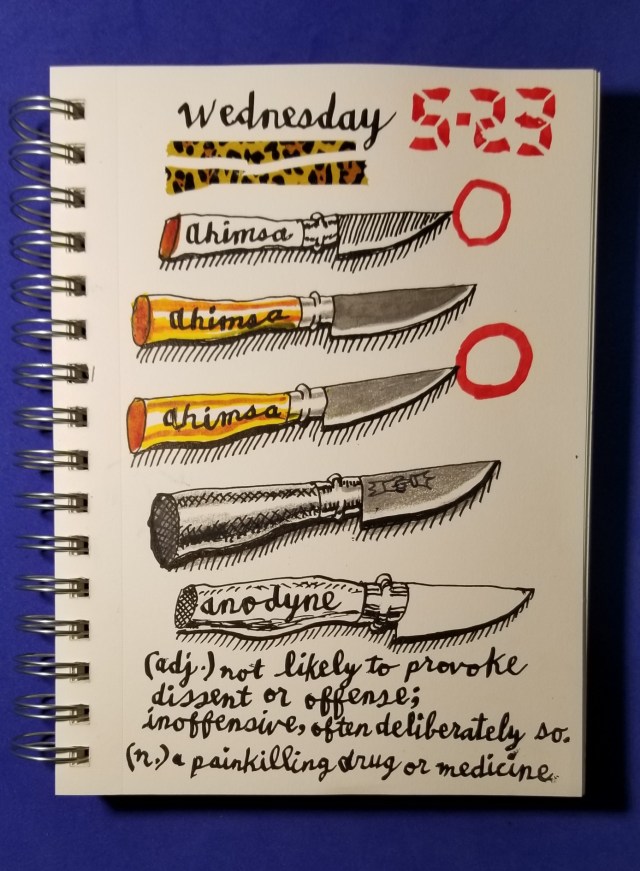
Vocabulary word of the day: anodyne

I was, for many years, prone to writing any unfamiliar word I’d encounter on a bookmark (with the page number next to it) and immediately looking up its meaning in the dictionary.   Then I’d read the sentence armed with this new knowledge and understand exactly what the writer meant by using the previously obscure word. This excellent habit was instilled in me by some wonderful teachers.  I recall, in High School, taking the vocabulary sheets they distributed quite seriously.  Little else they endeavored to teach me in High School meant very much to me, but expanding the number of words I could use to express myself clearly always made sense.

Now, with Jeevsie here, constantly by our side on the ubiquitous internet we carry around with us in our pockets, it is very easy to instantly have any unfamiliar word defined for us.  So it was the other night, when, drawing some knives, relieved that my favorite pen was behaving properly after a few days of struggle with her, I suddenly, unaccountably, wrote the word ‘anodyne.’   

20180524_024132.jpg

After I wrote it (I recall now hearing it months ago from Noam Chomsky describing the ‘anodyne explanations’ we get for each of our most unjust practices) I immediately looked it up.  Which took about 1.2 seconds with our modern data retrieval capabilities.  What a handy little fucker of a word!

We prefer the anodyne to the difficult, without a doubt.  An anodyne explanation usually smooths us down, a difficult conversation often churns us up.  Take American slavery, for example.  One can say, with great conviction and moral certainty, that it was a grave national sin that has not been practiced here for 150 years.  Abolished forever a century and half ago, our Constitution amended to make it perpetually so.  Done and done.  Nice and anodyne, wouldn’t you say?

 I’d be lying if I said I didn’t like a little anodyne myself, once in a while.  And you know how hard it is for me to lie.

Who gets to tell the story?

The cliché that history is written by the victors, as a rule, is hard to dispute.  We have to be a little careful about oversimplifying the categories of winner and loser, though.   Take the history of the American Civil War.   A generation or two after it ended the daughters and granddaughters of the great families of the South, the wealthiest families, the “best” families, in the popular parlance, became very concerned with how history would remember their glorious families.    An influential school of historians arose, largely supported by these well-born gals, who told the story the way they preferred it: a glorious history of high principle and protection of an inferior race who became predictably savage when liberated from the protection of their former masters.    

It may also be said that this history, written in the late 19th – early 20th century when most of the Confederate monuments were being erected to the heroes of the violent rebellion against federal tyranny, gave a moral fig leaf to a new generation of American racial terrorists.   The history is only now being written of the long, bloody decades of lynching and intimidation that went along with this sanitized, glorified version of the antebellum south and the Civil War.   It became cool, and often politically smart, for glory-seeking white racists to become “knights” in the Ku Klux Klan, membership soared nationwide after World War One.  Nothing like a good old-fashioned beating, mutilation and death by torture to remind everybody of their places.  The lessons of this brutality, even as it was most often kept a local secret, were not lost on anyone.

Who gets to tell the story?  In American politics mass media pundits (even drug addled ones), with no background in anything but self-promotion, are more influential than our most well-read, well-spoken, deepest thinking scholars.  Put the scholar on one side, a defiant blowhard on the other side, and America gets to watch another egghead get put in his fucking place.   It is a kind of thought crime here, basing your thoughts on too many fucking facts.  Fuck you and the fucking facts you rode in on, asshole!  You think you’re better than me just because you’re smart, and devoted to knowledge, and actively seeking facts and something you claim is truth?  I got your truth right here…

 Who gets to tell the story, even in your family?  Put any spin on it you like, dismiss the version that makes you feel bad.   No need to ever feel bad, just write anything bad out of history.  See how simple it is?     Most people I know, like my highly intelligent, idealistic father, eventually give up after enough time banging their head against the imperatives of our frequently merciless world.

I wrote the book about my father.  Not yet a book, it is a collection of stories and conversations, evoking the times, conflicts and the complicated spirit of a gifted man who did not fully enjoy his gifts, who died full of regrets.  More regretful than angry, even at himself.  How’s that for a deathbed surprise, dad?   The lifetime of rage and denial yields to the reality that death is hours away, your thoughts became more and more focused on how you missed out on the most beautiful parts of the ride your gifts might have otherwise provided you.

 “Oh, give it up, Elie!” says the skeleton of my father.   “Better to go through the hundreds of pages you’ve already written, picking likely lottery winning passages, pasting them together into a scroll.   Your lifetime of rage and denial will end in your own terrible regrets, when death is closing in on you, that you never managed to sell your book, be interviewed by Terry Gross.  I hear your man Leonard Lopate got canned for some likely sexual impropriety or other, so you missed that boat.   Keep paddling, Elie, is all I’m saying.”  

Righty-oh, dad.   I remind myself, while I’m wondering about who gets to write the stories we all come to believe, that there are many ways to see a given thing, a given person.   Not to say that every point of view is equally valid, equally interesting, equally revealing.  Can we separate a devoted Nazi’s beliefs from his watercolors?  I mean, the guy may have been a supremely gifted watercolorist, a regular Winslow Homer, but he was a major fucking Nazi.  A Nazi, dude, those beautiful watercolors were painted by an officer in the SS.    Nazi watercolors, dude.   Ain’t dassum shit?

The best artist I ever knew, a few nights before she died, expressed this very clearly.  She had no truck with Nazis who were otherwise very artistic people.

Selections for Sheila

My second cousin once removed, Sheila, recently asked me to send her what I’ve written about my father.   Sheila was always treated to the best of this likable man, his irreverent wit, his intelligence on every subject of consequence, his charm, his idealism.   I told her I’d send her a link to the 1,200 pages I’ve written in my two and a third year wrestling match with this gigantic subject.    

Then I thought better of it, picturing her struggling helplessly in that dense jungle of unorganized prose, and began going through the unwieldy manuscript, making some selections, almost at random, to give her a picture of the whole project.  I saved a 53 page chunk as “Selections for Sheila”– served with the personal touch, don’t you know?

She wrote back to tell me she liked what she’s read so far, though much of it was painful to her.   She’d had only the most generalized idea of the darkness in his early life and no inkling of the dark side he often retreated to in the company of his wife and children, the overarching tragedy of his life.  

I’ll refer you back to that post a few days ago for my thoughts on writing, why, and how and what for.   Bukowski wrote a great poem about real writing that is hard to argue with.   It is not the praise of another reader that makes a piece of writing worth reading, it is the writing itself.  Writing with passion and care is its own reward, sickening as that also is to say in a world where so many empty, ill-considered words are churned out by people well-paid to churn the vomit out, often with the help of ghosts who do the real work of making popular, bankable idiots sound relatively intelligent.   That said, having a reader or two who gets what you’re trying to do, appreciates the work involved– priceless.  

After I sent it off I looked over the Selections for Sheila and immediately wondered where a few important stories were.   At one point the manuscript had a table of contents and an index, to help me locate things.   That was hundreds of pages ago, I couldn’t keep up with the administrative tasks associated with the writing– the pages piled up too fast.   OK, I am… how to say?… I don’t like certain kinds of hard work.   I can work for two hours or more taking rough edges off a few paragraphs, increasing the clarity of what I am saying, adding an illustration where it will help the reader see something I haven’t been able to make clear enough.   To some people this kind of work is unthinkable.  To me, most other kinds of work are unthinkable.  

I am not anti-social, I like people, for the most part, enjoy interacting with people (animals too, for that matter).  I am open to people, let me say that.  I spend most of my time alone.   No single thing is as important to me, or makes me feel more like myself, than the time I spend by myself, focused, concentrating on making something as clear, or elegant, smooth or rough, as I can make it.   Craft has become one of those quaint notions in our fractured tabloid culture, but hold a beautifully finished wooden spoon in your hand once in a while, run your fingers over it, and you will feel what I am talking about.

I’ve always loved that Chekhov story  “The Bet.”   Chekhov wrote it when he was 28 or 29, a young man already two thirds of the way through what would turn out to be a short life (he died at 44).  Read it yourself, (click here) if you haven’t, it’s quite short.   The bones of the story:  a wealthy banker bets an idealistic guy who claims to love life and the pursuit of knowledge above all else two million dollars that he can’t stay locked in a room for fifteen years without any human contact.  The idealist takes the bet, on the condition that he can have musical instruments, books and writing materials brought to him whenever he asks.   He suffers terribly at first, constantly playing the piano, then learns several classical languages, reads the classics in their original languages, he studies a wide range of subjects, including the collected wisdom of the world’s religions.

I’ll save you the spoiler alert, in case you haven’t read that story, but I have always related to that character Chekhov created.   The banker is just the crass way of the material world, the pondering reader is the soul of the human world.  It doesn’t embarrass me to make this simplistic statement.   I am already too far gone.  

I am now collecting pieces for Selections for Sheila Two.  Hopefully one day a literary agent will be moved by an unsolicited packet of pages culled from those selections.  The agent will skillfully introduce my pages to some corporate person I wouldn’t piss on if they were on fire.  I won’t have to piss on them– they’ll give me money instead.

Now, back to collecting pages for Selections for Sheila part two.

Note to the writers out there — and a good one from Charles Bukowski

Wouldn’t you know it, five seconds, maybe ten seconds, after I hit “publish” on the previous piece, peevish about the long delay getting back to me by someone who promised to read something I’d sent her, I get a notification beep in my pocket.  I swear to your false gods, it was a few blinks of an eye.  An email from her, with an excellent reason for the delay, and some intelligent comments on the piece.

I appreciate her email, even as I also realized, as soon as I’d read it, that it was just an opinion.  Like mine, like anyone’s who clicks a thumb up or a thumb down on any of the 100,000,000,000 daily posts on the internet or any of its social media tentacles and capillaries.  Hey, Gangnam Style got a billion views at one point, probably has two billion by now (3,140,146,265 views and counting, grazie, Jeevsie).  Does that make it the greatest youtube video of all-time?   

Who gives a fuck?  The audience you write for is your own cultivated taste, served to the most intelligent, subtle-minded reader you can imagine.  It’s easy to forget that, particularly when the winds are stagnant and you’re getting the toxic stink full snout.  A friend sent me this poem by the great Charles Bukowski, which reminds us all of this, and more.  Kind of says it all (I have emphasized the stanza my friend pointed out).  Bon appétit:

so you want to be a writer?

Charles Bukowski1920 – 1994

if it doesn’t come bursting out of you
in spite of everything,
don’t do it.
unless it comes unasked out of your
heart and your mind and your mouth
and your gut,
don’t do it.
if you have to sit for hours
staring at your computer screen
or hunched over your
typewriter
searching for words,
don’t do it.
if you’re doing it for money or
fame,
don’t do it.
if you’re doing it because you want
women in your bed,
don’t do it.
if you have to sit there and
rewrite it again and again,
don’t do it.
if it’s hard work just thinking about doing it,
don’t do it.
if you’re trying to write like somebody
else,
forget about it.


if you have to wait for it to roar out of
you,
then wait patiently.
if it never does roar out of you,
do something else.

if you first have to read it to your wife
or your girlfriend or your boyfriend
or your parents or to anybody at all,
you’re not ready.

don’t be like so many writers,
don’t be like so many thousands of
people who call themselves writers,
don’t be dull and boring and
pretentious, don’t be consumed with self-
love.
the libraries of the world have
yawned themselves to
sleep
over your kind.
don’t add to that.
don’t do it.
unless it comes out of
your soul like a rocket,
unless being still would
drive you to madness or
suicide or murder,
don’t do it.
unless the sun inside you is
burning your gut,
don’t do it.

when it is truly time,
and if you have been chosen,
it will do it by
itself and it will keep on doing it
until you die or it dies in you.

there is no other way.

and there never was.


From sifting through the madness for the Word, the line, the way by Charles Bukowski. Copyright © 2003 by the Estate of Charles Bukowski. Reprinted by permission of HarperCollins. All rights reserved.


source

Note to HarperCollins and the Estate of Charles Bukowski:  please forgive this Fair Use of your copyrighted Charles Bukowski poem (and thanks for keeping the old boy in print for us all).   

If you deem this zero profit use a copyright violation, please have your lawyers contact my literary agent’s attorneys at … what did I do with that damned business card?

Better yet, read some of the recent shit on this site and let me know what kind of contracts you’re offering bitter fucking writers these days.

Slowing Down

Like the drag of age on the muscles, gravity, the wind, an ever more giant hand in the chest, I notice a diminution of my energies lately.   This could be nothing more than a little good natured depression, checking in to keep me honest.   It is the other side of creativity, after all, despondence when the creative impulse wanes.

It is possible, when ideas are flowing and possibilities seem endless, to see the world as a kind of infinite feast.   During such times you are not troubled by the concurrent reality that this world is a truly infinite feast only for connoisseurs of carrion.   Your vultures, rather clever birds, and hyenas, often regarded as cowardly, are the most well-known beneficiaries of this unlimited smorgasbord.  Although these intelligent birds and plucky scavenging wild dogs will soon enough go the way of the Dodo Bird.

It becomes an uphill push to sustain enthusiasm for any long-term project in the complete absence of positive feedback.  It is like anything difficult– if you have one stout supporter, one person deeply interested in what you are doing– that is often enough to get you through a sluggish period.   In the absence of at least one person who truly gets what you are trying to do– the wall you hit periodically will look like the end.  

This is just one more reason that most people prefer the rewards of working hard every day at a job that pays them decent money, and hopefully also provides a sense of satisfaction,  to the day-dreamy reward of playing a perfect guitar part, or drawing something beautiful — for no pay.  “Then ’tis like the breath of an unfee’d lawyer, you gave me nothing for it,” says the Fool to King Lear.

Looking for inspiration, one resorts to superstition.  I was born in The Year of the Monkey.  I once read a blurb about everyone born on this every twelfth year Monkey year.   We are clever, can be very sociable, even charming, we have a million ideas, but we rarely are able to follow through to see any of them to fruition.  My father was a Rat.   Rats have all kinds of complementary traits to the Monkey, but not framing everything as a war is apparently not one of them.   I don’t really remember much else from that paper placemat of the Chinese zodiac I read in the Gran Via on Dyckman Street many years ago.   The Gran Via itself, run by Chinese Spanish speakers from Cuba, is long gone.

I had a long email debate with an old friend, a very clever fellow (also a Monkey, it occurs to me now) over the issue of American torture.   He argues by habit and he’s very, very good at it.  It is sport for him, as well as his vocation.  I grew frustrated by his continual deflection of my points about the so-called Enhanced Interrogation program, by his refusal to accept any point I made, instead making endless deft lawyerly pivots.  In the end, exhausted by this futile exercise with a devilishly clever Devil’s advocate, I wondered aloud if, in order to clinch his debate victory, he was going to start actually torturing me.   “Oh, but I already am!” he wrote back, wry as you please.

I had a long chat with him recently about  a matter that has been torturing me for some time.   It came at a particularly inopportune time for him, I realized immediately after making it the subject of our dinnertime conversation.  I dropped him a line to apologize for belaboring the point at such a bad time for him.  He assured me that he was always pleased to be a sounding board and was glad I feel free to continue discussing such things with him.   I took the opportunity to send him another copy of a piece I wrote about it, something too private, ironically, to post here.

In the thinly fictionalized story I had set up my dilemma from another angle, having a narrator tell the story from her point of view, dismissing mine while revealing all the pertinent facts in the least malignant light to herself that she could provide.  The story is about a ten minute read and I’m unable to tell if it presents a fair sounding story or if the narrator is a hapless puppet with grotesquely visible strings clearly grinding my ax for me.

Everyone I know is somewhat familiar with the outlines of the story and the personalities involved.  In seeking a reader who could read the story objectively, someone who didn’t know any of the players or the events, I asked a good friend of a good friend if she’d be willing to have a look.   She agreed at once, told me she’d be delighted to read it.  I emailed it to her eighteen days ago.  

After about ten days, hearing nothing back, I wrote to tell her I wasn’t looking for literary input, just a general impression on two things: is the narrator credible and is she sympathetic?   I had an immediate apologetic reply about a particularly hectic week, assuring me that she was looking forward to reading it and that it would be her pleasure to give me her take on those two things. 

Since then, and after his assurance that my ruminations on this long standing situation didn’t faze him at all, I sent the piece to my old friend, recounting the story I have told just now about the reader who has been very busy but assured me again she is anxious to read the short piece.

I had his reply immediately:

I would be happy to read it, and offer my feedback!

To which, several days ago, I responded: Hah!

The world is a fucking hoot, to those not too bloody and bruised to wink at its puckishness.   A couple of days of ten hours of sleep ought to bring out a bit more of its wicked humor, I would hope.  Otherwise, I fear, this recent listless, sore kneed limping I’ve been doing may turn out to be the harbinger of something more ominous.


Lunch with cousins (& the grasshopper and the ant)

My ninety year old cousin Gene introduced me, at his birthday party yesterday, as his only living relative.    His wife, sister and daughter were also there, along with a brother-in-law and a son-in-law,  but his point was taken.   His father, one of eighteen siblings (nine of whom lived, for a while, at least) was the only one who made it out of the caldron that was Hitler and Himmler’s Europe in the 1940s.  His father had survived by sheer luck.   An uncle in the U.S. had sent his future father a ticket for a steamship.  This was around the time of the First World War.  That uncle died shortly after the thirteen year-old arrived in America.  That was it for that side of the family.   No trace was ever found of anybody else, and Gene searched on at least two trips to Europe.

My grandmother and Gene’s mother were first cousins.   They had come over together right before the First World War on a steamship called Korfus die Grosse.  I never met that grandmother, my father’s mother, who died young before I was born, but I remember Gene’s mother very well.   Dintch was a bright woman with mischievous eyes and prominent cheeks that were often raised in a wry smile.   She also lived to be ninety or more, if I recall.   The rest of our family disappeared into that marsh south of the Pina River, across from Pinsk in what was then Poland and is now Belarus.   There is no trace of any of them, or even the muddy hamlet they all lived in, as far as any of us have been able to find out.

Gene explained our exact degree of cousinly relation yesterday.   Since my father and Gene were the sons of first cousins, they are, apparently, second cousins.   This makes Gene and me second cousins once removed.   I believe the same relationship exists with my cousin Azi in Israel.  His mother and my father were first cousins, so their children, Azi and Azrael (Israel), both named for their common ancestor, my father’s grandfather and Azi’s great-grandfather, were second cousins.   Or something– I’m pretty sure my analysis is faulty, now that I reread it.  I have never been good at this cousin business, probably because I have so few of them it never seemed to matter.

Chatting in the restaurant with Gene’s sister, I couldn’t help mentioning the 1,200 page manuscript I’ve drawn up grappling with my father’s life.  Gene’s sister has only fond memories of the witty, well-spoken Irv, and of my mother, another colorful character, an opinionated, earthy woman who loved a good story and a good laugh.   Gene’s much younger sister expressed interest in reading it, as Sekhent put the sales varnish on it, that it’s a story of history, and memory, and forgiveness and blah blah blah (actually, all she mentioned was history, but she strongly suggested the ms. is way more than a cv of an unknown man going on 13 years dead).

As is her way, Sekhnet pointed out to the group at the table that it is much easier for me to keep cranking out new pages than it is for me to figure out how to package and sell the book I’ve already largely written.  That’s the hard work, she pointed out, making the obvious a little easier for all to see.  Hard work, she made plain, is something  I constantly shrink from.    Like the grasshopper I am, think of that parable of the grasshopper who loves to play guitar, and mocks his constantly worried, constantly working ant neighbor (until winter comes and the grasshopper begs in vain for some food), I continue tapping here, instead of reading the whole thing and plucking out a succulent 15-20 page slice to send out to literary agents and get to the next step.

Since I have promised to send Sheila the whole megilla, I figured I’d seize the opportunity to select a strong 15-20 pages and send her those first [I sent her a random 53 page sampling– ed].   It will be much easier for her to deal with an appetizing slice than more than a thousand pages of sometimes rambling prose.  

In my experience, people have a very hard time reading even a five page story, unless it’s published somewhere, in which case they are all pleased to send a good word.  I need to cut out a strong section to get to the next stage.  How I will do this, I have no idea.  I do know I need a cup of strong coffee before I get started.  That is the very least I need.  You hear me, Sekhnet, goddamn it?