3,000 words, first shot (2,914 words)

My father read two or three newspapers every day, starting with the New York Times.   The bending of the moral arc of history concerned him greatly and he could speak spontaneously and intelligently on many philosophical subjects without the need for notes.   He came across as something of a hipster, an ironic idealist with a dark, wicked sense of humor.   He loved soul music, particularly Sam Cooke.   For a few years, in the middle of his long career, he wound up speaking like the angry black cats on the street.  “As they say in the street,” he would say, then hit us with the latest street vernacular. “Dassum shit,” he would snap when confronted with something that struck him as bullshit.  He appreciated the subtleties of the word motherfucker.

Professionally, he hung out with the violent leaders of rival ethnic high school gangs, bullshitted frankly with them and won them over to his way of thinking.   In those days he wore mutton-chop sideburns and grew his dark hair down to his collar.   As part of a Mod Squad style team (Black guy, Jew, WASP folk singer, Italian guy, Puerto Rican woman) my father led the rap sessions, I am sure, with quick, barbed humor and irreverent, pointed honesty.   His deep identification with these discontented underdogs must have come across, along with his sincere hatred of brutal, random hierarchy and its inhuman unfairness.   He invited these young enemies to laugh, identify, curse, imagine, talk about injustice and find common ground. They all left as friends, or at least with mutual respect, at the end of these weekends, time after time.   There was a certain amount of charisma and a lot of deft, real-time improvisation involved in this alchemy.

He was born and raised in “grinding poverty”, a phrase he always spoke through gritted teeth, face like Clint Eastwood’s.   “Grinding poverty” stood in for his unspeakably brutal childhood circumstances in Peekskill, New York during the Great Depression.  My father had the good fortune after High School to be drafted into the Army Air Corps as America entered World War Two and live through a unique time in American history when hard work and determination, and a little help from the G.I. Bill, which put him through college and graduate school, could actually lift a person from humiliating intergenerational poverty to a comfortable middle class American life.   Not to say my father ever felt comfortable, not for a minute.   He paid a high price, working two jobs, to give his children an infinitely better life in a nice little house on a tree-lined street in Queens.  Naturally, his children, not knowing any different, never sufficiently appreciated the things they took for granted, the lawn, the great, small public school, the backyard with the cherry tree that gave big, black cherries. 

My father had all the appearances of a cool guy, but the pose concealed a dark, corrosive edge that was always at the ready.   He had a deep reservoir of rage that was kept under tight control most of the time.  His anger poured out almost every evening over dinner, in violent torrents over his two children, my younger sister and me.   Even as we expected it every evening, as our overwhelmed mother recited all her complaints about us for her tired husband to address before he drove out to his night job, the ferocity of his anger still surprised us, somehow.   It was a little bit insane.  

Like anyone who rages and snarls, he justified his brutality as necessary to deal with his responsibilities, in our case to educate the two viciously ungrateful little pricks he was raising.   He never hit us with physical blows but pounded us regularly with ferocious words intended to cow us and destroy unified resistance. The terrible mystery was how he could be such a tyrant while also imbuing us with important life lessons about decency, humility and kindness to animals.

The brutal battlefield of our family dinner table was a regular feature of our childhood.   It was as horrific as any war scene you can imagine.   The strafing from planes, ominously rattling machine gun nests, the rolling clouds of poison gas, the stinking trenches, rusted barbed wire, the groans of dying horses were as common to us as the steak, salad and Rice-a-roni we found on our plates in front of us virtually every night.   Eating steak was a sign of prosperity for a man who had been hungry during his entire childhood, my mother broiled steaks from Frank and Lenny’s almost every night.  The steaks were barbecued during the spring and summer months, my father or I usually turning them on the grill.  Ironically, and somewhat characteristically, my animal loving father joined PETA later in life and cut out a lot of his former meat diet.  

I was an adult, well into in my late-thirties, before I had the beginning of any insight into this confounding split in my father’s psyche.  On the one hand he was a funny, smart, sympathetic, hip guy who was very easy to talk to, when he wanted to be.  On the other hand, he was a supremely defensive man who more often used his great intelligence to keep others constantly off balance, a man who seemingly could not help trying to dominate and verbally abusing his children.  

My father had all the attributes to be a sensitive, lovable, very funny friend, yet he somehow chose to be an implacable adversary to his children most of the time.  

I’m realizing only now, as I write these words, since I am not a father, what most fathers would probably have realized a long time ago:  what a tormented father my father must have been all those years.  

I spent many years, before and since his death in 2005, trying to assemble a picture of my father as a whole person whose life made some kind of holistic sense.  I could never do it.  That’s the reason I eventually started writing this, an attempt to put together the puzzle of my father.  I work at the puzzle in a darkened room, most of the pieces missing, moving things around on a slanted, slippery table.  His unhappiness, right alongside his great capacity for laughter, was something I never had any insight into, not even a clue.   Puzzling over it as a kid must have been at the roots of my lifelong compulsion to research and write.  

Partly in search of insights into my perplexing father, I used to visit my father’s beloved first cousin Eli in his retirement cottage in Mt. Kisco, New York.  I’d drive up there every other week for a while, about an hour north of my apartment, and sit with the supremely opinionated Eli in his tidy living room, shooting the shit.   Then we’d go out for a meal somewhere.  We’d often wind up talking until well after midnight and by the time I left I had to drive the twisting, black Sawmill River Parkway steering with both hands on the wheel.    

Eli was an old man, well into his eighties, alienated from his own three kids, in a forty year blood feud to the death with his half-sister, on an every other year basis with his half-brother, he didn’t get that many visitors.   I was a fledgling writer and he was a great storyteller and it was usually a pleasure sitting around bullshitting with him about the past.  

It added to our bond that I was also the firstborn son of Eli’s favorite cousin, Irv.   Irv was the firstborn son of Eli’s favorite aunt, Chava who was the youngest sibling of Eli’s firstborn father Aren.  My father’s Uncle Aren had deserted from the Czar’s army, hopped a westbound train as the other draftees were shipped east to fight the Japanese.  Aren’s run to America, and bringing his little sister here a decade later, a generation before their hamlet was wiped off the face of the earth along with everyone they’d ever known there, is the only reason any of us were ever born.  Eli was Uncle Aren’s firstborn son, born in New York City, 1908.  

My father’s first cousin Eli was seventeen years older than my father, he had watched my father for his entire life.  The tough, American born Eli was the closest thing to a father figure my father had growing up, though his own father, a silent man from Poland overwhelmed by this world, was around until my father was in his mid-twenties.

Eli was a colorful character, no other way to put it.   A short, powerfully built, frog-bellied man of infinite charm, with a sandpaper voice, equally comfortable charming a pretty waitress with his smile or punching someone in the face with either hard hand.   I have often said of Eli that if he loved you he was the funniest, most generous, warmest and most entertaining person you could ever spend a few hours with.  If he didn’t like you, he was Hitler.  

I sometimes brought friends with me to visit with him.  I’d know in two minutes if the visit would be a fleeting ten hours of cheer, great stories and laughter or 150 endless minutes of grim, pointless discussion and occasional glaring.  Eli either loved you or hated you, there was not much in between, though he was capable of pretending, mostly, for a couple of hours.   He had his own demons, surely, but was devoted to my father, my mother, my sister and me — there was never the slightest doubt of that.  

He had a fierce temper, the “Gleiberman temper” as he called it, and would turn, in one second, from an infinitely charming raconteur into a purple faced, savage panther, white foam on his sputtering lips.  Even at eighty-five he was formidable when he was angry, and my father seemed to be somewhat scared of Eli until the end.  My mother was the only person I knew of who was allowed to constantly fight with Eli.  It was great sport between them, to rage at each other wildly and end up laughing, hugging and kissing when it was time to take their leave of each other.  

Once, describing a car trip back from Florida with Eli, my father told me happily “your mother and Eli fought all the way from Boynton Beach to the end of the New Jersey Turnpike.”  I pictured my mother, turned around in the front passenger seat, slashing at Eli with a broad sword as Eli swung his at her from the back seat.  Tireless combatants locked in mortal combat, swords clanging, for more than a thousand miles, then getting out of the car, hugging and kissing with genuine, unquestionable love, laughing and saying they’ll see each other soon.

I had something of this kind of relationship with Eli, every visit he’d turn purple with rage at least once, but we always parted as friends.

It was in this spirit of friendship, and seeing me so frequently perplexed by my father’s unfathomable anger and sudden alarming rigidity, his grim determination to win an argument at any cost, that Eli finally told me something that immediately changed the way I thought and felt about my father.   The more I thought about it, the more it explained.

“You remember seeing those old electrical cords they used to make before the insulation was made out of plastic?   They were thick and heavy, not very flexible, wrapped in layers of rough cloth for insulation.  The ones you saw as a kid were frayed, like burlap — you remember those cords on the old toasters?”

I did.

“Well your grandmother, my beloved Tante Chava, had one of those cords for her steam iron that she kept in a drawer near where she sat at the head of the kitchen table.”

I pictured the kitchen grinding poverty would have provided a little family in Peekskill, New York in the 1920s.   It was like a scene out of a gothic horror movie, a shaft of light coming into the dim, barren room from a high, narrow window, dust motes dancing listlessly, menacingly.  

“When your father was little, she used to reach into that drawer every time she got mad, and she had the Gleiberman temper, you know, and she’d grab that heavy cord and whip your father across the face with it.”

Across the face?  What?  I’d never met my paternal grandmother, who died before I was born, but… what the fuck?

“Yeah, she’d give him a couple of shots in the kisser with that heavy cord and he’d stand there cowering and crying.   I saw it many times.   After a while, all she had to do was rattle the drawer and your father would stand like this,” and Eli stood and did a remarkably moving imitation of a little kid staring down at the ground, cowering in terror.

“How old was he when she started whipping him in the face?” I asked.

“From the time he could stand,” Eli told me with infinite sorrow.

The skeleton of my father sat up abruptly in his grave at the top of the hill in the small First Hebrew Congregation cemetery just north of Peekskill.  

“Jesus, Elie, you spend forty years trying to dig up enough clues to solve an insoluble existential puzzle and you put that giant piece on the table just like that?   On page two?   You don’t think that’s kind of a spoiler?”

I never planned on my father’s skeleton being my partner in trying to tell the story of his life and times, but he made a pretty good case.   As I said, he was a very smart guy and, in spite of a lifelong twitch to defend himself at all costs, could always see the other side of whatever he was arguing against.  

“I love it when you talk to the reader like I’m not sitting right here,” said the skeleton, turning his head in a crackling circle to loosen his crepitating neck.  

I can feel this little intro slipping out of my hands, dad.

“Don’t mention it,” said the skeleton, with a nonchalant little flip of his boney hand.

High over the well-situated grave (there is a huge tree providing blessed shade) two Westchester turkey vultures made lazy circles in the air.   The skeleton looked up and nodded.

To those who loved my father, and there were many of us, including some very bright people who frequently roared at his tossed off lines, waiting with expectant smiles for the next bit of hilarity, it will cause great distress to read about his monstrous side.  

“After all, Elie, who among us has not employed relentless brutality to irreparably damage the children we raise?   Come on, Elie, be fair about that.”

I’m picturing the dinner table when Arlene and Russ Savakus were over.  Arlene with her keen appreciation, her super-sharp mind, Russ, her more low-key hipster husband, a moderately famous bass player, both of them howling.  Their explosions of laughter were a kind of music I can still hear.  My father was at his best with an audience like Arlene and Russ.

“We’re always at our best with people we love, who love us back,” said the skeleton.

Yes.  Love is all we’ve got here, really.  If you don’t have love in your life, nothing else really matters, except a ruthless lust for power I suppose.

“As your friend Napoleon, who reputedly regarded men as base coin, wrote in his diary  ‘As for me, I know very well I have no real friends, and you don’t suppose I care– as long as I remain what I am I will always have ‘friends’ enough.’  As you have noted before, Elie, who is the ‘you’ he is addressing this thought about not needing intimates to?”

Arlene and Russ.   I remember lying in my bed, as a kid, long after dinner, with the smoke from Arlene’s endless cigarettes wafting up to my room, along with their cackles and excited remarks.   It is hard to imagine, seeing you at your best, that you could have also…

“Well, there’s your mystery of life right there, Elie, and nothing very sweet about it, I’m afraid.”    

The potential in all of us, to be at our best, instead of pressed under the pressures we are constantly forced to fight being crushed by.  Mind boggling, how hard it is to put that best side always forward.    

“Well, some people are better at it than others.  Some people, some of our most successful people, are all show, a thin candy shell over an inner life of squirming, festering horror.  Look at this menace you have in the White House now.  Unloved bully, raised by a demanding, overbearing. loveless father and whatever the hell his gold-digging mother was, look at the cruel monstrosity that produces.   I like to feel, although, admittedly, I verbally whipped you and your sister in the face every night over dinner, that I never humiliated either of you, that I always, somehow, let you know how much I loved you both.”  

Aye, that you did, pater, though it took me almost sixty years to see it all clearly.

“The tragedy of life, Elie,” said the skeleton.   One of the vultures suddenly veered toward earth, the other one turned to follow.  

Also the triumph of life, dad.  We couldn’t have this kind of conversation when you were alive, but now we are.  

“I’ll take it,” said the skeleton, looking off toward the rapidly descending scavengers.
The rest of the 3,000 words, draft one

The skeleton of my father sat up abruptly in his grave at the top of the hill in the small First Hebrew Congregation cemetery just north of Peekskill.  

“Jesus, Elie, you spend forty years trying to dig up enough clues to solve an insoluble existential puzzle and you put that giant piece on the table just like that?   On page two?   You don’t think that’s kind of a spoiler?”

I never planned on my father’s skeleton being my partner in trying to tell the story of his life and times, but he made a pretty good case.   As I said, he was a very smart guy and, in spite of a lifelong twitch to defend himself at all costs, could always see the other side of what he was arguing against.  

“I love it when you talk to the reader like I’m not sitting right here,” said the skeleton, turning his head in a crackling circle to loosen his crepitating neck.  

I can feel this little intro slipping out of my hands, dad.

“Don’t mention it,” said the skeleton, with a nonchalant little flip of his hand.

High over the well-situated grave (there is a huge tree providing blessed shade) two Westchester turkey vultures made lazy circles in the air.   The skeleton looked up and nodded.

To those who loved my father, and there were many of us, including some very bright people who frequently roared at his tossed off lines, waiting with expectant smiles for the next bit of hilarity, it will cause great distress to read about his monstrous side.  

“After all, Elie, who among us has not employed relentless brutality to irreparably damage the children we raise?   Come on, Elie, be fair about that.”

I’m picturing the dinner table when Arlene and Russ Savakus were over.  Arlene with her keen appreciation, her super-sharp mind, Russ, her more low-key hipster husband, a moderately famous bass player, both of them howling.  Their explosions of laughter were a kind of music I can still hear.  My father was at his best with an audience like Arlene and Russ.

“We’re always at our best with people we love, who love us back,” said the skeleton.

Yes.  Love is all we’ve got here, really.  If you don’t have love in your life, nothing else really matters, except a ruthless lust for power I suppose.

“As your friend Napoleon, who reputedly regarded men as base coin, wrote (something to this effect) in his diary ‘As for me, I know very well I have no real friends, and you don’t suppose I care– as long as I remain what I am I will always have ‘friends’ enough.’  As you have noted before, Elie, who is the ‘you’ he is addressing this thought about not needing intimates to?”

Arlene and Russ.   I remember lying in my bed, as a kid, long after dinner, with the smoke from Arlene’s endless cigarettes wafting up to my room, along with their cackles and excited remarks.   It is hard to imagine, seeing you at your best, that you could have also…

“Well, there’s your mystery of life right there, Elie, and nothing very sweet about it, I’m afraid.”    

The potential in all of us, to be at our best, instead of pressed under the pressures we are constantly forced to fight being crushed by.  Mind boggling, how hard it is to put that best side always forward.    

“Well, some people are better at it than others.  Some people, some of our most successful people, are all show, a thin candy shell over an inner life of squirming, festering horror.  Look at this menace you have in the White House now.  Unloved bully, raised by a demanding, overbearing. loveless father and whatever the hell his gold-digging mother was, look at the cruel monster that produces.   I like to feel, although, admittedly, I verbally whipped you and your sister in the face every night over dinner, that I never humiliated either of you, that I always, somehow, let you know how much I loved you both.”  

Aye, that you did, pater, though it took me almost sixty years to see it all clearly.

“The tragedy of life, Elie,” said the skeleton.   One of the vultures suddenly veered toward earth, the other one turned to follow.  

Also the triumph of life, dad.  We couldn’t have this kind of conversation when you were alive, but now we are.  

“I’ll take it,” said the skeleton, looking off toward the rapidly descending scavengers.

First stab at 3,000 words (2172)

My father read two or three newspapers every day, starting with the New York Times.   The bending of the moral arc of history concerned him greatly and he could speak spontaneously and intelligently on many philosophical subjects without the need for notes.   He came across as something of a hipster, an ironic idealist with a dark, wicked sense of humor.   He loved soul music, particularly Sam Cooke.   For a few years, in the middle of his long career, he wound up speaking like the angry black cats on the street.  “As they say in the street,” he would say, then hit us with the latest street vernacular. “Dassum shit,” he would snap when confronted with something that struck him as bullshit.  He appreciated the subtleties of the word motherfucker.

Professionally, he hung out with the violent leaders of rival ethnic high school gangs, bullshitted frankly with them and won them over to his way of thinking.   In those days he wore mutton-chop sideburns and grew his dark hair down to his collar.   As part of a Mod Squad style team (Black guy, Jew, WASP folk singer, Italian guy, Puerto Rican woman) my father led the rap sessions, I am sure, with quick, barbed humor and irreverent, pointed honesty.   His deep identification with these discontented underdogs must have come across, along with his sincere hatred of brutal, random hierarchy and its inhuman unfairness.   He invited these young enemies to laugh, identify, curse, imagine, talk about injustice and find common ground. They all left as friends, or at least with mutual respect, at the end of these weekends, time after time.   There was a certain amount of charisma and a lot of deft, real-time improvisation involved in this alchemy.

He was born and raised in “grinding poverty”, a phrase he always spoke through gritted teeth, face like Clint Eastwood’s.   “Grinding poverty” stood in for his unspeakably brutal childhood circumstances in Peekskill, New York during the Great Depression.  My father had the good fortune after High School to be drafted into the Army Air Corps as America entered World War Two and live through a unique time in American history when hard work and determination, and a little help from the G.I. Bill, which put him through college and graduate school, could actually lift a person from humiliating intergenerational poverty to a comfortable middle class American life.   Not to say my father ever felt comfortable, not for a minute.   He paid a high price, working two jobs, to give his children an infinitely better life in a nice little house on a tree-lined street in Queens.  Naturally, his children, not knowing any different, never sufficiently appreciated the things they took for granted, the lawn, the great, small public school, the backyard with the cherry tree that gave big, black cherries. 

My father had all the appearances of a cool guy, but the pose concealed a dark, corrosive edge that was always at the ready.   He had a deep reservoir of rage that was kept under tight control most of the time.  His anger poured out almost every evening over dinner, in violent torrents over his two children, my younger sister and me.   Even as we expected it every evening, as our overwhelmed mother recited all her complaints about us for her tired husband to address before he drove out to his night job, the ferocity of his anger still surprised us, somehow.   It was a little bit insane.  

Like anyone who rages and snarls, he justified his brutality as necessary to deal with his responsibilities, in our case to educate the two viciously ungrateful little pricks he was raising.   He never hit us with physical blows but pounded us regularly with ferocious words intended to cow us and destroy unified resistance. The terrible mystery was how he could be such a tyrant while also imbuing us with important life lessons about decency, humility and kindness to animals.

The brutal battlefield of our family dinner table was a regular feature of our childhood.   It was as horrific as any war scene you can imagine.   The strafing from planes, ominously rattling machine gun nests, the rolling clouds of poison gas, the stinking trenches, rusted barbed wire, the groans of dying horses were as common to us as the steak, salad and Rice-a-roni we found on our plates in front of us virtually every night.   Eating steak was a sign of prosperity for a man who had been hungry during his entire childhood, my mother broiled steaks from Frank and Lenny’s almost every night.  The steaks were barbecued during the spring and summer months, my father or I usually turning them on the grill.  Ironically, and somewhat characteristically, my animal loving father joined PETA later in life and cut out a lot of his former meat diet.  

I was an adult, well into in my late-thirties, before I had the beginning of any insight into this confounding split in my father’s psyche.  On the one hand he was a funny, smart, sympathetic, hip guy who was very easy to talk to, when he wanted to be.  On the other hand, he was a supremely defensive man who more often used his great intelligence to keep others constantly off balance, a man who seemingly could not help trying to dominate and verbally abusing his children.  

My father had all the attributes to be a sensitive, lovable, very funny friend, yet he somehow chose to be an implacable adversary to his children most of the time.  

I’m realizing only now, as I write these words, since I am not a father, what most fathers would probably have realized a long time ago:  what a tormented father my father must have been all those years.  

I spent many years, before and since his death in 2005, trying to assemble a picture of my father as a whole person whose life made some kind of holistic sense.  I could never do it.  That’s the reason I eventually started writing this, an attempt to put together the puzzle of my father.  I work at the puzzle in a darkened room, most of the pieces missing, moving things around on a slanted, slippery table.  His unhappiness, right alongside his great capacity for laughter, was something I never had any insight into, not even a clue.   Puzzling over it as a kid must have been at the roots of my lifelong compulsion to research and write.  

Partly in search of insights into my perplexing father, I used to visit my father’s beloved first cousin Eli in his retirement cottage in Mt. Kisco, New York.  I’d drive up there every other week for a while, about an hour north of my apartment, and sit with the supremely opinionated Eli in his tidy living room, shooting the shit.   Then we’d go out for a meal somewhere.  We’d often wind up talking until well after midnight and by the time I left I had to drive the twisting, black Sawmill River Parkway steering with both hands on the wheel.    

Eli was an old man, well into his eighties, alienated from his own three kids, in a forty year blood feud to the death with his half-sister, on an every other year basis with his half-brother, he didn’t get that many visitors.   I was a fledgling writer and he was a great storyteller and it was usually a pleasure sitting around bullshitting with him about the past.  

It added to our bond that I was also the firstborn son of Eli’s favorite cousin, Irv.   Irv was the firstborn son of Eli’s favorite aunt, Chava who was the youngest sibling of Eli’s firstborn father Aren.  My father’s Uncle Aren had deserted from the Czar’s army, hopped a westbound train as the other draftees were shipped east to fight the Japanese.  Aren’s run to America, and bringing his little sister here a decade later, a few years before their hamlet was wiped off the face of the earth along with everyone they’d ever known there, is the only reason any of us were ever born.  Eli was Uncle Aren’s firstborn son, born in New York City, 1908.  

My father’s first cousin Eli was seventeen years older than my father, he had watched my father for his entire life.  The tough, American born Eli was the closest thing to a father figure my father had growing up, though his own father, a silent man from Poland overwhelmed by this world, was around until my father was in his mid-twenties.

Eli was a colorful character, no other way to put it.   A short, powerfully built, frog-bellied man of infinite charm, with a sandpaper voice, equally comfortable charming a pretty waitress with his smile or punching someone in the face with either hard hand.   I have often said of Eli that if he loved you he was the funniest, most generous, warmest and most entertaining person you could ever spend a few hours with.  If he didn’t like you, he was Hitler.  

I sometimes brought friends with me to visit with him.  I’d know in two minutes if the visit would be a fleeting ten hours of cheer, great stories and laughter or 150 endless minutes of grim, pointless discussion and occasional glaring.  Eli either loved you or hated you, there was not much in between, though he was capable of pretending, mostly, for a couple of hours.   He had his own demons, surely, but was devoted to my father, my mother, my sister and me — there was never the slightest doubt of that.  

He had a fierce temper, the “Gleiberman temper” as he called it, and would turn, in one second, from an infinitely charming raconteur into a purple faced, savage panther, white foam on his sputtering lips.  Even at eight-five he was formidable when he was angry, and my father seemed to be somewhat scared of Eli until the end.  My mother was the only person I knew of who was allowed to constantly fight with Eli.  It was great sport between them, to rage at each other wildly and end up laughing, hugging and kissing when it was time to take their leave of each other.  

Once, describing a car trip back from Florida with Eli, my father told me happily “your mother and Eli fought all the way from Boynton Beach to the end of the New Jersey Turnpike.”  I pictured my mother, turned around in the front passenger seat, slashing at Eli with a broad sword as Eli swung his at her from the back seat.  Tireless combatants locked in mortal combat, swords clanging, for more than a thousand miles, then getting out of the car, hugging and kissing with genuine, unquestionable love, laughing and saying they’ll see each other soon.

I had something of this kind of relationship with Eli, every visit he’d turn purple with rage at least once, but we always parted as friends.

It was in this spirit of friendship, and seeing me so frequently perplexed by my father’s unfathomable anger and sudden alarming rigidity, his grim determination to win an argument at any cost, that Eli finally told me something that immediately changed the way I thought and felt about my father.   The more I thought about it, the more it explained.

“You remember seeing those old electrical cords they used to make before the insulation was made out of plastic?   They were thick and heavy, not very flexible, wrapped in layers of rough cloth for insulation.  The ones you saw as a kid were frayed, like burlap — you remember those cords on the old toasters?”

I did.

“Well your grandmother, my beloved Tante Chava, had one of those cords for her steam iron that she kept in a drawer near where she sat at the head of the kitchen table.”

I pictured the kitchen grinding poverty would have provided a little family in Peekskill, New York in the 1920s.   It was like a scene out of a gothic horror movie, a shaft of light coming into the dim, barren room from a high, narrow window, dust motes dancing listlessly, menacingly.  

“When your father was little, she used to reach into that drawer every time she got mad, and she had the Gleiberman temper, you know, and she’d grab that heavy cord and whip your father across the face with it.”

Across the face?  What?  I’d never met my paternal grandmother, who died before I was born, but… what the fuck?

“Yeah, she’d give him a couple of shots in the kisser with that heavy cord and he’d stand there cowering and crying.   I saw it many times.   After a while, all she had to do was rattle the drawer and your father would stand like this,” and Eli stood and did a remarkably moving imitation of a little kid staring down at the ground, cowering in terror.

“How old was he when she started whipping him in the face?” I asked.

“From the time he could stand,” Eli told me with infinite sorrow.

(to be continued)

Placeholder

I spent the weekend, with ambitious plans, too distracted to do much, though I did do a mean version of Yer Blues for a while there downstairs.  My fault, really, being distracted, still letting petty, personal vexations twist and constrict me that way.  I am 62, it is past time to get much better at not being squeezed by extraneous emotions.  I’m not responsible for the misery of enraged, terrified, provocative people, I’m responsible for my own thoughts and actions, keeping my focus on what I need to do, in spite of all the noise all around.   

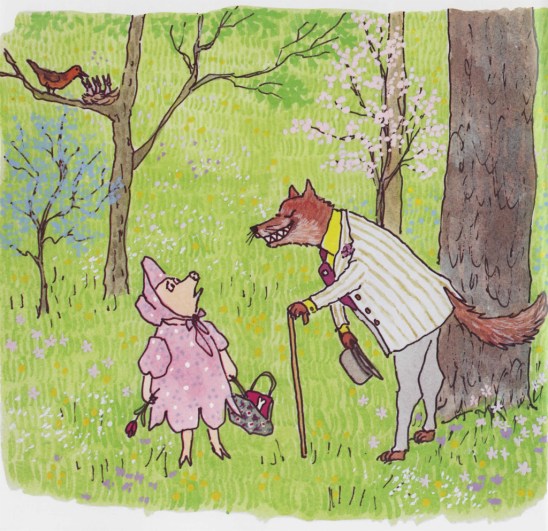
After all, the world is as the fox told Pearl in The Amazing Bone by the immortal William Steig (may he rest in peace).  

amazing bone.jpg

Pearl, the pretty little pig,  taken home by the smiling, courtly fox, is trussed and ready for the oven, flames already leaping inside the wood burning stove.   She pleads with the fox who is cutting up vegetables with gusto and whistling happily thinking of the tender, succulent pig he is about to enjoy.  Pearl pleads to the fox to spare her life.

“Why must you eat me, Mr. Fox?   I am young, I want to live.  Please!” The fox looks over at Pearl sympathetically. 

“Why are you asking me?” says the fox, “how should I know?  I didn’t make the world.”   (This isn’t the actual Steig line, the correct quote is below [1])  The fox finishes preparing his salad.   As he leads her to the door of the oven he offers further words of solace:

‘I regret having to do this to you’, said the fox. ‘It’s nothing personal’. 

It is the bone, it turns out, who says to the fox:

“You must let this beautiful young creature go on living. Have you no shame, sir!”

The fox laughed. “Why should I be ashamed? I can’t help being the way I am. I didn’t make the world.”  [2]

The wisdom of that “I didn’t make the world,” however cruel its particular use might be,  has always stayed with me. 

It’s an answer as illuminating as “because he can” to the question of why a dog licks his genitals or how a Supreme Court justice with a glaring appearance of impropriety can insist he has no legal or moral obligation to recuse himself from sitting to hear the case.  

“I didn’t make the world.”  

Truly.  I had no hand whatsoever in the making of this world.

My only work here these days is coherently setting down what I’ve seen, heard, learned, discovered, read, in an effort to understand as much as I can.  I don’t know what compels me, exactly, or why it seems so necessary to me to write down clearly as much as I can write  down in whatever time remains.  

I know it has something to do with this cosmic less than wink of an eye we each have to be alive in, this flickering miracle of consciousness we so briefly share.  How intolerable is it, therefore, to be forced to march in a column, for an insane reason, life and death decided by the worst and most violent humans on earth at any given time?   To wait a century or more for rights our Constitution provided for almost two hundred and thirty years ago?  Is it just me?  I don’t think so, my friend.

(placeholder)

 ii

A great book is like a fascinating conversation.   When you hear the voice of someone who reads a book with feeling, the author’s ideas coming out clearly in the spoken words, you’re having a conversation with those people.  The conversation of reading is as real as, and often much more substantial than, many actual conversations you may have with other living people.  Particularly conversations in these contentious, violent times, which can burst into flames quicker than you can say “wait…”.  

I have been listening to two fantastic audio books that I cannot recommend highly enough.   Eichmann in Jerusalem (Hannah Arendt) and Dark Money (Jane Mayer).   I intend to post full reviews of both here at some future time, hopefully some time this summer.  In fact, the NY Public Library is into me for two weeks of overdue fines already for the paper copy of Eichmann I have been making notes from. I have to buy a copy ASAP.  

(placeholder two)

iii 

I offer the following as an example of the kind of thing that, designed to eliminate stress, actually causes more stress, a kind of forgetful oversimplification that can lead to a fist fight.   It is the lazy mind’s approach to thinking.   Take a snapshot of the idea, and that’s the idea. The snapshot is the idea, get it?  If you hold the snapshot, the still frame from the movie, you’re holding the actual idea.   Nuance is for fucking eggheads, and, anyway, who can keep all that contradictory shit in their heads, you know what I’m sayin’?  The snapshot, on the other hand, is clear as the nose on your face.  Often the only possible response to a brilliant presentation of great nuance is “Fu-uh-uck YOU!”    That response often carries the day in the debate between a snapshot and the actual person in the photograph.

That’s just the way it is right now, when so many are angry, fearful, desperate, riled up, not going to take it anymore.   We didn’t make the world.  Consider, though, how limited the essential truth, if any, is contained in a single snapshot of anything.

There is a book called Man’s Search for Meaning, by Viktor Frankl.  I found it in the public library in Fresh Meadows back when I was in high school.  I read it and recall being very impressed by it.  An editor at Wikipedia did a wonderful job describing it:

Man’s Search for Meaning is a 1946 book by Viktor Frankl chronicling his experiences as an Auschwitz concentration camp inmate during World War II, and describing his psychotherapeutic method, which involved identifying a purpose in life to feel positively about, and then immersively imagining that outcome.

Toward the end of the book (a longtime international best-seller) Frankl writes, as I recall, that the highest form of personal purpose is one you’d be willing to die to defend.  I remember thinking as a sixteen year-old what a beautiful thing it must be to love someone or some value so much you’d die to protect her.  I also recall being a little troubled by the statement, even as a teenager.

Over the next few decades I’d come to see the danger of this statement, removed from the humanistic context of Frankl’s book.  Frankl was talking about defending decency against indecency, not endorsing some crackpot’s idea of hate and violent revenge that other enraged imbeciles would willingly die for.  But take that one statement by itself, present it as a snapshot of the book and you have the humanitarian Frankl advocating suicide bombing, killing abortion doctors, performing any of the many atrocities, undertaken for the sincerest of murderous beliefs, for which certain humans are rightfully abhorred.   These atrocities reflect badly on all of us humans, when you think about it.  Although we, none of us, made the world.

But dig how that works.  Out with the filthy bathwater, fuck the baby!    You read an entire book, enjoy and get engaging ideas from the author’s conversation, agree with virtually everything you read.  Then you find a paragraph toward the end that causes your brow to furrow.   You underline the sentence about being willing to die for your beliefs and put it next to a picture of fucking Mohammed Atta [3].   Then you take your snapshot: Frankl says Mohammed Atta is an example of the highest form of purpose and meaning in human life.   Based on that, the rest of the book can be dismissed as an intolerable incitement to fanaticism and murder.   You cast it on to the bonfire, along with Mein Kampf, The Art of the Deal, Atlas Shrugged and the rest of the worst of best-selling twentieth century dreck.

A stray thought: could this hateful principle, seemingly applauding fanaticism, have possibly come from the same book by the same Victor Frankl portrayed here?   Remove nuance from any conversation and all that’s left is simplistic folly, or worse. 

iv

When my weekend of agitated distraction was about to begin I had an ambitious, perfectly achievable, though challenging, plan.  I was optimistic about making a good start on it, with two days to myself, before my concentration was shattered by an intolerably annoying personal sideshow I was unable to put out of my mind for long.   My goal is a 3,000 word publishable abstract of my 1,200 page manuscript about my father’s life and times.  This would be published somewhere and I would send the enticing published clip out to literary agents to try to hook one to sell the book proposal, to get me some money, an advance from a publisher.   I will take the first step now:

the first draft is here  (placeholder)


[1]  I went searching for the exact quote, as I am bad at exact quotes in spite of having a better than average overall memory and spending hours daily carefully weighing words. You’d think I’d be better at quotations, but I really am quite lousy at getting them perfectly correct.   I get the sense, almost never remember the exact words.

My own copy of Steig’s masterpiece is buried somewhere in my apartment.   I found nothing on-line to enable me to give you the exact, perfect Steig quote (he was a master of language in addition to being a great artist). I provide a link to a short animated clip, an advertisement of the copyright holders for the very best of perhaps six hideous video versions of this marvelous book read aloud on the internet.   I am seriously considering plunking down my $1.99, this is a beautifully done animation and aloud reading of one of the great books of all time.

[2]   Excellent description and review of  the Steig masterpiece, complete with quotes (yay!) and selected illustrations:  HERE.

[3]  Mohammed Atta was one of the 9/11 suicide terrorists who flew two 747s  into the World Trade Center.  His face, in the single snapshot of him most people have seen, is a mask of hatred.   The nervous Sekhnet and I  were at JFK airport for a flight to Spain, around 2005.   She had some anxiety about the flight, and time pressure (due to my habit of arriving at the last moment), and asked me to arrive with her three or four hours prior to our flight time, to avoid stress, and I had agreed.  While she slept contentedly on a bench in the terminal I walked around aimlessly with our valuables, sullenly counting the wasted minutes.  Over the PA there was an announcement asking Mohammed Atta to please come to such and such a desk.  The announcement was repeated several times.   I was glad Sekhnet was asleep, and figured the name they were calling over and over must be a common one in some parts of the world.

Distraction

There are certain things that occupy the mind so clamorously that they crowd out all productive thought.   If you’re worried about something all the time to the point of preoccupation it’s hard to focus on anything else.   Your work suffers.   Eventually the boss sends in the guy with the ax, your head rolls a few feet and is booted into a basket.   If you have no boss, thoughts themselves can be your brutal master.   Certain thoughts, once they have their hooks in you, will not let go until they have sucked you dry of creativity, even the impulse to try to be creative.

Being captured by one of these thought occupying conundrums is like being caught in a loop while on a treadmill with no off switch.   Presented with a difficult, seemingly insoluble problem, one real possibility, once you’ve tried to solve the damned thing a few different ways and failed, is becoming caught in a recursive cycle.  You will continue to turn the problem, view it again from several different angles, tend to go over the same poor solutions again and again, failing each time and never being able to “think outside the box”, the only place where any possible solution exists after all other options have exhausted themselves.  In the end, incapable of the necessary leap of inspired imagination, you’ll become convinced the problem has no solution.  

Every serious problem ever faced by humans, the deadliest problem of the day, was solved by an inspired leap of creative imagination.  These leaps are not conceivable to caged animals, pacing their confinement off in a track that rubs the fur off one of their flanks.  Once the problem is solved, often by something ingeniously simple, the solution seems obvious, is eventually taken for granted.  Before we harnessed fire, what?

Take any political stalemate you like as an example of the supremely distracting, mental energy sapping thing I’m trying to bring out.  The killing on the Palestinian side of the Gaza fence.   You can turn that one several ways, and it doesn’t ever come out good.   The answer is not there, among terror advocates, human shields, political tools, protectors of democracy, dupes, zealots willing to die and snipers with orders to shoot to kill.   In the end, your mind glazes over, you pick a side and glare, or turn your eyes away in despair.  Even as you’re aware the human truth is not really there on either present merciless side: a terrorist outfit running Gaza, right wing nationalist extremists running Israel, and that no solution is possible as long as these merciless motherfuckers are running the horror show.

You get something stuck between your molars.  It is lodged so firmly that it actually makes your teeth hurt a little bit, pain now traveling along your jaw.  You can’t get it out with your fingers, your fingernails, with a toothpick, the thinnest blade of your pocket knife, the edge of your map, your tongue endlessly goes to it, you are talking, trying to do other things but distracted.  Nobody has dental floss.  You’re seven miles out on a hiking trail. Up shit’s creek, no paddle.  If only…

There are many things like this in life, particularly in a fast-paced competitive society that believes “time is money,” and “chop, chop, we’re on the clock.”   Time is obviously not money in the most basic sense.  You can have a billion dollars, but when you run out of time, the worms begin licking their lips, dirt is thrown over you (the passive voice used) and your money is no good here, sir.   Time is time, the only real possession we have while we’re here breathing, dreaming and being so often distracted.  It is, of course, difficult to see that in a land where everyone keeps chanting “time is money, chop, chop, we’re on the clock!”    The chant of a crowd is supremely distracting.  A good chant can actually produce mass mindlessness.   The examples in history and current events are so numerous and well-known that we can safely skip the example.   

I’ve often railed against the lying, attention demanding false show called advertising, also known as Public Relations (and in the political context; propaganda) which has, of course, come to rule electoral politics in modern democracy, as well as in modern dictatorship, now that I think of it.   During a brief stay in a PhD program in History (with the capital H, to be sure) I focused on the rise of the Nazis, masters of organized public lying on a mass level, the abusive fathers of the modern political advertising almost universally practiced today.  

The rise of Nazism and the functioning of their infernal state were things I’d studied long and hard as an undergraduate.  I even won a prize for my research paper The Nazis vs. Degenerate Art, which, like so many things, sounds more ominous in German: entartete kunst.  In the decades since that Joan Kelly Prize-winning paper several books have come out about the infamous Nazi campaign against modern art.  At the time, I was among the first Americans to explore the subject, with very little research material then available in English.  I was basically following somebody’s footnote about entartete kunst.  I somehow procured an original catalogue of the show that travelled through the Reich, the highest attended art show until the Metropolitan Museum put on King Tut (or maybe it was MoMA’s massive Picasso show) an art show that broke the record half a century later.  Devilish shit, that black and white glossy catalogue, with a particularly ugly African mask on the cover, staring out with dead, hollow eyes.   

Anyway, I noticed in my reading and watching that as mass media became the monolithic force it is today (and today, of course, our selected mass media is in our pocket, with a beep to notify us there is something urgently waiting for us to look at) corporations and governments took on more and more of the same tactics for influencing and dominating public opinion.  The same experts who earned the most money in commercial advertising (masters of “psychological warfare” like Edward Bernays, who coined the phrase around 1920) sold things like war (Committee for Public Information in the build up to U.S entry into WWI, much extolled by Hitler in Mein Kampf) and political candidates.   I’ve written a lot about this sickening subject over the years, there are many excellent books out there on the subject, (Noam Chomsky’s Manufacturing Consent comes to mind, there’s a great movie of that title on youtube, if I’m not mistaken;  I’m not, here you go ) and the power of advertising in our current world is hard to overstate.

DISTRACTION, on a mass level, by design.

When I sat down to write yesterday I was unable to begin the important, challenging thing I have in mind to write (a 3,000 word version of the book about my father, to sell to some publication so as to procure a literary agent to sell the book, though it will be hard enough to sell the short piece to any impressive publication without a literary agent– Catchuh-22!)  until I had written something else, cleansing the mental palette of what has been distracting me so much lately.  A long friendship dating back to when I was seven or eight years old, on the ropes, bleeding from multiple cuts, both eyes swollen shut, head carbuncled with contusions, panting piteously as the onlookers gasp, referee nowhere in sight.   I’m requested not to write anything about this, no matter how obliquely, even though writing clearly is the only way I know how to really process anything.  The only way I can set the thing clearly in front of myself is to write it coherently for someone else.   I am sternly requested not to write about it, chided with:  I would certainly never publicly write about you, or any of your troubles.  I could write it in my diary, I suppose, if I still kept one, but I don’t.  I consider the discipline of writing for “publication” essential to my writing life.

So there you go, let’s just close that annoying fucking loop and focus on the difficult work ahead.  Here we go loop de loo.  Fine.  Eyes on the prize.  Mind on spin cycle. There is no way out.   I will not be distracted, I will not be distracted, I will not be distracted, I will… OK, I suppose I will.

A true artist, I was once convinced, learns to extirpate everything from his life that distracts from making art.   Now I think this is a cynical formulation created by auto-mythologizing public relations monsters like genius and money-machine Pablo Picasso, who devoured whole women alive to obtain the raw materials for his masterworks.   On the other hand, fuck.  Some weeds just need to be rooted out, tossed into the sun to dry out, become airy puppets for the doomed feral kittens in the garden to bat around.


Fantasy Island in my mind

Outside, the world is raging.  People are actually arguing about what to call the cages they are throwing confiscated children into.   One wealthy country’s criminally misguided drug laws put neighboring countries’ drug cartels into overdrive, people are killed, tortured, threatened.  Citizens flee the violence of their impoverished home countries.  They are caught at a border, have their kids grabbed, or are told that their children will wait for them while they’re being processed as potential illegal terrorist types [1].  Then, as the adults go with authorities, their kids are secretly whisked hundreds of miles away, no receipt given, the kids can be anywhere.   Whose fault is that?  

Outside, on the Fourth of July, freedom is no doubt loudly, ponderously on the march.   Is it still freedom if it wears jackboots?   Back in Germany, between the world wars, as the violent revenge fantasies were gestating in vats of nationalist, racist steroids, militant German youth marched chanting “wir sheissen auf die freiheit!“. The NY Times translated this as “we spit on freedom!’ though, of course, the active verb in that sentence means “shit”.   WE SHIT ON FREEDOM!  

In my mind, it is much more quiet.  Nobody shitting on freedom, no bureaucrats sending children hundreds of miles from their parents with no records kept, no world leader threatening to detonate nuclear bombs and annihilate millions if he doesn’t get universal adulation — and a Nobel Peace Prize.

“You pretentious asshole,” says an old friend.

“Yes?” I say.

“You seriously believe you can write your way out of a world of festering horrors?”

Mmmm, result is unclear.

“Did you read that off the little screen of your magic 8 ball?”

It is likely.  

“Look, you seem to feel you can just write out your thoughts and feelings and put them up for your dozens of mindless followers to salute.” 

Here is my bottom line.  If you are my friend, I give you the benefit of the doubt.  I exert myself not to judge the things you do to survive, even if they are things I myself am unable to do.

“Fuck you!” says my old friend.

Didn’t mean to sound judgmental, old bean.   I only mean to point out that my first duty, as your friend, is to give you every benefit of every doubt.   I was directed to an interesting opinion piece in the Grey Skank the other day about the corrosive shame so many men feel, and how it leads to the disrespect of women, which fuels more shame.  This cycle culminates, of course, in toxic masculinity.   That is the kind of macho bluster that puts violence at the top of the list of ways to get people who say uncomfortable things to shut the fuck up.

“Jesus, the torture never stops!   Will you get to the fucking point?” says my old friend.

Of course.  Giving the benefit of the doubt starts with recognizing the feelings of another person.   He did this because he felt he was about to be killed.   Fair enough.  In his shoes I might well have done the same thing.  I certainly would have felt the same way he did. 

“You are maddening!” he says.  

Yes.  Anyway, I’ve learned that you cannot argue, or it is pointless to argue, aggravating and counterproductive to argue (unless your goal is a good argument), that you should not feel what you are feeling.  The feeling must be acknowledged, its reality accepted.  The feeling is what it is, the reasons for it cannot be understood or addressed without first acknowledging the feeling.  No productive conversation into overcoming the bad feelings can be had if the other person’s strong feelings are denied.

“Feel this, motherfucker,” says my old friend clenching his fist and brandishing it uselessly.

Oh, uselessly, eh?” says my old friend, swinging his fist an inch from my nose.

I smile without showing my teeth.  “Doan wase yourself…” I say through my smile/smirk, like Bruce Lee on the deck of that boat in Enter the Dragon, not even turning my head to the bully, watching the waves lapping in the distance.    

My friend punches me full force in the mouth.  

Feel better, do we?

“You self-righteous fucking asshole,” says my friend.

Yes?

Look, I get that your feelings are hurt.   I seem to be blaming you for acting badly, even though it wasn’t your fault.  You were in a total panic, afraid I was secretly angry at you, maliciously sabotaging your shaky marriage.  I get all that.  It was important for you to point out, at that time, that I always feel I’m right, never admit the possibility I could be wrong, never apologize about anything.  I apologized to you, for what it was worth.  Then you told me how hurt and angry you are that I see you as an anxious person who needs to be protected.  I get it, I get all that, truly.

Thing is, though, strong feelings, stirred and unacknowledged by the people who are supposed to be your closest friends, lead to other strong feelings.  This happens almost in direct proportion to the strength of the feeling that is left unacknowledged.  If you deny my right to be angry, what am I to do with the feeling?   You come to me in rage, I don’t acknowledge your right to be angry.  Tell you you’re a fucking baby, advise you to “grow a pair”, man up, stop being a pussy(cat).   What happens to the rage I tell you to fucking shut up about?

“One punch in the face wasn’t enough for you?” asks my friend.

Once is never enough, from a man like you.  You remember that Captain and Tennille line, the pretty Tenille singing to the Captain:  do that to me one more time, once is never enough, with a man like you.  What the hell?    

“I’m going to kill you,” says my friend.  

No, you are not going to kill anyone.  One thing I can assure you, I am not going to be killed by you today.   You may feel like killing me, and we can talk about that, you toxic male you, but you ain’t going to kill me any more than I’m going to kill you.

Feel free, in the meantime, to punch me in the face as hard, and as many times, as you like.   I’ve got to get back to my daydreaming on Independence Day, so forgive me if I don’t cry out.   Rest assured, your punches are mighty, and terrible indeed.


[1]  Not to make a gratuitous comparison between government lies told to helpless people, but when the Nazis forced the Jews at the killing centers to strip naked and line up, the Jews were told it was for a shower, not a gas chamber.   Which would you rather step into?  A nice hot shower, or a sealed room about to be pumped full of poison gas?  Come on, is there even a choice?

Seeing things in another light

It’s funny, sometimes, to notice how one thing leads to another.  Events and thoughts can proceed in a way that makes you suddenly see something in a completely new light.  

The other day, in the sudden extreme heat (the real feel temperature got over 100 in New York City the last few days), I found myself walking around in just shorts.   It was too onerous to wear a shirt, or socks, and since I was inside, moving from fan to fan, I simply wore the minimum to remain decent while walking past the many ground floor windows at the farm.

At some point, standing at the sink of the upstairs bathroom, looking into the mirror, I suddenly saw my immense, oblong gut in a new light– sunlight.   Sunlight may be the best disinfectant for certain things, but it is the harshest possible light in which to see something like a watermelon-sized stomach ballooning over a waist band.   The slanting sunlight lit my stomach from a merciless angle, with a light that made the bulk fully three dimensional in a way my own dim bathroom mirror does not.

I was suddenly filled with horror, true horror, as I turned and saw it from all angles (it was particularly grievous from the side).  I immediately vowed to limit my caloric intake (and have so far, going on my third day, though today for brunch I had toast and home fries) as I rehab my knees, toward the day I will also get back on my former exercise regime.  It was a visceral thing, truly.  Not as if, mind you, I was unaware of the twenty or so pounds I have to lose, but seeing it in this harsh new light there was no longer any way for me to rationalize wearing this thick, bulbous vest of adipose tissue.  Not good for my health, nor for wearing a bathing suit next weekend at our friends’ house by a lake. 

From this thought to Hannah Arendt’s illuminating insight that totalitarianism, as distinct from normal despotism, military dictatorship, brutal monarchy and other familiar time-honored forms of authoritarianism, requires mobilization of the masses in the complete service of the leader and his State.   This new mass authoritarianism only became possible with the advent of truly mass media.  Hitler or Stalin, no matter what their genius for manipulating their followers, could not have exerted the complete social control they did without full ownership of the press and those two nascent mass media technologies, motion pictures and live broadcasts over radio waves (plus telephones and a few other useful technologies for keeping tabs and issuing orders).  

Totalitarian society is always organized as a strict hierarchic bureaucracy, with party loyalists running every one of its hundreds of branches.  Bureaucracy had been around before totalitarians harnessed it, but with the advent of new technologies, it became a much more efficient machine for social control.   Technology, as it was developed, became instantly part of the administration of these bureaucracies.

International Business Machines (IBM), for example, caused a little bit of a stink (though it didn’t seem to hurt their corporate bottom line) when it was learned, after World War Two, that IBM had made its new punchcard technology available to Nazi bureaucrats who used it to ensure the cattle cars heading East were full, and to keep track of who was left to ship East for “resettlement”.   Just a business doing business, corporate bottom line and all, no moral stance whatsoever, just money making money. [1]  

The word bureaucracy conjures hellish images out of a Kafkaesque nightmare. That is for good reason.  Bureaucracies are pyramids, and the vast bulk of the workers in a bureacucracy are powerless, hopeless ants serving their individual bosses on each level, without the slightest autonomy, or even much enthusiasm for their small, mechanical jobs, jobs they usually do with almost total indifference.  

An ant seems undeterrably  enthusiastic about moving crumbs back to the queen at the top of the anthill hierarchy because it is programmed to do so, not because that individual ant has a sense of agency or any kind of autonomy.   A chemical impulse makes the ant behave as it does, and it is not the ant’s place to question anything. The human member of a bureaucracy, however, is by nature somewhat resigned, depressed and embittered.  It is a job that can make you cynical and mean.  You have responsibility for a limited set of mechanical tasks, a limitless amount of drudgery to get through each shift, a very small amount of power (if any at all) and, the best you can hope for, if you do the shit little job well, is upward promotion.

Reminds me of a great remark I once heard about the Rat Race.   Even if you win the rat race, you’re still a rat.

To be human is to expect more, if only because we have powerful myths about our unlimited power as individuals to determine the course of our own lives.   It is undeniable that human progress, and individual progress, is made by those who tirelessly work to make this potential real.  But for the vast masses of individuals, it’s off to work, to a job that usually sucks, for less money than they need or feel they deserve.

As a low level bureaucrat, you tell the disgruntled member of the public you are forced to deal with that they must do such and such.  When they complain you defensively tell them you didn’t make the rules, and that if they don’t want to give up their place on the long line they have already waited on, they’d better do what you’re telling them.   In modern corporate and government bureaucracy your chance of being given correct information is about 50/50, at best [2].   Things are much simpler under totalitarian bureaucracy: you simply do what they say or they send someone to get you and they kill you.

Adding current digital, algorithm-driven technology to bureaucracy brings us into a whole new world of shit.  Use your phone to look for a product, you get all the related ads almost instantly.   When Hitler was pioneering the use of radio, he could get on the air and make a persuasive, lying pitch to millions of Germans at once.  This ability to sell “on the air” helped make him a celebrity, a star, a man with seemingly superhuman powers.  He was the first to address a nation from the air, as his plane flew over a disputed corridor, under Polish control, that he claimed should by right be part of the German Reich.   This was something only a god could do back in 1932, thunder from the air to millions of people.  In 2018, a three year-old on the toilet, tweeting incoherently from his celebrity mommy’s phone, is as godlike as a flying, thundering Hitler over the Polish corridor.  OK, extreme example, maybe, and not the best.   A public official with 20,000,000 twitter followers can reach them all instantly, 24/7, from wherever he/she/it is.  How’s that for a god?

I don’t know where else to go at the moment with these thoughts.  It’s not as if, thank God, we actually have a public official with 20,000,000 followers who can instantly send them ranting real-time temper tantrums at 5 a.m. while straining over his stools.  

(More fiber, you imaginary costive motherfucker.)


[1] In our own time, recently Bill Gates had a tiny bit of dung flung his way when it was revealed that Microsoft facial recognition software had been sold (or perhaps given) to the current U.S. government to help I.C.E. recognize and root out the many potentially dangerous foreign rapists, murderers, terrorists and just plain undocumented “illegal aliens” and their so-tempting-to-cage children.

[2]  Trying to log-in the other day to pay my $375 biennial fee to keep my law license intact, I encountered a series of technological cul de sacs that prevented me from completing my registration (or even starting it, really).  Frustrating.   I sent an email to the help desk and got a helpful reply instructing me on exactly what I needed to do to complete my registration.  I did those things, got no further than the day before, wound up in the same cul de sac.  

Fortunately, the email reply came with a phone number, which I then called. Unfortunately, the phone was eventually answered by an imbecile.   The imbecile told me that I had to log-in with a computer, that I couldn’t use a Mac or an iPad to register.  I told the imbecile that I’d logged in and registered successfully two years ago with a Mac, which is also, by the way, a computer.   He soon grew impatient with my attitude.  

I asked him for the number for tech support, which he said was located in Albany.  He didn’t have the number.  Connected me to somebody who told me what was going on:  the site had been down the other day when I tried to log-in, there had also been many problems with the site’s functionality on Google chrome.  He assured me that, of course, it had nothing to do with Mac or PC format.  While I had this guy on the phone I logged in with another browser and found myself in the same cul de sac.   The problem was not Google chrome.

He agreed that an email about the website being down the other day, or known problems with Google, would have been preferable to constant ambiguous error messages, incorrect instructions, or the idiotic invention about the Macs.  I mentioned my former friend the computer programer who is on the Asperger’s scale, suggesting that many automated replies, such as the ones I kept getting were programmed by folks like him and were neither intuitive nor helpful.  We agreed that often machine logic is simply not the same as human logic, much as we might wish it to be so.   We talked for a while and found a work-around

He had more useful information for me, I could forego the $375 fee if I did such and such (I may do it next cycle, if I can confirm it’s true).   We spoke for a while, I made notes, he verified everything I read back to him.  Great guy.   Asked his name.  It was Joe.  “Thank you, Joe,” I told him.   The odds of talking to a person like that, in any bureaucracy, are about 10 to 1 against it.

In any bureaucracy, you have a more than 50/50 chance of talking to a peevish moron talking through his or her ass than to someone who actually knows how to help.  Luck of the draw, really.


A Few words about Isaac Babel

Isaac Babel was a Jewish writer from Odessa, born in 1894, not terribly far from where my mother’s people come from.  My grandparents were five or six years younger than him.   A kind of prodigy who wrote fluently in French as well as in Russian, and a great admirer of Guy de Maupassant, he was told by Maxim Gorky, to whom he submitted his precocious work, that he had talent but nothing to say yet.  Gorky told him to go live and come back when he had something to write about.   

Babel joined a group of Bolshevik Cossacks who rode into my grandparents’ neighborhood of the Ukraine during the second bloody phase of the Russian Revolution. These Red Cossacks battled the White Cossacks for control of the Ukraine and Poland.  Their savage, idealistic battle for human freedom won the hearts and minds of teenagers like my grandmother.  

Babel’s stories of this bloody campaign, and his life as a bookish urban Jew riding with rough horseman who lived by a brutal code, collected as Red Cavalry, are incomparable.   He wrote in an extremely compressed way, telling these merciless, human stories with an amazing, sometimes terrifying economy.   His characters spoke a dialect I immediately recognized, though I didn’t know from where.  It was my grandparents’ language, I realized years after they died.  (see this, if you would like more details)

He became a hero in the Soviet Union after the publication of the Red Cavalry collection — though the brutally honest stories also contained the seeds of his undoing.  Lenin died, Stalin seized power, Trotsky fled.   With Stalin, a paranoid mass murdering maniac in charge, the dream of the Revolution to spread equality and liberate the workers of the world from their oppression melted into a peculiarly Russian form of totalitarianism.

Under Stalin  Socialist Realism, a style flattering to the State, was required.  Babel continued to write but published little, tried not to say anything that might get himself killed, had chances to flee, didn’t get out of the Soviet Union in time.   Was eventually arrested by Stalin, held in an infamous hellhole, given a quick trial in a tiny room with no windows, and no witnesses.  He was expected to sign a confession that he was a spy, a Trotskyist terrorist and a traitor to the revolution.  

He asked to be allowed to finish his work. That was apparently the last thing he said.  He was taken out and shot in a courtyard a few months before Hitler ‘s armies invaded the Soviet Union.   He was one of millions quietly done in by the smiling maniac with the big mustache who many knew as Uncle Joe, America’s ferocious, indispensable ally in the war against Hitler.  

A reviewer of his works offers these bits of grim, colorful detail:

Babel was shot by firing squad in the Lubyanka, in 1940. His immense popularity in Russia did not save him; and besides, it had been most unwise of him to conduct a long-standing affair with the wife of the head of the NKVD, Nikolai Yezhov.

There was supposed to have been a trunk of Babel’s writings, hidden by his friends, a trove of his writings that were never published.   It’s not clear if any of these pages were ever found.   I know the trunk went the way of my mother’s blue, leather-bound poetry notebook I recall seeing as a child.  A fucking tragedy every way you turn it.

I wrote the following as a footnote to the previous post.  It seemed a waste to leave it as a footnote about a writer I love, an inspirational writer you may never have heard of, so here you go, those of you who may be unfamiliar with this genius’s work.

I am a great admirer of Isaac Babel’s writing.  I put Babel’s writing in a class with Sam Cooke’s singing, Django’s guitar playing, Meryl Streep’s acting.  I read Babel in English, of course, I know and love the 1955 translation (long out of print) by Walter Morison.    

I was once  told by a Russian poet that Isaac Babel’s Russian is “untranslatable”.   I have always loved the Walter Morison translations, which this Russian poet told me captured Babel’s Russian surprisingly well.   When I see other translations I am often struck by their clumsiness, the way they are nothing like the Babel I love.  

Here is an excellent discussion, leavened by wryness, of the challenges of translating Babel’s Russian into English.   I tip my cap to this writer, well done!   

Here is the first article on the challenge of translating Babel I found, which struck me as great at the time.   I thought it contained a section of Morison’s masterful rendering of Babel’s Guy de Maupassant  (though the notes in the book I love apparently attributed the translation to Raymond Rosenthal and Waclaw Soski).   It appears the author of the article linked above thought he was up to the challenge of improving this flowing translation.   I say no, but, alas, am too lazy to rewrite the whole piece.  To cut straight to the immortal passages in the beautiful translation I first read, skip to the last paragraphs of this post.  Scroll to the double space above Here, sorry about that.”

Here is Babel’s wonderful, laconic description of translating, of writing.   This is possibly the best short description ever written about what we do when wrestling our thoughts into the best possible language  (it comes after the other translator’s introduction of the story for context) (emphasis mine):

Babel himself was a translator from French and Yiddish. One of his best-known stories, “Guy de Maupassant,” is ostensibly about translation. Its narrator, a fictional Babel, has been hired by Raisa Berndersky, a rich Jewish Petersburg society wife, to help her with her attempts at translating Maupassant:

In her translation there was no trace of Maupassant’s free-flowing phrases with their drawn-out breath of passion. Mrs. Bendersky’s writing was tediously correct, lifeless and loud, the way Jews used to write Russian back in the day. I took the manuscript home with me…and spent all night hacking a path through someone else’s translation (*). The work was not as bad as it sounds. A phrase is born into the world both good and bad at the same time. The secret lies in a barely discernible twist. The lever should rest in your hand, getting warm. You need to turn it once, but not twice. In the morning, I brought back the corrected manuscript. Raïsa wasn’t lying when she told me of her passion for Maupassant. She sat motionless, her hands clasped as I read it to her: these satin hands melted to the floor, her forehead went pale, and the lace between her bound breasts strained and trembled. “How did you do that?” So then I started talking about style, about an army of words, an army in which all manner of weapons come into play. No steel can pierce the human heart as cold as a period placed just right. She listened, her head bowed, her painted lips parted. A black light glowed in her lacquered hair, smoothly pressed and parted. Her legs, with their strong tender calves, were bathed in stockings and splayed wide on the carpet.

No, wait just a minute.  This is not Morison’s translation, (or Raymond Rosenthal and Waclaw Soski’s) you treacherous fellow you.  I get it now, you think you have improved on the “Morison” translation, made it more faithful to Babel’s writing, to the actual Russian words he chose.  You haven’t, and I know this even though I don’t know a word of Russian.  It is in the flow, the music of the language, the rhythm.  Morison, the year before I was born, translated the phrase you style “hacking a path through somebody else’s translation” as “hacking my way through the tangled undergrowth of her prose” as far as I recall, I don’t have the tattered out-of-print paperback with me here at the farm.  But compare those two phrases.  Why would Babel have written the dry first phrase when the second is so full of flavor? 

Now I see many small brutalities, inflicted no doubt, and without a sense of irony (especially considering the story itself, the passage about the subtle art of translation!) in the interest of making the translation more accurate, more tediously correct, if I may borrow your phrase for Raisa  Bendersky’s stilted, painstaking, tuneless translation.   I know that translation is a fine art, a very difficult art, no doubt, a kind of intoxicating dance (when working with something like Babel’s uniquely delicious prose).  But sometimes you simply need to leave a fine translation alone.

“How did you do that?” with only the tiniest, almost imperceptible, turn of the warm lever, is inferior, and far less immediate, than Morison’s/Rosenthal’s & Soski’s breathless “How did you do it?”.

And fuck, the last line of the story, which made my young spine tingle and filled me with a longing to some day write a line like that, has been changed too!  And not for the better, it ends the transcendent story rather flatly.  It is rendered:

My heart felt tight.  I was brushed by a premonition of the truth.

Nothing like the icy fingers grasping his heart as he has a premonition .. wait, I have found the original line, on-line:

My heart contracted as the foreboding of some essential truth touched me with light fingers.

Another great line, butchered also, damn it, made clumsy and clunky, along with the bit about needing to turn the lever once, not twice.  The proof, if it was needed, that some phrases don’t need the lever turned at all.  You took this:

No iron can stab the heart with such force as a period put just at the right place.

and believe you’ve improved it, with only one turn of the lever, to this:  

No steel can pierce the human heart as cold as a period placed just right.

Dunce!

Goddamn it, you fucker.  Might be more accurate as a strict translation from the Russian, maybe the Russian word for “cold” is in there, “pierce” may be closer to the Russian than its close synonym “stab”, but for god’s sake, read the two lines in English.


Here, sorry about that.  I mentioned I don’t have my moth-eaten copy of Babel with me.  Read this, from the original translation, I found it in an old email I sent a friend in 2014. Observe the way it flows, without a word wasted:

I took the manuscript with me, and in Kazantsev’s attic, among my sleeping friends, spent the night cutting my way through the tangled undergrowth of her prose.  It was not such dull work as it might seem.  A phrase is born into the world both good and bad at the same time. The secret lies in a slight, an almost invisible twist.  The lever should rest in your hand, getting warm, and you can only turn it once, not twice.

Next morning I took back the corrected manuscript.  Raisa wasn’t lying when she told me that Maupassant was her sole passion.  She sat motionless, her hands clasped, as I read it to her. Her satin hands drooped to the floor, her forehead paled, and the lace between her constricted breasts danced and heaved.

“How did you do it?”

I began to speak of style, of the army of words, of the army in which all kinds of weapons may come into play.  No iron can stab the heart with such force as a period put just at the right place.   She listened with her head down and her painted lips half open.  In her hair, pressed smooth, divided by a parting and looking like patent leather, shone a dark gleam.  Her legs in tight-fitting stockings, with their strong, soft calves, were planted wide apart on the carpet.

The maid, glancing to the side with her petrified wanton eyes, brought in breakfast on a tray. 

Listening to an Audio Book

An audiobook of an excellent writer’s work, read by an expressive, intelligent reader is a wonderful thing.   The audiobook of Eichmann in Jerusalem, read by the great Wanda McCaddon, is a fantastic aural read.  I’d say Wanda’s reading is like a great translation of the original  [1].  It is certainly “value added” and I’m sure Hannah Arendt would agree. 

Listening to an audiobook requires a certain concentration, which can be improved with practice.  Listening carefully is not something most people ever practice, we’re in a hurry, yo, get to the fucking point, did you hear… oh, sorry, were you still not getting to the point?  I heard… wait, I thought you were done, were going to say the same thing you always say, are we still talking about that? —  etc.

Wanda McCaddon read a line by Hannah Arendt that caused me to make a note to find the quote in Chapter IX of Eichmann in Jerusalem.  It seemed to explain a lot.   Why did the other countries of the world not help the Jews during the mass murder that went on for several years?   Most of them did little or nothing to help (outside of Denmark) and looking back after most of one’s family has been murdered, like an Armenian after the slaughter by the Turks, it’s natural to feel betrayed, ask ‘what the fuck?’  

Arendt writes (and it turns out to be merely a passing parenthetical), leaving aside the prevalent (though not Nazi level) anti-Semitism in Europe:

(As though those tightly organized European nation-states would have reacted any differently if any other group of foreigners had suddenly descended upon them in hordes– penniless, passportless, unable to speak the language of the country!)

How much light does this short observation shed on the worldwide refugee crisis the world is in the middle of today?

The United States refuels Saudi bombers in the air over Yemen so that our monarchist radical Islamic fundamentalist allies can continue bombing the towns and cities below.  The Saudi planes and the bombs are made in the USA.  We participate directly in creating the humanitarian crisis that has caused untold numbers of Yemeni civilians to flee their war-torn, cholera plagued country.   When they flee the war that we are daily helping Saudi Arabia wage we make a new law: NO YEMENIS!!!  None, no reason needs to be given, the great Oz has spoken.

The Koch brother’s boy, current Secretary of State Mike Pompeo, releases an official State Department boast on International Refugee Day about how America has always been the world’s greatest supporter of those fleeing war and oppression.  He mentions a dollar amount we’ve given, the rough equivalent of a dime, or maybe three cents, and says no other country has done more since the end of World War Two.

A few days later a highly partisan 5-4 Supreme Court vote comes down, along strict party lines, upholding President Turd’s Muslim Ban, er…”travel ban”.  Under no circumstances (unless perhaps they are rich and doing business with one of the president’s businesses) will anyone from Yemen or several other Muslim countries be allowed to come to the United States.

USA!   USA!!!!!


[1]   I am a great admirer of Isaac Babel’s writing.  I put Babel’s writing in a class with Sam Cooke’s singing, Django’s guitar playing, Meryl Streep’s acting.  I read Babel in English, of course, I know and love the 1955 translation (long out of print) by Walter Morison.    

I was once  told by a Russian poet that Isaac Babel’s Russian is “untranslatable”.   I have always loved the Walter Morison translations, which this Russian poet told me captured Babel’s Russian surprisingly well.   When I see other translations I am often struck by their clumsiness, the way they are nothing like the Babel I love.  

Here is an excellent discussion, leavened by wryness, of the challenges of translating Babel’s Russian into English.   I tip my cap to this writer, well done!   

Here is the first article on the challenge of translating Babel I found, which struck me as great at the time.   I thought it contained a section of Morison’s masterful rendering of Babel’s Guy de Maupassant  (though the notes in the book I love apparently attributed the translation to Raymond Rosenthal and Waclaw Soski)   It appears the author of the article linked above thought he was up to the challenge of improving this flowing translation.   I say no, but, alas, am too lazy to rewrite the whole piece.  To cut straight to the immortal passages in the beautiful translation I first read, skip to the last paragraphs of this post.  Scroll to the double space above Here, sorry about that.”

Isaac Babel deserves his own post (and now, a few hours later, he has it), but here is Babel’s wonderful, laconic description of translating, of writing.   This is possibly the best short description ever written about what we do when wrestling our thoughts into the best possible language  (it comes after the other translator’s introduction of the story for context) (emphasis mine):   

Babel himself was a translator from French and Yiddish. One of his best-known stories, “Guy de Maupassant,” is ostensibly about translation. Its narrator, a fictional Babel, has been hired by Raisa Berndersky, a rich Jewish Petersburg society wife, to help her with her attempts at translating Maupassant:

In her translation there was no trace of Maupassant’s free-flowing phrases with their drawn-out breath of passion. Mrs. Bendersky’s writing was tediously correct, lifeless and loud, the way Jews used to write Russian back in the day. I took the manuscript home with me…and spent all night hacking a path through someone else’s translation (*). The work was not as bad as it sounds. A phrase is born into the world both good and bad at the same time. The secret lies in a barely discernible twist. The lever should rest in your hand, getting warm. You need to turn it once, but not twice. In the morning, I brought back the corrected manuscript. Raïsa wasn’t lying when she told me of her passion for Maupassant. She sat motionless, her hands clasped as I read it to her: these satin hands melted to the floor, her forehead went pale, and the lace between her bound breasts strained and trembled. “How did you do that?” So then I started talking about style, about an army of words, an army in which all manner of weapons come into play. No steel can pierce the human heart as cold as a period placed just right. She listened, her head bowed, her painted lips parted. A black light glowed in her lacquered hair, smoothly pressed and parted. Her legs, with their strong tender calves, were bathed in stockings and splayed wide on the carpet.

No, wait just a minute.  This is not Morison’s translation, (or Raymond Rosenthal and Waclaw Soski’s) you treacherous fellow you.  I get it now, you think you have improved on the “Morison” translation, made it more faithful to Babel’s writing, to the actual Russian words he chose.  You haven’t, and I know this even though I don’t know a word of Russian.  It is in the flow, the music of the language, the rhythm.  Morison, the year before I was born, translated the phrase you style “hacking a path through somebody else’s translation” as “hacking my way through the tangled undergrowth of her prose” as far as I recall, I don’t have the tattered out-of-print paperback with me here at the farm.  But compare those two phrases.  Why would Babel have written the dry first phrase when the second is so full of flavor? 

Now I see many small brutalities, inflicted no doubt, and without a sense of irony (especially considering the story itself, the passage about the subtle art of translation!) in the interest of making the translation more accurate, more tediously correct, if I may borrow your phrase for Raisa  Bendersky’s stilted, painstaking, tuneless translation.   I know that translation is a fine art, a very difficult art, no doubt, a kind of intoxicating dance (when working with something like Babel’s uniquely delicious prose).  But sometimes you simply need to leave a fine translation alone.

“How did you do that?” with only the tiniest, almost imperceptible, turn of the warm lever, is inferior, and far less immediate, than Morison’s/Rosenthal’s & Soski’s breathless “How did you do it?”.

And fuck, the last line of the story, which made my young spine tingle and filled me with a longing to some day write a line like that, has been changed too!  And not for the better, it ends the transcendent story rather flatly.  It is rendered:

My heart felt tight.  I was brushed by a premonition of the truth.

Nothing like the icy fingers grasping his heart as he has a premonition .. wait, I have found the original line, on-line:

My heart contracted as the foreboding of some essential truth touched me with light fingers.

Another great line, butchered also, damn it, made clumsy and clunky, along with the bit about needing to turn the lever once, not twice.  The proof, if it was needed, that some phrases don’t need the lever turned at all.  You took this:

No iron can stab the heart with such force as a period put just at the right place.

and believe you’ve improved it, with only one turn of the lever, to this:  

No steel can pierce the human heart as cold as a period placed just right.

Dunce!

Goddamn it, you fucker.  Might be more accurate as a strict translation from the Russian, maybe the Russian word for “cold” is in there, “pierce” may be closer to the Russian than its close synonym “stab”, but for god’s sake, read the two lines in English.


Here, sorry about that.  I mentioned I don’t have my moth-eaten copy of Babel with me.  Read this, from the original translation, I found it in an old email I sent a friend in 2014. Observe the way it flows, without a word wasted:

I took the manuscript with me, and in Kazantsev’s attic, among my sleeping friends, spent the night cutting my way through the tangled undergrowth of her prose.  It was not such dull work as it might seem.  A phrase is born into the world both good and bad at the same time. The secret lies in a slight, an almost invisible twist.  The lever should rest in your hand, getting warm, and you can only turn it once, not twice.

Next morning I took back the corrected manuscript.  Raisa wasn’t lying when she told me that Maupassant was her sole passion.  She sat motionless, her hands clasped, as I read it to her. Her satin hands drooped to the floor, her forehead paled, and the lace between her constricted breasts danced and heaved.

“How did you do it?”

I began to speak of style, of the army of words, of the army in which all kinds of weapons may come into play.  No iron can stab the heart with such force as a period put just at the right place.   She listened with her head down and her painted lips half open.  In her hair, pressed smooth, divided by a parting and looking like patent leather, shone a dark gleam.  Her legs in tight-fitting stockings, with their strong, soft calves, were planted wide apart on the carpet.

The maid, glancing to the side with her petrified wanton eyes, brought in breakfast on a tray.