Category Archives: writing
1924 (part 4)
Back to that baby, my father, born on June 1, 1924. It was a hard birth after a no doubt stressful pregnancy, the tiny mother struggled to give birth to a very large baby. The mother had lost her previous child shortly after birth and must have been undergoing tremendous emotional turmoil. The family was very poor, the horse that pulled the herring wagon may have already died, for all we know, and, if so, the breadwinner was winning no bread. Crime was rampant on the crowded Lower East Side where they lived, violent criminals were organizing into a national syndicate to profit from Prohibition which was already proving to have been a massive mistake.
The second time was the charm for my grandparents, the big baby survived. It was three of them now in the tiny, hot slum apartment during the airless summer of 1924. What could go wrong?
My grandmother’s older brother Uncle Aren intervened, packed up the family’s belongings in his truck and they made the then long trek up to Peekskill, where Aren lived. When this happened exactly is unknown. My uncle, who was fifteen months younger than my father, may have also been a tiny passenger on that trip up the Hudson River, past Sing Sing prison. Aren’s son Eli, freshly expelled from DeWitt Clinton high school shortly before graduation, helped the little family pack up and move.
Aren installed the little family on the second floor of a three story house he owned in Peekskill. Little comes down to us about those first years in Peekskill, except that when Eli moved there around that time he had an altercation with the three Ku Klux Klan member sons of the guy who ran the local hardware store.
“So you’re the new kyke from New York City,” Eli said they greeted him, blocking his way on the sidewalk in front of their store. “I dropped the biggest one, stepped over him and said ‘Eli Gleiberman, nice to meet you guys’. They didn’t bother me after that.”
“Eli’s full of shit! He’s a completely unreliable narrator and a notorious reviser of history” my father always insisted, particularly after I began visiting Eli regularly. Maybe so, but many of his stories had the ring of truth. Eli was menacing and physically formidable even at 85.
What we can establish, with simple arithmetic, is that my father started school just as the Depression was kicking off. In September 1929 the boy was five. His school career didn’t start off well since he didn’t speak any English and he was legally blind. Outside of that, he probably had a pretty normal adjustment to school. Here is a picture of him, one of very few from his childhood, that was taken during his early school years. That’s dad in the middle.
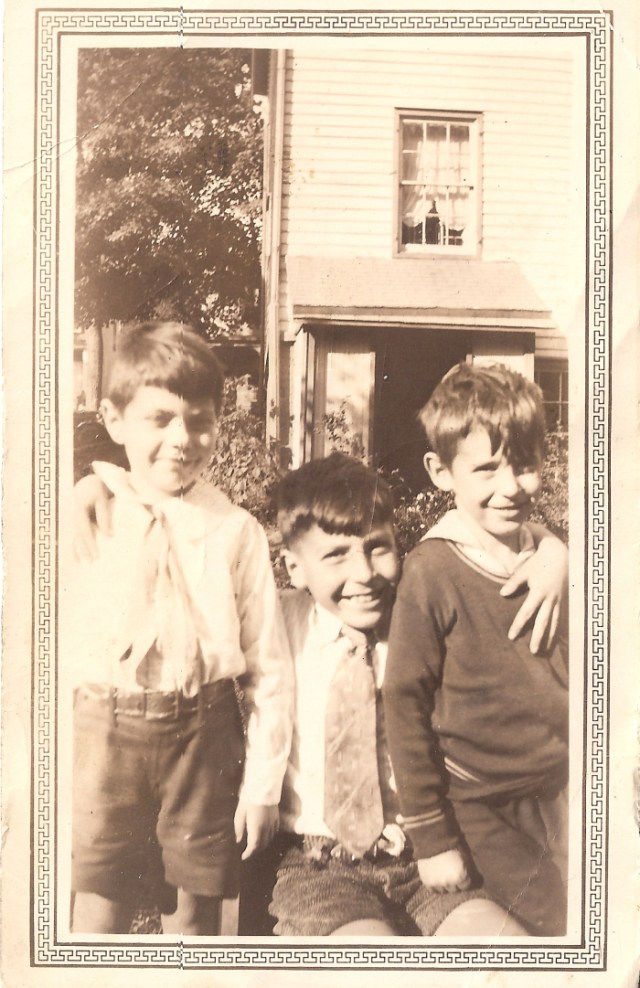
“Who’s that kid on the left?” I asked my uncle, sometime after my father’s funeral.
“That’s Henry,” he said immediately. Henry moved away from Peekskill shortly after the picture was taken, my uncle said, and does not figure further in my father’s story.
We note that young Irv is still not wearing glasses. He’s smiling, looking at the camera, seemingly everything is fine. He’s affectionately draping his arms over his friend and his little brother. All appears right in the world at that moment, during that literal snapshot of time. It’s probably fine.
Three Pieces of Terrible Psychiatric Advice and their fallout
I’m reminded, by a recent chat with a woman I’ve known since I was eight, of how destructive following bad advice from experts can sometimes be. The cliché that the craziest people often go into psychology is borne out by the experiences of my close childhood friend whose family and mine grew close as well. I think of the damage done to them by following three pieces of catastrophic psychological advice they were given by professionals over the years.
I had a call yesterday, out of the blue, from Caroline, the soon to be 93 year-old mother of a longtime friend I haven’t been in contact with in a few years. She told me she’s going stir-crazy during lockdown, was tired of reading (she can’t bear to watch TV these days) saw my name in her phone book, decided to call and see how I was doing. I was glad to hear from her.
My mother and Caroline were good friends for many years, until my father eventually took a deep dislike to her, which began to come to a head when Caroline, who busily visited everybody, particularly the sick and elderly, apparently never once stopped by to see my mother when she was recuperating from cancer surgery. “She lived five fucking blocks away,” my father pointed out. He later added other charges, to finalize the break with longtime friends Caroline and her husband.
I’ve always liked talking to Caroline. She’s bright and sharp and a good listener, as well as a character with an interesting take on things and the occasional cool turn of phrase (Trump, if he loses, will remain a media force and “make borsht” out of Biden). Like all of us, she has her faults, but they never bother me when we’re chatting, as we did for a long stretch yesterday. At one point, after she told me of her son’s soon to be finalized divorce, I summed up the monumentally bad advice her family had followed, in desperate moments, and she immediately agreed.
ONE
Mid-1960s: Her daughter was always a very dramatic and often unhappy girl. At some point dad began taking her into the city regularly for father-daughter nights on the town. They’d go to dinner and a Broadway show. Though she seemed to enjoy the nights out, they didn’t make the miserable girl any happier. Her unhappiness led to a threat of suicide, maybe even an attempt. Her alarmed parents brought her to a psychiatrist. The shrink told them to take her threats of suicide very seriously– basically to give her whatever she asked for, because if they didn’t, they could lose her.
Second opinion, anyone? No need. Instead they gave the teenager a credit card. She instantly developed a lifelong taste for the finer things in life. The bills came, the parents paid. What could they do? When she needed a car, she got one. Rent? They paid. The young woman did not become much happier, but she was able to live well without working, at least. In the end, she acquired disabling drug and alcohol addictions. Caroline agrees, in hindsight, that it was stupid, fifty years ago, to take the advice of that psychiatrist. At ninety-two she is still subsidizing her daughter’s lifestyle.
TWO
My childhood best friend had a series of Christian girlfriends during his college and post-college years. The relationships would fray when he informed each one he could never marry a Christian. At thirty, feeling desperate, he went to a shrink who told him he needed to stabilize his life by finding and marrying a Jewish girl.
He took this advice to heart, finding a Jewish girl to date (the younger sister of a guy we knew from Hebrew School), becoming engaged to her, in spite of several brightly flashing caution signs, (including vicious fights) and marrying her soon after, in a wedding notable for its openly simmering tensions. I didn’t understand the urgency of any of this, and told him so as he reported the latest fight while rushing toward his wedding day, but the shrink had told him it was imperative to his sanity to do it, so it was full speed ahead.
“I knew it was a terrible mistake,” said Caroline, “everybody did.”
The decision to marry was followed by thirty years of uninterrupted warfare between the spouses. A common early war theme involved my friend’s commitment to what he hoped would be a professional songwriting career. For some reason these activities (working with a singer, a guy, mind you) had to be carried out in secret. The secrecy led to occasional white lies, some of which were discovered. There was distrust, accusations of the husband being a fucking liar, screaming matches in the kitchen, the bedroom, the bathroom. An active war zone it horrified my friend to know he was raising his two sons in. He couldn’t imagine the damage he was doing to them by subjecting them to these regular explosions of violence between their parents.
“Sheesh,” said Caroline “yeah, that was some bad advice. Well, at least that long nightmare is over. The divorce will be finalized next week.”
THREE
This piece of bad advice led directly to me, the guy’s oldest friend, and it was also something of a doozy. I was on good terms with both my friend and his wife, felt like I performed a kind of peacemaking function when I hung out with them. They always seemed relatively fine when I was there. I always liked her, though I could also see she was troubled and subject to rages. I was only once on the business end of her anger, but it passed quickly. Later, I found out, she weaponized something I’d casually told her to beat her husband bloody with at a marriage counseling session toward the end of their marriage of a thousand atrocities.
Her husband had told me a quick story he regretted telling midway through. The little tale was truncated, it involved his wife and a third party I didn’t care much about it, he told me to forget it, I pretty much did. A few weeks later, his wife called to tell me the same story, which she laid out in great detail. For the first time the odd little anecdote seemed to make sense.
“Ah,” I said, unwittingly slipping my head into the noose.
” ‘Ah’ what?” she asked.
Here I made my fatal mistake, being unguardedly candid.
” Ah, I get it. Now it makes sense, when he told me about it I didn’t really understand why you stormed out at the end.”
“Oh,” she said, “what did he tell you?”
Looking back, I suppose I could have tried to sidestep the question, which would have been the discreet, if tricky, thing to do. Instead I spoke what I thought was a bland, harmless truth. I recounted what I recalled of the first version of the story and stressed that he’d told me the whole anecdote in about a minute and that I hadn’t asked him any follow-up questions, so he’d had no chance to clarify what I hadn’t understood about the little story.
She probably made some comment about what a fucking liar he was. If she did, I would have pointed out that it clearly wasn’t a case of lying, it was a quick story I didn’t much care about so I hadn’t bothered getting clarification of what was incomplete about it.
A few weeks later I had a text from my friend. He had to see me, immediately. I called to find out what was wrong, his voicemail picked up. He immediately texted me that he couldn’t talk on the phone, he had to see me in person. The texting went on for a few days until we arranged a time to meet in my neighborhood. When he arrived in his car he texted me, I texted back what corner I was standing on. He wrote back “got it” and, a minute later, drove right past me and turned right on to Broadway. I hobbled after his car and caught him at a red light a block away.
He was cheerful, but I noticed his eyelid was ticking. After a few minutes of small-talk I asked him what he needed to talk to me about. He came to the point: he was confronting me because I had deliberately tried to destroy his marriage.
“What?” said Caroline, as though I hadn’t also told her the story in detail at the time.
His wife told their marriage counselor that her fucking husband’s oldest friend confirmed that the guy was a fucking liar. She weaponized my remark about her husband’s “false” account of a story involving her. The marriage counselor and the wife told my hapless friend that he was not a man who could be respected, nor any kind of husband, if he let his oldest friend sabotage their marriage this way without confronting him. So he arrived to confront me.
“Oh, my God,” said Caroline.
I told her the funny thing was, in spite of the tensions between us by then, I really wasn’t that upset about the accusation. Seeing him in such turmoil, I tried my best to help him out of this impossible jam with his impossible wife in his impossible marriage. I gave him a reasonable account to bring back to his marriage counseling session, for whatever that might have been worth.
“Well, he’s a different person now,” Caroline said “he’s happier than he’s been in a long time.”
I told her to tell him mazel tov on his divorce and to tell him I was gratified that my attempt to destroy his marriage had finally born fruit.
At the end of a very pleasant ninety minute chat she asked me if she should tell her son we’d talked. I told her she certainly should. I told her again to tell him mazel tov on his divorce and to tell him I was gratified that my attempt to destroy his marriage had finally born fruit.
I made a note of the date of her upcoming 93rd birthday and hope to check in with her then.
1924 (part 3)
My grandfather, Eliyahu/Harry, was, I’m told, a tall, strong man. On the Lower East Side, in the early 1920s, around the time my father was born, he had a job delivering barrels of herring to the shops. He drove a horse drawn cart through the cobblestone streets, the horse would stop, Eliyahu would wrestle a barrel of herring off the flatbed and hump it into the store. He’d collect the money for his boss, get back on the cart and he and the horse would go to the next stop. He did this for some time and all went fine. Until, one day, the horse died and they hooked up a new horse to the wagon.
Eliyahu had no idea of the route, had never paid the slightest attention, the experienced old horse had known all the stops. Eliyahu rolled aimlessly through the streets of Lower Manhattan behind the new horse, not recognizing any landmarks, unable to read the street signs or the addresses on the invoices his boss had given him. At the end of the day he returned to the warehouse, cart still loaded with barrels of herring. That was his last day of work.
I learned this tale about fifty years after my grandfather died, from my father’s first cousin Eli, who told me most of what I know about my father’s childhood. Eli was seventeen years older than my father, and so was a young adult during my father’s early years in Peekskill. To the end of his days my father loved and feared Eli, a rough but loving customer (if he loved you), and Eli loved and was proud of my father. In the end, he exerted himself to try to help me understand my father. Eli turned out to be an indispensable source of family knowledge I’d otherwise have only guesses about.
In the last years of his long life I visited Eli regularly, in his subsidized retirement cottage in Mount Kisco. We spent hours talking about the long ago past, many times long into the night. He was a great storyteller and a wonderful host (if he liked you — if he didn’t, all bets were off). He was somewhat estranged from his three adult children, kids he’d famously ruled with an iron hand. His tyrannical child-rearing was something he told me he didn’t regret, by the way, considering the fine people they grew up to be. In fact, he gave a speech to that effect at a family gathering, where he allowed that his treatment may have amounted to abuse, if you will, but still, he felt vindicated by how well everything turned out. He handed me the speech he delivered to look over.
“Not one of them accepted my fucking apology,” Eli told me indignantly. I read him back his words, pointed out that it was hardly an apology, the way he’d phrased it, the complete lack of remorse, and we proceeded to fight it out, the way he and my mother always fought. He was fierce when angry, short and powerful, built like a sinewy bullfrog, he jumped to his feet, his face immediately magenta, veins popping, the white hairs on his head quivered, foam formed on his lips. He had the menacing aspect of a panther when he was angry. After the fight, like at the end of every one of the many fights between Eli and my mother, there were no hard feelings, we hugged goodbye and I headed down the dark, twisting Sawmill River Parkway to my apartment.
I wanted to learn more about my grandparents who’d died before I was born, people my father said virtually nothing about. I wanted to know about my grandmother, Eli’s beloved Tante Chava, who Eli loved above everyone else and, even more so, my grandfather, a mysterious, silent character whose wry smile I’d seen in the two photographs of him that exist. In one he is in a dark interior space, probably the synagogue, with his wife and younger son, my Uncle Paul, at that time about sixteen. Eliyahu is in a dark suit, wearing a fedora with a wide, downturned brim, smiling a wry and utterly incomprehensible smile.
While Eli had many stories about beautiful, hot-tempered Chava, my grandmother, he struggled to describe my grandfather to me. He used a Yiddish word, fayik, I’ve never met anybody who could translate (or had even heard of), in explaining how hard it was to describe him. Google Translate translates fayik as “fayik”. I have only found one reference to the word on the internet, this frustratingly short fragment: “The root, fayik, means. creative, skilled or …” summarizing a link that leads nowhere.
“People say he wasn’t fayik, but it wasn’t so, he was just very quiet, very withdrawn … he had a sense of humor, he was very funny, I may have been the only person who realized how funny he was, because it was so subtle and always done with a completely deadpan face… no expression at all… He always called me ‘big shot’ ” he struggled to describe the man’s face. Then he came up with a kind of beautiful haiku.
“His face was just two eyes, a nose and a mouth,” and he imitated the face, staring straight ahead, like a mask, making a zipping motion over the straight line of his mouth, to indicate how rarely Eliyahu spoke.
I quickly got the sense that he’d kept his mouth shut to avoid getting socked in the head. I’d always wondered how my grandfather’s English name was Harry and his brother, one of my father’s uncles on his father’s side, was also named Harry. The two sons named Harry was like a Polish joke until Eli gave me the obvious explanation. My grandfather’s mother died and his father remarried. The woman he married had sons named Peter and Harry. This evil step-mother did not tolerate the second Harry, hitting him hard in the head with whatever came to hand, including sturdy pieces of wood.
“So, I guess he just checked out after a while, his whole life seemed to be devoted to not getting cracked in the skull, and Chava could be tough too,” Eli told me.
While many apparently considered my grandfather mentally deficient, Eli saw his dry, deadpan sense of humor, his wit — his hidden fayik nature. He finally dug up an example. Eli’s father, my great-uncle Aren, ran a garage in Peekskill. He hired Eliyahu to work in the garage, he fixed cars and provided parking for others, but because Eliyahu couldn’t drive he was limited to releasing the brake and manually moving the cars around. Eli took him out one day to teach him to drive, it had become clear it was senseless to keep him at the garage if he couldn’t drive.
“Peekskill is hilly country,” he said, “and we’re going up a hill and the car starts losing power, and your grandfather is just looking ahead with that face and I say ‘Uncle Harry, give it gas! Give it gas!” and a second before we start sliding backwards he turns to me and says ‘gas costs money’ and we start going backwards down the steep hill, we’re about to get killed. I managed to get my foot in there and downshifted and pulled the car over and told him to get the hell out and that was the end of his driving lessons.”
It appears Uncle Aren (who ran my father’s little family) made the right call sending his little sister to explain to the school authorities why her son spoke no English when he started school.
1924 (part 2)
On the first day of June, 1924, Israel Irving Widaen was born in a crowded slum on the lower east side of Manhattan Island. He was named after his mother’s father, Azrael. According to Jewish tradition, which frowns on naming a child for someone still alive, this means that my great-grandfather Azrael was already gone by June 1924. The baby’s last name, at birth, was Widem, shortened a few years earlier, likely by a harried attendant on Ellis Island, from Widemlansky. It was rendered on his birth certificate as “Widaen”, a spelling my grandmother, who didn’t read English, apparently signed off on. My father’s father also didn’t read English, and so the mistake stood when my father, who until the age of eighteen was known as Irv Widem, was drafted into the US Army as Israel Irving Widaen.
Here is a key, basic, highly determinative, never considered detail of my father’s early life that didn’t dawn on me until years after my father’s death: he was born legally blind. For most of his life, up to a few years before he died, when laser eye surgery became common and effective, he had 20/400 vision, vision he said qualified him as legally blind without his glasses. 20/400 means that what the average person can see clearly at twenty feet looked four hundred feet away to the newborn Israel/Azrael.
His mother’s face, for example, after the tremendous exertions this tiny woman endured to give birth to a huge baby (by a husband in an arranged marriage, a man she hated), would have appeared hazy to the uncomprehending infant. That she may have come to treat the baby as unresponsive, stubbornly, aggravatingly retarded because he was basically blind, never seems to have occurred to anyone. The effect of this unknown blindness certainly didn’t occur to me until weeks or months into writing every day about my father. Think of the effect on your life, on your self-image, if nobody caring for you realizes you are legally blind until you are six or seven years old.
I have a picture of my father reading on the couch before dinner, after his day job, before his night job, his thick black-rimmed glasses up on his forehead, or on a nearby surface, the New York Times held a few inches from his face. He was nearsighted, like the famous Mr. Magoo, but unlike Magoo, he wore powerful corrective lenses that allowed him to drive on the right side of the road, serve in the U.S. military, lead a fairly standard life. If he wanted to read something he could easily read without glasses, as long as the print was very close to his face. He eventually settled on bifocals, which allowed him to read through his glasses, holding a book or paper like anyone else.
As he was dying he insisted he’d been the “dumbest Jewish kid” in Peekskill. This was incomprehensible to me. Whatever critiques could be made of this often contentious man, it is impossible to argue that he wasn’t highly intelligent, well-informed, quick witted. In the hospital room that last night of his life I questioned his assertion that he was the dumbest Jewish kid in the small town he grew up in. “It’s impossible for me to believe you could have possibly been the dumbest Jewish kid in Peekskill,” I said.
“By far!” he insisted, with a “humph!” hours before the end of a long life as a well-read, highly articulate intellectual.
Picture now being born in 1924, a year when the resurgent Ku Klux Klan reached its high-water mark in registered members, with 2.4 million nationwide. It was early in the ill-fated experiment in Prohibition, when murderous gangsters ran neighborhoods like the one where my father was born. There were no federal child labor laws on the books. A president sympathetic to the Klan and other xenophobes had signed a restrictive immigration bill into law, imposing strict quotas which effectively meant that the rest of the family in Europe was doomed to whatever Fate had in store for them. Your little family is bitterly poor, and, try as you may, you can’t make out the details of anything in the world around you.
Infantile blindness and its lifelong effects would have been an interesting subject to follow up with the baby who grew up to be my father, an old man who still believed he’d been dumb because everyone around him, teachers and classmates whose faces he couldn’t make out, laughed at him and called him a big dummy. Another subject I never got to talk about with the man who belatedly apologized for senselessly fighting with me my whole life.
There was a glancing reference to my father’s early struggles in school in the very limited family lore about his childhood. Like most of the details I know of my father’s difficult early life, this was humorously recounted by that great story-teller Eli Gleiberman, my father’s first cousin, Uncle Aren’s first born son. Aren had saved money and sent for his youngest sister right around the time World War One started. Eli reported that his tiny, red-haired Tante Chava (many years younger than Aren) was the most beautiful woman he’d ever seen and that she and young Eli had experienced mutual love at first sight when he and his father went to pick her up from the boat. Eli was a good-looking kid and, according to him, his aunt’s lifelong favorite.
The story goes that my grandmother Chava was called to school after my father, the oldest, biggest kid in his class, (in addition to being odd in his expressions, presumably) showed up for school without a word of English in his head. The school sent for her to find out how it was possible for a child born in America to grow up to the age of five or six without learning English. The answer was that they only spoke Yiddish at home, but that answer really answered nothing. Eli, by then in his early twenties, probably taught Chava the line she delivered in response to the school authorities. In a heavy Yiddish accent, when confronted by the school authorities about her son’s lack of English, she said “hee’l loin.” Eli’s face would light up in his devilish grin when he told that story.
The boy would indeed learn, and become a voracious reader with a vast English vocabulary. He would go on to graduate from Syracuse University and later get a Master’s Degree in American History at Columbia, one unfinished dissertation short of his Ph D. That would only happen, as it turns out, once someone at the Peekskill elementary school discovered that it was not mental deficiency, but legal blindness that made it impossible for this odd boy to learn his letters.
A related question arises, when I think things over now in the cool light of all of my detective work over the years. My father’s father, Harry, (for whom I’m named– his Hebrew name, Eliyahu, is my name) the “illiterate country bumpkin completely overwhelmed by this world,” I learned not long before Eli died, spoke English with no trace of a foreign accent. He’d come over from Europe as a baby and picked up unaccented American English, somehow. Go figure. Why didn’t he go to school to talk to the authorities? Because he was an illiterate country bumpkin completely overwhelmed by this world, I suppose. His sphinx-like presence, and his mysteriously unaccented English, would have no doubt made things even worse, Aren, the small family’s patriarch, must have reasoned. He was probably right.
1924 (part 1)
Some time around 1922 or 1923, a year before the Immigration Act restricted the entry of people like my grandparents, in the crowded, polyglot slum of New York City’s Lower East Side, my father’s mother gave birth to her first child, a girl. The baby did not live long and the whereabouts of her tiny corpse are unknown. In fact, I’m not sure how I even heard about this poor child, born of two desperately poor immigrant parents. Probably from my father’s first cousin Eli, source of much of what I know about my father’s early life. History records that on June 1, 1924, my father was born in that same slum, moved to Peekskill as a toddler (in his Uncle Aren’s truck) and later lived, as a middle class homeowner, to be almost 81. I was there to close his eyelids after he took his last breath.
My father never went into the details of his years of grinding poverty. He always used that term, “grinding poverty,” spoken through gritted teeth, to evoke the circumstances of his hard life before the army. Of his mother, who turns out to have been a savagely unhappy little woman, all he ever said, in Yiddishized Hebrew, was “may she rest in peace.” He said the same about his father, about whom even less was ever revealed. A few hours before his death, my father described his father, in his breathy dying man’s voice, as “an illiterate country bumpkin, completely overwhelmed by this world.” He did not speak of his mother. I knew by then pretty much why.
The rest of my father’s large family, outside of his mother’s brother, Uncle Aren, the American patriarch who’d fled the Czar’s army in 1904, disappeared into the fog of war, literally. Their muddy hamlet in the Belarusian marsh, somewhere between Pinsk and Stolin, was erased from history, wiped off the maps, if it ever was on any map. That little town met the fate of hundreds of other little Jewish towns in those dark years when Hitler was restoring Aryan honor to Germany. After the German occupation of those areas the towns and their inhabitants simply ceased to exist.
The family in Europe was disappeared while my father was training to fight in what would become the Air Force. The immensity of this loss was something my father never spoke about, outside of dismissing it as talk of “abstractions” when I got old enough to know and be deeply disturbed by it.
The arc of my father’s life is almost unimaginable today, an impoverished boy from the slums growing into a well-educated, solidly middle class burgher. He worked hard, two jobs, followed the rules, took advantage of the GI Bill (which worked wonders for white vets, not so much for other vets) and a rare moment in history when the American Dream of a life of financial comfort could actually be lived by children born in extreme poverty. He made this transformation along with tens of thousands of the generation who fought World War Two.
My father, according to my sister, never had a happy day in his life. It’s an interesting question, because, though he had all the tools for happiness, she might be right. He found the humor in things, he was quick, he had a dark take on things (though he loved animals and small children), was beloved by his few close friends, was an avid reader with a deep interest in history and justice. He made his friends laugh and often his family as well. He could also be cold, hard, unbending. He died with terrible regrets, he’d learned basic lessons too late to put them to good use. At the very end all he hoped for was one actual conversation before he died, one that wasn’t a death match. We managed to have that talk, and then he was dead.
Years later I took many months, a couple of years back, writing an unwieldy first draft of “The Book of Irv,” an attempt to fully think his life through. My idea was to put a tricky story into perspective, letting nobody off the hook, but at the same time, taking pains to also not vilify or punish anyone. To my amazement, this long exercise in trying to see the whole picture left me with the ability to see my father’s life and sometimes troubling attitudes and actions completely from his point of view. Seeing his viewpoint clearly doesn’t make me agree with the worst things he decided, but I can understand them, even empathize. A few years earlier, before my long exploration of his troubling life, the thought of reaching that understanding was unthinkable.
Because my father was often harsh to me and my sister, I was usually harsh in my judgments of him. There are certain things I took him to task for that I understand now were completely reasonable and within his rights. This understanding emerged only after I became able to see the position from his viewpoint. As a boy and a young man, I was hard on him for the way he permanently banished good friends who hurt him. People we once enjoyed the company of, laughed long and loud with, were suddenly dead, simply dead.
He was famously unable to forgive, in the end unable to forgive himself for the rigidly black and white way he’d seen the world, for how that worldview often made him act toward the people closest to him. I see now that those two traits, cutting friends dead and being unforgiving, don’t necessarily add up to an unreasonable position; although a fault may come into play it doesn’t always negate a perfectly understandable motive.
I’ve learned about that terrible moment when it becomes clear that friendship is returned grudgingly (if at all) and looking away only prolongs the estrangement that is already well underway. This is not merely a matter of being unforgiving, sometimes it is simply the way it is between humans who have long been close but who have stored up grievances against each other. As I observed in my own life, and learned from my father’s steady example, there is sometimes a point of no return, even in once close relationships.
To tolerate painful treatment from someone you trust is being a party to your own abuse and there is no healthy reason to do it. Abuse is where you have to draw the line, in every case where you have choice in the matter. If you point out to a friend that they are hurting you and your friend says “I am not, you have a problem and your vicious accusation is yet another example of it” it is probably time to use the door. The old man was not wrong about that, however quick he might have been to slam that door, to shut friends into eternal darkness when they hurt him. The timing of this inevitable moment, one you see it, now seems to me a matter of pulling the bandaid off quickly or slowly.
My father’s skeleton has been quiet, outside of remarks he made over the course of a few months, a couple of years ago. Those unexpected conversations with my father’s skeleton often had moments of real surprise for me, as if I really was hearing things for the first time, things my father would have said if that conversation the last night of his life had continued. Somehow I knew that it wasn’t merely my imagination conjuring these responses, they made organic sense to be coming from my father’s now wiser skeleton.
If the voices of my father’s parents, the ancestors he never saw, ever spoke to him, or cried out to him, I cannot say. He rarely spoke of either of his parents, and if he did, it was only to comment that they should rest in peace. If the murdered souls in that unlocatable marsh near Pinsk could call out to me, it would be in a language I can’t understand. The closest I can come to imagining them is the few of them I knew, and the lessons of those lives are the stories I am interested in telling now, before the clock runs out on my time to tell them — before the next personal extinction arrives.
Book of Friedman (6)
Years later, as Al Friedman lay dying in a Florida hospital, the oddest Mark Friedman story of all would take place. I cannot really begin to explain it, even all these years later, though I will tell it in as much detail as I can.
First I need to point out a subtle element of this story. The harmful nature of very smart, deeply damaged, people we become attached to can be very hard to see. They are able to intelligently explain why any problem you may perceive is not a problem they have any part in creating. They can often convince you, as is routinely done with children, that the problem is all in your own confused, less than perfectly rational, head.
Exactly how my father inflicted great damage on my sister and me, the lifelong actions he apologized for so miserably right before he died, took decades for me to understand. I fought against the clear unfairness and sometimes irrationality of his abuse as it was happening, but I had no real grasp of the full scope of the harm this otherwise reasonable, peaceable, politically sensitive, philosophical man was doing. The subtle nature of it, the way our father’s anger was always hidden behind some greater principle, made it a very slippery form of abuse. Much harder to understand than a sharp smack in the face. You want subtle? How about simply deploying silence when an answer to a perplexed question was requested?
In the case of my father, once I understood the unforgivable abuse he’d suffered from his mother, the face whippings, the furious demands that he have no will of his own, I could explain his desperation to myself. It made sense that he’d be filled with rage, anyone would. After enough time I came to see that, in a real sense, he couldn’t help acting the way he did, and further, that it was actually a kind of victory over his horrific childhood that he didn’t beat or humiliate his children. He merely raged at us, and made us feel it was always our fault. Bad, yes, abuse, certainly, but, at the same time, a great improvement over what he’d experienced. Silence may hurt when you are a child hoping for an answer, but a good whipping for no reason, when you are two, leaves no room for interpretation.
It was a matter of great, wonderfully-timed luck that I’d reached these understandings, digested the idea that he’d done the best he could and that anger toward him was unproductive, at best, when I got the call from my sister that he was suddenly on his deathbed. When I got to the hospital room where he’d die two or three days later I asked if he was in pain.
“Only psychic pain…” he said, his weary voice trailing off. He told me he wanted to talk to me, but that he was still putting his thoughts together.
The last night of his life we talked for hours. He talked, mostly, I asked a few clarifying questions and refilled his cup of water. He had certainly put his thoughts together. He put his impressive mind through its paces one last time, this time trying to get it all right. The organization of his thoughts struck me, obviously he spoke without notes, but he could have been reading from a thoughtfully edited essay. He had this great ability to speak off the cuff, always had. Finally he was using it to make amends. It was, as I’ve said, a blessing to us both, him making this attempt at peace, me finally in a position to hear it with sympathy instead of anger.
The day after my father died I walked around the circle in the retirement community where my parents lived. In my memory it was dawn. I’d been getting a steady stream of calls from Friedman who wanted to know how it was going, wanted to offer his support. By that time I’d begun to dread his calls. I called him back as I walked.
I was stunned by his first question after I mentioned the long talk the last night of my father’s life: “did you tell him to go fuck himself?”
I explained that there was no need, that we’d had a very productive conversation. Then, for the next forty minutes or so, as I completed the two mile circle and started around again, I heard the story of his oldest brothers’ new sports car, a beauty from the sound of it, and the beautiful, young girlfriend he had now, how things were really looking up for him, just as things had been looking pretty bad for him recently. Mark’s stories were always fantastically detailed. When he was done telling me these fabulous developments in his brother’s life I said “well, here, my father is still dead.”
I finally came to realize the difference between a struggle to come to peace with your father, or another family member and the constant vying with a friend who is a surrogate for these same people, who, while like the troubling family member in essential ways, was once a stranger and can easily be one again. We owe ourselves a certain psychic debt to figure out how to make peace with those in our family, if we can. We owe nothing to friends who insist on their right to be as vexing as the troubling intimates we are born into a family with.
Book of Friedman (3)
At the end of the movie, all becomes clear. As the credits roll you unconsciously start processing how the story was unfolded– what techniques were used to fairly or unfairly manipulate your expectations, stretch the old credulity — that willing suspension of disbelief needed to go where the story is taking you. If the story is told right, you feel satisfied that you were in good hands the whole time. If the plot has some giant holes, or the dialogue is unrealistic, if the acting rings hollow, or the direction is dumb, you will sometimes feel disgust– somebody wrote this shit, got paid a ton of money, millions were spent to make this dead dog of a movie, what the fuck. The world itself is like that sometimes, you find yourself thinking: what the fuck?
This is also true in the case of an individual human life, while it is being lived, and even more so when it is over and complete to the extent it ever will be. At the end, all of the pieces are now in place, what the person did, how they treated those they loved, how they were loved, what they said and how they acted under pressure, the demands they made, what they gave freely to others, if they ever made amends with people they hurt. We can also put together the larger story they told themselves as they proceeded and how well it matched the beliefs they held themselves to.
Put it like this, once you have the conclusive answer to a complicated puzzle, that answer seems inevitable. It was hard to discover, and you may have beaten your head against the wall in solving it, but once you have the solution it seems so obvious. That’s why “hindsight is 20/20” is such a well-worn cliche. A tune you couldn’t play a year ago, lacking the skill, that you can easily play now? In hindsight, all it took was diligence and an unflagging desire to learn it.
Understanding a complicated situation rarely comes easily, if it comes at all. The clues in this life that give real insight often come slowly, a pattern may take years to see, for many reasons. Many things keep us from seeing what later becomes blindingly obvious.
Your desire to see the best in someone, the need to feel connected to a person you seem to share many things with, will prevent you from seeing the larger, darker picture many times. If we believe in friendship, which most of us do, and bask in the wonderful, rare, intimacy of closeness, we have a great ability to be generous, and a need not to be distracted by faults that, after all, we all have.
In the case of Friedman, though his fatal flaws actually killed him in the end, in the beginning I was bothered by none of them. There were many reasons to cherish the bond we had, as teenagers. By the time we were in our forties I could not escape the fact that he was a terminally miserable bastard destined to die the kind of death any of us could have predicted for him, but that was years later.
In the beginning of my friendship with Friedman there were a lot of laughs, a mutual discovery of guitar, a remarkable meeting of two minds that were constantly reading, actively struggling to make sense of a brutal world, even if the conflict between us was also there from the start. I saw, belatedly, that in a real sense I was the cool younger brother he’d never had, somebody he felt he should be able to control. From my point of view, just out of Junior High School, there were also tangible benefits to our friendship. For one thing, the guy could drive! He also had a two track reel to reel tape recorder — unimaginably cool in 1970! We improvised our first (unreleased) album “Two Minds Working As One” in the first few weeks of our struggles to learn guitar.
The initial recognition that you are not alone in your floundering, at an awkward time in life when everyone is sometimes flapping like a fish on the floor of a rowboat, comes as a great relief. I am not alone! At the family dinner table, yes, I am alone, hunkered down as the chlorine rolls across the ground, the flashes among the barbed wire flare, the whine of projectiles mixes with the snarling arguments. In school, where I am forced to go, there are a couple of fellow misfits I can talk to. But finding a friend who really gets it, is engaged in a struggle very close to your own, comes as an incomparable relief. The kind of person you will take to as a friend is largely dictated by your life experience up to that point.
I mentioned that Mark was an unredeemable version of the worst in my father. This, I see now, was not by chance. It’s a common psychic mechanism we often use to try to resolve difficult things in our lives– acting them out with surrogates, trying to get them right. It’s not that I was not also vigorously fighting with my father, that bloody bout went on uninterrupted for most of the time my father and I were both alive and kicking. I was attempting, (it’s clear to me now) by wrangling with people like Mark, to gain skills I hadn’t sufficiently mastered, skills I needed to make peace with a tragically bellicose old man.
What was the tragic essence of my father? His need to defend himself, no matter what. I learned very late in the game that the childhood he never spoke of, beyond a few standard, snarled remarks about “grinding poverty” — and the way his little brother, my grandiose uncle, cringed around him– was a childhood of extreme physical and emotional abuse. From the time he could stand, his mother, who affectionately called him “Sonny”, would whip him in the face with the heavy, burlap- wrapped chord from her steam iron. She demanded his unquestioning submission and her absolute right to rage at him, with or without cause.
This kind of brutality, from your own mother, explains a lot about why as an adult my father could not tolerate even the slightest criticism from his ungrateful children, two entitled middle-class fuckers who had virtually never been hit, certainly never violently humiliated as he was. I was forty before I learned of the trauma my father had been forced to endure, almost fifty when I stood by my father’s deathbed calmly hearing his belated regrets, more than sixty when I finally was able to see the whole thing from my father’s point of view, after a prolonged conversation with my father’s posthumously wiser skeleton.
Granted, I’ve always been a philosophical cuss, always sat alone writing for long stretches, piecing the few things I knew together, trying to clarify things I have trouble grasping. It is a question of my nature, I suppose. I need to do this. Most people don’t, I get that, they are busy working, striving, going on vacations, returning to work, providing for others. I don’t do these things, preferring to live a materially modest life in return for having the thing I value most: the time to ponder. I try not to talk about it with others, makes me seem like some kind of scorpion, I think. But it is something I feel I should set out here, in the interest of full disclosure: I have always felt that understanding things that perplex or inspire me is about my deepest need.
Friedman, when I first met him, appeared exactly the same way. He was clearly in pain, something of an odd duck, quirky, off-kilter, trying to explain his condition to himself, to someone who would listen. We quickly developed a shorthand language, as teenagers do. In our language things that were impossible to communicate to others suddenly were capable of expression. Or so it seemed to me at 14, 15, 16. Mark was two years older, had had more time to ossify into the unhappy teenager he was. We did many of our initial drug experiments together. We showed each other things we learned on guitar, as soon as we got them. Since for most of our long friendship we lived in different towns, we wrote letters, long letters, back and forth, for years.
“We found a box of your letters to Mark,” his older brother told me, asking me if I wanted them. I told him to toss them, the thought of reading the origins of our fatal falling out seemed unbearable and unnecessary. One of the great moments of my life was reducing the endlessly caviling, insanely lawyerly Friedman to sullen silence, in a Florida diner, as the hardest rain I’ve ever seen pelted the world outside. He sat, glaring at me, hurt, finally unable to say a word in his own futile defense. That moment was the culmination of thousands of words I’d written him in recent years trying, in vain, to save a zombie friendship.
“I couldn’t throw this one out,” his brother told me, after we hiked up to the lake on a perfect October day to spread the last of the poor devil’s ashes over the lake he loved. He handed me an envelope, addressed in my long-ago handwriting, awkward, self-conscious, not quite the way I’ve come to write as an adult. On the envelope I’d scrawled “This is the most important letter of your life” or words to that effect.
“See what I mean?” he said as I tucked the envelope in my pocket. When I read the letter later I was consumed with actual horror. I was angrily apologizing for some unknown offense Friedman had accused me of, defending myself, admitting fault, alternately attacking and groveling. It was hard to even finish reading it, and when I did, I tossed it into the recycling bin, after passing it through the shredder.
A better example of live and learn I have not seen, in my own hand.
The Book of Friedman
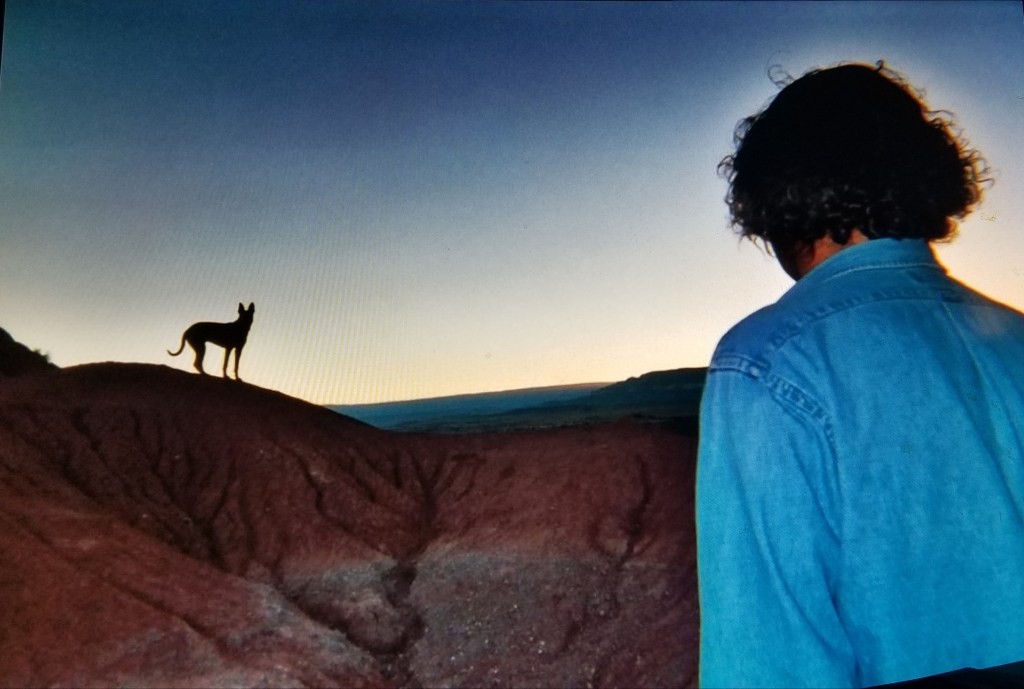
Friedman, a man with a problematic singing voice, was, at one time, a prodigious writer of highly personal songs that were often hard to listen to, sung in that difficult voice of his. A central tragedy of the poor devil’s life — to write with sensitivity for an instrument so ill-suited to music. The singer-songwriter had a good sense of pitch, it was not a matter of tone-deafness, in the strict sense. For all his skill on guitar and piano, for all of his original musical ideas, his singing was more than anything a certain lack of grace.
When he was found dead, naked in a chair last summer in his home in Santa Fe, his older brother was contacted by a Medical Examiner. “Just like on TV,” he said. The two brothers flew down to New Mexico to clear his cluttered house and settle his tangled business affairs. They lived for two weeks as guests of Friedman’s ex, a generous woman he finally rejected when he felt she’d been insufficiently supportive when he was inconsolable over the death of his mother, at almost a hundred. “She was his rock,” said his older brother, after their mother died, “he was lost without her.”
The older brother was dogged by guilt, he’d finally had it with his demanding, eternally unhappy youngest brother and had laid into him at one point. The younger brother had never spoken to him again. It had been three years. Then the call from the Medical Examiner asking what to do with the dead body. The middle brother, always a practical man, had avoided a fatal falling out with the youngest by always keeping him at arm’s distance. When an annoying email arrived, screen after screen of tortuous arguments, the middle brother immediately hit delete. He took the same approach to the clutter in the dead brother’s house. Several cartons of contractor bags, a quick look and toss the stuff.
Among the things tossed, to my great regret, were a series of letters between Friedman and the father he always complained didn’t respect him. A box of letters between father and son. They felt like voyeurs after beginning to read them and quickly tossed the collection. As a longtime student of Friedman, and someone who knew his father pretty well too, I feel the loss of these unknown letters keenly. Goddamn, I would have loved to read those letters! There was a book full of pathos and insight in that back and forth, 100%.
Another book, saved by the older brother, exists. It is the hard-covered once blank book where all of the lyrics (and probably the chords) to all of Friedman’s songs were inscribed. The definitive record of a life in music that was almost lived. If only he’d had the voice to sing them. It occurred to me recently to ask the brother if I can borrow this book for a while, to read his collected songs and use them to reconstruct his painful, illuminating life. The endlessly repeating tragedy of his life is the greatest cautionary tale I know.
Many years ago, and I mean decades now, Friedman accused me of using my friends as lab rats in my psychological dissections. I suppose he had a point, the long serving, giant lab rat, though I plead science and the expansion of human knowledge as a redeeming rationale for my experiments (as all the great monsters of history have). We are raised, many of us (and probably all of us who are subject to bouts of misery), deliberately blinded to what we are actually up against in this life. It takes determination, and openess, as well as a certain amount of blind luck, to eventually begin to see the crucial clues that are zealously hidden from us. Friends as lab rats, a small price to pay sometimes, to learn the things we need to learn to live less miserable lives.
(Cold? I don’t know. It certainly doesn’t put the narrator in the most sympathetic light. Start again.)
In telling the story of the talented, miserable, demanding, aggressively unhappy Friedman, I will try to illuminate the two paths open to each of us. We can struggle, in the darkness, to be right, always, to justify, everything, to prevail, at any cost. We can struggle to grasp what is intolerable in our lives, work to see and understand what particularly triggers our misery, seek to suffer less and inflict less pain in the world. I am, clearly, biased toward the second way. Friedman is the greatest example I know, though far from the only one, of the first way — the way of righteous anger and eternal victimhood and fatal disappointment.
Yes, we also have a president now who fits that description– a selfish, childish person who is always the victim, always right to be angry, a fundamentally unhappy person who, although already very wealthy, can never get enough. Forget him, if you can, as I tell you the story of Friedman, the youngest of three boys, an envious sibling who never got enough respect from dad or love from mom.
“OK, let me get this straight, sir,” says nobody in particular “you propose to tell the story of a remorseless, graceless asshole, with no insight into his own misery, told without sympathy, the tale of a putz famous for sweeping others into the ‘putzbin of history’ for betrayals real and imagined.”
I wouldn’t use that as my elevator pitch, no.
“Get on with it, then, why should anybody give a rat’s tutu about this so-called book proposal?”
Insight, man. Hard to come by. Look at it as I pieced it together. At one time this guy was my closest friend. Over the years I came to see, more and more unmistakably, that he was, in elemental ways, an unredeemable version of the worst of my father. Both were smart, articulate, capable of waging fierce arguments to the death, both were supremely sensitive in their own feelings and often monstrously insensitive to the feelings of others. My long wrestling match with Friedman turned out to be an attempt to get a grip on the dilemma with my own father.
“OK, so far you ain’t selling jack, son.”
Says the voice of the internalized victimizer. Look, I’ve been putting together clues for many years now. The Book of Friedman might be the most straightforward way to put them between two covers in the context of a story with a start, middle and end. Much easier to write than draft two of the 1,200 pages I’ve written as I came to see my father’s tragic point of view through his too late clear eyes.
“If you say so…” then there is the pregnant pause, more potent in its power to undermine than any words could be, “we’ll see if this idea comes to anything more than dozens of other big ideas you’ve hatched over the course of the long misadventure that has been your life here, dreamer.”
Which leaves me with this toothache of a thought: What is left of our lives here, beyond what we leave behind?
Write Every Day
Anything you care about, want to get better at, you need to do every day. This goes for music, learning languages, reciting poetry, improving your vocabulary, gaining flexibility in body or mind, mastering any skill. Daily practice is the best way to improve your skill.
More productive than a five hour session, followed by a week of inaction, are seven daily fifteen minute sessions. Constant, regular practice is the way we build better habits, better technique. This kind of daily practice helps us remember and internalize our advances and make steady improvement.
Take your 140 character tweet (I don’t use Twitter myself) and really look at it before you let it fly out into the world. Is there anything you wrote that can be written better? Fix it. Is there a phrase that could be read two ways? Turn it to the way you want it to be read.
You can say it really doesn’t matter if you write well, badly, clearly, muddily, that ignorance and sloppiness clearly rule already so what is the stinking point, Daddy-O? The point is not to lose the notion of craft, pride in your work, the pursuit of excellence, reinforcing the benefits of steady effort to make yourself better at what you love to do.
George Carlin had it right: think of how stupid the average American is, and realize half of them are stupider than that.
That does not apply to your efforts, if you are dedicated to self-improvement in any field. It is never stupid to try to do better. Also, don’t forget that half of Americans are also smarter than the average– that’s 150,000,000 people. Also, stupid people deserve the best we have too.
My two cents: put in at least fifteen minutes toward the worthy goal of making yourself better every day. If you miss a day, don’t trouble yourself, just start a new streak the next day. The improvement you will begin to see will motivate you to continue. In your small way, you will be making the world a better place.
 gratuitousblahg