Parent and child

I recently spent two years, every day, writing about my troubled, troubling father. Many of the sessions were spent in a kind of dialogue with the skeleton of my dead father. We had some excellent and revealing chats, picking up where he left off the last night of his life. Most days our talk seemed genuinely like an actual conversation with a wiser version of the droll, insightful person I’d been raised by, reflecting the realizations he’d had right before his death. The skeleton was humbled by his death, and looking for reconciliation.

I did this every day for two solid years, thinking about the project when I was not writing, imagining my father’s earlier life, trying to get to the bottom of how damaged my father was and the often subtle, but in many ways disabling, harm he inflicted on my sister and me. It was a great project and I actually learned a lot, whether or not I eventually rewrite the pages into a marketable book. The most amazing and unexpected outcome is that now I can see everything from his point of view, though I still disagree with most of the harmful things he did.

The other day I suddenly realized that some of the best men I’ve ever known have struggled (though much more successfully than my father) to be good fathers, some of the best women struggle with being unfailingly good mothers. Children who have wonderful parents and enviable childhoods sometimes grow up to be tormented, anxious, selfish, insecure, vain, perplexed. This point likely seems too obvious to make, perhaps, to anyone who has raised a child, who lives as a parent, but to me, having no children, it was a long time dawning on me what difficult, sometimes thankless work it is to always strive to be generous, to do one’s best, and still experience that sharper than a serpent’s tooth-inflicted pain that comes from an ungrateful, angry or oblivious child. We all have better days and worse days, and there is no real training on how to be a parent or how to be a child.

I knew a young mother, who’d been raised by difficult, immature parents, who decided to be the opposite of the way she saw her own mother. During her pregnancy she fell under the influence of a group of women called the La Leche League. According to her, their theory is that babies never manipulate a parent, they only ask for what they truly need. A child who is breast fed whenever they ask, and given every bit of affection and attention they seek, will grow up to be strong, confident and self-motivated. She breast fed her first child until the baby was three or so, then weaned her when the little brother arrived. He nursed until he was able to say things like “mom, I need to nurse now, if that’s OK with you.” It was a great bonding experience for the mother, and I have read that the oxytosin released during breast feeding can be quite addictive. What’s not to love about perfect love?

This young mother was fond of pointing to how wonderful her children were, the proof that she had learned mighty lessons from her own childhood and become the kind of 100% nurturing mother she never felt she’d had. “The proof is in the pudding,” she would say with a proud smile, pointing at her perfect children, who had never wanted for unconditional love and were clearly both amazing children as a result. I lost track of the family after a while, but the last I heard, the daughter is, according to the mother, a fearless genius and the son, also a genius, is a very insightful young man and something of a saint.

This young mother once spent the day with her husband and two year-old daughter, visiting old friends of mine. The next time I saw my friends I asked how they’d gotten along (I’d introduced them). They told me it had been an extremely long couple of hours, that they’d found the young parents’ zealous belief that they’d created the perfect child hard to bear. “Parents are one factor, one factor in dozens, as to how your child turns out, parenting doesn’t have that kind of one-on-one correlation with how the kid turns out in the end,” my friend told me. “To think otherwise is a kind of madness bordering on megalomania,” the other friend added.

I think of this now in connection to my own father, and his often problematic parenting. He was one factor among many in how I turned out, though he always loomed as a supremely difficult one. A parent who is often angry, and takes out their frustrations on their child, tends to be a large factor in how the kid grows up to see the world. Just as I am sometimes unable to disentangle myself from the abuse I suffered at his hands, in his life, and the reason he often lashed out at his own children like an injured two year-old, is that he had actually been a deeply injured two year-old.

One of the first things he told me when I returned to his hospital room around 1 a.m. that last night of his life, in that weak, croaking voice dying men often seem to have, was “my life was basically over by the time I was two.” I knew the bones of his story. I had learned them from a witness, an older first cousin, my father’s references to his harrowing childhood were always oblique, opaque.

His mother, a tiny, bitter, deeply religious woman with an unquenchable temper, living in a viscerally unhappy arranged marriage to a very poor man, used to whip her tiny son across the face, from the time he could stand. Picture that, and how much worse it is for a baby than verbal abuse, neglect, icy silence in the face of expressed concerns, or sarcastic dismissal.

Each of my father’s techniques for keeping his children, and his own demons, at bay were less atrocious than taking the rough, heavy cord of an old fashioned steam iron, and whipping your tender young child in the face, from his earliest memory. I finally concluded he did better than he’d experienced, though he admitted late in his life that verbal abuse is as damaging as physical abuse.

Over the years I sometimes thought beatings would have been preferable, since at age fifteen or so, skinny as I was, I would have started fighting back (he already showed fear of me by that age) and soon been able to kick the shit out of him if he lifted a hand against my sister or me. But that is a surmise I rarely think about.

What I think about more and more is how to take the lessons of my troubling childhood and lay them out clearly for others, in the name of becoming more forgiving, of oneself and the people you love who have hurt you. To explain simply, for the possible benefit of any reader who has been struck by the sharper than a serpent’s tooth cruelty of an unfairly angry parent, how I went from hardening my heart against an asshole father, to learning about and understanding the humiliating abuse he’d suffered in a truly hellish childhood, to opening myself, as he was dying, to simply listen to his deep regrets, and encourage him to say the things he felt it so important to say that he used his last breaths to say them.


Remember to be thankful today

It’s easy to forget, living in the overblown shit show we all have front row seats for, that we have a lot to be grateful for. A short anecdote for Thanksgiving and we’re off to spend the day with cousins.

I was working as a bicycle messenger, fighting New York City traffic and the me-decade of the 1980s, angry all the time. I had big dreams for my life, and being a cog in a corporate wealth machine was not part of those dreams. I found myself wasting time waiting for a slow elevator in a small building where some successful person had an important business that needed an important package immediately delivered to another office, it was a super rush. Time was literally money for me too, I didn’t get paid to wait around, I made money by being fast (which also allowed me to work as few hours as possible).

When the elevator finally arrived I got in and there was an older Black woman (probably younger than I am today) already in it, she had been delivered to the lobby for no reason. We watched the doors slowly close and the elevator began to lurch slowly upwards, then stop, then lurch a bit more. I muttered that it was not my day.

“Never say it’s not my day!” the older woman said, “if you’re alive, it’s your day!”

I nodded, attempting a smile that was probably more like a Clint Eastwood grimace. The old lady was 100% right though, and I salute her now, many decades later. It is good to take a moment to remember to be thankful sometimes, for something as elemental, and irreplaceable, as simply waking up alive in this precious life.

A gas chamber looks better by gaslight

I offer this anecdote to illustrate how even a very smart person, perhaps especially a very smart person, can create a world of shit simply by selectively using their intellectual gifts. You can turn anything into anything else, with the will and the skill. We see this all the time in public life now, not even done skillfully much of the time, but it is also sadly prevalent in personal life.

The common phrase for somebody pissing on your leg and dismissively insisting it’s raining is gaslighting. That term is based on an old movie where a guy, to drive his wife insane, makes the gaslight dimmer and dimmer and, when the wife keeps commenting on the increasing dimness in the house, insists the light is the same as it always was, and that the wife is insane, which eventually breaks her, I think.

I once worked for a brilliant man who had a very smart assistant and an armed guard in the room where he presided. He had a good sense of humor, and of the absurd, but he was also used to being listened to, respected and having the final word.

He had a theory about why so many people act out in our society, and a term for it: Honor Anemia. In this country we are not listened to, given even the minimal respect or recognition that every human being needs, so we are constantly seeking it, sometimes by acting out, even becoming criminals. The theory made a certain amount of sense to me.

We were having lunch one day, in the crowded outside area of a restaurant near the meatpacking district. He asked me if I had any theory about why child molesters, of all criminals, are so universally despised, even by rapists and murderers. I said it was probably because they prey on the most vulnerable of victims and pretty much destroy their young lives. This answer didn’t satisfy the philosophical man, who continued to probe.

Wasn’t it possible, he asked, if the adult truly loved the child he was sexually involved with, and always gentle to and considerate of, that the relationship wouldn’t harm the child? I told him that could theoretically be true, but even if it was true in 50% of cases, it didn’t account for the terrible wound it inflicted on the other 50%. Putting the traumatic damage to the kid on a coin toss, for the sake of sexual gratification for the adult seemed a very callous bet, to me.

I pointed out that the likelihood of lifelong harm to the child was probably closer to 99% than my hypothetical coin flip. I also said that if the adult truly loved the child he wouldn’t risk destroying the kid’s life to have sex with the child, he would wait until the kid was an adult to begin a romance. He chewed on this and we continued to talk.

It became less and less clear to me what he was talking about. Whenever I’d ask for clarification, he would nimbly digress to some other point I couldn’t grasp. I finally told him “look, I’m happy to talk about whatever you want, and I’m not squeamish about this subject, or any subject, it’s just that I don’t have any idea what you’re talking about at this point.” He thanked me, for being willing to talk about the taboo subject, telling me that nobody else had ever let him discuss it so frankly. I told him he was welcome, but that, really, I hadn’t gotten the point he was trying to make.

As we left the restaurant, walking over to meet his wife, he asked me what I thought of Edward Snowden and Chelsea Manning, two whistleblowers who had been much in the news. I offered a tepid defense of both of them, pointing out that whatever their criminal exposure, both of their revelations, which had required great personal courage to disclose, had been of immense public importance. He immediately began to snarl that they both had committed textbook treason, then raised his voice, denouncing me as an idiot, as someone obviously unaware of the findings of a series of great sociologists and political scientists of yesteryear that I’d never heard of, let alone read.

He raged at me so long that his wife, an intolerable termagant, a harping harridan, told him to let me get a word in. He did not. We were in his car, crossing the bridge back to Queens, then on the highway, I was a sitting duck.

I was no longer working for him and had no reason to forgive or forget his merciless tongue lashing. He called to apologize, then asked me to do him a favor, procure a bit more of something for him that was then still illegal in New York State. For reasons I can’t understand now, I did him this one last favor. When he came to pick up his contraband I foolishly accepted a ride to Sekhnet’s with him. Now he wanted to take me to dinner. I only wanted to not interact with him anymore, already regretting the favor I’d done. I declined his invitation, he insisted.

It was important that we had a good meal and talk everything over, he told me, we were friends. Friends, I pointed out, don’t mercilessly bully their friends over a difference in opinion. No, he said, we have to talk this out, over dinner. He pulled up in front of his favorite restaurant. I started heading for the nearest subway, but he grabbed me in a bear hug. “Please,” the large man said, “let me treat you to dinner.”

I was in my fifties at the time, he was in his early seventies. If you wound the clock back a few decades, he would have been in his thirties, I would have been around ten. None of this escaped me as I disentangled from his embrace without shoving or striking him. For reasons I also don’t understand, I went into the restaurant, ate a meal, and we had a talk I recall not a word of. It was like talking to a mummy, I suppose.

The next time I ran into the purveyor of contraband he asked me about my former boss, who’d been a good customer of his. I told him the story; the incomprehensible shift from thanking me for listening to his odd rambling meditation on child molestation to his rage that we disagreed about the nature of what Snowden and Manning had done.

“Psychology 101,” he said “he revealed that he was probably a child molester, and you’d been understanding in some way, and he hated himself for that and had to immediately make you hate him too.”

Though my neighbor is not generally known for his psychological astuteness, I thought he put things in a very insightful nutshell. If I had any doubt about my former boss’s intention in the odd discussion of child molestation, it was removed when he bodily intervened to prevent me from leaving him at the restaurant. It was a distinctly rapey move. Another kind of man would have roughly shoved him away, told him to fuck himself, slapped him hard if he persisted, knocked him to the ground, if necessary. I ate a plate of linguine and watched his mouth move without hearing anything he said, then it was all over.

Beautiful writing

I was sitting in the Fresh Meadows public library one afternoon, this was probably almost fifty years ago, turning the pages of a book by Russian writer Maxim Gorky. I recall reading a very short piece, maybe half a page long, where a shell-shocked soldier sees the blown up body of one of his comrades, hanging from the dark branches of a dead tree.

The corpse’s glistening organs have spilled out, festooning the branches, and the first birds were arriving. The light catches the entrails as the soft breeze makes them sway. The shell-shocked soldier, who narrates the anecdote, takes this in and immediately bursts out in uncontrollable laughter, he laughs until he can’t stand, throws himself on the ground and continues laughing his ass off.

I mention this beautifully drawn anecdote by Maxim Gorky, which I read many years ago, to illustrate that the most beautiful writing may be used to evoke the most terrible horrors. In fact, the more beautifully you can describe an atrocity, the more forcefully the and poignantly yhe horror of it hits you.

Beautiful writing at the moment, it seems to me almost every day, needs to be marshaled to illuminate and clarify the horrors we are up against. To mobilize readers to get involved in standing against atrocity, and the enraged irrationality that always accompanies and justifies atrocities.

The Department of Defense, years back now, did a study that concluded the disruption of populations as a result of global warming making areas uninhabitable was the biggest defense threat we face as a nation. Around the equator it would soon become so hot and water starved that people living on the land would have to migrate north. Island nations and coastal areas, including many of our largest cities, would be under water, former inhabitants of these places on the move by the tens of millions.

Picture any zombie movie you’ve ever seen and then imagine tens of millions of real life homeless refugees, climate refugees, moving en masse in search of food. It would not take long for cannibalism to take hold among these hungry hoards. Then the wealthy nations would have to “cleanse” the world of these cannibals, for the sake of the rest of the delicious population.

That scenario, by itself, should be enough to get every person of conscience on the earth to join an energetic search for solutions. Sadly, we are not that kind of wise ape, homo sapiens.

We read the most beautifully written accounts of the greatest joys we can imagine, and that is a good thing from time to time, to reconnect with the miraculous side of being alive. On the other side of the scale, the ticking time bomb of the earth’s greediest, sacrificing millions of lives, daily, for the sake of greater acquisition and perpetual hoarding by the few, the entitled, ain’t no unlikely hypothetical employed by right-wing defenders of torture. It’s as real as the soldier’s guts, swaying gently, and hilariously, from those branches as the birds get ready for a good meal.

Fifteen years


Fifteen years is long, for a prison sentence.  Fifteen years for the rest of your life seems like the wink of an eye.  As my father was dying, talking to me suddenly as his beloved son and not a lifelong adversary who’d gotten his young father’s back up by staring at him accusingly from my crib, he expressed a feeling that stays with me.

“I wish we could have talked like this fifteen years ago,” the dying man told me, after getting a lot off his chest, with no grief for either of us.   

At the time I thought “seriously, you’d settle for fighting like rabid rats for 35 years and then 15 years of peace?”   A sadly modest request that fifteen years seemed to me.

He died the next evening and I suddenly understood that fifteen years to speak humanely to each other would have been a great blessing to everyone.   So would fifteen months have been, or fifteen weeks, or fifteen days, or even fifteen more hours.  

When the other person breathes his last, there is only the silence and the love that might have been. 

Footnote (and John Eastman’s 6 point plan for Pence to steal the stolen election on January 6 for himself and his boss)

Trump has no friends, his type never does. They regard men as base coin to gratify their passions, in a phrase used to describe Napoleon’s attitude toward other humans. Some humans’ blindly driving ambition is useful, can greatly benefit the man who knows how to skillfully use others to his own advantage. As base coin, these ambitious types can be cast away at any time and replaced by other tarnished instruments.

Nobody truly likes a deeply damaged, loveless motherfucker [1] like our former president except for ambitious lackeys and angry mobs. Angry mobs adore his relentless in-your-face, norm and common decency smashing assault on liberals, queers, mass media, disloyal party members, Muslims, Mexicans, women of color, disloyal Jews, Blacks, cripples, losers, non-Scandanavian immigrants, socialists, anti-fascists, etc. He rules his spineless, platformless (2020 RNC platform — whatever the big guy wants) party by terror. The famously vindictive man’s sure, vicious revenge, guaranteed to be visited on anyone opposing his will, is a constantly reinforced reminder that he will not be opposed, no matter how insane his demands. Here’s the thing:

This particular angry, boastful, lying Orange maniac did not invent any of the corrupt, lying, authoritarian routine he practices, and while he certainly wasn’t their first choice, radical right billionaires have found their audacious front man to be very useful for their larger purpose, keeping everyone distracted and enraged as they game democracy to protect the privileges of vast inherited wealth in perpetuity. This Orange Polyp, since he is a malignant narcissist and an amoral opportunist, is their go to guy in the war of the few to keep hold of everything, in the face of the rising threat of the John Birch and Federalist Society’s great enemy, ‘majoritarian tyranny’.

Here is what former Trump lawyer John Eastman [2] advised Trump to do in a two page Privileged and Confidential memo entitled Scenario for January 6. This is the action plan part of what Glenn Kirscher and many others have called a blueprint for insurrection.

1. VP Pence, presiding over the joint session (or Senate Pro Tempore Grassley, if Pence recuses himself), begins to open and count the ballots, starting with Alabama (without conceding that the procedure, specified by the Electoral Count Act, of going through the States alphabetically is required).

2. When he gets to Arizona, he announces that he has multiple slates of electors, and so is going to defer decision on that until finishing the other States. This would be the first break with the procedure set out in the Act.

3. At the end, he announces that because of the ongoing disputes in the 7 States, there are no electors that can be deemed validly appointed in those States. That means the total number of “electors appointed” – the language of the 12th Amendment — is 454. This reading of the 12th Amendment has also been advanced by Harvard Law Professor Laurence Tribe (here). A “majority of the electors appointed” would therefore be 228. There are at this point 232 votes for Trump, 222 votes for Biden. Pence then gavels President Trump as re-elected.

4. Howls, of course, from the Democrats, who now claim, contrary to Tribe’s prior position, that 270 is required. So Pence says, fine. Pursuant to the 12th Amendment, no candidate has achieved the necessary majority. That sends the matter to the House, where the “the votes shall be taken by states, the representation from each state having one vote . . . .” Republicans currently control 26 of the state delegations, the bare majority needed to win that vote. President Trump is re-elected there as well.

5. One last piece. Assuming the Electoral Count Act process is followed and, upon getting the objections to the Arizona slates, the two houses break into their separate chambers, we should not allow the Electoral Count Act constraint on debate to control. That would mean that a prior legislature was determining the rules of the present one — a constitutional no-no (as Tribe has forcefully argued). So someone – Ted Cruz, Rand Paul, etc. – should demand normal rules (which includes the filibuster). That creates a stalemate that would give the state legislatures more time to weigh in to formally support the alternate slate of electors, if they had not already done so.

6. The main thing here is that Pence should do this without asking for permission – either from a vote of the joint session or from the Court. Let the other side challenge his actions in court, where Tribe (who in 2001 conceded the President of the Senate might be in charge of counting the votes) and others who would press a lawsuit would have their past position — that these are non-justiciable political questions – thrown back at them, to get the lawsuit dismissed. The fact is that the Constitution assigns this power to the Vice President as the ultimate arbiter. We should take all of our actions with that in mind.

source

NOTHING TO PROSECUTE ANYONE FOR, ON MY SIDE!!! TOTAL WITCH HUNT!

[1]

Of course, sometimes motherfucker simply means motherfucker, but a few words are in order about using this vulgar and inflammatory phrase to describe a vulgar man who treats others like his slaves.

My father, during a few years of my school life, taught a group dynamics seminar where, at one point, he asked Black kids and White kids to give their thoughts on the word “motherfucker.” It’s origin on the plantation, of course, was a guy like Thomas Jefferson, rich, powerful, entitled, who, if he found your mother beautiful, was at liberty to fuck her, since he actually owned her body and controlled her actions. If a child was born, the motherfucker owned another slave, it was win-win for him. So the term was always ambiguous and multi-edged for male slaves on the plantation, you hated the motherfucker, but also, damn.

My father asked an Italian gang leader from a Brooklyn high school what the word motherfucker meant to him.

That’s the last word you hear before the fists start flying and the chains and gravity knives come out,” he said, looking across at the Puerto Rican and Black gang leaders. The Black kid smirked. My father asked him what ‘motherfucker’ meant to him.

Where I come from ‘motherfucker’ is one of the most useful and versatile words we have,” he said. “Contrary to the usage given by my Italian-American colleague over there, it doesn’t generally mean I want to fight you, unless I say it right before I’m going to fight a motherfucker. In that case, I use it as a deliberate provocation, otherwise it means a lot of things, depending on the context.”

For example?

The late great John Coltrane played like a motherfucker. Miles Davis is a motherfucker. Are you crazy, motherfucker? That motherfucker is hilarious. Motherfucker… please… That algebra test was a motherfucker. This motherfucker thinks his shit don’t stink. That motherfucker can’t take a joke. Relax, motherfucker. Motherfuckers were dancing in the street. Motherfucker be like…” and he imitated an idiosyncratic motherfucker they all knew.

My favorite dictionary definition of all-time is Merriam-Webster’s explanation of the word ‘squeamish’: “Exhibiting a prudish readiness to be nauseated.” This language-scrupulous Caucasian motherfucker has a prudish readiness to be nauseated by the word ‘motherfucker,’ and also by the unexpurgated ‘n-word’ and the common ‘f-word’. Oh, my.

[2]

Eastman spoke at the January 6 rally that preceded the attack on the Capitol. He retired from his position as a professor at Chapman University a week after January 6, which occurred amid protests from faculty at the Southern California university over his participation in Trump’s efforts to overturn the election.

Eastman told the Washington Post that his memo merely “explored all options that had been proposed.” In an interview on Tuesday, Eastman told CNN that the two-page memo had been only a preliminary draft. He provided CNN with a longer six-page memo laying out numerous other scenarios for Pence to follow on January 6. Eastman told CNN that during the January 4 meeting he’d had in the Oval Office with Trump and Pence, he had told Pence he should only delay certifying votes in the seven states, not try to throw the election to Trump.

The reality, however, is that a delay was simply another avenue to stop Biden from taking office.

source

Meditation on 5782

Today is the first day of the Jewish year 5782. The most religious Jews believe that HaShem, according to Jewish tradition, created the universe by performing the miracle of dividing light from darkness, land from waters and creating life 5,782 years ago, literally, as it is written. Thus Jews believed two thousand years ago and, so it is, to the most fervently religious, to this day. Other Jews see 5782 as a symbolic number, the bit about God creating all the plants and animals one by one, culminating in his masterpiece, his special children, humans, woman created out of the first man’s spare rib, as so much Biblical poetry.

Religious belief has never interested me, I have no talent for it. My first thought is armies of the fucking righteous, putting the faithless to the sword, century after century. Virtually every religion has had a turn at Holy War. The most righteous of every creed recognize that the reward of an ethical life, some version of heaven or enlightenment, belongs to the righteous of all nations, when they are not slaughtering them.

My second thought is the hotbed of anti-Semitism that was Hillcrest Jewish Center, where, for several years, I was forced to attend classes after the regular school day was over.

Beyond the “fuck that” of a kid who’d just been sprung from jail having to report to another jail for a few hours, especially on beautiful days when playing baseball was much closer to God than learning to parrot prayers, in an unknown language, that were never translated or explained, there was the silencing of all questions. The blotting out of critical thinking was the most intolerable part of the Hillcrest Jewish Center religious experience. It was a gaslighting similar to what I experienced at home, where my very clever father endlessly fought me over everything, generally by recasting whatever else we were talking about as a damning referendum on my character.

Trips to the principal’s office, fucking Frieda Berkman was her name, did not cure me of my need to question things we were supposed to believe, rites we were supposed to perform by rote, mouthing prayers we didn’t understand. After Berkman got sick of having me wait in her tiny outer office day after day under a poster that said “a teacher attempting to teach without inspiring the pupil with the desire to learn is hammering on cold steel” (I asked her about that one, she didn’t like my disrespectful question at all), I was sent to wait in the plush outer office of the rabbi, Israel Moshowitz by name. Moshowitz was photographed shaking Nixon’s hand, of course. He was a big deal. I have no recollection of the pious speech he eventually laid on me about being a good Jew and just doing what I was told. I’m fairly sure it involved the Holocaust.

It took me many years to get over the antiSemitism that was instilled in me by my early religious miseducation at Hillcrest. I used to recoil from the well-dressed swarm of once-a-year hyper-religious Jews who congregated at the Yom Kippur service (the Day of Atonement is ten days from Rosh Hashana, Jewish New Year). I’d feel real disgust watching them hurry home to break their fast, in a huge hurry, all full of the righteousness of not having eaten in 24 hours. I’d walk to the synagogue to meet my father, shouldering my way past these hungry, rushing, bad-breathed creatures, and walk him home to break our fast.

I had no patience for the meaningless “please rise, please be seated” ritual of the Hillcrest gymnasium, where cheaper seats for High Holiday services were made available to those who were unable or unwilling to pay top dollar for an expensive seat in the sumptuous main chapel. Once in a while, in the gym, people would faint, and fall off their folding chair on to the lacquered wooden floor where, on other days, I’d played basketball.

No need to mention the vengeance of Frieda Berkman, who snarled at me over a loudspeaker during assemblies, or the united fucking by the synagogue itself, first in not presenting me with the Bar Mitzvah kiddush cup I had earned by reciting a few lines of Torah when I turned 13, and then by inviting me to a special service, in the Ferkauf Chapel, where, I was promised, I’d be presented with my kiddush cup. I put on a suit, went down there, “please rise, please be seated, please rise, please continue to stand,” and, at the end of the ponderous droning, there was no kiddush cup. I think of this every time I celebrate shabbat with friends who have their own, and their adult children’s, kiddush cups on the table filled with wine. I also think of how telling it was that my parents never intervened on my behalf.

So ritual for me, for the most part, so much contemptible horse shit. I say this with God Himself looking down on me, only slightly hurt. Worse things have been said by Jews, by Christians, by the otherwise righteous of all nations. If you experience a sense of community and spiritual completeness by sitting in a temple with others of your faith, God bless you, more power to you.

For me, religious ritual just reminds me of the super-religious Amy Coney Barrett, quickly ruling that religious gatherings during Covid-19 must be exempt from all health regulations, because God requires worship, and then, a short time later, ruling that an unconstitutional abortion ban in a state with a notoriously high infant and maternal mortality rate, a law designed to kill more poor women by forcing them to give birth whether they want to or not, is perfectly fine because the unconstitutional law is administratively complex. You can keep the ritualistic, inhuman religion of fanatics like Amy.

I emerged from a scarring childhood of incoherent religious idiocy, years later, to separate the moral teachings of Judaism from the empty rituals. There is a moral core to the teachings of the rabbis that is worth embracing. If you hate something, don’t do it to others. Be not intimate with the ruling authorities. Remember that you were a slave, do not tolerate the enslavement of others – freedom demands it. If you hurt somebody, do your best to make amends. A pretty good set of core principles, I believe.

These are moral precepts I have gleaned, some during interminable services (bar and bat mitzvahs, usually) where I flipped to the back of the prayer book and read Pirkey Avot, Selections from the Fathers, a short collection of pithy sayings that is part of the Mishnah, a vast book explaining every aspect of God’s laws. “Be not intimate with the ruling authorities” is in there somewhere, and it makes a great deal of sense to me. “What is hateful to you, do not unto others” is Rabbi Hillel’s famous formulation of what would later become Jesus’s Golden Rule “Love thy neighbor as thyself” and, to my mind, it provides a much more concrete guide for how to live an ethical life. If you hate something, don’t do it to somebody else. We humans know few things more deeply than what we hate.

Love, on the other hand, while precious beyond poetry, is a much shakier guide for how to act. A woman I used to know, who loved me, once gave me some counsel I argued against following. She countered that she wasn’t telling me anything she wouldn’t tell herself. I told her I knew that, but pointed out that in the past she had told herself to shut all the windows, turn on the gas and put her head in the oven, something I would never consider doing myself. In fact, I’d fight somebody who tried to insist I kill myself. She had the grace to concede that I had a point. Love is slippery as hell, and many of us don’t love ourselves as unconditionally and faithfully as we should, making it hard to love our neighbors as ourselves in the kindest possible way. At the same time, we, and those we love, are all we really have.

So I was happy today to see my smiling friends, regular synagogue goers, video me from a beautiful beach where they are celebrating today. “The beach is our shul this year,” my friend said, smiling from her beach chair, a light breeze tickling the shade umbrella under a perfect blue sky. I told her how beautiful their shul was, as she got up to take a panoramic shot of the sand, sky and ocean, and stop filming our other friend, who’d said hello but, like me, had had enough of the video conference after a short time. “Please be seated,” I should have told her.

Writing it as fiction

“Writing truth as fiction must never be done with a heavy hand,” the old man said, quoting a line from his last published short story.

“You want to write what really happened as a fictional book, that’s fine, leave nothing important out of the story, at the same time, you do the reader no favors trying to be cute about how this fictional story may be based closely on deeply experienced personal events, or events torn from the front page of the newspaper.”

“So, for example, avoiding the heavy hand, you’d never have a character immediately bring up Larry Fucking Elder and the latest California fucking recall of the Democrat [sic] governor.”

The old man shook his head. “Perfect example, and self-proving one too. It’s too late, once you do that kind of move, to undo it.”

“But isn’t that what editing’s for, man?” I said, though I was somebody else, an entirely imaginary person, living in an alternate universe. “but now that I’ve sullied my lips by mentioning Larry Elder…”

“Fine,” the old man said, “this is worth a footnote, I suppose. When the aptly named Dick Cheney set off the California Energy Crisis by deregulating energy on the West Coast, and you know the minutes of his ‘Energy Task Force’ meetings with oil executives and the identities of those executives were never revealed, per Antonin Opus Dei Scalia, they recalled a Democrat, Grey Davis, over the budget shortfall produced, down to the dollar, by the soaring price of unregulated energy on the west coast, and you quickly had the celebrity Arrrrrnold in there – probably the last reasonable Republican in office. Scalia, for his part, was huffy when asked, decried it as ‘a sad day in America” when an American journalist would ask a sitting Supreme Court Originalist about the appearance of impropriety of him flying around on Dick Cheney’s private jet while he was deliberating over a lawsuit brought against Cheney.”

“USA! USA!!!” alt-me said.

“Just one other thing, the California recall is another example of shit like the Electoral College, the filibuster, tools to keep the hands of the elites on the reins of power in an electoral democracy. As a result of this bizarre legal provision, a guy who won 62% of California’s vote can be ousted by a guy who later wins 14% of the vote, after a 51-49 decision to take the elected governor out.”

“Dass sum shit, as my father used to say,” I said, as not I.

“Living in a time when a hate jockey from talk radio gets the highest civilian honor this nation has hung around his neck by the prime beneficiary of his years of hate speech, it makes perfect sense that the tutor of American Jewish Nazi Stephen Miller, a status quo loving black former talk radio celebrity, at that, is poised to be California’s next governor if they can turn out a 51% share of their angry base in this emergency election to oust the governor elected by 62% of California voters. Makes perfect sense, right?”

“Yeah,” someone said, echoing my thoughts exactly.

“The intrusive narrator is another thing to be on constant guard against. We all know that move, Bob Hope looking directly at the camera, breaking the fourth wall and confiding to the audience ‘this is the last movie I ever do for Paramount, they let a bit player from MGM walk in right before the credits roll to steal my girl… sheesh’.”

“We hear that,” they said.

“Another thing, these pronouns y’all use these days,” said the old man.

“It have a problem with that?”

“Never mind, kid. It’s all good, as we say. I just wanted to give you my two cents about the tricky nature of writing fiction from your own life. Especially if you’re trying to take a political, humanist, stand during brutally political, inhuman times,” the old man took a thoughtful swallow of his scotch. “Nazi novelists are never at a loss for their plot lines. Anti-Nazi novelists have to be a lot smarter if they want to write something that could have any effect on those wavering toward joining the exciting mob.”

“The Exciting Mob,” she said, “it sounds like a movie from the fifties with Marlon Brando and Lee Marvin.”

“One last thing,” said the old man, “before I fade back into the ether of this guy’s imagination,” and he pointed at yours truly, incorrigible as Silvio Berlusconi in pursuit of a beautiful young hooker, “if you’re doing this to show off, just stop it. Any moron, literally, can opine without the least censorship or even the guiding hand of common sense, spew those opinions into a few sloppy paragraphs and hit ‘publish’. If you employ a savvy ‘social media’ plan, you can reach countless people with your half-formed, ill-informed yet heartfelt and deeply believed opinions.”

“What is your point, old man?”

“If you’re doing this just to show off, please just stop it.”

“OK, fine.”

Drop me a line

When I was a teenager, and I made friends who lived in other states, we’d keep in touch by letters and phone calls. Long distance calls were expensive, but letters could be written any time, drawn on, dropped in the mail and delivered within two or three days for the price of a full-sized chocolate bar (in those days less than a quarter, believe it or not). “Drop me a line,” we’d say, taking our leave of each other, and get busy, on a bus, a train, lying on a couch, setting pen to paper. It was always a great moment when a return letter arrived, particularly when a friend came up with an inventive envelope (for a time we always tried to top each other with wild, ridiculous hand-made envelopes).

Now, those were, to be sure, primitive times, very similar, in terms of communication, to the previous hundred years or so. We did not carry small, powerful personal computers in our pockets that could also be used to text, tweet, make phone calls and video chats. We sat and wrote by hand, folded the pages, put them in an envelope, addressed it, put a stamp on it and dropped it in the mail box. Seems unreal now, even though I sometimes still send drawings and scrawled notes to a small circle of people from time to time.

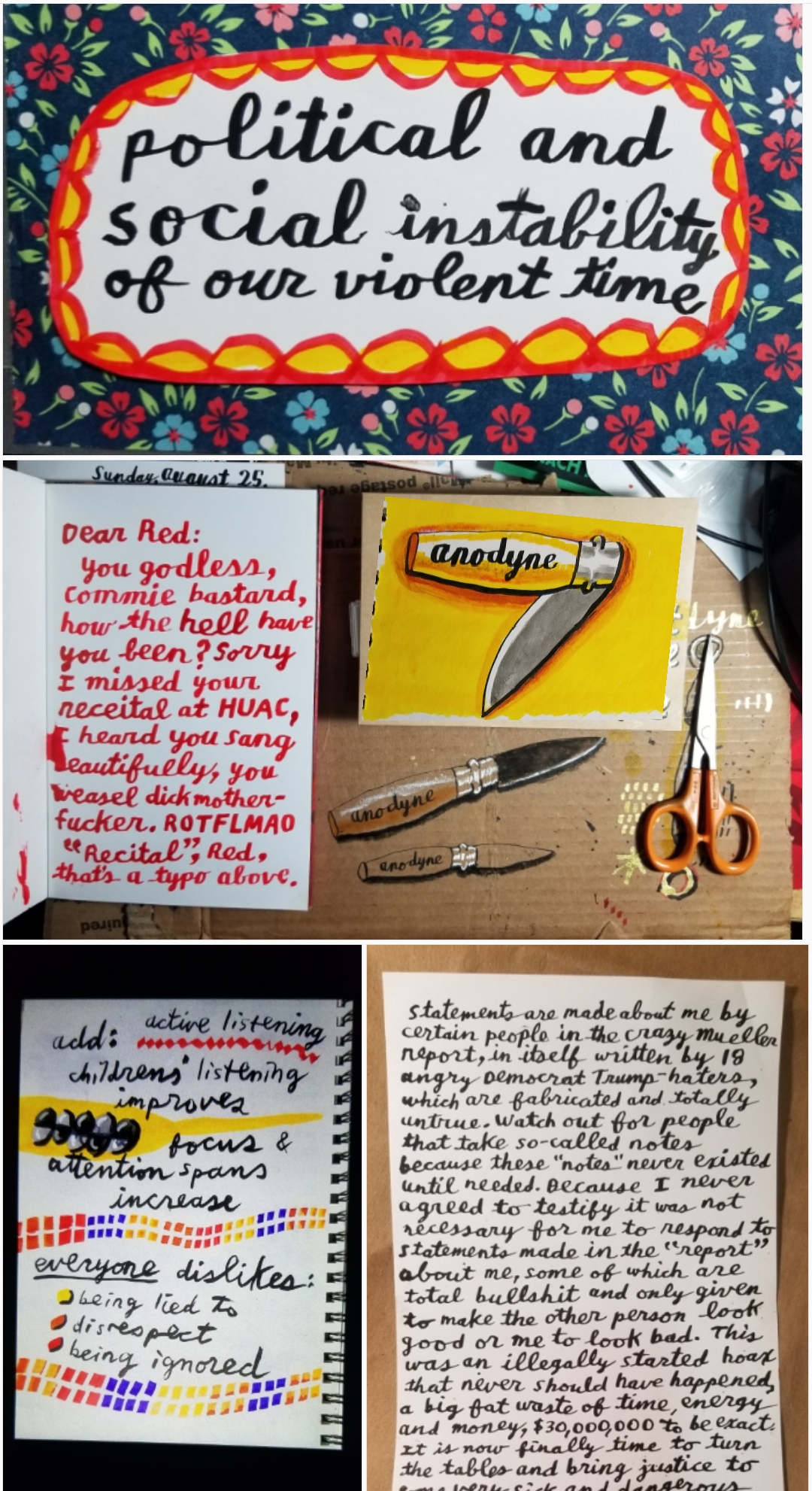
Here’s a “funny” thing, though. People regularly don’t know what to say when they get something in the mail (and, admittedly, my letters are often more visual than literary, so theres’s also that). As often as not I never even find out my letter has reached its intended recipient, unless I follow up later by text. I have a few theories, including that people in general don’t know how to react to “art” (particularly if it is not monetized, official, etc.), but it is notable, I think, that if you ask a question in a colorful, handwritten letter, you will virtually never get an answer to that question. Although, of course, it’s not hard to see why this letter may not have received a response:

I get that there’s something a bit maniacal-looking there. It is part of my graphomania, when it strikes, I am helpless against it. On the other hand, it is not uncommon to have a question, asked simply, unaddressed when it is written on a page, with other stuff, and mailed to somebody. This is my experience anyway, not many people are attuned to the art of old-time correspondence in our era of super-terse hyper LOL instant response-demanding knee jerks. It was not always this way, my young friends, and, like anything else, the old way was not without its pains in the ass.

I had a close friend for many years, a prodigious correspondent, who was a solipcist. By this I mean that he was convinced of his own reality in the world, (because he thought, and therefore, he was), but was not convinced anyone could ever truly know what was in somebody else’s mind or heart, or even if they actually existed, independently, outside of his perception. This belief, to me, is the essence of intellectualized alienation and a ticket to misery, as it was in his case, but he sure loved to write long, complex letters, in spite of his deep skepticism about anyone actually being able to truly understand anything he expressed.

At a certain point, tired of getting ten page, two-sided letters, mostly about his troubles and unresponsive to anything I’d written, I negotiated a deal with him. We agreed that in every letter, often at the end, we’d re-read the other person’s letter and briefly respond to everything of note. These quick responses would be set off between ellipses, the old dot dot dot (or in the Orange Polyp’s case dot dot dot dot dot dot) in the manner of famous antisemitic doctor and novelist Ferdinand Celine… the Celine section we called it… as in “now I will review and Celine your latest”.

It turned out to be a great innovation. You’d get actual feedback on things you’d written, a response.

“Yer description of the putz — on the nose … no, I never tried ayahuasca, did you ever find some?… she’s always like that, remember August 1971 for but one famous example … they suck, as you have noted whenever the name of their Nazi owner comes up … funny bit about your urinary troubles, if you know what I mean … further comments on the issue of solipcism are in order, remind me next time, if you actually DO exist independent of my perceptions of you …”

While not spontaneous or ideal, this enforced mutual responsiveness was a great improvement to our correspondence and probably extended our friendship by several years.

To me, having a dialogue is like having a leisurely catch. You throw me the ball, I hold it for a second, feeling its texture and its weight, and I toss it back to you, placing the ball in the air where you can easily catch it. We do this until we agree we’ve done it enough. Nothing is more natural, I think, than tossing a ball back and forth on a nice day.

This kind of meditative back and forth is tragically a more and more rare experience in our always in a hurry, time is money, make your point in 140 characters, too late, wait, I was distracted, what was I saying? society. Because we are always in a hurry, and time is not only money but money is free speech, and because so much free speech is also false, and the firehose of mendacity sprays full bore, torrent so powerful it can rip your skin off … I’m sorry, what were you saying? Wait, I’m getting another call… oh, God, here’s a text coming in too, a very important one, can you… hang on, Oh I don’t believe it! I don’t fucking believe it! Wait til I send you this… on second thought, maybe not, can you hold, can I call… what the hell do they want now?… can you text me later?

Ah, you know what, I’ll drop you a line.

Though I’ve learned to deal with it better and better in recent years, I am predisposed to a tic about silence by way of reply, because my father, in his most sadistic moments, would simply refuse to reply, deploying the old deniable silence (“what are you whining about, I didn’t even fucking hear you”) to wound quite effectively. So silence by way of reply when I ask a question has long had a kryptonite effect on me. Still, as a general rule, we all want to know we are being heard and replied to sensibly. It does not happen enough these days in general, which is one major reason people are so isolated and ready to jump into an online rabbit hole like QAnon that provides a false sense of community to those lonely, crazy souls who embrace it, “where we go one, we go all”, and shit.

It is worth the minute or two it might take, when a friend asks you a question that requires an answer, to actually digest what they are looking for, indicate confusion if there is any, wait for clarification and then think for ten seconds or so before giving your thoughtful reply. Worth it in my humble (and my conceited) opinion, anyway.

With the benefit of hindsight

Sometimes it is impossible to see a thing clearly, if you you feel a certain way about it, until you can look at it with the benefit of hindsight. Something you had no way to understand as significant when it happened can become clear as part of a pattern you can only see looking back. A seemingly small thing you didn’t see as any kind of problem can come into focus as an important clue to what went wrong, once the entire situation is in the past tense.

I used to be good friends with a cheerful madman, hospitalized periodically for bouts of mania, who inflicted terrible, fatal damage on his old friend’s beautiful Gibson ES-335 (BB King’s Lucille was an ES-335). The lovely guitar, a pleasure to play, had its F-holes gouged out with a file, its mellow Humbucker pickups pried out, it’s perfectly formed, smooth mahogany colored hollow body partially bashed in. The neck was violently pried off, splintering some more great wood. Its remains were then left floating in a bathtub full of soapy water covered with hair the nut had maniacally clipped from his partially shaved head. The guy in the guitar shop just shook his head sadly when he saw the brutality of what had been done to this wonderful instrument. He pronounced it dead.

With hindsight I came to understand how deep my friend’s reservoir of rage was, but that was a lesson I’d learn much later. As for the guitar he destroyed, I knew the back story right away. It makes no sense in the cold light of pure Reason, but I understood part of the rage that made the gleeful desecration seem momentarily justified to my out of control friend. The occasionally crazed man was a fairly good musician who could sometimes come up with cool parts for the songs of his friend the songwriter. He often added inventive keyboard parts that greatly enhanced his friend’s songs. The songwriter always viewed his friend as a side kick, his loyal accompanist. The songwriter, like Lennon and McCartney before him (when they gave Harrison no credit for his many great arrangement ideas and melodic contributions, like the brilliant, soulful song-making opening riff in “And I Love Her”) never gave him any songwriting credit. It wore on him over the years. Finally in a bout of mania he fucked up the guy’s expensive, vintage guitar (this guy I’m talking about, not George Harrison).

Footnote: credit or no credit was purely academic since not one of the songwriter’s songs was ever published, let alone performed and monetized. As a sign of respect and friendship, the songwriter would have been well advised to give some credit to his friend for his major help on a bunch of his tunes. Particularly in light of how things ended for that beautiful guitar, and their long friendship.

I had a friend, since Junior High School, who became a locally well-known lawyer. He explained to me, when we were adolescents, that he had to work hard in school, to graduate at the top of his class, to maximize his chances for getting into a top school that would be a ticket to professional success and ultimate happiness. His vision of success, he explained (as I smoked a joint he would no longer share — he had extra credit homework to complete), was coming home every night to a beautiful home where his beautiful wife would hand him a perfect drink as he relaxed, admiring his sunset view, as the final touches were put on his gourmet dinner. It struck me as a shallow vision of the good life, even at fourteen, but who the hell was I to judge? To each his own, or as we learned to say in our Junior High School French class “a chacun son gout“.

He worked hard, graduated at the top of his specialized high school class, went on to Harvard and then Columbia for his law degree. He got a highly paid job at a prestigious law firm which involved, among other things, defending toxic polluters against lawsuits from tree huggers. After a relatively short time, he changed sides. He took the litigation skills he developed at that corporate law firm and, taking a big cut in pay, went to work defending the environment as the lead lawyer in a branch office of The Earth’s Law Firm, fighting the same powerful world destroying scoundrels he used to represent. This move was the right thing to do, and as far as I know, he never regretted making it.

We remained close friends over the years. He didn’t like to talk about personal troubles of his own very often, feeling that the world is a bitter enough place without adding his complaints to the conversation. He seemingly enjoyed talking about my personal troubles, though, probing for the intimate details, playing devil’s advocate to show me that, arguably, the person I was having trouble with no doubt saw me as the culpable asshole, and not without reasons, which he would lay out and I would counter. I took all this in the spirit of what I thought of as friendship, in accordance with the emotional limitations of what this unhappy, critical old friend was capable of giving.

Until one day not long ago, when he called me in agitation, to challenge me about strong feelings I’d expressed to him in an email. He was very concerned, he said, that I seemed to be so disproportionately angry about a relatively small thing that had happened to me (the illegal termination of my ACA health insurance in January 2020). He was angry, in fact, that I seemed so irrationally angry, and was worried that I was going to kill myself with unhealthy rage. It appeared to him that I was full of destructive self-pity, seeing myself as the only person fucked by a giant fucking machine he was up against every minute of his life, as was everybody else. He eventually challenged me to tell him to go fuck himself. I declined, which, in hindsight was a mistake. Within a few months, after a lot of futile effort to avoid it, I essentially had to tell him that anyway.

But here’s the thing that hit me so clearly, looking at it in hindsight the other day, out of the blue, as I kept a steady pulse with a few simple chords on my guitar. I’d visited him at his new girlfriend’s house in California. He had two nice guitars and I began playing a steady, easy to improvise to rhythm part on one guitar. He began soloing over the simple changes on the other guitar. His girlfriend passed by with a big smile, commenting on how good we sounded. I played rhythm guitar behind him for the whole time we played together. The sound of a few notes in harmony, placed just right against the beat, and keeping the pulse steady as a heartbeat is the soul of guitar playing, to many of us. I never mind playing accompaniment behind a singer or another instrumentalist.

We’d both been playing since we were fourteen, he’d started a bit before me. He had been a hardworking lawyer while I’d spent those same working years, as a lawyer, working as little as possible, mostly as a low-paid court appointed piss boy, and before that, a teacher. I see now the great advantage I’d had over the years in the music department, because I loved guitar I’d spent countless hours of my life of leisure learning to play it. In his busy life of great responsibility, with much less time to play, he focused on mastering scales and modes, to solo. His soloing sounded pretty good.

After an hour or so I asked him to play a three or four chord vamp, so I could show him a bit of Gypsy guitar I’d learned. He said he couldn’t do it. The chords were simple, I don’t know what his reason was, but I didn’t press the matter. When it came up later, I told him it was fine, I’d had fun accompanying him, he sounded good.

Now, in the cool light of hindsight, this odd refusal to do a simple thing makes a certain amount of sense. Since reading the fable of the Grasshopper and the Ant together in ninth grade French class, my hardworking friend often referred to himself as the Ant, while I was, clearly, the Grasshopper. In this morality play the Grasshopper played violin all the time and wanted nothing to do with his fretful friend the Ant’s constant neurotic reminders that winter was coming and that he’d better start gathering food for those long cold months. The Grasshopper mocked the Ant, played some fancy violin, and the Ant furrowed his brow and went back to work. When winter came, and food became scarce, the Grasshopper, starving, finally swallowed his pride and went to ask his friend the Ant for food. The Ant, who had worked his ass off and had no time to “enjoy” life in the reckless manner of the self-indulgent Grasshopper he had tried to warn, tells the Grasshopper to fuck off. The Grasshopper starves to death. FIN.

In that context, my friend’s anger at my anger is as understandable as his claim that he couldn’t play a D, G7 and C chord, the chords every guitar player learns in the first week of playing. He has always been a competitive man, number 26 in his highly competitive graduating class in HS, degrees from two top Ivy League schools. I have always been an under-achiever, trying my best to gain insight and become a better person. To him, as to many ambitious people, achievement and success are the only measures of self-worth, and trying to become a “better person” is an illusory pursuit, a foolish exercise in self-deception. To me, doing what I love as well as I can and treating myself and the people I care about gently seem to be my top two loser priorities.

So, picture this — he’s playing live music, with a friend who plays a steady vamp that is open and easy to improvise to, and his girlfriend loves it. Why would he start playing possibly shaky rhythm guitar, which he hasn’t spent decades perfecting and polishing (as the fucking Grasshopper, in his life of infinite leisure, has) so that his shiftless friend can start improvising in a way that could, possibly, make him look bad? It’s lose/lose for him. So he simply says “I can’t do that.”

Seen in this new light I’m tempted to drop my old friend a line, tell him concisely how contemptible and ultimately self-destructive his reflexive competitiveness is, using this petty but telling example of his inability to play three simple chords for two minutes. I’d follow up with a couple of choice politically incorrect insults from our adolescence characterizing the unfair, childishly insecure type who is afraid, in front of his girlfriend and the best friend he ever had (“I love you like a brother”) of “looking bad” somehow — or worse, letting his unworthy friend look good. Because, as every successful person knows, playing music is actually about proving your dominance over the other players…

Funny, in the moment, most of us tend to let these kind of things slip by, in the spirit of not sweating the small stuff, not making a friend uncomfortable for no reason. Those of us who are not, by nature and long habit, carping, argumentative, super-competitive douche bags (his favorite phrase for worms, from back in the day), at any rate.