Drop me a line

When I was a teenager, and I made friends who lived in other states, we’d keep in touch by letters and phone calls. Long distance calls were expensive, but letters could be written any time, drawn on, dropped in the mail and delivered within two or three days for the price of a full-sized chocolate bar (in those days less than a quarter, believe it or not). “Drop me a line,” we’d say, taking our leave of each other, and get busy, on a bus, a train, lying on a couch, setting pen to paper. It was always a great moment when a return letter arrived, particularly when a friend came up with an inventive envelope (for a time we always tried to top each other with wild, ridiculous hand-made envelopes).

Now, those were, to be sure, primitive times, very similar, in terms of communication, to the previous hundred years or so. We did not carry small, powerful personal computers in our pockets that could also be used to text, tweet, make phone calls and video chats. We sat and wrote by hand, folded the pages, put them in an envelope, addressed it, put a stamp on it and dropped it in the mail box. Seems unreal now, even though I sometimes still send drawings and scrawled notes to a small circle of people from time to time.

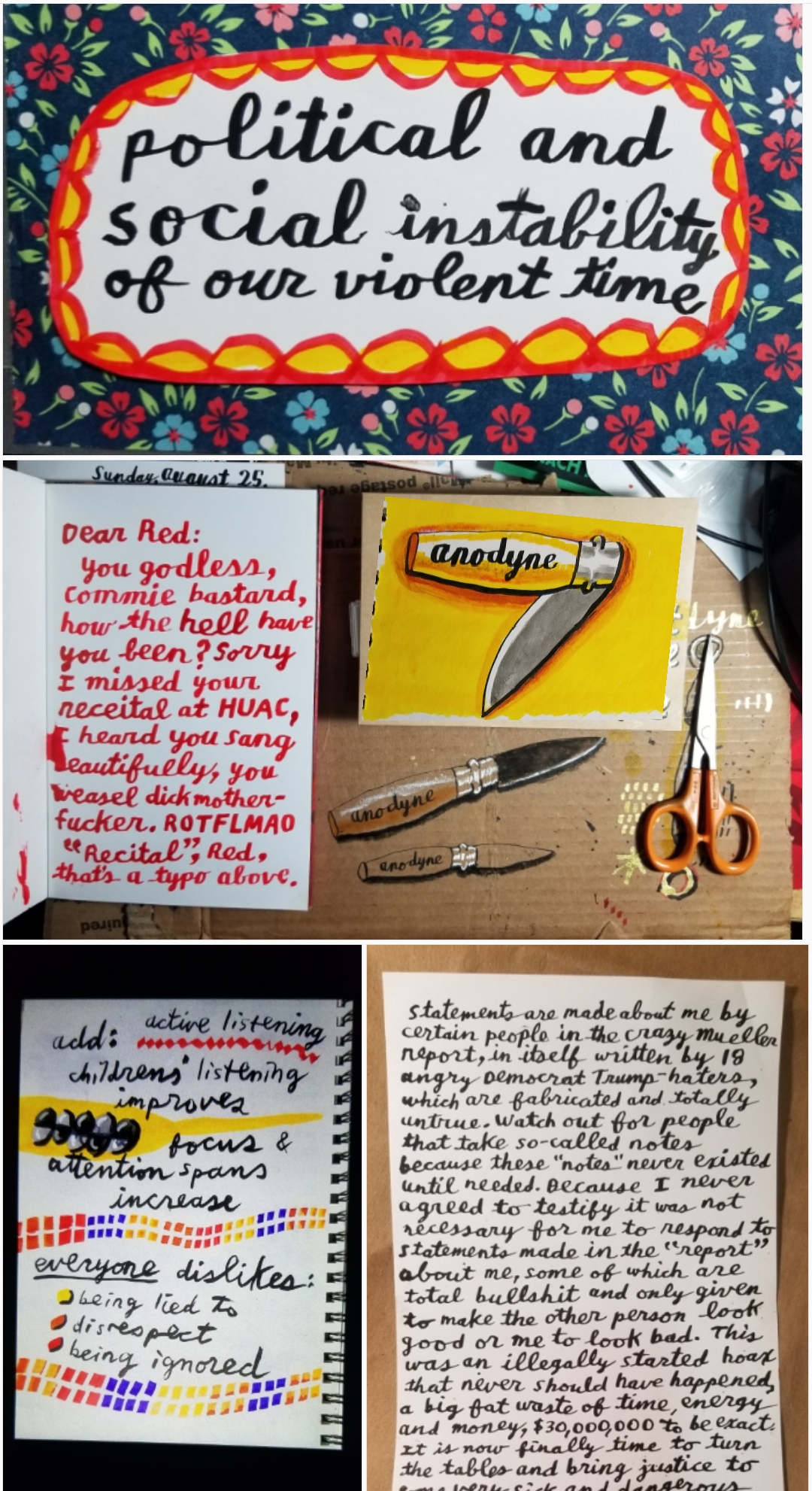
Here’s a “funny” thing, though. People regularly don’t know what to say when they get something in the mail (and, admittedly, my letters are often more visual than literary, so theres’s also that). As often as not I never even find out my letter has reached its intended recipient, unless I follow up later by text. I have a few theories, including that people in general don’t know how to react to “art” (particularly if it is not monetized, official, etc.), but it is notable, I think, that if you ask a question in a colorful, handwritten letter, you will virtually never get an answer to that question. Although, of course, it’s not hard to see why this letter may not have received a response:
I get that there’s something a bit maniacal-looking there. It is part of my graphomania, when it strikes, I am helpless against it. On the other hand, it is not uncommon to have a question, asked simply, unaddressed when it is written on a page, with other stuff, and mailed to somebody. This is my experience anyway, not many people are attuned to the art of old-time correspondence in our era of super-terse hyper LOL instant response-demanding knee jerks. It was not always this way, my young friends, and, like anything else, the old way was not without its pains in the ass.

I had a close friend for many years, a prodigious correspondent, who was a solipcist. By this I mean that he was convinced of his own reality in the world, (because he thought, and therefore, he was), but was not convinced anyone could ever truly know what was in somebody else’s mind or heart, or even if they actually existed, independently, outside of his perception. This belief, to me, is the essence of intellectualized alienation and a ticket to misery, as it was in his case, but he sure loved to write long, complex letters, in spite of his deep skepticism about anyone actually being able to truly understand anything he expressed.

At a certain point, tired of getting ten page, two-sided letters, mostly about his troubles and unresponsive to anything I’d written, I negotiated a deal with him. We agreed that in every letter, often at the end, we’d re-read the other person’s letter and briefly respond to everything of note. These quick responses would be set off between ellipses, the old dot dot dot (or in the Orange Polyp’s case dot dot dot dot dot dot) in the manner of famous antisemitic doctor and novelist Ferdinand Celine… the Celine section we called it… as in “now I will review and Celine your latest”.

It turned out to be a great innovation. You’d get actual feedback on things you’d written, a response.

“Yer description of the putz — on the nose … no, I never tried ayahuasca, did you ever find some?… she’s always like that, remember August 1971 for but one famous example … they suck, as you have noted whenever the name of their Nazi owner comes up … funny bit about your urinary troubles, if you know what I mean … further comments on the issue of solipcism are in order, remind me next time, if you actually DO exist independent of my perceptions of you …”

While not spontaneous or ideal, this enforced mutual responsiveness was a great improvement to our correspondence and probably extended our friendship by several years.

To me, having a dialogue is like having a leisurely catch. You throw me the ball, I hold it for a second, feeling its texture and its weight, and I toss it back to you, placing the ball in the air where you can easily catch it. We do this until we agree we’ve done it enough. Nothing is more natural, I think, than tossing a ball back and forth on a nice day.

This kind of meditative back and forth is tragically a more and more rare experience in our always in a hurry, time is money, make your point in 140 characters, too late, wait, I was distracted, what was I saying? society. Because we are always in a hurry, and time is not only money but money is free speech, and because so much free speech is also false, and the firehose of mendacity sprays full bore, torrent so powerful it can rip your skin off … I’m sorry, what were you saying? Wait, I’m getting another call… oh, God, here’s a text coming in too, a very important one, can you… hang on, Oh I don’t believe it! I don’t fucking believe it! Wait til I send you this… on second thought, maybe not, can you hold, can I call… what the hell do they want now?… can you text me later?

Ah, you know what, I’ll drop you a line.

Though I’ve learned to deal with it better and better in recent years, I am predisposed to a tic about silence by way of reply, because my father, in his most sadistic moments, would simply refuse to reply, deploying the old deniable silence (“what are you whining about, I didn’t even fucking hear you”) to wound quite effectively. So silence by way of reply when I ask a question has long had a kryptonite effect on me. Still, as a general rule, we all want to know we are being heard and replied to sensibly. It does not happen enough these days in general, which is one major reason people are so isolated and ready to jump into an online rabbit hole like QAnon that provides a false sense of community to those lonely, crazy souls who embrace it, “where we go one, we go all”, and shit.

It is worth the minute or two it might take, when a friend asks you a question that requires an answer, to actually digest what they are looking for, indicate confusion if there is any, wait for clarification and then think for ten seconds or so before giving your thoughtful reply. Worth it in my humble (and my conceited) opinion, anyway.

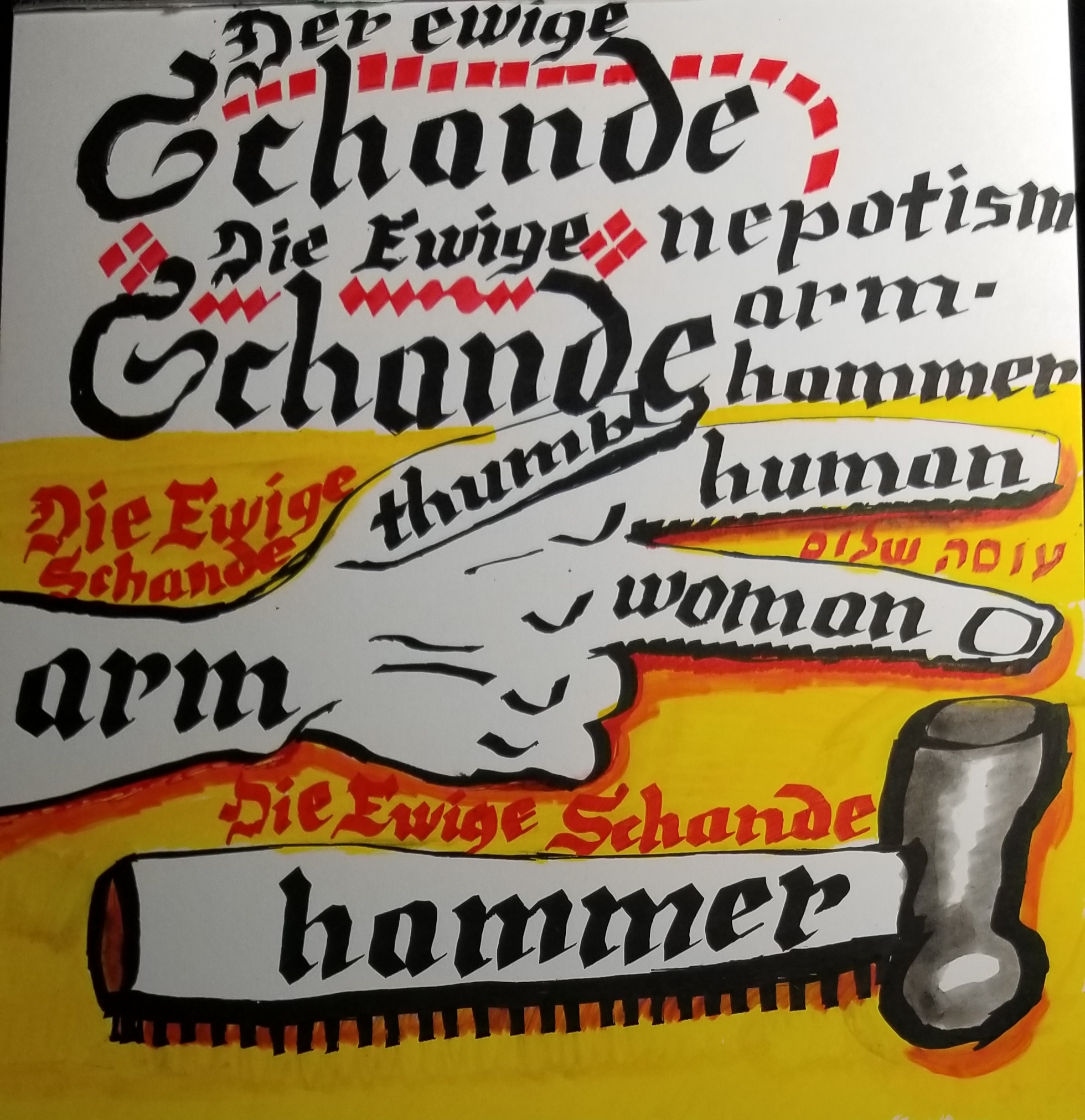
With the benefit of hindsight

Sometimes it is impossible to see a thing clearly, if you you feel a certain way about it, until you can look at it with the benefit of hindsight. Something you had no way to understand as significant when it happened can become clear as part of a pattern you can only see looking back. A seemingly small thing you didn’t see as any kind of problem can come into focus as an important clue to what went wrong, once the entire situation is in the past tense.

I used to be good friends with a cheerful madman, hospitalized periodically for bouts of mania, who inflicted terrible, fatal damage on his old friend’s beautiful Gibson ES-335 (BB King’s Lucille was an ES-335). The lovely guitar, a pleasure to play, had its F-holes gouged out with a file, its mellow Humbucker pickups pried out, it’s perfectly formed, smooth mahogany colored hollow body partially bashed in. The neck was violently pried off, splintering some more great wood. Its remains were then left floating in a bathtub full of soapy water covered with hair the nut had maniacally clipped from his partially shaved head. The guy in the guitar shop just shook his head sadly when he saw the brutality of what had been done to this wonderful instrument. He pronounced it dead.

With hindsight I came to understand how deep my friend’s reservoir of rage was, but that was a lesson I’d learn much later. As for the guitar he destroyed, I knew the back story right away. It makes no sense in the cold light of pure Reason, but I understood part of the rage that made the gleeful desecration seem momentarily justified to my out of control friend. The occasionally crazed man was a fairly good musician who could sometimes come up with cool parts for the songs of his friend the songwriter. He often added inventive keyboard parts that greatly enhanced his friend’s songs. The songwriter always viewed his friend as a side kick, his loyal accompanist. The songwriter, like Lennon and McCartney before him (when they gave Harrison no credit for his many great arrangement ideas and melodic contributions, like the brilliant, soulful song-making opening riff in “And I Love Her”) never gave him any songwriting credit. It wore on him over the years. Finally in a bout of mania he fucked up the guy’s expensive, vintage guitar (this guy I’m talking about, not George Harrison).

Footnote: credit or no credit was purely academic since not one of the songwriter’s songs was ever published, let alone performed and monetized. As a sign of respect and friendship, the songwriter would have been well advised to give some credit to his friend for his major help on a bunch of his tunes. Particularly in light of how things ended for that beautiful guitar, and their long friendship.

I had a friend, since Junior High School, who became a locally well-known lawyer. He explained to me, when we were adolescents, that he had to work hard in school, to graduate at the top of his class, to maximize his chances for getting into a top school that would be a ticket to professional success and ultimate happiness. His vision of success, he explained (as I smoked a joint he would no longer share — he had extra credit homework to complete), was coming home every night to a beautiful home where his beautiful wife would hand him a perfect drink as he relaxed, admiring his sunset view, as the final touches were put on his gourmet dinner. It struck me as a shallow vision of the good life, even at fourteen, but who the hell was I to judge? To each his own, or as we learned to say in our Junior High School French class “a chacun son gout“.

He worked hard, graduated at the top of his specialized high school class, went on to Harvard and then Columbia for his law degree. He got a highly paid job at a prestigious law firm which involved, among other things, defending toxic polluters against lawsuits from tree huggers. After a relatively short time, he changed sides. He took the litigation skills he developed at that corporate law firm and, taking a big cut in pay, went to work defending the environment as the lead lawyer in a branch office of The Earth’s Law Firm, fighting the same powerful world destroying scoundrels he used to represent. This move was the right thing to do, and as far as I know, he never regretted making it.

We remained close friends over the years. He didn’t like to talk about personal troubles of his own very often, feeling that the world is a bitter enough place without adding his complaints to the conversation. He seemingly enjoyed talking about my personal troubles, though, probing for the intimate details, playing devil’s advocate to show me that, arguably, the person I was having trouble with no doubt saw me as the culpable asshole, and not without reasons, which he would lay out and I would counter. I took all this in the spirit of what I thought of as friendship, in accordance with the emotional limitations of what this unhappy, critical old friend was capable of giving.

Until one day not long ago, when he called me in agitation, to challenge me about strong feelings I’d expressed to him in an email. He was very concerned, he said, that I seemed to be so disproportionately angry about a relatively small thing that had happened to me (the illegal termination of my ACA health insurance in January 2020). He was angry, in fact, that I seemed so irrationally angry, and was worried that I was going to kill myself with unhealthy rage. It appeared to him that I was full of destructive self-pity, seeing myself as the only person fucked by a giant fucking machine he was up against every minute of his life, as was everybody else. He eventually challenged me to tell him to go fuck himself. I declined, which, in hindsight was a mistake. Within a few months, after a lot of futile effort to avoid it, I essentially had to tell him that anyway.

But here’s the thing that hit me so clearly, looking at it in hindsight the other day, out of the blue, as I kept a steady pulse with a few simple chords on my guitar. I’d visited him at his new girlfriend’s house in California. He had two nice guitars and I began playing a steady, easy to improvise to rhythm part on one guitar. He began soloing over the simple changes on the other guitar. His girlfriend passed by with a big smile, commenting on how good we sounded. I played rhythm guitar behind him for the whole time we played together. The sound of a few notes in harmony, placed just right against the beat, and keeping the pulse steady as a heartbeat is the soul of guitar playing, to many of us. I never mind playing accompaniment behind a singer or another instrumentalist.

We’d both been playing since we were fourteen, he’d started a bit before me. He had been a hardworking lawyer while I’d spent those same working years, as a lawyer, working as little as possible, mostly as a low-paid court appointed piss boy, and before that, a teacher. I see now the great advantage I’d had over the years in the music department, because I loved guitar I’d spent countless hours of my life of leisure learning to play it. In his busy life of great responsibility, with much less time to play, he focused on mastering scales and modes, to solo. His soloing sounded pretty good.

After an hour or so I asked him to play a three or four chord vamp, so I could show him a bit of Gypsy guitar I’d learned. He said he couldn’t do it. The chords were simple, I don’t know what his reason was, but I didn’t press the matter. When it came up later, I told him it was fine, I’d had fun accompanying him, he sounded good.

Now, in the cool light of hindsight, this odd refusal to do a simple thing makes a certain amount of sense. Since reading the fable of the Grasshopper and the Ant together in ninth grade French class, my hardworking friend often referred to himself as the Ant, while I was, clearly, the Grasshopper. In this morality play the Grasshopper played violin all the time and wanted nothing to do with his fretful friend the Ant’s constant neurotic reminders that winter was coming and that he’d better start gathering food for those long cold months. The Grasshopper mocked the Ant, played some fancy violin, and the Ant furrowed his brow and went back to work. When winter came, and food became scarce, the Grasshopper, starving, finally swallowed his pride and went to ask his friend the Ant for food. The Ant, who had worked his ass off and had no time to “enjoy” life in the reckless manner of the self-indulgent Grasshopper he had tried to warn, tells the Grasshopper to fuck off. The Grasshopper starves to death. FIN.

In that context, my friend’s anger at my anger is as understandable as his claim that he couldn’t play a D, G7 and C chord, the chords every guitar player learns in the first week of playing. He has always been a competitive man, number 26 in his highly competitive graduating class in HS, degrees from two top Ivy League schools. I have always been an under-achiever, trying my best to gain insight and become a better person. To him, as to many ambitious people, achievement and success are the only measures of self-worth, and trying to become a “better person” is an illusory pursuit, a foolish exercise in self-deception. To me, doing what I love as well as I can and treating myself and the people I care about gently seem to be my top two loser priorities.

So, picture this — he’s playing live music, with a friend who plays a steady vamp that is open and easy to improvise to, and his girlfriend loves it. Why would he start playing possibly shaky rhythm guitar, which he hasn’t spent decades perfecting and polishing (as the fucking Grasshopper, in his life of infinite leisure, has) so that his shiftless friend can start improvising in a way that could, possibly, make him look bad? It’s lose/lose for him. So he simply says “I can’t do that.”

Seen in this new light I’m tempted to drop my old friend a line, tell him concisely how contemptible and ultimately self-destructive his reflexive competitiveness is, using this petty but telling example of his inability to play three simple chords for two minutes. I’d follow up with a couple of choice politically incorrect insults from our adolescence characterizing the unfair, childishly insecure type who is afraid, in front of his girlfriend and the best friend he ever had (“I love you like a brother”) of “looking bad” somehow — or worse, letting his unworthy friend look good. Because, as every successful person knows, playing music is actually about proving your dominance over the other players…

Funny, in the moment, most of us tend to let these kind of things slip by, in the spirit of not sweating the small stuff, not making a friend uncomfortable for no reason. Those of us who are not, by nature and long habit, carping, argumentative, super-competitive douche bags (his favorite phrase for worms, from back in the day), at any rate.

We brought out the worst in each other

I stand by my original comment.

“From when I asked you what was the reason for your final, fatal estrangement?”

Yeah, when I told you we brought out the worst in each other.

“Yeah, I remember when you said that, but I have to confess, I never really got that.”

I fucking shot the guy, twice.

“OK, but it seems clear you had no intent to actually kill him.”

I took a gun and shot my oldest amigo twice, once in the thigh, once in the kneecap. In the kneecap, because it’s supposed to be excruciatingly painful to be shot in the knee. I would say the worst in each of us had been brought out by that point.

“Not so, I beg to differ, not the worst, he didn’t bring out the worst in you (though you may well have brought out the worst in him). The worst would have caused you to shoot to kill, you would have blown his brains out or shot him twice in the gut, so he’d die slowly and in great agony like in the Westerns when somebody gets gut shot

Well, sure, killing him would have been worse, in a strict sense the worst, but goddamn it, I shot a guy I’ve been friends with since we were ten years old. I would say we brought out the worst in each other, or, at the least, very bad things.

“As you admit, not the worst, bad, sure, very bad, but by your own admission, not the worst.”

Well, as Shakespeare has some poor devil say in King Lear, “as long as you can say it’s the worst, it’s not the worst.”

“Ah, you mean:

  • Edgar[aside] O gods! Who is’t can say ‘I am at the worst’?
    I am worse than e’er I was.
  • Old ManTis poor mad Tom.
  • Edgar[aside] And worse I may be yet. The worst is not
    So long as we can say ‘This is the worst.’ “

Yes, I lack your eidetic, photogenic memory.

“You mean my lightning fast google fingers.”

Yes, I’m sure that is what I mean.

“But anyway, I’m interested in hearing more of this ‘we brought out the worst in each other’ business.”

Well, shooting my old friend was about as bad as it got, and, of course, I only winged the guy, or crippled him I guess is more accurate, so I guess nothing really bad happened between us…

“No need to be snide, Clyde. Precision in language is important, as you know, being an officer of the court. Bringing out ‘bad enough’ in each other is far from bringing out the ‘worst'”

Is there a point to this exercise in semantics?

“Are you referring to lexical or conceptual semantics?”

Plain old school yard semantics.

“It’s just that you are in the habit of making wild claims you later are unable to back up, I’m trying to help you communicate more clearly and not contradict yourself.”

So to avoid contradiction, for you, I need to make it clear that we brought out very bad, dark, violent things in each other, that while shooting him was, admittedly, bad, and I spent two years on probation (talk about a good lawyer), we did not actually bring out the absolute ‘worst’ in each other, unless you consider that perhaps the worst I could do was shoot somebody I’ve known for years twice, deliberately, to cause maximum pain.

“No need to be so snippy about it, I’m just making a point.”

Snippy, you say, could you give me the lexical semantic etymology of that term of art?

“Snippy is a colloquial phrase, as you well know. It means short-tempered, snarky, bitten off with an overtone of hostility, as in snipping, or perhaps, nipping. I don’t think it’s fair to take it out on me if you habitually seek a pass, a poetic license, for speaking with imprecision.”

I made the point that we stopped being friends for good once I finally understood that we were in an eternal struggle, that there was no chance of coming to any understanding, that we were locked in a zero sum game for who had the right to be more disappointed by the other, whose anger and hostility was more justified. Our rotting cadaver of a friendship had by then become toxic, septic, it had to be put out of its misery for everyone’s good. My shorthand for all that, and my abiding belief, when pressed for a summary of the reason we are no longer friends, after almost half a century, is that we brought out the worst in each other. We had no empathy towards each other, to put it as mildly, and unsnippily as I can.

“Well, there’s no reason to be so fucking snide…”

Argumentative, your Honor!

“I’m not the one making floridly exaggerated claims.”

Floridly, you say, as in floridly psychotic, complete with the fragrant bouquet of hallucinations and addled brain full of false beliefs?

“Whatever… you know, for someone as smart as you are it’s kind of sad that you can’t have a simple intellectual disagreement with somebody without getting all bent out of shape and taking it out on the other person, charging me with being argumentative. You know argument is sport with me, and I can as easily argue your side of the debate as the side I am staunchly defending against you. Why do you take it so personally?”

I only take it personally, I suppose, because I am personally being subjected to this hectoring lecture on precision in language, over a heinous and painful thing I personally did to an old friend after years of escalating hostility. I personally have to defend myself against your sporty, fun ‘I get such a kick out of being contrary!’ inquisition, or maybe prosecution is more accurate, I have to check to see if my poetic license has expired or not.

“Jesus, you really are a fucking hard-ass. You can certainly dish out the punishment but you seem incapable of taking even a gentle push to make yourself more clear.”

The only way I could be more clear, at this point, is by going home, getting my legally possessed gun (great lawyer!) and pointing it at your fucking knee.

“Oh, you talk a good game, tough guy, but this would be a second offense and you’d do prison time.”

Not necessarily, not if I killed you and buried your body here, at this scenic spot where your carcass would never be found.

(He pulls a gun out of his backpack and clicks off the safety).

“You talk a good game, pal, but now that you’ve threatened to kill me, this would be self-defense, standing my ground in reasonable, or at least articulable, fear of deadly assault, here in the great state of Florida.”

We’re in Mississippi, friend.

“Same shit, different state motto”

Well, you might as well shoot me, but, not in the knee, please, for the love of God.

“Don’t worry about that, there is only one reason to shoot somebody, and it’s not to make him limp for the rest of his miserable life.”

Your clearheadedness is an inspiration to everybody in the Laughing Academy, sir.

“Oh, I’m the crazy one? On your knees, motherfucker.”

You shouldn’t use the ‘f-word’.

“Are you fucking mocking me?!”

Oy, I wouldn’t dream of it!

Why Do You Write? (2)

The world comes into focus when I sit down to write. As I write, and rewrite, what I mean to say becomes clearer and clearer, to me and to anyone who reads the words. Writing feels very much like having a meaningful conversation with another person, an unhurried exchange with no regretted, blurted word, as little ambiguity as possible, the endless chance to make things as clear as they can be made, nothing that can’t be fixed before it’s a problem. Writing and careful editing can make everything more understandable, which in itself is a beautiful thing.

Writing feels like a talk where everyone is listened to, all confusion is heard and responded to thoughtfully, every complexity clarified. This is rare in conversation, sadly, and we fondly recall those conversations where we take the time to really hear and are listened to this way. I feel the embrace of this kind of intimate talk virtually every time I sit down to write. It matters little to me, as I write, that very few people, or no people, will read a particular piece. The conversation goes on in any case, ready to be joined at any time.

What is it, exactly, that is spurring me to write today? What do I want to talk with you about? Once you give your thoughts a title (an excellent suggestion from Kurt Vonnegut, Jr. I read, and took to heart, as a sprout) it becomes much easier to follow them, to corral them, to get the flow of them to make sense. Today I am writing about why we write, though, of course, I have little insight into why YOU write.

I speak for myself, obviously, as I write these words. I’m certain that many of you experience a similar feeling of connection to others when you sit down to write. This feeling is particularly precious in our atomized, virtual world where much of our communication is done in short text bursts or other digitized interactions, without the nuances of eye contact or body language. The conversational/connection angle of writing and rewriting will resonate with those of you who are motivated the same way I am.

Vonnegut said he always wrote imagining his bright, well-read sister’s reaction. If he could picture her shaking her head over something he wrote, that passage would have to be rewritten until it met her high standards, or tossed. When I write, I sometimes picture a literate stranger, in India, China, or the Ukraine, and strive to make my prose as clear and my train of thought as focused as I can. I also sometimes picture my mother’s reactions when I write, she was a keen appreciator of good writing.

When I was a boy, I used to write much more emotionally, driven by the mistaken belief that I could include everything I’d ever felt, thought or learned in the piece I was writing. I was driven by a strong need to sum everything up every time I sat down to write. I have heard this impulse compared to trying to hit a mammoth home run every time up. It took time to adjust my expectations, get better control of my swing, to learn that making good contact is the point of this game. It took time to learn to choose one thing to focus on at a time. That’s where Vonnegut’s advice comes in so handy. The universe swirls, an infinite multi-dimensional kaleidoscope, in constant, frenetic motion, making it impossible to focus on the giant themes we often feel up against. Unless you focus on one specific thing at a time, and naming that one thing up top helps. Which, of course, is not always as simple a matter as it seems.

For example, I heard a few snippets of some of the speeches at the recent Conservative Political Action Conference (mein kampference [1]) in Dallas. The former president, a compulsive liar loved by 39% of Americans, continues to lie about his second term being treacherously stolen from him in a fake election. The faithful do not doubt that his lie (which would, of course, require a national, bipartisan conspiracy against him) is true — if not literally true, based only on evidence, then true in the higher, faith-based sense that true believers believe is a higher truth than the earthly, limited fact-based variant. To verify that his endlessly repeated claim of a stolen election is an audacious, incendiary lie, we need look no further than the many Republicans and Trump-appointed judges who found there was no fraud in the election the Orange Polyp still claims was rigged to steal from the rightful winner, him. To see how provocative and dangerous this lie is, we need look no further than the deadly January 6 riot and the GOP’s continued far-fetched defense of a stirred up insurrectionist mob that violently stormed the Capitol and successfully stopped the peaceful transfer of power for several hours, at the exhortation of the former president and his faithful, like his son Junior, Rudy and Alabama Representative Mo Brooks. Yet, the CPAC crowd [2] drowned the lying speakers in adulation, chose the ex-president by 70% in a poll of who these extremists want to represent their party in 2024. This paragraph would become the seed of a post, after I called it something like “Nazi rallies had nothing on these cute pups!”.

So I realize another reason I write is to digest things that are otherwise indigestible to me and to make my point of view known. Most people I know have little tolerance for discussing the depressing battle over our nation’s soul, they want to relax, enjoy life, be out in nature, eat good food together, not be tortured by someone making an all-too convincing case that we are living in Berlin, 1932. Or the soon to be violently sundered United States of 1860. I can gently judge them without blaming them, I understand their point of view, nobody likes a fucking party pooper, I hate them myself. Here, on the other hand, I can lay things out that would otherwise suffocate me, if left unvented. Writing it out here helps me process things and leaves me able to say much less to friends about the details of this ongoing horror movie we are all living in.

Thoughts lead where they do, and if we follow them carefully we can make the path of those thoughts intelligible. It gives some comfort, at least to me, to be able to see things in perspective. In the case of the paragraph about CPAC, it leads, invariably to certain related thoughts and questions. The MAGA riot actually stopped the function of government, as it was intended to, which is the legal definition of an insurrection, so why is nobody on trial for inciting insurrection? Why have none of the funders ($50,000,000 on advertising alone), organizers and promoters of the attack on the Capitol been indicted for anything? Why are there no senate investigations into senators who actively spread the Big Lie and then actively contested the counting of uncontroversial votes, based on the prevalent Republican belief in the Lie they had helped to spread (Lying’ Ted, you brazen little vampire!)? Same in the House, why no ethics investigations if members were seen conducting tours of the building for the rioters in the days before January 6? Is Merrick Garland, a thoughtful, decent man who cried at his confirmation hearing recounting how this country had saved his family from the Nazis, the right man to face off against our home-grown American Nazis? I’d have loved the even-tempered, fair-minded jurist on the Supreme Court, but I don’t know that he has the stomach to do what must be done to face down the virulent antidemocratic threat we are up against.

I see I’ll have to go where these thoughts lead me today, but I’ll go there later, in another post. Another great feature of writing is that you can leave off wherever it makes sense to leave off, and hours, even days later, pick right up after reading everything you wrote in the previous session. What you have already written leads you directly to your next thought.

Which is a magical thing about reading and writing, along with our human ability to string letter symbols into words which can then be fashioned into expressions of even our most complicated thoughts and feelings. Wow.

Another beautiful thing, you can go back, proof-read, trim, fix, reorganize, restate, clarify, polish, as many times as you need to. I’ll no doubt be back to this post a few times in the next day or two, making little tweaks.

Hey, stop me if I asked you this before: why do you write?

[1]

An obnoxious little (parenthetical) darling, adding nothing, likely subtracting, that I should almost certainly murder …

[2]

reads a bit like it was written by Dr. Bronner, but surely the work of a true patriot:

Why do you write?

People write for different reasons, just like we play music for different reasons. Thinking of music, I know some people who play music for the applause, in hope of fame, dreaming of playing to and impressing large, appreciative audiences and being thought of by others as a real musician. In writing it that way, I see I am passing judgment on them, just for doing the normal, natural thing in a competitive society where all we are is what we can prove to others we do better than most. It also suggests there is another way to think about making beautiful sounds, about writing, about doing anything we love. I will explain.

When you play an instrument to produce the best possible sounds you can on it, you are attuned to it, related to it, and you will always play as well as possible. When you pay attention to your intonation, the dynamics of your notes, how you produce different sounds, which sounds most make you love the instrument in your hands, how you bend the note, or slide to the note, or hammer it from a lower note, you are playing in a universe that has nothing to do with others appreciating it. You play for love of what you are doing, love of the sounds your fingers (or breath) and the instrument are making.

I suspect every great instrumentalist plays because they love the sounds they begin to master, love the instrument that produces the sounds, love the way it interacts with other instruments in the mix. When you are in this zone, nothing else really matters to you. When you play out of this kind of love, you naturally get better and better, because it’s not a matter of practicing to attain a goal, it’s always a matter of joyful play. There are few better feelings than making a beautiful melody sound as beautiful as you can, laying in a harmony or counterpoint line as creatively as you can. There really is no better work.

You play a note on the piano. You can bang it hard, stepping on the sustain pedal, and have it ring like a gong. The instrument is called the pianoforte because it is capable of playing pianissimo (quietly) or forte (strong!). A good player can make a piano whisper too, whenever needed. You can sound some notes loudly and others quietly to achieve all kinds of subtle effects. There is a range of things you can do with the piano’s palette of dynamics that were impossible to do on the instruments that preceded the piano, like its direct ancestor the harpsichord. Writing is the same thing, the range of what you can do with words, lining them up in different ways, loud and soft, for different effects, is limitless.

I’ve been writing since I was a kid, and I’m officially an old man now. I often wrote when I couldn’t understand something, or make myself understood. Though I always spoke well enough, writing was needed. There were things I struggled to express, things I didn’t understand, that only writing, thinking, rewriting, editing, clarifying, could help me grasp. Writing led me to understand things that perplexed me and it allowed me to share what I learned, through the writing itself or talking, in light of what I’d worked out on the page.

What struck me more and more as I wrote every day was the incomparable beauty of clarity. The writers I admire most set things out clearly. If you don’t give the reader all the necessary background, set out concisely so as not to waste her time, you’re not doing anybody any favors. If the context needed to understand a point is missing, ambiguity floods in. There’s enough of that in life; confusion, muddiness and incoherence are the enemies of clear thinking and good expository writing.

My goal when I write is clear exposition, showing what I’m talking about. I cut away anything that interferes with clarity. I sometimes have to murder a darling, resist the impulse to make the words dance, or shimmy, or call attention to themselves. My main thought when I’m reviewing and revising my words is to eliminate ambiguity and misunderstanding. This is particularly important when dealing with a difficult, perplexing subject.

For example, and this example stretches over decades, you are perplexed at an unresolvable contradiction about a parent. In my case my father was very smart, very funny, his politics always favored the underdog, the oppressed, he loved animals and treated them with great tenderness, he was insightful, keenly interested in the world and could be very reassuring when he wanted to be. A wonderful man. At the same time, he was very often irritable, angry, critical and mean. He was an abusive prick to my little sister and a determined enemy to me for most of my life. How do you reconcile these things? How is it possible not to take your father’s seething anger at you personally?

If you internalize this kind of parent’s view of you, the world makes no sense, your life is a painful jumble. A devoted friend of the underdog, a man who believes deep in his soul in human equality, in the right to be free of tyranny, who teaches you to be kind to others, to treat animals with tenderness, snarling over dinner that you’re a venomous snake … WTF?

How do you understand this? You take an insight, like George Grosz’s comment that in order to understand how someone can behave brutally you have to study the humiliation they underwent. You read this line in a biography of Grosz you are reading as you research how this political artist used his talent as a weapon, how he was forced to flee by the Nazis, who would have happily made a gruesome example of him, how he struggled in the US. You started reading about Grosz because your father once compared your drawings to Grosz’s, a compliment you did not take to heart at the time, but one you cherish in hindsight.

You have to study the humiliation that makes a man act with brutality. How do you do this? You can’t really ask the man. One kind of writer would write a novel, create a character she could interrogate, put in different situations, see how he acted, what made him brutal, fill in the imagined humiliation that made the story make sense. I am not this kind of writer, though I love good fiction I’m not drawn to writing it, my attempts over the year have been sketchy. I need actual details to work with directly, things I’ve lived and observed to describe as accurately as I am able.

So I spent many, many hours conversing with my father’s beloved seventeen years older first cousin, Eli. The man was mostly estranged from his own three children and grandchildren, and great-grandchildren, the result of his tyrannical insistence on raising them as he saw fit, not as they might have liked to have been raised. He could be very difficult, flew into a rage easily, but also, as with my mother, was very easy for me to placate when he jumped up in anger, backing off just a bit, like I was easing up on the gas pedal.

As easily as Eli’s face turned purple, spittle formed on his lips and he became savage as a leaping panther, he would calm down and return to being a warm, funny, wonderful story-teller. I suppose it was the same dynamic between him and me as the one between my mother and him. They loved each other enthusiastically and fought just as passionately.

As often as he was blind to the needs of others, to his own role in making people miserable, he also had frequent moments of great insight. It was fascinating to watch these two contradictory things marching forward side by side in our conversations. If I’d spent 40 hours talking to him, I’d never have learned what I needed to know. It took hundreds of hours, over the course of dozens of drives up the twisting Sawmill River Parkway to visit him, before he thought to reveal the difficult truth I needed to know about how my father was humiliated, from the time he could stand.

It was a crushing revelation of a mother’s violent abuse of an infant and he made it with all appropriate hesitation and regret to have to tell me, but describing it to me was an act of love that turned a light on in the universe and enabled me to start to let go of much of the pain and anger that had been building in me for decades. It allowed my father, a few years later, to have a son standing next to his deathbed who knew exactly why he felt his life was over by the time he was two. In a sense, it is a miracle my father did only as much damage to my sister and me as he did.

I have mused about this, and Eli’s gift, over the course of a thousand page first draft that is sitting on this blahg, needing another pass to start turning it into a book you could read and extract lessons from for your own life. Click on the subject “Book of Irv” to the right of this post and you will see what I’m talking about.

A word about “by Oinsketta” instead of publicizing my name, Eliot Widaen, as any normal writer would do. When I started this blahg it was to get access to a supposed archive of research on Malcolm X compiled by Manning Marable a scholar who died shortly after (or maybe right before) the publication of his biography of Malcolm X, El Hadj Malik el Shabbaz. I’d read the book in fascination, thinking it was a great and insightful work, and then the critical shit hit the fan. People who loved Malcolm (as my father had, as I do) were outraged by some of Marable’s assertions in the book. I’d seen a reference to an online archive of Marable’s research, went looking for it, found it, logged in and found virtually nothing of use there.

I remember feeling quite disgusted at the “archive”, that the sources of the controversial parts of what Marable had written had apparently gone with him to the grave. Before being able to access the Malcolm research archive site, I had to log in to something called WordPress. I logged in as my late, beloved cat, Oinsketta, created a PIN and was given a blog. That was about ten years ago. I don’t think I can change the author’s name at this point, on the other hand, I never really checked it out. On the other hand, I suppose I don’t really care enough to research it. At the same time, the clock is ticking, and I’m trying to get some of the best of my thousands of pages of writing into publishable form.

Why do you write?

One more about my mother

Here —-> is a link to one of two pieces I was actually paid for writing. It is about solving the mystery of my mother’s longtime distaste for Stephen Colbert, a comedian she should have loved as much as Jon Stewart, who she loved to pieces.

I have to point out that the cliche-prone “editor,” in return for the $250 his company paid to contributors, reserved the right to put asshole lines like this into my mouth:

” … found one that made me feel like a regular Sherlock Holmes.”

He’s probably also the author of this immortal phrase:

“One case I was proud to crack…”

Come on, Larry, couldn’t it at least have been a “caper”?

Anyway, this piece is mostly free of his editorial flourishes, and nothing as maddeningly meaning-altering as his idiotic improvements to my first piece.

Once I he published the first two I imagined I could get paid for a few of these every month, they were easy enough for me to write. He loved the first three I sent him and instantly published the first two (well, the first was a bit of a pissing contest before I could get paid, but he loved the piece and I managed to leap easily enough through every additional hoop he set up).

A bitter aside:

This imagined source of easy income curdled, dried up and blew away as I encountered Larry’s insistence on having the very last word on everything related to paying me the $250 fee. In the end he changed his mind about publishing the third one, a piece he’d immediately emailed to tell how much he loved and that he was publishing. Then he changed his mind about publishing it, without letting me know, though he could have sworn he’d sent me an email. After that, he was nothing but quibbles and I soon lost patience with the idiotic game we were playing.

I was told he gave certain authors a lot of shit about making endless changes (as he had on my first piece which I was forced to cut from 1,500 to 1,200 to 1,000 words), especially authors who wrote better than he did (just about anyone) and those who were not his personal friends (the rules applied to them were different, 4,000 or more rambling words were not a problem for him and a few of his long-winded buddies). Oh, well!  

There is no kingdom too tiny for arbitrary tyranny, I’ve noticed.

As to the mystery of why my mother hated Colbert, here is the full story. I felt like a regular Sherlock Holmes when I proudly cracked that caper, I can tell you for sure, boys and girls!

A few more thoughts about my mother

She would be angry about Mitch McConnell’s current plan to filibuster the formation of a January 6 Commission, the 6-3 corporatist Supreme Court engineered to outlaw a woman’s right to choose — and poised to do so, the radical nihilism of a party become a violence-embracing cult steeped in insane conspiracies. Hell, she was still upset enough about the prospect of Sarah Palin in power to ask me, hours before she died (and two years after Palin ran for vice president), to promise her that Sarah Palin would never be president. When she got really angry, my mother would cry.

She’d bellow too, don’t get the wrong idea, she could snarl and yell with the best of them. She had no problem speaking her mind, even while angry, but when talking about something that unfair, and brutal, and in the face of which she felt so helpless, in the end she’d cry. Hard to blame her, really. I can imagine exactly how Kyrsten Fucking Sinema and Joe Shit-breath Manchin would sit, crosswise, in her craw, incoherently defending the bipartisan right of McConnell to use the filibuster, which, they senselessly claim, was created to foster bipartisanship, just as Mr. Trump’s decisive loss in 2020 was actually a landslide victory and the so-called riot to Stop the Steal was the fault of angry Blacks and radicals who dangerously and mistakenly believe there is institutional racism in our unimpeachably exceptional nation.

My mother liked Tom Hanks (as most people I know do, how can you not?) and would be horrified to hear he’d been singled out as one of the elite Hollywood pedophile child-blood drinkers, viciously persecuting the innocents unlikely hero Donald Trump was chosen to deliver from this monstrous evil, from Satanists. “Tom Hanks?!” I could hear her voice, incredulous, her intonation bristling with Bronx street outrage.

In that childhood in the Bronx, growing up in a first floor apartment on Eastburn Avenue, which meets the Grand Concourse on one end, a half block from her apartment (my mother always proudly claimed to have grown up on the Grand Concourse, the Champs-Élysées of the Bronx) she learned a certain amount of toughness and also, complete vulnerability.

She was vulnerable to loneliness, having grown up an only child, a “latch key” kid, as she said, someone who came home after school and let herself into the empty apartment. Both of her parents worked and she wouldn’t see them until dinner time. She was helplessly vulnerable to the giant engines of politics, as a teenager her entire large family was wiped out in Europe, when she was twenty Robert Moses cut Eastburn Avenue in half, condemning and demolishing two blocks of her neighbors homes and stores and beginning to dig the huge canyon that would accommodate the roaring Cross Bronx Expressway, and destroy a series of Bronx neighborhoods like my mother’s childhood home.

We never spoke much about any of this. Not the family taken to a ravine on the north west of town and shot in the back of their heads, not the destruction of her childhood home by hater of the working class Powerbroker Moses. I only saw the windows of her apartment toward the end of her life, when a friend and I took a bike ride in the Bronx to find Eastburn Avenue and I called her in Florida. She was very excited to describe exactly where her apartment was, lead me to the window, on the first floor, right side next to the front entrance, where she used to look out to see who was walking up the courtyard.

It was through this window that she first saw the gangly teenager who’d become my father, a countrified hick (to her way of thinking) who arrived with his tiny mother and younger brother to visit a cousin who lived in the building. She was horrified, a few years later, after her mother forcibly ended a romance between my mother and a suitor her mother hated, when her mother proposed, and later insisted, she go on a date with the bumpkin. The bumpkin turned out to be surprisingly smart, witty, tall, dark and fairly good looking, and he made her laugh — the rest, as they say…

Her mother, my grandmother Yetta, was tough as nails, in a certain way. Very strong willed and certain about what was right (like the fact that Dinche’s cousin was the perfect husband for her daughter), she took no back talk or rebellion from little Evelyn.

Odd little detail, Yetta had named her daughter Helen, my mother, as a child, somehow had that name legally changed to Evelyn. I don’t know more than that about her name. I do know that Yetta would not hesitate to break a yardstick over her daughter’s ass, whatever the girl wanted to call herself.

I know this because both of my parents nonchalantly tossed off that Yetta had broken countless yardsticks over her daughter’s ass. They usually mentioned this with a smile, for some reason. Yetta always had a yardstick handy because, since she was a girl, she’d been a talented seamstress. Her nickname among the Jews in her little town back in the Ukraine was der schneiderkeh “the little tailor”. She was apparently so good, at such a young age, and her services were so in demand in her small town, that she employed several women to help her turn out the orders.

None of this translated in New York City when she arrived in 1921, and she had to work her way up from sweatshop worker to special assistant to the designer herself– Helena Troy, the designer’s name was. Troy would send Yetta to fashion shows to steal design ideas. Yetta had an amazing visual memory, with no notes she’d go back to the office and replicate the most interesting new designs she’d seen, which Helena Troy would make a few small changes to and pass off as her own. My mother often said of her mother that if only she’d been perfectly fluent in English (she read and wrote haltingly in English, though her Yiddish was top shelf), and American born, her mother would have been the first woman president of the United States. I don’t know about that, but I later saw one of those yardsticks. Holy shit.

The yardsticks I was familiar with were flimsy 1/4″ thick slats that hardware stores gave away. We had several with “Eisner’s” printed across them (Eisner looked like Ed Asner and ran the hardware store we could walk to from our house). You could snap them in half easily, even as a young kid. So I always pictured these snapping harmlessly over my mother’s butt, little signs of my grandmother’s annoyance and nothing more.

Then I saw one of the old, stained wooden ones, the kind Yetta used. A sturdy piece of square lumber you could only break with a saw, or by swinging it with a good deal of violence at an object you didn’t care much about damaging.

Toward the end of her life, in a last futile attempt to bring a little more understanding between my mother and my sister, each locked in a struggle with the other, I mentioned that most mothers and daughters have conflict. I named a few examples, people we knew. Then I made a dangerous mistake.

“You know, mom, you had some serious conflict with your own mother…” I began, but was instantly cut off by an angry snarl.

“I had a great relationship with my mother!” she said, her nostrils flaring and her face becoming slightly red. We were standing a few feet apart in the little hallway between her bedroom and the guest room where I stayed when visiting Florida. She was close enough to lunge for my throat, her teeth were already out.

My mother had observed, a few years earlier, how much better I’d become at dealing with my anger. It was in the middle of a fight I was having with my father about whether people can meaningfully change things about themselves. My father was angrily insisting I was pathetically misguided, and just as fucking angry as I’d ever fucking been, that I was deluded, fooling myself to believe I had changed in any fundamental way, especially regarding my violent temper. My mother passed through the room where my father and I were duking it out.

“I’ve seen a big change in you,” she said, as she walked with her coffee back into the bedroom to continue reading a murder mystery.

The second my mother roared in pain when I suggested her own mother had been brutal to her I remembered my vow not to fight with her. I’d promised myself when my father died five years earlier, as I’d promised him on his deathbed I would take care of her, that I would not make her angry as she ticked off the final years of her life. In the next moment I was as nimble as a young Fred Astaire.

“Do you want to have dinner at Lester’s or the Thai place?” I asked her.

“Oooh, let’s have Thai!” she said, as happily as a baby who’d been furious a second before, now flushed with wonder and joy, absorbed in the tinkling of the keys waving magically in front of her face.

For a bit more about my mother.

Happy Birthday, Mom

My mother would be 93 today, hard to believe. Seems like only yesterday she was a new mother overwhelmed by her two young children, me and my younger sister. Time has got to be one of the most mysterious forces out there — the more I think about it, the less sense it makes to me. We often think it flows in a straight line, from past to present to future, but there is plenty of reason to doubt the simplicity of that conception. In a blink it is fifty years ago.

My mother loved to read, appreciated good writing and was a pretty good writer herself. When she was in college she carried a notebook in which, when inspiration struck, she stopped and wrote poetry. I remember a blue, leather-bound journal that she told me contained her poems. I recall seeing it as a kid. I imagined her rushing to a bench at Hunter College, shortly after World War Two, excited to jot down a phrase or idea before it was lost, the way I will sometimes do (increasingly into my very smart phone) when I’m out for a walk.

At some point my mother stopped writing poetry, except for the occasional birthday card, and I never found the blue journal of her poems after she died. I searched every corner of the apartment as I cleaned it out, went through every box, feeling hopeful at every turn, but nada.

What happened to that poetry is probably what happens to everything else that lives and breathes. Comes a time when it fades to black. You can call it what you like, the impenetrable black is the same. It’s like what happened to that plump little solid gold heart my mother wore on a thin gold necklace when my sister and I were little. I remember it swaying over us in our beds. Now? It is nowhere.

I look over at the box where my mother’s “cremains” have sat quietly since they emerged from a Florida crematorium almost exactly eleven years ago. A religious friend called my mother’s apartment on May 20, 2010, to wish her a happy birthday. I told him she’d been taken to the hospice and had been in a coma for several hours.

“That’s a sign of righteousness,” he told me “when God really loves you he lets you die on your birthday.”

My mother, who was quite hostile to religion, had fought with this guy over and over when she was alive and kicking. She thought religion was a foolish, often destructive, lens to look at the world through and was disgusted that so many religious people were loophole surfing hypocrites.

God (and don’t get her started on that one) says you can’t eat “chumaytz” on Passover? That is, a Jew is not allowed to eat anything containing leaven during the week commemorating the exodus of the Israelites from Egypt. We eat flat, unleavened bread, the “bread of affliction,” to remind us how our enslaved ancestors suffered as they fled tyranny and bondage.

Except that they’ve developed perfectly fluffy cakes and other foods to eat during this time, delicious items that taste and feel very much like the real thing, but do not contain “leavening”. They found a perfectly kosher way to observe the letter of the law while gracefully skirting its spirit. Nu, why should we have to suffer? My mother had no patience for that kind of pious hypocrisy.

And so it was that she refused to breathe her last on May 20, she waited until the following day. It was as if her last act, even in a coma, was a middle finger to orthodox Jewish religious belief.

At her memorial I told the group assembled there that it was highly ironic for us to be gathered in a synagogue, a place my mother avoided. Particularly ironic for the synagogue to be in Peekskill, a town my father immediately fled at the end of his horrific childhood there, a place he almost never visited, but where he was now buried.

The Jewish group that ran the cemetery, by the way, First Hebrew Congregation of Peekskill (in whose chapel we’d gathered), had decreed that no cremated ashes could be buried in the cemetery, even if the member had paid for the grave site for 50 years, as my parents had. I pointed to the bag containing the box of my mother’s ashes, seated in the front row. She had no comment, but everyone in the room could imagine it.

“There’s no Jewish law against burying ashes,” my parents’ religious friend had told me on her final birthday “which means you can go to the cemetery and quietly bury them in her grave yourself.”

I told the friends and family assembled in that synagogue that my mother admired a Florida rabbi who wrote a weekly column my mother loved. This rabbi was fiercely liberal and wrote scathing and witty denunciations of the radical Republican party under Cheney and Dubya. Reading his weekly column was a great relief to my mother, living among Floridians, many of whom believed that Dubya was working directly for Jesus Christ, and she often mentioned this rabbi to me in our daily chats, sometimes reading me bits she particularly liked.

Her neighbor told her that the rabbi would be speaking at their local temple the following Friday night. She was very excited at the prospect of hearing him speak and went to synagogue, in spite of her lifelong reluctance to attend a religious service if she could avoid it (she almost always could.) Oddly, when we spoke after the service she didn’t mention the rabbi, or the service. I asked her how it was.

“Oh, it was awful, very disappointing. He was up there on the bima the whole time, but he didn’t open his mouth, he didn’t say a word. Not one word! He just sat there. They introduced him and he sat there and waved.”

Then, reliving the worst part of the nightmare, she said “and they read every goddamn prayer in that fucking prayer book! [1]”

It was my mother in a nutshell and everyone there immediately recognized her, and her influence on me in telling this particular anecdote in the solemn sanctuary, in front of the fancy ark that held the Torah scrolls.

Anyone observing the ease between my mother and me, and how carefully I protected her during the last years of her life, would have no doubt of the love between us. I owe a great deal to her, including my love of reading and writing. When I wrote something that moved her, she smiled with the deepest possible delight. “It’s wonderful,” she would say.

Kurt Vonnegut once wrote that we write for an imagined audience of one reader. In his case it was his older sister he always wrote for. He’d imagine her reaction, and that was his guide for how to write, what would make her nod, or laugh, or think, what would displease her, make her demand better. I suppose my imagined audience is my mother. It certainly is right now, as I remember her on her birthday and try to conjure just a little of her spirit for others today.

The beauty of writing is the chance, every time we sit down, to make our meaning absolutely clear. With the luxury of time, which is all we really have (ask my mother), we’re able to reread and weigh every phrase we’ve written, think further, remove any word that distracts, say what we mean to say as clear and true as possible.

Through this daily practice of writing we can learn to communicate exactly what we mean to say. That is far more than we mortals can often do in real time, especially in the heat of those moments when it is almost impossible to say exactly what we mean. Writing, for those of us who love it, is a great way to clarify what we feel and what we think.

If this practice of daily writing hasn’t helped me, necessarily (no matter how clearly you write there are always those who’ll insist you haven’t made yourself clear, or, on another level, that you’re a chump for not getting paid to write, if you think your writing is worth anything), it certainly hasn’t hurt me. In fact, it has helped a great deal, I know this every time I sit down to spend time combing through my thoughts and feelings.

I once bought my mother a blank journal for her birthday. “I have nothing to write,” she said, after thanking me for the book. I reminded her that she used to love to write, and told her if she started to do it again she’d probably find it worthwhile.

“You’re the writer, not me,” she said. “You have a million ideas, I don’t have any ideas. I have nothing to say. It’s a very nice journal, but the thought of a blank page fills me with dread.”

Nothing I could say helped her recall that once familiar moment, when she thought of something she wanted to say, and set everything else aside to work out the best way to say it. It had been so many years since this bright, opinionated woman had thought to take the extra time to more elegantly express what she’d already said that she no longer had any memory of her need to do it. She must have stopped believing it mattered what she wrote, at a certain point. Which is a whole other story, now that I think of it.

Happy 93rd birthday, mom.

[1]

She may have said “every fucking prayer in that goddamned prayer book” but even someone known for an excellent memory, as I am, can never be sure.

Letter to the editor, NY Times

To the Editor:

I have to question why an article that concludes “(t)urnout for the vote was low, at only about half of all eligible workers, suggesting that neither Amazon nor the union had overwhelming support” was headlined  Why Amazon Workers Sided With the Company Over a Union.  If the article was PR written by Jeff Bezos himself, it could not have been more faithful to his point of view or desired outcome.  Fittingly, it ends with Mr. Bezos promising shareholders he’ll do even better to make his lowest paid employees even happier.

The authors observe that if the estimated 25% of the workforce that “turned over” during the three month organizing/voting period had stayed, unionization likely would have prevailed.

Among crucial issues unaddressed by the article, if Amazon workers side with Amazon, why does Amazon have such massive worker turnover, even during a pandemic and economic hard times in one of the poorest states in the US?

The reader is left to piece together, from the “wish” expressed by Amazon supporters that they could have more than a 30 minute break during their ten hour shifts, that working conditions might be less than ideal at the Bessemer, Alabama Amazon fulfillment center.

The reader is left completely uninformed about the “aggressive” (and multi-million dollar) measures Amazon took to defeat the union and dissuade half of its workforce from voting at all.

We get only the gentlest hint of the famously oppressive conditions at the Amazon warehouses that cause so many to quit their jobs, even during an international health emergency. As though the right to urinate when it’s urgent is irrelevant compared to a generous minimum wage and company provided health insurance.

Draft of a letter to the Grey Lady

I find myself so churned up these days, as truth and outrageous fiction have become interchangeable in politics, and even reasonable medical advice is weaponized for “political” ends in our 40% John Birch Society America. 

The news is an ongoing nightmare to me, as things that should not be in controversy at all are continually fought to the death — you say reality, I say Q!

Since the Chauvin trial for killing the handcuffed George Floyd began on March 29th, only 64 civilians, a mere three a day, have lost their lives during encounters with police, (50% of them have been white) [1]. The question everyone on the right is asking — why are Blacks and liberals claiming there’s a problem with police violence, or the disproportionately racist application of police violence?

Now we have new headlines informing us that Republicans are starting to unite in their opposition to a commission to study if prominent Republicans organized, funded and fomented the January 6 riot at the Capitol (and let it rage for hours, unchecked).  Of course they are united in opposing it. You would be too!

So, in the absence of something more concrete to do about anything today, I’m taking Sekhnet’s advice and drafting a letter to the NY Times about their recent “puff piece” for Jeff Bezos.


To the Editor:

I have to question why an article that concludes “Turnout for the vote was low, at only about half of all eligible workers, suggesting that neither Amazon nor the union had overwhelming support” was headlined Why Amazon Workers​ ​Sided With the Company Over a Union​. If the article had been PR written by Jeff Bezos himself, it could not have been more faithful to his point of view or desired outcome.Fittingly, it ends with Mr. Bezos promising shareholders he’ll do even better to make his lowest paid employees even happier.  

The authors observe that if the estimated 25% of the workforce that “turned over” during the three month organizing/voting period had stayed, the union likely would have prevailed.

Among crucial issues unaddressed by the article, if Amazon workers in fact sided with their employer over the union, and love their well-paying $15/hr. jobs and health insurance from day one, why does Amazon have such massive worker turnover, even during a pandemic and economic hard times in one of the poorest states in the US?

The reader is left to piece together, from the “wish” expressed by Amazon supporters that they could have more than a 30 minute break during their ten hour shifts, that working conditions might be less than ideal at the Bessemer, Alabama Amazon fulfillment center.

The reader is left completely uninformed about the “aggressive” (and multi-million dollar) measures Amazon took to defeat the union and dissuade half of its workforce from voting at all.

We get only the gentlest hint of the famously oppressive conditions at the Amazon warehouses that cause so many to quit their jobs, even in one of the poorest states in America, during an international health emergency. As though the right to urinate when it’s urgent is irrelevant compared to a generous minimum wage and company provided health insurance.

Eliot Widaen, New York, NY

Mr. Widaen is a wild-eyed hothead who is often angered by the status quo-defending distortions regularly published by the Journal of Record.

[1]

Grrr… grrrrr!!!

The NY Times has got me by the throat lately, I just read this beautifully crafted, non-judgmental paragraph, in the article cited above, about the 64 civilians who died in encounters with police since the Chauvin trial began three weeks ago, that is making me foam at the mouth slightly:

And their [police killings] fallout has been wrenchingly familiar, from the graphic videos that so often emerge to the protests that so often descend into scuffles between law enforcement and demonstrators on streets filled with tear gas. Just as one community confronts one killing, another happens.

source

Reasonable, constitutionally protected protests that are typically met by police clad in anti-riot gear, deploying crowd dispersal methods designed for use against violent insurgents “so often descend into scuffles” on streets “filled with tear gas” (probably terrorist tear gas, no?, beautiful thing, that passive voice — who released the tear gas that filled the streets “filled with tear gas”?) 


Makes me wanna holler.