When you lose, kill the winner

Narcissism has come into popular consciousness after almost a decade of a malignant narcissist dominating the news cycle every day, amplified by the destructive behavior of the ambitious psychopaths who justify his rage to dominate, all normalized by profit-hungry corporate media. One key feature of narcissists, because their ability to see things from anybody else’s perspective was destroyed early on, is a rigid insistence that they can never be wrong, no matter what they have done.

If they are wrong, it is somebody else’s fault for making them wrong, so they’re actually right. They justify every excess by blaming others for their temper tantrums, hurt, rage, shame, need for revenge and everything else that makes them unbearably uncomfortable. You get a great encapsulation of narcissistic rage, and its reflex to justify retribution, from our former president as he made his lying case during the privately organized, privately funded pep rally at the Ellipse on January 6, 2021, the tasteful prelude to the peaceful, patriotic Trump riot at the Capitol.
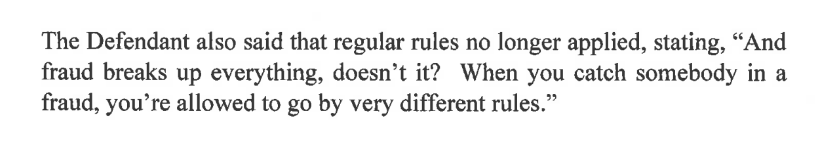
Very different rules. You can “illegally” take millions of dollars from foreign powers for your campaign, in exchange for promised political favors, because the other side is cheating. You can claim your predecessor illegally wiretapped you, because he wasn’t even a legitimate president, he’s a liar. You can order your attorney general to violently remove peaceful protesters from the streets so you can show strength in a photo op, because the protesters hate America and are violent terrorists. You can have the wife of a Supreme Court justice walk into the West Wing at will, and when she leaves, decide which disloyal members of your staff need to be fired, because, separation of powers (or States Rights, or whatever). You can make political martyrs of those who violently attacked police, because, when there’s fraud, you know… You can lie to your supporters over and over, and steal money from them based on those lies, because the other side is a powerful cabal of cannibal pedophiles who advocate the murder of newborn babies and are legally killing them by the truck loads in Blue States.

There is nothing you are not allowed to do, when fighting an evil so monstrous. The narcissistic mindset is reptilian in its reflex never to be wrong, no matter what.

I think of my one time closest friend, today on his 68th birthday. His primal wound is that his father, a strong and generally admirable man, never protected him from a crazy mother with a violent temper. He grew up triggered by his manipulative mother, now over ninety and as able to reduce him to anger as when he was a child, and mourning the loss of a father who emotionally abandoned him.

The punchline, I suppose, is that he inflicted the identical damage on his own children, by being helpless to intervene whenever they were raged at by a mother who became abusive whenever she felt challenged. Here’s the man’s perfect rationale for nonintervention, as he’d explain to his children when they insisted on being hurt: what you think was abuse was really not abuse, you have to understand, because mom loves you so much, it’s just that she’s used to being in charge, has been since she was a girl, and so when you defy her she gets her back up, understandably.

Imagine falling asleep at night after your mother unfairly raged at you and your sympathetic father fed you that big, comforting spoonful of shit. Why would you not find yourself prone to panic attacks?

Proving an idiot is an idiot

Demonstrating that someone is an idiot, talking out of their ass, constantly contradicting themselves, making no sense as they toss out their word salads, transparently lying, then insisting they are not the liar, (you are!), that they get angry rather than answering simple questions, and so on, is not hard to do. An idiot speaks for himself. All you really need are a handful of their quotations in context to prove your point. Still, what do you actually gain by proving someone is an idiot?

A charismatic or powerful person who is an idiot gets admiration, and a pass for being dumb, by people who fall under the spell of the admirable idiot’s performed personality. You will not change the mind of anyone who follows, or even worships, an idiot, by offering proof that the object of their fandom is, in fact, an idiot, cretin, imbecile or other person of sub-average intelligence. Having true faith and personal loyalty means that you are impervious to “rational” arguments against the indisputable truth of the thing you fervently hold dear. There is no objective proof that can make a dent in true belief.

So the argument about a malicious idiot who is also loved goes round and round and there is no exit from the cul du sac of that senseless, unresolvable debate. In the end, it is idiotic to expect to prove to someone with a closed mind on a subject that they have been influenced by an idiot and that their belief in the idiot is, uh, not smart.

Belief, like other strong feelings that give meaning to our lives, is not really subject to proof or disproof. The end of an argument over beliefs, with a certain percentage of offended believers, is a punch in the face or other outburst of violent indignation.

When we observe that certain people we encounter are idiots, and we are in forced contact with them, it is best to stay away from topics that might provoke them. Avoid anything but idle chitchat, smiles and good natured jokes and everything is generally more or less OK. It is not hard to be pleasant, even if you sometimes have to be somewhat false.

Of course, moral idiocy is not limited to stupid people. We also see very intelligent people who lack empathy, are stubborn, cruel, manipulative, vindictive etc. Idiots have no monopoly on being assholes, it’s a character flaw that works across the spectrum of human intelligence. Even though it’s hard to do sometimes, it is better, I’ve found, to avoid arguments with anyone, smart or idiotic, who shows you they will never, under any circumstance, actually take in what you have to say and give you a thoughtful response.

I have learned this seemingly simple lesson the hard way, and paid a high price for the understanding I have now, an understanding I remind myself of by writing things like this. I offer it to you for free, for whatever it may be worth to you.

The emotional component of healing our medical culture seldom acknowledges

The mind/body connection in health is well-known to anyone who has ever had a painful bodily reaction to stress. Stress can literally cripple a person, as in migraines or disabling back pain. Emotional pain robs us of resiliency and limits our ability to heal.

The concept is pretty basic and easy to observe, but many American doctors fail to take it into consideration, in my experience. After a painful surgery, repeated difficulty obtaining refills on pain medication for failure of the office to return multiple telephone calls may be considered (as it was by my knee surgeon’s office) the difficult patient’s problem, for example.

A vivid illustration of the emotional component of bodily pain for you:

I had a massage recently from an excellent masseuse. Lying on my stomach at the start of the massage I was aware of a painful hemorrhoid that threatened to ruin the massage. For the first ten minutes or so I felt the sting of this literal pain in the ass more than the hands that were massaging me. Then the massage began relaxing me. The pain of the hemorrhoid disappeared as I relaxed. It was gone for hours afterwards too.

So if a doctor discounts your emotional upset about anything related to your medical condition or its treatment, or expresses anger or frustration toward you, you are not in the right hands. Take the advice of someone who has experienced this a few times. Find a more sensitive, emotionally mature doctor.

Also, remember that it’s futile to argue with an angry asshole, it only makes things worse, in the short term (since it inevitably makes them angrier and more determined to prove they are not the asshole, you are) and afterwards. Better to walk away, find a new doctor and relieve yourself of the need to explain anything.

Feeling of dread

Some days I wake up with a feeling of dread that can be hard to shake.  Last night I slept eight hours but woke up feeling like I’d hardly slept.  There was a feeling in an unfamiliar part of my stomach, at the base of my bladder, other places where I’d been recently poked, probed and prodded — the reminder of bad medical news and an unscheduled operation I need to set up and have soon.  My eyes took a long moment to focus, the cataracts, after years of slowly making themselves known, appear to be spoiling for a fight with an eye surgeon.  The feeling of dread became more and more palpable.  It persists as I tap these keys.  I switch from first to second person in order to pry a little emotional distance from this persistent unease in the proverbial pit of my stomach.

That feeling in the pit of your stomach is telling you the truth. Dread needs to be dealt with. In the case of medical worries, those must be put on the calendar and treated, no matter how badly many of your recent medical experiences may have gone. In the case of making a difficult case, when you have right 100% on your side, which alone gains you nothing, you must calm yourself again and address what remains to be done in the short time left before the short SOL (statute of limitations) leaves you SOL (shit out of luck).

It is not hard to recognize that having detailed concerns about mistreatment by a professional dismissed in three curt sentences by the board that oversees professional discipline, without a hearing, without access to the evidence used to dismiss the complaint, without the right to appeal, would awaken a strong feeling of injustice instilled during a traumatic upbringing.  You will not be heard,  all concerns dismissed, if you write them down your arguments will be deemed unpersuasive, there is no appeal, asshole.   Why would fighting this familiar, mind-fucking battle, in court this time, feel any different as the clock winds down and your right to contest an arbitrary and capricious summary dismissal is about to disappear forever?

Why would an office of professional discipline not take five or six unethical acts complained of into consideration before dismissing a complaint without a hearing and with no right to appeal? You tell me, judge.

Why would a parent, hours before death, tell an adult child that the abuse they subjected them to was, in a real sense, never personal?  “I’d have acted the same brutal way toward you no matter what you did, no matter who you were” said my father, in that dying man’s voice he had at the end.  The only way you get to hear something like that from an abusive parent is by remaining supremely mild and calm in the face of strong emotion.  There is rarely anything to be gained by pointing out the monstrousness of a monster.  The dread might remain, but you obtain a certain advantage over it by remaining as calm and deliberate as possible facing its cause.

Damaged souls replicate themselves!

My father, I learned late in his life (and not from him) was the victim, from infancy, of his mother’s uncontrollable, violent temper. His mother’s lifelong brutality left him unable to trust anyone, including his own children. He fought us every night at the dinner table, cursed, insulted and undermined us. It was all he could do when he felt under attack. He was always on guard against threats to his fragile sense of wellbeing.

My sister and I suffered greatly under his childishness. He had the emotional resilience of a two-year old and the agile intellect of a skilled prosecutor, a daunting combination. His genius was his ability to calmly and persuasively reassure those he abused that he was motivated only by love and that any misunderstanding, while understandable, was not his fault in any way. In the end, he convinced my sister, who had dubbed him the Dreaded Unit (DU), of his sincere and unalterable love, in spite of his frequent angry overreactions.

My sister told me, not long after her son was born, that she was the DU. “I’m the DU,” she said nonchalantly at the Dunkin’ Donuts where we were having coffee. I reacted with alarm, telling her that as the mother of two young children she needed to fix that, get help to make necessary changes for the better.

“Being the DU means you can’t change,” she said.

Her answer, it took me decades to understand, was completely true. If you have experienced trauma and humiliation and adjusted to this by becoming a strong person who can never be wrong, never be questioned, that’s all she wrote as far as positive change in your future.

These monsters, these dreaded units, replicate themselves before they die. They leave behind the same exact monstrosity that harmed and haunted them for their entire life. They recreate themselves in their children, and then they die. Talk about a hellish vision of hopelessness.

Getting enough sleep

Sleep deprivation, as every dark site practitioner of “enhanced interrogation” knows, is the ultimate torture. Deprive the most well-trained partisan torture resister in the world of sleep for long enough and you will eventually break them in half, even as you render them insane. Being unable to sleep night after night, for whatever reason, will rob you of optimism and eventually destroy you.

On the other hand, a good night’s sleep is the best medicine. When you wake up after enough sleep your day starts off better, your mood is lighter. Get enough sleep day after day and your faith in the goodness of life and a large range of possibilities returns.

Of course, all bets are off when it comes to psychopaths. They may be insomniacs or machines that sleep exactly eight hours a night. What’s the difference?

How long it can take to learn simple things

I am an old man, made older by an implanted prosthetic left knee that developed an intractable inflammation and limits my walking to the range of an 85 year-old. I am grateful to have finally learned this simple but elusive life lesson, after experiencing it many times since childhood: those who act abusively toward you are incapable of doing anything else.

You can employ every trick you know to get along with someone who occasionally treats you with contempt, in the end, your best efforts will earn you more contempt and anger. When you see rage, get away from it. It took me 67 years to learn this seemingly simple thing, and I am grateful to know it now, but damn.

How can something so simple be so hard to see? Our need for love and connection is powerful. We are instructed, by virtually everyone, in the importance of forgiveness. If someone we have a deep connection with acts like a psychopath once in a blue moon, the proper thing seems to be to see it in the context of a long, loving relationship and forget about it. It makes us feel good to act with this kind of philosophical maturity. It also marks us as the perfect victim of an enraged loved one who needs to take their anger out on others from time to time.

Not so easy to look dispassionately at someone who swears they love us, someone we have shared many a wonderful time with, and grasp the brokenness in them, the terrible damage that makes them lash out unfairly, always blame others, insist on their indignant right to rage whenever they need to, at whomever they choose to direct it. Someone who acts this way is not a good partner for anything important. They are not someone you can work with or trust with your vulnerability. They lack all problem solving tools and any ability to compromise. Whenever the slightest conflict arises they always lash out in boundless, childish frustration.

Love them or not, believe their protestations that they love you or not, these damaged souls cannot be fixed. Not by you, not by a team of the world’s greatest experts. There is only one productive way to deal with them. It is not by trusting them to act less abusively next time. It is by completely removing yourself from their reach.

The greatest gift you can give yourself is learning this hard lesson and walking away from these unredeemable creatures whenever you encounter them. There is nothing you can do for them, and equally hopeless, nothing they can do for you — except rage at you, when the time is right.

Impossible irony

For a period of time I persisted in writing impossible letters, longshot attempts to persuade people I cared about to communicate with me, even as I knew they were now well beyond reasonable discussion. These letters attempted to do something no letter can do, silently get through to someone on the other side of a locked, fortified door and change their heart. I have a number of them here on this blahg. That I kept writing these letters is proof that I had not yet grasped an essential feature of human life — there are deeply rooted emotional positions that can never be changed.

I wrote these letters to try to repair painful estrangements. Only one, a letter to an old friend, a rabbi, ever achieved its short-term goal of reestablishing dialogue. That letter was perfected over the course of weeks, calmly making every painful point I needed to make while removing anything that could make the rabbi, who had behaved with surprising hostility toward me, feel defensive. It appealed irresistibly to his desire to be a mensch, to be admired, forgiven, to have his vanity stroked. We had a single warm but pointless talk as a result of that excellent letter. I realize now that the most moving letter I can write will change nothing.

At one point, after much agonizing, I wrote one of these letters to my niece and nephew, after years of estrangement. My sister is humiliated about certain true things that I witnessed in her family. She lives in terror of my big fucking mouth. If her children had relationships with me, the odds, she fears are overwhelming that eventually I would impart some of these humiliating true things to her children and she would never be able to reclaim their admiration and love.

A smart young man, around my niece’s age, offered to read the drafts of the letter and give me his feedback. He soon found himself at a loss. I mentioned to his father what a hard job his son had signed on to, and that I felt a little bad to have put that weight on him. The father volunteered to read the letter-in-progress as well. In the end, father and son both told me that my final draft of the letter was warm, loving and an excellent attempt at reaching out. I sent it.

I never heard back from my niece or my nephew. I have not heard from my sister since the letter to her children arrived. That was around three years ago. Now for a bit of impossible irony.

My old friends’ son, who had read the letter, visited us in a rented vacation house. He was unusually hopped up. His father had shared my pain about the silence from my niece and nephew. There was inexplicable, rising tension in that house that eventually became unbearable. Within a year the son would move back in with his parents and, two days later, be locked in a mental ward. His father and mother, after months of silence punctuated by anger, would be spreading the dubious, but apparently emotionally convincing, claim that I am the reincarnation of Adolf Hitler. I am dead to all of them. At least I’ve finally grasped the ridiculousness of writing impossible letters.

We live and learn, those of us capable of profiting from our most painful mistakes. Many have learned everything essential that they will ever learn by the time they are two years old, clenching their fists and vowing never to be hurt again, no matter what kind of person they are obliged to become. Writing a letter hoping to successfully question this kind of rigid, brittle self-confidence is pointless. Success is impossible, and the mission is futile, if also a supreme artistic challenge. I have finally learned that it is hubris to expect to succeed in that particular challenge.

Energy Vampire

Years ago an old friend, let’s call her Gina, decided that her old friend was not her friend anymore, in fact, that they were never really friends, in spite of their closeness in former times. She told others that the woman, in whose apartment she lived for a year or two decades earlier, was an “energy vampire” and everyone simply accepted that, like any of us, she had an absolute right to choose her own friends.

The old friend she rejected, and smeared as an energy vampire, was understandably devastated by this sudden repudiation. In my experience she is not an energy vampire, but the charge was enough for people who barely knew her to assume that Gina had every right to cut ties to someone who was demanding and emotionally draining. I had zero insight, at the time, into the narcissistic psychopathy of dear Gina, the woman who decreed her former close friend a life-draining energy vampire.

Fast forward a decade or so. I now have 100% insight into the raging personality problems of this damaged, controlling, easily enraged, terminally insecure woman of great charm, and former beauty. I, in fact, was reckoned far more dangerous than an energy vampire and she and her sychophantic [1] husband (she holds a humiliating secret over his head and she’s not shy about playfully flaunting it) deliberately assassinated my good name among a group of old friends.

I had a call the other day from a friend in France. At one point he mentioned a satire of a reality TV show called What We Do In The Shadows. A film crew lives with a group of vampires. He was laughing that the most feared vampire in the house doesn’t drink blood, it is an Energy Vampire. He’d never heard the term, he loved it, and he described the creature beautifully.

The energy vampire finds an empathetic listener, plays to the person’s kindness and then proceeds to latch on and suck them dry by droning on with the most boring possible monologue for hours on end. The energy vampire preys on its victim’s empathy and is expert at eliciting sympathy as it moves in for its long, painful drink. Once it senses kindness it gets its hooks into the person and never lets go until it has drunk its fill of the nice person’s empathy.

If we are too nice we can fall victim to these creatures, sure enough. That’s why maintaining healthy boundaries is so important.

Thinking more about energy vampires, and that unfair charge my old friend Gina made against her old friend, I realized how ironic Gina’s smear is. For one thing, Gina is not the least bit empathetic, though she does a convincing performance of it socially. Feelings make her very uncomfortable and she is adept at making anyone who needs to talk about feelings feel weak and pathetic. Energy vampires are powerless against someone like her, they will die of thirst if she is their only target.

Additionally, in her need for admiration, Gina is far more of an energy vampire than the woman she smeared as one.  The moment you question Gina’s right to control everyone else, she rages.  In her inchoate, irrational anger she is capable of things far worse than sucking someone dry of energy.  She is capable of anything any tyrant ever thought of.  I’d rush into the arms of an energy vampire to get away from someone as damaged and soul-destructive as her.

[1] sycophantic

  • Of or pertaining to a sycophant; characteristic of a sycophant; meanly or obsequiously flattering; courting favor by mean adulation; parasitic.
    Similar: parasitic
  • Given to obsequious flattery.
  • Attempting to win favor by flattery.

The GNU version of the Collaborative International Dictionary of English •

Deleterious Cognition finally defined

I had a concept in mind, since taking my first philosophy course at City College: deleterious cognition. I knew what it meant, knowledge that can only hurt you with no possibility of helping. I like deleterious cognition as a phrase, but I always had a devilishly hard time defining it (just like ‘catastrophizing pain’, a potentially revolutionary modality for pain management, but for the lack of an agreed on definition). The chairman of the philosophy department, KD Irani, after listening with a furrowed brow to my struggle to define my term, suggested that I might be referring to cognitive dissonance. I wasn’t, but, at nineteen, I couldn’t explain exactly why.

The other day, after an alarmed, alarming call from a kidney specialist about things that showed up on a recent CT scan, I had a moment of insight.

Deleterious cognition is a rumination on actual known facts with no hope of coming to anything but more fear, anxiety and other psychic harm.

In other words, had I taken up any of the numerous email invitations to see the full results of these worrisome scans, I would only open the door to deleterious cognition. I’d be looking at cold scientific facts, context free, with no option but to worry more. Hence, any cognition based on a scary report I have no intelligent way to interpret would be deleterious. Better to wait for a medical consult with someone who can put the scary facts into perspective and offer the best options.

A stickler would quibble about ‘cognition’ in that phrase, since the word means “mental action or process of acquiring knowledge and understanding through thought, experience, and the senses”. Can a terrified worst case scenario reading of scary medical information, without context, be called ‘cognition’? Who the fuck knows?

All I can say is that pondering the worst facts presented to you, fully considering each terrible piece of information and all of the inevitable extensions, reasonable or not, without the proper training and experience, can only lead to deleterious cognition.