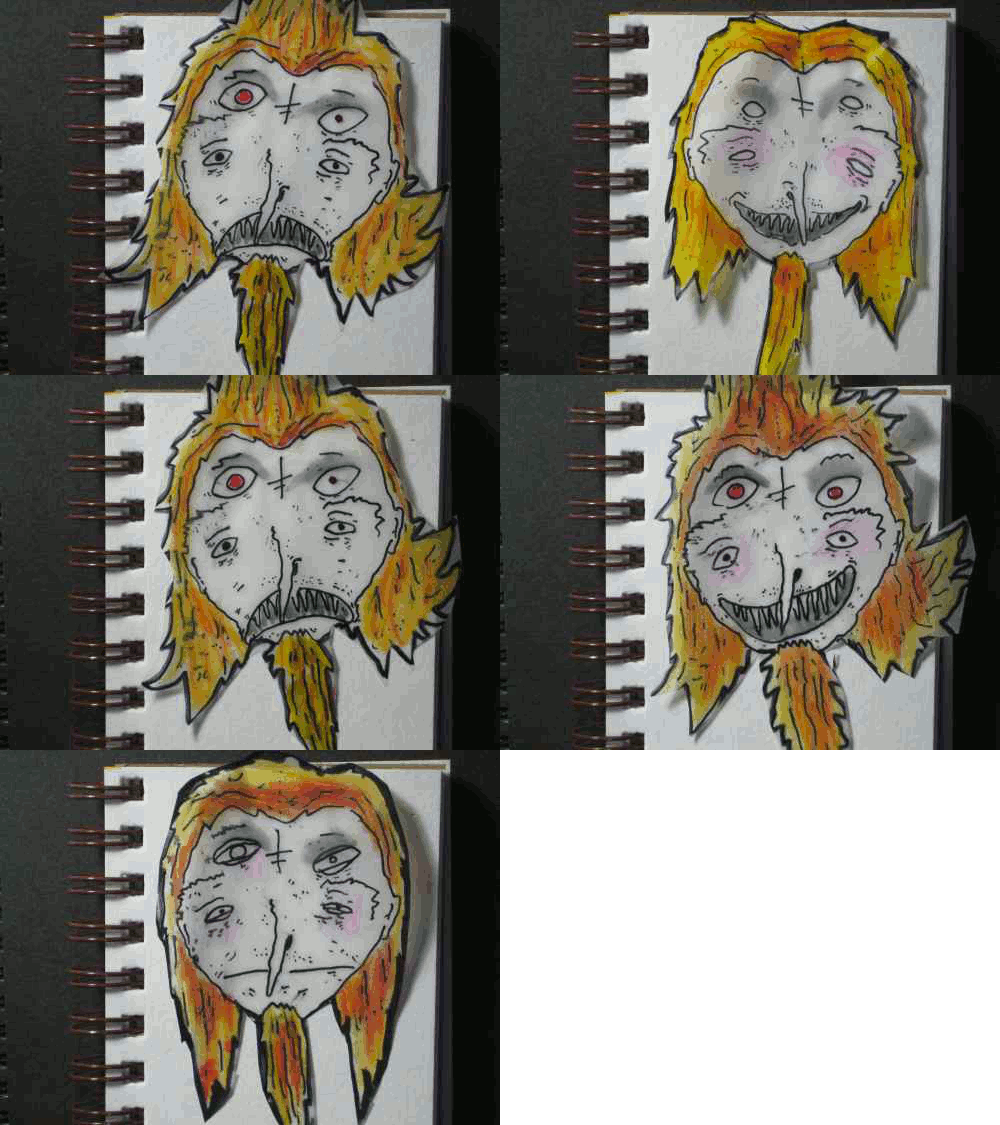
Truth and Reconciliation

Got a supremely annoying phone call from a former old friend.  I don’t know what the point of the call was, except to do the hideous dance one last time.  

In the course of an aggravating conversation he continually justified his unreliability, made oblique references to my over-sensitivity, laughed at one point when I was sputtering slightly to finish a point he’d interrupted a couple of times for shows of peevishness.  He was angry that I wouldn’t grant him it had been nervous laughter and not the passive aggressive enjoyment of a weak and angry person who had succeeded in making his antagonist mad.  How dare I presume he was being passive aggressive, how dare I not let him tell me why he was laughing while I was trying to control my anger!  

He told me I’d been vicious, in writing of his unreliability, characterizing it and him so uncharitably, no matter how hurt or angry I might have been.    “Sometimes writing can be much more vicious than speech,” he pointed out, “and the attempts to sublimate and refine the pain and anger are more damaging than just having out with it.  How hurtful do you suppose those things on the blahg were to me?”

I grant him the truth of that, as I grant him most things.  One thing I don’t grant is being shouted down when I am making a point.

“The first precondition of a meaningful apology is the recognition that the person apologizing has hurt the person he is apologizing to.  It is an acknowledgment of why the other person was hurt, a demonstration of empathy, followed by an admission that the behavior was wrong and some assurance of not repeating the hurtful behavior.   It’s like the truth and reconciliation commission in South Africa…”  suddenly I’m cut off by a loud voice.

“That was about murder and a system of brutality!  Nobody was killed or brutalized here!  You have this overblown tendency to make everything like that, everything is Hitler to you,” he thundered pre-emptively dismissing any point I may have been about to make.

I managed to finish my point anyway, though my lungs hurt by the time I was through, and not because I’d been shouting for more than a few seconds to break back in to finish my point.  

It is a funny thing about experiences that smell similar to the childhood abuse I experienced– I feel a certain burning in my lungs whenever I’m near it.

“If you won’t acknowledge how hurtful what you did was, intentionally or not, how important the thing you promised to help me with was to me, how many hours, literally days, elapsed before you even got back to me….”

“I called you seven and a half hours later, how is it my fault you never got that missed call?  Why didn’t you keep calling me when you didn’t hear back?  I had bronchitis!  You wrote vicious things about me on the blahg.  You…”

An imaginary friend winks, tilts his long necked beer bottle to me.

“You would have been much better off forgetting the Ahimsa shit for a minute and just calling this clown and saying what you had to say originally, when he started calling you a couple of days too late, and leaving wheedling voice mails, and calling your girl friend when he couldn’t get an immediate call back from you … it’s kind of funny that he kept referring to your ‘nine days of enraged silence’ toward him, that master of enraged silence.  I like when you counted off that it had actually been more like four or five days.  But you should have just said what you had to say, Dude, in as few words as originally would have sufficed.”

“We’re done.  You’re a cunt.  Been nice.”  

“Clean,” he said, and took a drink.

It’s true, that’s what this call amounted to anyway, with a residing pain in the lungs to show for my sad attempt to stay on the high road, give a stubborn former friend a chance to state his insufficient case for the hundredth time.

“You hanging up on me?  You’re going to fucking hang up on me now?  Hello?  hello?”  I can still hear the peevish fellow justifying himself, clucking about how vicious and unfair I am.  “After all, you’re not the only one with problems, I’m not the only one who doesn’t help you, your constant references to Hitler, no matter the context, are inapt, and what about…’bon voyage’?  ‘bon voyage’?  oh, nice…. hello, hello?”

Mania

Tired, very tired today after succeeding in the frustrating prolonged struggle to get the new website up and running.   That I did it all completely on my own is a source of some pride, though mainly the source of my exhaustion.    

An individual must be rugged, it turns out, if he or she is to work alone over a prolonged period toward a far off goal.

Now that I can embed videos on wehearyou.net directly (see Thanks and Animation pages), I am determined to replace them all.  Although there is an ether gremlin in the mix that causes two of the four to disappear, instead of playing, but only on the masked site…

Determination… hard to tell from mania today.screen cap ether gremlin

Listening

You have never really been listened to, granted.

I grant you everything.  I grant you the pain of never really ever having been listened to.  It is a primal pain, to feel that when you first spoke, until now, that you have rarely, if ever, been attentively listened to.   Dig it.  Many people, sadly, experience this in life.  It is a trauma that puts a heavy burden on the soul.

I knew a woman who said she loved me, acted very much like she did.   She did very loving things for me, was generous with her love.  I could tell she hurt when I hurt.  She gave me advice sometimes about my life, what she thought I should do to be in less pain.  She told me she was giving me the same advice she had found useful in her life.   When she was dispensing advice she told me she always talked to me the same way she spoke to herself.

I did not doubt this, even as I often resisted some of her advice.  One day, when she tried to insist, I said to her “but sometimes you have talked to yourself and convinced yourself the best thing to do was to put your head in the oven.”  She was quiet.  She had told me of these moments of weakness, the things she had done in desperate moments.  I wasn’t telling her this to make her feel bad, I was reminding her of the difference between us, and how we treat ourselves, to put her advice in perspective.  

“I remind you of this to illustrate as vividly as I can, so you will have no doubt — if someone tried to put my head in an oven I would fight them to the death.   I would never put my own head in an oven.”   Just saying.  She still offered advice from time to time, but I think this perspective stayed with her.

People who care about you will sometimes give you advice, with the best of intentions.  They tell you things meaning very much to help.   They may never have been really listened to themselves.  Many people were not.  They learned as best they could, filled their lives as best they could with the things they needed and never got in life.   They took whatever wisdom they were able to find and they try to share it with you out of concern.   Not all of these people can help you.  In fact, few can actually help you.  

Turns out the thing that probably helps the most is someone listening to you with enough care to hear what you are actually saying.  This kind of listening does not  assume it knows what you are about to say and does not respond to what it thinks you may have said, based on the past.  

Empathy turns out to be the best thing one person can give to another, the best thing we can give ourselves.  It is a question of attention– of asking questions when things are unclear, until you understand.  It is a question of time, being generous with your time to hear what the other person is really concerned about.  In my experience it is almost impossible for  a person who is niggardly with their time or attention to be a valuable friend or even a good person to talk to.

A sufficiently mature person can tolerate being ignored, forgotten, slighted, thought of last, if at all, and can make philosophical accommodations to all these things.  But when a person who claims to care for your well-being does these things, you must not tolerate it.  Care does not include these things.  

So, best to be direct.  I have told you as clearly as I can what hurts me in your actions.  I have told you again.  I have explained it on a third and fourth occasion.  I have given you every fair chance to do better.  You have not done better, you have done worse.  If you have not done worse on purpose, you did it because you were not capable of doing better.  You did not care enough.  I understand your limitations in friendship better than I did before.

You were not taught to care enough, nobody showed you how it should be done.  That is true for many people, no doubt.  It is the rare and blessed person who is shown the way to care for others.  Most of us have to learn it as we go, the best we can.

I am trying hard to be a man of peace, and I succeed more often now than before in my life.   I understand that self-hatred and confusion drive some people to act destructively, to themselves and others.  But understanding the reason for it does not give permission to anyone to act destructively.  Hitler had a horrible childhood, clearly.  But fuck Hitler.

We come in the end to the point where the only question remains:  hand open or hand closed when it bids you peace and go in good health?

excerpt from the transcript

“If you’re not insane why are you in this laughing academy?” she asked with a challenging smile.  

“I’m not in a laughing academy,” I said.  

“Ha!” she said.  This cracked her up.

“Nothing like a girl who appreciates her own wit,” I said.  “I’m glad you find this funny.”  My profession of gladness snapped her right out of it, the frown returned to her face.  

“This should cheer you up,” I said.  “A fragment of the transcript of my intake interview.  Listen to how it reads so naturally like someone speaking.”

She read:

And it was an object lesson to me about the power of apology. It was like, the feeling of hurt was dissipated instantly. And I felt much better friends with him because he empathized completely  with how hurtful what he did was and he, as quickly as possible, made it go away. 
 
I said earlier I believe in the power of apology and forgiveness and all that, and it was a sad trait in my family: my sister, my father,  my father’s first cousin, my grandmother, they had a very hard time forgiving.  And that’s kind of unforgivable to me.  I’ve seen 30, 40, 50 year grudges in my family and so that incident with my friend was really like a light going on in a room.
 
“Kind of unforgivable to you,” she said handing the paper back with the most deadpan of expressions.
]
]
]
]
Jheadfoureyes

Does the thought of anger make you mad?

Is the subject of anger so infuriating, threatening, hideous in itself that virtually any mention of it will, sooner or later, stop conversation?

Likewise, the subjects of apology, repentance, forgiveness.   Do these of necessity, except, among a small, select, wounded population, induce squeamishness and avoidance?

“May I play Devil’s Advocate?” she asks, and without waiting for so much as a nod says “Here’s another either/or.   Either your intensity, self-righteousness and over-sensitivity on any subject go beyond the boundaries most people consider decent, made worse by a relentless demand for response, stated or strongly implied, put people to silence, just to make it stop.  Or, if what you write is like… oh, never mind.”

What?

“You freak people out, and piss them off, when you… you know, when you act like yourself.”

Hmmmm.  Good to know.  I’ll try not to act like myself so much.

“That’s not what I mean,” she says.

Corporations are people, with feelings too, sniff, sniff, you judgmental, insensitive bastard.   Is that what you mean?

“I don’t know what you’re talking about,” she says.  “I mean that you might like to think you are not an angry person any more, that you have made great progress in that area, gained important insights you’ve had the courage and persistence to act on and are just currently frustrated, discouraged and trying not to wake up and smell the napalm, but that doesn’t mean….”

Hold it right there, girlfriend.  I was in the middle of a long discussion over the roles of genetic predisposition, nurture and  conscious effort to change innate personality traits one is unhappy with.  The correspondence reached a certain point and then abruptly stopped on the other end.  Silence as loud as the other person yelling “Silence! Enough!” [1]  

I stumbled on this line in my notes last night:  “the most insidious enemy of death benefits [taking positive lessons from the lives of even difficult departed loved ones–ed.] is the pervasive assumption that personality is fixed by midlife.” source

“Maybe your correspondent believes this pervasive assumption fervently, or hopelessly, as you might say, and has proven to his own satisfaction that struggling for any kind of positive personality change is futile and is just tired of your 2,000 word meditations, your opinionated self-regarding back and forth about the importance of doing things he feels are futile at best– particularly in light of your objectively depressing circumstances and lack of prospects for changing them any time soon.  Maybe he’s doing you the kindness of not telling you he finds these attempts to justify your life particularly distasteful.   Maybe he’s protecting you by not calling you on what bullshit virtually everything you say is.”

Dad?  Is that you, you rascal?

“You will find, son, when times get tough, that I am everywhere.  But let me assure you of this: you have made progress, and if I was still alive, still enlightened by the regrets I expressed on my death bed and my wishes to have lived differently, been, in fact, more like you, I’d be very proud of you.   Proud that you continue to believe in what you feel is right, in spite of the difficulty of it, despite the deliberate and inadvertent deafness of virtually everyone you encounter these days.”  

Must be easier for you these days, to say things like that, being a skeleton.  

“Oh, I can’t tell you how much easier it is, now that I’m just bones with dirt between my smiling jaws.”

[1]  Of course, another obvious reason for the gap in this particular case is the present lack of time required to thoughtfully reply in a life I know to be particularly emotionally complicated at this moment.   This goes as well for each of the other several cases where the subject of anger has been unveiled and then left to languish a bit.  –ed

Salient Point Left Out of Previous Post

I left an important detail out of the account I just posted.

The thing that left the whip marks on me was not recalling a difficult childhood and the sad details appurtenant to it.   Many have had it much worse than I did, than my sister did, or my parents, though each of us had it bad enough.  The siblings of three of my grandparents and their families, for example, thirteen years before I was born: I can’t think of a worse childhood than you and everyone you’ve ever known being massacred by organized gangs of drunken haters backed by a powerful occupying army whose commander is determined to wipe out every trace of your ancestors.

The whip marks I felt after yesterday’s session came a moment after I was asked if I had experienced any traumas.   At first I answered no, then I put my finger on an ongoing one, with roots in my earliest life, the moment that has always stopped me in my tracks:

when an angry bully, usually with an arbitrary hierarchic advantage of some kind, steps up and tells me to put my eyes to the ground.  

I recalled a few instances of this as an adult, how the rising feeling of unfairness, and powerless to do anything but fight, enflamed nerve endings seared repeatedly when I was a boy, how needy bullies have always had an easy time locating me in a crowded room.  I’m not hard to find, I’m the one who hasn’t learned to put my eyes to the ground at the key moment so someone else can take the blows.

“Your therapist can work with you on that,” the grad student told me sympathetically.

Getting to the Part That Hurts

During the first screening interview to get into the Cognitive Behavioral Therapy research study most of the yes/no questions seemed designed to rule out people with serious psychological handicaps.  These people had larger problems than waking up exhausted every day and would be no more useful to the study than the study would be to them.  Changing how they think about their life would not likely help them very much, if at all.  Trying to reason their way to more productive pursuits would probably only take them so far.

“Do you sometimes hear celebrities on TV talking directly to you, acknowledging your secret connection?”  

“Do you feel that, as soon as you leave a room, everyone heaves a sigh of relief and begins unloading about what a complete jerk you are?”  

“Do the commands you get when wearing your tin foil hat seem more reasonable to you than the ones you get from the neighbor’s dog?”

“Do you believe that Dick Cheney would kill thousands of people to get what he wants?”  (a few were trick questions, I noticed)

This interview was at times a little tedious, but there was nothing unpleasant or challenging about it.  After the session I spent about 20 minutes filling out a written questionnaire with many of the same questions, or questions of their ilk.  

“Do you believe a health insurance industry insider and lobbyist was deliberately placed in charge of drafting the Patient Protection and Affordable Care Act to ensure that no violence would be done to the fabulous profitability of that industry by those with ‘noble’ ideals about human dignity?”  

I was also given a longer form to take home and fill out with questions about people who had influenced me, family dynamics growing up, the death of loved ones, traumas I may have experienced, my happiest moments, most significant events at various times of my life, what my main goals in seeking treatment are.  

The second interview was free-ranging and surprisingly enjoyable.  It was like an interview on a talk show conducted by an open-minded host who was intent on showcasing what I could do.  There were a few laughs along the way and the time felt very much like the time I spend writing here– following my thoughts where they go, retracing my steps to make a connection, clarifying something, adding an aside, noting that the aside was not strictly relevant perhaps, a laugh line, pause for ironic irony, back to a serious point, etc.

At the end of that interview I was asked to tell ten stories, five minutes or less each, about ten specific incidents in my life.  In the end, probably because I had told so many little stories in the course of the previous hour, the interviewer was satisfied with five or so stories.  Since all of these sessions are videotaped, I called afterwards to find out if I could have a copy of the interconnected stories.  They seemed to put my life and moral progress in a certain nutshell.

The stories are being kindly transcribed for me now by an assistant who works at the research study.  I was told by Conan they’d make the narrative skeleton of a novella with excellent bone structure.   He told me so the other night, transmitting the thought directly to me from my neighbor’s TV.  

I emerged from that second interview feeling like a wholly integrated person whose life made a certain organic sense.  Having the good fortune to be able to dedicate myself to a worthwhile but unlikely plan that could potentially shine a little light into a dark and angry world, having designed it based on insights gained from the often painful events of my life, seemed like a great blessing, in spite of the difficulty of struggling alone to do the impossible.  I’d work on reframing my daily struggles, get some help moving forward and, y’allah.

I had a call to say I was good to go for the therapy, they’d be charging me the low end of the sliding scale ($20 less than my co-pay for limited treatment under Obamacare, plus no $1,750 out-of-pocket), that the therapist would contact me (she did) and that the third interview would take place at such and such a time (yesterday at 3).  This was all good news, since I’d been pursuing a study like this since early December and yesterday was March 4th.

Then, yesterday, the third interview.  “How are you?” the young graduate student asked with a smile.  I nodded and said “OK” with only the faintest note of cautiousness in my voice.  I noticed, even then, that I didn’t do the polite thing and ask the same of her.  What harm could the meaningless pleasantry have done?   Asking how she was would have been a decent bit of human reciprocity  requiring perhaps two seconds to do.  I thought about that afterward, not sure if there was deeper meaning to assign to my failure to do the social thing.  I decided it wasn’t worth thinking about too much, that I hadn’t been there for polite chat, after all.

Her pleasant greeting soon took on a different cast as she began to probe with the final set of questions.  “You’re going to feel a little stick,” she might have said as she paused with the oversized needle only partially hidden.  The questions seemed innocent enough, but they were boring down into the answers, each ten words or so filled in on small blanks (do not use extra paper), that I’d provided on the questionnaire I’d done at home after the first session.   She was working from what looked like a typed and annotated transcript of my answers.

This is the beginning of the hard part, I realized at some point during that hour.   These are not softball questions teed up to me while a buzzed studio audience laughs and enjoys the show.  They’d set the speed on the pitching machine to ‘high’ and these pitches were being thrown with purpose.  A few came in right under my chin.  “Provide five adjectives to describe your relationship to your mother.”  The fifth of these, I recall, was ‘complicated’.  My arms were too tired to take a better hack at that fifth one.  

Then I had to describe why I’d chosen each adjective.  Complicated, and the thing that connected all the moving parts was the pain behind each adjective.   My mother’s limitations, the sorrows she’d lived with, the humiliations she’d undergone, all overshadowing her talents, work ethic, great intelligence and sense of humor.  My childhood had been lived on a battlefield, surrounded by mine fields and beyond them barbed wire and dark, muddy trenches, and my only escape was into the world of my imagination.  That world held hope and terror in almost equal proportion.  I felt by the end of the session as though I’d made almost no progress from that imagined world of hope and nightmare that was my foundation in life.  It seemed to me I live there still, in that war zone.   The insights I’d gained?  Butterflies of the imagination losing color and substance as I tried to remember them.

We were done in exactly one hour, the shortest time the exercise could be done in.  I told the young woman that I’d take 41 more seconds to show her something, she was agreeable.  A moment before I left the room a shuddering nine year-old wondering why the world remained such an evil place I handed her the iPad and she watched this, which elicited a few chuckles from her as she watched.  She asked if I’d seen the Lego movie, I hadn’t.  I gave her a wehearyou.net Idea Book, which she accepted gracefully (she’d admired Sekhnet’s label at the end of the previous session when I’d made a note in my own worn Idea Book).  I put my coat on as I thanked her and said goodbye over my shoulder turning toward the lobby while she went into the office in the opposite direction.  I didn’t pause or turn to make final eye contact with her.  

What’s up with that running out of there like a whipped dog, I thought a moment later, feeling a bit like a whipped dog.  I continued feeling that way as I walked the streets near the original school where I’d gotten the program up and running.  I was aware of a strong desire not to run into anyone I knew from that school.  “How you doing?” they’d ask.  “Good!” I’d say, wincing out a smile and turning slightly to avoid showing the whip marks on my dog back.

The hard part is why few people succeed at doing things that are hard.   There are many things leading up to the hard part that most people can do well enough.   Then comes the hard part and, as George Dubya Bush said, with visible peevishness, about good people in his administration who had botched the rescue of poverty-stricken hurricane victims  (the wealthier ones did OK, thank God), the delivery of democracy to Iraq and anything else they touched, “it’s hard work!”  

“Which of your parents were you closer to?”  And, in spite of the complicatedness of the relationship, I had no hesitation choosing my mother.  “My father was a total asshole,” I said by way of summary, like a petulant eight year-old,  before clarifying, rephrasing, reminding us both that considering where he came from, the unimaginably painful abuse he’d suffered as a young kid, and all through his childhood, he deserved to have it clarified– yes, he was a verbally violent man, but, as I’ve described, it’s more complicated than that, and I don’t say asshole in a dismissively judgmental way.  

I thought afterwards of my friend quickly walking back his understandable frustration with the demanding mother who was driving him crazy during his annual visit to her.  He began talking about how manipulative she is, caught himself and began to talk about what a basically good person she is, how lonely she is, how much she loves him.

The hard work of that third interview left me feeling my wounds for the next couple of hours.  I realized, walking away, that there would be no more getting-to-know-you sessions in the green room, no more canned laughs.  If this therapy was going to help me move myself and this program forward, the hard work would be beginning toot sweet (comme un dit).

I thought of the Temptations, Cloud Nine – “The childhood part of my life wasn’t very pretty, I was born and raised in the slums of the city.”  My identification with those born and raised in the slums of the city is something I can’t shake.   My disconnection from those who lead comfortable lives and accept the inevitability of slums, the viciousness of the cycles of inherited poverty and inherited wealth, the routinized murder of children the New York Times refers to as “collateral damage”, the ongoing evil of wars fought only to make the rich richer, a status quo that accepts as an externality of corporate wealth that the vast majority of the world, and the earth itself, will suffer whatever is necessary to maximize profits… all these things in the category of things I cannot change and that I ask an indifferent, or wholly absent, God to grant me the serenity to know I must simply bear…  

“You’re getting yourself worked up, calm yourself.  Why do you do this to yourself?” 

Who the fuck are you?  The hard part, in a word, is anger.  We have a damned good right to it sometimes, yes.  Now what are we going to do with it?

How It Made Me Feel Today

Hitting the “publish” button here completes the illusion of instant connection to everybody, and I can see from the world map on my wordpress stats page that someone in Taiwan read my latest post, two people in India clicked by, or one person there, twice.  I can see when my friend in Poland has had a chance to visit and I nod, anticipating  the intelligent comment my note will sometimes inspire.  When I saw I’d had a visitor from Yemen a few weeks ago I involuntarily pictured the face of that little Yemeni girl, confronted by the camera, after the rest of her family was blown apart by an American missile launched from a menacing American robot plane.   Hearts and minds, Brother O, way to go, sir.   But if we look at this phenomenon of maintaining a blahg for what it actually is, what causes the fingers to tap and one of them to press “publish” at the end, it’s hard to say what it actually is.  

Like everything in the world we have multiple explanations, theories, half-assed (or full-assed) opinions, proposed answers.   Each of these illuminates the matter from a slightly different angle, each contains some bit of truth, each convinces us a bit more or a little less according to our tastes.  In the case of why people post things to the internet, Occam’s Razor doesn’t quite cut it.

Zora Neale Hurston’s oldest human longing: making oneself known to another, strikes me as a huge reason people post things they create on the internet.   The impulse to connect with others in our increasingly connected, increasingly isolated culture is no doubt part of the heart of any complete explanation.  Sharing information, trying to unite with others, giving a take on news that seems vital to understanding but does not seem to get reported, except by the brilliant author of a book that sells well, wins an award, ignites a small discussion that is quickly spun into oblivion as the news media churns the cycle.   Celebrity culture and 24/7 media blaring and flashing in infinite forms makes almost everyone who partakes of it just a little bit thirsty for  Andy Warhol’s fifteen minutes of fabulousness.  In our narcissistic age, why not tell everybody how that makes us feel?   And we have the technology now, and talent or no talent is no longer such an important distinction, we say fuck the corporate gatekeepers.  Everyone is a star, no?  Or if not a star, everyone is someone with something to say. Or with nothing to say, but a cool place to say it and WTF, LOL, ROTFLMAO.  My new boobs are nice, admit it.

I try to write well, and I write about things that get to me one way or another.   That puts me in the same boat with millions of other bloggers.   Democracy at work, yo.  “What is it you want from people?” my sister once asked me pointedly during a calm period in an argument that would soon turn ugly.   I told her I want a conversation, a back and forth where people speak openly about things they care about.  Ideally it’s like a catch, throwing the thing gently back and forth.  They listen carefully to each other, interrupt only for clarification and respond intelligently to what the other person is trying to communicate.  

My sister and I grew up in a war zone and my answer wearied her considerably at the time.   She and I have good talks these days, but back then my answer really annoyed her.   It seemed so much to want, I think, like someone insisting on clean water to drink every time they are thirsty in a land where people are keeling over from dehydration all around.  We had little experience of respectful conversation as kids, though both of our parents were otherwise quite intelligent.  Being funny was something we were used to, and my sister has a quick wit, as did the rest of the war party around our dinner table.  

“A joke is the epitaph on the tombstone of a feeling,” said a dime store philosopher named Nietzsche.  True dat, Fredrich, as was “without music, life would be a mistake”, which goes without saying, and really, except for its indisputable truth, has no place here.   

I am not one to be coy about my feelings or opinions here, or anywhere, really, but this post is going to be a bit more personal than usual because it’s about how something made me feel about my own life today.  I was surprised at how acutely I felt it, under my skin, in my blood and cells.  

Which, by way of semi-amusing digression, calls to mind this email I had blind cc’d to me recently from a guy I was friends with years back, a great improviser on trumpet who really listened, as all great improvisers must, a brilliant photographer, a man of many talents:

Probably one of the most “in-depth” interviews I ever have given to anyone.

Talking about my photography, my movie documentary work, but also about aspects of my personal life and experiences I never shared with anyone before, not even my close friends.
Possibly an interesting read, especially if you are, like me, here in NYC, stuck indoors due to bad weather !
He provided a link, and a recent photo of himself looking darkly pensive, and the charming rascal signed it Much Love, which gave me a dry little chuckle.   I sent this email on to a few others who had known this chap, likely with a cynical comment in the subject line I couldn’t quite resist.  Epitaph on the tombstone, you know.  None of us were going to click on that shit, though we all enjoyed the Much Love.
Having set the table a little too fastidiously, and with that last digression, my strength to continue with what I intended to write tonight drains away.  I will be back at it again soon, because this experience today, at the final of three pre-interviews before I begin what I like to think of as my ECT, was not like the first two, which I enjoyed, and it brought up some deeper things than I was expecting, beginning with the inexperienced nurse smiling and greeting me, a little too solicitously,  “how are you today?  Uhm, you’re not squeamish about the sight of your own viscera, right?”
I was surprised at how prudish my readiness to be nauseated actually turned out to be.

Would I?

I recently found a large painting in acrylic of a nude young woman reclining, succulent.   She is painted from feet to head, casting a dramatic shadow to her left.  The style is right on the border of realistic and cartoon and I was glad I’d found it.   I hung it on the wall in my cracked bedroom where I can glance at it from my pillow (which led me to notice and regret that the two nicely rendered feet are of glaringly different sizes).  It was done from a drawing I remember making of her, on a piece of brown corrugated paper highlighted with a white china marker and gouache, the drawing being much better than the painting.
 
The girl in the picture, rendered as three dimensionally as I was able, was twenty or so at the time. The painter was thirty.   The painter had been reassured by a mutual acquaintance, when hesitating momentarily to ask the girl out, that she was uncommonly mature and that he was uncommonly immature and so the age difference should not be that big a deal.
 
I did not regret anything about the affair, except that it ended somewhat badly a year later.  She went on to marry a guy, a young executive type, who sounded like a self-important dick, a hugely ambitious baby, a narcissistic mama’s boy.  They moved to a city one would never think of voluntarily moving to, the corporation had promoted him and assigned him there.  I did not hear from her for years after that, which came as no surprise.   In that city she gave birth to their daughter and, in fairly short order, he revealed himself, in a way that became increasingly impossible to endure, as an ever more self-important dick, a hugely ambitious baby, a narcissistic mama’s boy and, also, an impressively complete asshole.
 
During the painful divorce negotiations she called me regularly and I spoke to her calmly.   She greatly appreciated these conversations and I didn’t mind having them.  Truthfully, painful conversations are one of the few times you get the real person instead of the veneer.  I would rather speak with the real person than the veneer, so I’m not ruffled by the painful situation that brings the real person out.   That the pain is not directly my own is another plus and makes it easier for me to speak in a calming way.
 
One day she called during the day, usually she dialed me late at night, and came to her point rather directly “if I came to New York, would you fuck me?”   Even typing these words now, years later, makes my eyes open a little wider.  I stumbled for a few seconds looking for the right way to say there were few things I’d rather do but that I was in a monogamous relationship with a person I loved, that she was putting me in a tight spot with the question, that at any other time…. and as I spoke I jotted the question; “if I came to New York, would you fuck me?” on a post-it to consider at my leisure, perhaps to write about ten or fifteen years later.

And in the usual course of things, the post-it remained in my pants pocket where I’d put it until it somehow found its way into my beloved’s hand on laundry day.  She asked about it, naturally, with a certain irked urgency and I was once again thrust into that uneasy tap dance the original query had caused me to tap out.

After her divorce, when things settled down for her, I stopped hearing from the girl, now in her late forties.  She contacted me about a year ago to tell me how great my program is and that she would be supporting it with a cash donation, but to my knowledge no donation was ever made. That was the last peep I had from her.

I think there is probably no point to have that painting of her at twenty, presenting herself like a birthday cake, hanging on the wall next to my bed, even if there is little chance of my beloved ever seeing it as she can’t stand the decrepitude of this apartment of mine and avoids it like the proverbial plague.

Which is not an unreasonable position to take.