Why I Brood, short version

Got to get this done in five minutes or less, finish the crucial work I can’t get to, be done with a series of invisible bones crosswise in my throat.

I spent my childhood often blamed for things I had no control over. Motives were ascribed that were not my motives.  I had to defend myself, at times, for things I hadn’t even done.   This was the work of my traumatized father, primarily, with the able assistance of my almost equally traumatized mother.  I am not complaining about this, merely stating how it was for my sister and me growing up.  My sister claims it was worse for me because I fought against it.  I don’t know if it was worse for me, I know it was bad enough for each of us.

Attempts to get the whole truth on the table: denied.   A child hasn’t all the tools to counter a determined and brilliant adult adversary in partnership with a loyal adult ally, also of great intelligence.  Over decades these tools can be acquired, along with a certain amount of insight, but it takes a lot of work and it can take a lifetime.

Fast forward 45 years or so.  Father on his deathbed says to his son, his lifelong adversary: you were right to feel betrayed and I was wrong to betray you.  I am so sorry I was such a brutal prick.  I am amazed that you seem able to forgive me.

The son says:  you did the best you could, I realize now that if you could have done better you would have.

The father (with a sigh):  I wish I’d been mature enough to have had this kind of talk with you fifteen years ago.  

Long pause.  

Now, if you will excuse me, son, I’d like you to help me die.  I have no idea how to do it.

“Nobody does, dad,” I told him.  

Ten minutes later I closed his dead eyes with two fingers of my right hand, then handed his oxygen tube back to the nurse who had silently come back into the room.

What Happens to Anger that is Swallowed?

Bad things happen when anger is swallowed but not digested.   Anger that is not acknowledged seeps out in ways that are famously bad for the health, the body, friendship, peace between individuals, groups and nations.  It is threatening and highly toxic, possibly the nastiest emotion humans have to deal with.   Anger that is swallowed fills us with a bitterness that banishes mercy and makes us capable of justifying any cruelty.  

Ask the guy who feels how viciously unfair I was to express how hurt I was by his failures to keep promises I depended on, and his subsequent inability to take responsibility.   And I didn’t even swallow my anger — I was like a cat determinedly hacking up an indigestible hair ball– and it took days, and it’s still not completely out of my craw.  Being treated unfairly is indigestible, and when done by a good friend who insists you are at fault for being over-sensitive, it can lead to an inner tumult that is hard to quiet.  

Hacking up the hair ball I did, in the form of words on this blahg setting out exactly why I’d felt so hurt, filled the meditator with rage, which he barked at me when I tried to leave the door open for a conversation between old friends.  His rage was justified, you see, because no matter what he may or may not have accidentally done to me, I had no right to be deliberately mean to him in return.  I had betrayed him by not being content with his repeated assurances of friendship and instead making an unfair public accounting of his disappointing shortcomings, things he already hates himself for.  Anger always justifies itself.

I open this hideous and uncomfortable subject not to give useless advice or even insight, just to point out one popular way unprocessed anger seeps into the world.  This provocative technique is done passively, “innocently”, and I will illustrate its mechanism as clearly as I can.  It is either this exercise or finding a way not to snarl “what the fuck?!” at the sender of a recent email that rankled me by unconsciously employing this very technique.

My father had a colleague who became very close to the family when I was a boy.   My sister and I found this brilliant woman funny, and caring, and she seemed to relate to us as a peer.  She was like a very cool big sister to us.  My mother was very fond of her too. Then, seemingly out of the blue, my father was done with her, for reasons he was too disgusted to detail for his disappointed kids.  We never saw her again.

Years later my father and I spoke about what had happened to their close friendship.   “She is pathologically competitive,” my father said, his face very much like Clint Eastwood’s iconic mask of hatred when he is confronted by an on-screen enemy.  “She will fight to the death over everything and never gives an inch, especially when she’s wrong.   Her reflexive self-justification makes her impossible to deal with, even after years of therapy and supposed introspection, she still has no insight into how damaged and enraged she is.  She is always primed to fight and she fights even the smallest things to the death.  She’s one of the most maddening and provocative people I’ve ever met, and I finally just had enough, after a particular incident at a conference we did with Gladys Burleigh.”  That the same could be said for my father, minus the years of therapy, did not need to be spoken by me at the time.

My father had come to another breaking point with a good friend, part of the pattern of his life that troubled me greatly growing up.  It seemed to me he never gave these close friends a chance to make amends.  It took me decades to see that things sometimes advance beyond the point where amends are possible, much as it saddens me to see this.   When things become ugly enough between two people trust is torn and it can become almost impossible to make amends.  Anger puts each of them on the defensive, they become the worst versions of themselves and can justify their behavior down to the snarl.

Back to the point then, what happens to anger that is swallowed?  My father executed a sentence of death on this woman my sister, mother and I felt so close to.  He felt 100% justified.  Decades later I was talking to Sekhnet about how close I’d felt to this one time friend of my father’s and she urged me to look her up on the internet.   I found her easily.

We had a mutually delightful reunion by email which led to Sekhnet and me spending several days in her guest house in Santa Monica during a trip to California.  In her version of that conference my father had alluded to as the last straw, it was my father and Gladys who had set-up, sabotaged and betrayed her.  Unbelievable! she’d laughed, when I gave her my father’s version.

A great animal lover, she had a rescue dog, a lovely, skittish black lab, smaller than your average black lab– possibly still not full grown at the time.  She named the dog Boo!  Boo! was immediately very friendly with Sekhnet but seemed afraid of me.  Our host explained that Boo! had been abused by the man who owned her and that she was skittish around men.  By the end of our stay my cooing at Boo! to come over and not be afraid turned into “get off me, Boo!” as the affectionate dog would not leave me alone.

Had the story ended on this lovely note it would have been a wonderful tale of redemption.   My father had been wrong about many things, as he sadly admitted on his death bed, and his banishment of this wonderful woman was just another of them.  Except, the story did not end on this lovely note.   I have written about this at length elsewhere and it wearieth me too much at the moment to dig it all up, but I offer you the bones, which are hopefully illustrative enough to illuminate my point.

An unflinching advocate of social change when I knew her, a crusader for the underdog and righteous fighter for the oppressed, she had become, several decades later, a deeply conservative supporter of Dick Cheney, Sarah Palin, Rush Limbaugh, Dennis Prager, Glen Beck and a host of other characters that would have made her earlier self recoil.  She asked if I’d be willing to have a dialogue about politics, which she’d had a revelation about after 9/11, as a favor to her, since we had such excellent communication and all of her other liberal former friends had cut her off (and she had new ones who were, like her, political independents of the far right).  To my eternal regret, I agreed.

The correspondence did not go well.  She and I found no common ground, and worse, for me, whether she had a coherent answer or not (and I eventually tried to reduce our Bush era correspondence to two questions:  why Iraq?  How do you justify torture?) she was vehement.  She insisted she was right, whether her answers made sense or not.  All of the experts she believed in told her that if we did not rain death and torture on those who hate our freedom they’d literally be upon is in our beds, literally cutting our throats.  Besides, we never tortured anyone, she insisted, and we only water-boarded three people (which she didn’t consider torture, in any case) and only because they desperately needed it and there was, presumably, a ticking time bomb and it was us or them.

A difference of opinion, we might say, and not something that should lead to the end of an otherwise wonderful friendship.  Our disagreements escalated.  My detailed emails were dismissed for their hopelessly misguided liberal bias, the larger points unanswered.   It soon became an exercise in masochism for me.  I eventually had enough.  We had a long falling out, I came to see her exactly as my father had described her– pathologically competitive, incapable of giving an inch of ground and irrationally spoiling for a fight.  

After years of silence I sent her a piece about Ahimsa that I’d written, she wrote back very moved, and grateful for the chance to renew a warm and mutually beneficial friendship.  She agreed 100% that we would no longer discuss politics, that it was a third rail we would not allow to electrocute our friendship again.

Except, even though she continually renewed her promise not to send political emails, darn it,  she could not resist once in a while (sometimes accidentally, she claimed) sending me something she really thought might change my mind.  She’d apologize most of the time when I reminded her I didn’t want provocative political emails and she promised each time not to do it again.   But she simply couldn’t help herself, darn it, sometimes a given piece was just too convincing for me not to be convinced by.

During all the turmoil over the deaths of unarmed black young men at the hands of police she sent me a piece that complained about how these same agitators who protest against the police conveniently ignore the hundreds of times more deaths black young men inflict on each other.  An opinionated and simplistic response I found not only irrelevant, but idiotic and inflammatory, and not even well-written.  A self-appointed American pundit compares killings by the police, sworn to serve and protect, with killings by violent criminal gangs, sworn to get rich or die trying?  This is your response to protests against police killings of unarmed civilians?  Really?

But, see, she couldn’t help it, you dig?  She was still earnestly trying to convince me she was right, get me to see the truth, get me on board with those who see the light, no matter how many times I’d expressed how these attempts make me feel.  I was so willing to have frank dialogue about so many things… why so closed minded about politics?

To me, there is only one explanation for this seeming irrationality that makes sense.  This is one thing that happens to anger that is swallowed whole:  it comes out as otherwise unexplainable tone deaf determination to be right that cannot consider the provocative effect it will have on the person it is directed to.  

The expression is very often directed at someone who had nothing to do with the original swallowed anger, which starts early in childhood, goes into a mass of general anger and creates the conditions for this kind of righteous moral tone-deafness.  And it’s “innocent”, you dig, and it conveniently becomes another proof that the person who gets upset over it is just an irrationally angry hot-head himself.  

The People rest.

Nice Hitler Mustache

I’d rather just have a small goatee, like an old hipster with a scruffy shadow on my chin.  I’ve never really liked mustaches, it’s just that the goatee without it makes me look like former Surgeon General C. Everett Coop, or an Amish man.  Sekhnet also said like a trout, I think, though it may have been a catfish.

So the mustache is a compromise to begin with.  I don’t like it bushy, like Stalin’s, don’t like it in my food, I don’t like the sides hanging down like a mocking Mexican bandit’s slit eyed mustache.  I blow my nose a lot, so I can’t have the mustache coming all the way up to my nostrils; I carve a horizontal snot channel into every mustache I’ve grown in recent years, to prevent nasal matter from landing in the mustache.  

I barely tolerate having a mustache, is the thing.  I think Django’s mustache is cool, so I model mine a little after his.  Sekhnet’s father always wore a trim, white mustache, and made it look natty, and he gave me some good tips on keeping it trimmed, so I do.  My godfather, Volbear, always had a close cropped mustache, the better to abrade the tender bellies of young cousins he’d hold upside down as they squealed.   Sekhnet likes to scratch various parts of her face with a short napped brush of a chin beard, and the cropped, trimmed mustache goes with this.

In trimming the mustache, to keep it as short as the beard, I sometimes inadvertently clip it a little too close on one side of my mouth, then I have to trim the other side to match.  It is only a matter of a few days until this grows in again, but sometimes, during that time, I see my friend Maya.

“Nice Hitler mustache,” says Maya pleasantly.  I used to try to explain how mine is more like Jimi’s mustache, how it doesn’t go all the way up to the bottom of the nostrils.  I always felt like showing her a picture of Hitler to show her how vastly different my mustache is from Hitler’s.  

On the other hand, she makes a good point.  I thank her, she smiles.    

She’s right, when you put it that way.  Why wear even the ghost of Hitler’s mustache?

The only trouble is, I trim my mustache much more often than I see Maya.  Have to start checking in with her more regularly.

Lest the tone of these posts tend to bring you down

I strive to make this blog more than a compendium of carping cavils, a cellar of acidic whines, a half-full glass of luke warm dysphagia with a dyspepsia chaser, despite an often robust appearance to the contrary.  

We all have our complaints, which sometimes must be shouldered out of the way before better things can come in to play.  Some of these posts are just grunts I put my shoulder into, to allow me to do something more productive.   Sometimes setting some galling absurdity into a few short paragraphs helps me move forward, though I am always happier when a post can help someone else move forward too, or allow some gentle, or even vicious, reader to pause and consider something from another perspective.  

It is a blessing to recall, when pressed, the blessing of all this; the gift of life.  The senses that sense, the limbs that work, the interactions with those we care about, the things we love to do.  Life is hard and grim, or easy and fascinating, partly depending on what we are undergoing and partly the result of our perspective.  

We learn now of a happiness gene, some people born genetically predisposed to feel good, be chipper and positive.  These types are apt to burst into song, because of the presence of a gene on their twisted coil of DNA.  We have long known of a predisposition to melancholia and other qualities that drag on the spirit.  A happiness gene, there’s a delightful fucking thought!  God bless the happy.

The narrative of a successful life is constant and pervasive: it is a busy life filled with tangible and regular achievement.   Hardly time to sit down in this tightly programmed life, let alone brood, and certainly not about problems well beyond your power to help solve.  On the other hand, those too busy to brood… I don’t know about them.  

Seems to me a person who doesn’t have time periodically to ponder things outside their own life is missing something.  On the other side, a person who has only time to ponder is clearly not doing enough with their life.

It’s possible that I have mastered nothing but the art of rationalization.  I have found the thing I most want to do with my life at this point:  be in a room full of kids who don’t have a chance and watch them excited about feeling like they have a chance.  Becoming a finger pointing to a world of creative possibilities.  

By the time these at-risk kids are grown up, if they make it to adulthood, water might be too expensive for them to afford anyway.  The oceans may have reclaimed cities everywhere, the world might be more like Mad Max than anything else.  The odds are clamorously against anyone who does not avail themselves of every advantage their life offers them.  The odds are always tilted against fairness and decency on any kind of large scale, particularly with a multiform mass media megaphone droning “fuck them!” 24/7.  Self-interest and the profit motive rule the world, Mr. Fucking Ahimsa-face.

“Slaughter sides!” screams the skinny kid on the team of losers, looking at the muscular, athletic giants chosen for the other side.

“Yeah, you got a problem with that, squirt?”  A game’s a game.  The game must be played, the hand dealt must be smelt.   

“The one who smelt it, dealt it.”  False, but at least it’s got a bouncy rhyme.

I’m rambling a bit here, and have to get back to my busy schedule, time is money and chop chop and all that rot, but take a few seconds to breathe one deep breath and let it out slowly.  

Seriously.  Take a moment and breathe, just once, deeply.

I’m doing it now. 

Nice.   Few things compare to that, my friend.  

Now, let’s take a quick look at some accidental, if minor, delight, provided by our friends in the world of professional sports.

While checking in on Tanaka’s and Scherzer’s pitchers’ duel yesterday, I noticed this, at the bottom of the box score.   I thought this was very nice of them, and a kindness you don’t often see in the macho world of sports:
Picture 3

Five Year Anniversary of my mother’s death

May 20th, 2010, was my mother’s 82nd birthday.  She was in a quiet room in Hospice by the Sea, fading fast.  Her angry, haggard, bitter upstairs neighbor slipped a card under the door that morning, wishing her a happy birthday and wishing her many more years of health and happiness.  I brought the card to the hospice and gave it to my sister.

“She’s nuts,” said my sister handing the card back to me next to the bed where our mother was asleep, the expression of death already on her face.  Toward the end of her birthday our mother slipped into a coma.  

A religious Jew my mother had long known, and fought with regularly, but with great affection, called to check in on her.  I told him she was in a coma.

“It’s the mark of a tzaddik (righteous person) to die on their birthday,” he told me.   A woman who didn’t believe in God, intensely disliked the often false piety of religious people, was dying as a tzaddik.   The thought gave me a smile, would have tickled my mother, perhaps.

I told the man that we’d decided to honor her wishes and have my mother’s body cremated.  He tried to talk me out of it, saying she’d want her skeleton to repose forever next to her husband’s in the plot reserved for her.   I told him she’d talked about her desire to be cremated several times over the years and recently expressed a terror of being buried and eaten by worms and insects.  I had assured her this wouldn’t happen.  He told me that Jewish law was against cremation, and so on.   To his credit, he didn’t insist beyond a few short arguments.  

When I mentioned that the cemetery where their burial plot was forbade burial of ashes (many Jewish cemeteries allow this practice) he said: “that doesn’t mean you can’t bury her ashes there” and described a stealth burial.   I liked him for that.

My mother, always somewhat stubborn, refused to die as a tzaddik.  She truly didn’t believe in that kind of thing.  She breathed through that last night, into the morning, and died today, one day after her birthday, five years ago.

I don’t recall feeling gloomy or somber on the previous anniversaries, perhaps I did.  But this one has got me a little bit glum, I have to say.

Happy Birthday, Mom.

So, in a nutshell

“I didn’t wind up painting yesterday,” she said, “but I looked at the colors and the brushes and I had a thought.”

“OK,” he said.  

“I realized what frustrated me so much the other day when you were probing about something that had made me angry.  I don’t mind the probing, but I object to the premise– ‘you believe you were wronged but there is another possibly equally valid side to the story and isn’t it possible that you are completely wrong, and in fact, the one who wronged the other person?'” she said.

“Not an unreasonable premise,” he said.  

“No, not unreasonable. Even something worth discussing.  Only there was one thing missing– you jumped to that premise without recognizing how hurt I was and that, possibly, I was entirely in the right to feel hurt.” she said.  “Even if I later realized I was wrong to be hurt, after reconsidering in light of your new insights, I was badly hurt at the time and you brought up something that was a painful experience for me. And brought it up with no expression of sympathy before trying to convince me I could have been wrong to feel the way I felt.”

“Yes,” he said, “but isn’t it equally possible that you were wrong?”

“Possible?  Yes, particularly if I was a thoughtless and emotional person who reacts to things impulsively.  Equally possible?  No, not even remotely equal.  If you heard my side of the story, which you did, and couldn’t admit you’d feel hurt too, which you eventually did allow, after an hour of batting back hypotheticals, you would have to recognize that I had good reasons to feel hurt.  You would have felt hurt too.  Might have acted much like I did, maybe better, maybe worse.  In the end, you might have convinced me to reconsider, but not if you didn’t at least acknowledge that I had a right to feel hurt.”  

“So this is all about you?” he asked.  

“Listen to me carefully: I am going to paint now,” she gave a wan smile and turned to head out into the garden.

“I will never have true peace with this person,” he thought hopelessly as she went.

Blues for Sammy Worst

two and a half years of mostly iPad images presented in a semi-snappy 3:49

Blues for Sammy 2

sorry, boys and girls, I had to take the link to the movie down.  Too much personal content up there for any unscrupulous content collector to collect and pass off as original.   I will put the soundtrack up for  music collectors to enjoy and for the more unscrupulous to claim as their own odd composition.

We take our laughs where we can get them

There was a woman, a very good looking young woman, actually, who had a small business running after-school programs and seemed to grasp the educational and group dynamics potential of the student-run animation workshop.   When I increased the price to about double what the first after-school program was paying, she barely hesitated before agreeing to pay it.   Her assistant was a great and supportive fan of the workshop, she urged me to organize the little mini-animation festival I put on for the kids and their parents.  One day a week or so before the festival the usually cheerful assistant came in and told me her boss had died the previous day.  Cancer she never revealed to anyone she worked with had ended her life at 34.  Her business winked out of existence a few months later.

Fast forward a few challenging months and, temporarily (or permanently) out of public school programming, I am conducting a four session workshop for women with chronic serious diseases.  Some are in recovery from cancer, others show up straight from chemo, some show up once and not again, others make half the sessions.  A core of four is there every week.  These first time animators all produced very cool animation, worked beautifully together, got more and more demanding about seeing the day’s rough cut before they left, high fived each other at the end.   One woman in particular, Liz, was a great innovator.  She came in with brilliant and ingeniously different ideas week after week.  Her animation for the four sessions is here. 

She was excited about assisting at the recent Stevenson workshop, the first I’ve done since last summer.  The day before the workshop she was hit by the flu and couldn’t make it, she expressed her sincere regrets.  I assured her there’d be more sessions, promised she’d be at the next one, whenever I could arrange it.  A few days later I sent her the clip from the Stevenson session, telling her how difficult it had been and that she hadn’t missed much fun.  I didn’t hear back.  I wrote again a few days later, telling her I hoped she was up and around and that I’d be sending her the new website soon.

When the website was done I sent her the link, since she had grasped the idea so well and run with the ball so enthusiastically, once she’d had her head down on the table for the first forty minutes or so of each session.  I emailed her once more after not hearing back, and was beginning to fear the worst for this talented woman I barely know.  I have gleaned that she is living with cancer, and that it is not easy living.

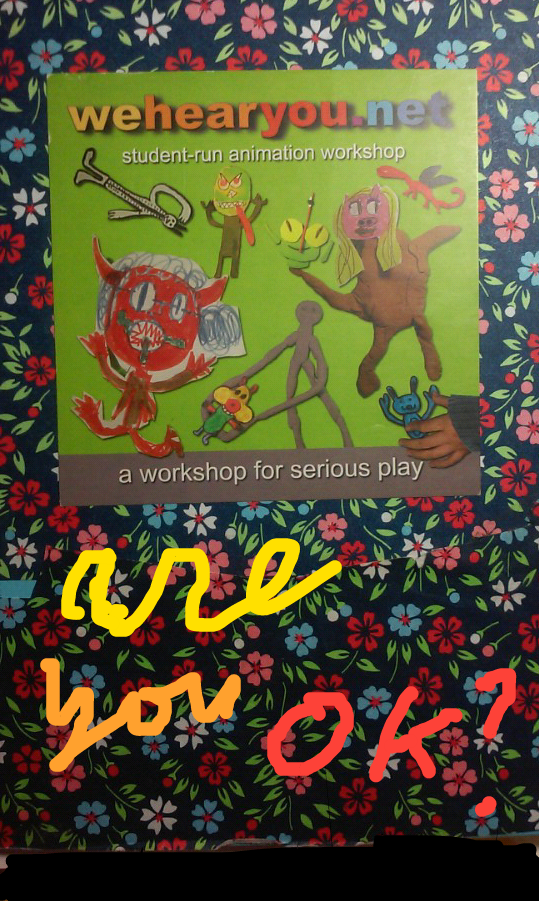
When I got a smart phone I texted her that I’d joined the 21st century, hoped she was over the flu and feeling better and added this picture.

Are You OK ?

Several days passed, and hearing nothing from her, I imagined the worst.  A gloomy thought twisted its way into my head: this workshop is the accursed kiss of death to the rare women who really get its potential and find it compelling.  

Then tonight, at 1:35 a.m. a tiny bell in my pocket sounds, and she’s texted:

Congratulations!  Sorry for the delayed reply.  I’m so so happy flowers are growing (emoticon of red flower) Rain makes it happen (yellow umbrella) Happy Spring!

I wrote back:

Thanks.  Good to hear from you — and happy Spring to you, too!

I hope you don’t have any objection to this wonderful bit of work being here (and I sent her the link)

3:42 a.m.  I’m glad you sent this.  I’m very upset and can’t sleep.  Seeing this animation was uplifting.  Thank you . … (emoticon of girl holding up hand)

3:45 a.m.  I’d share this on my Facebook (emoticon of two people holding hands) except one thing.  If it’s not too much bother, I’d like an edit…

Here I had an actual laugh.  A small one, yes, but genuine (nobody here to impress with a fake laugh) and, like I said up top, I’ll take me larfs where I can get ’em.

3:49  the part with the butterflies has the cat jumping in. (Cat head emoticon)  At one point its head changes to a dog.  That’s not my taste (slightly disgusted looking emoticon)

3:52  I’d post your page without hesitation if that part were eliminated (a series of emoticons animating a round yellow face bursting into a laugh)

3:55  Thanks for replacing maddening thoughts with delightful ones.

She made my day with that one.

4:08  I enjoyed Jesse’s project!  (gold star emoticon)  The patterns in the beginning are well done.  The tumbling guy has fun hair.  (emoticon of a thumb up)

4:14   I will try to sleep and think of (emoticon of rowboat, I think) being inside (angel fish emoticon) animation (some kind of water emoticon).  Thank you. (emoticon of little angel head with halo).

How exposure to adversity effects the developing child

I’ve known people, my mother was one, who although very intelligent, open to considering new ideas, otherwise insightful, would rather kill you than acknowledge their own anger or the harm that was done to them in childhood.   Literally, repressing enough pain that they looked like they’d rather kill you than admit to being angry enough to smash someone.  

“We never fucking killed anyone, asshole!” they say as a chorus now in my mind, I can see their faces, not relaxed, calm or even, in some cases, recognizable as themselves.  

“‘Face twisted and contorted in hate,'” my sister quotes our father, and we both laugh.  It was a phrase we heard many times over the Rice-a-roni, flank steak and salad at our formica dinner table in Queens.  It was snarled, this peculiar phrase, and stated in exactly those words each time.  A very curious phrase to be repeated verbatim, if you think about it.

 “Twisted AND contorted,” my sister will say, and we’ll both have another chuckle.  But we were not chuckling then, during those terrible battles, nor am I chuckling about it now.  

My sister, working in a terrible school, is afraid to apply to move to a better one.  “It’s a concentration camp but I’m used to it,” she says, “and I don’t want to leave all my friends I’ve cried with for years.”  She agrees it would be better to make new friends she could celebrate with sometimes, instead of just crying and commiserating, but, in spite of being a master teacher, and someone who makes friends easily, she’s afraid to change schools.

“I’ve told your sister a thousand times what a wonderful teacher she is,” said my father on his deathbed, “but no matter how many times I tell her, it makes no difference.”  

“A thousand times?” I ask him.  

“Many, many times,” he says, remembering distinctly the time he told her that, at the assembly at the school where her class performed, and another one, more than one, besides.  To him that was a lot.  “I told her a thousand times,” seems to indicate that.  

“A thousand times,” says my sister with her trademark irony.  Not for nothing did she dub her father the D.U., The Dreaded Unit.  

“You are a whiner,” says an observer.  

“Do you hear me actually whine?” I ask the jury.  On closer inspection I notice the jury is composed of a couple of weatherbeaten mannequins, a decomposing cadaver, three skeletons and a few unidentifiable animals preserved by amateurish taxidermy and propped crudely on the chairs of the jury box.

The judge, for his part, is indescribably horrible.  Good thing this is a jury trial, I think to myself.

NOTES

How does it work? Well, imagine you’re walking in the forest and you see a bear. Immediately, your hypothalamus sends a signal to your pituitary, which sends a signal to your adrenal gland that says, “Release stress hormones! Adrenaline! Cortisol!” And so your heart starts to pound, Your pupils dilate, your airways open up, and you are ready to either fight that bear or run from the bear. And that is wonderful if you’re in a forest and there’s a bear. (Laughter) But the problem is what happens when the bear comes home every night, and this system is activated over and over and over again, and it goes from being adaptive, or life-saving, to maladaptive, or health-damaging. Children are especially sensitive to this repeated stress activation, because their brains and bodies are just developing. High doses of adversity not only affect brain structure and function, they affect the developing immune system, developing hormonal systems, and even the way our DNA is read and transcribed.

Nadine Burke Harris, MD

source