Reminder: this too shall pass

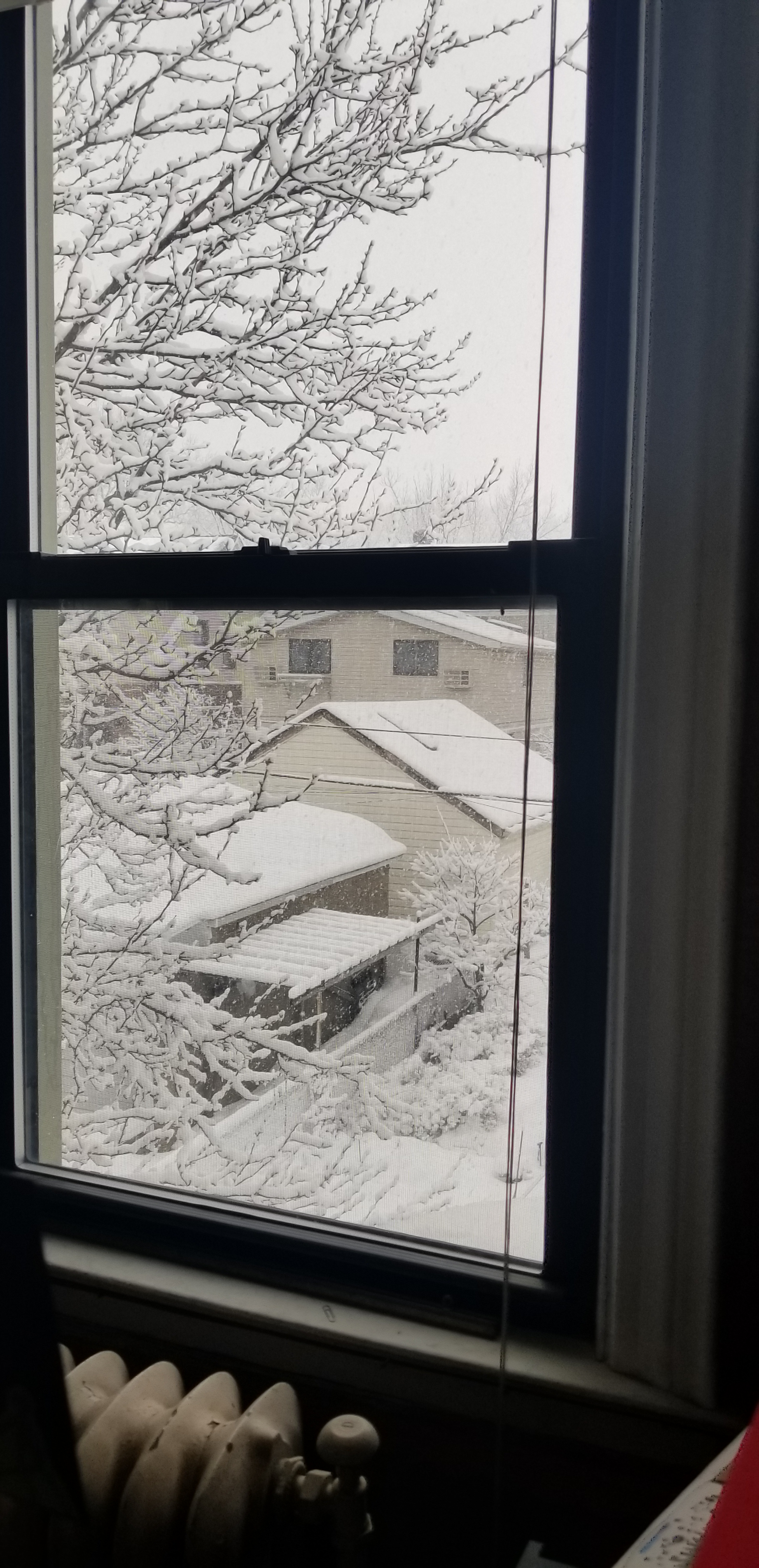
This is the view from my desk, out the window of the room where I am tapping out these words. Our bodies were just about recovered from the last strenuous session of countless lifts of shovels heaped with snow, a few days ago. Woke up a few days later to Groundhog’s Day, the movie. Got to say this for the snow, it’s beautiful this time. The last batch did not sit so perfectly on the branches of the trees.
It’s easy to forget, when you are faced with the forced lifting of something heavy, that this is not your life, or your fate. It’s a few hours, a day, a week, a month, a season. In the case of 2020, a year. In the case of the last four years, a few decades. Everything passes.

It’s easy to forget how odd and disorienting it is living through a deadly, airborne plague. It’s actually hard to remember once common things, like sitting in a room with a bunch of people you like but don’t see often, somebody cracking wise and everybody laughing. It used to happen all the time, the odds say it will happen again before too long.

It is not easy to remain philosophical during catastrophic times, though remaining philosophical is always a good thing to do. Yes, we are living in an age of worldwide insecurity, terror and rage — an age of terrible suffering on a massive scale. Yes, many millions around the world are freaking out, getting unreasonable, desperate, violent, authoritarian. The terror and rage is somewhat understandable, given the circumstances. This is a challenging epoch we are in, a bad patch, historically bad times. Unreasonableness has become the rule in many places. That doesn’t make it right, of course, but the reasons for it are pretty plain to see.

I usually chalk it up to the insatiable desire of a few entitled people, with the means and the power, to have, literally, everything. Pursuing this urge to have everything requires convincing millions that this arrangement — 1,000 for me, 1 for the rest of you suckers to share — is what nature intended. This convincing has never been easier to do than during this age of mass, instant “social media”. It may seem like a simplistic premise, but the unsatisfiable greed of those few in position to do either great good or terrible bad, explains much of the misery in the world.

I think of it like the old story of the fisherman’s wife and the magic fish, a parable about the inevitable misery that comes from an irrational, insatiable desire to have everything. A former girlfriend’s guru compared this unquenchable urge for ever more to a deer chasing a mirage of water as it dies of thirst.

The fisherman, a poor man, catches a remarkable looking fish. The fish speaks to him, telling him that if he shows mercy and throws him back that he will grant the poor fisherman any wish. The fisherman puts him back in the water, telling him this wish is too important to make by himself, that he must consult the wife. The fish tells him to go talk to his wife, promises to wait.

The fisherman talks to the wife, goes back to the fish. Tells the fish they want a beautiful house, with indoor plumbing and heat. The fish says fine and when the fisherman returns to the hovel there is a beautiful house, with indoor plumbing and heat. The fisherman and his wife celebrate.

Of course, it’s not long before the wife becomes dissatisfied with what now seems like a modest wish. “Go back to the fish,” she tells her husband.

When he returns it is drizzling. The fish agrees to turn the beautiful house into a magnificent castle. The fisherman returns to find the beautiful home is now a majestic castle.

It soon dawns on the wife that a castle without servants is not a very good deal. “Go back to the fish,” she says. Now it is raining hard as the fisherman conveys his wife’s request to the fish. The fish seems a little impatient but provides the servants.

You can see where this story is going, and where my analogy is going to go right after. Each request for more — soon it is power the wife wants, she needs to be a duchess, then a queen — is accompanied by worse and worse weather. In the end the fisherman is standing at the end of the dock in a raging hurricane, waves splashing around his legs, telling the fish sheepishly that his wife is no longer happy being the queen, she wants to be God. “Go back to your wife,” thunders the fish.

When the fisherman finally gets back home the wife is furious, dressed in her old rags in the original hovel.

We have people among us who are the fisherman’s insane fucking wife. Their voices are much louder, their breath much worse, than the rest of us. Depending on your prejudices you know who these people are. I am thinking of particular people, or corporate “persons,” owners of vast wealth who literally feel they are entitled to all the wealth in the world. This is a long discussion, perhaps, and this post, about remaining philosophical during challenging times, is not the place to make my case. If $100,000,000 is not enough to allow you to enjoy your life to the fullest, is $100,000,000,000 going to somehow help you in that regard? Just asking.

We have a certain amount of choice about certain things that torment us. We can exercise this choice to reduce the irrational urges we are all subject to sometimes. An undisciplined boy millionaire who craves respect and attention grows up to be a young adult “playboy” who brags in the media, like a comic book hero, about being the greatest winner in Gotham City. Then he needs to be at the top of the Forbes wealthiest list. Being rich and famous is not enough to fill his bottomless emptiness, of course. “Go back to the fucking fish, you fucking fucks,” he tells his lackeys. Being the president, of course, is not quite the same as being the king, or God. “Go back to the fucking fish, you worthless pieces of shit!” he thunders, as he sends a mob to decapitate the government he is about to lose control of.

It’s not just him, of course. There are a few thousand just like him. There’s a genius who makes $70,000,000,000 during a pandemic and tells his workers (and the independent contractors whose tips he steals) to suck it up and get back to work and if they don’t like the conditions — fuck off and die. There’s another guy who makes a similar bundle, stubbornly (and counter-factually) arguing that Americans are smart enough to decide for themselves whether one of the two major political parties is run by a cabal of Satan worshipping child raping cannibals. Just because millions of people hear this arguably extreme claim hundreds of times a day, on his platform, it is not, legally or morally, his concern. While literally billions of people live in desperate poverty, a shitload of the world’s wealth is in the hands of a fairly small group of super-wealthy guys who are unaccountable to anyone but the shareholders. We live in a hyper-competitive society that has only one true value — the bottom line.

People of good faith can argue both sides of this proposition about systemic unfairness, I guess. There is nothing inherently wrong, perhaps, with one person having more wealth than can be spent in a thousand lifetimes while millions of others live precarious lives, bundling ragged, hungry kids into their outdoor beds, while tens of thousands die deaths every year that could have been prevented, if only they could have seen a doctor, in the wealthiest nation in history. It is an abstract question of morality, perhaps, whether we just have to accept injustice as the way it is and has always been, no matter how vicious it sometimes is.

Those are arguments for another day. Discussions, really. If we are arguing about these general principles of fairness and mutual responsibility, the day is already lost. If Reason cannot guide us to be reasonable, it’s set and match. It may be set and match already, only time will tell, though the odds at the moment say that we won’t be meeting in a death camp (worst case scenario) but rather in a room full of people we like where someone will crack wise and we’ll all be laughing again (one of the better case scenarios).

To the extent you can, be of good cheer. Remember, this too shall pass. Here, it’s almost time to gear up and get to shoveling again, if only to dig out a couple of our feral cats trapped out back in this winter wonderland.

Letting Go of the Past

The idea that it’s necessary to let go of the painful past is very big in the self-help world. “It is never too late to have a happy childhood,” we are told, among other encouragements to let go of the bad things in the past and gratefully embrace the many beautiful things about our present lives. As a general principle, letting go, not constantly reliving the hurts we’ve experienced is healthy, essential to living our best lives and to protecting our loved ones. The devil, as always, is in the details of how we actually do this.

Letting go of hurts of the past is a theme I chew on frequently, having a decent amount in the past to let go of. I feel my daily connection to history, for better or worse, and my personal stories, funny and terrible, which support my view of the world. Seeing the value of these memories, I am reluctant to simply let the past go. I feel like there are lessons in these stories, endlessly repeated; learning we need to extract and digest to move forward. It’s important to view the past in its complexity, considering the terrible things beside the inspiring ones. My once-large family was massacred back in 1943, during dark times in Ukraine and Belarus; pruned down to a very small family that lives and prospers today in the USA and in Israel. Both things are equally true.

I think of this theme of letting the past go in personal terms every time I encounter how hard it has always been for me to accept the the loss of a longtime friend. I understand that certain estrangements are inevitable, and we can see them coming most of the time, but also, a world of associations and shared memories are irretrievably lost each time. Each loss of a longtime friend is a little rehearsal for death.

Although I know the reasons for it, it bothers me each time that I could not find a way to reconcile with a couple of old friends and fond acquaintances in recent years. You could say that our lives are the stories we have lived, have told ourselves are true. People come to different conclusions about what is most important in life. Sadly, sharp differences of opinion (accompanied by drifting apart, taking friendship for granted and fading empathy) can prove insurmountable obstacles to a mutually beneficial relationship.

This leads me to once again consider how personal the political actually is, (political views are based entirely on our personal feelings about the world around us), and how political the personal can be, for the same reason. I hope to work through this “letting go” idea concisely today.

There are at least two ways of letting go of things that hurt us, as true in personal life as in political life. We can forgive and forget, using love to move forward without the need to rehash everything that hurt us in detail. This is a kind of Christian forgiveness, turning the other cheek when we are struck, as Jesus, The Prince of Peace, advised his followers to do [1]. Another way to let things go is to separate ourselves from people who hurt us repeatedly. This second way involves making hard decisions about who is accountable for what and what, realistically, is likely to happen going forward if we simply forgive and forget. Once we have done this, it is easier to let go of that troubled part of the past, though, of course, it is not as simple as that.

The difficulty of letting go of strong feelings is most easily seen in the context of physical violence against us, which is often a criminal matter best dealt with by a court of law. If someone beats us to a pulp and then asks us to please let go of our anger against them for their mistake, are we required by any moral power in the universe to agree to this? In the case of violent physical assault, there is an understandable emotional limit to a human ability to “let go of the past,” no matter how compelling a general case there is to be made for the idea.

The advice to let go of the pain and forgive can preempt the idea that you have a right not to be violently assaulted by someone who then tells you to get over it. There is a process you have to go through, once you are victimized, to first live with your rightful feelings and then separate yourself from that feeling of helplessness in the face of torment.

When a MAGA mob ransacked the Capitol recently chanting “Hang Mike Pence! Hang Mike Pence!!!” elected officials went into hiding from rioters calling for the execution of one of Trump’s most loyal sidekicks for the crime of not overturning an election he was powerless to overturn. There were also calls to shoot Nancy Pelosi in the head. During the several hours of rioting (as federal troops were told to “stand down and stand by” as Mr. Trump watched it unfold on TV) NY Representative Alexandra Ocasio-Cortez wound up taking shelter in Katie Porter’s office where they barricaded furniture in front of the door to keep the lynch mob out. Ocasio-Cortez recently revealed that she had been a victim of sexual assault in the past. Imagine how extra “triggering” a shouting mob kicking at your door might be if you had been violently assaulted in the past.

As a general principle we might all agree that nobody should ever be placed in the situation of having to barricade themselves into a room to try to protect themselves from a violent lynch mob. We might all agree to that, I think (when I say “we”, obviously I’m not talking about members of the lynch mob and those very fine people who support the mob’s right to violent anger.)

Here is a seemingly subtle thing that seems irrefutable to me now, coming back to the personal. If someone in your life is unsympathetic to your situation once in a while you can (and should) indeed let it go, overlook it, be generous, write it off to their being preoccupied with their own problems. We can’t all be empathetic all the time. It is different, and a sign of trouble, if the person is repeatedly unsympathetic and also quickly turns to blaming you for any challenging situation you find yourself in. If this happens with any regularity you will find yourself in a destructive cul du sac of contentiously conflicting perspectives. In my experience this self-perpetuating conflict can often be irreconcilable, since each party is certain that they are being mistreated by the other. If you can make no progress toward getting the other person to see the harmfulness of their stance, it is time to hop out of that deadly dead end.

It matters little what the other person’s argument is against your feelings, particularly if the argument is aggressive, angry and unyielding. Once you see that the other person will never yield, won’t concede anything to your expressed feelings … it’s time to go. Someone who is capable of empathy, and self-reflection, and who really cares about you, will find a way around their need to be right, in the interest of making a lasting peace and ensuring a mutual future. Again, true friends are very rare, especially when times are toughest. You should try not to fight about things, most things are not worth it. Once the fight takes on an abusive feeling — time to go.

As in personal life, so it is in politics. We are being told that Trump’s refusal to accept the will of the voters, his insistence that, in spite of bipartisan agreement about the fair election, and all of his lost voter-suppression and voter-fraud lawsuits, he won in a “landslide”, his raging lies about a “stolen election” that led to a rampage that could have resulted in the deaths of dozens (“only five” died directly, two Capitol Police officers took their own lives shortly after– three more dead than BENGHAZI… hmm…) including the executions of Pence, Pelosi and others, is something to “get over”. In the name of unity and healing, you understand.

As in politics, so it is in personal life. If someone beats you up, then asks forgiveness, then beats you up again, then asks forgiveness — what is the proper response? An understandably human response is to mercilessly kick the shit out of him next time he raises his hand to you, if you have the power to do so. Another, much more practical, response is walking away from the person, not letting them within punching and kicking distance. In either scenario, you accept the hard truth that this person who claims to love you is a violently angry person who can’t help taking it out on you when he feels up against it all. In no case is it a healthy response to simply get over it, until it happens next time.

Countless spouses and mates stay in these kinds of abusive relationships, being profusely apologized to by someone who will, in time, beat the shit out of them again. People stay in these kind of abusive relationships for many reasons, mostly related to fear and a feeling of not really deserving any better from their mate. Every person who stays convinces themselves of the same thing: my mate loves me, it’s just understandable human weakness that leads to the abuse. “I would be a monster not to forgive, look at those tears… ”

We can, and should, healthily let go of many things from the past that trouble us. Awareness of abuse isn’t one of them. The only thing to learn to do about abuse is to recognize it when it arises (it is not always as obvious as a fist to the face) and take steps to get far away from the perpetrator when it persists. Being out of harm’s way is the first necessary step to letting it go. The rest, friends, is much trickier, but we will never get to it while still in the cycle of endlessly replenished anger.

[1]

How often this Christian turning of the other cheek is done in reality, and how effective it may be if one manages to do it, are separate questions. For one thing, responding to mistreatment with love presumes the presence of the Divine in the person who struck your cheek.

Don’t ask why I read this Appendix

After a long sermon, in Appendix II, about the importance of recognizing that all morality flows from biblical sources, the now defunct 1776 Commission offers Appendix III: Created Equal or Identity Politics? a solid John Birch Society analysis of what makes these despicable freaks demanding equality so goddamned repulsive and deserving of our scorn (to skip to their Conclusion, scroll to [1]):

In recent times, however, a new creed has arisen challenging the original one enshrined in the Declaration of Independence. This new creed, loosely defined as identity politics, has three key features.

First, the creed of identity politics defines and divides Americans in terms of collective social identities. According to this new creed, our racial and sexual identities are more important than our common status as individuals equally endowed with fundamental rights.


Second, the creed of identity politics ranks these different racial and social groups in terms of privilege and power, with disproportionate moral worth allotted to each. It divides Americans into two groups: oppressors and victims. The more a group is considered oppressed, the more its members have a moral claim upon the rest of society. As for their supposed oppressors, they must atone and even be punished in perpetuity for their sins and those of their ancestors.

Third, the creed of identity politics teaches that America itself is to blame for oppression. America’s
“electric cord” is not the creed of liberty and equality that connects citizens today to each other and to every generation of Americans past, present, and future. Rather, America’s “electric cord” is a heritage of oppression that the majority racial group inflicts upon minority groups, and identity politics is about assigning and absolving guilt for that oppression.

According to this new creed, Americans are not a people defined by their dedication to human equality, but a people defined by their perpetuation of racial and sexual oppression

You can, of course, put it much more simply and without the fancy, pejorative “ideological” label (or without hammering the word “creed” over and over, telltale tic, that). If it is self-evident that we are all created equal, if the Constitution has been amended to ensure the rights of citizenship to all former slaves and their issue, then equality among citizens is a goal as American as apple pie and belief in Jesus Christ Himself. It follows that people who are not treated equally even now are entitled to equality under law. So sorry if it makes you pompous oppressor fucks feel perpetually angry and guilty!

Look around at America right now– whose foot does this shoe fit on?

Identity politics, on the other hand, sees politics as the realm of permanent conflict and struggle among
racial, gender, and other groups, and no compromise between different groups is possible.
Rational deliberation and compromise only preserve the oppressive status quo. Instead, identity politics relies on humiliation, intimidation, and coercion. American self-government, where all citizens are equal before the law, is supplanted by a system where certain people use their group identity to get what they want.

humiliation, intimidation, and coercion

Nobody we know specializes in that shit.

Again, this hits me personally, from a lifetime of experience with people who insisted they loved me and claimed the right to angrily define me as they saw fit. If you have the good fortune to stand calmly beside their deathbed you might hear a last minute admission that they were wrong to call you a vicious, unfair, irrationally hurtful fuck. You may hear, as I did from my father, that the long war had not been your fault but their’s, though they uncompromisingly blamed you for all of it.

The 1776 Report was a long exercise in identity politics, from the lofty perspective of the noble knights of the Ku Klux Klan. Good riddance to Trump and the stinking Historical Revisionism Commission he commissioned (a Biden executive order dissolved the 1776 Commission).

[1]

Conclusion

Identity politics is fundamentally incompatible with the principle of equality enshrined in the Declaration of Independence.

Proponents of identity politics rearrange Americans by group identities, rank them by how much oppression they have experienced at the hands of the majority culture, and then sow division among them. While not as barbaric or dehumanizing, this new creed creates new hierarchies as unjust as the old hierarchies of the antebellum South, making a mockery of equality with an ever-changing scale of special privileges on the basis of racial and sexual identities. The very idea of equality under the law—of one nation sharing King’s “solid rock of brotherhood”—is not
possible and, according to this argument, probably not even desirable.

All Americans, and especially all educators, should understand identity politics for what it is: rejection of the principle of equality proclaimed in the Declaration of Independence. As a nation, we should oppose such efforts to divide us and reaffirm our common faith in the fundamental equal right of every individual to life, liberty, and the pursuit of happiness.

How to Never Heal

Pro tip: NEVER, EVER, ADMIT YOU WERE WRONG!

In a world where we all make mistakes, sometimes very hurtful ones, I’m glad to have a disposition that allows me to forgive people. That may sound funny coming from a man who felt he had to cast many old friends adrift over the years, but it’s true. All I need to be able to forgive is a sincere expression of regret when somebody I care about hurts me, their understanding of why I was upset and an assurance they will try hard not to act that way again. Reconciliation can’t happen without truth. If I won’t even acknowledge that I acted badly toward you, when you spell out exactly why you were hurt by my actions, repeated actions in many cases, what hope can you have about the comfort of our friendship going forward? Think about it.

How not to heal: refuse to hear what the other person is concerned with, no matter what, focus on your own counter-grievance, press it over and over. When they complain, tell them they are whining snowflakes, oversensitive, passive aggressive pussies. “I elbowed you in the Adam’s Apple for the fifth time this week — BY ACCIDENT, ASSHOLE, as I already fucking told you!” is an explanation that attempts to bully you into accepting your powerless in the relationship. “I’m not wrong, YOU ARE,” is an asshole’s first response most of the time.

People who are not comfortable apologizing will often “double down” in the sickening gambler’s phrase we all learned during Mr. Trump’s regime. Apology, admittedly, requires a moment of putting yourself in the other person’s shoes, recognizing that you too would feel hurt, followed by an act of humility — contritely asking forgiveness — that makes you vulnerable. Ironically, it takes a certain amount of strength and self-confidence to apologize, even when you know you’ve hurt someone.

Insecure people have a very hard time admitting they are ever wrong, especially when the result of their actions is set in front of them. By reflex they feel attacked, become defensive, counterattack. It is the only play of someone too insecure to acknowledge the possibility of being mistaken. We are living through a prime public example of what I am thinking about in interpersonal terms and it has us at the brink of being angry enough to actually begin murdering one another.

In the case of the many Republican politicians continuing to support the president (many by their silence) in his endlessly repeated lying claims of massive electoral fraud (he made the same claim when he narrowly “won” in 2016, millions of dead people voted then too), they are sticking to their stories [1].

That their story may make little or no sense, less important than having a story. As more and more terrible facts emerge, like sickening details of the violent riot incited by their leader, seen by everyone, the stupid cover-stories about the sudden need for unity, or Antifa, or Trump learning the first lesson of his life, become more and more ridiculous. They simply can’t stop now, not after their tireless, valiant campaign has finally brought us to to bring about this sickening, anti-democratic zero-sum political moment. Now even a violent riot by insurrectionists planned and fomented by the president can be … a… a teachable moment? — a step forward on the road together? They need a story. Any story is better than no story, wait, here we go.

To hold Trump accountable for planning and inciting a riot, inviting an angry mob to D.C. on January 6th to STOP THE STEAL!, sending the stirred up mob down to the Capitol while he instructed federal law enforcement to stand down, in hopes of seeing Mike Pence (so disappointing!!) swinging from the gallows and the heads of his other enemies on pikes (“Hi Nancy, hi Chuck!! Hi, Shifty Schiff! who’s laughing now?”), would– eh, DIVIDE THE COUNTRY! That’s it — yeah, Democrat traitors, look who’s trying to divide the country now, shameless partisan hypocrite zealots!! We’re trying to heal here, you libtard commie fucktards, and you’re… so… goddamn mean and hypocritical — and vindictive! Admit you’d do the exactly the same thing if you had the election stolen from you, or even claimed repeatedly and falsely that it was stolen from you!

As I watch this heart-sickening theater, personal feelings are being vigorously stirred. Two friends from childhood did exactly this move in recent years. One simply by refusing to admit that his reflex to make me angry had anything to do with him, the other by telling me he had no idea why I was upset with him, repeatedly asking for an explanation for why I was so hurt and then attacking me for explaining it in such a brutal way. In short, two smart people incapable of great insight into themselves, unable to behave any better than they did and angry at being unfairly expected to. Each now has the consolation of knowing that I was finally the cruelly self-righteous, heartlessly unforgiving asshole who put an end to a long, beautiful friendship. I don’t begrudge them, it’s all they’ve got.

I was telling a friend recently that I’d truly have no problem forgiving either of them, if they would only own up to what they’d done, and kept doing, that was so hurtful to me, promised to try to do better. If the first guy had a breakthrough in psychoanalysis and called to tell me he realized that he was actually, unconsciously, often trying to provoke me to rage and was sorry about it, I’d be playing guitar with him the next day. The second guy is a slightly harder case, because although he initially thanked me for my mildness in stating my grievance without accusation the first couple of times, he remained specifically unapologetic (he claimed to have no understanding of why, exactly, I’d been so upset) and non-responsive, repeatedly telling me I still hadn’t made myself clear, pushing me for clarification, and then blaming me for clarifying things, which was very hurtful and made him feel terrible! A more complicated kind of asshole than the first guy, still, I’d be glad to forgive him, if he contacted me with even a soupçon of insight into how his actions, and his constant doubling down, had finally aggravated me beyond endurance.

Politics is personal, its roots go back into our formative childhoods. Social scientists have run tests to determine the basic personality types of the typical liberal and the typical conservative. Here’s a test. Take these traits and assign them to one side of the political spectrum or the other: obedience, loyalty, harsh punishment, self-sufficiency, individualism. If you said “liberal” you pass the test. How about these: fairness, reconciliation, mutual help, community. If you picked “conservative”– how right you are!

We embrace the worldview that comports with our upbringing, or sometimes rebel against it hard, like Stephen Miller (whose family, survivors of Hitler, is anti-fascist). If dad taught you that the Bible said “spare the rod, spoil the child” and took every opportunity to not spare the rod, well, you are more likely to have a certain view of the righteousness of harsh punishment and retribution. If mom instilled a conviction that food should be shared equally by everyone at the table, that no-one should ever go hungry, or get less than somebody else, there’s a different fundamental lesson about what is truly important in life.

I knew the families of these two guys I grew up with quite well. The home life of the first was an endless exercise in restraining and repressing very understandable anger. The mother, a woman of great charm and intelligence, is a compulsive (though often harmless) liar and something of a manipulator. The father, an equally charming person, was treated like a rebellious child in their home, and acted chastened much of the time. This daily humiliation was disguised as a deep love that nobody could deny. The second kid was raised by an openly autocratic father and a narcissistic mother who worshipped his uncompromising dad without question. My friends had little chance to learn any life lessons at home but what they did. Both of these boys, as men, endured rough marriages that ended in ugly divorces.

You can understand these unfortunate backstories and, still, it doesn’t sit right (my home life was as bad or worse in many ways), in a world where we can work to gain more insight and change things about our lives that torment us the most.

I am prone to anger, and it is my daily work to get better at not succumbing to it, work I consciously do. One thing I’ve learned is that when you cannot solve an interpersonal problem with someone, it is crucial to simply walk away. That applies in the moment you are getting mad as well as longterm, of your decision to stay in an aggravating arrangement with little emotional counterbalance. To conclude that proneness to anger is simply my nature, and there is nothing I can do about it, would be an abdication of any moral responsibility or agency on my part. What they used to call a “cop out” in the sixties — it’s not me, man, it’s undeniable, immutable genetic-social necessity!

To return to my personal examples of the problem of making peace with people who have lost the ability to see things from your point of view: the first guy will endlessly deny his anger and his unconscious provocations, make it everybody else’s problem that they are so angry all the time — a stance that is, frankly, infuriating. The second guy will do pretty much the same, actually, though in a much more sophisticated way. They will both be right, eternally. And so be it.

It is beyond our powers to change any of that, least of all in someone else, particularly a person who sincerely believes we can really not do anything differently, or better, than we’ve always done. It reminds us of the role our native dispositions play in our outlook, I guess, and whether you’ve had the luck to have at least one parent love you unconditionally.

Back to “politics”, the sword hanging over all of our heads. As the US nears 375,000 dead of the pandemic, it’s clear that the president, who has snapped that he has no responsibility for it, doesn’t care. He cares about overturning a rigged election he has produced zero proof was in any way improper. He clearly DOESN’T CARE IF YOU DIE and he’s not going to address taking reasonable steps to prevent the wild spread of COVID-19, in fact, he’ll weaponize disease prevention itself and insist on super-spreader events like that mask-free tour de force of domestic terrorism he hosted last week then inflicted on the Capitol.

The plain fact that the leader of the wealthiest nation in the world, whose infection and death rates are 5X higher, by population (4% of world population, 20% of infections) than anywhere else, clearly doesn’t care about stopping the spread of this deadly plague, by itself, should be a compelling argument for removing him under the 25th Amendment. It’s depraved, if not outright insane.

Oops, there I go again, angrily dividing this poor, ravaged country!

Back to the promise of the title: How to Never Heal. Focus on a grievance and being the victim. Nurture those painful feelings, no matter what.

In the case of aggrieved Trump followers, let’s take one major strand of their belief system — that the unreasonable, pushy demands of America’s coloreds endlessly claiming racism in America are a crock of crap. Here’s what you do, Trumpie, hit back with history. FACT: the ones who were slaves, the black ones, were freed more than 150 years ago. Fucking get over it! You people are fucking animals, look at you! That’s why we had a phalanx of National Guardsmen in full anti-riot gear guarding the steps of the Lincoln Memorial as you passed by in your protest march — because you are insane, violent savages who will never be satisfied no matter how many rights we give you and you would have attacked even the sacred statue of Abraham Lincoln, the best friend you ever had until LBJ, if given the chance. Nothing will be enough for you, until we are your slaves. Now get out of our way so we can go hang Mike Fucking Pence.

There you go, it is as easy as that. If you are determined to be right, even with a grievous self-inflicted wound, even if it means being a moronic, self-deluding puppet screaming against your own best interests, it is very simple to do. Take the three easy steps again: focus on a grievance, nurture it, justify it, no matter what; repeat as necessary. You can thank me later.

On the other hand, if you want to heal, for some reason, there are a few necessary steps. You have to be honest. You need to honestly discuss the things in the past that have led to the harmful situation we find ourselves in now. You have to acknowledge terrible things that happened (beyond a nonchalant “we uh tortured some folks”, if you know what I mean) and commit to fixing them. You have to listen carefully, be open to all proposals for improving things, if you want to have real reconciliation. If you want to correct injustice you have to first look at it fairly, listen to the voices of those who are being hurt by it, remove from the conversation those who are intent on perpetuating unjust practices.

If you want to be right, of course, just blame the pitiful losers for wanting to be victims when YOU ARE ACTUALLY THEIR VICTIM! You know what I’m saying?

USA! USA!!!!

[1]

The New York Times, channeling The Onion (America’s Finest News Source), reported on its front page earlier today (they removed the headline in the last hour, during updates, so I paraphrase:) Supreme Court Declines to Fast-track Trump Election Case. I was too slow to click on it while it was up, and it can’t be easily found (searching “Supreme Court” on the buggy NYT phone app doesn’t do it) but, seriously– WHAT THE FUCK? What fucking Trump election case?

better shot

In the underlying letter I complain to my nephew about Louis DeJoy, too busy sucking his own ass to deliver the hand-written letter I sent the young artist weeks ago, lost for good, it appears (after more than three weeks), irretrievable as the millions of undelivered Trump ballots that resulted in such pain and violence, disappeared as if by angry mouth-breathing Anti-maskers, into the mist of crude Nazi fog machines.

One from the vault (Sensitive Dog)

One from the Random Acts of Senseless Creativity files. After I thought about this track an hour ago I went looking for it, a journey through a labyrinth of old emails and various digital booby-traps. After a few small wrestling matches with the technology, I was able to place it here, where it can be found easily next time. I was happy to locate it and I’m glad to pass it on.

The underlying track for this is called Dog on a String, composed and performed by Paul Greenstein sometime after the turn of the twenty-first century, if memory serves. This was an improvisation I recorded, back on April 14, 2006, apparently. All parts were played for the love of making the track and for that reason alone.

For me this over-the-top jam captures the thrill of interactive invention — the joy of improvising over a groove you’re really digging.

Our ability to find joy and improvise has been sorely tested in the isolation of this COVID crisis. Mutual, playful improvisation, a vital part of human interaction, a free delight of life, fades during dark times, the habit of playing happily — another casualty of the pandemic. Playing together gives us joy, undeniable but easy to forget, sometimes. This track reminds me of how much fun play is.

Paul’s track was a delight, I greatly love that mysterious, soulful Indian singer, all of Paul’s parts are superb (if several lovely ones were drowned out by the overloud distorted guitar, sorry about that). It is also beautifully engineered, everything is exactly where you want it to be in the mix and the EQ. I’ll ask Paul for the original track, so I can post that beauty for you to hear.

Listening to this track I hear my excitement, the enthusiastic variations inspired by the sheer fun of following a wildly idiosyncratic groove.

Sensitive Dog starts with a dog lover’s question for Cesar Milan, who then considers the best way to interact with a dog who is very sensitive. Odd to say, I couldn’t tell you what key it’s in, I had no idea when I was playing it, most unusual for me, I followed the singer as best I could.

There are suboptimal notes, which I can’t begrudge someone inventing parts over a track he is greatly loving as he plays. If you don’t let yourself be distracted by the mistakes and take in the entire 1:56 as a piece, I think you’ll get what I’m talking about.

My only regret is the mix. If someone had been sitting at the controls (there were no controls, the overdub was recorded off the small amp that was also playing Dog on A String) and adjusting the volume on the distorted guitar, to allow Dog on A String’s many subtle nuances to be appreciated, the track would be infinitely better.

To me, the track is still cool, instant time-travel to a moment of great fun. A reminder of a vital thing, sadly easy to forget during dark days — the joy of carefree play with someone you enjoy. I hope you find it so too.

What are we doing today, baby?

As universally hated Lyin’ Ted Cruz and now eleven other brave Republican Trump supporters in the Senate (the most highly placed members of the Sedition Caucus) call for an emergency special commission to immediately audit undisputed votes in an election certified in every state (and recounted a few times in several) that only Trump the Kraken insists was rigged, stolen, corrupt, fraudulent, a lie, a big fat complete Communist con job, #StoptheSteal! I wonder “what am I going to write about today?”

I certainly ain’t writing about Lyin’ Ted, the despicable guy with the unsexy wife, whose father killed JFK and whose ancestors, people are saying, nailed up Jesus. Fuck him and his vile, seditious crew (note, this may be the first time the wildly unpopular Cruz is the leader of any crew, way to go Ted).

I’m also not going to mention the provision of the National Defense Authorization Act, vetoed by Trump in the first Trump veto overrode by the Senate (never too late to do the right thing, I suppose), that makes it criminal for federal law enforcement agents to cover their name tags while performing their duties or otherwise operating as unmarked, unaccountable thugs [1]. Who’d have thought such a measure was needed in our nation of law?

This was likely one provision of the military budget bill that outraged the easily angered Trump — if former Attorney General Barr says it’s perfectly legal and reasonable to use chemical irritants, batons and a horseback charge by mounted federal law enforcement, with covered name tags, to break up peaceful protests (Washington D.C.) or to have heavily armed, generically uniformed goon squads jump out of unmarked rented vans and grab dangerous anarchist, God-hating protesters off the streets, force them into unmarked vehicles, without identifying themselves as law enforcement (as federal agents did in Portland) who is the goddamned Congress to usurp the massive powers conferred by Article Two?  Fuck that noise, everyone knows Trump wishes he’d been a real dictator, instead of a Twitter dictator. Today is Sunday, a day of rest.

So, like, what do you want to talk about?

Is this an example of you talking to yourself?

Hah, no, it’s an example of you talking to yourself.

You got me there, comrade.

You’ve been noted, around the house, because, during this tyrannical COVID lockdown you no longer live alone in your apartment where passersby in the hall and in the airshaft have no inkling you’re not muttering to somebody else, that you are, in fact, carrying out grunted conversations with yourself…

Nay, that would be YOO, muchacho.

Hah, OK, you got me there! Anyway, she mentioned these grunts I seem to make as being pretty regular, constant, apparently. From the other room she hears the conversational-sounding grunts, she says.

Hmmm, we always imagined that these internal conversations were in your head, my head, our heads.

Well, that’s imagination for ya!

By the way, I admired your restraint above in not mentioning fucking Acting head Homeland Security stooge Chad Wolf, declaring that unrestricted federal military force was necessary in Portland because violent anarchist terrorists were out of control (he used the term “violent anarchists” 60 times in a short speech when he got to Portland), including those hundred or more bitches, the mothers of these violent anarchists, who came out to form a peaceful barrier between unmarked assault-attired federal officers and their fellow citizens. And, you know, got gassed, the wall of mothers.

OK, OK, calm down. “‘No reason to get excited,’ the thief he kindly spoke.”

Yeah, I suppose that’s true. Good to have you here to calm me down sometimes.

Yes, yes indeed, and I wouldn’t have it any other way.

Neither would I. By the way, it was determined by the government office that determines these things that fucking Chad Wolf had been in the “acting” role longer than was legal and that his authority was now being exercised contrary to American law.

Look, you know better than most people, when you’re dealing with childish, irrational assholes with authority accountable only to somebody exactly like them, you just have to cut them infinite slack.

I know, I know…

So?

Fuckface likes “acting” loyalists in charge of everything. “I like ‘acting’,” he said nonchalantly, with his characteristic frankness. They don’t have to be vetted or confirmed, their lack of credentials for the job is immaterial, they are accountable only to his moods, can be used as needed and discarded like the disposable toilet paper they are, you can fire them at will and nobody will even care!

Basta, bastardo!

Right! I did cook a nice variation on Divya Alter’s delicious mixed vegetables in cashew curry sauce an hour so so ago. Came out really delicious, creamy, with a nice mushroom accent.

Let’s not talk about that, you ruined lunch, you heartless fuck.

OK, well, anyway, it was nice talking to you, as always, I have to get on with some random creative pursuit now.

There seems no way to stop it these days.

True dat.

Have a nice day, man.

You too, bubba! Nice talking to ya.

[1]

OK, obviously not “criminal” but Congress stated that federal authorities must “visibly display” their name tags when operating in public. Clearly there is a great deal of play in the word “must”.

Reservoir of Rage

The Age of Reason was an age of optimism, unfounded in many ways, as an insightful psychiatrist named Frank Yeomans observed. We like to believe that we “wise apes” act based on the intelligent use of actual knowledge — the wisdom gained through experience. We also like to believe that Death will never actually come for us. Look at any newspaper for a glimpse into the role of Reason in our world today and compare its effect to the workings of terror and anger.

In these days of increased isolation caused by this raging pandemic I sometimes find myself thinking back to a series of lost friendships, looking for a common denominator. The common trait in every friendship of mine that went to shit, I can easily see now, is rage — anger and disappointment that wound up being mutual. Good luck reasoning with that force of nature.

My friend Mark, one of the first close friends I finally had to cast over the side, was frequently in an agitated depression but if you pointed out that he was angry, as shown by the harshness of his judgments of himself and others, he’d hotly deny it, quickly become enraged. I am prone to expressing my anger when it flashes, a trait I’m not proud of, but my anger is often there to be seen by others when I am hurt.

Most people do not readily display this unseemly emotion, carefully covering the embarrassing lack of control it reveals. It doesn’t mean they don’t get angry, of course, they just don’t readily express it most of the time. I’ve done better, recently, sometimes, not reacting with anger when something irks me beyond endurance, but the strong reflex is always there.

What I’ve learned, at great expense, is the value of breathing and keeping quiet when the impulse to say something cruel is strong. Quickly apologizing is also a necessity after angrily expressing harshness toward someone, I’ve found, not that it will always be the healing balm it is intended to be. One or two sincere apologies will often be accepted, and I quickly accept the sincere apologies of others, but once the need to apologize becomes a pattern, it indicates something deeper and, well, good luck to you and your friendship.

My father, a man prone to outbursts of anger, always insisted that we cannot change our fundamental nature, our reflex to act a certain way. He’d point to babies born with an easygoing nature, placid and easily contented from day one, and others, like me, that fussed all the time, rarely satisfied, defiant from the day they first focused their eyes to glare accusingly. There is a certain amount of truth in this, the over-the-top surrealism of the description of the second baby aside.

You can see the truth of this principle illustrated in every new litter of feral kittens. Some baby cats are bolder and more trusting than others, others more prone to flee, to bite, to cower. This behavior was not learned, they were born with a certain predilection, a fundamental nature that will not change that much. The reflex to be petted or to cower will always be there to a certain extent, no matter how much they may learn about the tender intentions of the people who take care of them.

A friend of mine cheerfully reported on an article she’d read about the discovery of a suspected “happiness gene”, a bit of DNA that predisposes one to optimism and contentment. She looked across the table with her sly smile and observed to her fellow happiness gene recipient, Sekhnet, that her husband and I sadly did not seem to have much of this gene. I told her to fuck her so-called fucking happiness gene. But the point is made again, we are born with certain traits that are then pounded into more or less permanent form by how we are treated while we are malleable little lumps of clay.

I think back to the list, now considerable, of former friends, people with whom I shared confidences and a love of badinage [1]. All affable, smart people, articulate, many quick with a witty comeback, most of them connoisseurs of dark humor. One other common factor I saw only too late: each had a deep reservoir of rage and an inability to forgive.

I understand the workings of the Repetition Compulsion, to some extent. Some of us are compelled to recast and repeat painful relationships, the dynamics of which we don’t understand, in an unconscious effort to have a better outcome. It’s called a compulsion because it is not something we choose, those of us who do this must do it. I saw it clearly in my old friend Mark’s life– he endlessly repeated variations on the identical three act drama: idealizing, being disappointed by, violent betrayal. Easy to see in someone else, if you are around long enough. In our own case, it’s hard to see if we’re behaving reasonably or out of some kind of compulsion.

So, take my case, say you were raised in a long war with your parents. Your father is angry just about every evening at the dinner table, raging, making ugly pronouncements, baleful predictions. Your mother, for the most part, indignantly takes your father’s side. Her mother once famously said of her, in Yiddish, “you stick to his ass like a wet rag!” Both parents, at the same time, are smart, avid readers, expressive, love to laugh, enjoy the old badinage, are connoisseurs of dark humor. When searching out friends to commiserate with about your often painful life at home, it is not surprising that you would always be attracted to people who had these fine, cherished qualities.

It may seem funny to write this, but witty repartee with friends, which used to mean so much to me, now means little. I like to laugh, of course, I’ll often toss off an absurd take on something ridiculous (the menu of such things is comically gigantic), but whether you are a wit or not means little to me these days. My friends are funny, sure, but that back and forth of smart rapid-fire commentary doesn’t seem to play a large role in my life these days. The release of humor, it seems to me, was necessary in those years to protect me from the painful darkness all around me. Now that I’ve emerged from the worst of that darkness (for the moment) that need for banter just seems funny, if you follow me.

What we want in a friend is a person who will give us the benefit of the doubt. If a friend snaps at us, they will immediately express their sorrow as soon as they calm down. The larger world does not operate this way, neither does nature. This good will is what separates our friends from everyone else. The loss of good will, the benefit of the doubt, the lost impulse to quickly overlook a friend’s bad moment, is painful. Once good will is gone it is almost never coming back.

When I go down the list of people I once shared intimacies with I see that despite variations in their personal styles, they were all capable of titanic anger (maybe everyone is, but each of these bastards sure was).

The more introverted, quiet ones were no less given to implacable fury than the more extroverted ones. In fact, the reservoirs of rage in those who rarely expressed any sort of displeasure was perhaps the deepest of all. Keeping that existentially threatening anger inside at all times means that when it finally explodes, it’s going to cause an avalanche, helpless villagers running in terror.

Then silence again, which in friendship is the deadliest and most final expression of eternal anger.

1]

[

Take Care of Yourself, friend

There are things you love to do. You should do them. When things are at their worst, at their scariest, when life on our planet is teetering on the brink of extinction, it is imperative to remember to cherish the things we love and to do them often.

The people we love too, of course, of course, we have to try extra hard to take good care of them. It is more important now than at other times to show them as much mercy and kindness as you have in your heart, and that goes for mercy and kindness toward yourself too in this terrifying, aggravating time. But what I am talking about now is doing the things that make us happiest, that restore us to ourselves. It is super important now to remember them, and do them often.

I love to play music. I am a good guitar player and a limited, though functional piano player. Few things I know compare to the pure joyful relaxation that takes over once the guitar is staying in tune (cold weather, and sudden changes in temperature, can really mess with the strings), the instrument is warm in your hands and the musical sounds emerge as beautifully as you can make them. Take a beat, if you like, swing another beat against it. It’s probably as close as I’ll ever come to taking off and soaring on thermals, or gliding a mile under a perfect ocean.

The words you are reading now, something else that gives me great pleasure to put together. Obviously, I spend time every day doing this. I am compelled, but, also, I love to do it.

Cooking a tasty, healthy meal, something I’ve always liked to do, has taken on more meaning to me during this lockdown as Sekhnet feels up against the daily horrors and it is a comfort to us both to share a fresh meal that is actually good for us. I am starting to love the whole process of making a pot or pan of something good.

Walking is something I’ve always liked to do. Now that I have arthritis in both knees, it has become a necessity for me to walk throughout the day, to avoid pain. An hour or two in nature, breathing in the trees, is always a beautiful thing. I love certain moments of my long daily walk. There is a time, after walking long enough, when the stiffness and soreness in my knees melts away. The pleasure of sitting on a bench after thirty minutes of purposefully striding along — I love it.

Odd to say, though I’ve always loved to draw, and make all kinds of marks on paper, have always carried a drawing book with me, and several of my favorite pens and pencils, I’ve done virtually no drawing or calligraphy during this pandemic nightmare.

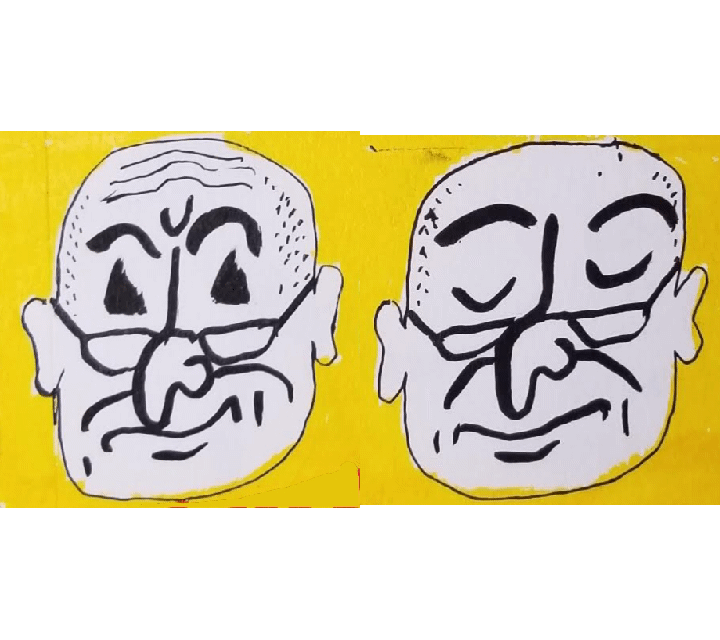
I showed a friend’s super-talented granddaughter how to do simple stop frame animation the other day. Under the mounted camera I drew a simple face and quickly showed her the principle of making animation out of two or more carefully registered drawings (or in this case, two stages of the same drawing).

I explained to her that you can later make the drawing as colorful or detailed as you like, photograph it and add the changes to the animation. (We were working outside in a park, so our art supplies were quite limited). At home afterwards I decided to refine the drawing above to demonstrate this idea to her. You will understand at once, I think, why I decided not to send her the drawing.

Who wants to look into those bizarre, hopeless, death-haunted eyes? Certainly not a sensitive seven year-old who is living through one of the worst periods in recent human history.

Shoot, maybe that’s why I’m not drawing these days. More than in anything else I do, my subconscious emerges most freely in drawings. I can play a stiff version of a beautiful tune on the piano, it’s not great music, but it doesn’t have even a hint of the terror in the face above. Perhaps I’ll try a bit of calligraphy later.

For now, do yourself a kindness. Think of something you love to do, maybe have forgotten about in your overwhelmed concern about the simultaneous and intrusive plagues that are upon us now, and do it. You will thank yourself afterwards, I’m pretty sure. Even if you don’t thank yourself (ingrate!) time is never wasted doing something you love to do.

groove for Plague Mice, collaboration with PG, 5-16-20 (with thanks to Jimi for the bassline)

Final Note on Estranged Friends

Note: the title of this piece is probably about as true as any of Mr. Trump’s assertions — this subject is one my thoughts inevitably return to from time to time [1]. Fascinating and terrible at once, it’s hard for me to keep from periodically chewing on the perplexing mystery of losing old friends. I will try to add a few thoughts to a piece I posted the other day called The Complex Difficulty of Human Affairs.

Zora Neale Hurston, toward the end of her 1937 masterpiece Their Eyes Were Watching God, wrote of two women sitting together under the night sky sharing that “oldest of human longings — self-revelation.” The desire to know and make yourself known to another in an authentic way ideally leads to acceptance — you will know all these things I share and give me similar things in return and neither will judge the other. It strikes me as a profound comfort human beings often seek in a world that is often indifferent, in a life that inevitably ends in death.

It is foolish, of course, to seek this profound connection in every relationship. Mutual self-revelation, on more than a minimal scale, is a rare thing. The good news is that good friendship can be based on many things, without any express self-revelation as such. We know each other by our deeds, our mutual willingness to help, our desire not to hurt. When you need my help, I’m there, when I need a hand, you won’t hesitate to lend one.

In thinking about the end of my long correspondence with Karl, a short, politely worded email about the impossibility of continuing our almost daily writing, I have to think about our very different expectations of life. Also, Karl as part of a troubling pattern over the course of the second half of my life — fatal estrangements. As a friend noted recently, finally putting these terminal friendships out of their misery helps me sleep at night. On the other hand, the mystery of why I’ve experienced so many of these fatalities remains. Is it not better to let friendships that have outlived their lives simply drift away?

It is a mild spring-like day outside, and an argument could be made I’d be better off vigorously exercising out there than rattling the keys here in a dim room overlooking Sekhnet’s garden. We each have our own way of doing what we need to do. I’ll take a long walk with Sekhnet when the sun is low in the sky.

I’ve written about my now deceased former friend Mark and his eternal three act tragedy. Mark, a man with high expectations, was compelled to relive the same excitement, deterioration, betrayal pattern in every relationship he ever had. It was easy for me to see, easy for anyone I mentioned it to to recognize, there were countless examples, stories with the identical dramatic arc. Mark had no insight into his need to idealize, criticize, alienate. He lived an unhappy life and died alone, probably of a broken heart, naked in his chair.

Looking at the many friendships I’ve had over the years, relationships that I no longer have, I must recognize the possibility that I am as blind to my role in their inevitable deaths as Mark was to his role in driving people he once loved away. After all, it is not one person who has angrily attacked me for being angry, or considered himself so intolerably provoked by me that he had to strike back hard, or felt the need to use deadly force to defend himself against a detailed list of “intolerable” offenses I insisted on “resolving”.

It could simply be that the many subtle ways I learned to infuriate my father during our hundreds of senseless fights to the death are something I cannot control. I believe, when I reach my breaking point with someone I’ve known for years, that I’m being logical, fair and humane, that I am presenting reasonable needs calmly; the recipient sees only a death ray. I do not discount the possibility that to them I show every aspect of a raging, over-sensitive asshole, though I also don’t accept that view as necessarily true.

I can also see that the people I wind up estranged from fit a certain personality type, not unlike my father on a fundamental level. They are people who will never back down when they feel cornered, no matter how gently one may have “cornered” them. This kind of casting is a feature of the Repetition Compulsion, placing others into the role of a primal trauma-inducer in an attempt to replay the psychological drama to a better outcome. It’s a game for suckers, that, a game we play unconsciously. I can also see, in hindsight, that over my life I’ve chosen many friends for their intelligence, wit and, often subtle, similarity to my combative father’s desperate zero-sum mentality. We both can’t be partially right and come to an understanding based on compromise of any kind — one of us has to die.

There is a small counterbalance to be had, looking at the subsequent lives of people I could no longer maintain friendships with. Raj and his wife finally divorced, his old friend I fell out with years ago (former husband of a woman I recall as Hitler) and Raj are no longer friends, Pavel told me I was by far his closest friend (before I unfairly accused him of insensitivity when he was only being cooly analytical about my vexing medical insurance situation) Karl lives an isolated life in Poland swallowing anger and serving a strong-willed second wife, etc.

I can look at each of these largely unhappy guys and think — we couldn’t help each other when we needed support the most. It happens. It is not the fault of anything but our respective human natures. The miracle is not that we finally went our separate ways, but that we were friends for so many years.

What expectation do I have of the world? To try to be patient listening to and honestly discussing the worries of my mate, without making her feel worse about things that already bother her. To have her listen to my troubles, without rushing to offer solutions before she’s heard the entire problem. To immediately make amends when I know I’ve hurt somebody. I have to admit, I eventually find these things, when they are missing, intolerable.

What expectations does Karl have of the world? I have no idea, but his worldview seem fundamentally more pessimistic than mine. Life is brutish, unfair, short, I suppose. In his case, it strikes me as a characteristically grim Protestant view of our duties to each other here on the earth. Impossible in the end, perhaps, for a humanistic Jew like me to fully grasp and appreciate, just as my outlook must seem absurd to him.

What expectations does someone who will only offer an apology when forced into it have? It seems they’d be unlikely to expect an apology if they were hurt — though perhaps they would expect it more than most. It is largely futile trying to imagine what is in the head and heart of somebody else, unless they work to reveal it to us. In most cases, the inner lives of others are a mystery.

As we can see all around us, people will construct whatever meaning they need to live as they see fit in our troubled world. A candidate they back can lose an election by more than six million votes and they can honestly insist he didn’t lose — the states that returned majorities against him were in on a conspiracy to steal the office from him. Proof or lack of proof do not come into strong convictions that will cause righteous armies to march — they feel the truth of it boiling in their blood.

So it is with people I’ve been close with, who, in several cases, I have had to behead in the end. They will believe, with the irrefutable proof that I wielded the sword that felled our friendship, that I am a vicious and unforgiving hypocrite who talks about not causing harm but who is as destructive as end-stage cancer. In my estimation, they were not capable of the kind of honesty that is a bottom line in my own life: if someone tells you they are hurt, hear them out before dismissing their complaint as the whining of a weak, corrupt, spoiled, hypocrite bastard.

On the other hand, and, of course, I may simply be a whining, weak, corrupt, spoiled, hypocrite bastard. Something like that is very hard to ever know for sure, no matter how certain we may feel in our bones.

[1]

A murdered darling I couldn’t totally delete, I’d originally added: as a dog returneth to his vomit.

Which is part of that great, largely meaningless, proverb:

כְּ֭כֶלֶב שָׁ֣ב עַל־קֵאֹ֑ו כְּ֝סִ֗יל שֹׁונֶ֥ה בְאִוַּלְתֹּֽו

As a dog returneth to his vomit, so is a fool who repeateth his folly.