Irv’s deathbed dilemma

This is becoming a terrible irony I can’t seem to overcome. I didn’t agree with my father about certain things, but this indigestible thing that he found so maddening I can’t seem to get past either. On his deathbed, when the subject of a family member came up, my father, Irv Widaen, was fixated on an insoluble vexation.

I tried, unsuccessfully, to lead him past it. This single issue seemed to blot out everything else about that family member. My father simply could not get over this one thing, he returned to it over and over. After a more than twenty year wrestling match with the issue, I find myself stopped by the same thing that confounded Irv.

It’s unfair, perhaps, to write anything about this here, but it is burning me daily so I’ll do a delicate dance to set out the dilemma in the abstract. I must describe it without revealing any of the many details that would cause shame. Try that one on sometime, it is a good workout.

This is the larger problem– when you are forbidden to speak of a dark thing there is no way toward the light. You might be totally reasonable seeking to put a troubling issue on the table, but those who feel their very souls will be jeopardized by disclosure will fight you, literally, to the death. Many find it infinitely better to pretend than to face a painful thing, especially if they believe people can’t change anyway.

My father was pessimistic in this regard, always arguing that while people might make superficial changes to their behavior, their innate, fundamental natures could never be changed. If you make strides in controlling a temper that has gotten you in trouble many times, you are only pretending you are not angry, each time you restrain yourself, but you are still prone to it in a way that others, born less angry, are not.

To me that position made little sense, since learning to control your temper is a great stride forward in life. Either you can work to improve something important or not. But many are as pessimistic as my father was about our emotional elasticity, our ability to learn from our painful mistakes and do better. That pessimism itself prevents growth, since the pessimist feels that growth is an illusion.

So, I cannot mention the thing that is eating at me, not here, certainly not with the people involved, not anywhere really. It’s like the “disappearance” of the bulk of my family, on my mother’s side, in August, 1943, all led to a ravine on the northwestern edge of town for a bullet in the back of the head in that sloping mass grave. On my father’s side, there is no clue how they were all murdered or what happened to their corpses, all we know is that every one of them was killed. It was always a subject too terrible to discuss. What would have been the point?

My grandfather, the sole survivor of his large family (recently I discovered a younger brother or a nephew who had an amazing, harrowing adventure escaping death over and over as a draftee in the Soviet Army– the reason he was not in town when its Jewish population was liquidated) liked violent movies, “shooting pictures” he called them, and lived a quiet life of fear and prejudice. My grandmother swung between great cheerfulness and despair, drinking sizable quantities of vodka along the way. She lost all six of her siblings, her parents, all but one aunt and uncle, everybody she’d ever loved back home, but never said a word about it.

Again, thinking about it now, what can anyone really have said about such an atrocity, the hideous details of which I only confirmed recently? Maybe they should have been in therapy or something, but I can understand how they never discussed this indigestible horror with their grandson. I get why my parents kept their silence.

The thing that tormented my father as he was dying, the thing that torments me now, is an ongoing situation that nobody is allowed to talk about. Since nobody is allowed to talk about this individual’s long pattern of shameful deception and abuse, done and hidden year after year after year, unrepentantly, the only alternative is to pretend none of it ever happened. We do this for the sake of a loved one, I suppose, not that this pretend really helps anyone.

The price we pay for doing this is participating in a lie — pretending these awful things, real betrayals that have changed lives, never actually happened. The price we pay for continuing to be perplexed by this is that we make ourselves dangerous enemies of those who want to leave others in the dark, out of shame.

I remember sighing when my father kept bringing this situation up as he was dying. I was hoping he had another message I could play back to our family member, who’d had a troubling relationship with Irv — as we all did. I hoped in vain, I could never play the little digital recording to the family member — it would not have helped anyone. Now, almost sixteen years later, I find myself behind the same immovable rock my father was pinned by as he lay dying.

I can say only a few more things about it. My father, by his harmful behavior and his outright emotional abuse, kind of made this outcome inevitable. There’s a fucking irony for you, one I couldn’t go into when I was trying to comfort the complicated man as he was dying. I could have made an irrefutable case of direct cause and effect, but what would have been the point when the guy was trying so hard to make amends, to go in peace, when that was truly all I wanted for him?

We have all met people so damaged that they insist on things that make absolutely no sense. We see national figures making such ridiculous, lying pronouncements in the media every day. Someone I knew told me a few years back that she loved me, and her family loved me, that they considered me part of the family, but that if I didn’t immediately forgive someone who would not yield in his insistence that his many provocations were figments of my easily angered imagination, that there would not be a second chance. Love us now or you’re dead to us all, she told me. And so I was dead, because people who loved me now saw that I was a totally unforgiving fucking asshole, no matter about any actual apology or show of contrition that would have allowed me to do the thing I wanted to do, forgive a childhood friend.

This is a very important piece, often overlooked in the widespread belief that all forgiveness is good and any failure to forgive is a fault– true forgiveness can only happen when the person who has done the damage is contrite, expresses an understanding of the hurtfulness of their acts, promises to try to do better. Without contrition and seeking forgiveness reconciliation is a brittle sham, waiting for the next offense to shatter it. Some are able to empathize and make amends, others reflexively vilify the unforgiving person they were unable to apologize to. I don’t understand this, but it always strikes me as an indication of severe damage when someone tells me they love me, but that they’ll kill me if I don’t let go of all hurt instantly.

These things go back to our upbringing. Some people are raised by emotionally mature parents and they get the benefit of a parent who is able to keep the child’s best interest front and center and not confuse their own needs with the need to show their child the right way to deal with life’s challenges. In my case, sadly, both of my parents, although very intelligent, decent, with good senses of humor, had survived brutal childhoods that left them emotionally unable to not react with frustration and rage at times when a much better reaction would have been silence, more thought, and a reasonable response that actually dealt with the issue in a way that taught the right lesson. It did not help me greatly when I first realized this about my parents, but it helps me now.

Again, pain and fear will stop us in our tracks. “Why didn’t my mother love me?” is a painful question. The answer is bad too: she did, as best she could, in her fucked up, damaged, damaging way. This is hard to understand, hard to make any good use of. The only thing that can lead to any kind of useful insight is understanding how they became this way, what happened to make them monsters. In the case of this family member, that kind of inquiry is strictly forbidden. To even pose the question makes you an enemy, since it presupposes that this person should change, should be able to make amends to the people he hurts. The false image of this person as emotionally whole, and good, and always loving, needs to be fostered at all costs. And maintaining that false image requires lying.

As I was writing the draft of my intended book about my father, I was careful to make no mention of this person, or the dramatic dynamic that illustrated a side of my father so clearly. I did not want to lose any members of my small family by divulging what I knew they kept secret (those who even knew of it) at all costs. We agree to disagree (an odious concept), simply don’t talk about it, everybody knows where everybody stands, it’s fucked up, possibly emotionally indefensible, intellectually dishonest, but it is what it is and no philosophical wiseass fuck insisting on the abstraction of “truth” and its great value in understanding our place in the world is going to make any difference. Forgive and love or, at least pretend to do those things, simply play along with the long con, or else you are the fucking problem, Jack.

I am the fucking problem, no doubt about it. Which leaves me in the same untenable position I often found myself in as a boy– you may be absolutely correct, you may be righteous, your position might even be mature and the most helpful one around– but you are the fucking problem, you sick bastard. In the case of my troubled, damaged parents, I was able to finally come to a helpful understanding. This one, man, it’s just sodomizing me around the clock and trying to make me swear it’s doing nothing of the fucking kind, a demand such things typically make of us.

A Thousand Cuts

The dermatologist does a volume business, so the surgeon cuts deep, to cut only once and be done — he can see many more patients this way. Mohs surgery is designed to leave a minimal scar, particularly when removing a cancer on the face invisible to the naked eye, as this latest one (unseen by the dermatologist, diagnosed by me) was. But it takes time to remove the cells a few layers at a time, examine the cutting under a microscope, scrape a little more if needed. In a volume practice you simply cut down to the cartilage of the nose, examine the cutting under a microscope to verify you got the whole thing and you’re done.

As the patient, if you don’t want a deep scar, you can pay out of pocket to have your nose cut again, differently, stitches put in, etc. Or you can stop being a crybaby, this is the fourth or fifth scar on your nose anyway. Every other Mohs surgery you’ve had took hours, with this one you were in and out, after having the wound cauterized, in about thirty minutes.

You learn new words as you get older. Nocturia, waking at night to urinate. You hope to wake, anyway (so far, so good). Crepitate, the cracking sound your arthritic knee makes when you get up from a chair or the bed, the snap and pop accompanying the pain. Venous ablation — the process of inserting a wire into the veins of your leg to cauterize them from the inside to allow normal blood flow to return and reduce the odds of a stroke from pooled blood in the lower legs. Hematuria, blood in the urine, sometimes dribbling out in a dark brown stream, before the clot can finally be pushed through and get spit out.

Sometimes this shit just seems to come in a flood. You get up for nocturia, crepitate with a wince of sharp pain, feel a throb from where the next vein needs to be ablated, et voila, gross hematuria, a thin stream of prune juice and an impressive clot in the toilet bowl. Then you break a tooth.

These things can have an effect on your mood, like angry people claiming that because they love you they can do whatever they want to you and you just have to accept it — Ahimsa Boy. Especially hard to take as you watch the suffering of tens of millions, the unnecessary deaths of tens of thousands and the embrace by tens of millions of a brazen, partisan denial of this suffering. Things being done to solve massive, societal problems, things supported by 3/4 of our citizens, are countered by lies and irrelevant talking points told to undermine every effort to ameliorate mass suffering. The proposed budget for pediatric psychiatric services in the American Rescue Plan, for aid to suffering children during an unprecedented (in a hundred years) pandemic is countered by a snarl of “cancel culture” when a private publisher decides to stop printing books with a few hilariously racist characters in them [1].

Then we throw this deep, cunning cut into the mix, just to complete the picture mood-wise:

This feral cat’s affectionate, fierce mother, Mama Kitten, died in October of an undiagnosed disease. It took a few months after her mother’s death for Little Girl, her mother’s shadow, a good hunter who had always been second in command to her dominant mother, to get comfortable in her new role as the alpha cat. In time she became almost as trusting and affectionate as her mother had been. Her coat is silky and she loves to be scratched and petted (when she feels like it, being a cat). She and her sister Whiteback are the only survivors of the litter with their brothers Whitefoot and Turtleback.

Lately she has shown the same signs of approaching death that her mother displayed before she died. A curious asymmetrical thickening of her abdomen (similar to her mother and older sibling Grey Guy right before they died) and a loss of energy, appetite and status. Her dopey little sister Whiteback recently stepped up to take her food the way Little Girl had done to her mother right before the end. Little Girl took to the same warm, insulated box her mother stayed in before she died and she didn’t come out for meals yesterday.

I offered her a treat, which she declined. I reached in to pet her and she reminded me she is a feral cat, giving me a nice long slash on the thumb with her sharp claws. Sekhnet was more persistent, and more persuasive, and she spent a long time petting and comforting the doomed cat, virtually immobile in her warm box. As fate would have it, it was frigid last night. We both expected to find a beautiful little corpse this morning.

Sekhnet sent me the picture above, from earlier today, reported that the cat who hadn’t eaten yesterday was very happy to eat a new kind of fish shaped cat cookie, as well as some sardines. “Her last supper,” Sekhnet said fighting back tears.

Later I went out to the garden and saw Sekhnet, comically bent in half, Little Girl lounging on Sekhnet’s back, one of her favorite places. Little Girl was massaging Sekhnet’s back.

As a kitten she’d often perched like a parrot on Sekhnet’s shoulder as the human went about her work in the garden. As Sekhnet maintained her bent pose and tried to resist crying I petted and scratched Little Girl for a long time. She inclined her head to indicate the angle she wanted her face massaged from.

She seemed happy for the attention and showed no inclination to leave her comfortable spot on Sekhnet’s back. After a time I lifted her to a nearby perch where, after revealing how wobbly she was on her legs, she had a few more fish-shaped treats and drank some water.

It appears there will be another feral cat funeral very soon. I hope I’m able to carry her to her final resting place after my fourth goddamned venous ablation tomorrow.

[1] fucking politics:

What does one thing (helping people in deep jeopardy) have to do with the other (“cancel culture”)? FUCK YOU! The so-called facts of an organized, well-funded months’ long campaign to convince Americans of a lie, that Joe Biden was elected by massive fraud, with the collusion of countless Republican traitors in several states, are met by a cry that Biden is the fucking liar and a tool of vicious radical N-word terrorists! Irrationality is just as valid as so-called rational analysis! In other words: FUCK YOU!!

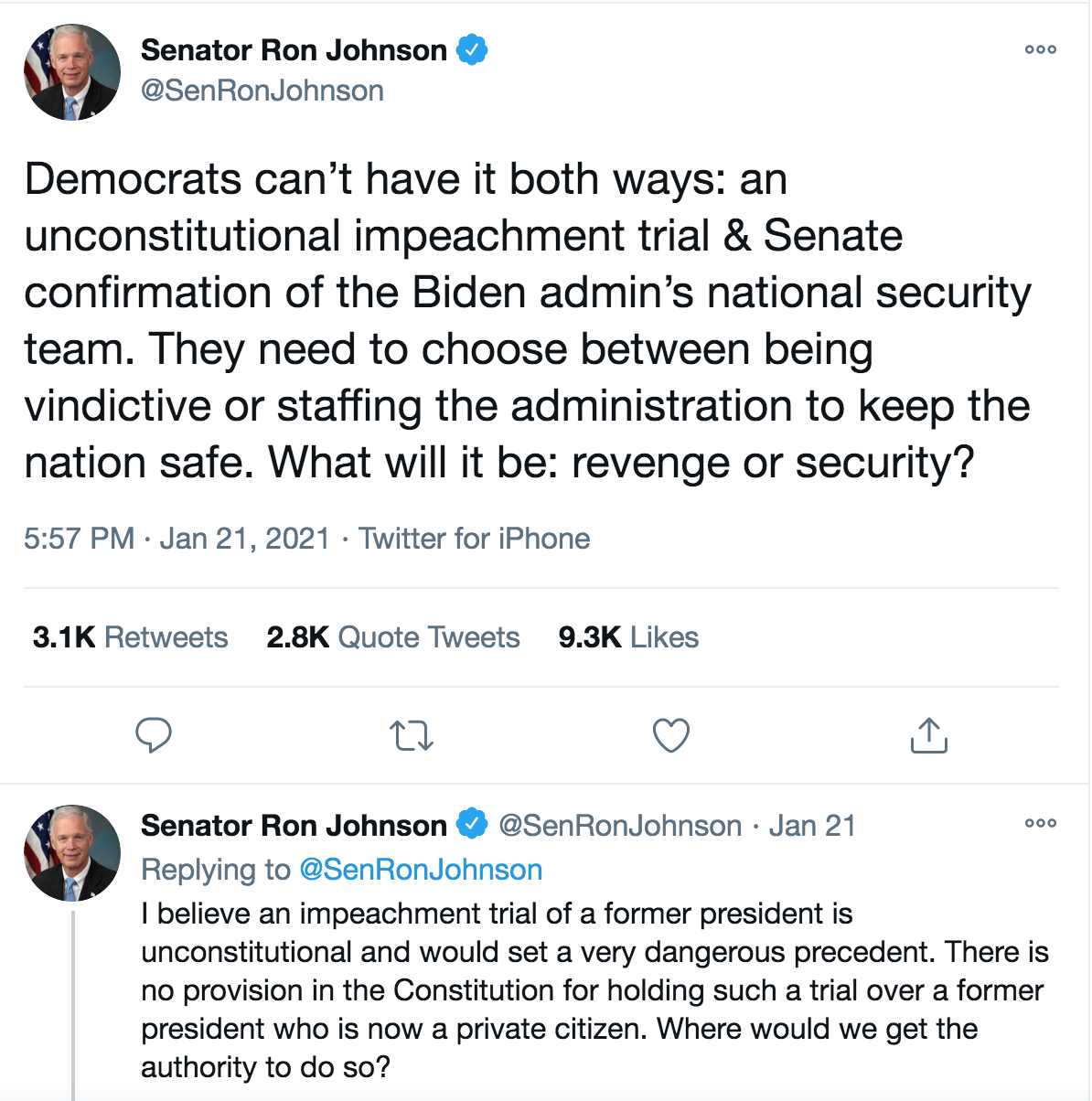
You have a brazen zealot like Ron Johnson from Wisconsin, who insists it wasn’t Trump’s people who ran amok in the Capitol after months of Trump fomenting a lie, after the “Stop the Steal” rally was shown an incendiary propaganda video blaming thieving, violent libtard cucks, inflammatory speeches delivered right before the riled up mob headed to the Capitol to “stop the steal”– the angry mob had every right to be angry, first of all, because they truly believed a fucking infuriating alternative fact– and second of all, it was leftists, posing as Trump supporters, who smeared feces and attacked cops on January 6th.

Prior to party-line passage of the American Rescue Act Johnson somehow was able to force hapless clerks to read the 628 page Democrat [sic] aloud to an empty chamber, until the wee hours of the night. A clever leftie (Sarah Lazarus at Crooked Media) will observe of this kind of stunt:

Senators finally began debating the coronavirus-relief bill on Friday, after Sen. Ron Johnson (R-WI) forced a handful of innocent clerks to read the full text out loud to him all night as a stalling tactic. Democrats immediately made up for the lost time by shortening the debate from 20 hours to three hours when no Republicans were there to object, but hopefully Ron had a nice time at his tyrannical, coronavirus-themed slumber party!

source

And then we learn that the GOP managed to extend the “debate” to 24 hours of bipartisanship anyway. To demonstrate that you can win an election, by a signifiant margin, and still be regularly pantsed by the minority party, a unified, lockstep party with no compunction about justifying anything their mad leader says or does, no matter how wild, insane or demonstrably false. Many people I know tune out politics because, it only aggravates us and there’s nothing anyone in a democracy can actually do to hold anyone else accountable for anything.

Irv – a complicated man

My father would go with that description. Fine, he was a complicated man. He would occasionally refer to the demons we all battle. The highly personal battle with one’s personalized demons is… complicated. In his case, gaining any useful insight into his demons was not an option. He believed that no amount of insight into the nature of one’s troubles could allow a person to make significant changes in their lives, the demons always got the last word. I never bought that pessimistic view of our lives here.

If you were impressed by Irv, as many were, you admired his nimble intellect, his command of language, his irreverence and his wit. He could be very funny. He had charisma of a certain kind. He could be self-effacing in a charming way, as when he joked about often being mistaken for Rock Hudson. He was persuasive. argued convincingly, often in the cause of social justice and basic decency, raising good point after good point based on irrefutable common sense seasoned with insights from his wide reading. He had an excellent memory. He could be a good friend and an excellent mentor. He was loved by many.

Those more attuned to intellectual bullying could observe in Irv the flexing that such types use to keep adversaries off balance, to put them down. The wit, dark, sharp and quick, would be used to parry, skewer, belittle, ridicule, deflate, humiliate. His style in arguments was to quickly prove that any intelligent person, armed with the facts, had to agree with him. He’d often do this by presenting the opposing argument in detail, then dismantling it methodically. He had little patience for anyone who seemed to be on to what he was up to in these displays of intellectual dominance.

We are none of us always our best self. The gifts Irv brought to friendship, teaching and mentoring, were not always at his disposal when dealing with his own little family in the house he’d bought to shelter them, as they ate the food he paid for. He’d grown up in grinding poverty and it had been his life’s mission to never know deprivation again. He succeeded, working two jobs, and his thanks, night after night, were two ungrateful little middle class pricks who had no idea of the despair and humiliation of poverty their father had saved them from.

The complication of this generally fine man arose when his talents were pressed into service by his demons. At the dinner table, after the litany of his wife’s complaints about their unruly kids, the rebellious boy, the sneaky girl, before he got ready to leave for his second job each evening, he’d explode in rage. He’d deploy his entire intellectual arsenal to verbally bludgeon his children, who returned fire according to their personalities.

Why am I writing about my father, a man who has been dead now going on sixteen years? I’m struggling to finally put this story in a clear frame, to tell it in a way that makes sense (we also note my reluctance to wade through the 1,200 page first draft I produced a few years ago– though that seems necessary at some point). I believe my father’s story contains a universal lesson, certainly something to ponder for anyone who was raised by an angry parent who was often impossible to placate. A parent like this puts a kid in an emotional bind that can last a lifetime.

The bones of this story will be familiar to many, the conclusion of the story contains a redemptive surprise, though the value of that gift is sometimes hard to see.

In a nutshell, someone who is prone to anger after childhood humiliation (as Irv was humiliated by the double monster of extreme poverty and an angry, religious mother who whipped him in the face from the time he could stand) will behave toward their offspring with certain emotional disabilities. In the case of a parent with severe emotional disabilities, since none of us want to see ourselves as wrong, they will actively construct, and become unyielding advocates of, a worldview where their fucking children are the real problem.

Now follow me here — if the child is to be made the real problem, you need to lay out, and reinforce, the reasons why, so everybody understands the terrain. So when the kid is an infant, several days old, accuse him of challenging you from his crib.

“You were born with a hard-on against the world. You had it in for me from the day I picked you up at the hospital, staring at me with those big, black accusing eyes, always glaring at me through the bars of the crib by my side of the bed.” The crib had to be moved to the other side of the bed, to mom’s side. Sheesh. You started this fucking war when you were a few days old and have not taken a minute off since then, you merciless little bastard.”

If you believe this remarkable story, and why wouldn’t you, at five, at eight, you are in for a lifelong wrestling match with your own demons, some of whom will insist, not unreasonably, “what the fuck?” You will grow up with cognitive dissonance, the things ascribed to you will not feel like a fit with what you actually learn about your own life. You will be subject to nightmares, dark thoughts, to fear and displays of anger, which you may come to regret, or, alternatively, cringing submission, a shameful surrender which you can later take out on yourself. There are few healthy ways to react to a parent intent on proving that you have the problem, not them, especially when you are a child.

Healing from this kind of upbringing is a hard, complicated process. It requires a certain optimism about our capacity to heal. It also takes learning to be the parent you never had, replacing the harsh internalized voice with a more merciful one. Your odds of success will also depend on the severity of what you were forced to suffer.

Irv was verbally abusive, something he admitted was as damaging as physical abuse — he rarely hit us. I eventually found a way to understand my father’s brutality, and depersonalize it, though if Irv had punched me in face every day of my childhood, I wonder if my path to recovery would have been the same. If he’d sexually assaulted my sister and me? The horrors humans do to each other are varied, I can only speak sensibly about the ones I experienced.

I had the luck, after striking up a friendship with my father’s seventeen years’ older first cousin Eli, a complicated character of infinite charm and equally deep hostility, to have someone turn on a light in a dark room. After talking around my father’s situation week after week, the sad adversarial relationship between us, my father’s arguable streak of madness, Eli revealed a terrible truth to me one day. Coming from him, who gave me the horrific detail one day with great sadness, it had the ring of absolute truth.

His favorite aunt, his father’s beautiful red-haired little sister who loved him to death, was Tante Chavah. He had many stories about Tante Chavah and her fierce love for him. Tante Chava was my father’s mother, the grandmother I never met (she died before my time). I knew she had a terrible temper, I knew she was very religious, I knew that although she was the poorest of the poor, she gave money to charity every week, I knew she had been barely five feet tall and a great cook. Eli confirmed all these things, telling me stories about each of them. One day he took a deep breath and told me how she treated my father as a baby, and throughout his childhood, the abuse she heaped on her oldest boy, who she always called “Sonny”.

This unspeakable tale of severe child abuse, told with infinite sorrow by my father’s much loved first cousin, suddenly made me see my father in a different light. He instantly became sympathetic. His irrational behavior as an adult suddenly made a kind of sense to me.

I count this revelation as maybe the greatest single gift I ever received. How do you understand a man who could ruthlessly bully his six year-old grand-daughter on the eve of her birthday, making her so understandably upset she’d vomit moments after he left the house, without understanding the abuse he’d suffered? Impossible, I think.

I count my unaccountable optimism about our capacity to take deliberate steps toward a healthier life as another great blessing. Both of my parents were confirmed pessimists. I don’t know where I got the feeling that our brains are elastic, our life experiences subject to improvement, our interactions with others improvable. No idea.

I will skip to the end of the story here, in the interest of a spoiler. Or, on second thought, nah. Back at you another time.

Cause and Effect — senseless brooding or productive musing?

I have been wrestling with a difficult issue for many years now, my seemingly all but final estrangement from two people I was always close to. Their loss was a kind of ‘collateral damage’ resulting from the demand to hide someone else’s well-founded feelings of shame.

Seen in the worst light, my constant return to this painful subject is what psychologists call perseverating, self-inflicted pain from regretful preoccupation with an ultimately insoluble tragedy, the neurotic need to constantly relive the past suffering that caused deep wounds.

Seen another way, the way I prefer to see it, I’m searching for an elusive solution to an ongoing tragedy. I’ve been turning the evidence of our estrangement over in my hands, looking at it from every direction, shining light on it from every angle, seeking a creative solution to something important to me, an inventive idea that has been evading me.

Last night I thought of two questions, one for each of them, that sum up my long musings, without divulging anything of underlying shameful events to anyone involved.

They are a sister and brother, the girl a history buff, the guy a poet and a fiction writer. Sadly, I lost touch with them over the last few years. My intermittent attempts to maintain the relationships are finally met with mostly silence. Yesterday, while thinking about something else, I stumbled on a final question I could ask each of them. If I had only one last question to ask, I think it might be these (note the lengthy illustrations to the historian’s question).

To the young historian:

Q: Is history the fact-based inquiry into the nuanced reasons events and trends happen in human society, pursued to give us insight into the challenges of the present and the future? Isn’t the alternative to factual history propaganda, a false narrative supporting a pre-determined outcome?

Historical narratives emerge to make sense of the past. From earliest human history people were strategically erased from memory. In the days of the Pharaohs the new dynasty would send slaves to scrape the faces of their predecessors off the tomb walls, fucking them in the afterlife, erasing them from history. This is an ongoing pattern in human affairs.

When Germany lost the first World War certain Germans came up with an infuriating myth, The Stab in the Back — the victorious German army had been betrayed and humiliated by treacherous enemies who would be made to pay with their lives. The endlessly shifting narratives of history often swing wildly between opposite interpretations. A school of history will hold forth its theory — insist and largely prevail for generations (like the Dunning School at Columbia rewrote the history of the Civil War) inverting the previous understanding. In the case of the Civil War, the revisionist early twentieth century history (influential for decades) held that the Confederacy did not secede over slavery, that in a real way they never lost the glorious war to preserve their way of life, that the people they massacred were the real traitors to the Constitution.

We are watching a historic battle for the soul of history at this fascinating, scary moment in history. The recent riot at the Capitol, the ascendant far-right tells us now, in one voice, was done by leftists posing as Trump supporters, to make Trump look bad after they stole the election from him.

Isn’t inquiry into the facts of what actually happened in the past the crucial work of the historian? Isn’t good history the business of making the often irrational human endeavor understandable by placing carefully uncovered ideas and events into context?

Example:

Senator John Tester (D-Montana) told Bill Maher the other night that the original purpose of the filibuster was to promote bipartisanship by requiring a 3/5 majority vote to hold a legislative debate or a confirmation hearing [1]. Maher had no comment on this origin story, a dubious story Tester offered in passing, one he had no obvious motivation to promote.

Tester’s comment leads to a reasonable question: was the filibuster designed and used to promote bipartisanship in the senate?

Would even a cursory reading of history, or Wikipedia [2], show that John C. Calhoun, our nation’s greatest defender of slavery in the Senate, refined the use of the filibuster to allow the proslavery minority to block legislation that could threaten the viability of the Peculiar Institution? Would we learn that virtually every use of this minority tool during the twentieth century was to oppose legislation that would favor the greater rights for the majority? Does this not strongly suggest that bipartisanship was not the original motivation for this parliamentary device that can instantly disable a majority’s ability to pass laws?

Or, does it make no difference, historically, like whether or not the 2020 Election was actually stolen from the rightful winner by an illegitimate president who was sworn in over the strenuous objection of countless patriots?

In the case of the 2020 election there is a great deal of evidence to suggest this claim of a stolen election is a lie, and no evidence of substantial voter fraud has ever been produced, but couldn’t you say, without being judgmental, that it’s really just a hotly disputed matter of opinion that people of good faith could agree to disagree about?

Or, is there even such a thing as historical fact?

For the young writer:

I was more than forty years old, after solid decades of senseless war with my heavily defended, often aggrieved father, before I got a glimpse of understanding into his desperation, what made him so intent on winning an imaginary war against his children. His mother, it turned out, had whipped him in the face from the time he could stand on his little baby legs. Trying recovering from that primal betrayal.

Learning this, from a relative who’d witnessed it many times and sadly related it to me, flooded me with sudden sympathy for my poor battling old man. I understood, in a flash, the humiliation that led to his desperate lifelong battle against his children. It didn’t fix the years of senseless brutality or reverse the damage he’d done, but it gave me an insight that opened a door I’d never seen. A few years later that insight, and months with a good therapist, enabled me to stand by his deathbed and gently listen to his regrets, help him die as peacefully as he could.

If you are writing about a character who is depressed or angry, or conflicted, or up against it, is it important to show the stress, provocation, abuse and other stresses she underwent that led to her dramatic situation? If you tell the story of an unhappy, angry, anxious character compelled to dramatic action without giving the reader these things, what kind of story are you telling?

Or is all shit simply stuff that just happens? A Zen koan unfolding against unhearable music?

And if someone reaches out to you and you don’t acknowledge it, after a while, shouldn’t that idiot eventually get the message that the continued reaching out is folly? Seems straightforward enough, no?

[1]

I just realized, the filibuster– requiring 3/5 of the Senate to vote to hold a hearing on a bill or confirmation, was our nation’s second 3/5 Compromise (the first being in the Constitution, to increase the power of the less populous plantation states by increasing their populations for Congressional representation by counting 3/5 of each slave towards apportionment in the House).

[2]

Reliance on Wikipedia, in this case, would result in a skewed understanding of the filibuster, which in this telling was first used by Alabama Senator (and future vice president) William Rufus Devane King, and was not the favorite obstruction tool proslavery and later anti-Civil Rights minorities in the Senate, liked the good old boys who blocked anti-lynching legislation for decades during the height of anti-black terrorism in the U.S. Although, you will read:

Then Democratic Senator Strom Thurmond of South Carolina broke this record in 1957 by filibustering the Civil Rights Act of 1957 for 24 hours and 18 minutes,[24] although the bill ultimately passed.

source

Lying Hides Shame — at least for a time

It seems too basic to point out here, but it’s worth a thought, I think. Many lies are told primarily to avoid shame.

For example, if I lost my job, due to petty embezzlement that was discovered by my friend Dave who had hired me recently, I’d feel ashamed. My wife would have a shit fit and it would ruin our weekend. So I tell her that Dave was forced to reluctantly downsize on Friday, and since I was the last hired, I had to be let go. The guy hired right before me also got the ax from Dave, who apologized and promised to rehire us as soon as business picks up.

My wife will be sympathetic instead of angry, my firing had nothing to do with me, nothing at all. She might be suspicious, since I lost my last two jobs due to petty embezzlement and lied about each of those, and she’d be within her rights to rage at me for another lie to cover another petty theft from my boss, but I can always convince her of a lie she wants to believe. Her short-term sympathy, gained by this harmless lie, will be worth it, especially since she’ll be mad as hell when she finds out in either case. By the time Dave calls my wife on Monday, snarling about my betrayal (he had done me a solid by hiring me, I did kind of betray him) and threatening to have me prosecuted if my wife doesn’t repay the money I stole, I will have had a peaceful, shame-free weekend basking in my wife’s sympathy. Better than nothing.

If you do something you’re ashamed of, you will often feel a strong need to deny it. There are various ways to do this, but if it takes a straightforward lie, so be it. Lying is better than feeling shame, by a mile. If you’re caught in the lie, well, shit happens. You’ll figure out the next lie as you need it.

I’m sure shame comes into the Big Lies too, especially ones based on national humiliation. Are the lies about a rigged, stolen election, and the $50,000,000 ad budget to promote the lie and a well-planned, well-financed ($3,500,000 that we know of) attempted insurrection based on that infuriating lie, based on shame? I suppose we could say so. If you claim, before and after two elections, that the election (even the one you legally won, in spite of an almost 3,000,000 “popular vote” loss) was marred by massive fraud — and you produce no evidence of fraud, beyond the 1 case out of every 2 million votes found by the Koch-backed Heritage Foundation’s election fraud database — does that indicate shame? After all, you were raised to believe that there are only two kinds of people, winners and losers. You are a winner. The only way you can lose is if some powerful force lies to cheat you. That’s how the victorious German army “lost” the First World War, after all.

If a lie is to gain a foothold in the minds of millions, it must be undeviatingly insisted on. Publicly and privately, it must be repeated over and over. Asked point blank if Joe Biden and Kamala Harris won a fair election, supporters of the president’s baseless claim that radical Democrats stole it will point to a swarm of ornate talking points. Ask them on national television: Yes or No, motherfucker, did Biden win a fair election?

You can hear their straight answers to this direct question, from the intellectuals of the GOP, men like Senators Rand Paul, Lyin’ Ted Cruz, Josh Hawley, Rep. Steve Scalise, the head of CPAC:

Well, you see, that’s the kind of question you people always ask, and next you’re going to call me a liar, which is all you liars know how to do. But as even you have to admit, the real question is why the signatures of Black inner city voters were not verified as the state laws require, in state after state, city after city, or why millions of ballots, cast by mail– against state law, were accepted DAYS AFTER THE ELECTION. The real question is why illegal ballots were fraudulently harvested and counted, millions and millions of unverified Muslim, Mexican and Transsexual votes– and countless child-blood drinkers’ ballots. The real question is “fuck you, you fucking fuck!”

Yesterday’s hearing about the federal government’s unaccountable failure to mobilize enough police presence to prevent the January 6th insurrectionist riot at the Capitol featured this moving testimony from U.S. Capitol Police Captain Carneysha Mendoza. She describes, among other horrors, the rioters’ release of military grade CS gas, inside the building, mixed with fire extinguisher spray deployed by rioters, that resulted in chemical burns to her face:

Senator Ron Johnson [1], who comes from Wisconsin, reads into the record the alternative fact that it was not Trump supporters who clashed with police, sprayed them with bear spray, overran the barricades, crushed them in doorways, beat the police with flagpoles, carried Trump and Confederate flags into the Capitol, released poison gas, spread feces over paintings and statues of famous Democrats — it was, literally, a false flag operation! The violent ones were all antifa provocateurs! The Trump supporters were all peaceful — it was the outside agitators who made them look like an ugly mob who wanted to kill Mike Pence and Nancy Pelosi!!!! Posing as Trump supporters, who were, to a man and woman, as peaceful as baby lambs, even as they trampled one of their own to death, her “Don’t Tread on Me” flag notwithstanding.

Where did Johnson, who had previously argued that the mob was not “armed” because most of them had no firearms (military grade CS gas, bear spray, improvised clubs and spears, brass knuckles, knives, tactical gear– not “arms”, snowflakes…), get this account that he read into the official record? A rightwing website, reporting on a single source who made this extremely far-fetched claim — he read directly from their post.

Prove Johnson knew he was lying. Fucking prove it, you fucking liars!

Is Ron Johnson publicly spreading this lie, on some level, because he’s ashamed? Were the GOP 140 Representatives who voted to block the certification of Biden Electors? Hawley? Cruz? Tuberville? The rest of the Senate Voter Integrity Skeptic caucus? Impossible to say, really. That’s what Ethics Investigations are designed to find out.

[1]

Dream with a win-win happy ending

I woke from a dream a few weeks back with a sense of wonder about how everything worked out much better than expected throughout. I still clearly remember the dream, the kind impulse leading to oddness and incoherence, the escalating danger, the surprise happy ending. There was every reason to anticipate the worst, things looked worse at every turn — instead, it turned out well for everybody, man and beast alike.

It used to be, prior to our current bellicose, threatening, highly infectious epoch, that sometimes grim-looking situations turned out fine. The unlikely thing happened sometimes and everyone walked away relieved instead of skittering sidewise like agitated crabs on the ocean floor. In our present moment, most of our hope for this kind of mutually beneficial outcome is forgotten.

The encounter where everybody comes away better than they were before was commonly called a win-win scenario, something that is almost impossible to remember, the black and white, toxic way things are now. Surprise happy endings are really not that rare, they certainly weren’t in the past, but this dream hit me with some force, reminded me how unlikely any kind of humane resolution to anything seems in our troubled, troubling, increasingly violent times.

I generally don’t remember dreams in any detail after I’ve had them, this one stayed around for a few days afterwards, is with me now weeks later. I intended to write it out and eventually made a note in my drawing book days that I didn’t need to even look at before writing this[1]. The only detail I forgot was the owner’s threat to call the local police on me — the law and common sense being completely on his side.

I was in the large enclosed porch, or maybe an unfurnished room with floor to ceiling windows. It was in a stranger’s house, a place I wasn’t supposed to be, I was trespassing. When I passed I’d seen there was a dog in there, alone, seemingly trapped, and in some distress, the door to the room was unlocked, or at least easy enough to pop open. The dog seemed traumatized, did not approach me, but watched me, cowering. There was no food or water anywhere to be seen. I was trying to figure out a way to help the poor devil.

As I puzzled over what to do about this dog, in a place where I didn’t know anybody (it seemed to be a small seasonal community, perhaps Cape Cod, during the off-season), a guy walks in the door on the other side of the room. He’s got a dog on a leash, he’s glowering and at the same time seems slightly sheepish. He was a short, stocky black man who reminded me of Cleveland on Family Guy, only he was angry and defensive.

As I began telling him about the dog he admitted that the dog used to be his, that he’d abandoned the dog. He looked guilty when he told me that, but also determined not to take any shit from me about about it. He didn’t know why he did it and he didn’t want to talk about it, was trying to be a tough guy but was obviously hurt, somehow. I told him I wasn’t from around here and asked him if he knew anybody who might be interested in rescuing or fostering the dog, maybe a local vet.

Suddenly the owner of the house, an imposing looking white man in a plaid flannel shirt, entered through the other door.

The scene was set for something bad to happen. The white guy was not happy to find two strangers in his place, trespassers, sitting, engaged in a tense conversation, as if one of them owned the place. He stood at the other end of the open room, demanded to know what the hell we were doing in his house. He may have had a shotgun, if not pointed at us, at hand, it might have been a baseball bat. He was about to call the police, told us he’d let us explain to the cops (his good friends) what the hell we’re doing in his house. I was at a loss for words, start gesticulating toward the dog, began to say something.

The man looks at the dog, as if seeing it for the first time, and it is clearly love at first sight. The dog immediately goes over to the guy who starts petting the dog and ruffling its fur. The man is happy, the dog is happily wagging its tail and gladly accepting the affection. The sheepish, angry black guy leaves quietly through the opposite door with his dog as this is going on. I’m sitting there, relieved to no longer be a suspect or in any jeopardy, watching the man and the dog happily enjoying each other. Everything is suddenly clear, the right thing is happening, no need to explain anything to the man and his new best friend. If anything, the guy will express gratitude toward me when I get up to leave.

I remember a great feeling of peace, of being in a universe where everything is in its place, for the right reason. The feeling was with me when I woke up. It is with me, a little bit, as I write these words.

I woke up (this was maybe three weeks ago) thinking “damn!” and feeling amazed about this dream long after I woke up. It has stayed quite vividly in my memory ever since, very rare for even my best dreams.

I wonder how long it has been since I pictured anything besides troubling, dangerous things inevitably turning to shit, the worst playing out in an escalating death spiral, inevitable as the next bit of widely broadcast lying propaganda enflaming angry, stressed out people on both sides.

The possibility of love and connection and things working out wonderfully for everybody — it hasn’t really gone anywhere, odd to say. It’s just that we’re living in disorienting times, beaten down by a long relentless war to keep unfairness firmly in place and we can hardly remember a time when it wasn’t this relentlessly bitter and threatening, no longer even dreaming of the possibility of things not being exactly as angry as they are right now, or worse.

You’re in trouble, you explain (no words needed), you are understood, no longer in trouble. Instead you get to watch the first flush of new love playing in front of your eyes, everybody getting what they need. Not a bad win-win, I’d say.

[1]

NOTE (from my drawing book):

dog dream

happy ending

dog adopted by guy about to call cops

former owner had no excuse

The seeming slipperiness of the truth, and its value

Our defeated ex-president, seizing on the death of a man of great certainty of opinion and even greater influence, around whose neck he’d hung a presidential medal at his last State of the Union, reemerged into the public spotlight, on FOX, to repeat the familiar refrain that he’d won, in a landslide, the election he lost decisively. In support of his ongoing #Stop the Steal campaign he said that this great, recently departed American anti-Leftist had strongly agreed with him, the presidency was stolen from him, from all real Americans. The professionals and experts all know the truth, he said — that the presidency had been stolen from him and from America by a vast cabal of evil, sick, dangerous enemies of the people — the vast Leftwing, Antifa, BLM, Feminist, Homosexual, Liberal Jew media conspiracy.

The charge that he won the election he lost may be untrue, (reasonable people can argue about it, claims Lyin’ Ted Cruz, reasonably) but you have no right to call it a lie when tens of millions honestly believe it’s true that there was massive voter fraud that stole the election from the rightful winner. How dare you call the sacred dead former talk-show host with talent on loan from God a liar?!! Standing up for possible truth is the whole reason more than a hundred and fifty GOP members of Congress united to contest the “certification” of an election that nobody ever proved wasn’t massively fraudulent, the deliberate and systematic theft of an election, by lying traitors, that the “defeated” candidate actually won in a landslide.

Back for a moment to the personal, to the moment when somebody decides you will be in a fight to the death no matter what you think about it, no matter what actions you may take to try to prevent it. Certainty is a powerful force. I’m thinking about an old friend who called to angrily confront me about being unjustly angry after my health insurance was abruptly cancelled, (illegally as it turned out). He then escalated his indignation and challenges week after week, finally, after pressing me to just fucking move on from whatever my grievance was, snapped, cut me off mid-sentence with a snarl and hung up. Then texted me that he was done being reamed by me.

It seems petty, I know, to keep coming back to this same indigestible example of another old friend suddenly become a devoted, eternal enemy. I’m trying to wring something instructive out of the vexation of it. It seems like the lesson has to be more than that we can all convince ourselves of the righteousness of our own actions, once we construct the right frame. It may be no more than that, though that answer is as unsatisfying as the conclusion that homo sapiens are just a petty, quarrelsome, largely irrational species whose history is always written in the blood of the justifiably murdered.

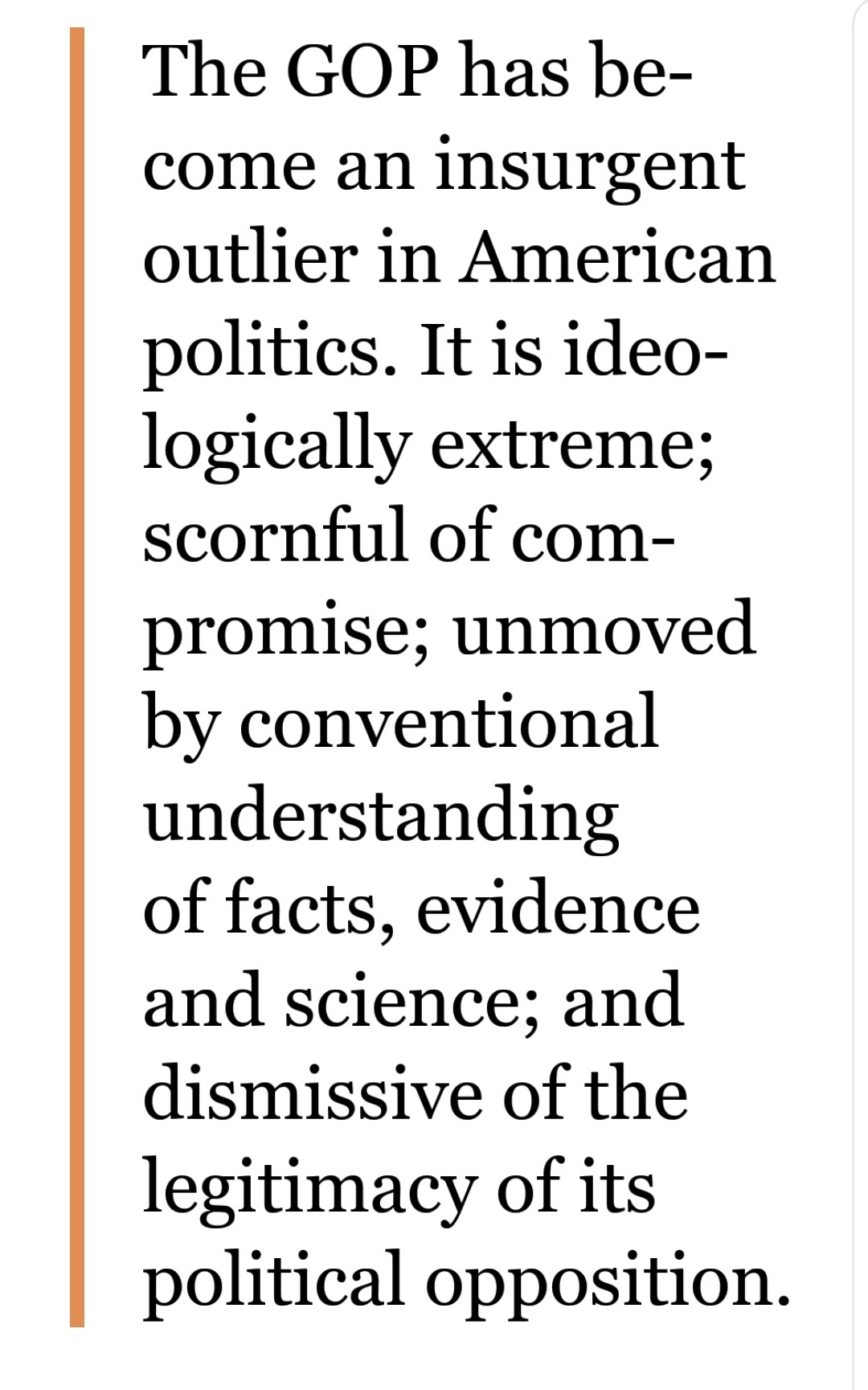
Surely there is something like objective reality. If you have no dog in the fight you are generally able to look at what actually happened, trace cause and effect, and often assess who is basically correct and who seems to have things ass backwards. The answer is rarely that both sides in a heated argument (like the consensus of Climate Scientists versus for-profit Climate Change Skeptics) are equally valid. There is generally more truth, more fact, more data, more thought behind one position than the other. The genius of the long right-wing project to convert the GOP into a radical right-wing party, similar in its essential features to the one-time fringe conspiracy-based John Birch Society cult, described this way, by political scientists Norm Ornstein and Thomas Mann in 2012:

is that today massive, repeated allegations of something, funded by tens of millions of dollars in ad buys to convince people of the allegations, suffice to back and fully justify any political move, including a righteous riot to disrupt the peaceful transition of power in the Capitol. You no longer need a shred of proof, evidence or any discernible facts on your side — the accusation itself is sufficient to fuel the righteous fight to the death.

Proponents of the need to contest the results of an election they claim (without evidence) was massively fraudulent, even after results have been certified fair by bipartisan officials, votes recounted, challenged dozens of times in court, left in place by the courts (for lack of evidence of fraud) need only site the ALLEGATION of fraud, believed by millions, to support their right to contest the election. Regardless, of course, of whether there is or isn’t, or has ever been, actual evidence of significant voter fraud found, even by the Koch-funded Heritage Foundation or Trump’s Presidential Electoral Fraud Commission headed by Hang Mike Pence and defeated voter-suppression expert Kris Kobach.

The project of convincing tens of millions of fraud that didn’t actually happen is vast power at work, and successful propaganda instilling belief in something that is based only on the needs of maintaining that power. It is our job going forward to make a humane case for the 99% as emotionally undeniable as these Koch-funded geniuses have made on behalf of the 1%. It saddens me to see the Democrats resorting to Lincoln Project-style attack ads, which they are now (the Lincoln Project proudly claims credit for Trump turning on his loyal retainer Pence) and I keep thinking there has to be a better way to make the case for fairness, although maybe not at the moment.

Back to the personal. This long-time friend, no matter how clearly I set out my issues, my specific concerns about our long “argument,” insisted that we can’t ever really know what is in anybody else’s head or heart, even someone we’ve known well for half a century.

It seems an untenable and depressing position to me, one that inevitably leads to estrangement, but this man is very smart, an accomplished lawyer, and he rests his case for this unshakeable belief on the fact that in the end, after my many attempts to be analytical and nonviolent in stating my concerns (concerns he repeatedly asked me to clarify, no matter how clearly I’d already made them) I admitted, in a very hurtful way, that I was frustrated, angry and disappointed in his limitations as a friend.

After all, from his point of view, every one of his attempts to make peace was met by my stubborn refusal to simply forgive, even after he made it clear that he truly didn’t understand what he’d ever done to me that was hurtful. Instead, he pointed out, I kept struggling, stubbornly and incoherently, to make him understand what was so “hurtful” about his conduct.

When I hear that Tucker Carlson, for example, said, of the police killing of George Floyd (bracketed by Brook Gladstone’s commentary from her excellent On The Media:

BROOKE GLADSTONE Later that evening, Fox primetime hosts Tucker Carlson and Sean Hannity drew on increasingly deranged conspiracy theories to denature the evidence [in the impeachment trial –ed].

[CLIP]

TUCKER CARLSON They’re just flat out lying. There’s no question about that. The question is, why would they lie about this? For an answer, think back to last spring. Beginning on Memorial Day, BLM and their sponsors and corporate America completely changed this country. They changed this country more in five months that it had changed in the previous 50 years. How’d they do that? They used the sad death of a man called George Floyd to upend our society. Months later, we learned that the story they told us about George Ford’s death was an utter lie. There was no physical evidence that George Floyd was murdered by a cop. The autopsy show that George Floyd almost certainly died of a drug overdose. Fentanyl. [END CLIP]

BROOKE GLADSTONE Right. A full autopsy report by Minneapolis police found that Floyd had fentanyl and other drugs in his blood. He also had Covid-19. None of that killed him. His death was ruled a homicide. Maybe Tucker will move on to flim-flam less foul, but why would he? 

source

my blood instantly boils.

I don’t often listen to FOX, or Cucker Tarlson (or whatever the well-born, entitled prick’s name is) but hearing him smugly intone a transparent and incendiary lie, calling the story of Floyd’s (who he called “Ford” at one point) homicide a lie, made me ready to fight him, as it was intended to. I immediately felt a violent urge to put my knee on Tucker’s neck and kneel on him for as long as it took him to stop kicking and begging, letting him up a second before his death. The whole FOX/Murdoch right-wing exercise is “triggering the libtards” and thar’s gold in them hills (Rush Limbaugh died with a net worth of over $600,000,000). The Minneapolis coroner who ruled that a grown man, armed with a gun, supported by three armed colleagues, kneeling on the handcuffed George Floyd’s neck for almost nine minutes, the last three after Floyd lost consciousness after begging for mercy and calling out for his mother, had caused Floyd’s death? A fucking liar and traitor, a tool of the fucking lying libs.

Hearing Carlson’s inflammatory hate speech I immediately, and involuntarily, flashed on my former friend’s claim that in spite of the thousands of words I’d written him trying to keep the peace (the first few thousand he thanked me for humbly, for I’d taken pains not cast undue blame on his actions) nothing I had written, in the end, gave him the slightest clue why I was so hurtful to him now.

The truth can slippery once strong emotions creep in, and people we trust can twist it convincingly sometimes, but, call me old-fashioned, I still believe there is a world of cause and effect that can be observed, that some narratives are closer to the truth of what happened than others. I can’t be sure what the root cause of my friend’s insistence that we fight to the death was. Not sure I made all the right moves to try to avoid it, obviously I didn’t, based on the irreconcilable enmity at the end.

But if someone asks you why you are angry, and you tell them you are protesting the long history of too many unarmed black people unaccountably murdered by the police in this country every year, and they respond by calling you a terrorist, dispersing protests with the full force of non-deadly state violence (tear gas, horseback charges, rubber bullets, anti-riot squad phalanxes swinging batons, mass arrests) you might be forgiven for feeling unheard.

“What is the real core issue here?” asked my friend, time after time, telling me he clearly didn’t understand what he did that seemed to have upset me so much. I told him that, in a nutshell, having my expressed concerns met by silence is probably the single most hurtful thing to me, that the attempted negation of my feelings by silence is like kryptonite to me. He stood on his right to remain silent, and on the reciprocal truth that I had no right to expect any different, since nobody can ever truly know what is in somebody else’s heart and mind or why they feel as they feel or do what they do.

“I read everything you wrote, searching in vain for a single clue as to what I’d done that made you so irrationally angry and hurtful to me,” he concluded, resting his case.

I can’t do anything about the gigantic phenomenon of unchallenged far-fetched falsehoods being presented as just good as undeniable truth when it comes to a partisan GOP argument. Greg Abbott, the Trumpist governor of Texas, is angrily blaming the Green New Deal for his state’s deadly weather-related emergency — and fuck your fucking facts, cucktards. The political is personal, of course, and there’s little we can do, outside of hard, slow, resolute work on the long-game of bending the long arch of history towards justice. In our personal lives, our choices are more straightforward.

I can’t do anything about a friend who insists that he will do everything in his power to save our friendship, while standing on his right not to revisit any concern that might make him uncomfortable, or even acknowledge I’ve clearly expressed a single goddamned thing worthy of consideration. In the end I can do one thing in the case of a friend like that — let him make his final arguments, accept his right to remain unchanged, and his verdict, and try not to brood about it whenever I hear a similar case indignantly made by a Tucker Carlson.

Though, I also have to acknowledge the deeply disturbing personal resonance of things like hearing the Rochester cop, while hand-cuffing and pepper spraying the emotionally disturbed nine year-old girl (and the fact that the cop was not immediately fired and prosecuted tells you the race of the child) demanding that she stop acting like a child. “I AM a child!” she replied, stating the obvious, to a brutal asshole who didn’t have the slightest concern for what was true and what was instantly verifiable bullshit. I heard the same from my own father, when I was that age and younger. That I should start acting like a man instead of a fucking child. He apologized about that right before he died, for whatever good that might have done anyone.

Truth and reconciliation, y’all, there is a tremendous value to it. It’s the only path to true healing.

A visit from el perro negro

At a particularly depressing and anxious time for the human race like the one we find ourselves in now, depression and anxiety are understandable. It is hard to stay optimistic in the face of prolonged social isolation, a still raging incurable disease that can kill you, lies and denial of reality in the service political brutality, cascading climate catastrophe and all the rest. The hanging out with friends, family and likeminded strangers that used to remind us of the other side of life is now dangerous, must be approached with caution, if at all.

Social media, texts and emails are no substitute for personal contact with people you like. People think you are insane (and they are probably justified) if you send them a hand-written letter in the mail. Sekhnet, a self-proclaimed happy hermit, is relatively fine with cheerful random encounters with strangers, by phone or socially distanced and masked. At times I find myself wistful about the ongoing lack of connection with others.

I’ve been aware of not falling into the trap of despair. The world is the world, always full of danger and challenges, and though fear may grab us hard sometimes, and doubt, and all the other dark things of this world, it is best to keep in mind all the rest, the sweetness of life that keeps us grateful for every lifegiving breath we take.

The world is also change, all life is constantly moving, evolving, changing. This shit too will pass, surely, and once the pandemic is over we’ll hang out together to talk about it and laugh in relief to have survived it.

There is hard work to be done fixing a lot of things that are badly broken, I’d like to help. I hope to figure out how to lend a hand, throw my back into it. I feel like I’ve been doing OK emotionally, the usual complaints (the arthritis in my left knee is getting to be a real pain) aside.

Last night I cheerfully dialed an old friend, to check in, to resume my long habit of checking in with distant friends. I’d decided not to talk for long, just hear how he was doing, hopefully have a laugh (he’s a funny bastard) as I exercised my ailing legs outside in what was suddenly a mild evening. I got his voice mailbox, which was full.

I suddenly remembered the weight he carries, responsible for the livelihoods of literally hundreds of people in his badly stressed organization, dozens of whom must call his cellphone daily. It was too late to ring his home phone, his wife goes to bed early and it was already almost 10:00. Figured I’d call the home line tonight, after the dinner hour, see how they’re doing.

Watched an episode of David Attenborough’s brilliantly presented (and beautifully shot) Planet Earth on Netflix, had a moment of despair about what human greed has made of the oceans and deep seas (which contain 95% of the earth’s life, I think I heard), but mostly, we marveled at the weird and wonderful beauty of nature and the gentle, wise presentation of it . Here’s a nice montage from the wonderful limited series.

Sekhnet and I went upstairs, played few rounds of Wordscapes on my phone and I tucked Sekhnet for the night (so she could spend the next hour learning Chinese in Duolingo).

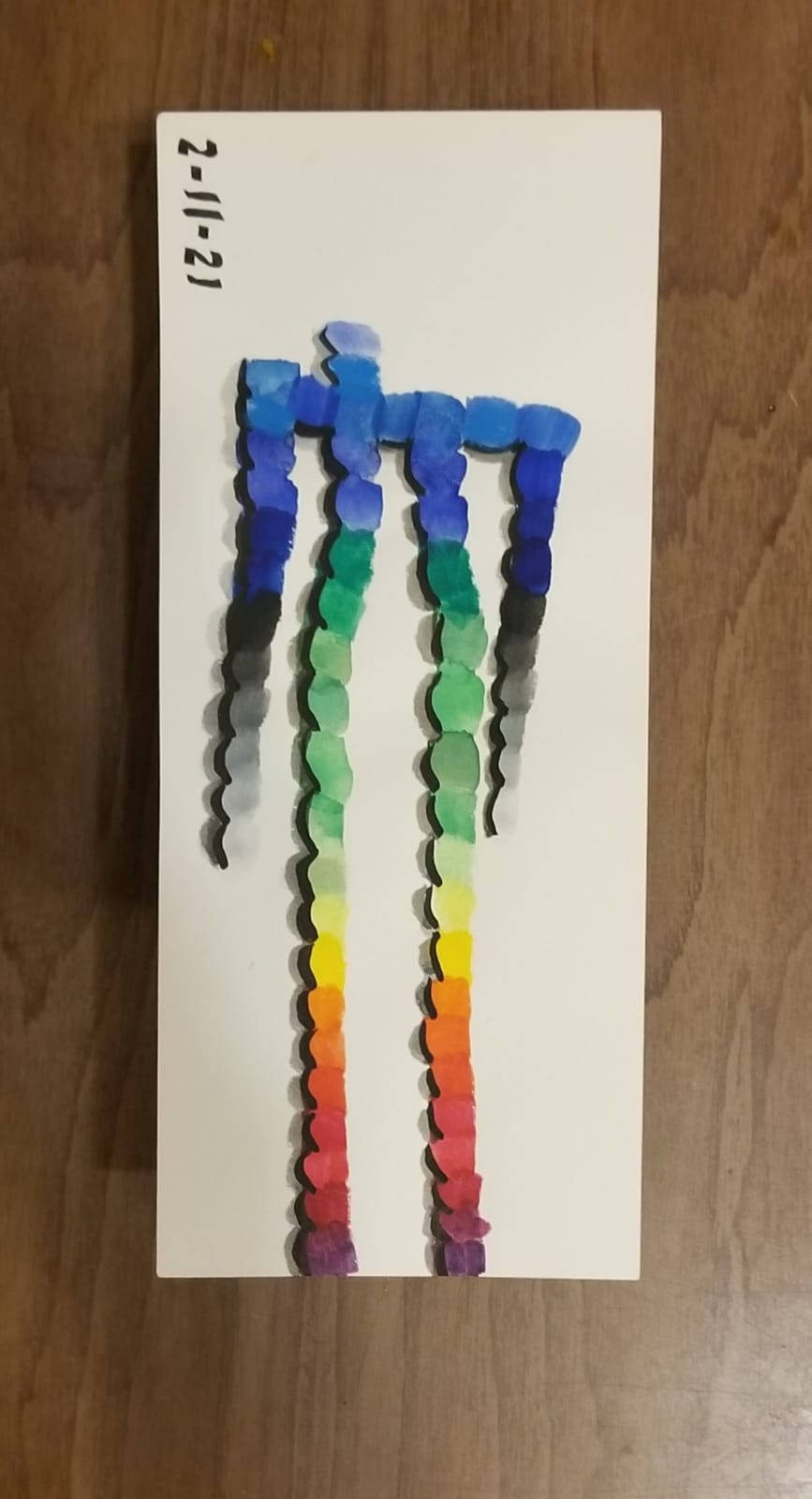
Then sometime after I did a little watercoloring (a variation on the figure below):

washed the dishes, got myself a cold drink and sat down to prop my leg up and watch a dark crime show, I became aware that the Black Dog had crept into the room with me.

I’d truly forgotten all about el perro negro.

“Remember me, motherfucker?” asked the black dog.

I did, indeed. Everything was suddenly hopeless. Why bother calling my friend? I’d destroyed my life, utterly, the whole thing a series of stupid mistakes I’d keep making until the end. Nobody gives a rat’s ass about your precious, polished, meaningless, unmonetized hobbies. The world is only a depressing antechamber to certain, terrible death. Nothing is ever going to work out well, you’ll see. Everyone who ever said they loved you was lying, and they proved it, in spades; everyone you love, dead. Evil triumphs in this world and if you think it doesn’t — fuck you, I’ll slit your ugly face. Look around, asshole.

“Forgot how persuasive I am?” asked el perro negro, stinking faithfully at my feet.

Not for a second.

I took two Tylenol PMs (discovered by Sekhnet’s insomniac cousin recently) and waited for the stabbing in my left knee to subside. Within an hour I was drowsy, went up to bed. Today, no sign of the black dog, though I can still smell his wet, cloyingly pungent fur. I’d forgotten all about the motherfucker, actually.

GOP Narrow Framing, personal anecdote

As former president Trump’s legal team and his party begin to argue that it is unconstitutional to impeach a president once his party has run out the constitutional clock on an impeachment trial, and that anything the president might have said that made certain irrational people act violently against elected officials, even if seemingly in response to his exhortations, was within his protected First Amendment right to free speech, I have a personal anecdote that is directly on point. I’ll try to set it out in a flash for you.

When I was thirty my younger sister got married. I was the best man. There is a photo of me in my rented tuxedo making my ironic, prophetic toast welcoming my brother-in-law to the family. Behind me in the photo the caterer, also in a tuxedo, if I recall correctly, is glaring at me. Not a fan of irony, perhaps, I don’t know. A short time later the caterer was pounding me with his fists, trying to bash my face in.

Afterwards my parents took the caterer’s side in this dispute. My disrespect toward the caterer had, understandably in their view, justified the caterer in his strong conviction that I needed to be punched in my smart fucking mouth a few times. This fight, clearly, took place long before I began trying to practice a form of ahimsa, consciously refraining from harmful actions as much as I can.

In my own defense, I had no idea the caterer was an off-duty cop. Had I known perhaps I’d have chosen a less inflammatory way of telling him to buzz off than the one I used. In hindsight, I see how disrespectful it was of me to tell the officer to suck my dick. I’m still, more than thirty years later, not certain it gave him the right to physically assault me, but that’s not our concern here.

A few days after the wedding (the party was amazingly not interrupted by my loud fist fight with the cop, the band drowned us out) my parents were still in a rage because, in their view, I had deliberately tried to ruin my sister’s wedding. I was angry too. It seemed to me too evident to dispute that the caterer, at the moment he began trying to bash my face in, was at least as culpable as I was in the ugly confrontation. My parents disagreed. It had been 100% my fault, no question. The caterer was a lovely man, I was a violent, enragingly provocative thug, as they told me several times. After a few days of a sickening stand-off I went to confront my parents about this, to try to set the record straight.

They were defensive, sticking to their guns. I was a provocative, irrationally angry, violent-tongued person. I had no right, in any universe, to tell the nice man to suck my dick. My explanation, whatever it was, was beside the point. Once I said that to him he was within his rights to charge me, get me up on his hip and begin throwing punches into my face as hard as he could.

My explanations bounced off my parents like Jewish space lasers off a kryptonite force field. Like the caterer’s punches to my smart face, which landed on my forearms as I continued to provocatively curse at him like the pugnacious potty mouthed asshole I’d always been.

Nothing I said could make them see any part of the unfortunate confrontation any differently. My father was mostly quiet, letting my mother do most of the heavy lifting. When he finally spoke, it was to calmly deliver the death blow to my arguments.

“You’re leaving out the most important part of the whole thing,” my father said confidently, holding the trump card that would cancel out all of my arguments. I walked into his trap.

“You had no right to be in the kitchen, so whatever happened after that, was completely your fault,” said my father with icy calm.

Talk about narrow framing.

I had permission to be in the kitchen, from the caterer himself, earlier in the evening, when he told me to just go into the kitchen to get something I’d asked him for.

No matter. You had no right to be in the kitchen.

There is nothing like a stubbornly narrow frame to frustrate an adversary. Frame any issue in a narrow enough legal strait jacket, and hold fast to that framing, and you can eliminate any discussion of the facts, the merits, drama, nuance, culpability, incitement, escalation, etc. from any story.

Did the president stoke escalating anger by constantly lying about a stolen, fraudulent election for months, invite his followers to a wild rally to #Stop the Steal on the day the election was going to be officially certified, exhort them to go down to the Capitol to STOP the STEAL, to TAKE THEIR STOLEN COUNTRY BACK? Did he watch the riot on TV for hours, refusing to take panicked calls from the locked down Capitol, before reluctantly allowing the National Guard in to restore order? Did he finally tell his rampaging followers to go home now, that they were right to be angry about the stolen election, that he loved them?

All irrelevant, you see. Our position is that it is clearly unconstitutional to hold a trial for a president who has already left office. Y’all know that. Y’all know that! Even if you somehow twist it and get a 51-50 vote that the constitution allows this outrage, you’re punishing free speech in an insane, partisan political stunt motivated by irrational hatred for an innocent man whose only “crime” was making America great again!

After my father pulled his Bill Barr-like parlor trick with the flimsy trump card that he claimed foreclosed all further discussion, I grew more frustrated. I laid hands on my father with violent intent for the only time in my life. Actually, I laid one finger on him, smartly across his nose, to demonstrate the difference between verbal assault and a physical one.

The cop caterer was perhaps within his rights to tell me to eat shit and die, or to go fuck myself, or that I should suck his dick, but not to start grunting and trying to punch me in the face over and over. My father was unconvinced by my demonstration, though he was now outraged too, began bellowing threats from his couch, and as my mother screamed “suck my dick! suck my dick!” over and over I took my leave of my unreasonable, angry parents.

This pathetic scene is basically what is going to be playing out in the Senate the next few days, by all appearances.

The importance of a word of hope in dark times

I forgot this one important chapter from my short piece about the life and death of a supremely unhappy man, The Book of Friedman. It might be the most significant and illuminating snapshot of the whole sad story. A reminder of forgotten hope at a terrible time is a great gift to give somebody, just as a sincere expression of premature doom may be about the worst thing you can offer somebody in trouble.

As a boy I believed I was destined to become a great artist. I always loved to draw and I was encouraged in this dream of immortality by my grandmother (who dreamed of my worldwide fame, which would surpass her first cousin’s, internationally known sculptor George Segal) my mother, and to some extent by the grudging respect for my talent that my natural born enemy, my father, often showed. My mother foolishly (she was proud, I guess) told me that my IQ was a ridiculously high number and that, therefore, it followed that I had all these limitless interests and talents. I was going to cure cancer, my mother predicted, while never explaining how my drawings would do that.

It was all largely a crock of shit, of course, as I would soon learn, but it pleased me as a young man to believe that being smart, sensitive and talented meant something more than a lifetime of “underachievement” and a number of friends holding sullen, mounting grudges that burst into inexplicable rage from time to time. An oversimplification, obviously, but I don’t want to linger here setting the stage for this illustration of the power of a word from a friend at a crucial time.

My old friend Friedman, as you may recall, lived an endless repetition of the same three act tragedy for the entire time I knew him, more than forty years. Act one was great admiration, excitement, hope, joy, giddiness. When he discovered something he found amazing, he adored it with all his might, placed all of his hopes for happiness in it.

When he found a long-haired kid two years younger than him who truly seemed not to give a shit, who had a quick, dark sense of humor, seemed open to the world and infinitely curious while finding the absurdity in everything, he was hooked. I was the object of his great admiration and I, in turn, basked in the admiration of this quirky, very intelligent two years older guy who could drive a car. The friendship worked well for both of us in the early days. I had one concrete benefit at the start, he taught me to drive and I would tool around Ft. Lee, New Jersey in his parents’ Dodge Dart.

We started playing music at the same time, we were fledgling guitar players together. Our band, Stifled Sweat, recorded its first album a few weeks later. It was a heady adventure, making anything we could imagine become some kind of cockeyed reality, “two minds working as one” (the name of our second album, I think).

Soon, unbeknownst to both of us, we began the longest and most convoluted Act Two in Friedman’s life of a thousand identical three act tragedies.

Act Two, you will recall, is the nagging inkling of disillusionment phase of the play. Cracks begin appearing, warts, enlarged pores, spider veins, hairs in the wrong places, signs that the perfect, beloved object may contain some imperfections. For a man who’d come to be increasingly haunted by signs of aging, of death, seeing these flaws created great tension in him. Imagine his horror to discover that it wasn’t that I didn’t give a shit about anything and quickly found the absurdity in everything because I was naturally cool, it was mostly that I was trying to escape from tremendous pain I could hardly understand and I had no fucking idea how to make hurt less.

Far from being the cool guy he thought he’d found, I was insecure, uncertain, sometimes brutal. The adorable, perfectly self-contained kitten he’d adopted was shedding his fur, and skin, and there was some kind of formidable snake emerging!

As an older man, I can now easily see that this was Friedman’s problem of perception and expectation and had little to do with who I actually was or even how I seemed to be. Nothing in his expectations of me or his perceptions of me had that much to do, really, with who I was or what was in my heart and mind.

At the time, though, Friedman’s constant disappointment in me for not being an actual mythically “cool guy” was a source of great mutual bitterness. The more shit he gave me about not being a cool guy deep down, the cooler I’d be. You want cool, bitch? Here you go. It’s the kind of stupid back and forth certain young people get into, particularly young men, I suppose. He lamented that he lacked the unhesitating certainty and killer instinct of Isaac Babel’s brutal, grimly cool cossacks. I became a cossack.

Anyway, as my thirtieth birthday approached (we covered about 16 years in the previous few paragraphs), I struggled to reconcile my view of what the role of an “artist” was (smart social critic) with the widely accepted view that an artist is someone celebrated for their vision, their inspired works displayed as marvels in the world’s museums, someone famous, popular, sought for conversation by media types, prized for wit and insight into human affairs, whose bravura scrawl on a restaurant table cloth is gratefully accepted as full payment for a lavish meal for ten at the most expensive bistro in Paris.

A crock of “poop” I picked up somewhere that was suddenly much too heavy to carry, especially as my recognition of class conflict and the injustice of wealth inequality became more and more acute. So the wealthy art-collectors/speculators decide who is a great artist and who is just a pretentious, agitated schmuck with unrealizable ambitions? I griped about this to an art teacher once at City College and he shrugged. “When has it been any different? Every artist we remember today had a wealthy patron. You want to get paid? You work for the rich.”

To resolve this tricky conflict I did the only thing possible. I had a kind of nervous breakdown. I’d made an ambitious super 8 mm movie that had been enthusiastically cheered by an audience of a hundred or so people I assembled in an auditorium on the Lower East Side. I was riding a bicycle, making deliveries, to make money while I dreamed of an even more ambitious movie, this one starring me as a misunderstood, highly sensitive antihero based loosely on Bruce Lee.

I was hit by a car while cutting across several lanes of traffic diagonally on Fifty-Seventh Street (ironically in front of one of the city’s most prestigious art galleries). The guy grazed my handlebars, spun the bike, I wound up breaking an arm. Waited at the scene with the driver, as I’d learned from experienced colleagues, until an ambulance picked me up.

Even though it had clearly been my fault, the driver’s insurance company was on the hook. A few months later some shyster got me a few thousand dollars from the driver’s father, or the insurance company or whatever.

This money was going to be my big break. I was going to go to Israel to visit friends and drink fresh carrot juice, then travel East a bit (most of the route east of Turkey was by then already an Islamist hotbed I probably couldn’t have navigated). When I returned to New York I was going to make this movie with the remaining four or five thousand dollars from the bike accident. That movie was going to be my calling card, the artistic statement that would vindicate everybody’s expectations of me as a great artist (and possibly also cure cancer).

I found it harder and harder to make decisions. My arm had healed, I didn’t need to work, yet I hesitated making plans to travel. I needed shoes, went to a shoe store, spent two hours trying on shoes, agonizing, left without a pair of shoes. The same thing happened everywhere. Soon my wit turned against me, as soon as I thought of something funny to say a harsh voice in my head would angrily tell me how stupid the crack was. I had trouble sleeping, I had trouble staying awake.

I’d promised a friend he could sublet my apartment while I was traveling. He’d made plans to move in. Then I told him I wasn’t sure what I was going to do. He was pissed, I told him I’d call him back.

“Look,” said my father, “it’s not fair to jam up your friend Brendan because you can’t make a decision. You’re planning to travel, so get out of your apartment and while you make up your mind, you can stay here.” I agreed, making the worst mistake in my life to that point. Brendan moved into my apartment for six months and, at twenty-nine, I was suddenly back living in my parents house, a place I hadn’t lived since I was seventeen. I soon found myself too paralyzed to do anything.

Dark days followed, the darkest of my life so far. I won’t linger trying to describe the pain of those interminable days as I became more and more comatose. I went into the city twice a week to talk to a shrink of some kind. She knitted her eyebrows with great concern. I’d walk to a friend’s place near her office, sit on his couch and immediately fall into a deep sleep. To me my waking life felt like Jimi’s line about “living at the bottom of a grave.”

The shrink eventually diagnosed my state as some kind of dysthymic disorder [1], not even full blown depression. I was too numb to be scandalized by this weak tea diagnosis. One thing that stayed in my mind at the time, as I read William Styron’s account of his own period debilitated by depression, was that the duration of a depressive episode was the same if you took medication or not. The shrink concurred. I opted out when she offered me pills.

One icy night I found myself walking with Friedman, down by Battery Park. It was freezing cold, thick sheets of ice all over the ground, and we were shuffling around this desolate park on the edge of the abandoned business district, by the river where it was even colder than everywhere else. In the distance the Statue of Liberty’s brass brazier was frozen in the harbor. Walking there was like being in hell. Physically and psychologically acutely uncomfortable, though fortunately for me, I was warmly dressed and mentally numb. What we were doing there I couldn’t tell you. Presumably Friedman had driven us there and parked his van, we got out and started to walk in this frozen hellscape. It was all the same to me. Friedman turned to me at one point and said the words this whole thing has been the frame for:

“Of all the people I’ve ever met, you’re the last person I ever thought would end up like this.”

The words he delivered with such sincere disappointment and conviction hit me hard. The compliment of the first part was totally lost on me. I’d ended up like this. Fuck. I don’t recall anything in those six months that hit me with anywhere near the force of that sad conclusion by a close friend.

A few weeks later a friend, finding out I was back at my parents’ place, invited me to live in his spare bedroom on West 163rd Street. He had a four track tape recorder in that room and a couple of nice guitars. I wrote three or four of the better songs I ever wrote, recorded them. I still couldn’t sleep, and couldn’t stay awake, and couldn’t really carry on a conversation, but this was a much better arrangement while I waited to get my apartment back in June.

In the spring I went to a party, in the former painting studio of my teacher and friend Florence. There was a girl there, cute, dark eyes, dark curly hair, caramel colored skin. She was wearing a white peasant shirt, open at the neck and bare tan shoulders and every time she passed I somehow tried to look down her shirt. When she was leaving she asked me to call her. I looked at her blankly “how.. uh.., can I call you if … I don’t … have your number?”

She seemed to find this charming, gave me a little laugh and a winning smile, bent to write her number and as she did I finally got a look down her shirt. Fuck me. Within a week we were having conjugal visits. Life was worth living again. Not perfect, but, shit, it never is. Still, I was very glad I hadn’t wound up like that. I was the second to last person who ever thought I’d end up like that.

[1]

A mild but long-term form of depression. Dysthymia is defined as a low mood occurring for at least two years, along with at least two other symptoms of depression. Examples of symptoms include lost interest in normal activities, hopelessness, low self-esteem, low appetite, low energy, sleep changes, and poor concentration. Treatments include medications and talk therapy.