What do you do with your rage?

“And what,” he asked, “do you do with your rage?”  

“What makes you think I fucking have rage?” she asked.  

“OK,” he said, “not rage… anger.  What do you do when you get angry?”  

“When I get angry I get silent.  I don’t believe in yelling any more, it doesn’t help.  The only thing that helps me when I’m angry is being silent.  I need to process it, think through what exactly is hurting me, why I am so angry, see if I can discover a way to not react with the violence I sometimes feel when I am hurt by someone I trust.”  

“What if the person you’re angry at needs to talk things out?” he asked.  

“Fuck him,” she said, “I truly don’t care when I’m hurt or angry what the person who made me angry needs or wants.  What I need and want is an apology, or failing that, silence.”  

“But that’s not very fair, I thought you’re trying to be mild and peaceful,” he said.

“The world is a circle of people justifying everything they do– everyone does it and here in the West it is a reflex, a tic.  We have to be justified, will argue hypotheticals to the death, we live in an adversarial system where every idiot makes his most vigorous argument.  There is always a reason somebody accidentally forgot, or was careless, or stupid, or hated themselves too much to realize you had troubles too, or got sick and couldn’t keep a promise, or was confused, or underestimated the harm they were doing, or said the wrong thing at the exact worst time, or acted like an asshole, racist or shithead believing sincerely that they were in the right the whole time.  Very few people do things believing they’re wrong, they do things they feel justified in doing, even if their justification is objectively feeble or even insane.  The first thing I need when I am hurt by somebody I know is the simple acknowledgement that they fucking hurt me.  It’s called empathy, also, taking responsibility instead of making an excuse. Does not seem like a huge thing to expect, if the person is concerned with my feelings, as I expect my friends to be, as I try to be toward them.”

“But you are capable of violence,” he said “and it scares people.”

“When have I ever been violent?  If people are scared they don’t know me, they are defensive, maybe, they’re scared how they would act if they were as angry as they think I am.  They compare their anger to mine and imagine what terrible things they might do.  I have no idea what people are scared of.  I use words and I try to use them as precisely as I can.  I often write them down and revise them until they are as clear as I can make them.  Words can sometimes hurt more than a punch in the face, worse than an arrow, I know.  I try to measure my words before I let them fly,” she said, “I make every effort to do better with my anger.  And anger, as you know, is a devilishly challenging emotion.  In fact, I see you can refer to it, and talk about mine, but not actually talk about your own.  It is easier to speak of mine, I suppose, since I express it more freely.”  

“Well, you do speak your mind,” he said.  

“Yes, I speak my mind,” she said.   “I would recommend the same to you, don’t be mad, don’t be passive aggressive, don’t dissemble, don’t complain I’m not listening while assuming you know what I’m about to say based on some memory of something I may have once said.  Don’t give me another hypothetical I can’t use while parsing and finding flaws in the one I give you.  Listen.  Use your great brain to hear what I am telling you, use your sensitive heart to feel the feeling I’m talking about– that’s more immediately important than the intellectual part.  I am not fucking Gandhi, it’s true.  Who knows if Gandhi even was Gandhi.  If there’s an afterlife Martin Luther King, Jr. has an excellent reason to be mad as hell.  MLK would be right to be raging up there at God’s right hand, in light of the almost ridiculous symbol he’s become in light of how little has changed for the masses of those he struggled for in the almost 50 years since he died. I couldn’t blame Martin for coldcocking God right now.  Gandhi too, for that matter, I wouldn’t blame him for kicking St. Peter in the balls.  I’m not them, or what they represent, but I’ve gone a long way toward becoming more like them.”

“Maybe not as long a way as you like to think,” he said.  “You’re still pretty goddamned angry, and scary too.”  

“As El Gato Ensombrerado said to the querulous fish in The Cat in the Hat, Spanish version ‘no temas, pececito’– ‘don’t worry, little fish’.  My father was an angry man, my mother was an angry woman, both of my grandmothers raged, one of them whipped her infant in the face, the other broke yardsticks over her kid’s ass.  I come from a home where people raged at each other, in a world with many styles of expressing anger including, frequently, deadly ones.  It is a daily challenge to do better, to get as far as I can toward being more patient,  more reasonable, milder.  It is better to forgive than to be stubborn about being right, it’s true.  But there is also a time when another person tears the fabric of trust and friendship, and argues like a lawyer, or a cornered rat, instead of empathizing with you for the harm they’ve done, and that’s the time to leave the room.  Only bad things can happen if you stay in that room, it’s a room where the air becomes toxic and never clears.”  

“Or you can work it out, truly be committed to being mild, forgiving, even when you have every right to be mad,” he said, “as you yourself are fond of writing in calligraphy.”  

“That’s true,” she said, “it is a good and noble aspiration and something I might do more if I was a fucking saint able to repair the torn fabric of a relationship that had grown toxic.  Which I am not.  Now, if you will excuse me, I have to go paint now.”  

“Wow,” he said, “right in the middle of our conversation.”  

“I’m sorry,” she said, “what exactly are we discussing that we are in the middle of?”

A whiff of fear stirred on the air around him and he said nothing.  Without any noticeable expression she went into the other room, presumably to paint.

Decant de whine, sir?

When I taught public school a couple of decades back I had a wonderful third grader named Karina in my class.  She was larger than the rest of the kids, and very whimsical.   Her non-English speaking mother had moved to an area where there were almost no Spanish speaking people, I guess she couldn’t read the signs pointing to Spanish Harlem.  She wound up in regular Harlem and so Karina was one of only a few Hispanic kids in the school.

Aside: I remember once a white mother brought her young, Bart Simpson-looking kid into the office to enroll him.   My droll, brutal “assistant” Miss June was walking by the office at that moment and didn’t miss a beat.  Pointing as we passed each other she said “Look, Whitey, we integrated now.”  I got a big kick out of this.  June was quick.

Karina came up to me repeatedly and asked, in a singsong, whiny voice “Mr. Widaen, can I drink water?”  

And in the humanistic teaching style I am so rightfully reviled for aspiring to I said “I’d be happy to let you go have a drink, if you can ask me without whining.”   As she clearly had no idea what “whining” was, I explained it to her.  

“Mr. Widaen,” she said at once, without a hint of complaint, self-pity or cringing entreaty, “can I go drink water?”  I smiled and told her she certainly could.   This lesson took immediately and our pleasant exchange was repeated whenever she asked me something and I always happily obliged.

One day toward the end of the year she came up to me at the end of class and began whining my name.  I said “Karina, what are you doing?”

“I’m whining, but….” and then explained that Sean had thrown a chair at her and was threatening to beat her up.  

“Good explanation,” I said, going over to intervene with volatile, doomed Sean.

Here we pause to consider Mel Brooks’ enlightening definition of comedy and tragedy.  Tragedy: I break my fingernail.  Comedy: you fall into a manhole and die.

The difference between whining and a valid, respectable complaint? Whether it’s my fingernail or your manhole, on one level, though we’d hope for something more universal.

If a customer complains that the store, quite legally, will not tell him the price of the product he is buying until after the sale is finalized, you might tell him to go to another store.  If he tells you that under a new law every store has a right to do this for the particular product he is shopping for, you might dismiss him as nuts.  If you find out he is not nuts, is his complaint a whine or a valid, respectable complaint?

Under the Patient Protection and Affordable Care Act the private insurance company you buy health coverage from cannot tell you in advance what a given procedure or office visit will cost you out of pocket.  You have to wait, they say, until the provider sends his bill to the insurance company and the amount they have contracted for will be sent back to the provider and you will then be informed how much the 100% covered service will cost you out of pocket.

“Surely you are making this up.  This is your typical whiny bullshit, sir,” a defender of President Obama’s bold and groundbreaking, if admittedly flawed, health insurance plan will say.

I wish I was, son.  But that’s just the “whine” that comes to mind as I have just returned from a two hour visit, for an undisclosed price (on top of my monthly premium) to be referred to another doctor (a specialist– for another impossible to predict out of pocket fee) to be actually examined.

Here’s a hypothetical ass-twister:  you complain that people are distracted, apt to assume and to argue about the perceived flaw in your thinking rather than take in the point you are making.  

“Humph,” you might snort, “nobody has a right to complain about that. Nobody fucking listens to me, nobody responds to my needs, why should I listen to someone else complain that nobody listens or responds to what he is actually saying?  I have troubles enough and long ago gave up thinking that anyone gave a real shit about anything I have to say.  I’m the first one to dismiss the things I have to say. It’s called being a goddamned adult and living in the real, flawed, world.”

Fair enough, I suppose, if you have managed to truly lower all expectations to zero.

“Let’s backtrack a minute.  You were whining about Obamacare above, how you are expected to pay out of pocket for ‘100% covered’ services.  This has to be bullshit.”

Once would so hope, in vain.  Preventive care (subject to unimaginable exclusions) is 100% covered under the PPACA.  So my colonoscopy, billed at thousands of dollars, was paid by insurance, to the tune of about $800.  Patient responsibility: zero.

“So you were fully covered, whiner.”

Yes, I was, except for the new PPACA mandated pre-colonoscopy doctor’s office visit to the specialist, with the $50 co-pay and the repeated bills and collection letters for the additional $81 dollars insurance had agreed I would pay for the remaining balance due on the short pre-preventive care visit.

“So you were billed $131 for a procedure that costs thousands, oh boo fucking hoo.”

“Well, for some reason I was also required to pay $100 towards the colonoscopy by check, before the procedure could be done.”

“$231 — oh, boo fucking hoo!”  

There were additional expenses related to the 100% covered colonoscopy that insurance wouldn’t pay:  $189 for the lab report on the polyps.   If there had been no polyps, no need for a lab test, the preventive procedure, outside of the $231, would have been 100% covered, as it arguably was.

But, clearly, this doesn’t effect you, is just me stumbling into a tiny pothole that is not even a manhole and grousing into the sky about it.  It may well be frustrating, Obamacare is quite possibly the insurance industry-authored scam some claim it is, but the larger question is: why should I expect anyone not directly effected by it to give a shit in this world of limitless sources of aggravation?

If a friend repeatedly fails to keep promises, why must I be so judgmental as to demand an apology or cast that friend into the sea of people not worth being friends with?  Why the moral condemnation? Why the necessity to characterize human failings with loaded terms like “liar” and “unreliable” even if repeated promises turned out to be untrue and the things you were urged to rely on turned out not to be things you could rely on?

If a stranger has no response but a too-late warning or after-the-fact criticism you cannot put into effect, why ask me to confirm that you have the right to be irked?  If the uselessness of such feedback is acknowledged, what more can be expected?  

All complaining is whining, in one way.  Unless one takes into account the cause, which is sometimes quite understandable.  It seems little enough to acknowledge another person’s right to feel hurt by something objectively annoying.  Such acknowledgement is worth a lot, and something most people, given the choice, would do for each other gladly.

But since nobody does that for me, one can reason, how dare someone demand that of me and what gives them the right to get all snippy if I am not Johnny on the Spot with the fucking sympathy?

Know what I’m sayin’?

Cone of Learning and Albert Goering

cone of learning

This convincing, and intuitively true-looking baby, it turns out, is a tissue of bullshit.   The impressive, invented percentages were apparently put in by someone using Edgar Dale’s illustrative Cone of Experience.  Based on the famous maxim from Confucius:

I hear and I forget,
I see and I remember
I do and I understand
 

Cone of Experience[edit]

An example of the false “cone of learning” attributed to Dale

Dale’s “Cone of Experience,” which he intended to provide an intuitive model of the concreteness of various kinds of audio-visual media, has been widely misrepresented. Often referred to as the “Cone of Learning,” it purports to inform viewers of how much people remember based on how they encounter information. However, Dale included no numbers and did not base his cone on scientific research, and he also warned readers not to take the cone too seriously. The numbers may have originated as early as the 1940s, when a scholar at the University of Texas at Austin created visual aids for the military.[5] [6]

http://en.wikipedia.org/wiki/Edgar_Dale

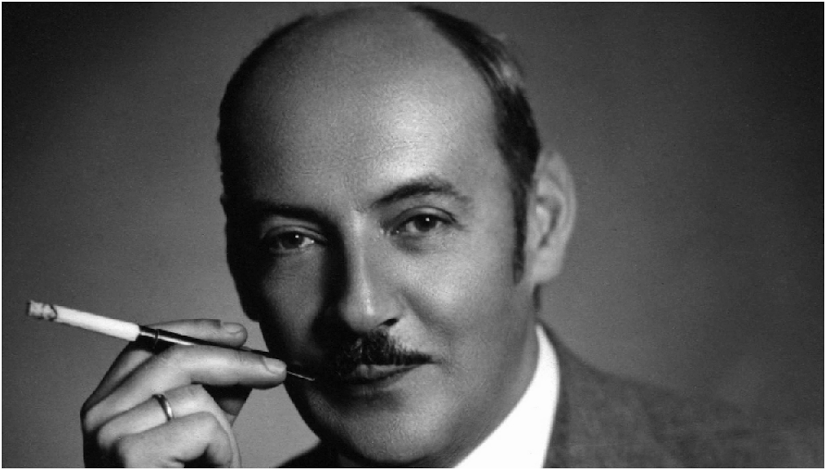
Albert Goering, looking elegant in this studio portrait from the early 1930s, was the brother of Nazi number two (literally– big, unflushed number two) Hermann Goering. Albert was quietly but resolutely anti-Nazi, and actively saved people during the Thousand Year Reich.  He was on the Gestapo’s radar several times, but Hermann stepped in to squash the investigations.  After the war he was imprisoned and interrogated with the rest of the war criminals at Nuremberg.  He was locked up for a long time before people he saved began to come forward and he was eventually released.  The rest of his life was pretty much fucked– his name was Goering.

Albert Goering

We take our laughs where we can get them

There was a woman, a very good looking young woman, actually, who had a small business running after-school programs and seemed to grasp the educational and group dynamics potential of the student-run animation workshop.   When I increased the price to about double what the first after-school program was paying, she barely hesitated before agreeing to pay it.   Her assistant was a great and supportive fan of the workshop, she urged me to organize the little mini-animation festival I put on for the kids and their parents.  One day a week or so before the festival the usually cheerful assistant came in and told me her boss had died the previous day.  Cancer she never revealed to anyone she worked with had ended her life at 34.  Her business winked out of existence a few months later.

Fast forward a few challenging months and, temporarily (or permanently) out of public school programming, I am conducting a four session workshop for women with chronic serious diseases.  Some are in recovery from cancer, others show up straight from chemo, some show up once and not again, others make half the sessions.  A core of four is there every week.  These first time animators all produced very cool animation, worked beautifully together, got more and more demanding about seeing the day’s rough cut before they left, high fived each other at the end.   One woman in particular, Liz, was a great innovator.  She came in with brilliant and ingeniously different ideas week after week.  Her animation for the four sessions is here. 

She was excited about assisting at the recent Stevenson workshop, the first I’ve done since last summer.  The day before the workshop she was hit by the flu and couldn’t make it, she expressed her sincere regrets.  I assured her there’d be more sessions, promised she’d be at the next one, whenever I could arrange it.  A few days later I sent her the clip from the Stevenson session, telling her how difficult it had been and that she hadn’t missed much fun.  I didn’t hear back.  I wrote again a few days later, telling her I hoped she was up and around and that I’d be sending her the new website soon.

When the website was done I sent her the link, since she had grasped the idea so well and run with the ball so enthusiastically, once she’d had her head down on the table for the first forty minutes or so of each session.  I emailed her once more after not hearing back, and was beginning to fear the worst for this talented woman I barely know.  I have gleaned that she is living with cancer, and that it is not easy living.

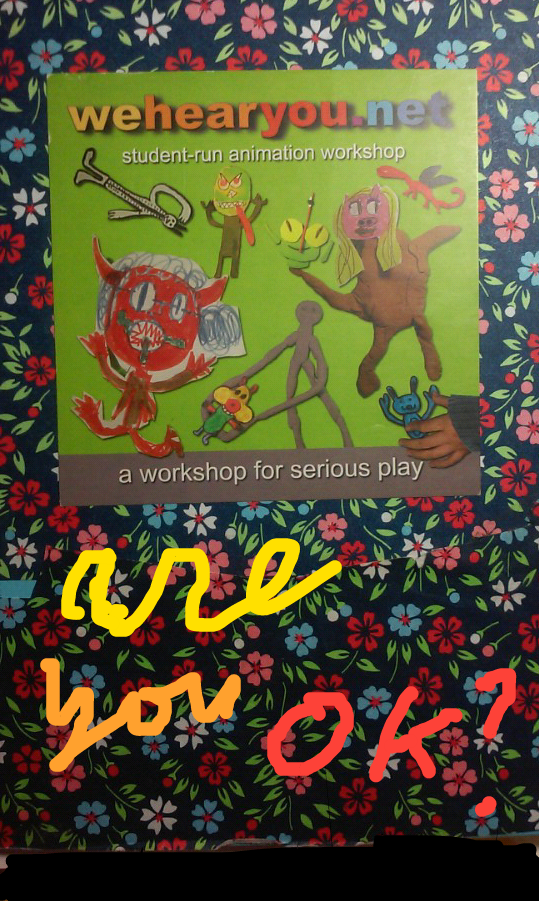
When I got a smart phone I texted her that I’d joined the 21st century, hoped she was over the flu and feeling better and added this picture.

Are You OK ?

Several days passed, and hearing nothing from her, I imagined the worst.  A gloomy thought twisted its way into my head: this workshop is the accursed kiss of death to the rare women who really get its potential and find it compelling.  

Then tonight, at 1:35 a.m. a tiny bell in my pocket sounds, and she’s texted:

Congratulations!  Sorry for the delayed reply.  I’m so so happy flowers are growing (emoticon of red flower) Rain makes it happen (yellow umbrella) Happy Spring!

I wrote back:

Thanks.  Good to hear from you — and happy Spring to you, too!

I hope you don’t have any objection to this wonderful bit of work being here (and I sent her the link)

3:42 a.m.  I’m glad you sent this.  I’m very upset and can’t sleep.  Seeing this animation was uplifting.  Thank you . … (emoticon of girl holding up hand)

3:45 a.m.  I’d share this on my Facebook (emoticon of two people holding hands) except one thing.  If it’s not too much bother, I’d like an edit…

Here I had an actual laugh.  A small one, yes, but genuine (nobody here to impress with a fake laugh) and, like I said up top, I’ll take me larfs where I can get ’em.

3:49  the part with the butterflies has the cat jumping in. (Cat head emoticon)  At one point its head changes to a dog.  That’s not my taste (slightly disgusted looking emoticon)

3:52  I’d post your page without hesitation if that part were eliminated (a series of emoticons animating a round yellow face bursting into a laugh)

3:55  Thanks for replacing maddening thoughts with delightful ones.

She made my day with that one.

4:08  I enjoyed Jesse’s project!  (gold star emoticon)  The patterns in the beginning are well done.  The tumbling guy has fun hair.  (emoticon of a thumb up)

4:14   I will try to sleep and think of (emoticon of rowboat, I think) being inside (angel fish emoticon) animation (some kind of water emoticon).  Thank you. (emoticon of little angel head with halo).

Honor Anemia

The man who made the case that many in our society suffer from Honor Anemia was himself a highly respected member of our civic society.   He was treated with deference in restaurants he frequented and he always handled this attention with smiling graciousness.   It seemed strange that the theory about people craving respect was his, but here it is:

We live in a society where many people feel disrespected.  They crave the honor of being treated fairly, recognized for their efforts, they suffer greatly from the lack of it.  If you give somebody a title, special recognition, it goes a long way.   Honor anemia can only be palliated by giving honor of some kind.

Dale Carnegie noted the same thing a century earlier, if you want to make friends and influence people, and sell things to them or get them to do you favors, you need to make them feel appreciated and important.   Carnegie, and my friend decades later, noted it and it will be noted again, as the lack of respect many people feel is a major cause of anger, depression and violence.   Anger, depression and violence– aren’t those really phases of the same thing?  

We live in a culture where the bottom line more and more requires the individual to be placed on hold, thanked for patience he doesn’t have, forced to talk to robots, get calls from recordings asking him to press numbers so he can get in line to speak to a human who will give him shit about something, usually a bill.   We live in a culture organized on the myth of the free individual and his inalienable rights, yet very few get to be treated as unique individuals.   Much suffering flows from this anonymizing of most of us.

“You think too much, you write too much and you’re giving me a head ache.  Would you do me the honor of shutting the fuck up, please, at least while I bolt this crappy, high-fat, low-nutrition fast food dinner I’m trying to get down?”

“Of course, sir, my bad.”

How exposure to adversity effects the developing child

I’ve known people, my mother was one, who although very intelligent, open to considering new ideas, otherwise insightful, would rather kill you than acknowledge their own anger or the harm that was done to them in childhood.   Literally, repressing enough pain that they looked like they’d rather kill you than admit to being angry enough to smash someone.  

“We never fucking killed anyone, asshole!” they say as a chorus now in my mind, I can see their faces, not relaxed, calm or even, in some cases, recognizable as themselves.  

“‘Face twisted and contorted in hate,'” my sister quotes our father, and we both laugh.  It was a phrase we heard many times over the Rice-a-roni, flank steak and salad at our formica dinner table in Queens.  It was snarled, this peculiar phrase, and stated in exactly those words each time.  A very curious phrase to be repeated verbatim, if you think about it.

 “Twisted AND contorted,” my sister will say, and we’ll both have another chuckle.  But we were not chuckling then, during those terrible battles, nor am I chuckling about it now.  

My sister, working in a terrible school, is afraid to apply to move to a better one.  “It’s a concentration camp but I’m used to it,” she says, “and I don’t want to leave all my friends I’ve cried with for years.”  She agrees it would be better to make new friends she could celebrate with sometimes, instead of just crying and commiserating, but, in spite of being a master teacher, and someone who makes friends easily, she’s afraid to change schools.

“I’ve told your sister a thousand times what a wonderful teacher she is,” said my father on his deathbed, “but no matter how many times I tell her, it makes no difference.”  

“A thousand times?” I ask him.  

“Many, many times,” he says, remembering distinctly the time he told her that, at the assembly at the school where her class performed, and another one, more than one, besides.  To him that was a lot.  “I told her a thousand times,” seems to indicate that.  

“A thousand times,” says my sister with her trademark irony.  Not for nothing did she dub her father the D.U., The Dreaded Unit.  

“You are a whiner,” says an observer.  

“Do you hear me actually whine?” I ask the jury.  On closer inspection I notice the jury is composed of a couple of weatherbeaten mannequins, a decomposing cadaver, three skeletons and a few unidentifiable animals preserved by amateurish taxidermy and propped crudely on the chairs of the jury box.

The judge, for his part, is indescribably horrible.  Good thing this is a jury trial, I think to myself.

NOTES

How does it work? Well, imagine you’re walking in the forest and you see a bear. Immediately, your hypothalamus sends a signal to your pituitary, which sends a signal to your adrenal gland that says, “Release stress hormones! Adrenaline! Cortisol!” And so your heart starts to pound, Your pupils dilate, your airways open up, and you are ready to either fight that bear or run from the bear. And that is wonderful if you’re in a forest and there’s a bear. (Laughter) But the problem is what happens when the bear comes home every night, and this system is activated over and over and over again, and it goes from being adaptive, or life-saving, to maladaptive, or health-damaging. Children are especially sensitive to this repeated stress activation, because their brains and bodies are just developing. High doses of adversity not only affect brain structure and function, they affect the developing immune system, developing hormonal systems, and even the way our DNA is read and transcribed.

Nadine Burke Harris, MD

source

Expectations

“You expect too much, that’s why you get so cruelly disappointed,” he said.

“Perhaps,” she said, “but by expecting nothing, to minimize disappointment and keep alive the dim hope of a pleasant surprise, don’t you also sacrifice standards and ideals?”

“Maybe so, but keeping my expectations low is more realistic than expecting the rare excellent things that are so infrequently delivered,” he said.  

“Mmm,” she said, “it is a lot to expect to be heard, I suppose.  We talk most of the time to hear ourselves talk, because we need to speak, after all, not as a way to thoughtfully mull over what the person we are talking to has expressed.  It’s the way of the world.”  

“My work here is done, sister, you have grasped my essential point.  Until you get in the habit of expecting nothing, you will always be disappointed, given the way of the world, as you say.”  

“Mmm,” she said, “still, isn’t the way of the world also to wage war, to rage when frustrated, to expect the worst will always happen, to justify torture, to accept our powerlessness against any of the many gigantic, ruthless forces arrayed against us?  The way of the world, isn’t the profit of the privileged always bought at the expense of 98% of the world’s inhabitants?  At the price of the destruction of the planet we live on and the extinction of most of its life forms?”  

“My little socialist,” he said, smiling.  “Surely you don’t expect any of this to slow down in our life times.”  

“Nobody expected the end of child labor,” she said.  

“We fixed that by making international business treaties that allow child labor anywhere but here.  Many of our goods are still made by child slaves, and it keeps our prices down, I might add. You feel like paying $2,000 for an iPad made by workers protected by fair pay laws?”  

“Nobody expected the United States to do away with slavery.  Jefferson and Madison, who both owned slaves, were typical of the antislavery visionaries among our Founding Fathers, and yet…”  

“All it took was the bloodiest war in American history and a century of legally winked at lynching, et, voila, a small percentage of formerly enslaved people are now as free as anyone else who has enough money,” he said.  

“You make a good point, but it doesn’t swallow the larger point,” she said.

“You say most of us don’t have conversations where we really take to heart what the other person is saying.  That may be so, in one sense, in your experience.  Yet every day, a million times an hour, these kind of conversations are conducted by salesmen.  Salesmen must be adept and sensitive listeners and respond to what their potential customers want and need.   If a salesman doesn’t speak in a way that… why the look?”  

“What people do to earn their living is not the same as what we do in our most cherished private encounters,” she said.  “A psychiatrist may listen carefully and respond thoughtfully…” she began.  

“Oh, here we go!” he said, louder than before.  

“Why is that so threatening to you?” she asked.  

“Oh, boy!” he said.  “It’s not like we haven’t had this conversation ten or a hundred million times.   I get it, I get it.  I GET IT!”  

“What do you get?” she said.  

“Oh, no,” he said “I’m not going to go there, let’s not and say we did, I know you are but what am I?  Hoo boy, no, no, no.  Not again, never again.  You are singing a one note samba built upon a single note.  What is it with you?  Why, Dolores, why? I mean, really, Dolores, for fuck’s sake.”  

“No,” she said, “you are absolutely right.  Anyway, I brought you the cookies you asked for.  Here you are.  And I will try to get back here to visit you next week.”  

“That’s very nice of you, Dolores,” he said, getting up and taking his long coat off the table.  “Thank you so much for the cookies,” he said, “they look delicious.”  He shrugged into his coat, gave her a hug.  

“Anyway,” he said, “thanks for coming to see me.  It always makes me happy when you find the time.  Once again, you’ve made my day.”  

“And you mine,” she said, smiling happily.   He smiled back and turned to walk down the long, depressing hallway.  

In the elevator he took a long breath and shook his head.  “Some fucking world,” he said to himself, as he pulled up the collar of his coat and headed through the lobby and out into the street to hurry back to the office.

Illuminating Quote

“All violence is an attempt to replace shame with self-esteem.”

James Gilligan is a psychiatrist who spent years working with violent inmates and is the author of a series of books on our epidemic of violence.

Looking forward to checking some of these books out.

Untangling Knots — maybe

A few moments spent trying to untangle a knot about some ways people deal with the painful things that happen to them in life.  

For a child raised in an angry home, or a cold home, or in a place where little physical or emotional support is given, the options in adulthood may seem limited.  

The adult can say, as many do:  I turned out OK, all humans have problems, when I stay busy I don’t think about bad things, the past is the past, I’ve made a decent life for myself, people love and depend on me, I may have a temper, and my faults, but I’m basically a good person.  

The adult can say: what was done to me was wrong, no child should have to endure abuse, though millions unfortunately do.   The parents were perhaps incapable of doing better, but damage was done.  On a cellular level, it turns out.   Steps must be taken to acknowledge the harm done, identify it clearly, begin to heal real wounds that were inflicted.  That the infliction of these wounds was largely unintentional does little to mitigate their ongoing harmfulness.

Some adults will be infuriated by adults who take this second approach.   The idea of a person feeling entitled to revisit the wrongs done to them drives them into immediate anger.  They may begin, as my father always did, to reflexively compare any complaint to what they themselves have endured and, in their mind, surmounted.  This reflex short circuits empathy.   The new complaint will always emerge to them as a whine, a cavil, the sniveling of a weakling.  

That there are sniveling weaklings who justify their own failings, even brutality, by their victimhood, there can be no doubt.   Depending on which side you feel more drawn to, the very words I’m typing now could be seen this way.   Of course, unlike the child being hectored while held by the collar, you need not read another word of it, nor consider:  

To many people it seems preferable not to dwell on childhood injury.  To others, it’s a necessity, attempting to understand and overcome the harm and live a more intact life of integrity.  When I get that burning in my lungs during someone’s attempt to bully me, I know exactly why it happens.  Many others are not so “lucky”, or lucky, as the case may be.  

Then again, luck, I suppose, is largely a matter of luck.