Personal vs. political

I am sitting alone, having my daily silent conversation, ostensibly with a reader, (with you, dear reader!) though one can pretty easily see that I do not write for a great number of readers. [1]   It doesn’t matter if you write for one person, as in a letter, or to every sentient reader on the earth (as many of us strive to write for) the process is the same.   It is a personal process and also a political process.

No less an authority on the subject than Adolf Hitler wrote, early in his life, that art is a bridge from the artist’s heart to the heart of another.  He later applied this same principle to the art of political propaganda.   Too bad the little shit was rejected from art school, his hissy temper tantrums at art critics and gallery owners without taste would have served the world much better than the ones he threw on the world stage, but that is another matter.   No idea why I am thinking about fucking Hitler right now. [2]  

I guess, to say, the exercise is essentially that —  building a bridge from the self to others outside of the self.   Writing clearly is the goal; making it easy for the reader to follow our guided tour through our thoughts, ideas and feelings.   These are three different things, thoughts: what goes through our minds as we ponder, ideas: conclusions we come to about the things we ponder, and feelings: our emotions as this is happening.   All three of these are important, essential really.  When we write we explain what we are thinking and feeling to ourselves, in the process of setting it out clearly to the imaginary reader.  

Kurt Vonnegut always wrote imagining his sister, who was a great reader, his ideal reader, reading the page.  If the joke would make her laugh, it was worth keeping in.  If the image would make her eyes grow moist, her nostrils flare slightly, the image stayed.   If she would roll her eyes, or not buy it, or find it pretentious or ridiculous, out it went.   His writing appealed to millions, appeals to this day, but he wrote every word, to hear him tell it, imagining his sister as his only reader.  Good enough, I’d say.  We write, on one level or another, to that imagined sensibility, the sensitive reader we’d love to be reading our words.

My mother was a great reader and I can often picture her reading a sentence or paragraph I’ve just written.   She had a great grasp of language, and a love of it, and a poetic imagination.   She didn’t mind something being just a little cartoonish, if it served to make the thing more clear, the feeling and colors more vivid, the conclusion that much more emphatic.

The dialogue we have when we are alone… I don’t think I could put a price on it.  In the previous post Hannah Arendt is quoted as believing:

The passion of being was in thinking. And that comes from that two-in-one dialogue in one’s head.  And for her, that was the beginning of moral life, that dialogue.  

Can I get a “hell yeah!”?   The world is vexing, often perplexing, the only quiet we often get, and the best chance to get any real perspective (if we are persistent and lucky, and disposed toward this exercise)  is sitting by ourselves, thinking through this kind of quiet inner dialogue.   All around us busy people are complaining:   “I don’t have time to think!”  “I don’t know whether to shit or wind my watch!”   “Who has the time?!!!!”  “It’s all too much!”    “I can’t watch the news, it fills me with dread and hatred!!!”

I am a man with the luxury of time, and I spend some of it each day doing this, having a silent chat with someone I’ve never met as I run everything by myself.

How do I make the time?   Admittedly I save a lot of time every day by doing virtually no cleaning.  I clean my kitchen sink regularly, and keep all decomposable food garbage in the freezer until I take it out, I clean my bathroom occasionally.   Outside of that, and a hump to the laundromat with a heavy bag every couple of weeks, I live in a chaos that would be embarrassing if photographed.  

I could see the horrified jurors:  “Look, ladies and gentlemen, if you have the stomach for it, at these photographs of the defendant’s living room…”   The prosecutor could rest his case after showing the shots of the jammed shelves, the overflowing tabletops, the collapsing piles of boxes, the carpet of papers covering everything, the tangled chaos on the floor, the cracked walls, ceilings and broken tile floors.   A jury of my actual peers would be a slovenly twelve indeed, but that is not the point.  I’m not competing for a spread in Better Homes and Gardens.

I also have the great luck not to be a covetous person, which saves time too.  A friend who plays guitar OK and has a couple of beautiful, expensive guitars– I say, God bless him!  Truly.  I’m not the envious type.  I don’t waste time or emotion measuring what I have against the acquisitions of other people.  I’m content to own what I need, to preserve the things I love– favorite pens, knives, musical instruments, to use things up, to wear the same shirt for a decade or more.   One of my favorite shirts is one my mother always liked, I wore it to visit her at the hospice the last day she had her eyes open.  It was the last shirt she saw me in, and she smiled to see it.   A colorful affair it is, purchased at Costco once upon a time.  My mother died eight years ago.  I wear the shirt now for special occasions, rarely mentioning the shirt’s connection to my mother’s death, how she smiled to see it one last time.

There is the personal, the things that matter most to us, the things we find most fascinating, compelling, irresistible.  These things vary greatly from one of us to the next.  The realm of the personal, though, is something we all share.  We all take certain things personally and we can all relate to exactly why that is.   If you can illuminate your personal passions three dimensionally enough you might draw somebody through that doorway, into a world they never appreciated before.  It’s like the old adage (and a wise one, too) that you take the professor, not the course.  You can sign up for the most interesting sounding course in the catalogue, only to find the juice and life sucked out of it by a cadaverous professor.  The flip-side is that you can take a course that appears less than marginally interesting in the course description that turns out to be fantastic, because the professor is brilliant and draws you into her love of the subject.

The personal, we are often reminded, is political, as the political is personal.  Take the average partisan voter, they take their politics very personally and their political views flow from the experiences of their personal lives.   If liberal they get exercised by the idea of racism, the state’s overbearing interference with a human right (abortion comes first to mind), the grotesquely uneven distribution of wealth and opportunity, the destruction of the natural earth by greedy corporations mining the last scraps of the world’s resources and poisoning everything.   If conservative they are pissed off at “political correctness”, the idea that every lazy poor person feels entitled to free food, free medical care, a low-cost place to stay, a cell phone, fancy sneakers, sickened at government interference with human rights– like the right not to be killed as a fetus for the convenience of an immoral pregnant woman– job killing regulations to save some endangered bird or rodent, on down the line.   These issues are litmus test left-right issues.  Abortion.   Poverty.   Catastrophic Climate Disruption.   Regulations.  Income inequality.

Also, all deeply personal issues.   This is where the rubber meets the road, as they say in that big cliche mill in the sky.   The successful politician makes a personal connection, as, say what you will about him, the current president has undoubtedly made among his supporters.   He speaks plainly to them, speaks the way they do, doesn’t worry if a bad word slips out, everyone uses a bad word sometimes.   Fuck those sons of bitches, you know what I’m saying?  Am I right?  Seriously, (a huge huzzah of approval) fuck those fucking losers.  We’re going to bomb the shit out of those motherfuckers!  You know what I’m saying?     His audience roars, they know exactly what he’s saying.  

He is a star because he speaks a language his audience takes very personally.   His opponent in the last election, whatever else we might say about her,  did not have the same gift, was not as able to make that personal connection, even as she was arguably more personable, certainly less abrasive, than our current attacker-in-chief.   Partisans will argue over which one was the bigger liar.  We must not forget, the last election was a close contest between the most hated and second most hated political personalities in America.

I have long believed, and do even now, that if people of good faith and good will sit down to solve the local version of world problems, there is much even political opposites would agree on.  The argument against this is the way “winning” politics is conducted in our intensely commercial society.   It was discovered at some point that negative campaigning wins elections, if you can get people to believe your opponent is a pedophile, for example– you have a huge advantage with the voters.  

Newt Gingrich and his friends made a science out of “wedge issues”, hammering on the emotional issues that divide us into opposing camps.   The Democratic party’s response was to try to make their tent big enough for everybody, by carefully not offending anyone.   Which in itself is kind of offensive to many, particularly if you adopt the worst ideas of your opponents in the name of “compromise” while engaging in the standard servile courtship of super-wealthy human and corporate donors.  

The Democrats’ inclusive approach was disparagingly branded “identity politics” as though the politics of the conservative is not also based on identity, and carved into the other side of the same stone.   On and on.  Blue hat, red hat.   Blue asshole, red asshole.  Brands, mere brands in a culture raised on brand loyalty, steeped in the consciousness of brands, understanding quality only through brand names.

What is my brand?   Not having a brand.   (see footnote 1)

“Not much of a goddamned brand.   Excellent brand for a loser, though, I have to give you that.”

The tone of the conversation in my head is calm, as honest as I can make it, with a bias toward trying to be fair.   If we are fair when we analyze a problem, the odds are better we’ll come to reasonable ideas about how to solve it, or at least make it better.   The alternative is an eternal contest between sullen, immovable two year-olds.

The trouble with voting for a brand, being a partisan, is that very often no thought at all goes into taking rigid positions that are always presented as either/or.   Spokesmen for our self-identified brand will tell us what side to take on any given issue, assuring us that there are only two sides to any issue, an imbecilic position few bother to question.   Good people don’t kill fetuses vs. good people don’t force fourteen year-old rape victims to carry the rapist’s baby for nine months and give birth to it.   There are arguments on both sides, I suppose, and a world of nuance between these two absolute views but the ones that begin “God said”… well, enough said, I think.  

I say believe in God as deeply as you like, and may the good, merciful things you do multiply as your faith deepens.   Personally, I have no problem with the righteous of any religion, until they come with swords, because God told them… you know.

Meantime, the conversation continues, as all good conversations should.


[1]  When I get a “like” I generally try to return the favor and like something on the liker’s site.  I read something I like and click like, and am often number 399 liking that post.   A big post for likes, in my case, is four or five.

I shit you not, I got a couple of likes on this very post today, went to the blahgs, read something I liked and clicked “like”.  Czech it out, eerie, crazy:

Screen shot 2018-06-29 at 2.31.43 AM.png

[2] Not a day goes by… I had a great experience recently, a nervous, chatty guy I was waiting for a medical procedure with (by pure chance, never met him before), as we went up in the elevator, asking me what my ancestry was.   I assumed he was asking if I was Jewish, so I told him where my people came from.  “You’re a Jew?   Jesus Christ,” he said, which I repeated with a big smile.  I love that kind of shit.  Only tangentially related to not a day going by without some thought of Hitler, this guy certainly didn’t strike me as an anti-Semite, but… Jesus Christ!   That was great.

Hannah Arendt, towering intellectual It-Girl

I am, apparently, not the only one currently reading Hannah Arendt’s massive and fascinating The Origins of Totalitarianism (there’s a line waiting for it at the NY Public Library).  It may actually be back on the best-seller list, for reasons impossible to fathom.   One of those accidents of history, I suppose.   Sekhnet alerted me to Krista Tippett’s great interview with a British academic and author, Lyndsey Stonebridge, who recently re-read Arendt’s collected works and wrote an article on Hannah Arendt.   You can hear their conversation HERE and, bless Krista, there is also a full transcript of their edited chat.

Krista quotes Hannah Arendt:   

“What prepares men for a totalitarian domination” — and here, again, is what happens in the human heart and psyche and society that makes these things possible — “is the fact that loneliness, once a borderline experience, usually suffered in certain marginal social conditions like old age, has become an everyday experience of the ever-growing masses of our century.”

Loneliness, which has multiplied exponentially in our cyber age.  Loneliness and the disconnection that leads some to despair, tens of thousands of Americans annually to death by drug overdose, gunshot, hanging, suicide by police, by drunk driving.   Loneliness, which makes people join mobs, if they get the chance, chanting idiotic slogans by the flickering light of Tiki torches.  

Loneliness, which has been monetized by shrewd fucks like Mark Zuckerberg (to the tune of $74,000,000,000 personal profit and counting) and organized by algorithm into potent personalized political propaganda delivery, instantly to your pocket, or bedside, with a little notification beep to remind you it’s waiting.     Loneliness is the source of much human misery, and, as so often with massive human misery, there’s gold in that misery (think of slavery, Imperialism, the coal mines, the original factory system).

Here, at the oddly placed footnote below, Krista and Lyndsey Stonebridge talk about the power of a provocative lie versus the feebleness of factual truth in politics, something that has an unaccountable relevance at the moment, though, again, hard to put my finger on why.   [1]  

I need to read more about Hannah Arendt’s life, her soul calls out to me from another world.   I feel she is a precious wise ancestor I’d be good friends with.   I recall her description of an assimilated nineteenth century Prussian Jewish woman of great wit and charm, one Rahel Varnhagen,  who held a salon where actors and other artistic and intellectual misfits gathered.    Of Rahel Varnhagen Arendt later said, (Wikipedia informs us)  that she was “my very closest woman friend, unfortunately dead a hundred years now.”[13]   I have similar feelings about Hannah Arendt, though she’s been dead far less long so far.    Here   is a nice short piece about my dear friend Hannah, with numerous linked quotes and articles.

Here is what she thought about thinking:

MS. TIPPETT:  … And honestly, Americans have a very conflicted kind of relationship, historically and philosophically, with thought and ideas. It’s a different thing than it was, for example, in the Germany that Hannah Arendt was raised in. The power of ideas. But it feels to me like there might be a receptivity now precisely because we see that it’s not getting us anywhere to be meeting my emotion with your emotion. Her — as you say, you can only have moral imagination if you also think, if you are thinking.

You talked in this podcast I heard you in that brought me to you, In Our Time, about how she always talked about the dialogue we have in our heads, that we are constantly working out what it means to be human, to be a person, whether we realize it or not.

MS. STONEBRIDGE: Yeah. She took this from Socrates and then from Heidegger, but her sense of what it meant to be a thinking person was always to be having the two-in-one dialogue in your head, that thinking wasn’t about mastery. It wasn’t about thinking about stuff in order to control it or to rationalize it. Thinking was a way of being.

The passion of being was in thinking. And that comes from that two-in-one dialogue in one’s head.  And for her, that was the beginning of moral life, that dialogue.  

There also follows — there is a notion of judgment that comes through thinking and dialogue. And the ability…

MS. TIPPETT: Discernment. Reflection.

MS. STONEBRIDGE: Well, thinking, she says, is not the same as judgment, but it creates the right conditions for judgment. But also, she says, if you can’t have that inner dialogue, then you can’t speak and act with others either because it’s part of — if you’re already divided in yourself because you’re having this conversation with yourself, and that’s the passion of your being, people who can do that can actually then move on to having conversations with other people and then judging with other people. And what she called “the banality of evil” was the inability to hear another voice, the inability to have a dialogue either with oneself or the imagination to have a dialogue with the world, the moral world.

The inability to hear an opposing view, a voice not your own, to imagine an experience you have not personally encountered.   The abiding curse of our fucking times.

Arendt quote.jpg


[1]     MS. TIPPETT: We’re going to have to wind down here, but I’ve got so much else I want to talk about. But I want to talk briefly and this follows on that idea of lying. Which was one of those elements of totalitarianism, very much a subject alive in American politics now. But something I’m very intrigued getting a little bit deeper into this, and reading her — and I’ve thought a lot about — like a lot of things right now, it’s just out on the surface, what was already kind of fermenting. We already had a crisis of truth, or not being able to speak about truth in a complex way. And we’ve been relying on facts, and facts were never enough. And she makes these — like, here’s her essay “Lying in Politics.” She says that “factual truths,” here’s that. “Factual truths are never compellingly true. The historian knows how vulnerable is the whole texture of facts in which we spend our daily life. It is always in danger of being perforated by single lies, or torn to shreds. Facts need testimony to be remembered and trustworthy domain of human affairs. From this it follows that no factual statement can ever be beyond doubt.” Take us inside that and what that means for us now.

MS. STONEBRIDGE: For Arendt, I think why the idea of thinking and speaking as a form of action are important to her is that what she’s saying there is, you can throw enough facts, you can throw all the facts you like at people, and they will not stick. We had this, in the U.K., and I know you have, too, that it’s — “OK, against the false news we’ll have fact-finding, and we’ll tell you.

And we’ll have a team of researchers, and you just have to look on our website, and we’ll tell you which of those are lies.” And you can scream facts at people until you’re blue in the face, and a lot of colleagues and universities and journalists have been doing exactly that very hard, working tirelessly. And it’s not making any difference. And I think what she’s talking about there is the ability through thinking and communal discourse, to make truth meaningful in the world, it has to happen between people. Which is not saying we just make up our own reality. She’s not saying that. It means that this is why…

MS. TIPPETT: When she says testimony, it needs…

MS. STONEBRIDGE: Testimony.

MS. TIPPETT: It needs experience. It needs human experience around it.

MS. STONEBRIDGE: Yeah. And so I think she — that was why testimony was important to her. It’s why history and the sense of a myth were all important to her because it’s what makes truth meaningful to people together in a community. If you want a culture that’s going to take on fake news, and the political lie, I say as someone who teaches literature and history, what you need is a culture of the arts and humanity. What you need is more storytelling. What you need is more discourse. What you need is more imagination. What you need is more creation in that way, and more of a sense of what it is that ties us to those words and ties us to those stories.

MS. TIPPETT: Yeah. We need three dimensional — we need stories and facts and conversations between people and all of that working together. Right?

Writing, the last refuge of a scoundrel

It is, I suppose, the last refuge of a scoundrel, this sitting and writing out the things that vex you.   Writing on the internet gives carte blanche for every opinionated asshole to have a good purge with no editor to get in the way. [1]  

I had an editor once, I suppose he could be called that, he definitely did edit.   Since the company he worked for paid me $250 for a thousand words, he got the final say on what I really meant.   One of his improvements really fucking got to me, I can tell you for sure.   He took the line “It made no sense to me that a man with all the qualities he possessed could be such an intractable asshole” and rendered it “It made no sense to me that a man my mother absolutely adored could be such an intractable asshole.”  

It made perfect sense to me that my mother loved my father, and I understood the many reasons she did.  I shared many of them myself.   That was no mystery to me. The mystery was that someone with all the admirable qualities he had, and the humanistic ideals, could abuse his children, that was the point of the sentence, the rest of the paragraph.  It was why I had placed the line where I had in the complicated story I was trying to tell in a way too few 1,000 words.

The perfected sentence was clearly much closer to what the editor felt was true, he couldn’t believe, apparently, that his mother had loved his father, an intractable asshole he’d written about in a svelte 10,000 word essay also published on the site.   Fuck him and the knock-kneed, swaybacked turd he rode in on, the dick-fingered mediocrity.   His unsought refinement of  what I really meant made me want to slap him hard, back and forth, smartly, bip-bap!   We eventually had a series of misunderstandings [2]  and I saw that sending future work to him for his random editorial attentions  was not worth the $250 or the emails from friends congratulating me on having my tampered with prose published.  [3]  

Thus it is with the world, my invisible friends.   We constantly have to weigh what is most important to us.  To me, it is finding as much clarity as I can, wrestling things that don’t make sense, particularly maddening things, into some kind of coherence. I am, for better or worse, a life-long student.  I tend to brood and read, make notes, brood, read, stop while walking to make a note.

If you don’t know the people involved, you will probably find my piece about the terrible erosion of an old friendship an interesting read that might apply to your own life.   If you know the people, there will inevitably be a shudder of horror seeing the situation set out so starkly.  I have come to prefer seeing a thing clearly and deciding the best course of action based on my beliefs about the way to be in the world to passively waiting for the next arguably inexplicable assault and the sickening argument that sometimes follows about who was the bigger asshole.  There is nothing to compare to doing an emergency favor for someone and then, instead of thanks, having some shit thrown on you.   I can tell you this from recent personal experience.

I think of something like the president’s current policy of ripping babies out of the arms of asylum seekers, having government personnel lie to the parents that after a short interview they’ll see their kid again, while during the interview the kid is shipped to a prison for children, never to see the parents again.   The first thought that comes to mind, outside of the fact that the privatized prisons where these poor kids are warehoused have some kind of exemption under this supremely corrupt administration, where they get a huge break on the already lowered tax for corporations, is that this is exactly the kind of “feeling out public reaction” that Mr. Hitler’s people used to routinely do.  

Hitler didn’t come to power and immediately open up the now famous Death Camps.   It took years, step by step, to prepare everyone for this final, extreme, previously unthinkable step.  That final step only became necessary, you understand, once the nation was at war.  Step by step, always prepare the next step carefully.   First you gas ‘useless eaters’, people in insane asylums, the mad, the demented, the retarded.   You read the polling carefully.  Most Germans, it seems, had no problem with euthanasia, if it was pitched correctly.   Eventually you will be able to euthanize all enemies of the state, keeping it discreet and secretive and always, always justifying it as a mercy done for the greater good.

(added the next day)  Stop the presses.  The larger point about the incremental nature of the ascendence or evil practices remains, but my example is problematic. We learn from Hannah Arendt that the gassing of “mentally sick” Germans had to be stopped, due to public outcry, after a mere 50,000 souls were “granted a mercy death”.  No such protest was made a couple of years later when the “granting of mercy deaths” was liberally extended to millions of Eastern European Jews and many others who died in the gas (the Nazis preferred poison gas, Zyklon B, was originally developed as a pesticide, don’t you know?)  and by other methods.   

So the fact that Trump and his diminutive racist lapdog A.G. are forcibly, and deceptively, separating parents and children when the family comes seeking asylum, is just one of the many steps toward becoming a society where unspeakable cruelty is as common as America’s Top CEO’s bristling over-sensitivity to criticism.

Look, once something becomes routine, most people will stop questioning it.  It’s human nature, you can only be outraged for so long, particularly if there is nothing you can do about it.   A shame that thousands of children and their families will be scarred for life, fleeing violence in one country to experience cool, rationalized, perfectly legal government violence in the country you fled to.  But what is that next to the brutal scarring that men like the president and his Attorney General must have experienced to make them the vicious people they are today?

That is always the question, in this world so deftly described by the brilliant Mel Brooks in his explanation of the difference between comedy and tragedy.   “Tragedy is when I break a fingernail, comedy is when you fall down a manhole and die.”  If you are not personally the victim … well … you can understand … kind of … an abstraction like why it’s wrong to torture somebody who was turned in for a large reward … on the off chance that he is a terrorist … or wrong, OK, to take a baby from its mother’s arms and lie to the mother, as you lead her away … or wrong to lie, repeatedly, about everything … but on another level these things will never be absolutely, compellingly real to you.   

If an old friend is in a panic to see you, accuses you of malice, gives you the chance to say you were mistaken, or lying, then tells you that you’ve never been a true friend, are incapable of admitting wrongdoing or apologizing, and expresses deep anger for a good deed you did thinking you were sparing his feelings … well?  What is one to make of this?  I was confused as hell for a few days, then, as I digested the constituent parts of it, came to finally see it clearly.

The old friend is prone to anxiety, fears the worst, always, apparently.  This anxiety causes him to live a nervous life where he really can’t always give the feelings of others the same immediate attention he must give to his own feelings.   His friends must understand this characteristic distractedness, his true friends must see past it.   They must make an allowance for this personality trait, even if he can’t always reciprocate.  His life is, in a phrase Springsteen once sung, “one long emergency.”   He has many fine qualities, great intelligence, humor, warmth, but he also has needs that can sometimes obscure these qualities. 

I don’t have great insight into panic or anxiety.  I had to imagine and understand, as best I could, what life must be like for someone prone to that.   Depression I have lived, I get that, but what it must be like living with constant anxiety took some imagining.  I don’t understand being angry for reasons that are mysterious to myself.  It simply makes no fucking sense to have anger you don’t understand constantly simmering in the background.  I have to understand why I’m mad.   It can take time, but most of the time I can put my finger on it.  I get a certain relief when I understand what I’m mad about, I can often take some action that will help.  This old friend has no time for this exercise, and his anger comes out in odd ways.  Like lambasting someone who has just spent a couple of hours being as kind to him as he knows how to be.

This old friend’s oldest son is a mensch, a really admirable young man.  I don’t know him nearly as well as I know his father, but I know enough to hold him in high esteem.   It was the thought of him reading what I had originally posted, a more detailed, much angrier piece, that caused me to take the post down.   His father never reads anything I post here, the son periodically does.   After talking to Sekhnet, someone I’ve never known to pull a punch, telling me I might want to pull this punch, I realized how much the original version could have hurt the son.   It’s possible the revised post might too, but much less, I thought, and there was value to the post in the “larger conversation” I am always dreaming of.

Relationships, like all living creatures, have a life cycle.  It’s hard to see this when you are young and idealistic, but live long enough and you will come to see this life cycle over and over.   When a friendship is mutual everything is cool.  Over time certain patterns become ingrained, resentments can build up.   One guy crucifies the other guy’s priceless guitar.   Anger is stored up.  Distance is inserted between people to insulate themselves from further damage.   Mistrust accrues every time an untruth is uncovered, or an attack happens.  Enough of this shit happens for long enough, the warmth of friendship can cool to coldness.

I haven’t reached that point with this guy’s father, someone I’ve known for about fifty-five years, but I certainly am not confident that my old friend is capable of the kind of self-knowledge I need in those closest to me.  I have friends as neurotic as he is but they have never given me the same cause to doubt their basic good will.   I intend to give my old friend every benefit of the doubt, I’m just not optimistic about the long-term health of our long friendship.  I hate the idea of holding him at emotional arm’s length, for the sake of remaining friends, but that may be the only working compromise available to me.

Consider this, related, if seemingly unrelated, to the incremental way things die.  It would have been unthinkable a few years ago to imagine waking up in the USA every day and hearing the lede “the president attacked”.  This thin-skinned man with the massive inferiority complex attacks someone several times every day.  It’s what he does.   After a few hundred attacks we just take the words “the president attacked” for granted.  It’s tempting to fume about that for a moment, but I’ll rein in that impulse and give one last grunt here.  (You may laugh, or at least grimace, to see how well I rein in that impulse, I suppose).

Professional football players respectfully protesting police violence against unarmed blacks are “sons of bitches” fumes this man who then screeches that they should be “fired!”  His campaign fundraiser crowd goes wild, applauding their hero who basks in their adoration.    One of the bitches tweets that she’s proud of her son, proud to be the bitch who raised him to be such a man of  integrity.   The president, of course, has no answer to this, he’s looking for someone else to attack, the main thing is to keep attacking.  

His daughter, a mannequin-looking woman he’s on record as wishing he could have sex with, busily promotes her many brands while a public servant, profiting handsomely, if corruptly, from her selfless service to the nation.  A comedian points out that she’s behaved with monstrous insensitivity regarding her father’s policy of ripping young children from their asylum-seeker parents’ arms.  The comedian calls her a “feckless cunt” for not confronting her father on this heartless policy, instead of  narcissistically, obliviously, posting pictures of herself hoisting one of her loving children.   The description seems to fit pretty well, feckless meaning “lacking initiative or strength of character, irresponsible” except that “cunt” is the c-word, like “nigger” is the n-word.  It is a word that simply may not be uttered, except at one’s peril.

Now the president gets to be righteously outraged, the thing he does best.  Picture how much restraint it must have taken him not to tweet that the offending comedian, Samantha Bee, is the cunt.  “She’s a cunt, not my daughter, her, she’s the fucking cunt, with a mouth like a fucking toilet bowl full of disgusting vegan shit!”   He could have tweeted that, but he’s the president and aware of his power as a role model, so he merely ranted a bit without profanity about no talent, loser Samantha Bee and her low-rated show and called for her to be fired.   The First Amendment is overrated, he thinks, even as the sacred Second Amendment is constantly under attack by liberal c-words and n-words who fucking hate our freedom.  Lock her up, lock her up!

USA!   USA!!!!!


[1] With WordPress you can even do it for free!

[2] A nice example is outlined here, along with a 1,000 word piece he actually solicited, one he rejected as “strangely unmoving”.

[3] WordPress bots helpfully provided a link to an earlier piece, which has more a bit more detail and nuance.  Vous pouvez clickez ICI,  mes amis.

The Larger Conversation

Perhaps this conversation exists only in the realm of imagination, a place where I do like to hang out, but I believe there is a larger and more important conversation, an enriching conversation about principles, context and perspective, that is rare in our daily lives.  I see this dispassionate dialogue about principles, integrity and fairness as an island of peace in a world of war.  It is the imagining of a world where one does not have a gun thrust into one’s hands along with extreme pressure to shoot at the enemy.  

I write much of the time intending to contribute to this larger conversation, though, aside from reading the words of others engaged in this project, it is a mostly one-sided conversation.   A silent one on my end, for the most part, unless I manage to find publishers for my contributions to the conversation.

George Orwell put a finger on his motivation to add to this larger conversation:

I write it because there is some lie that I want to expose, some fact to which I want to draw attention, and my initial concern is to get a hearing.

He expressed it as one of the four major motivations for writing:

(iii) Historical impulse. Desire to see things as they are, to find out true facts and store them up for the use of posterity. [1]

A specific case is needed to illuminate the nature of this larger conversation I am imagining.  In the case of my endlessly long draft memoir of my father’s life, certain motifs and themes emerge.   Not everyone, I grant you, is disposed to ponder painful personal matters.  I’ve always been drawn to ruminating and seeking some kind of understanding, a predisposition reinforced by my upbringing, I suppose.  

For me, an ongoing vexation cries out to be examined, turned carefully in the hands, set aside to cool, examined again, combed over for clues, set into a larger context, reconsidered, clarified. Writing is an essential part of this process for me, putting my thoughts and feelings in order, expressing them as plainly as I can, as clearly.  In time, sometimes, a certain peace can be obtained about something that was formerly only a torment.  It is the peace of finally understanding something essential in what only recently made absolutely no sense.

Specific: my father was verbally abusive to my sister and me.  His language, when he was in a rage, was extreme.   He regularly assaulted his children in ways that made me wonder if a simple beating wouldn’t be more merciful.  My many attempts to have a conversation with him about this abusiveness were in vain.   In hindsight, it was predictable that my father, being also a man of conscience, humor, ideals, great intelligence, himself the victim of unthinkably brutal abuse that started when he was an infant, would be incapable of productively discussing his abusiveness.  The subject, naturally, made him very uncomfortable, defensive, angry.

If I succeed in setting out my father’s brutality in a nuanced way, showing the harm it inflicted and the terrible harms it flowed from, as well as the torment it must have caused my father, the reader has something to work with.   People who have experienced something similar in their own families are likely to be engaged by  a detailed dissection of this familiar syndrome.

Questions of forgiveness come into play, how do we forgive an abusive father, why would we?   The reader will understand from my account that the son had largely forgiven the father by the time the father was expressing his terrible regrets the last night of his life.  The exposition of this process, the true understanding that the father’s brutality was, hard to understand, also a tragedy inflicted on the father, could be helpful to others struggling with the same difficult feelings.

Those who knew my father, who know me, having all required preconceptions will only be able to take in part of the story, only be ready for a piece of the larger conversation.  The partisans will pipe up.

“Well,” those who simply loved and admired my father might say,  “you paint a mighty unflattering portrait of a very fine man”.  True, perhaps, but also a true portrait, I believe.   My goal as a portraitist is not flattery, but verisimilitude.  Can you picture how the subject of this painting draws a breath, moves, persuades?  

We can, instead of delving into more important aspects of the person’s life, the lessons we might draw from it,  be distracted prosecuting a devilishly detailed argument over how fair or unfair a portrait I have painted of the fine man, since feelings are bruised on both sides.  That argument will get us no closer to larger, more important truths, only connect us more firmly to our deeply held opinions about this person or that one.

“Well,” those familiar with my long refusal to monetize any of my skills, my long battle with my father, might say “isn’t this in large part just the ravings of a frustrated man who believes himself more insightful than most, the kind of self-righteous egotist a father might well endeavor to teach important life lessons to?”   Etc.

The reader who has never met my father or me has the great advantage of reading the account without prejudice.   That reader alone will be in position to decide if the narrator is credible, if the history seems fairly presented, if the voice of the dead man is three-dimensional, the voice of a real person.  Paradoxically, by not knowing the people involved, this reader can best judge the credibility of the account.  That reader, having read the book, will be in good position, if she desires, to take part in the larger conversation about the themes and potential lessons the story raises.

There is a lot of nuance in our world that we are often too distracted to appreciate.  A person can often be a wonderful friend, warm, funny, sincere, playful, and also have a mean streak.   A mean streak seemingly beyond their control, a mean streak driven by inchoate anger.  Inchoate in the sense of incoherent, generalized, not understood or developed.   Many of us are subject to this kind of faceless anger in some form from time to time.

Anger plays a part in every life, as often as not on an unconscious level.  An angry person is the worst version of himself: rigid, self-righteous, hurt, flailing, justified in violence, incapable of empathy, reason or love.  

Anger comes most directly from personal hurt.   You, personally, are treated like a powerless asshole, told you’re mistaken about essential things, treated as someone with no right to your hurt feelings.

Anger at powerlessness is a common human experience.  Even living in a great democracy like ours we are confronted daily by policies, carried out in our names, that make us want to scream, things we have absolutely no ability to influence.   These accumulated common public “fuck yous” give rise to the serenity prayer, asking for the simple ability to not be enraged by maddening things we have absolutely no control over.  

Torture, extrajudicial execution, two tracks of criminal justice — a merciful one for the wealthy and a merciless one for every other low-life motherfucker, the world’s most expensive and often inadequate medical care (while tens of thousands of Americans still die annually for lack of any medical “coverage”), corporations as persons, disputing the legal right of a fifteen year-old rape victim to terminate the unwanted pregnancy, denial of the plainly observable curse of man-made climate disruption, forcibly taking children of asylum seekers from their parents, insisting from on high that there is only one way to be a patriot in America [2] and doing everything in your power to make sure those who don’t conform to that single way are punished [3], on down the endless fucking list.

Remove the personalities.  Forget what Trump says and does, what Obama said and did, forget Mitch McConnell and Bernie.  It’s hard to separate the principles involved from the individuals who throw these things in your face, I know, particularly the way issues are packaged and presented by partisans.  Removing the distracting personalities from the conversation is the only way to weigh the issue fully and fairly.  It is very hard to do.

The larger conversation I am seeking involves putting as many available facts as possible on the table between us, both of us able to examine them at our leisure, and coming to as many common understandings as we can.  

I’m not talking strictly about politics, though a larger conversation would be a wonderful thing to have in the political realm.  Actual problems could be solved.   I am talking mostly about the way we treat each other in our personal lives, how we proceed in the world, what we expect to give and receive.  The personal is, of course, also political, how we feel, what we hold most dear, expresses itself in our political leanings.  On another level, the personal is personal– and that personal realm is something we share with everybody else on this miraculous, troubled planet.  

One trouble people encounter in connecting with others is that the personal, what is most deeply precious to us, is often closely guarded and seldom shared.  There is a great deal of fear involved in being vulnerable.  Once somebody comes forward and opens the door, as in the case of millions of sexually abused women coming forward, which started with one brave soul stepping into the light, the larger conversation can begin.  The conversation is not easy, but it’s essential if the need for change is great.

The larger conversation is the one we have with others who’ve experienced vexations similar to our own.   None of us escape troubles.  That is the conversation I mentioned looking forward to in connection to this book about my father, should it ever be published and promoted and reach an audience where some could be moved to enter the discussion.  It could be, as I said at the start, only in my imagination, though I can picture it very clearly.

It begins with seeing the larger principles, untainted by the personalities involved. It moves on, if all goes well, until a feeling of not being alone or crazy in your beliefs emerges.  There are many basic human things we can all agree about, if you remove the fucking personalities.   That’s the larger conversation  I am so often thinking about.


[1] source

[2]  This donkey-like insistence on the only proper way to love America coming from a man, a president no less, who later mouths the words to God Bless America, mangling the ones he does manage to sing.  Of course, “patriotism” is really beside the point– it’s a white supremacy thing for this man, who has the unwavering support of every red-blooded asshole who resents black professional athletes and their undeserved wealth trying to exercise their right to political expression.

[3] And a hearty fuck you to the sheeplike, “patriotically correct”  billionaires who own the NFL teams and wrote new rules to  punish “insufficient, unquestioning gratitude to America” during football games.  Shout out to the NY Jets owners for announcing they’ll pay player fines for anyone resisting this fascistic decree from the NFL owners.


Sitting with Difficult Emotions

The more difficult the emotion, the harder it is to sit with it.   We don’t want to feel the things that hurt us, quite naturally, and we have sophisticated, if often not very subtle, means of not feeling them.   One of the most striking is the method described by Dr. John Sarno [1], who died recently at an advanced age.  Sarno cured crippling back pain in countless patients by having them understand that immobilizing spinal pain, which the mind causes by making the body clench, constricting blood/oxygen flow to crucial muscles and nerves, is more palatable to the psyche than feeling the threatening primal rage that causes it.  Understanding that, and feeling a hint of the emotion behind the physical manifestation, appears to be a big step to feeling better.   Spine surgeons hated Sarno, as did other medical experts.  Bad for business was fucking John Sarno.

I’ve never tested Sarno’s theory, not having suffered from what the good doctor called TMS, Tension Myoneural Syndrome.   But I have often sat with anger, which is a motherfucker to sit with.  Much easier to do virtually anything else, I’d have to say.  Blaming others for your anger is a great alternative, I think you will agree.  No shortage of asshole provocateurs in this world.  Hah!  Done and done.  Nothing a hearty “fuck you!” won’t cure, repeat as needed.  If people weren’t often such merciless pricks, you wouldn’t have to get angry at all.   Anodyne as all get out, no?

In a quiet moment you will realize that blaming and venting didn’t quite work, you’re still angry.  There is a cure for that too!  Endure no quiet moments!   There is so much noise available, sought or not, that we can keep ourselves from moments that will… well, you get the idea.   Stay busy, my friends, and you need never feel things that will cut you too deeply.  Work hard, play hard, pass out, repeat.   It works for many people, I don’t knock it, really (though I also do knock it, clearly).  

 Some consider pondering things like your own anger a form of masochism.  That would be true if you used your anger against yourself, blamed and excoriated yourself for feeling something so ugly.   I don’t advocate self-harm in any form, though you might not know it from my lifestyle, which involves, I suppose, a certain amount of it.  To my mind, and my spine, there is a good benefit to sitting in a comfortable chair with difficult emotions, or taking them for a leisurely stroll.   For one thing, these terrible emotions lose some of their power.  When you sit next to a monster intimately tied to your life you will tend to feel more comfortable with, and less terrified by, the monster after a while.    

Go down the list of the seven deadly sins [2] as an exercise.   Take a fearless moral inventory, if you like.   Note how the seven deadlies overlap.   Do you regularly experience, say, jealousy?   Deal with your feelings of envy by understanding where they come from.  Your fucking older brother got all the credit while you got none, never, not once.  Mom and dad beat the shit out of me, while my siblings got away with murder.  My brother and sister literally murdered and dismembered people, in front of mom and dad, and my parents just laughed and gave them lavish gifts.  If I set the table wrong, the salad fork on the wrong side of the entree fork, I’d catch a beating.  A beating and not so much as a stick of gum, ever.  You wonder why I’m fucking envious of the spoiled bastards all around me everywhere?

I’m not actually recommending anything.  There is nothing to recommend.   We all do what we need to do, constantly.   Me, I need to draw, write, play music.  Can’t help it, don’t sell any of it, even as all three things are done at an increasingly high level, a professional level, one might say.   My problem, when phrased that way, is my stubborn lifelong refusal to even try to monetize any of several highly honed skills.   On another note (accompanied by a lovely, old-timey minor 6th chord), I don’t give a fuck about this world of noise and strife when I am doing what I love.

Not to say that I love sitting with difficult emotions, but the obligation to sit with the stinking bastards comes with being sentient, as far as I can see.   I’d have it no other way.


[1] I have written a bit about Sarno, you can read it here and follow the links for more information about Sarno’s radical, medically disparaged but true sounding, theories.

[2] Anger, jealousy, pride, lust, greed, gluttony, sloth.

Walking into a storm

It’s difficult to remember sometimes, but it is best to remain calm when you are walking into a storm.

Some people, I’ve come to understand, are riddled with anxiety under most circumstances.  They will not remember what you talked about last time, because… oh my GOD!!!  You cannot imagine what it’s like to live with constant anxiety, it has got to be the worst thing out there.  I’m sure I can only begin to imagine it, only because I’m one of those people who take imagination seriously, seriously enough to practice it regularly.   I’ve clung, you might say, to a childish refusal to lose the ability every kid has to wonder about mysterious or amazing things and picture the missing parts.

 The walls in your house are constantly threatening you, they are not straight, they could fall, causing a terrible, agonizing death of broken bones and slow suffocation.  There are a million things to do, crucial protective things that need to be done, and secrets also, terrible shameful ones that can crush you in an instant, but the real threat is that you can only remember to be aware of five or six of these key things at a time.  But there are literally a million!  So many more than can ever be controlled because they can’t even be named! And, of course, it’s the ones you forget that will bite you the hardest, bite you to death, with razor sharp teeth, row upon row of them.

 “We had this conversation last time,” you might say, seeking to avoid going through the whole thing from the beginning,  finding it hard to imagine all that talk was for nothing last time.  Tbe anxious person will say you’re mistaken, eyes looking past you at an approaching catastrophe possibly just past your shoulder.  You know, the whole thing can come tumbling down in a rage of fire and rocks, it happens all the time, but, actually, it’s very late and I have to go now, I should have gone an hour ago, I can’t believe I’m still here!  The Bible may be bullshit, metaphor, whatever you want to call it, but the torments described in it are very real.   Disbelieve at your peril.   Put that pen back exactly where you got it from, it belongs next to the red one.  The RED ONE!   Next to the fucking RED ONE, do I have to explain every…. Oh, my God!  Never mind!   Just give it to me, give it to me, give me the pen, the pen, give me the goddamned pen!

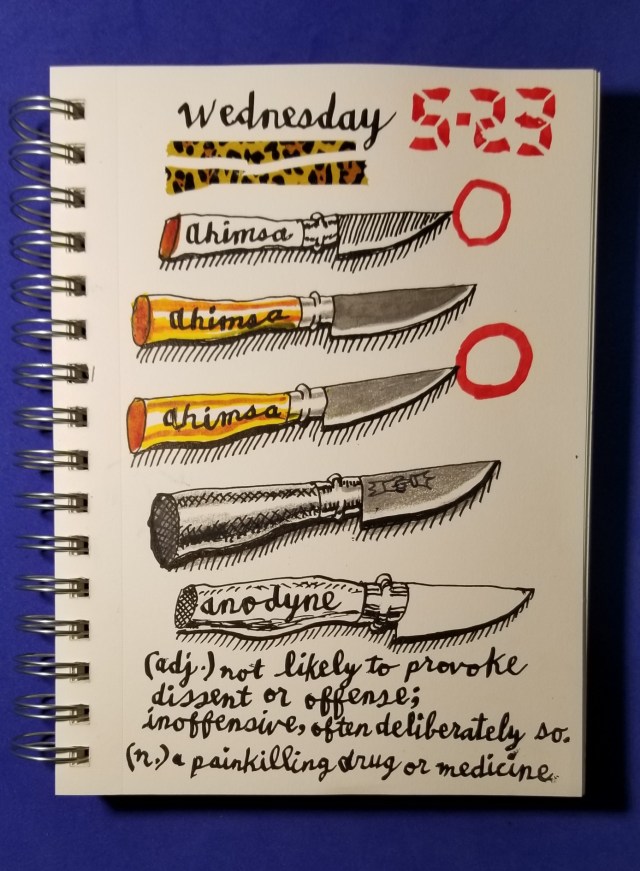
Vocabulary word of the day: anodyne

I was, for many years, prone to writing any unfamiliar word I’d encounter on a bookmark (with the page number next to it) and immediately looking up its meaning in the dictionary.   Then I’d read the sentence armed with this new knowledge and understand exactly what the writer meant by using the previously obscure word. This excellent habit was instilled in me by some wonderful teachers.  I recall, in High School, taking the vocabulary sheets they distributed quite seriously.  Little else they endeavored to teach me in High School meant very much to me, but expanding the number of words I could use to express myself clearly always made sense.

Now, with Jeevsie here, constantly by our side on the ubiquitous internet we carry around with us in our pockets, it is very easy to instantly have any unfamiliar word defined for us.  So it was the other night, when, drawing some knives, relieved that my favorite pen was behaving properly after a few days of struggle with her, I suddenly, unaccountably, wrote the word ‘anodyne.’   

20180524_024132.jpg

After I wrote it (I recall now hearing it months ago from Noam Chomsky describing the ‘anodyne explanations’ we get for each of our most unjust practices) I immediately looked it up.  Which took about 1.2 seconds with our modern data retrieval capabilities.  What a handy little fucker of a word!

We prefer the anodyne to the difficult, without a doubt.  An anodyne explanation usually smooths us down, a difficult conversation often churns us up.  Take American slavery, for example.  One can say, with great conviction and moral certainty, that it was a grave national sin that has not been practiced here for 150 years.  Abolished forever a century and half ago, our Constitution amended to make it perpetually so.  Done and done.  Nice and anodyne, wouldn’t you say?

 I’d be lying if I said I didn’t like a little anodyne myself, once in a while.  And you know how hard it is for me to lie.

A theory

I was thinking idly the other day, as I so often do, when an obvious theory presented itself to me as I walked.   What makes a man a power-crazed, misogynistic, narcissist?   How does a person become a rigid, sadistic asshole?   As George Grosz famously said, to know this we have to study the humiliations the person underwent.

I had a friend who was the youngest of three boys.   He never felt he got enough attention.  His father seemed indifferent to him and his mother, a charming woman, apparently did not give him quite enough undivided attention when he was young.   I’m not a psychologist, nor do I play one on TV, but I could eventually see by the way he lived his life — intent on adoration, constantly disappointed and betrayed, rigid in any conflict, incapable of useful self-knowledge, needing to get the very best out of any and every deal– that he was a deeply damaged person.  He could not avoid conflict, no matter how gently he tried to control the situation.

In the end these traits made him insufferable.  It was his lack of insight into how extreme his personality was, as much as his quirks themselves, that finally tipped the balance.   I later learned, from his oldest brother, that he has been unable to keep any friends.   SAD!, yes, but not that big a surprise.

This poor devil had unrealizable expectations of life.  He expected to be recognized for his musical genius (he was quite talented) and it burned him that even those closest to him did not give him the props he deserved.   His father, for example, was unable to sit still for a long recital of recent piano works.  Father and adult son sat together in a cousin’s apartment where the concert was played for an audience of one.   As the composer played, his father, seated behind him, began flipping through the CDs on the rack next to him.   He reported how his blood ran cold as the cases clacked, how his spine stiffened as he bitterly forced himself to play the remainder of the new opus for a father still totally unable to focus on his youngest son.   I couldn’t help identifying a bit with the man forced to sit for as long as it took for him to finally recognize his son’s undeniable brilliance.  

We, many of us, have unrealizable expectations of life.  Others manage to realize these unrealizable things, which can serve to stoke our own unrealistic dreams.   At times, it appears, these fabulous accomplishments lead one to sourly ponder the old “be careful what you wish for.”   A terminally unhappy person, dreaming that climbing a certain mountain will make them happy, often finds empty bitterness at that peak as they stand there in what should be blissful triumph.   Certain holes in the soul cannot be filled by accomplishments, no matter how lofty.

I was thinking of the most powerful man in the world.   The first man in his job who is constantly attacking people from his phone.   “The president attacked…” is a common daily lede for current news stories.  He is an innovator, of a certain type.   He has made himself part of history.   From my point of view, my opinion only, he is not making himself a very inspiring part of history.  He is, from all appearances, a bully unconstrained by anything but his own need to dominate others.   How does a person get this way?   Walking uptown last night I had a theory.    

His father was known as something of a tyrant.  He had inherited a small fortune, from a truly entrepreneurial father, and, from an early age (the father died when he was a young teenager) began single-mindedly building that small fortune into a huge fortune.   His methods were sometimes unscrupulous, he cultivated political favors, took advantage of government programs for grants and tax breaks, but he built a huge fortune on his real estate empire.  He had a beloved oldest son who had too much of a conscience, from what I can glean, to take the family fortune to the next level.   They had a falling out, the heir apparent quit (and eventually drank himself to death) and the father had to go to his second choice, a younger son who was a discipline problem.

Much has been made of the relationship between the overbearing mentor father and his tiny million dollar loan and the boy sent to military academy to get some discipline, to become a man.  The kid had crossed a line in his bullying when he bought a batch of switchblades, the better to rule his private school schoolyard, I suppose.   After military academy the grooming of this young mogul-to-be began in earnest.   I had a sudden thought last night– what role did the boy’s mother play in all this?    

The man’s father was born to some wealth, and soon acquired fantastic wealth of his own.   The mother had been born poor, was an immigrant.  It is reported that she went personally to the laundromats they owned in her mink coat, driven by a chauffeur, to collect, and then count, the quarters from the washing machines.  Nothing particularly unnatural about this, I think.  I then thought of the effect on her children of this kind of grasping, coin-counting desperation to feel wealthy and important.  The effect on the young son, seeing his dynamic mother trying to act like an aristocrat.  What values could she have instilled in the boy?  We can only judge these by the man’s behavior.

This very public man has made virtually no mention of his mother, outside of canned comments he repeated over the years about her being beautiful and brilliant.  “An amazing woman,” he will say, using the same adjective he used to describe his Healthcare for All plan, the Wall to keep Mexican rapists out, the record size of the adoring campaign crowds who cheer him and every other product he offers for sale.  I can only imagine, by his overt contempt for women (one only has to picture him lurking menacingly behind his hated rival Crooked Hillary during a debate) that his mother, in some fundamental way, gave him only conditional love and support.   The kind of thing that plants lifelong bitterness deep in the heart.   If love depends on being a certain way… well, what the fucking fuck?  I’ll fucking be that way in fucking spades, bitch.  I’ll show you that certain way!    Goddamn it, you want a certain fucking way?   Here you fucking go, you amazing woman.

(Amazing as my long inability to excavate this desk… find an agent, get to the top of that little mountain of dung I sometimes find myself daydreaming about.)

Why So Pissed, El?

I have a great memory, made of a moment that sucked in real time but which has become precious to me over the years.   During one of our normal family fights at the dinner table I became furious.  I must have been eight or nine, maybe younger. 

My mother, who sat next to me, responded by grabbing me by the shoulders and shaking me.  She shook me like a terrier shakes a rat, or a floppy rag doll version of a rat.  In my memory I am limp, and being wagged in the rhythm of her words, almost syllable for syllable.  Picture it: “what (shake) did (shake) any (shake) body (shake) ever (shake) do (shake) to (shake) you (shake) to make you so (shake) fucking  (shake) angry?! (shake)” 

I thought of my reply many years too late.  It was one of those moments some clever grenouille dubbed l’esprit de l’escalier, the bon mot you think of after the fact, on the stairs, the perfect witty rejoinder realized moments too late to deliver.    My missed line was an obvious one: I don’t know, mom, maybe being angrily shaken when I’m clearly pissed off and asked angrily why I’m so fucking angry? 

I don’t offer this story as any kind of indictment of my mother, not at all.  She never gave me reason to doubt her love.   Those fights at the kitchen table were no holds barred, we were all in pure survival mode in the fog of war as we fired our rounds, lobbed grenades, ducked wherever we could.   She and my father were as helpless as we kids were.  I don’t hold it against either of them, at this point, it was just a tableau vivant (although not silent, but screaming) of the Human Condition.

I love the image of the mother angrily shaking her young kid and demanding to know why he’s so fucking angry.

I’m not writing this as part of my Mother’s Day or birthday card to my departed mother.   Though I’d like to note here that an orthodox Jewish friend of her’s, Benjie, hearing that she was in a coma on her 82nd birthday, told me that it is considered a sign of a righteous life to die on your birthday.   

My mother was miles away at the time, in a nice room at Hospice by the Sea, but she seemed to have heard this remark.  She’d always fought with Benjie about what she considered the idiocy of a life ruled by religious ritualism.   She hung on overnight and died a day after her birthday, that way winning one last argument with the religious friend she loved to fight  with.

Why am I angry lately?  On one level it’s the same reason my mother and father were so often angry.  An imposed sense of powerlessness, frustration they had their faces rubbed in over and over.  In reality I am no more powerless than anybody else, I just get more occasion to soak in it than most people I know, living on a small fixed income, as I do.  And, of course, I have much more time to feel my feelings daily, being self-unemployed until I can start selling little slices of myself the way professionals all do.  Few people can have any real understanding of the possible value of what you are putting together unless you sell it; once you are paid for it, all the work makes perfect sense.

We all live in the same viciously materialistic society, currently governed by a grasping, entitled madman who personifies its values to an alarming degree and is stinking up the common space with uncommon speed and effectiveness.  The poor, the weak and the marginalized are vilified in our great democracy as greedy parasites, while the truly insatiable and powerful are celebrated.  Yeah, yeah, I know, go write a letter to your Congressweasel… write an op ed, write your damned blahg, in fact, monetize it, win or go home, take a flying fuck at a rolling donut. 

I had the same chance for a comfortable, successful middle class life as any of my hardworking friends, I know.  It is unseemly of me to complain, really, having so flagrantly failed to cash in my winning ticket years ago.  I could be running on a very fancy treadmill in really, really expensive running shoes.  Instead of moralistically daydreaming about making any difference about anything, or even having a  voice in the conversation.

So what is it specifically that is so maddening?  We accommodate ourselves to the world we must live in.  It is a place where only a microscopic fraction of humans have any say about what is done in our names.  We learn as much as we can about the proper way to act and try to take as much solace as possible from doing what we believe is the right thing, from our sense of integrity.  Having integrity of any kind is just one challenge of being a member of a dodgy species like our earth ruling, hubris-filled, existentially terrified homo sapiens.   Homo sapiens, the self-named “wise man”, has figured it all out, everything except how to behave decently toward his fellow primate.  Oh, and how not to destroy life on the planet while exploiting its bounty and striving to own and control everything.

Money, motherfucker, the only thing you lack, to give substance and reality to your fleeting, meaningless life, is a dump truck full of filthy lucre.  Until you get paid, you ain’t shit.  If you forget that for a minute, how about a long wait for a subway at night, a tight squeeze into the train with a thousand other powerless chumps too stupid to take a $45 cab ride home, remember now what you are?   Next go visit a doctor here, wait a few hours for surly service, try to see a specialist — here, let us remind you again, bitch — you want to feel like you have integrity of some kind, with that laughably shit insurance?   Hah! Yaw hilarious!  Unless and until you get paid for what you can do better than someone else, friend, you ain’t a fart in the wind, let alone shit.  Let that be a fucking lesson to you, ass-bite.  Have a wonderful day!

(to be continued)

Happy Birthday, Mom

Yesterday I was at a party, a memorial and celebration of the life of the mother of an old friend who died recently at 95. [1]  My friend’s mother was, in fact, almost 96 when she died.  In a glamorously lit photo from more than 70 years ago, she appears as a dreamy beauty from the silver screen.   Her smooth face is illuminated as Rita Hayworth’s was in those gorgeous black and whites taken during the war with Hitler and Tojo.  [2]   When I met his mother, my friend and I figured out, she was 47.   Seems like the blink of an eye.

My own mother, who died in 2010, would be ninety today.  Happy birthday, mom.   There is a book to write about you, someday, if the God it’s hard not to curse just a little allows me the time and focus to write it.   Not that you had much use for that particular fable, the whole God thing, the all-wise, always merciful creator who lets the creatures He made in His image take the fall for every evil thing that is constantly happening in His miraculous world of Free Will. 

There was a blue, leather bound notebook I remember seeing as a kid.  Your poems were in it.  Your gravestone, don’t forget, is inscribed, in Hebrew, “heart of a poet”.   You had such a heart, a heart that would not allow a simple story to be told without a couple of embellishments that would make the story shine a bit more.   I came not here to quibble about truthfulness, not on your birthday.  Not to say you weren’t also essentially a candid and truthful person.   You just always had that artist’s desire to make the thing a little more perfect, in this crooked, cockeyed world.

Funny though, as funny as this conceit of talking to someone dead for eight years tomorrow, I was sitting at your kitchen table in Florida, close to the end of your long battle with cancer.   That twenty-three year ordeal that knocked the shit out of you, and eventually took your last breath.   You were on the phone, talking to your buddy Sophie, also my friend, and she asked you if I had arrived in Florida, as planned.

“No,” you said emphatically, as I watched in amazement, “he got stuck at the airport, in that terrible blizzard they had in New York last night.  He was there for hours, before they finally cancelled his flight.  I don’t know when he’ll get here…”   I said nothing, of course, but as soon as you hung up the phone I asked you what the fuck?! 

“I love to lie!” you said happily.  “I don’t know what it is, but I love to lie.”

A few days later, when we were visiting Sophie, the subject of my being stranded at LaGuardia never came up.  Why would it?   Sophie lived to be 98 by living in the present.  She was happy we were there, happy we were going to your favorite restaurant for lunch, eager to hear all the latest news.

I know, I know, of all the stories, that’s the one I tell on your birthday.  Some fucking son!   Hey, what can I tell you, mom, that’s the way God made me.

Kurt Vonnegut replaced Isaac Asimov as the president of some organization of free-thinking atheists.  In his first address to the group he told them Asimov was looking down from heaven, smiling on them all.   This caused the assembled intellectuals to roar in mirth.  If it had been now, one might have texted ROTFLMAO!    Funny line, Kurt.     

What has that to do with you, mom?   You know very well.  You always loved a good story, especially one with a punchline.   I don’t really have one for this birthday card, as I am feeling almost constantly angry these days, but I’m, you dig, trying to keep it light here for you.   For YOU, mom.  That’s kind of funny right there.   Even as we both know you’re smiling down from heaven right now, thinking of the perfect rejoinder.


[1] I am well-aware, Sekhnet (and mom), that the structure of this sentence is as ridiculous as the one I love from the old Mad Magazine “I was the prisoner of a sadistic hunchback with bad breath named Harold.”   I point out that the ambiguity about who died in that first, dick-fingered sentence, my friend or his mother, was resolved a nano-second later in the sentence that follows.   For what it’s worth, to a caviler with bad breath named Sekhnet…

OK, as I suggested above, I’m too pissed off and impatient at the moment to fix it.  (No, you don’t have bad breath, Sekh, and I’m pretty sure if you did it wouldn’t have the same name that you do).  Peace!

[2] see note above.  Rita never posed with Hitler and Tojo.  No way.