Notice to sustain legal termination of benefits for those who rely on a government program for health care

It gets better, the closer you look.  By better I mean, of course, much worse.

Here is the top of the March 11 notice I had absolutely no notice of (until, in desperation, suddenly, irrevocably without health insurance or access to affordable health care, I stumbled on it on April 14):

Screen shot 2020-04-28 at 12.01.26 PM.png

That highly effective, legally impeccable March 11 notice, transmitted immediately to my insurer (my only copy was belatedly found, a month too late, nestled in the inbox of the website we are forced to visit once a year to re-enroll,) referred to the “separate notice” I also had, exclusively in my inbox on their website, the one placed in my inbox the day after I re-enrolled last December.  

Emails from your agency, your corporation, reminding us about voluntary customer surveys untaken, updating us about your handy new phone app?  Sure, absolutely, we can send as many of those as you like.  A single email informing you your health insurance is in immediate jeopardy of sudden cancellation without notice?   Show us the law that requires that, loser!

An unambiguous warning, you must admit, that March 11 notice.  If I’d seen it, I would have known what I needed to do immediately (as I quickly and easily did on April 14, as soon as I found the March 11 notice on-line).  Unfortunately, the law doesn’t protect LOSERS from their own negligent mistakes, loser!  What’s hard to understand about read the fine print CAREFULLY?

There was, admittedly, a strong hint in December’s “separate notice” informing me that, although I had apparently successfully re-enrolled for 2020, and would be covered for a long period, that I was not yet actually fully qualified for the insurance that had been approved (and that covered me from Jan.1 through March 31, and from May 1 til the end of the year, presumably).  

That much was  made plain in the very first lines of the 12/7/19 letter, the “separate notice” noticed in the notice of March 11.  In hindsight, the clues “for a limited time” and “required document(s)” are dead giveaways. How could I have been so dang STOOOO-pit?!

The 12/7 notice begins:

We have redetermined your household’s eligibility on December 6, 2019 for enrollment through NY State of Health based on updated information we recently received.  Below are the results of our determination: EW Marketplace ID: HX000075019789123123345677889

Eligibility Result: Eligible to enroll in the Essential Plan with a $(redacted) premium per month for a limited time. This means that you must return required document(s) to NY State of Health to continue your eligibility. The Essential Plan will cover all essential health benefits with low co-pays for certain services and no annual deductible. You may choose to also enroll in dental and vision benefits for an additional monthly premium. This eligibility is effective as of January 1, 2020.

What you need to do next: Provide additional information in order to confirm your eligibility – More information about what documents you need to provide NY State of Health can be found in the “Request for Additional Information to Confirm Your Eligibility” section of this letter.

Using your health coverage – You will receive services through your health plan. Information about your benefits can be found in the “Additional Plan Enrollment Information for Essential Plan” section of this letter.

In fairness, the “Request for Additional Information to Confirm Your Eligibility” section plainly described the  document I needed to submit.  It was right there, in impossible to miss black and white, on a long list on page 12 of the twelve page letter.   It is likely the drop-dead cancellation date of March 5 (triggering the March 11 notice to insurer to cancel effective March 31) was also explicitly mentioned somewhere in the bulk of the letter, perhaps after the several pages that repeated certain legal rights in a host of languages spoken by the citizens of New York State (which is where the tax document I uploaded was listed).

The point, of course, is not whether any of it is fair or not.  The point is not whether somebody with the means would hire a lawyer and take legal action to have something done about this kind of outrageous institutional abuse.  A person of means would not find themselves in this position anyway, there are certain minimal protections for the average prosperous citizen, even as they may not be robust protections (except for the extremely wealthy).    The point is:  if you depend on the kindness of your government and the corporations it does business with TO HELP YOU, what are you going to fucking do about it, you fucking loser?  LOOO-zuh!

Go write a sarcastic tweet, as is your absolute privilege under the United States Constitution, Amendment One.

No Intent Can Be Implied– though, to be honest, the intent is pretty clear

We are sometimes reminded, often by lawyers for people doing bad things, that we cannot infer legal intent from a mere course of conduct, no matter how consistent or seemingly suggestive.   This lawyerly principle applies even when that intent is expressed in a clear, polite, unambiguous “fuck you, asshole.”  

I’ve had my health insurance cancelled without warning twice since January 2020; luckily for me I found out about it the second time (cancelled without notice March 31) just in time to have my low-cost insurance back, as of May 1.  Nobody is to blame for any of this except, presumably, me, though intent on my part remains unclear.  

In January, when I called to pay my insurance premium for the ACA health coverage I’ve had for several years, the insurer told me I’d missed a ten-day “grace period” they’d had no obligation to inform me of and that my insurance had been irrevocably cancelled, pursuant to the “guidelines” (whatever those might be).   Two days later Healthirst, the insurer, confirmed that I’d lost an internal appeal and that my insurance had been properly terminated.

Meanwhile, I found an on-line consumer complaint form at the New York State Department of Financial Services, the agency responsible, among other diverse duties, for regulating health insurance companies that do business in the state.   Within two business days of submitting this complaint I had a call from Healthfirst, apologizing for its mistake and restoring my health insurance.

I was naturally curious about what law or regulation had caused them to reconsider their irrevocable, unappealable, legal decision.  They could not tell me. I want to know this law.  I’d like to publicize it to the many agencies I’d spoken to, government agencies who had no idea what the patient protection law in New York State requires of insurers before they can terminate ACA insurance without notice. Hearing nothing back from the Department of Financial Services, after my complaint quickly resolved my sudden lack of insurance,  I wrote them this:

I had a call from Healthfirst on January 28 informing me that their termination of my insurance had been a “mistake” and that they were sorry.  They admitted they had received my 1/24 NYSDFS complaint and were ready to accept the payment for January-June 2020 I’d attempted to make on January 22 when they informed me that I had no health insurance and that there was no further appeal at Healthfirst, or anywhere else.

I am wondering why:

1) there is no notice requirement before a health insurance company can terminate health insurance.  (I had absolutely no notice of the “ten day grace period” they suddenly waived after my DFS complaint);

2) NYSOH Marketplace, sole provider of ACA health plans in NYS, does not inform consumers of the practice of insurance companies abruptly (and “mistakenly”) terminating insurance for failure to pay during a “grace period” nobody is informed of;

3) there is no findable provision in the Patient Protection and Affordable Care Act, or NYS law, that sets out notice required before terminating policies.  

Is there no provision requiring private health insurance companies to direct suddenly insurance-free patients to the new NYSDFS on-line complaint process that can force immediate compliance with the unknowable law?

Is there someone I can talk to at DFS for more information about these questions?

Two weeks later, on Valentine’s Day, in fact, I had a response from DFS [1], a form letter, addressed to me, instructing me that DFS has no jurisdiction over my low-income healthcare and that all future correspondence should be addressed to the overwhelmed NYS Department of Health, the agency that oversees all Medicaid and Medicaid-like health plans for low-income New Yorkers.   The NYS Department of Health, perhaps because its programs serve primarily poor people with no other options, has no analogous on-line process for quickly resolving violations of undiscoverable laws.

My individual story had a quick reversal of fortune, a lucky, happy ending.   I did not lose my insurance for more than a few days, and it had been retroactively restored with alarming speed.   That was the position of the attorney at DFS who was assigned to provide me a copy of the law that had caused Healthfirst to reconsider its unappealable termination of my insurance.   He e-mailed me that since the insurer had admitted its error and restored my insurance that I should no longer need to see the provision of the law that had forced them to do so.

I periodically wrote to this lawyer for status updates, since he’d been assigned to provide me the relevant legal provisions I’d requested.   He asked me again, only six weeks in, to be patient, and questioned my stubborn-seeming need to know the law, since my insurance had been restored.  He also disputed my assumption that I’d not been alone in having my low-cost insurance abruptly terminated.  

He didn’t necessarily agree that a private company, with every incentive to cull non-profitable low-income insured from its rolls, and no disincentive, outside of being forced to admit error, if one of the poor devils stumbled on a legal remedy at the agency that regulates them; none of that meant that private insurance corporations would necessarily take advantage of unsophisticated or language-challenged low-income customers it was forced to insure by the opaque 906 page Patient Protection and Affordable Care Act.

It became a kind of hobby of mine, trying to remain polite to this government attorney, who seemed to be a kind of troll, judging by his terse non-responsive responses.   I was probably being unfair to the man.  He was probably right; I should have simply been grateful instead of a persistent burden to this hardworking government lawyer.

All was well, until, suddenly, in the midst of the worldwide pandemic, where I found myself at its epicenter, a doctor’s office I had an upcoming kidney disease-related appointment with (by phone) informed me that my insurance came up “inactive”.  I told them that was a mistake, my premiums were paid through June.  They told me I’d have to straighten this out with my insurer.   

It could not be straightened out with my insurer, who informed me that unfortunately there was nothing they could do — they were following orders from a New York State agency that they were forbidden, by law, to contact on my behalf.   I was told on that April 10 call that the insurer had been informed, electronically on March 11, to cancel my insurance effective March 31.   I’d had no such notice. Nobody, apparently, had any legal duty to inform me that I was about to lose my insurance or even that I was now uninsured.  During a pandemic.

I did not react well to this news.   In spite of the personalized February 14 warning that I was not entitled to use the DFS on-line complaint form (a warning not made anywhere on-line when you go to complain) I immediately submitted this:

I was informed Friday afternoon, when I called my insurer after being told by a doctor that my insurance came up “inactive,” that my Healthfirst health insurance, prepaid through June, had been cancelled, effective March 31 by the New York State of Health Marketplace.  

According to Healthfirst, no reason for this termination was given by NYSOH, NYSOH, I was told, had sent Healthfirst notice of their intent to terminate my ACA insurance on March 11.  Neither Healthfirst nor NYSOH provided me any notice of this termination, not prior to the effective date nor since.

I am instructed to call NYSOH, an overwhelmed and unresponsive agency on a good day, where one hears this recording:

New York State of Health is experiencing high call volume.  Because of the public health emergency we are extending the due date for people who are expected to renew before April 15.   You will receive another notice of the new due date before any changes will be made to your coverage.   You do not need to take any action at this time.  

Also, because of a new federal law, no person who currently has Medicaid coverage will lose their coverage during this emergency.  If you are enrolled in Medicaid and get a notice from New York State of Health telling you that your coverage will end after March 18, 2020, you can disregard this notice.  You will have no gap in coverage.  If you have Medicaid you do not need to report any changes to your account except a permanent address change.

I have to assume that termination of prepaid health insurance without notice violates some NYS law, administrative rule or something, in addition to the due process protection of the US Constitution and the PPACA.  One searches for New York’s legal answer to this question in Titles 10 (Health) and 11 (Insurance) of the NYCRR  in vain, there is no chapter on point.  

Can you help me get my improperly terminated insurance back during this worldwide plague? I’d be eternally grateful.


Thankfully, before they had time to act on this complaint, a friend helped me discover a copy of the March 11 “notice” from the NYSOH, on their website, in my inbox.  I’d received no email informing me of its existence on the website low-income New Yorkers are required to visit annually to re-enroll, not that day (when I could have acted to save my insurance for April), not any day.   I also did not receive a copy of this notice by mail, not in March, not on any day.   When my friend asked if I’d checked the website, and my “inbox”, I went on-line, saw the “notice” for the first time, fixed the omission in my application, re-enrolled and was quickly good to go effective only a few weeks later, on May 1.

I attempted twice to retract my DFS complaint, on April 14 and April 15.  I wrote:

I withdraw complaint CSB-2020-01351366.  Healthfirst had nothing to do with this termination of my ACA health insurance. They might have informed me of the impending loss of my insurance, which they knew of for three weeks before it was terminated, although they likely had no legal duty to do so and every business reason not to.  My complaint should not go to Healthfirst.

My insurance was terminated by the NYSOH, for my own oversight,which remained uncorrected for lack of notice of the mistake by NYSOH.  I have since been able to correct this oversight and my insurance will be restored effective 5/1/20.  

Please terminate this complaint. 

I was too late, though, the wheels of justice were already grinding on my behalf. The very next day I had a call from the same Resolution Specialist at Healthfirst who’d resolved nothing previously, informing me in grim tones that they had received the DFS complaint, that she was calling pursuant to it and so forth.   My description of that unexpectedly pleasant chat is here.

Here’s the thing, though.   Within a couple of days, on April 17, I had an email from DFS with two attachments.  The first attachment was the same form letter I’d received previously, directing me, as a low-income New Yorker, to the Department of Health, informing me, again, that, although they’d once again quickly investigated my complaint, DFS was not the proper agency to contact, since I was too poor to qualify for their on-line consumer services.  

The second attached PDF was an official summary of legal findings  — something we must note was not prepared or sent to me in the previous case, when the insurer had, and later admitted, erroneously terminated my health insurance in January.  

Again, no inference of intent is drawn, why should it be?   Can an agency or a corporation even have intent?   The report of their legal findings was dated April 16, 2020, the day after my second attempt to retract my complaint.

Curiously, on the cover sheet of this three page report, next to the box “Has the member been made whole?” the answer DFS inputted was NO.

I have transcribed it from the PDF faithfully (outside of a few added comments):

This communication serves as the Plan’s Response to the Member EW (sic), grievance against the Plan regarding his termination of coverage on 03/31/2020.  We have researched the member’s grievances and provided below is a summary of our findings and resolution.  

Upon receipt of the complaint the Enrollment and Billing Departments advised:  

* The Member EW enrolled into Healthfirst Essential Plan with an effective date of coverage for 01/01/20.   The Member’s coverage was active and paid through March 31, 2020 (paid through June 30, actually, but why quibble?).  

* On 04/15/20 the Enrollment and Billing Department advised (who?) that the Member’s coverage was terminated as per the New York State of Health transaction file no. ET00158341700 received on March 11th, 2020.   (Note, 4/15 was days after I complained of this conversation, which took place April 10)

* An inquiry was sent to the New York State of Health regarding the Member’s coverage termination.

The Plan advised (was advised?) that on:  

*On 12/07/2019, the New York State of Health sent a letter requesting proof of income that needed to be submitted by 03/05/20, in order to maintain continued coverage.  (why March 5, a deadline both arbitrary and capricious?)

* On 03/11/2020, the New York State of Health sent another letter indicating that proof of income was not received as requested, and that Member’s coverage will be terminated effective 03/31/2020.     (really)

* On 4/14/2020, the Member uploaded the required documents and was re-enrolled for an effective date of coverage 05/01/2020.  

* On 04/16/2020, the Member Services Department outreached the  Member regarding his complaint.   The Member informed the Plan that he realized that the termination was not Healthfirst’s decision, but on the part of the New York State of Health.   The Member advised that he tried to rescind the complaint but realized it was too late (he did when he got the call from insurer– for sure — ed.).  The Member verified that as per New York State of Health that his coverage would begin 05/01/20. A credit is currently on file and will be applied to the Member (sic) future coverage (applied to July’s premium, actually).  

We trust that this response provides sufficient explanation for your inquiry.

The official report was signed by a female employee of DFS, to whom I can only say, (with Joe Biden-like insouciance), it could all not have been clearer, sweetheart.


[1]

Screen shot 2020-04-28 at 2.46.39 PM.png


It’s Essential to Have Words to Describe Tricky Things

Without the language to describe something, it’s hard to even conceptualize the thing we may want to talk about.   We see this everywhere.   In the absence of a good frame in language, you basically have to invent a way to talk about things that are hard to make clear.  When you have the phrase — voila! — it’s instantly much easier to have a meaningful discussion.

When I heard our scarcity-based economic system called “extractive” and the sustainable alternative called “regenerative” a light bulb went on — it’s a very clear, concise way to describe an energy policy based on burning up resources that can’t be renewed, a regime that has taken us a long way toward destroying the planet we all live on– and a saner alternative.   A fossil fuel run economy is “extractive” by it’s nature.

Yesterday I heard a great phrase that explains the forces that ensured the rise, and unchecked power, of the Mitch McConnells and the Donald Trumps — “Plutocratic Populism” — unpopular policies that benefit only the super-wealthy that are ushered in by mass popular rallies of galvanized angry have-nots funded by the plutocrats, who ride these tractable hoards, booted and spurred, as their kind was born to do, in their quest for ever more well-protected privilege.    

Same with racism.   One response to centuries of deep institutional racism in our great land, an organized movement to protest regular police shootings of unarmed minority citizens– “Black Lives Matter”– has been seized on by very fine people on both sides — an overdue demand for justice;  another example of unprovoked rage by dangerous, very angry people [1].  

I am thankful to a friend who, several years back, clipped out a little definition of an odd, ingeniously descriptive term for a tricky, but widespread, problem and called my attention to it.  The concept is called Complementary Schismogenesis, and it explained a lot about a certain kind of irreconcilable difference that only gets worse the more energetically both sides try, blindly, to resolve it.  

My every attempt to calm you down only makes you more upset, and vice versa. Seeing the other incomprehensibly more upset, instead of less, we redouble our vain efforts, to similar effect, our now mutually impatient, morally obtuse-seeming responses increasing the frustration between us.   Let me see if I can find the clipping, which was sent to me in digital form.

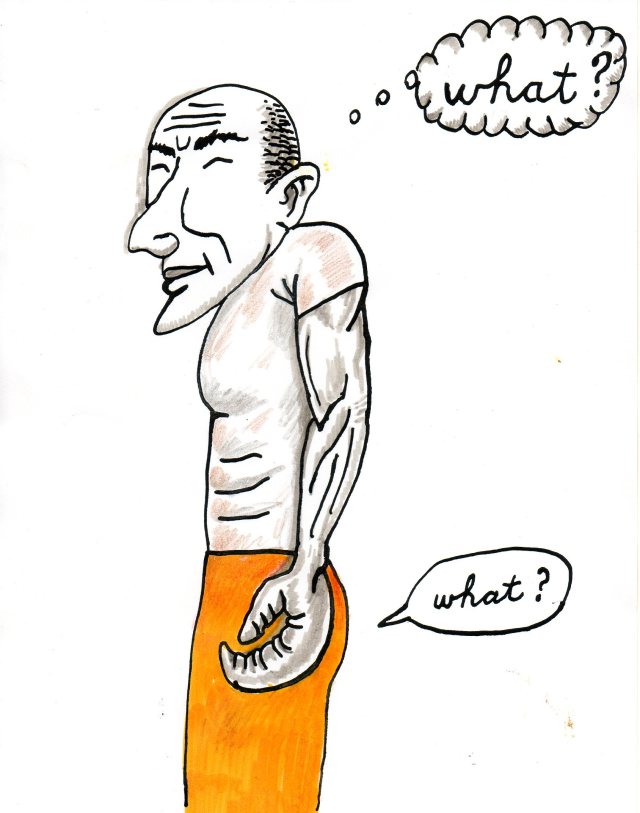
I can’t find it.  I did find this 2012 drawing, though:

what  2-19-11003


Turns out I’d written out my take on Complementary Schismogenesis pretty clearly four years ago:   

Complimentary Schismogenesis, I am told, is when two opposites are locked in some kind of conflict, neither getting what they need out of the arrangement, the attempts of each to resolve it, coming from opposite orientations, only make the problem more intractable, tighten the knot.   The schism continues to deepen as the two struggle cluelessly in opposite directions to heal the underlying fissure.

If we assume everyone is somewhat fucked up, damaged by life, laboring under certain sometimes vexing disabilities, friends are those whose asshole side we are able to overlook.  The friend has other lovable qualities we value that counterbalance the bad tendencies we all have.  We extend the benefit of the doubt to friends, a benefit we do not readily confer on random people we encounter.  

I told a friend recently that whatever other problems we may have had with each other over the years, we both are confident that neither of us would, seeing the other strapped in the electric chair, throw the switch before insisting that every single witness had a chance to speak.  He agreed.


Only one thing has changed since then, the guy who agreed that if I was strapped to the electric chair he’d let every witness for me speak before throwing the switch, may have revised that generous offer, the witness list might no longer be very extensive.  

The precipitating reason for this recent falling out — my attempt not to get angry when hurt wound up infuriating my friend who honestly had no way of knowing how upset I was since I didn’t even fucking scream at him like a normal person who claims to be so goddamned upset!   Plus, I was an aggressively self-righteous cunt about my “right” not to be “hurt,” even thoughtlessly, innocently.

My attempt to remain mild made him wild.  

If the glove don’t fit, don’t have a snit.

The Difficult to See Slow-Killing Murder of (attempted) Love (Part 2)

Love is what we all seek in life, what every living creature needs to flourish, even to survive, and I don’t mean to shit on anyone’s interpretation of love.   We all know what love feels like when we are loved, virtually every one of us has been blessed to feel this and remembers it gratefully.   I’m going to try to analyze how thwarted, frustrated or imperfect love can lead to anger, violence, lifelong hatreds and other terrible things.   Not thwarted in the sense of a hope for love that is rebuffed, most of us know how bad that kind of romantic strike-out feels, but love that is not given in a way the loved one can derive real support from.

I have to be fair.  Not everyone is always good at expressing their deep feelings for others.  I’m not.   We are all creatures of our upbringing, our genetic predispositions, society’s often unrealistic and harmful myths [1].    I’ve only recently made a habit of returning Sekhnet’s regular “I love you” greetings, and I’m glad I have, but it was something I had to learn.   My father, as he was dying, lamented that he had had no idea how to express love, never having seen it done in the miserable home he grew up in.   Made me feel great tenderness for the poor devil and even sadder about his last-hours’ struggle to make peace with a representative of the people he’d hurt by his disabilities.    It really was not his fault, in a certain very real way, as I finally came to see.

I woke up today an hour or two before I was done sleeping and couldn’t get back to sleep.  I woke up thinking about fairness, what it feels like to be the victim of unfairness.  A regular theme, of course, but as I was recently shrieked at by an outraged old friend who keeps a close watch on his emotions, I woke up wondering if I’d been unfair.   Was it really fair of me to ask for things this old friend was clearly incapable of giving?   Clearly he didn’t think so, nor would he admit he is incapable of anything– he’d always given me his best version of philia and agape (two crucial kinds of love that don’t involve romance) and I’d ungratefully, maliciously taken a greasy, prissy dump on it.   Incoherently demanding yet more of him, after all he’s struggled to give, over more than half a century, an intolerable demand that was irrational and fundamentally unfair.

I thought of a phone call I had a year or two ago.  The wife of another childhood friend I could finally not continue to negotiate the terms of a frayed adult friendship with.   She informed me that I had to remain friends with him, and her, and their two sons, because they loved me.   “We love you!” she told me, and I know she was telling me the truth, the deepest truth she knew, an undeniable truth.    I knew it myself, they clearly did love me.  Then she gave me the ultimatum:  forgive him immediately, I’m giving you this one chance, out of love, but if you don’t — you’re dead.  I told her what had become unbearably clear to me:  “forgiving” a person who can’t see he’s constantly hurting you, no matter how many times you try to make it clear, is kind of impossible.   We came to a kind of understanding, out of mutual love  — I am a dead man writing today.  

I don’t think I need to give the details of that situation beyond this restatement of what I was being asked to accept:  love is what we feel toward you, not how we may sometimes act toward you.   My husband and I, now long-since estranged and living apart, practiced our best version of love for years, fighting, making up, storing grievances, yelling at each other, hating each other, making up, storing grievances, etc.   We loved you the same way.   It was the best we could fucking do, and we fought with you MUCH LESS than we fought with each other, you judgmental fucking asshole!

I am not trying to sound morally superior to anyone (he said, unconvincingly).   It’s pointless to judge people on the basis of what they’re unable to do, just as it’s important to get away from them if it has a bad effect on you.   I guess I draw the line where someone demands the right, out of love,  to treat me in a way I can’t tolerate.   It’s a bottom line for everyone, I suppose, not accepting being treated badly, unfairly by people who claim to love you.   It may take a long time to get to that bottom line, but in the end, somebody you feel is treating you unkindly will not be able to convince you that they are treating you well.  Or that the treatment  is the best you deserve.  

Again, not to knock anyone’s life choices, many people come to accept that what they get from those closest to them is the best they deserve.   More power to them if they are comfortable in that belief.    My parents had a lot of personal demons, both of them had been ruthlessly subjugated by very angry mothers from the time they could sit up and look at the world.   In the end, I felt loved by both of my parents, nonetheless.   We fought constantly and at times I felt I hated them, but I know I was loved.   Funny how those things can all be true.   One thing I emerged from childhood convinced of:  I did not want to replicate the unhappy lives of either of my parents.

There is a subjective element of love, for sure.  When we are full of love for somebody we truly want only the best for them.   It is not always possible for us to give it, but we always intend to give it and we hope our intention outweighs our mistakes or failures.   We all have our limitations and our needs.   We have design flaws.  We can’t help being angry when someone we try to always show love and patience to is ungrateful for our best efforts.    None of this is hard to understand.

The hard part, it would appear, is not letting our disappointment show in a way that infuriates somebody who loves us, no matter how imperfect that love might feel to us.   A secret to avoiding their fury, I would guess, is never to expect more than the person who loves us is able to give.  


[1] One example: you must always forgive every hurtful thing that is ever done to you, it is primarily for yourself that you must forgive, to free yourself from the pain of what was done to you.   This sensible sounding idea is repeated in many forms, by many of our subcultures.  To forgive is divine, even if the ability to easily hurt is human.   Jeanne Safer brilliantly lays out the destructive fallacy of this A Good Person Always Forgives dictum in her book Forgiving & Not Forgiving: A New Approach to Resolving Intimate Betrayal.  

Look, it should be clear enough: you have no moral obligation to forgive the unrepentant serial rapist uncle who has only fond memories of raping you and keeps insisting you just have an irresistible ass, LOL!  Is it necessary to resolve things within yourself to close off the pain the evildoer caused, absolutely, but to forgive?   That’s some pretty divine ability to forgive right there.   Fuck that puto. Forgive him right after you forgive Hitler, or whoever else might have murdered your family in the name of bettering the world…

The Difficult to See Murder of Slow-killing Love (part one)

A few days after an unfortunate event at my sister’s wedding decades ago, my parents and I met in their living room for a violent confrontation.  There was snarling, bad language exchanged, overheated comments made on both sides, and once things became too much for me, physical violence — a single finger passed inexcusably across my father’s nose — to illustrate to him the real difference between physical violence and the emotional violence that was his specialty.

I have to back up for a moment, as I’ve tried to condense too much there.   The argument between my parents and me was over whether I had a right to be upset after an attempted beating, by the caterer of my sister’s wedding, who, by the end, had the assistance of three or four fellow off-duty cops who held me by my arms. True, he’d only thrown a dozen punches, or so, and I’d managed not to be hurt, though it was an undeniable ordeal, deserved or not, particularly while wearing a rented tuxedo I later got some of my blood on.  

My parents position was that, since I had clearly provoked the confrontation with this polite, smiling stranger, no matter how I might try to spin it to justify myself, I had only gotten what I deserved.  I found that position unfair, particularly coming from my parents, who I’d hoped would be at least partially sympathetic listening to my side of things.   Their unified, hardline attitude made it impossible for me to restrain myself from expressing my opinion at length, and with increasing conviction.

And so, because these two irreconcilable emotional positions could not be peacefully resolved, things quickly came to an ugly stalemate there in my parent’s comfortable living room.   After the illustrative pass of a single finger across my father’s nose, all hell broke loose.  It was like throwing a lit match onto a lake of gasoline.   The explosion of ugliness was not without an instant of timely, dark wit from me, but this story is not about any of that.

After enough screaming was done, I gave my parents the finger one last time as I left their home, a home I’d been told I was no longer welcome in, and rode off on my bicycle, through the rain, toward the subway for the long ride back to my apartment.   Passing the nearby home of an artist friend, a woman my parent’s age, I stopped by and rang the bell.   Florence and her husband listened to my story, troubled and sympathetic, and told me gently that time would heal this too, that these kind of mad family things have a way of blowing over and that I should not be too hard on myself.   All good to hear.  I hugged them and went on my way through the cold, dark, rainy night.

The point of this story:  the next morning I woke up to sunshine, birds singing, feeling unexpectedly light as a feather.   It was as though an immense anvil had been lifted off my chest, a tremendous weight I’d carried always, without realizing it, was suddenly gone.  I felt like leaping through the air, the relief was exhilarating. I remember the surge of energy I felt to be free of the kind of love that sadly concludes that if somebody wanted to punch you in the face over and over, they probably had a damned good reason for it.  [1]

Understand, I’m not trying to present myself as an innocent victim.   As you can probably conclude just from reading these words today, the words of a man who’d whip his own father across the nose with an outstretched finger, I am not a person who shrinks from a fight, nor any kind of angel.  When I was younger, if somebody told me I couldn’t talk to them like that I’d smile and tell them to go fuck themselves.  Cost me more than a few jobs in my day.   I have tried to learn to do better.  I’m pretty sure I do better, certainly in terms of not always giving vent to my anger, but that is not the point of this story either.  

People who insist they love you sometimes don’t really grasp what love is, and, in fairness to them, they may have come to their understanding of love honestly, never having experienced it.  The first requirement of love, it seems to me, is wishing no harm to the person, or creature, that you love.   First order of business, tend to the hurt they are expressing.   Feelings are real and can’t be dispelled by mere logic when they are enflamed.   Later order of business, once things are calm, if it will be helpful in the future, talk about the underlying issues involved, how to resolve things, etc.  But when you see a loved one crying, the first instinct must be to help them dry their tears and sit with them until they start to breathe normally again.  

That may sound kind of tender, coming from a man who’d slap his father across the nose with a finger, I know, but does it ring true to you?  

You come to me upset.  I say “before I hear your entire long story, let me quickly tell you five reasons why you really shouldn’t be upset, you need to let me finish — JUST LET ME FINISH–  before you can continue.  Try not to interrupt me, it will only take a few minutes and my calm explanations will clarify everything for you.  I have a right to tell you these things, because I love you.”  You raise a hand, extend one finger and slap me smartly across the nose.   Knowing what I know now, I really can’t blame you for that reaction.  

The thing to do, except in a situation where someone you love is about to hurt herself or somebody else, is let the person you love do what they need to do, say all they need to say, particularly when they’re upset.   The time may come, when heads are cooler, to discuss why I wasn’t actually wrong to insist on telling you the reasons you were wrong to be so upset.   But that time is not when you are upset.  

The immortal Charles Bukowski, in his immortal “The Shoelace” catalogues some of that swarm of trivialities that kill quicker than a heart attack.  On that list, and leaping off of it some days, are “people who insist they’re your friends.”   They claim to love you like family, and often they do.   It is good to remember that many assaults, most murders, and all incest, occurs in families, but that is a side note.

The main note is this — horrific as it also is, and upsetting to the stomach and disruptive to sleep as it is — if a person who tells you they love you does not treat you the way they’d want to be treated by the people they love, then that love is probably not the best kind of love for you.  

If they impatiently sit through your explanation of why you were hurt, when they meant only to help, and they insist on their right to tell you why they still believe they did nothing to hurt you, intentionally or otherwise, no matter how precisely you try to explain the hurt — and they wind up screaming at you and hanging up the phone because you have so upset them by denying their right to be just as upset as you are, in fact, more upset because your upset over an “accidental tasering” is such an irrational and unfair accusation of them… well, the best you can probably hope for is waking up the next day feeling a bit lighter.   As I can practically guarantee you will.  


[1]  This wonderful feeling of liberation would not last long, my father called a few days later to negotiate a peaceful return to the status quo, and after some wrangling over the course of several powwows, we went back to the way things had always been.  It would take until the last few hours of my father’s life, thirty years later, before he expressed his deep regrets about having been the way he’d always been.


We must often make do with the best we can do

Dr. Pangloss, an absurdly optimistic character created by Voltaire, famously lived in the “best of all possible worlds” where everything happened for a preordained purpose, even the most senseless and horrific things.  As I recall he kept this belief even after half of his ass was removed by cannibals for use as a ham (and many other equally atrocious things befell him and his student).  Easy to laugh at a panglossian chap like that as we look around at a world that could certainly be better in many obvious ways, but I mention him to remind myself that sometimes doing very little is actually the best we can do in this world, and doing that little takes us, in a real sense, to the “best of all possible worlds.”   Under less than ideal circumstances, of course, but still, by far the best alternative available to us, the little we can do.

Being able to transmit complicated thoughts and difficult emotions in words is a gift of being human.    It is among the miracles of being a “wise ape.”  True, it exists along side our susceptibility to mass terror, mass murder and so forth, but our ability to speak, to read and write, is, in itself, a great blessing.   Words that literally change the world can sometimes be conceived and written.   Words can save a person from despair when she reads them, actually save a life.   Save a single human life, say the sages, and you have saved all of mankind.

Many of us write here on the internet [1].  We write for many reasons — to entertain, inform, make our opinions known, for attention, the illusion of writing for a readership, to brag, to show off our skills and our humility, to pretend to wisdom or expertise, to sing, to play, to force ourselves to write as well as we can, to drum up business, to gather an army of followers to invade and conquer other websites, to pass the time, etc.   But every one of us knows, I think, that, confronted by a sudden vexation, it is a great advantage to be able to write it out clearly.  

The ability to write clearly allows us to set things out for others to share and also, to see things more clearly ourselves.  Often this thinking-writing process is the best we can do and the time we spend here becoming better at writing with clarity is time well-spent when the last seconds are ticking away on the clock and the game is on the line.

You get screwed by a bureaucracy, say you lose your health coverage, without warning, during a deadly pandemic (to take a random example).   Frightening, disorienting, unfair, possibly illegal — just writing these words provides the beginning of relief.  Putting a scary or aggravating scenario into clear language does something to neutralize panic.  The practice of writing an aggravation down, tweaking the lines for clarity and brevity, adding helpful details, deleting distracting ones… an excellent discipline for taming thoughts and feelings that might otherwise run amok and rob you of rest in your slumbers. 

We’re living in a fucking worldwide plague, literally, with cynical, calculating, clueless cretins in charge of Federal Emergency Management and many other areas of public health, safety and liberty.   The thought that the forces of greed and death are exploiting this tragedy to gain even greater advantage over the masses of us worldwide is objectively horrifying.  There are many reasons to be concerned, afraid, magnified by disorienting loneliness during this time of “social distancing” when the closest to socializing many of us can get is the telephone or “social media” which is a shorthand for how to be in touch without actually venturing anything personal that you wouldn’t want the entire world to know about.  

Social media fosters the actual opposite of intimacy, it creates the superficial illusion of connection.  Intimacy is a rare and life-sustaining form of friendship that can only be achieved one on one, over time, with the ongoing sharing of vulnerabilities, values and trust.  You cannot, strictly (or even permissively) speaking, share real trust via social media, trust me on this.

Being old school, you reach out in your isolation to write a personal letter to an actual flesh and blood friend, knowing that she has a tendency to freak out sometimes and suffer in silence, to make sure she’s okay, extend a hand for mutual support.   “This plague is a disorienting ordeal, n’est-ce pas?  I hope you and your pup are OK” you write in a hand-written letter that sets out some of your own worries.

The answer comes directly a few days later, typed and delivered on your phone’s beautiful, glowing screen.

“Me and Bonesy are fine, old friend, thank you for asking, and, as you know, even if I was struggling and terrified, which I am not, thankfully, I wouldn’t be a whining, self-pitying wuss like you and make a squealing incoherent federal case out of bad luck that is entirely of your own making, pal.  Thanks for reaching out! Always great to hear from you.  Please keep in touch.”  

You might think, poised over the tiny keys of your phone: it appears my old friend might be in  trouble, I wonder — is there anything helpful I can do from here in my own quarantine?   Well might you wonder.   You might want to write a few hundred words, to make the wonder something you can set out in front of you, organize, study, explain a bit to yourself, mull over.   Edit, clarify and repeat.   Word to the wise.


[1] It occurs to me from time to time that I need to figure out how to collect the probably millions of words I’ve composed and posted here on this website the last few years and save them in a format I can store on various hard-drives.   If I had a mass of readers I’d ask for any ideas about how to do this, but since few stop by, I’ll keep the question to myself.  On second thought, anyone have any ideas?  Does WordPress still have something like that old RSS feed that can be copied and pasted easily?

A Vision of Heaven

As a child I had a picture of heaven as a place of eternal peace.   I’m sure this came from my father, who, though angry and embattled while he was on this earth with the rest of us,  is living in such a place now.   My child’s image of heaven was of old enemies meeting on a cloud, embracing and laughing off their old, earthbound enmity.  Their old reasons for hating each other now delicious jokes to be shared and laughed about together in the ever-after.

I was reminded of this today, when I had a wake up call from Elaine at Healthfirst, the health insurance company that has done so much to impersonally fuck me over lately.  Apparently my DFS complaint, which I had attempted to revoke by email on Tuesday, had been quickly assigned to an investigator who contacted Healthfirst.  Good to know that process still works so quickly, anyway.

The last time Elaine and I spoke, things had not gone well.  I had asked her pointedly several times if she was drunk.  I eventually hung up on her after one too many incoherent, drunk-sounding answers from the Resolution Specialist.  That was back on March 7, I think, the last, and ugliest, of several long conversations we had.

She began our conversation cautiously, as you might imagine.   I immediately informed her that I’d contacted DFS to retract the complaint (I believed I had finally successfully done that last night on their website).   I told her that this time Healthfirst was not to blame for the termination of my health insurance.   I told her I wished Healthfirst had contacted me on March 11, when they were informed that they needed to terminate my insurance effective March 31. I could have prevented the cancellation of my health insurance if I’d had a heads up from them in time to stay insured.

She explained that the March 11 notice Healthfirst got contained the same claim my on-line, inbox-posted version had — that I’d received two notices to remedy my easily fixable error, one the day after I re-enrolled and the March 11 notice I was never notified of.   Healthfirst was in the same boat as I was, it seemed.   No other notice had been sent to anyone, I never got the March 11 notice in any form, until after my insurance was terminated and it was too late to do anything about it.  Unlike Healthfirst, only I had had my health insurance interrupted for a month during a plague, but that wasn’t Healthfirst’s fault.  

The odd thing is how gentle our conversation was.  I had no animus toward poor Elaine, a native Russian speaker doing her best in a difficult language.   Her promised written summaries had been the best she could do, subject to redactions from “regulatory”, I grasped that now.   It was not her fault that NYS does not provide consumers with the laws that protect them from, for example, termination of health insurance without notice.  

“Did you call the New York State of Health?” Elaine asked sympathetically.  I explained to her that on a good day one cannot easily get through on the phone, during the pandemic wait times are much longer.  The reps one eventually speaks to there are as limited in their knowledge and their power to help as the ones at Healthfirst, they cannot see the entire picture or explain difficult things that are difficult, or even impossible, to explain.  She seemed to understand this.   I told her I’d found and fixed the mistake easily on-line.  If only I’d had notice to do it sooner!

Thinking about the surprisingly pleasant call afterwards (she’d been palpably relived to get no fight from me), and how we wished each other well, and spoke for the first time without defensiveness or anger on either side, two humans in very similar little boats, I was reminded of my childish view of heaven.   From the minds of children…


Inner Dialogue, Pandemic installment #1

I used to have frequent conversations with the skeleton of my long-dead father.  I did this for about two years, almost every day, sitting at the computer, taking dictation to the steady beat of my tapping fingers, thumb adding off-beats on the space bar.  Once in a while I read one of these chats, often out of curiosity after I see someone has clicked on one (as somebody did yesterday) and realize I miss talking to my witty lifelong enemy, now that he is dead and full of self-knowledge and empathy.

“Who are you talking to, motherfucker?”  

You’re a droll one, doll-face.  You know goddamned well who I’m talking to.  I’m having what you might call an inner dialogue, something that becomes necessary from time to time to straighten out my unruly thoughts, if you know what I’m saying.  

“Talking to yourself…”    

I’m going to ignore these interruptions.   The nagging, niggling voice of the reflexive interrupter is not something to be interrupted by, if you seek clarity of any kind.  

“If you say so, Chief.”  

You can be 100% correct in your analysis, based on specific past experience and outside knowledge, your overall analysis can be dead on, and you can still, in an individual case, be wrong.  For example, you can be dealing with an inhuman bureaucracy, bent on saving money by cutting the eligibility of anyone it can, in a system brutally skewed toward protecting the privileges of the privileged; that bureaucracy can have twice or more arbitrarily fucked you, in excruciating detail, for reasons they later reverse — and in “the instant case”, as we are taught to say by law professors,  you may have simply been fucked by your own inaction or error, the inhuman bureaucracy in that particular case virtually, or at least legally, blameless.

“Seriously, man, who are you talking to?”

That is a disgusting and fake question.  You have a sickening smell.   You’re a disgraceful excuse for an interrupter!  

“Apologies, SIR!”  

As you were.  Now men, it is very important, and I say this to you as a role model and the steward of your morality, that you not be confused by these competing truths.   Both things can be true at the same time, even if one is more true at the moment than the other.  Do not doubt your essential analytical skills because you find yourself mistaken in one instance.   Yes, the enemy is brutal and sneaky.   Yes, sometimes you fall asleep at your post with your hand on your dick, mouth open, vulnerable to even the kindest, most considerate attack.  

“Sir, yes Sir!”

The exploitation of your vulnerability, even if done by the enemy in the most considerate possible way AT THAT TIME, does not mean that at any other time your ruthless enemy will not revert to character, not revert to the supremely inconsiderate beast it also is.  

Your faith in your fact-based analysis, men, should be as clear to you as a glass of pure water.  Be the water, not the glass.

“Bruce Lee, Jeet Kun Do, the Way of the Intercepting Fist.”  

Just so.

You can live on a low income, by choice, and not really be entitled to call yourself low-income, though why you would want to do that  is another question entirely.  You can be protected by someone who loves you, who has the means to protect you financially from the worst, and still be vulnerable to the same institutional cruelties that routinely kill many other people in your situation.   

Be self-effacing at your own risk, men.  Remember, the boy who cries “poison gas!” in a coal mine filled with odorless gas will still be killed by the poison gas he can’t smell.

It’s may be easy to view someone you feel has not worked as hard as you, at least not for pay, as a whiner complaining about the brand new rope being used to hang him.  

To consider me a pampered stuck pig screaming in pain from a self-inflicted wound I imagine is another of the thousand cuts freely given to anybody who speaks up, or stays silent, howling at unbearable, over-amped length, tediously advertising myself as the most learned and righteous of victims, giving pompous, imagined voice to the other, voiceless, real victims, is to paint only a corner of the larger picture.  I am also, potentially, with the right marinade and glaze, and slow-cooked to a turn, a very tasty rack of ribs.

“Sir, yes SIR!  Oh, yum! SIR!”


Laddie Boy, and bullying for no reason

There was a popular dog food, when I was a kid, called Laddie Boy.   For all I know it’s still around, I’m seldom in that aisle in the supermarket these days.  I think our brilliant dog Patches may have eaten Laddie Boy.  I recall the stink of it when the can was opened — in later years on an electric can opener that sounded like George Harrison’s electric guitar on Revolution (White Album version).  

I had a classmate, for a couple of years, named Fred Ladner.  I liked Fred, we stood at the back of the sized place line in fourth or fifth grade and he was always pleasant.   One day, for reasons– or more likely simple, brutish reflexes — I can’t recall, I menaced Fred in the school yard.   I remember how he recoiled, confused and hurt and I recall the vitriol with which I called him “Laddie Boy” as I glared at his sudden fear.  I may have grabbed his shirt, but I don’t think I even did that.  He didn’t make a move to get away, just stared at me wide-eyed, his sense of my senseless betrayal clear in his wet, scared eyes.   I don’t know how it happened, I don’t know what, if anything, may have precipitated it.   What I remember was his fear and confusion, and that I was the direct cause of it.  

I don’t remember any other incident of myself being a bully in childhood.   I sometimes expressed a bit of malevolence here and there, as any boy sometimes does, like after a friend’s mother drove him and his sister into a concrete stanchion and the guy wore a maroon wool hat, a la Mike Naismith of the Monkees (not sure what color Mike’s wool hat was) all day long in school.  One day somebody snatched the kid’s hat off and we saw that it covered a white circle shaved into the dark curly hair of his head, where he had been probed, or stitched or whatever.   He was very unhappy to be exposed this way and I was in the circle of boys, his friends and classmates, who sadistically kept the hat away from him in a game we used to call Saluji, for some reason.  He desperately tried to get the hat back, only to see it flicked away at the last second by the mercilessly grinning little boy he rushed.

It was a momentary thing, and this kid was probably my best friend at the time, something I quickly forgot about.   I had no recollection of it until, to my surprise, I learned that he was still very bitter about it more than fifty years later, when he brought it up one day with great feeling.  

It is easy enough for me to see these behaviors, and if there were two instances I can recall there were surely more, as me acting out what I experienced at home.  Where my sister was sly, passive aggressive, darkly, sadistically funny, I fought back directly whenever our parents took a verbal swing at me.  My father was, I can see now, often tormented by demons that caused him to act contrary to the way he taught my sister and me to behave, contrary to his ideals and highest beliefs.  He bullied my sister and me, often goaded by my mother’s demand, after a long day at work, as he was trying to rest up a bit before going to his second job,  that he do something about the two disobedient, disrespectful little pricks she had been dealing with all day.

We are aggressive and sometimes irrationally hostile, we smart apes, and, in crowds, we are capable of doing things that are the stuff of nightmares.   We have always been this way.   We don’t always know why we are screaming and pumping our fists into the air as someone we hate is being publicly tortured to death.   It’s a homo sapiens thing.   You don’t see cats and dogs doing this kind of thing.   Pigs raised for slaughter in Auschwitz-like conditions don’t act this way.   Only humans form lynch mobs, send armed men into villages to rape and burn, build vast state-of-the-art machines to kill as many as possible in the shortest amount of time.

As I state the obvious I’m also thinking about what makes a reliable narrator.  Is somebody trying to get to the bottom of his or her pain a reliable narrator?   For example, I wrote hundreds of pages, posted here, in a first draft trying to get to my father’s point of view as he was inflicting terrible damage on his children.  This process caused me to swing wildly at times, in an attempt to vividly describe the damage and also understand it from a bully’s point of view.  

Although he generally bullied us, is that really what my father was at his essence?   Surely there were many other things at work in his nature, more salient features that those who knew him would see him as before “bully”.   Describing my father’s angry glare as “psychotic,” for example, was a wild swing and a clear miss.   In the second draft, should I live long enough to produce it, these missteps will be corrected as I convince the reader, and, more importantly, the publisher, that I knew what I was doing all along when I stumbled through the first draft.   (Tip of the yarmulke to Neil Gaiman who hipped me to this in his Mahster-clahss youTube ad).

I don’t think it requires a Sigmund Freud to convince anyone that the indigestible traumas of our childhoods live on in us many years later.   The pain we can’t understand or process has nowhere to go except various, mostly unconscious, survival strategies: a rigorous daily exercise regime, sarcasm, constant busy-ness, “recreational” drug use, etc.   We make vows to do better, as I have with my attempt to apply an “if I can’t help, I don’t hurt” ahimsa-based approach to my own life.   Knowing that I am as capable as the next little Hitler of cruelty to my fellow creatures, I try to be aware of my hurtful actions as I keep my own interactions with violent or provocative assholes at a minimum.   A neutral straight face shown to a vicious person one encounters by chance, I’ve learned, is usually better than a sneer, a comment, a middle finger raised.  As is getting away from them as smartly as possible.

Still, most of us get to understand so little about what makes us act the way we do. Of course, we’re all masters of justifying it, to ourselves and anyone who might be offended by it.   I realized a few weeks ago, to my great surprise [1], that after writing everything I could think of about my father, in the course of a daily practice over two years, that I am now able to clearly see things from my father’s point of view.   I imagined his voice, informed by the regrets he had while dying and the lifetime of progress he made in the last few days of his life, expressing what he wished we could have talked about when he was alive.  

Talking to his skeleton regularly explained things to me I could never understand before.   I don’t pretend to understand exactly how this happened, but imaging the conversations I know he wished we’d had revealed things I never had a conscious clue about.   I finally understood this perplexing character, in a way I cannot presently understand the little boy who suddenly turned on his friend Laddie Boy and made his eyes grow wide in betrayal and fear.    Very much like my father’s eyes when, one day during a verbal beating he was dishing out, I stood, a skinny fifteen year old, with such violence that the old man in his chair was suddenly afraid.  


[1]   As I learned, to my great surprise, one day during law school while I was transcribing words of a legal decision into a paper I was writing, that I wasn’t looking at the keys as I typed.  I was amazed to realize that I’d taught myself to touch type, completely unconsciously, simply by typing countless pages during my dreamy creative writing days and as a rat-like law student. 

Colluding to pretend all is well

We always have the option to pretend that the things that hurt us are not that bad. You can have a heavy history of sour battles with someone, and pretend it all weighs nothing.   The fear is that allowing the feelings that cause the conflict into view and trying to work things out will inevitably lead to more conflict, a fight to the death over who is the bigger asshole — who is to blame for everything.  

To accommodate yourself to this internal dilemma you need to stop caring as much about the person, since if you cared too much it would be painful to sit with somebody who may be compelled, when the moment is right, to stick a finger into your deepest wound.    This “compromise” agreement not to talk about the 600 pound gorilla in the room is a powder keg situation, both parties sitting on the explosive keg smoking cigarettes and acting as if there is no possible harm to any of it.

It is strenuous, wearying work, I find, to pretend that a relationship with someone who can’t help being insensitive, suspicious, antagonistic, untruthful (or worse) is actually fine.    In psychologist Jeanne Safer’s book about sibling conflict, Cain’s Legacy, the author talks about what she calls “sibspeak”, the intimate language siblings speak among themselves, full of code words and often silent agreements not to acknowledge the painful sources of fundamental conflicts.  

Avoidance is common in the secret language many siblings speak to each other, since there are often primal conflicts going back to earliest memories, things that trigger real hurt, fear and anger.  Avoidance produces only caution, I find.   I read the book, which describes numerous troubled sibling relationships,  with interest.   Reading her conclusions, the general principles she sets out,  a series of steps to take for better communication with a sibling, this one jumped out at me.

20200117_144421.jpg

This collusion to keep the dark, fearful, enraging things hidden is a trap.   It requires ignoring strong feelings that are telling you important things. Things like: when somebody tells you angrily that they want to kill you, believe the strength of their feelings.  Things like: after somebody hurts you, an apology — an expression of empathy, remorse and vow to do better–  is necessary before reconciliation and forgiveness can happen.    Things like: if even a small breach of this “agreement” not to talk about  painful things leads to accusations and rage, there is a major problem.

Of course, you can always nonchalantly cross your legs again, after fishing out your lighter, and putting the flame to a new cigarette, being as careful as one can be sitting on a keg full of explosive powder talking about everything else in the world.