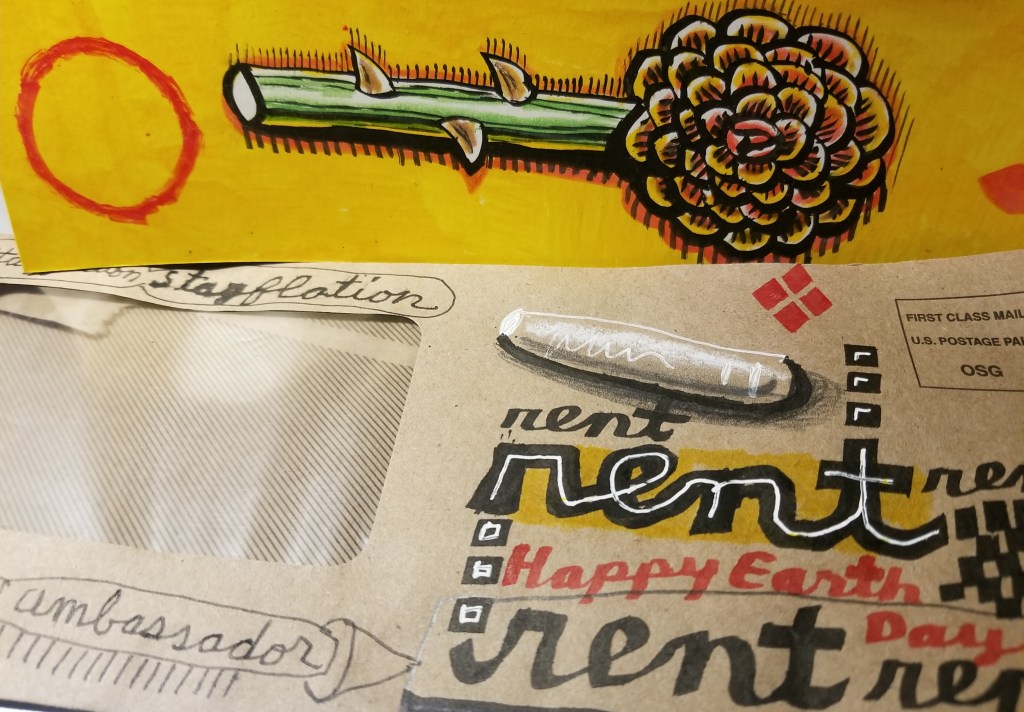
Happy belated Earth Day
Reminding us again that the real sting of death is that eternal silence where a beloved life once was.
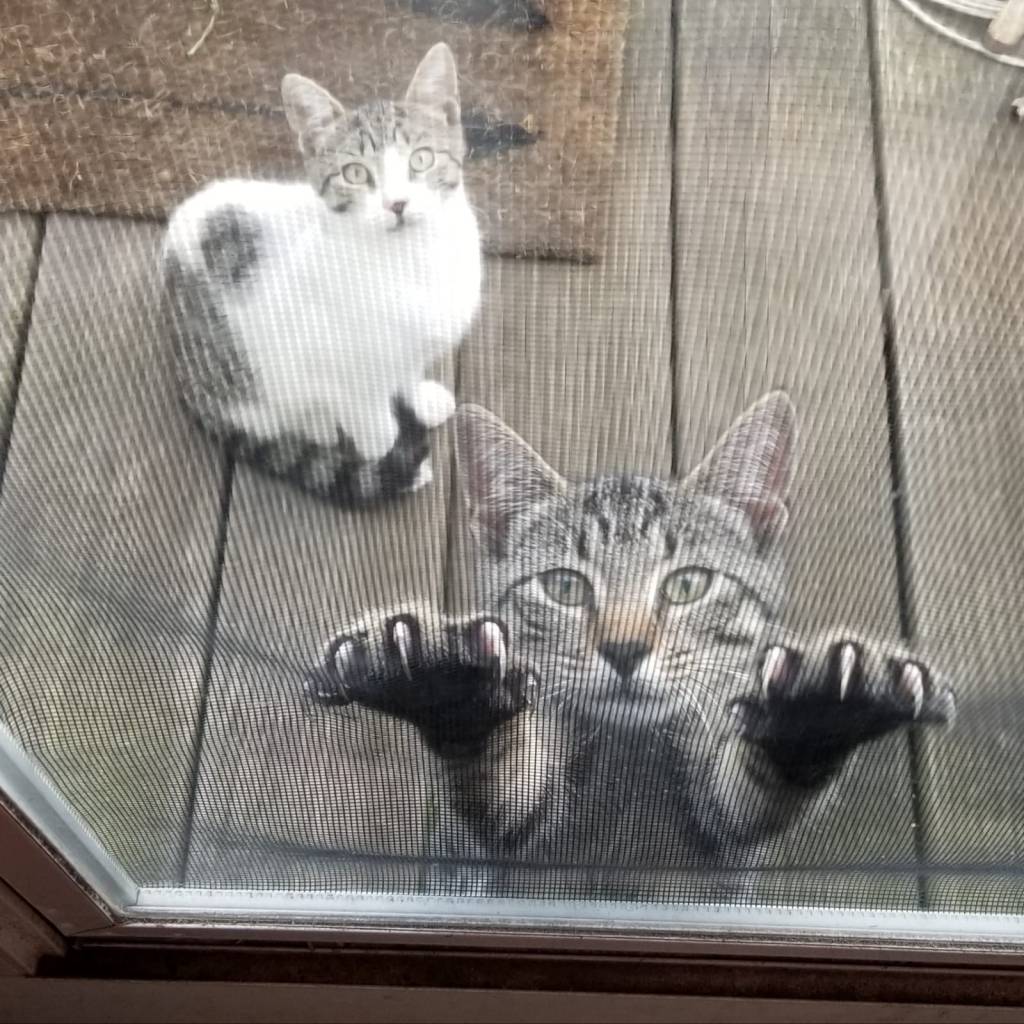
Little Girl (foreground, her sister White Back behind her, as always), who greatly resembled her beautiful mother Mama Kitten, her constant companion and ally, left us as gracefully as she came into this short, precious life four years ago.
Her absence hangs heavily over the turf she bravely defended and enjoyed the many roosts of, and where we touched base late almost every night. She was an agile, athletic hunter who could grab a bird out of the air, a gold glover who could catch a tossed treat and pop it into her mouth. She always showed up in the driveway to shake us down every time we approached the door. She carried on the tradition her mother started. They were known as the Driveway Bitches, two natural beauties, demanding their due, and they always happily collected their toll.
An ordinary event, the natural death of a sometimes affectionate feral cat we loved, filling our mortal hearts with sorrow, threatening to burst them, until the sorrow overflows.
Reminding us again that what takes your breath away at death is that eternal silence where a soul we loved once was.
Every child believes deeply in fairness, until the world teaches it otherwise, the kid begins picking a side in every fight and fairness becomes secondary to her team prevailing. Unfairness is universally painful, being treated unfairly hurts everybody it happens to. We all like to think we’re fair, it is a synonym for reasonable, but the fact is that adults can be fair or unfair, recognize the importance of rules to ensure fairness or defy any norm that allows any outcome they don’t want.
A reasonable person listens to a story with an open mind (to the extent possible) and assesses it as likely or unlikely based on experience and knowledge. The purely transactional listener evaluates a story based solely on how well it advances the interests he wants to advance. The mercenary listener is looking for an angle, a simple transaction, not complicated by the merits of the case, the evidence presented or that abstract quality of fairness, only how it increases advantage and enhances the desired bottom line. You have either a fairness based vision of justice, or a might makes right mentality.
You treat everyone as equal under the law or, under might makes right, you treat your friends as above the law, exempt from all legal coercion, and demand that anyone who opposes your desires be subject to the harshest of laws available (and not ruling out extra-judicial forms of discipline, which are always on the table). While you are in charge your friends and supporters don’t have to worry about any law that will stop them from acting on their strong feelings. As long as they are vocally loyal to you, you will protect them, until it is transactionally advantageous to cut them off. Because what the fuck is Fair anyway?
You can weigh the arguments on the actual facts of the case or you can weigh the arguments and frame them cleverly, to reach the desired outcome. The second way is the way of the zealot, the partisan, the political activist, the way of the Federalist Society.
The stench coming off the McConnell/Trump Supreme Court today is a reminder of how crucial nonpartisan elections are for democracy. How it is crucial to elect a few more Democratic senators, to prevent two from vetoing filibuster reform to get election and voting rights laws passed.
Norms, it turns out, don’t restrain zealots and extremists who believe only in power, and in using power to retain power (the updated definition of “conservative”). Laws can ensure a certain measure of justice, but only if they are always enforced. Selective enforcement, and the outcomes of court challenges often hinging on which party has more money to spend on an army of top lawyers, ensures rule by the most corrupt. Which, as any eight year-old will tell you, is completely unfair.
I say strange belief because the world often appears to defy understanding. Look around, and tell me an understanding can be reached between people who hate each other. I believe it is possible for two enemies to become friends, once they learn how much they have in common, how many fundamental beliefs they actually share. It is rare, sure, but it has been known to happen.
The mother of a boy randomly killed by a new gang member tells the kid when he’s convicted that she will kill him. She visits him in prison, sends him books and money. When he’s released she lets him live in her murdered son’s room, which he does gratefully as he finishes his education. They become as close as mother and son. The young man asks one day if she still believes what she said at the end of his trail, that she’d see him dead. She tells him she does, and that his current life proves she did kill that monster he was becoming. He understands the truth of that. A beautiful true story I heard the woman herself narrate years ago on a program about the power of forgiveness. Rare, and wonderful, and also, proof that things that seem impossible can be done, if the heart is right and the actions taken are intelligent and consistent.
I enjoy talking with people, particularly when the conversation goes beyond normal pleasantries and daily observations and takes unexpected turns into new terrain and unknown commonalities are revealed. There are difficult things we learn sometimes, important life lessons, and I particularly love those rare occasions where conversation takes this deeper turn and we compare the personal details of hard lessons we’ve learned about a particular vexation.
In my home growing up, though the four of us were all reasonably good at talking, and liked to chat, our conversations often turned into angry arguments. In that previous sentence we see, I suppose, the roots of my strange belief in the power of listening, speaking clearly, acknowledging — my belief in the importance of understanding.
You can argue adamantly, to prove you’re right, dominating the person you’re arguing with, yielding nothing, ever, or you can argue without stubbornness, open to another perspective and trying to illuminate a misunderstanding or unintended cruelty. Dispassion is a word Buddhists and others use to describe thinking and communicating that is not the slave of passion, not in service to strong feelings that impede our ability to reason, to weigh things fairly, under a warm light. If you speak and listen dispassionately you hear better and your responses are not as likely to add fuel to anger. Dispassion is sometimes derided as unemotional, robotic, inhuman, but the real essence of it, I think, is keeping your thoughts slightly apart from your feelings, particularly strong feelings that will often stir you to assemble the troops to counterattack, and bearing in mind the larger, more humane purpose of the conversation.
In the grips of strong emotion we are often not at our best, emotionally, intellectually or morally. In the last five years of my mother’s life, on the rare occasions I said something that made her explode in anger, I became adept at quickly changing the subject to something pleasant. It worked very well, she’d immediately release her mask of aggression and smile with great relief. I came to see that the thing she was angry about was something I could immediately stop pressing and the thing I distracted her with showed that I understood her pain and we were now talking about something she liked instead. I recognized that there were some things, like her painful relationship with her daughter and grandchildren, that she needed to vent about, and get my sympathy for. She was unable to imagine anything better between them and her hurt and anger got inflamed whenever ideas about how to improve the hopeless situation were suggested by her know-it-all son. Finally recognizing this inability of hers, an inability she shared with her daughter, sad to say (and which doomed every suggestion I might make), I would desist in my doomed peacemaking efforts at the first sign of anger.
My father and I had a lifelong debate on whether people can change their fundamental natures. There are good points on either side of the issue, but I was locked into proving that my belief that we can change much of what is painful to us was reasonable and based on evidence, and he was determined to prove that the idea that we have this kind of autonomy and power to change is a cruel illusion that does more harm than good. I can see truths on both sides of the debate as I type these words. Because of the acrimony between my father and me it was never possible to persuade my father of how much we can change our reactions to things that bother us or to move him off his fixed belief about the inevitability of pain, frustration and anger.
“You admit you’re only changing your reaction, the superficial part, and that doesn’t touch the inborn, fundamental nature at all,” my father would say. “If you are born with a prickly disposition, no amount of navel gazing is going to make you able to resist provocation when it arises, provocation that would not even bother some one with an innately placid nature . You might get a tiny bit better at not immediately snarling, but you are only changing your surface reactions, not your genetically programmed reflex. The fundamental things about ourselves are immutable and it’s pathetic to believe in something impossible.”
“But changing your reaction, say not responding with reflexive anger, makes it possible to have a reasonable conversation with others, and that’s not a small thing,” I’d say. In the end I pointed out that he himself had changed his angry reactions toward me, and that our relationship was better for it. This proved a bad example to hand to a wartime prosecutor like my father, though he had, in fact, greatly moderated his angry reactions to me in recent years, after a difficult conversation I’d initiated with him one Yom Kippur.
“I only changed my superficial reactions,” he told me, “nothing fundamental changed in me. I became a better actor, is all. If I ever honestly told you what I really think of you it would do such irreparable harm to our relationship that we’d never be able to talk again.”
He rested his decades-long case by saying the one thing that proved he was determined to be right, more than anything else in the world, and this neither he, nor I, nor any power in the universe could change — and here was the final proof. All this talk of emotional plasticity and the value of a skilled therapist, of introspection, self-criticism and self-acceptance, so much bullshit for contempibly weak people to believe. As for him, he was man enough to admit the difficult truth about humans — however we are, emotionally, at two years old, is how we are for the rest of our lives.
Therefore, following the logic, we cannot learn anything important, not really. Superficial things, OK, we all learn to use toilet bowls, and language, academic subjects, but we can never learn how to hurt ourselves and others less. Some people are born decent, reasonably happy, they get along in the world without friction or conflict. Others are born riled up, unhappy, critical, ready to rumble, and these angry little ass kickers, who can never be wrong, are doomed to live in a world of hurt.
His tune changed on his deathbed, as apparently not infrequently happens. Part of it, I believe, was seeing his lifelong adversary quiet, thoughtful and willing to do whatever he could to make his father’s death easier. He lamented that he’d been unable to consider so many things, had been so limited in what he could imagine, had been so adamant, seen the world as so black and white. He had painful regrets that he expressed for the first time, and I did my best to reassure him about each one that he’d done the best he could.
Now, it’s important to note how many times I have infuriated people close to me in recent years by my determination to remain peaceful and mild-mannered in the face of escalating bad feelings. In the end the ugliness where there was once friendship and laughter, the absence where mutual good will used to be, becomes impossible to ignore. In their defense, there is nothing more maddening when you are angry than some fucking prig on the high road, managing to keep the anger off his tongue.
Expressing anger dramatically is a deadly game I’ve played countless times over the years, so, in the end, after enough angry invitations to tell a friend to go fuck himself, I yield to the surge of righteousness I’ve been trying not to express as contempt and tell the person, in detail, all of the irredeemable things about them I can no longer tolerate. Friendship does not recover from this, because at the point where everything about another person is reduced to their worst and most shameful weaknesses, well, that’s irreparable harm.
So maybe my pre-deathbed father was right all along. If you are locked in a battle with an adamant rival, intent on winning at all costs, you will, in the end, revert to however you were born to be. The angry will rage, the placid will cry. You can pursue dispassion, believe in the power of conversation to illuminate difficulties, remove hostility, the plasticity of the human soul, forgiveness and all the rest, but in the end, when a line is crossed that is impossible to get back to the other side of, you are only prolonging the terminal phase of something that is already dead. All your high ideals about the power of understanding are so much useless, smelly, self-righteous baggage.
Maybe so.
I continue to work on being clear, and listening carefully to others. It is not the work of a few days, that. Do we get better at things we practice faithfully? All signs say we do, however loud the hooting chorus of fatalistic naysayers gets.
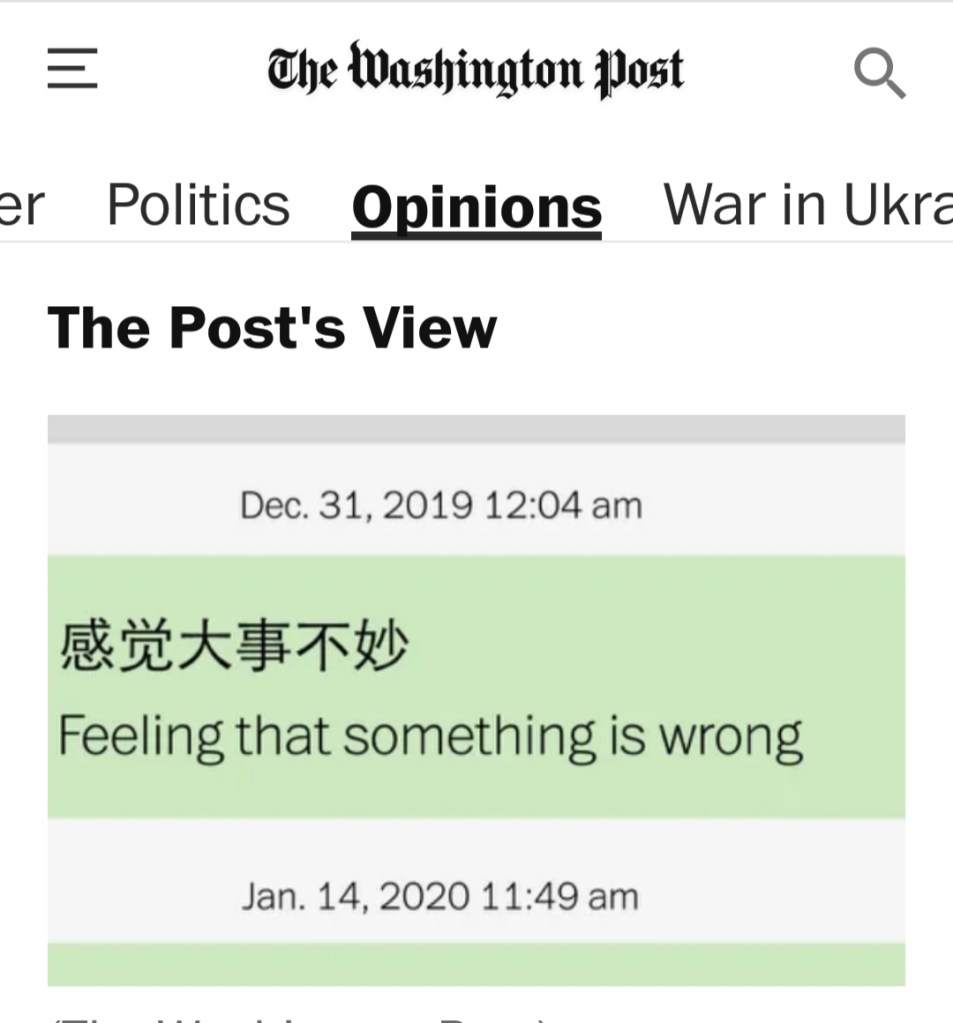
Gail is Gail Collins. Bret is Bret Stephens. They write for the New York Times. As the Gray Lady styles it:
Ms. Collins and Mr. Stephens are opinion columnists. They converse every week.
Gail: Lord help us. Even if Twitter tanked, wouldn’t there be some new post-Twitter communications system coming around the bend soon? You’re 10 times smarter than me about this stuff, so tell me what you think, and I’ll adopt it as my theory. At least for the spring.
Bret: Maybe in the distant future a big media company will create a platform in which non-unhinged adults can exchange ideas, air their disagreements without rancor, make a few jokes, have their claims fact-checked before they are published and then go out for a friendly drink.
I’m sympathetic to the idea that social-media companies should try to honor the spirit of the First Amendment, even if they aren’t legally bound by it. But the idea that Twitter is a good forum for speech is silly. Trying to communicate a thought in 280 characters isn’t speaking. It’s blurting. You don’t use Twitter for persuasion. You use it for insults and virtue signaling.
A healthy free-speech environment depends on people talking with each other. Twitter is a medium for people to talk at others. The best thing that could happen to Twitter isn’t an acquisition, by Musk or anyone else. It’s bankruptcy.
Gail: Wow, I’ve always pretty much avoided Twitter, but it was mainly out of laziness. Now I’m cloaked in righteousness and am deferring to you on all Twitter topics.
I struggle, more than most, against lifelong impediments installed in my childhood. My parents were generally united in their theories, rationales and accusations, but most of the hostility I faced was generated by my brilliant father, a perplexing contradiction of a man to be raised by. There is nothing more difficult for a child to make sense of than sentimental tenderness expressed with humor alternating with sudden rage, particularly when the anger is defended in a unified front by both parents.
For example, it was beyond debate, according to them both, that I had been born a very angry baby. After all, they’d say, I’d displayed red-faced rage and challenged my parents on everything from the time I was a few days old. My father referred to the accusing way I stared at him from my crib, with huge, unblinking black eyes, from the day I returned from the hospital, a newborn. This creeped him out so much they moved my crib to my mother’s side of the bed after a couple of days.
It always seemed crazy to me, this insistence that I was born angry, stared “accusingly” at my father from the second or third day of my life, and that there was no concievable explanation for my natural born intransigence as an infant, and my constant anger, but that was always their position, at least until the last night of my father’s life.
I struggle against the damage done to me by insistent, unlikely theories about my character in several ways. One is a determination to avoid any echoes of the unfair, opinionated, sometimes insane, beliefs about me that I was expected to accept as true. I am attuned to the sometimes subtle machinations of angry self-defense and how it often becomes intent on blaming others for sudden outbursts of anger. Such displaced anger is a common thing most people encounter and sometimes practice, the assigning of unfair blame for grievous acts a loved one never committed. It is commonly done by people close to each other, because that is the safest place to prosecute such anger. Or maybe not, most murders, we’re told, happen between people who know each other, often within families.
Another way I struggle is by researching and pondering, often while tapping these keys. It took me years to discover the source of my father’s frequent rage and how that rage shaped my view of the world. I sat down finally, in 2016, at sixty, to write out everything I knew about my father’s life, to write his biography as best I could. I found myself putting together a puzzle with thousands of missing pieces, working in almost total darkness. I wrote daily for two years. Much of it was like searching history for a trace of the muddy hamlet my father’s mother came from, a place wiped off the map in 1942 along with everyone in it, like literally thousands of other little Jewish hamlets and towns in those years.
Initially I was looking for a scene to dramatically convey the severe damage my father inflicted on my sister and me. This was devilishly hard work because his techniques were frequently very subtle, the withholding of an encouraging word, a glare, often just silence applied, by reflex, to strategically cruel effect. I couldn’t point to a busted nose or a broken arm, a tearful midnight trip to the emergency room. The damage that can be done with words alone, backed by an implacable will, is impressive. It is also often fiendishly subtle. We all get hurt by words sometimes, and we can all say, together “boo hoo!”, though the pain hurtful words can inflict is as sharp as the entry of an arrow into our flesh.
I struggle against a ready temper, every day. I overcompensate sometimes in my efforts to remain mild. This has sometimes driven others to rage, that I try not to react with anger when provoked, goadingly clinging to the high road, like a superior fucking prig. This is maddening to people who want a good fight. I don’t want a good fight. I never wanted a good fight, though I was forced to fight daily for the first few decades of my life. Like most experienced fighters, I’m aware that facial expression, tone of voice and body language are potent weapons of war. Part of my struggle against my temper is against an inability to keep these reflexes under control. A look on the old face, no more than a telltale micro-expression, a tone saying otherwise polite words just so, a tensing of the body are still fairly automatic when the heat is being turned up. Mastering that shit, my friends, may well be beyond my powers.
I’m aware that many people may view these struggles of mine as a kind of vanity, if not also folly. My father, for one, put forth a lifelong argument that people cannot change anything fundamental about themselves. He denounced as deluded the belief that a skilled psychiatrist or other therapist can help us gain insights and change anything about our innate natures. As proof he’d point to the reflex to become angry. Some are born with a hair trigger temper and some are born with a more placid disposition, no amount of work is going to change the reflex in a born-angry person to get mad easily. As if in proof of this theory, as much as I consciously try to remain mild, I fly into a rage instantly when a computer or smart phone bends me over, even momentarily. I wax Tourretic when forced into a corporate or bureaucratic cul du sac, or encounter idiocy built into their help line, like having to navigate five menus to learn the help line is currently closed (easy enough to post hours of operation next to the number, no?). I have also provoked a couple of people in recent years, at times by not showing I was hurt by getting angry, as any normal person would.
I can say this with certainty — had I not gone through a painful course of psychotherapy toward the end of my father’s life, I’d have never been able to be calm and supportive the last night of my father’s life as the poor devil was expressing his sincere regrets, and for the first and last time in his life, his apologies. Without the twice weekly wrestling matches with my demons I’d have never realized that letting go of much of my anger toward my father, rightful as most of it undoubtedly was, was a necessity for my own life, growth, ability to evolve into a more insightful, hopefully kinder person than my father was. If we can’t make 100% progress in such changes, I’d say, 50%, or 30%, is still pretty good. At the very end, even my father had to agree.
I can also say this with certainty, virtually any of us is capable of acting like a fucking tyrant, given the right context. And we almost always believe we acted that way with perfect justification.
In the end, the story of the Book of Irv is about anger, insight and the power of repentance and forgiveness. I believe the story of the long, senseless, ugly war between my father and me, and its unexpected peaceful conclusion on the last night of the old man’s life, could be useful to many readers. It is a story of persistence, and the durability of love even under brutal conditions. If I can tell it properly it will evoke the power of learning to forgive, ourselves and others, though the lesson came too late to do my father much good, though my own struggles are lifelong.
My father’s life was an example of a very smart, funny, likeable man, a friend of the underdog and lover of animals, often trapped in the emotions of a two year-old viciously assaulted by an insane mother, a life he told me, hours before his death at 80, had been pretty much over by the time he was two. He said this, in the passive voice, after a lifetime of angrily denying that childhood has anything to do with the adult, that only whiners complain to shrinks about how mean their parents were and snivelingly try to blame their parents for their own problems.
I am a fairly old man myself now. The clock is ticking on my time to put everything I learned in those two years of daily writing into a coherent book that others can read and consider. Much of the first draft is a conversation with the skeleton of my father, the skeleton applying a dead man’s too late insights to much of the discussion, somehow providing me with details it was impossible for me to know from the scant record. The skeleton showed up one day early on in my writing, seemingly of his own accord, and I came to look forward to sitting down each day to talk to the spirit of my dead father, much wiser than when he was alive and struggling in the world, between the beating he took as an infant and his deathbed realizations.
Think about this too, just because serious damage can be inflicted in subtle, deniable ways doesn’t mean we have to accept it and move on. My father’s life, and mine, demonstrate the impossibility of just accepting it and moving on. The price of accepting what is unacceptable, without understanding it and learning lessons from it, is a price nobody should have to pay. To my mind, it is a merciless fucking price to demand someone pay.
From nine years back
My mother, always a large and heavy woman, was, for the last few years of her life, almost gaunt. She’d been a fat baby, there’s an oblong portrait of her as an infant, she’d had it blown up and put into a gilt frame. In the photo her eyes are black, she looks like an apple cheeked glittering-eyed Italian bambina. She was overweight for most of her adult life, but for the last few years, gaunt. Cancer and the Widow’s Diet, as she called it, did that for her.
Her mother had died of cancer, a terrible, painful, wasting death we all watched up close. When it was finally time for my grandmother to die, she couldn’t go. Her eyes turned huge, and black, and she screamed. My grandmother was not in there any more, just the will to live. It was dreadful to see.
My grandfather was gone…
View original post 708 more words
Some days the world will try to crush you, you may wake up with the weight of it solidly on your chest. It’s nothing personal, the world does it to everyone sometimes. Stay busy enough, I suppose, and you can often outrun thoughts that will otherwise stop you in your tracks: the senseless war over slowing or speeding up climate catastrophe, finally addressing racism head on, the war over public education, a propaganda machine effectively substituting grievance-stoked rage for discussion. If you stay busy enough you may never think, “Jesus, all the evidence is out there in public, has been for years, why are these dangerous, powerful criminals not being indicted?” Then, after a day of great exertion you collapse into bed, exhausted, ready for needed seep, but there is a small crew with jackhammers outside your bedroom window, waiting to energetically make sure you will make do with short sleep.
The world will crush you sometimes, it always does. What to do on those days? Do something you love, even if only for a short time. Remember, the world is a crushing machine on certain days and you are not wrong to feel squeezed by it. Moods change, the people and things you most love remain. Reminders of all the rest of this miraculous life can help lift the weight of the fucking world off of you. It won’t lift at once, or permanently, but, shoot, I’ll take less of an anvil on my heart any day. It may be tough to dance with a million tons on your shoulders, but it’s easy enough to listen to the music that makes you want to dance.
The first thing is to breathe. Breathing is the best thing to do, the first, most essential and naturally calming thing you can do. Remember to breathe, slowly, deeply, appreciating with each inhale and each exhale how much more beautiful this life giving process is than the inevitable alternative which always comes in its time. If you wake up feeling crushed, focus on breathing, first. My two cents.
Gaining insight is hard, delivering a punch in the face, when provoked, is pretty straightforward. Not to say you might not pay a price for the punch, you can break your thumb, bruise your knuckles, have the shit beat out of you, even get shot or stabbed, but the reflex to lash out when angry is pretty basic. It’s simple, primitive, sometimes effective in dealing with a real or imagined threat. Those who train to deliver a punch effectively learn to harden their hands, protect their fingers from damage, turn the fist just so right before impact for maximum effect. Everybody else is free to let fly, with real or metaphorical fists, like a hurtful series of words you can never take back.
Insight, on the other hand, is hard to come by, often painful. You need to learn to see things from a perspective not your own, feel things that may never have happened to you directly, learn to study the broken pieces calmly, detached from your ingrained reactions. Insight allows you to make connections on a more thoughtful level than our world consistently operates on.
The level our world operates on is a well-deserved punch in the face. More specifically, a punch in the smug, fucking face. Insight allows you to understand the operation of life on a less reflexive level. Gain enough insight and almost everybody may want to punch you in the face, if you’re not insightful enough to be cool about your path toward insight.
I give the example of my own attempts to not replicate what I experienced from my parents in my youth. That is, I try to follow Hillel’s formulation of the Golden Rule. I try not to do things to others that I hate being done to me. All we can do is try, but trying is a step in the right direction, every time. I hated being unfairly accused of things I hadn’t done, painted in an ugly light, I still do, as does everybody else, of course. In my parents’ house I was constantly confronted, always portrayed as coming home from the hospital two days old angry and ready to fight, usually blamed for the anger that was always exploding all around me, and always required to fight. I fought, and got pretty good at it, even as I understood how tragically ridiculous the nonsensical war I was drafted into was.
I have made it a long project to make myself less susceptible to my anger, less ready to react with rage. Reading about Gandhi’s philosophy of satyagraha (not in detail, mind you) I began trying to practice ahimsa, non-harm, as a first principle. A difficult stance, in our violent world, particularly without a religious framework and a community of fellow non-harmers, but I have found the goal very worthwhile. Trying to keep the principle of non-harm in mind has made my life better, even if I am far from serene.
If you come from a mindset of not harming others, of being straight in expressing what you need, being direct and patient, it seems to me your life will improve, particularly if you were raised in a senseless war where everybody had to fight all the time for no real reason.
It turns out even a straightforward insight like this is very shaky in the real world. Certain old friends will insist that you’re deluding yourself, that you may have become a tiny bit better at DELAYING the arrival of your famous fucking anger, but you are actually just kidding yourself, propped on a flimsy moral pedestal that with only a few hours of determined kicking I can topple, proving that your rage is very real and present, you fucking superior fucking asshole. In the end, I will make you want to punch me in the face, Ahimsa-boy, proving that I and the brutal real world are right and your ahimsa pose is just gas, self-righteous fumes, no matter how much you may think you’ve improved in overcoming your reflex to respond with anger.
To me, resisting the impulse to react with anger is a net good, no matter how incremental the improvement. If in the past you would have been angry a minute into an aggravating situation, you now find you are able to go for an hour before the anger starts sapping your will to remain peaceful. In one sense it is a huge step forward, you will find yourself doing better in many situations that would have turned to shit instantly in the past. It is a useful skill in our world, to refrain from striking others with words or fists.
On the other hand, to someone intent on proving that you, like them, are a piece of shit beyond redemption, beyond the possibility of meaningful change of any kind, well, in the end they will be able to grind you down. You are not a bodhisattva, you are just trying to do better, and in the end you will reach your limit and get that look on your face that will prove their triumphant point.
Been there, done that, showing great patience with people who demonstrated that insight was not for them, that a punch in the fucking face was much more to their taste (even if beyond the limits of their physical courage), and that I, actually, rather than being less angry and provocative with my so-called insight and ahimsa was even more of a piece of shit for trying to be better than them. Of course, and I say this just between us, I was already better than them, in terms of treating people the way I would like to be treated myself, but my goal was to be better than myself, not anybody else. I’m not in competition, in any field you can name, except to make myself better.
Insight is the only way out of pain, outside of the usual painkillers. It is not a magic door you can walk through, of course, it is a path you take, a goal you aspire to. Much easier than pausing to gather yourself and trying to develop understanding is staying on the treadmill, running until your heart gives out. Hard to blame people who recoil from introspection. People don’t like things that cause them pain, unless they are masochists.
Think of it this way, though — you can repeat the same tragedy over and over in your life, with minor variations, or you can learn from the way you play your part in the tragedy and do it a little bit less tragically next time. Or, you know, you can just punch me in the fucking face, it’ll probably feel better, at least until the adrenaline and cortisol rush wears off.

 gratuitousblahg