The first day of 5783, the new Jewish year, dawns after a night of plentiful rain. The garden is looking very lush after its long, refreshing drink. Tomorrow we join a group of old friends for lunch and a walk to the river to symbolically throw away our sins, our bad thoughts, our hurtful deeds, the times we gave in to our baser impulses. Thoughts percolate in my head as every year at this time, maybe more so today than most years.
Today is the first of the Ten Days of Repentance, a traditional time of introspection for Jews, a period when we are supposed to make amends, let go of hurt and anger and repay debts. In my experience, few people have much use for introspection. It’s not hard to understand why. It makes people feel like shit to spend too much time thinking about their real motivations, confronting the demons that make them act with (justifiable) brutality toward others. We would rather feel right, just and loving than wrong, unfair and punitive. If you think I’m wrong, unfair and punitive I’ll show you who’s fucking wrong, unfair and punitive!
Some people pray at this time of year. I’m with Ricky Gervais on this: pray, by all means, it’s fine, but do not cancel the chemotherapy. Prayer is between you and God, if you have that kind of relationship, have a deep, prayerful talk with your Maker. Not for me, though. Prayer does nothing for me. If I talk to God at all it’s as an equal, made in the All-Merciful’s image, as we all are.
The arrogance of humans can be seen in a hundred variations, in every direction. If you are ashamed, crush whoever makes you feel ashamed. If you have hurt somebody, it’s their fucking fault for being an asshole. If you are caught in a criminal act, blame others, wail about being persecuted by ruthlessly unfair enemies.
Religion can ordain certain actions, but it cannot cause a greater truth to enter the heart unless people allow it to. We surrender our own will to a higher will and feel righteous doing so, some of us. Others try to live a life of fairness, expecting no more of others than we ourselves are capable of. Then we will have a war, where both sides fervently believe God has our backsduring the righteous slaughter. Pathetic earthlings.
Best to you all for a happy, healthy, sweet 5783. May it be much better, in every way, than 5782.
Asked, on his book promotion tour (the self-serving tome is apparently a bestseller on Amazon) whether his father-in-law had won the 2020 election, graceful Jared did this brilliantly original dance (as reported in today’s NY Times, link at bottom):
“I think that there’s different words,” Mr. Kushner told the talk show host Megyn Kelly during a friendly interview on SiriusXM. He added, “I think there’s a whole bunch of different approaches that different people have taken, and different theories.”
Pressed to say whether Mr. Trump lost, Mr. Kushner demurred. “I believe it was a very sloppy election,” he said. “I think that there’s a lot of issues that I think if litigated differently may have had different insights into them.”
Clearly, it was not the election itself, it was the failure to properly litigate the election, that is, the failure to offer any proof of fraud in any court of law that made the real difference into insights that determine what you call it: sloppy, a steal, a mistake, a fuck up, a mirror image of me, myself and the outsized ambitions apertunant thereto.
The Times book reviewergushed:
“Breaking History” is an earnest and soulless — Kushner looks like a mannequin, and he writes like one — and peculiarly selective appraisal of Donald J. Trump’s term in office. Kushner almost entirely ignores the chaos, the alienation of allies, the breaking of laws and norms, the flirtations with dictators, the comprehensive loss of America’s moral leadership, and so on, ad infinitum, to speak about his boyish tinkering (the “mechanic”) with issues he was interested in.
This book is like a tour of a once majestic 18th-century wooden house, now burned to its foundations, that focuses solely on, and rejoices in, what’s left amid the ashes: the two singed bathtubs, the gravel driveway and the mailbox. Kushner’s fealty to Trump remains absolute. Reading this book reminded me of watching a cat lick a dog’s eye goo.
link tofull reviewat [1]
On Wednesday, when asked on Fox News if Mr. Trump made a mistake in taking classified documents with him to Mar-a-Lago after leaving office, Mr. Kushner stepped carefully.
“President Trump, he governed in a very peculiar way,” he said. “When he had his documents, I’m assuming he did what he thought was appropriate.”
Mr. Kushner has condemned the F.B.I.’s search of Mar-a-Lago, saying on Tuesday, “It just seems like what they keep doing is breaking norms in their attempt to try to get him.”
His father-in-law has been touting his book as a MUST READ. He’s giving it away as a promotion to those who make a certain sized donation to his omnibus Defend the InnocentTrump from unfair partisan persecution PAC fund.
The friendly venues have mostly spared Mr. Kushner tough questions about Mr. Trump’s role during the Jan. 6 attack. His interviewers have also steered clear of asking about how Mr. Kushner secured a $2 billion investment from a fund led by the Saudi crown prince, whom he defends in his book as a reformer on certain topics.
Fourold friends share a vacation house for a few days.For reasons none of themunderstand, tensions continue to escalate. Each one unwittingly plays a part in this rising stress. By the third or fourthnight, one, feeling provoked by another, reacts in fury. Later, another will lash out in anger.
People under stress get mad from time to time, especially among people they love, who, being safest, are easiest to take anger out on, which sometimes just happens. Hurt feelings heal, hopefully quickly but certainly over time, given patience, kindness and communication.
Injuries to esteem can be traumatic,especially if familiar from earlier lifeandprolonged. Their pain can threaten, even kill, old precious relationships.
Friends in the grave are no different from friends who are alive and of whom we no longerspeak, their righteous hurt become intolerable to us. Except that it’s mainly the other living ones we sometimes can’t forgive.
There are many ways to describe the same situation, multiple stories are possible for every set of events. The moral of each story is wildly different as are the heroes, villains and innocent bystanders. This is common in our smash-mouthpolitics, as we see everyday.
It’s not that anything wrong was done (note the beautifully passive voice) in accidentally removing sensitive, automatically declassified national defense documents from their secure location, not by us, though those evil, partisan zealots on the other side are totally out of control, weaponizing everything, including illegally using laws and so-called legal procedures, clumsily planting fake evidence and willing to lie and do all manner of evil in an attempt to embarrass, dominate and win, because they’re sick and dangerous traitors who need to be hangingfrom lamp posts.
Clearly there are other, much different, ways to lay out the facts and details and explain the cause and effect in this story.The main thing, in our litigious culture, beyond even accuracy, is that the story is emotionally compelling.
Bill Barr was found by a judge to have lacked candor in his representations to the court about a DOJ memo written in response to the Mueller Report. He was found the other day, by a panel of appellate judges, to have been untruthful in asserting that the memo (on how to communicate to the public that Mueller had exonerated Trump for a crime Mueller said he could neither charge Trump with nor exonerate him for) was privileged because it discussed deliberations over whether to charge the former president with a crime or not. Mueller and Barr relied on the same OLC memo that said a sitting president may not be charged with a crime, so there was no deliberation over whether to charge him in that memo. Barr was lying, as Mueller suggested in his strongly worded letter about Barr’s misleading spin on the report, complaining that Barr had mischaracterized his findings. Barr kept Mueller’s immediately written letter to himself for months, while claiming under oath that he had no inkling of what Bob thought of his characterization of the report.
In another way of telling the story Barr was himself simply telling a story, it was puffery, a lawyer’s poetic license to spin the story to best suit his client’s needs.Those who share Barr’s worldview feel that Barr had every right, in the face of such, vicious, relentless enemies, to do everything that he did to help the leader he was rightfully protecting.
This is the society we are currently living in. We don’t need to look at politics for more examples of wildly divergent, irreconcilable accounts of an occurrence people lived through together. A blow up between old friends that nobody understood the reasons for will be described in incompatibly different stories. In one, the four all played parts in the escalating tensions, discomfort, eruptions of anger and the sickening aftermath. In another, three were pretty much the victims of one, a dangerous, sadistic and unforgiving person who nobody could even speak to without fear of being tortured. In another, the blame for the accidental horrors was fairly evenly spread between three, while the fourth was largely blameless. Another way of telling it was that once their respective traumatic childhood wounds were reopened, all bets were off, it was a zero sum war of survival, each against all. The story then became one of alliances, who believed what and, in the end, whose story would become the finalnarrative in their little social circle.
One story lets the narrator completely off the hook, in fact, makes them the sympathetic victim and defender of a fellow victim, and they themselves will tell it calmly, yet passionately, to persuade friends of the truth of it. In another story, the worst injury described will be completely absent from the first account. Things one person remembers being said, things that shocked her, are not recalled by another person, the one who allegedly said it, though a third person does recall it, although not exactly as the first one said.
In one story the only way out is through a process of reconciliation, involving a painful but necessary conversation conducted in the safety of old friendship and extending the benefit of the doubt all around. In another story the only solution, the only way to avoid reliving the devilishly painful details, is agreeing to forget the regrettable thingsever happened and carrying on as if they didn’t, even though it means, unfortunately, tacitly tolerating the intolerable sadism of thestubbornly unforgiving one who tortured everybody and demanded they comply with a twisted version of events.
And on and on. If the goal is peace, and restoration of what was lost, and that goal is shared, there seemingly should be a way out. There is not always a way out, because, while we all consistently do the best we can, sometimes the best we cando is not good enough for somebody else. If judgednot good enough someone’s best can become the seed of a new story, and that failure of character is the reason we can never fix this broken, once beautiful, rare and cherished thing.
You know what my father said to me before he died? And I mean right before he died, it might have been the last thing he said. He goes “I don’t know how to do this” and I said “it’s okay, dad, nobody knows how to do it” and a short time later he was just quiet and I saw that he wasn’t breathing. I closed his eyes with two fingers of my right hand and took the oxygen tube out of his nostrils.
I understand now that I said the right thing, what he needed to hear in that moment. “Nobody knows how” was a reassuring touch, but the words he needed to hear were “it’s okay, dad” they released him to go in peace.As he did a moment later, as gently as you can imagine.
12. A lesson is repeated until it is learned. A lesson will be presented to you in various forms until you have learned it. When you have learned it, you can thengo on to the next lesson.
13. People always do the best they can. If they are doing poorly, it is because they have not learned the lessons that will enable them to do better.
When I was in my late twenties, visiting the farm of my parents’ best friemd, Arlene, she laid a great truth on me. As we watched the sun set one evening shesaid:
“You feel like you disappointed your parents, like you’re responsible for their unhappiness. I love your parents to death, as you know, they’re my best friends, but they are both very unhappy people. They just are, they were that way long before you were born. Their unhappiness has nothing to do with you, there is nothing you can do to change it, the burden of it is not something you need to carry through life.”
Though what she said sounds obvious to me now, it was like she’d reached up and pulled a string to turn on a light in the universe.
That understanding was an immense help to me, comparable to my father’s older first cousin Eli, years later, describing how he witnessed his beloved Aunt Chava grab the thick, burlap covered cord for her steam iron, from a drawer behind her seat at the kitchen table, and whip little Irv across the face with it.
“In the face?”I said.
“Yep, over and over,” said Eli.
“Jesus,” I said, “how old was he?”
“However old you are when you can stand on your two feet without falling over,” he said, with limitless sorrow. He saw it many times after that, and he said that over time all she had to do was rattle the drawer where she kept thewhipping cord and young Irv would stand at rigid attention, staring at the ground, trembling, waiting for the whipping to start.
Mapmakers used to describe gaps in their knowledge of the world under the phrase terra incognita. The legend on old maps described uncharted, unimaginable expanses of unknown terrain. Krakens, dragons and every kind of supremely destructive beast were presumed to inhabit terra incognita. Prove they didn’t, using the maps of the day, you couldn’t. Therefore, under the coercive, superstitious logic of the day, these monsters actually lived in the terra incognita, and if you disagreed too conspicuously, you could be bound and publiclyset on fire as an instruction to other monster skeptics.
Armed with better and better maps intrepid explorers, funded by kings, queens and wealthy early corporations (Dutch East India Company comes to mind) bravely ventured into these uncharted areas and the maps became more and more complete until there was no corner of the earth (except perhaps deep under the sea) that was truly terra incognita. Today the greatest expanse of terra incognita is inside the minds and hearts of homo sapiens.
A friend used to have a footer on his emails (which I was unable to find in a pile of emails to quote verbatim, dagnabbit): be kind, remember that everyone you meet is engaged in a hard battle. True, and good advice. The invisible battles waged by everyone are truly terra incognita. We stumble into this land of other people’s unimaginable terrors at our peril. When your interior battle crosses mine, watch out.
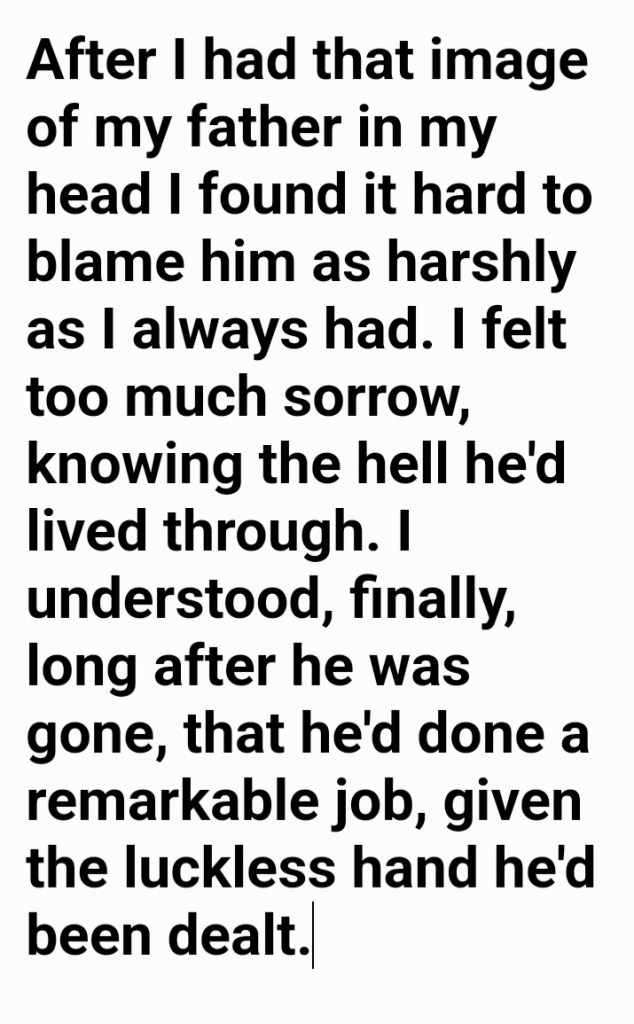
I spent two years, every day, writing everything I could think of about my father, a perplexing man of unlimited potential and unlimited defensiveness. My father was chased every moment of his waking life by what he referred to as the demons we all have inside us. After writing and conducting a long post-mortem discussion with him for two solid years I came to truly understand his motivations, though I didn’t always agree with them, and this understanding allowed me to truly forgive a destructive character who apologized for the first and only time at the very end of his life, hours before he breathed his last. Still, as well as I grasp the tragedy that was my father, the recesses of my heart are still haunted, as all such recesses are.
Do the same thing my father used to do, glare with implacable hostility, maintain an angry defensive silence, defend yourself in lawyerly and inhumane ways, create and insist on an insane counter-narrative to make me the aggressor, you the victim, and I immediately find myself in that familiar, terrifying, incoherent terra incognita. We can’t map this terrain because we can’t bear to look at it for more than a second or two at a time. It overpowers us and seems to limit our options to fight or flight. It is primitive, terrible, maddening business. We push it down because there is little else to do about it. Anyone seemingly not engaged in a hard battle is very good at acting, until you touch a nerve that sets off their fight or flight response.
We live in a culture where our collective terra incognita has been set on fire. Along with actual record wildfires on various continents, and the rage and violence we see and hear in many of our citizens, a fire rages in the hearts of tens of millions of us. This fire is fed regularly, and much of its most potent food is incoherent poison, things a healthy body would never put into its mouth. No matter. Down the hatch it goes, and instead of digestion, fire belches forth, to singe the eyebrows of anyone who dares to ask “Jesus, are you OK?”
When you breathe fire, of course, you are not OK, not fucking OK at all! How infuriating is that stupid question when the burning inside you is actually flaming out of your mouth and singeing the face of your interlocutor? Jesus, am I fucking OK? Yes, I’m fine, you’re the one who is about to die, asshole…
When a relationship is strained, lines are drawn, sides taken and moral stances struck. The first casualty in such standoffs is often honesty, which is a shame, since it’s also the only way back to health. But since feelings are strained, hackles are easily raised and things are at a breaking point, you must be very careful about what you say, how you say it, what you leave out, what is safe terrain and what is a minefield that will blow everybody up if you set a toe on to it.
Though this limited honesty may feel to you like a kind of death, if you are used to an honest back and forth, it is nothing like death. It is an attempt to save the life of a frayed relationship in the only way possible, by putting things on a respirator in hopes of an eventual return to health and good cheer.
Only time will tell if your efforts towards repair succeed. A primal wound feels the same every time someone pokes a finger into it. The loss of a long, close friendship, in spite of your best efforts, always hurts exactly the same way, is identical to the grief of death in its inexorable finality. I will say, from my experience, a friendship that ends with someone screaming at you or bullying you is much easier to walk away from than one where your friend expresses only hurt, confusion and exasperation. It is as if the anger of the friend you are trying to reach cauterizes the wound, since you feel immediately relieved to be away from someone who can’t stop hissing and snarling. Good riddance to the raging bastard.
It is a tricky business, to be a human, as anyone who has tried it will tell you. The most important tool to mending hurt ismutual understanding.
Trying to reach understanding with only limited honesty, certain things never on the table for discussion, is supremely challenging. If the relationship means enough to you it is possible to find the patience to wait, even though it may seem impossible to be that patient at certain points. As long as you don’t lose your temper there is a chance of repair, even with the prickliest, most defensive of characters. The hope is that at that point mutual honesty will also be restored, everyone wiser for the long, terrible disruption of good will.
Close friendship, that state of grace where we extend the benefit of the doubt to sympatico strangers who become friends by returning the kindness with reciprocal care, adds years to our lives, psychologists tell us. We feel this every time we are refreshed by a relaxed visit with old friends. We don’t need science to tell us that laughing, breaking bread together, catching up, retelling old stories is a great antidote to the many daily horrors we are powerless against.
The other side of the picture, a life without close connections to anyone, is about the most hopeless darkness imaginable for social creatures like us. Millions and millions are confronted by this terrible darkness, many of our relationships reduced to tapping out little notes to each other on the phones that surveil us and mine our quirks for dollars. Isolation, as so many of us felt much more acutely during the pandemic lock down, kills.
Deaths of despair multiply where there is no hope for relief, new records are set every year for overdose deaths, deliberate and accidental, here in the USA. Shooting by gun is now the number one cause of death for people ages one to twenty years old in this country! Mass murders of enraged despair become common as young men break under isolation, particularly when isolation itself is weaponized to further divide us, the “reasoning” of the killers being that since nobody will understand or care about me anyway, might as well go out as a “gunman”, in a hail of bullets, and make others feel the unbearable pain I fucking feel.
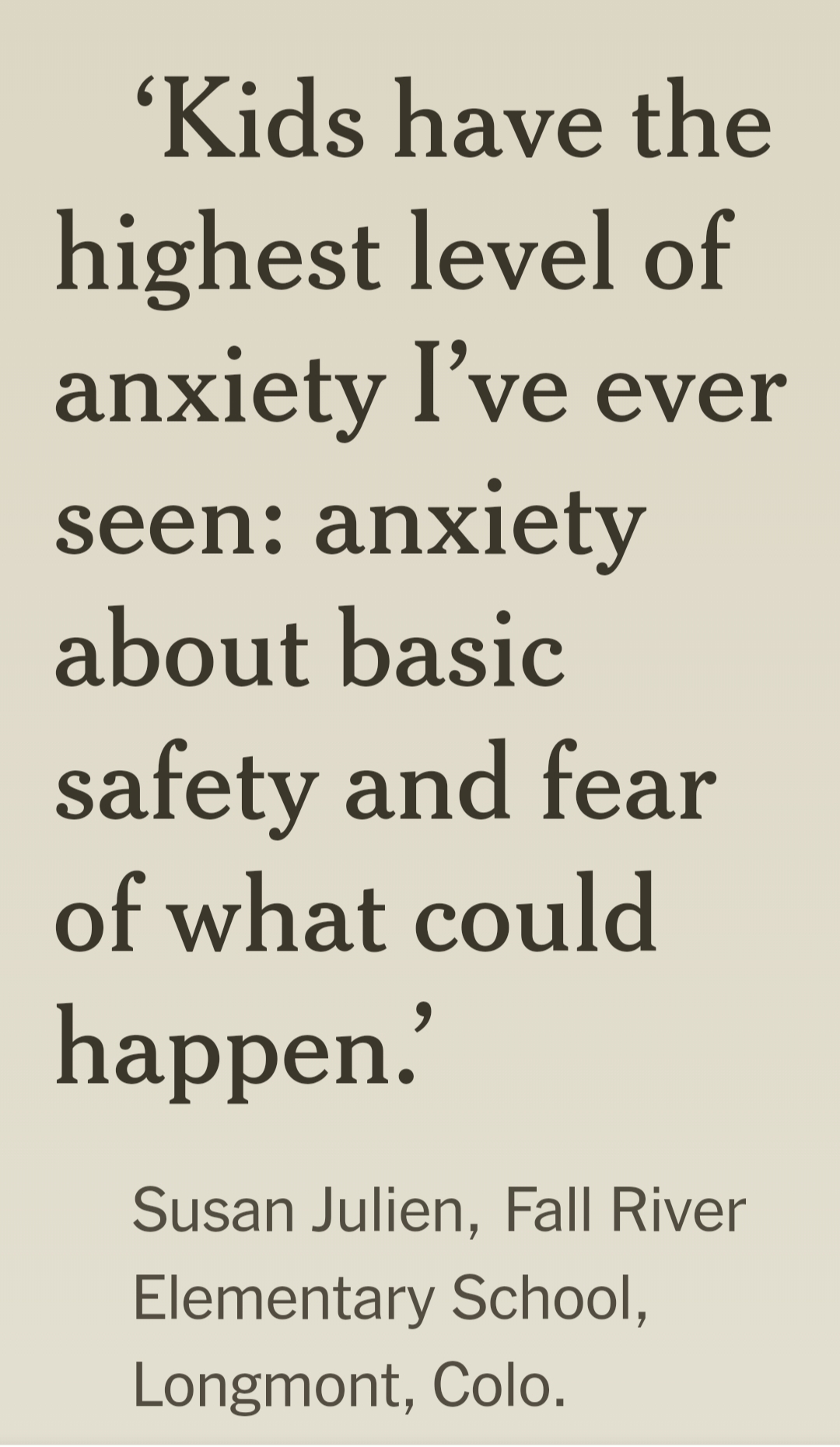
The New York Times periodically publishes a story like this one, 362 School Counselors on the Pandemic’s Effect on Children: ‘Anxiety Is Filling Our Kids’ Do you need to read the report to understand how shattered young people are absolutely right to feel today? It’s not as if we lived in a harmonious, universally fair nation of infinite promise and hope before the pandemic. Add a world-leading million pandemic deaths, at least half of them preventable, and the hot war over who is to blame for all those deaths, scientists or political absolutists, and you don’t need the New York Times to delve into the uniquely American reasons for more schoolyard fights than ever in our history as school mass murders reach record levels, adults clash angrily over whether any laws can change this grim exceptionally American reality, and a handful of Senators insist on the right of a minority to block all discussion of such laws in the Senate, should it come to that.
The question I wrestle with today is what to do when every direction you look in, public and private, leads to sorrow? There are only so many things we can do to distract ourselves from it, or numb ourselves to it, before the sorrow in every direction we look turns to despair, hopelessness, misdirected anger. Old friends deliberating over whether they can accept your immediate, sincere apology for momentarily losing your cool? A blow that lingers over the course of their ongoing deliberations, which can extend indefinitely through months of avoidance, denial and a pointless argument over who has the greater right to be hurt. A slowness to forgive becomes coupled with a new readiness to take offense? The self-preserving reflex is to walk away, the harder path of continually extending understanding for your old friends’ weakness is very fucking hard after feeling enough extended unresolved hurt. Keep the door open or finally close it, to keep the grave-scented chill out? Hard question, that one, with terrible consequences to loved ones beside yourself for a hasty choice.
My family was brutally truncated by angry mobs mobilized by the fanatical followers of Adolf Hitler, an insane man of limited intellect and great apparent charisma. Of the many dozens of family members alive and struggling before Hitler invaded their insecure little corner of then Russia only five or six (all but one in the US) were alive after 1943. The letters just stopped coming, in my father’s chosen description of their slaughter.
The loss of all these close relatives, whose names I never even learned, these abstractions (“mere abstractions” as my father called them), haunts me as I watch the world gearing up for the next round of irrational mass killings in the name of hopeless, senseless rage that needs somewhere to go, an “ideology” to direct it. That sympathetic, funny youngest brother of my grandmother’s, her favorite, little Joey (the only one whose name I know), might have been my most beloved great uncle, had it not been for the gleeful, drunken mob that massacred them all in a ravine to the northwest of town thirteen years before I was born. It takes one particularly relatable loving family member, or stranger, like a great teacher, or sympathetic neighbor, or friend of your parents, to change the course of your young life. Or, as many beautiful ghosts as you can imagine, which is a poignant substitute for the touch of the living hands and expressive faces of those souls when they werecapable of showing you love.
My niece and nephew grew up without their playful, sympathetic uncle in their lives. They saw him regularly when they were kids, their mother’s only brother, their only uncle, recalled his visits with love, and then, after their grandmother was buried, never saw him again. They never learnedthereason — that the lies their parents tell to protect them, and themselves, those desperate attempts to shield themselves from shame they actually lived were impossible for him to play along with. To preserve his tenuous relationship with their mother, the uncle would never lay out explicitly to his now adult niece and nephew that the reason for their estrangement was the dishonesty required of him, the pretend smile, the erasing of shared, lived history, a strict adherence to a lifetime of lies he, his sister and his brother-in-law all know are lies. How to tell the truth without becoming the enemy their parents always feared stymied the uncle every time he contemplated how to explain to them why he hadn’t seen them in more than a decade. From their point of view, they can only take it as a personal abandonment, otherwise their strange, inconstant uncle would have found a way to spend time with them.
How many years of unresolved sorrow can we expect ourselves to endure before our life expectancy begins to take a hit?I am fairly sure my old former friend Friedman, a man who fought with and was eventually betrayed by everyone he ever cared for, literally died of a broken heart when he expired in his chair from no apparent cause a few years ago, at age 65.
Here is what I have worked out for myself, though I don’t know how coherently I can lay it out or how helpful it will be to you. I exert myself to remain mild in the face of aggravation, in ways I could not have imagined twenty years ago. That, by itself, it turns out,only helps a little. You will get no points for it. The heat can always be turned up and turned up until your old reflexes finally boil up and you must tell someone in no uncertain terms that it’s enough, they can feel free to fuck off now, for the following seven impossible to unhear reasons.
More important to facing sorrow is my sense of fairness, my determination not to treat others in a way I hate to be treated, nor to endlessly accept such treatment from others, no matter how ingeniously rationalized. The knowledge that we can all only tolerate a certain amount of unfairness is important to working through sorrow caused by friends who may, under great stress, need to blame you for the strains we all feel from time to time. I give myself permission to grieve, to feel hurt, to eventually stop extending the benefit of the doubt to people who continue to insist on denying me the same. Their insistence is usually based on a purely emotional appeal, a protestation of love that will be instantly withdrawn if you don’t relent and return their love without hesitation or need for further discussion. That far I know now I will never come in my long quest to be as unfailingly gentle as the Christian’s Jesus, as my imagined Hillel, or the Buddha.
Spend time every day doing something you love. Creativity for its own sake, if we are lucky enough to enjoy it, is a great balm, and an excellent tonic, though it is somewhat dependent on mood. You can become overwhelmed by the sorrow all around and even the act of making yourself feel better by taking your imagination out for a spin can seem futile.
Do not succumb to futility, action to improve your mood and situation, to exercise your liberating imagination, is always better than inaction, impossible as it may sometimes feel.
I write, every day, to you. We have never met, you and I, but I imagine the reader of these words with the fond hope of making an intelligent connection. Those readers who know me, once in yer proverbial blue moon, will mention that they were moved by something I wrote, which always makes me feel good, but most of the time it’s just a “like” or a larger than usual number of readers clicking on a certain post that tells me I have made some kind of connection. I remind myself periodically that the clarifying act of sitting down to write, and making it as clear as possible to others and myself, is itself a net benefit and a good swing in the fight against felt debility.It is also indispensable to me beyond that, the quiet in your mind as you write is a kind of sacred space. Being able to hone your expression, in a way not possible in daily speaking, an infinite blessing.
This impulse to connect to others is important to nurture in the larger project of avoiding despair. The feedback we get is also very addictive. Lately the number of views of these posts has dropped dramatically and I feel disappointed when I don’t get the usual hit of dopamine I felt after posting something when I saw that several people had immediately clicked on it. That piece hit the mark, I think to myself lately, as the number of views stays at the same low count for hour after hour, as if rebuking me in my belief that I can connect with strangers.
This is the world young people were born into, likes, dislikes, friend, unfriend, LOL, WTF. Shoshana Zuboff laid out the dystopian world of social anxiety, conformity and future robbing this online feedback loop from peers real and virtual produces. A brilliant hermit I know, once a good friend, has zero in person social connections, but hundreds of friends and followers on “social media”. Going online to find missing connections, as I am doing right now when Sekhnet is sick of hearing me talk about things that make her sad, is like wearing those goggles that realistically put you in a three dimensional, totally realistic world that doesn’t exist. Girl of your dreams? She’s waiting for you when you put on the goggles and check out that smile of happiness to see you and thedream outfit she’s wearing for you! Why would you ever leave that conscious dream world? Predictions are that you would not, time would disappear, the illusion of fun, love and excitement infinitely preferable to a world where your best bet for coping with your sorrow is a strong anodyne (some of which will kill you if taken wrong) or a military assault rifle to give yourself a feeling of agency, importance and godlike power.
I’d like to end on a note of hopefulness. The forces that would make us all fight each other to the death so that they can own and control everything seem to have become bullyingly triumphant here in the US a few months too early to take the absolute power that has long been their dream. This tiny but powerful reactionary core appear to have overplayed their autocratic hand with time to organize against them before the crucial midterm elections.
After the Civil War (War of Northern Aggression to you, Yank) there was a brief period, called Reconstruction, during which our Constitution was amended to reflect a better understanding of democracy and a more perfect union. We created the Department of Justice to enforce laws required by this better understanding. Reconstruction, which proved we can do much better as a nation, was soon halted in a series of Supreme Court decisions and political compromises, after about ten years.
During the time Reconstruction was allowed to proceed it demonstrated that democracy can work to produce a better, more fair and inclusive society. Such a result was intolerable to thosefew with the most power, north and south, and the most to lose by “equality” and “justice”. In the defeated Confederacy it was not long until a form of race-based American fascism took over. Elite, wealthy local white men, backed by a secret army of terrorists and like-minded police, lawmakers and judges, and empowered by a block of similar white men in the state and federal legislatures, ruled unchallenged in every area of the South, with a firm, autocratic hand, until LBJ betrayed his former buddies by signing both the Civil Rights Act of 1964 and, even more importantly, the Voting Rights Act of 1965.
Hope? The American oligarchs and their paid apologists seem to have overplayed their hand in a way that if mobilized around correctly will jar millions out of their apathy to vote for candidates who do not insist that the 75% who support gun control, the right of a pregnant woman or girl — particularly one who was raped, or in danger of death from the pregnancy — to end an unwanted pregnancy, who support fair taxes on the wealthiest to fund desperately needed public programs, a living wage for all workers, affordable health care, real measures to slow the gathering climate catastrophe and all the rest of the “kitchen table” issues simply stop acting like spoiled “woke” babies and socialists and shut the fuck up.
What is the official current GOP platform? The guy who repeatedly lies about losing by 8,000,000 votes is himself the victim of LIES!!! By a bipartisan cabal of powerful pedophiles, queers, anti-fascists, Black racists, dirty immigrants, Muslims and Jews!!! After enough frustration, that kind of transparent bullshit wears thinwith all but a diehard 39%, particularly in the face of a premature, in-your-face celebration of minority triumph in defeating what the powerless 75% strongly prefers. We are told 110,000,000 eligible American voters didn’t bother casting a vote in 2020, thirty million more than voted for either presidential candidate. Those are the sorry, demoralized citizens we have to reach, instill with minimal hope, get them to cast a vote for the minimum of what the majority of us needs andwants.
That may not be direct, personal hope for a lonely world where all we can personally see is sorrow in every direction we look, but any steps we take, with others, away from the march toward worldwide oligarchy and fascism, are steps in the right direction, steps toward hope rather than despair.
As a personal matter, treat your friends and family with as much care as you can, but know also that agreeing to a demand that you somehow overcome prolonged, unresolved suffering has its limits and a time may sadly come when the best course is to step away, that very few things last a lifetime. I’m going to compose a long letter to my niece and nephew, setting out the harm done to our ability to know each other by years of insistence that lies be accepted as the real truth, no matter what some disturbed, childless uncle in NY might think. If I can set out the issues clearly and non-judgmentally enough, one or both of them may actually be able to hear me. If so, I’ll chalk one up to the power of love speaking truth without blame.
Above all, and however difficult it might be at a given moment, be of good cheer!

 gratuitousblahg