Who is Roger Stone (and why does he have Nixon’s face tattooed on his back?)

Self-proclaimed totally innocent rat fucker Roger Stone, one of Trump’s closest long-time advisors (unofficial! No legal connection to Trump!) and coiner of “Stop the Steal” (2000, 2016, 2020, 2024) appeared before the January 6 Select Committee for a few minutes yesterday to assert his Fifth Amendment right against self-incrimination. He claimed that Democrats just want to trap people into fake perjury so they can persecute them. The multi-millionaire then began a crowd-funding campaign for his legal defense and to pay for around the clock security guards.

Dirty trickster Stone is an innovator in political dirty tricks who raked in a mountain of cash with his former partner Paul Manafort (no connection to Trump! He worked for free!). Stone has been integral to the disinformation, outright lying and threats of right-wing political violence culture we now live in.

Here is a capsule description of this cynical, destructive man’s career as a presidential campaign disinformation specialist from a recent episode of historians Heather Cox Richardson and Joanne Freeman’s Now and Then podcast called Disinformation and Democracy:

Heather Cox Richardson:

. . . And one of the things that’s interesting about the Nixon campaign . . . is that one of the people involved as a young man who carries an image of Nixon on his back to this day in a tattoo, and that is Roger Stone, who was a 20 year old operative in that campaign. And he did things in that, like making a donation from a fake organization called the Young Socialist Alliance, to somebody who was opposing Nixon in the primary, using things like that to go ahead and again, slime opponents. And that business of running politics by lying is going to make a huge difference in our lives in the year 2000. Thanks again to Roger Stone.

So Roger Stone, again, cuts his teeth in this idea of running politics by convincing people of things that are not true, by changing the trajectory of reality by creating narratives and creating images. And he is instrumental in, what’s known as the Brooks Brothers riot in 2000 after the election of that year. And the way that that played out was that the election of that year was on November 7th. And on that election, it became clear that the outcome of the 2000 election would depend on the electoral votes from Florida. There were a lot of problems with that Florida election; there was a butterfly ballot in which you didn’t actually read down one side of the page and then down the other, you were supposed to read page to page, which meant that a bunch of democratic voters get siphoned off to vote for a far-right candidate. There were a number of people kicked off the roles immediately before the election. But after the election, it becomes clear that Bush has a lead in the state, but as they continue to do recounts, the numbers of votes that put Bush in the lead start to drop, and they start up by a lot. Usually recounts don’t change the vote very much, but in fact, the recounts in Florida drop Bush’s lead in the state from 1,784 votes, to 327 votes,, then to 154 votes.

And finally, attention comes down to Miami-Dade County, which is a democratic stronghold. And there, it seems likely that Gore is going to pick up a lot of votes in a recount. So on November 21st, the Florida Supreme Court authorized a manual recount in four counties and set a deadline for November 26th on that. And then on November 22nd, the Miami-Dade County Canvasing Board decided to focus solely on the contested ballots in order to meet their deadline. And so, they’re trying to hunker down, and trying to avoid the media frenzy that’s descending on them. And so in order to go ahead and avoid that they move into a smaller room on the 19th floor of the County Building, so that they can be close to the ballot scanning machine. That day hundreds of people from around the country, including a bunch of Republican staffers descend into South Florida to protest the recount.

There’s a New York Congressman, for example, a man named John Sweeney who was working for the Bush campaign, who ordered protestors to shut it down, meaning to shut down the recount. And there’s more and more pressure on the Miami-Dade recount that eventually becomes known as the Brooks Brothers riot, because the protestors who were trying to shut it down, come dressed in buttoned shirts and sport jackets. And they appear at the room outside where the counting is taking place, and they start screaming, “Stop the count, stop the fraud, let us in.” And the protestors increasingly accuse the Miami-Dade counters of stealing ballots and of stealing the election. The guy in charge of that was the democratic county chairman, a guy named Joe Geller. And six days after the Brooks brothers riot, Geller told Salon, and this is a quote, “This was not a Miami moment. It was outsiders, Hitler Youth sent in by the Republicans to intimidate the election officials.”

And that’s actually exactly what it was. It was a Stone operation to go ahead and orchestrate that protest in Miami. He recruited a bunch of Cuban American protestors by warning on the radio, for example, that democratic candidate Al Gore was going to stage a coup, the same way that Fidel Castro had staged a coup in Cuba. He’d organized phone banks to encourage Miami Republicans to storm the counting site. And on the day of the rioting, he actually was in a Winnebago outside, organizing the protests. So there was this sense that by manipulating the media and getting people to think that there was something untoward going on in what was really quite a legitimate recounting, that he could go ahead and orchestrate and end to that recount. And that is exactly what happened.

Joanne Freeman:

And think about the layers of impact of that. So first of all, you have the people doing the recount who have the impression there’s this mass of people banging down the doors, wanting to end it all, and that there’s mass opposition. You’re getting an awareness outside of that place that somehow or other there’s a mass movement, mass opposition against what, of course, must be some kind of illicit attempt to steal the election. And that the fact that there’s that kind of protest shows that things not right down there in Florida. So on many, many levels, this out and out fabrication can spread to voters, can spread to the public, can have an impact in Florida, and in the counting of votes in Florida, it echoes, it resounds out in a lot of different ways. And it’s completely fabricated.

Heather Cox Richardson:

Well in a sense, we’re talking about information, and how in a democracy, you desperately need to have an informed public, but the manipulation of that information into disinformation that then can be transmitted increasingly quickly over first telegraph lines, then telephone lines, then radio, then television, and now the internet, means that we have a real problem with disinformation, and with its ability to whip people up to an emotional reaction to go ahead and change our history, change our political history. And in the case of 2000, stop a recount that looked as if it were going to put a Democrat who won the popular vote into the White House, rather than a Republican.

Joanne Freeman:

To act on impulse and act on emotion rather than to act on real information. So first of all, that in and of itself, not only is it disinformation, it’s anti-information. It’s trying to get people emotionally riled up. And that kind of emotion is always going to be more effective than plain old, boring truth when it comes to what’s being publicized and what’s catching the public eye. And as you just said, Heather, different forms of technology are helping that transformation, that spread of deliberately emotion rousing lies, to change the whole political picture and alter American political history.

You know, if you think about it, democracy in and of itself is a conversation of sorts between people who hold power, and the people who have given it to them. And the process of governing has to do with the communication back and forth of people with power, and the people who’ve given it to them, that’s where accountability comes in. But any form of technology that alters the nature of that conversation, alters democracy. It makes perfect sense, if democracy is a conversation between people with power and those who’ve given it, any technology that changes that conversation is going to transform democracy. And the question then really becomes: how does the nation adjust to that new technology? How is that new technology reigned in or accommodated what happens in that moment when people are trying to figure out in essence, a new language of politics. And depending on what happens there, really depends the direction of the nation’s politics.

source
https://i1.wp.com/themillennialdemocrats.com/wp-content/uploads/2018/03/roger-stone-nixon-tattoo.jpg?fit=1156%2C771&ssl=1
WATCH: When drawing comparisons between Nixon and Trump ...
Roger Stone: Trump ally, political strategist, Nixon fan ...

I like this federal law

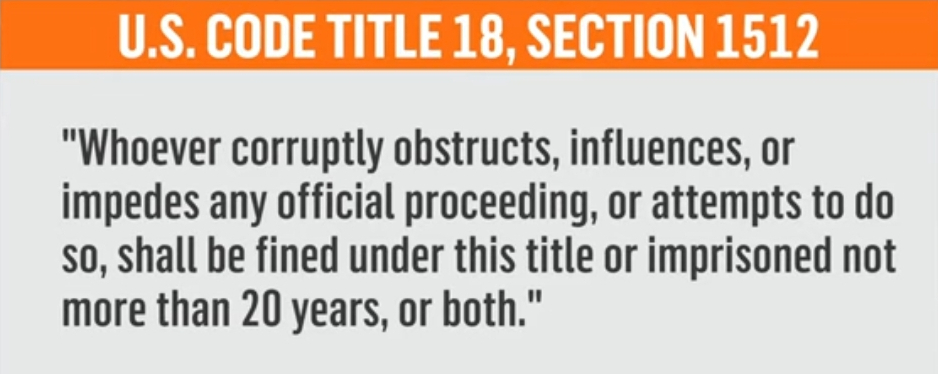
Lawyers for two misguided patriots who attacked Capitol Police on January 6 and made their way into the building to impede the final counting of Electoral College Votes for the candidate who won the election argued their clients did not violate 18 US Code Sec. 1512 and moved to have the federal criminal charge under 1512 dismissed.

The lawyers argued that the joint session of congress was, for a variety of arguable legalistic rationales, not an “official proceeding” and that “corruptly obstructs, influences or impedes” gives unconstitutionally ambiguous notice to rioters who break into a closed Capitol building to merely stop the steal, because “corruptly” is a vague, overbroad and essentially meaningless word.

Federal judge Dabney L. Friedrich, of the DC District Court, was having none of this and wrote a precise and basically unappealable decision denying the motion. In 25 crisp pages she clarified why the law applied directly to the actions of two men who assaulted police with a variety of deadly weapons and forced their way into the Capitol to obstruct, influence or impede the official proceeding then underway.

As for explaining what “corruptly” means in the legal sense (and in the popular sense), she did so unambiguously:

In this sense, the plain meaning of “corruptly” encompasses both corrupt (improper) means and corrupt (morally debased) purposes. … The Court agrees that § 1512(c)’s proscription of knowing conduct undertaken with the specific intent to obstruct, impede, or influence the proceeding provides a clear standard to which the defendant can conform his behavior.

source [1]

It’s hard to think that this same federal law would not apply to an elected official who had been informed by the Attorney General of the United States that voter fraud claims had been exhaustively investigated and were “bullshit” and who nonetheless aggressively spread a knowing lie, organized a rally, and an unpermitted march (no reason to have phalanxes of DC cops on the route to the Capitol, which would have happened with a permit for a march, you understand), to corruptly obstruct, influence or impede the last official session of Congress relating to the peaceful transfer of power.

What do you think, Merrick?

[1]

Jennifer Rubin wrote an excellent piece called “A federal court has ruled that obstructing the electoral vote count is illegal. Trump should panic.” describing the case, the ruling and the potential worries for Mr. Trump and his most ardent loyalists.

Grey Lady Attacks!

Exposure to prolonged fear of terrible sickness and death from a highly infectious disease, against which we are largely at the mercy of others doing their part, leads to changes subtle and dramatic in the human psyche. Some respond to this reasonable fear by lashing out, insisting on their right to infect whoever they want, in the name of opposing tyranny. Others isolate and wear two or three masks in public. The endlessly morphing pandemic is terrifying, worldwide and it has changed societies everywhere. It has changed families, friendships, relations between neighbors, mostly not for the better.

At the same time, life must go on. So there was an organized attempt, coming up on a year ago, by our avatar of Covid madness, Donald Trump, to overturn the 2020 election. They did this using a daft, quasi-legal theory that, under the 12th Amendment, the defeated Vice President, whose role it is to certify the electors as the last step in the peaceful transfer of power, is actually in charge of deciding who the new president and vice president will be. You know, democracy. The president’s top lawyers who espoused this bat shit crazy “theory”, or made unfounded fraud claims, or both, John Eastman and Jeffery Boessart Clark, are now standing on their Fifth Amendment right not to incriminate themselves by answering questions under oath.

The second paragraph of a NY Times article entitled “Meadows and the Band of Loyalists: How They Fought to Keep Trump in Power” underscores the objective madness of our current moment in history. The Times ordinarily bends over backwards to present the reasonable-seeming side of utterly unreasonable situations and positions, in the interest of appearing always above the controversy in question. Last night readers saw this:

WASHINGTON — Two days after Christmas last year, Richard P. Donoghue, a top Justice Department official in the waning days of the Trump administration, saw an unknown number appear on his phone.

Mr. Donoghue had spent weeks fielding calls, emails and in-person requests from President Donald J. Trump and his allies, all of whom asked the Justice Department to declare, falsely, that the election was corrupt. The lame-duck president had surrounded himself with a crew of unscrupulous lawyers, conspiracy theorists, even the chief executive of MyPillow — and they were stoking his election lies.

source

The lame-duck president had surrounded himself with a crew of unscrupulous lawyers, conspiracy theorists, even the chief executive of MyPillow — and they were stoking his election lies.

Damn, Grey Lady! You too? Never mind, good to know that at this perilous moment, even you show a bit of relatable human emotion. Unscrupulous lawyers, indeed.

Liz Cheney and 18 U.S. Code § 1505

I don’t like her extreme right-wing views, or that her father is one of the most evil and destructive men ever in US government, but I have to tip my hat to Liz Cheney. She has been fearless, and laser focused, in her determination to see justice done in the matter of a wildly scheming defeated president inciting a violent siege of the Capitol building to disrupt a joint session of Congress performing their constitutional duty to ensure the peaceful transition of power.

Here is her recent public statement on a key question before the committee:

“We know hours passed with no action by the president to defend the Congress of the United States from an assault while we were trying to count electoral votes,” Ms. Cheney said. “Mr. Meadows’s testimony will bear on a key question in front of this committee: Did Donald Trump, through action or inaction, corruptly seek to obstruct or impede Congress’s official proceeding to count electoral votes?”

source

This tracks the language of a federal criminal statute:

18 U.S. Code § 1505 – Obstruction of proceedings before departments, agencies, and committees

Whoever, with intent to avoid, evade, prevent, or obstruct compliance, in whole or in part, with any civil investigative demand duly and properly made under the Antitrust Civil Process Act, willfully withholds, misrepresents, removes from any place, conceals, covers up, destroys, mutilates, alters, or by other means falsifies any documentary material, answers to written interrogatories, or oral testimony, which is the subject of such demand; or attempts to do so or solicits another to do so; or

Whoever corruptly, or by threats or force, or by any threatening letter or communication influences, obstructs, or impedes or endeavors to influence, obstruct, or impede the due and proper administration of the law under which any pending proceeding is being had before any department or agency of the United States, or the due and proper exercise of the power of inquiry under which any inquiry or investigation is being had by either House, or any committee of either House or any joint committee of the Congress—

Shall be fined under this title, imprisoned not more than 5 years or, if the offense involves international or domestic terrorism (as defined in section 2331), imprisoned not more than 8 years, or both.

And as far as the definition of corruption goes, here’s Jennifer Rubin’s piece on a recent federal ruling that is very much on point. It’s called A federal court has ruled that obstructing the electoral vote count is illegal. Trump should panic.

Here’s Tucker Carlson, with the GOP rebuttal:

apologies, I was unable to embed FOX’s link to this hard-hitting report

Ms. Cheney has said that the investigation could very well lead to Mr. Trump facing her questions, with criminal penalties hanging over his head if he lies.

“Any communication Mr. Trump has with this committee will be under oath,” Ms. Cheney said this month. “And if he persists in lying then, he will be accountable under the laws of this great nation and subject to criminal penalties for every false word he speaks.”

source

A trial with witnesses and evidence

As someone who dislikes liars, bullies and shameless self-promoters, I’m encouraged by what the January 6 Committee has been doing lately. Chairman Bennie Thompson has announced that in the first months of 2022 they will lay out their case to the American public, and the world. They’ll present detailed evidence that there was an organized, well-funded conspiracy to overturn the 2020 election that resulted, when all other efforts failed, in the storming and sacking of the Capitol. There will be live testimony, there will be graphics, there will be blow ups of the text messages sent back and forth between the conspirators as the attack on the Captiol was going on.

It seems it’s taken a ridiculously long time, and much time was wasted when Democrats negotiated in good faith with Trump’s Republicans over the investigation, but the committee has seemingly uncovered a mountain of damning details. Details they are now strategically releasing in a teaser of what’s to come when they put on their case. I have a few thoughts about the difference between a trial with and without witnesses and evidence.

When Nancy Pelosi decided that Mueller’s findings about apparent obstruction of justice by former president Trump, charges Mueller explicitly wrote he could not exonerate the president for, were too complicated for Americans to understand she opted to impeach him over his attempt (the day after Mueller’s monosyllabic testimony to Congress did no further harm to Trump) to enlist a foreign government to smear his likely opponent, Joe Biden. Whatever you make of Pelosi’s decision, and I think it was a very poor decision, here is the problem with a purely political “trial”. You can have all the proof of your case at hand — the detailed report of the perfect phone call to Zelensky, suspiciously hidden in a top secret government safe, the attempt by Barr to illegally bury the urgent whistleblower complaint, the vicious, public attacks on those who properly reported the improper call to Zelensky, in some cases as they were testifying — but if the head juror announces he will be working closely with the defense, and not allowing witnesses to testify or new evidence to be introduced, and that head juror is the deciding vote, you lose. 100% of the time.

When you can have witnesses testify live, under oath, and evidence can be produced that must be rebutted by actual counter-evidence, and where the fact-finder has not corruptly announced he will be working closely with the defense to get this fake, witch hunt fishing expedition thrown out of court, the outcome is an open question.

If Don McGahn had been forced to testify, repeat publicly the things he told Mueller’s investigators, under oath, the American people would have seen the former White House counsel admit that Trump asked him to fire Mueller and then, after he declined, to write a memo claiming that Trump had never asked him to fire Mueller. Obstruction of Justice 101. Then add Hope Hicks to the witness list, and have her repeat what she quotes Trump as saying when Sessions told him a special prosecutor had been appointed, his soliloquy and anguished call for Roy Cohn’s ghost, in which he despaired “I’M FUCKED!”

There were many more witnesses of apparent obstruction of justice, who’d already given sworn testimony to Mueller, but Bill Barr took care of that. He created the most expansive executive privilege claim in American history, an absolute blanket protective privilege against any attempt by anyone to get any information whatsoever, and told Trump to run with the absurdly broad claim, that he could run out the clock. And so they did. Two impeachment trials in the narrowly GOP Senate, no witnesses or updated evidence allowed, two party line acquittals. Everything was ducky for the former president. Until Trump lost the election and his powerful gunsel Barr finally had to quit.

I have to say, I’ve always been in favor of disclosure. Things kept in the dark molder and fester. Sunlight is said to be the best disinfectant. I can think of endless instances of things hidden and forbidden from discussion coming back to haunt the parties that demanded their banishment. We pay a high price for backing a person’s right to lie if they find themselves in a tight spot, facing shame, loss of career, criminal charges. I’m looking forward to a little public sunlight on this hideous attempt to install an American dictator.

File the Appeal

The judge who dismissed this lawsuit brought to thwart an illegal “fishing expedition meant to embarrass the former president” was appointed by the former president. The disloyal ingrate added that Trump was wrong on the law and gave him a minimal fourteen days to file an appeal in hopes of finding a reversible error that could bring the dismissed case back to life.

The Supreme Court should pencil this one on its shadow docket for a few months from now …

Nothing to See HERE

Jeeze, Louise…

Tea Party Congressman turned final Trump chief of staff Mark Meadows handed over a trove of documents, 9.000 pages, then, on the day his lawyers chose for him to speak to the January 6 Committee (the day his book came out), he suddenly cited Bill Barr’s absolute, blanket, protective privilege for anything relating to his boss, Mr. Trump. In spite of the fact that Trump, the arguable owner of executive privilege, had not invoked the fabulous Barr-created absolute privilege in relation to Meadows. In fairness to Meadows, Trump was furious at Meadows betraying him in the book. It is hard to imagine the terror that Mr. Trump’s rage produces in his loyalists.

Several of Rupert Murdoch’s top FOX news entertainers, including Laura Ingraham and Trump-confidante Sean Hannity, texted Meadows during the 187 minutes when Trump was riveted to live coverage of his riot, urging him to get Trump to make it stop, telling him Trump was destroying his brilliant legacy. Don Jr. also texted Meadows, urging him to get his father to call this shit off.

“He’s got to condemn this shit ASAP,” Donald Trump Jr. texted Meadows as the attack was underway.

FOX, who took a much different public position on the totally innocent protest on January 6, did not cover last night’s hearing of the January 6 Committee where the case for Meadows’ contempt of Congress was voted on, neither did OANN or Newsmax, nor did der Sturmer, for that matter.

Here is Mehdi Hassan, covering the revelation of the unprivileged texts Meadows has decided he will answer no questions about, until the courts eventually rule on the issue of Bill Barr’s absolute blanket privilege against anything that could compromise the prospects of his master, Mr. Trump. Check out Liz Cheney.

Jeeze, Louise…

Here’s the two minute version, featuring Liz Cheney’s reading of the texts, vs. what FOX hosts told their viewers on the Fair and Balanced Network:

Good column from Jennifer Rubin

Jennifer Rubin salutes the DC Appellate panel, gives some pertinent excerpts from their recent decision denying Trump’s “privilege” appeal, and lays out how the decision should be used in the ongoing battle to preserve our strained democracy in this largely lawless power grab by American zealots, backed by an army of angry white Christians.

Opinion: Distinguished persons of the week: The D.C. Circuit shuts down Trump

Image without a caption

By Jennifer Rubin Columnist |Yesterday at 7:45 a.m. EST

The Supreme Court may have lost its luster due to its blatant partisanship, but lower federal court judges are consistently upholding the Constitution and not allowing Jan. 6 to go down the memory hole.

The three-judge U.S. Court of Appeals for the D.C. Circuit on Thursday issued a unanimous opinion shutting down former president Donald Trump’s ludicrous claim that he can assert executive privilege over White House documents in contravention of the current president’s waiver of privilege claims.

“On the record before us, former President Trump has provided no basis for this court to override President Biden’s judgment and the agreement and accommodations worked out between the Political Branches over these documents,” the court held. “Both Branches agree that there is a unique legislative need for these documents and that they are directly relevant to the [House select committee’s] inquiry into an attack on the Legislative Branch and its constitutional role in the peaceful transfer of power.”Advertisement

Rarely is the court’s recitation of the facts as powerful as this one, given the MAGA crowd’s ongoing gaslighting:

On November 3, 2020, Americans elected Joe Biden as President, giving him 306 electoral college votes. Then President Trump, though, refused to concede, claiming that the election was “rigged” and characterized by “tremendous voter fraud and irregularities[.]” … Over the next several weeks, President Trump and his allies filed a series of lawsuits challenging the results of the election. The courts rejected every one of the substantive claims of voter fraud that was raised. … The events of January 6, 2021 marked the most significant assault on the Capitol since the War of 1812. The building was desecrated, blood was shed, and several individuals lost their lives.

In case anyone had forgotten, the court offers a reminder that any claim of a stolen election was and remains a lie. This was not a “normal tourist visit.”

The court reiterated that the current president waived executive privilege, writing, “In this case, President Biden, as the head of the executive branch, has specifically found that Congress has demonstrated a compelling need for these very documents and that disclosure is in the best interests of the Nation. Congress, which has engaged in a course of negotiation and accommodation with the President over these documents, agrees.”

The court then reaffirmed that the current president holds the privilege:

“To start, as the incumbent, President Biden is the principal holder and keeper of executive privilege, and he speaks authoritatively for the interests of the executive branch,” the court held. “Under our Constitution, we have one President at a time.”

The court also emphasized the legitimacy of Congress’s inquiry:

The very essence of the Article I power is legislating, and so there would seem to be few, if any, more imperative interests squarely within Congress’s wheelhouse than ensuring the safe and uninterrupted conduct of its constitutionally assigned business. Here, the House of Representatives is investigating the single most deadly attack on the Capitol by domestic forces in the history of the United States. Lives were lost; blood was shed; portions of the Capitol building were badly damaged; and the lives of members of the House and Senate, as well as aides, staffers, and others who were working in the building, were endangered. They were forced to flee, preventing the legislators from completing their constitutional duties until the next day.

Proceeding through the test the Supreme Court laid out in Trump v. Mazars, in which the high court ruled against Trump’s bogus claim of absolute privilege while he was in office, the appeals court concluded, “At the end of the day, the Mazars test is of no help to former President Trump’s effort to demonstrate a likelihood of success in invalidating the January 6 Committee’s request.”

With some rhetorical flourish, the court wrapped up with this:

Benjamin Franklin said, at the founding, that we have “[a] Republic”—“if [we] can keep it.” The events of January 6 exposed the fragility of those democratic institutions and traditions that we had perhaps come to take for granted. In response, the President of the United States and Congress have each made the judgment that access to this subset of presidential communication records is necessary to address a matter of great constitutional moment for the Republic. Former President Trump has given this court no legal reason to cast aside President Biden’s assessment of the executive branch interests at stake, or to create a separation of powers conflict that the Political Branches have avoided.

The court’s opinion is so tightly reasoned that it is hard to imagine even this Supreme Court riding to Trump’s rescue. (Indeed, it did not do so in Mazars.) The appeals court performed three essential functions in rendering its decision.

First, it demolished the “big lie” of a stolen election and restated the seriousness of the violent insurrection that disgruntled Republicans launched. Every member of Congress should read the opinion and prepare to explain how, if at all, the court’s recitation of facts goes astray. Lacking any facts to refute the court, Republicans’ refusal to accept the 2020 electoral votes and their dismissal of the insurrection should be seen for what they are: Partisan bad faith in violation of their oaths.

Second, it obliterated the basis for the assertion of executive privilege from Trump cronies Stephen K. Bannon and Mark Meadows. They are looking at conviction for contempt of Congress, as will other witnesses attempting to cover for Trump. (Rep. Liz Cheney of Wyoming, one of two Republicans on the House select committee, explained in a series of tweets that these stunts have not slowed the committee, which “has already met with nearly 300 witnesses … [and is] conducting multiple depositions and interviews every week.”)

Third, in so thoroughly shredding Trump’s bogus legal arguments, the court made clear that Trump’s entire legal strategy is to stall and run out the clock. The facts and the law are not on his side, and the court has refused to help him delay the process by reviewing every document. In this case, the wheels of justice turn swiftly.

For its clear-eyed opinion and reaffirmation of the rule of law, we can say to the D.C. panel, well done.

washingtonpost.com © 1996-2021 The Washington Post

Hair on Fire

If you are devoted to American democracy and the ongoing project to form a more perfect nation, and your hair is not on fire, watching the feeble parliamentarian efforts to fight an opposition party united behind a ruthless, determined, deep-pocketed group of reactionaries, fronted by a deranged narcissist, then what can I say? Barton Gellman published a long article in the Atlantic last week entitled “January 6 was practice” and retitled Trump’s Next Coup Has Already Begun (I can’t give you the link, I’m out of free articles at the Atlantic, here’s the Atlantic’s summary of the article with a link) detailing exactly why Biden’s hair, Merrick Garland’s hair, everyone’s hair should be on fire. It is well worth reading and I have pulled three sections for you (below) to whet your appetite for your hair bursting into flames.

The phrase “hair on fire” became popular as an image of someone with an urgent warning of a catastrophe (that soon happened) that was being ignored. Twenty years ago, in the months before Saudi religious fanatics brought down the World Trade Center and put a hole in the Pentagon in a spectacular act of terrifying mass murder, there were high national security officials like Richard Clarke running around with their “hair on fire”. Clarke was trying to get the attention of the vacationing leader of a then highly unpopular administration and brought bulletins with titles like “Bin Laden Determined to Strike in US” and Al Queda plans to fly Planes into US buildings to the president in the weeks before the attack. Bush and Cheney paid no attention to these warnings, though their party was ready with the voluminous Patriot Act within days of the attack and Bush’s popularity soared starting on September 12th. The Project for a New American Century began in earnest, something its reactionary architects predicted would take decades, absent a galvanizing Pearl Harbor type attack. Then, bingo, September 11, and the rest is history. A history we still don’t have important details of, like who were the wealthy investors who made a killing on the stock market with strategic buys and sells the day before September 11.

Almost a year ago a president who lost the election by a wide margin tried everything in his power (and much beyond his legal power) to change the outcome of the election he lost. His last, desperate move was to incite a riot to Stop the Steal, the fraudulent claim he’d been pushing for months, starting well before the election. In the aftermath of the riot he incited (and note, there was no permit for the march that swarmed into the Capitol — a permit would have meant massive police presence along the route), Trump was immediately condemned, by leaders of both parties. His top enablers, Mitch McConnell, Kevin McCarthy and Lindsey Graham all spoke forcefully in the days after the MAGA riot stopped a joint session of Congress in its constitutional duties related to the peaceful transfer of power. Trump would quickly bring virtually all of them in line. McConnell, who gave Trump his greatest, indelible success during his term by ramming home hundreds of Federalist Society lifetime judicial appointments, is now hated by Trump for not falling 100% back in line like the rest of his cult members. They are planning on an improved version of what narrowly failed the last time.

Here are three sections from Gellman’s important article. At the risk of burying the lede (which you can skip to) his hair on fire conclusion is saved for last. The headings are my own, not Gellman’s.

A bullshit legal theory of Scalia-like brilliance

Elections are complicated, and election administrators have to make hundreds of choices about election machinery and procedures—the time,place, and manner of voting or counting or canvassing—that the not specifically authorized. A judge or county administrator may hold polls open for an extra hour to make up for a power outage that temporarily halts voting. Precinct workers may exercise their discretion to help voters“cure” technical errors on their ballots. A judge may rule that the state
constitution limits or overrides a provision of state election law.

Four justices—Alito, Neil Gorsuch, Brett Kavanaugh, and Clarence Thomas—have already signaled support for a doctrine that disallows any such deviation from the election rules passed by a state legislature. It is an absolutist reading of legislative control over the “manner” of appointing electors under Article II of the U.S. Constitution. Justice Amy Coney Barrett, Trump’s last appointee, has never opined on the issue.

The question could arise, and Barrett’s vote could become decisive, if Trump again asks a Republican-controlled legislature to set aside a Democratic victory at the polls. Any such legislature would be able to point to multiple actions during the election that it had not specifically authorized. To repeat,
that is the norm for how elections are carried out today. Discretionary procedures are baked into the cake. A Supreme Court friendly to the doctrine of independent state legislatures would have a range of remedies available to it; the justices might, for instance, simply disqualify the portion of the votes
that were cast through “unauthorized” procedures. But one of those remedies would be the nuclear option: throwing out the vote altogether and allowing the state legislature to appoint electors of its choosing.

Trump is not relying on the clown-car legal team that lost nearly every court case last time. The independent-state-legislature doctrine has a Federalist Society imprimatur and attorneys from top-tier firms like BakerHostetler. A dark-money voter-suppression group that calls itself the Honest Elections
Project has already featured the argument in an amicus brief.

How close the mob came to hanging Mike Pence

Less than an hour earlier, at 1:10 p.m., Trump had finished speaking and
directed the crowd toward the Capitol. The first rioters breached the building
at 2:11 p.m. through a window they shattered with a length of lumber and a
stolen police shield. About one minute later, Fairlamb burst through the
Senate Wing Door brandishing the baton, a teeming mob behind him.
(Fairlamb pleaded guilty to assaulting an officer and other charges.)

Another minute passed, and then without warning, at 2:13, a Secret Service
detail pulled Pence away from the Senate podium, hustling him out through a
side door and down a short stretch of hallway.

Pause for a moment to consider the choreography. Hundreds of angry men
and women are swarming through the halls of the Capitol. They are fresh
from victory in hand-to-hand combat with an outnumbered force of
Metropolitan and Capitol Police. Many have knives or bear spray or baseball
bats or improvised cudgels. A few have thought to carry zip-tie wrist
restraints. Some are shouting “Hang Mike Pence!” Others call out hated
Democrats by name.

At 2:26, the Secret Service agents told Pence again that he had to move. “The third time they came in,”
the vice president’s chief of staff told me, “it wasn’t really a choice.”

These hundreds of rioters are fanning out, intent on finding another group of
roughly comparable size: 100 senators and 435 members of the House, in
addition to the vice president. How long can the one group roam freely
without meeting the other? Nothing short of stunning good luck, with an
allowance for determined police and sound evacuation plans, prevented a
direct encounter.

The vice president reached Room S-214, his ceremonial Senate office, at
about 2:14 p.m. No sooner had his entourage closed the door, which is made
of opaque white glass, than the leading edge of the mob reached a marble
landing 100 feet away. Had the rioters arrived half a minute earlier, they could
not have failed to spot the vice president and his escorts speed-walking out of
the Senate chamber.

Ten minutes later, at 2:24, Trump egged on the hunt. “Mike Pence didn’t
have the courage to do what should have been done to protect our Country
and our Constitution,” he tweeted.

Two minutes after that, at 2:26, the Secret Service agents told Pence again
what they had already said twice before: He had to move.

“The third time they came in, it wasn’t really a choice,” Marc Short, the vice
president’s chief of staff, told me. “It was ‘We cannot protect you here,
because all that we have between us is a glass door.’ ” When Pence refused to
leave the Capitol, the agents guided him down a staircase to a shelter under
the visitors’ center.

President Biden’s plan to protect democracy in 2022 and 2024

THERE IS A clear and present danger that American democracy will not
withstand the destructive forces that are now converging upon it. Our two-
party system has only one party left that is willing to lose an election. The
other is willing to win at the cost of breaking things that a democracy cannot
live without.


Democracies have fallen before under stresses like these, when the people
who might have defended them were transfixed by disbelief. If ours is to
stand, its defenders have to rouse themselves.

Joe Biden looked as though he might do that on the afternoon of July 13. He
traveled to the National Constitution Center in Philadelphia, which features
on its facade an immense reproduction of the Preamble in 18th-century
script, to deliver what was billed as a major address on democracy.

What followed was incongruous. Biden began well enough, laying out how
the core problem of voting rights had changed. It was “no longer just about
who gets to vote” but “who gets to count the vote.” There were “partisan
actors” seizing power from independent election authorities. “To me, this is
simple: This is election subversion,” he said. “They want the ability to reject
the final count and ignore the will of the people if their preferred candidate
loses.”

He described the means by which the next election might be stolen, though
vaguely: “You vote for certain electors to vote for somebody for president”
and then a “state legislator comes along … and they say, ‘No, we don’t like
those electors. We’re going to appoint other electors who are going to vote
for the other guy or other woman.’ ”

And he laid down a strong marker as he reached his rhetorical peak.

“We’re facing the most significant test of our democracy since the Civil War.
That’s not hyperbole,” he said. “I’m not saying this to alarm you. I’m saying
this because you should be alarmed.”

But then, having looked directly toward the threat on the horizon, Biden
seemed to turn away, as if he doubted the evidence before his eyes. There
was no appreciable call to action, save for the bare words themselves: “We’ve
got to act.” Biden’s list of remedies was short and grossly incommensurate
with the challenge. He expressed support for two bills—the For the People
Act and the John Lewis Voting Rights Advancement Act—that were dead on
arrival in the Senate because Democrats had no answer to the Republican
filibuster. He said the attorney general would double the Department of
Justice staff devoted to voting-rights enforcement. Civil-rights groups would
“stay vigilant.” Vice President Kamala Harris would lead “an all-out effort to
educate voters about the changing laws, register them to vote, and then get
the vote out.”

And then he mentioned one last plan that proved he did not accept the
nature of the threat: “We will be asking my Republican friends—in Congress,
in states, in cities, in counties—to stand up, for God’s sake, and help prevent
this concerted effort to undermine our elections and the sacred right to
vote.”

So: enforcement of inadequate laws, wishful thinking about new laws,
vigilance, voter education, and a friendly request that Republicans stand
athwart their own electoral schemes.

Conspicuously missing from Biden’s speech was any mention even of
filibuster reform, without which voting-rights legislation is doomed. Nor was
there any mention of holding Trump and his minions accountable, legally, for
plotting a coup. Patterson, the retired firefighter, was right to say that nobody
has been charged with insurrection; the question is, why not? The Justice
Department and the FBI are chasing down the foot soldiers of January 6, but
there is no public sign that they are building cases against the men and women who sent them. Absent consequences, they will certainly try again. An unpunished plot is practice for the next.

DONALD TRUMP came closer than anyone thought he could to toppling a
free election a year ago. He is preparing in plain view to do it again, and his
position is growing stronger. Republican acolytes have identified the weak
points in our electoral apparatus and are methodically exploiting them. They
have set loose and now are driven by the animus of tens of millions of
aggrieved Trump supporters who are prone to conspiracy thinking, embrace
violence, and reject democratic defeat. Those supporters, Robert Pape’s
“committed insurrectionists,” are armed and single-minded and will know
what to do the next time Trump calls upon them to act.


Democracy will be on trial in 2024. A strong and clear-eyed president, faced
with such a test, would devote his presidency to meeting it. Biden knows
better than I do what it looks like when a president fully marshals his power
and resources to face a challenge. It doesn’t look like this.

The midterms, marked by gerrymandering, will more than likely tighten the
GOP’s grip on the legislatures in swing states. The Supreme Court may be
ready to give those legislatures near-absolute control over the choice of
presidential electors. And if Republicans take back the House and Senate, as
oddsmakers seem to believe they will, the GOP will be firmly in charge of
counting the electoral votes.

Against Biden or another Democratic nominee, Donald Trump may be
capable of winning a fair election in 2024. He does not intend to take that
chance.


This article appears in the January/February 2022 print edition with the headline “January 6 Was Practice.”
Barton Gellman is a staff writer at The Atlantic and the author of Dark Mirror: Edward
Snowden and the American Surveillance State and Angler: The Cheney Vice Presidency.

Imagining a better world

It’s not hard to imagine a better world than this one. For all its miraculous beauty, all of its amazingly cool life forms, interacting for mutual benefit, all of its potential to be a kind of paradise. I suspect, and every history I read seems to confirm this, that our beautiful planet has always been run for the benefit of the most ruthless and unprincipled among us. It is important to imagine a better world, because commitment to that vision comes before any effective action.

If we had binding ethics rules in the Senate, or House, for example, one member of a committee who stands to profit from defeating legislation that most citizens of the world are in favor of, slowing the devastating warming of our planet, could not block that law because his personal fortune would take a hit. Case in point, filibuster supporter Joe Manchin III, coal profiteer, largest recipient of fossil fuel money in the Senate and chairman of the Senate Committee on Energy and Natural Resources.

The ethical standard for a judge recusing herself from a case is the appearance of a conflict of interest, the appearance of impropriety. Not a provable criminal conflict or some gross impropriety, the appearance of impropriety, anything that would make her appear to favor one side over the other. Why is this not the ethical standard for the Senate or the Supreme Court? Because– eh, FUCK YOU, HOW DARE YOU?!

Ethical behavior has never been a particular strength of the kind of human who craves power over others. Many such people consider themselves selfless public servants, taking one for the team, foregoing the fortune their talent, education and connections would afford them in the free market, and as such, they argue, they must not be subjected to arbitrary ethical rules and certain discipline for violating those rules.

In a more perfect union the judicial system would not allow frivolous cases to drag on for months or years, baselessly running out the clock on various investigations. We learned in law school that you instantly lose your law license if you bring a case without evidence, a frivolous case you have no hope of winning. Frivolous lawsuits are unjust, and hated by ethical judges, because they are calculated only to cause vexation, delay and confusion. They are discouraged because they clog up the justice system with crap lawsuits designed only to vex, delay, intimidate, bankrupt, create public relations campaigns and confuse the public. Yet, of the dozens of frivolous cases brought by an army of die-hard Trumpist lawyers trying to overturn the 2020 presidential election, based on a host of wild conspiracies involving allegations of massive fraud that never occurred, very few of these shysters have been slapped a little bit, forced to pay some legal fees and so on.

Don McGahn, Federalist Society superstar, the man who managed the successful installation of 2/3 of Trump’s majority on the Trump Supreme Court, exploited the crowded federal D.C. docket to drag out a very iffy case for two years– weaponizing the delay to legally dodge a valid subpoena until the damaging testimony he gave against his client, Donald Trump, was a dead letter. You can almost hear the right-wing fuck laughing as he admitted everything years too late to make a difference of any kind, behind closed doors, and not under oath. Powerful insiders play let’s make a deal, while the rest of us must deal with a system that never bends.

I like to think these motherfuckers, the same ilk who were militant in their highly principled, righteous Christian defense of chattel slavery, may be finally overreaching. Charles Koch is an old zombie who has lived to see much of his radical dream play out for America — a nation where those born with incredible wealth are free to amass as much additional wealth as their talents and drive allow, a nation that coerces nobody to give a shit about anybody else, a nation where the government can only force you to do things if you’re a powerless piece of garbage. A transactional nation designed for the well-born to rule as benefits them most.

I like to imagine they have finally over-reached, are miscalculating in their lockstep march behind an increasingly deranged, widely hated front man whose only real talent is stirring rage. By allowing an unconstitutional abortion law to stand in Texas, denying countless poor women of Texas a right guaranteed to them by the Supreme Court because the scheme Texas came up with is a diabolically clever evasion of judicial review — there’s literally nobody to sue to stop it! — these zealot dickheads have finally shown their hideous hand, openly, proudly, the way Charles Koch himself does these days after decades of doing his damage from under a rock.

Recall, the powerful master of the Koch network announced that he would support neither Hillary nor Trump in 2016, until Trump announced that he would put as many of Koch’s Federalist Society vetted picks on to the Supreme Court (and various federal appellate courts) as he was able to.

It is good to imagine that the walls may finally be closing in on these unprincipled, reactionary motherfuckers. Too slowly for my taste, but increasingly, the mountain of evidence already collected and made public has become too high even for modest, mild “institutionalists” like Biden and Merrick Garland to remain silent about. It is not hard to imagine a reckoning, between a legal system rebuilt in 1870, when the Department of Justice was founded to combat the evils of slavery and post-slavery racist terrorism and an incorrigible gang of largely bumbling loyalists ready to use violence on behalf of a megalomaniacal madman to overturn an election he lost, and strongly lied about losing. Trump’s denials of losing the election are as strong as Muhammed bin Salman’s “strong” denials about having Jamal Khasoggi strangled and dismembered, after luring him into the Saudi consulate in Istanbul.

In the battle between a mountain of evidence of crimes and the demand to deem it all fake, I’m still taking the mountain of evidence, even in this weak, teetering democracy we have left. Especially in this weak, teetering democracy we have left.