Living In My Own Head

An imaginary application to participate in TED talks as a 2013 TED Fellow:

TELL US ABOUT YOURSELF

We take this portion of the application very seriously. Please take the time to answer the questions thoughtfully, with enough detail to help us understand who you are. 

All responses are limited to 1500 characters except where noted.

What is your current primary activity? *


I am the facilitator of a child-run animation workshop and the Creative Director of the nonprofit wehearyou.net.  Our mission is to carefully listen to the children’s ideas and concerns and to encourage them to express these things in animation.   And they do.  The children set up the camera stand and lights for each session, create the animation, shoot all the frames, input them to a computer, edit the frames, make the soundtrack.   There is virtually no creative input from adults, whose role is to keep an eye on the clock and make sure things run smoothly.  Being this hands-off is hard work, too, and requires a high degree of calmness, alertness, discipline, attentiveness and humor.  Also, perhaps most importantly, flexibility on the fly.    

In addition to my work as lead facilitator of the workshop I am also the organization’s Director of Development, recruiter, fundraiser, corresponding secretary, trainer, marketing and branding officer, writer, webmaster, social media director, head of outreach, bookkeeper.   I also do the final edit of the weekly animations and mix the soundtracks.   (1,068 characters)


What are you best known for? *

Oddly enough, cool under fire, sang froid.  I’m aided in this by an overdeveloped sense of irony acquired during constant warfare in the contentious family of my childhood.   I am known for several skills and talents that I’ve made no efforts to exploit financially, to the puzzlement of many.  I am considered an inventive draftsman, I play guitar and keyboards and arrange, I’m a clear, concise and sometimes moving writer.  I am also known for dreaming and my many ideas, which I have never hesitated to share.  Also for a sometimes uncanny memory. 

In the professional realm, I am best known for variations on the above.  As a subsistence lawyer I was probably best known for my deadpan style, quickness of tongue and odd grace dancing before judges, especially when they were being disrespectful.   As a teacher I was probably best known for my easy rapport with children, candor and quickness of retort.  I also gave a high priority to the students’ creativity and took pains not to pour water on any idea they expressed.  Parents and colleagues often remarked on how creative my classes were.

As a young man I was probably best known for my angry words.   I have been transforming myself into a more deliberate, milder person.   A quick, cutting response may be fun to make, and satisfying in the moment, but one learns (with luck) that it does little to advance a real conversation.  I am known for being someone you can have a meaningful conversation with.  I place a high value on real conversation.


What other achievements (not only academic) would you like to share? *

As hinted at above, my achievements are difficult to quantify, in worldly terms.   My biggest achievement to date has been my ongoing dedication to my beliefs as embodied in wehearyou.net.  My creation of and involvement with this program, which I consider radical and sorely needed, has necessitated many positive changes in my thinking and action.  

I’ve come to understand that most people are mostly preoccupied most of the time and that the modern attention span is very short.  I’ve had to learn things I’d never thought about.   I’ve had to learn, for example, that most people don’t give a rat’s ass about whether or not poor children in Harlem make animation.   I am, after a long digestive period, able to keep those perceptions in mind without letting them deter me or slow my progress.

My mission is to encourage people to listen to and respond to each other gently.  It’s a life-affirming thing for a child to be listened to attentively by an adult, to have a moment to dream out loud uninterrupted.  While this is a sadly rare thing (for anyone of any age) in our hyper digital world of virtual connection and overloaded distraction, the program and I have made some very encouraging first steps in this direction.


Beyond your work and studies, what are you passionate about? (e.g. hobbies, causes, activities, issues — please do not talk about your work in this section) *

I am passionate about playing music, listening and preserving the spaces in music that are where the action is.   I am passionate about improvising and helping to bring out the creativity of others.   I play the guitar, mostly, and am always most pleased when another musician comments on how much space I leave for other people’s ideas.  I also enjoy accompanying singers.

I am passionate about justice, which is one reason the law was such an unappealing detour on the road of my life.  Justice in America is largely the justice you can afford to purchase.   I can point you to the relevant provisions in our constitution which obliquely say as much.  The gulf between what is legal and what is right is an enormous, stinking crevasse.  My powerlessness in the face of recent injustice,  “the war on terror” and its related excesses, the widespread,  crippling criminality of the financial sector, led me to imagine a program that would encourage children to plan, stage, critique, problem-solve in groups.  To help them become informed, effective citizens of a democracy.

I dream of helping create articulate young citizens who are able to inform themselves about issues, argue them and organize to change intolerable conditions in our democracy.  I plan to give a digital megaphone and increased sense of agency to children, particularly those society has decided get all the help they need from programs for “at-risk” and “underprivileged” kids.   

I am passionate about letting the larger society, the one busy piously acquiring wealth, see what is in the minds and hearts of young people who are seen, if at all, as profitable widgets for privatized prisons. 

I am passionate about drawing, writing well and, whenever possible, having deep conversation.


Share an example of something you have been a part of (including created, led, or joined) that you consider unique, even if no one else does. Why do you think it is mould breaking? (Limit 2250 characters) * 

Not to harp on wehearyou.net, but I consider our approach unique and mould breaking.   Here’s the idea, with illustrations at the end.  The creative potential of young children is increasingly discounted.   When children are allowed to choose their projects, &  control all aspects of production, remarkable things emerge.  Week after week children ages 7 to 11 create, in the chaos of a free-form workshop, surprisingly inventive animation.   I am amazed by some break-through just about every session.

The great Sugata Mitra demonstrated children’s ability to self-organize, learn and teach each other things they are passionately engaged with.   Mitra used a computer embedded in a wall and documented the progress of illiterate children, as a group, who mastered the technology with no outside help.   Wehearyou.net is using the canvas of animation to help demonstrate the rich creative lives of children who are increasingly forced into ever more restrictive learning environments where most of them will learn failure rather than any kind of success.

In the test-prep age of No Child Left Behind children are seen as passive vessels to be filled with information and skills geared to standardized tests rather than as partners in their own education.  Kids are capable of learning much more than most educators give them credit for, particularly if license is given for their creativity to enter the classroom.

8 year-old with cut-out and three foil coins asks how to make the little character juggle.  I tell him I have no idea, see what you can do.  Within moments the little cut-out is juggling, the kid is already on to the next thing, with barely a backwards glance.  Two seven year olds create a guitarist and drummer.  Passing by I suggest they cut off and move the guitarist’s arm to make him strum.   A short while later they shoot a sequence where the two tiny musicians play perfectly in sync, the guitarist strumming then flipping his guitar in the air to catch and strum it on the beat.  The drummer, meanwhile, flips his drumsticks in the air, catches them and, bam!, exactly on the same beat.  How they did it, truthfully, I have no idea.

Idea Girl, nine, with five ideas a week she is too distracted to carry out, describes sequence where character will take part of his stomach, make a basketball backboard and hoop out of it, dunk a basketball, turn a somersault, pick up the backboard, eat it, get fat and then turn into a ball.   I ask if she’ll do this with clay.  She nods.  A few hours later, when first looking at the frames they shot during the session, I am amazed to see the frames, which needed no editorial improvement, doing exactly what she described.  (2732)


What questions should we have asked, but didn’t? Please write them down and answer them! (in other words, tell us something about yourself that we don’t know yet). (Limit 2250 characters) *

(I’ll get back to them on this one) 

Can you share a memorable anecdote from your life that will give us a further sense of what makes you tick?

My father was brilliant and very funny but also brutally defended at all times.   I learned, at age 40, that he’d been the victim of atrocious abuse from his mother, whippings as soon as he was old enough to stand.  Learning this unspeakable secret, from Eli, an older cousin, gave me great insight I could never have had without knowing about the abuse he’d endured.

My father and I had a life-long debate about whether people could change.   He argued that only superficial things could be changed, that deeper personality traits were ingrained and set.  I said changes in response were the first step toward making the deeper changes.  He angrily denied any insights I may have thought I’d received from Eli, pointing out that his cousin was a problematic historian and tyrannical father.

At 1 a.m. on what turned out to be the last night of my father’s life I visited him in the hospital.  His first comment: “Eli hit the nail right on the head, only he didn’t tell you the worst of it.”  He hadn’t recovered from being whipped as an infant.  This brilliant man remained somehow convinced he’d been the dumbest kid in town.  He told me I was right about change.  He wished he’d had the insight to try to change himself.  “I imagine how much richer my life would have been if I had not seen it as a zero-sum war.”  

As sun set the next evening he breathed his last, I closed his eyes. The profound gift of these last moments with my father remains with me, and sustains my beliefs.  (1476)

How did you hear about the TED Fellows program?

I don’t recall exactly.  I think I stumbled on a TED talk on youTube and have watched many since.  I also subscribe to the podcast on WNYC.   Several friends, it turns out, are also great fans of TED (how can you not be?) and I have done some evangelizing and turned a few others on to these remarkable talks.  I probably learned of the Fellows program on the TED website.


Have you participated in TED before? If so, to what extent? (e.g. you watch TEDTalks, you’ve attended / hosted / spoken at a TEDx event, you’re a TEDTranslator, etc) 

Only to the extent of being inspired by many of the talks.  The inspirations have been too many to list in 1,500 characters, but for purposes of wehearyou.net, the talks of Sugata Mitra, Ken Robinson and Seth Godin cannot be praised enough.
Two minute drill

If no consequence is attached to evil practices such practices will continue.  If you don’t raise an eyebrow when your predecessor redefines torture to allow it to be practiced at will, nobody should be surprised when you do the same.  If you find remote control killings of enemies and innocent alike preferable to boots on the ground, you’ll do it.   If you’re cool with a government that prosecutes whistle blowers and tries them in secret, well, you’re cool with it.  It doesn’t make you a bad person, necessarily, to wink at evil, but don’t put your arm around me, brother.

Ahimsa in Practice

The cells in your body, flooded with persuasive chemicals, will tell you clearly  to kick somebody’s ass.   There are many who are adept at making these chemicals flow like a waterfall.  

Your soul will thank you if you unclench your fist, make your hand soft, and do something productive, instead of kicking the ass of someone who is begging for, and richly deserves, an ass-whuppin’.  

Best to avoid these types altogether, if you can.  If you can’t, practice effective action to neutralize them.  They can sometimes actually be made to disappear, depending on your level of skill.  

Practice.

Love, Death and the Bottom Line

A one minute video of a kitten having a nightmare and being comforted by her cat mother gets 51,640,359 views because it’s cute (it is, check it out) and because it adorably shows us what we all want– someone to calm our fears in the middle of the night.  Love is the only thing that really matters, on the way to death, though we live in a world obsessed with the “bottom line”.   Love and the “bottom line” are often at odds.  Guess who usually wins?  The result is sometimes a heavily armed “gunman” acting out unbearable pain.

It will surprise nobody to learn that Antonin Scalia’s brilliant lawyer son, Eugene Scalia,  is the lead lawyer attacking Dodd-Frank’s weak-ass, loophole ridden attempt to regulate the super-lucrative government backed gambling house banks, too big to fail, that enriched themselves enormously while sucking almost every drop of blood out of the economy that sustains it.  Eugene Scalia skillfully drives a tank through the loopholes in the law that require a thorough “cost/benefit analysis” before the government may place any limitation on these monster profit machines.  After all, shouldn’t masters of the universe be able to pay themselves whatever they like?  And why is it their responsibility if people are stupid, sign contracts and lose their homes or their pensions?

You can be sure Justice Scalia is very proud of Eugene, probably hugs him warmly at family gatherings.  Is that not love?

Would it surprise you to learn that the lead attorney for Monsanto, a bland, mild-mannered but deadly mongoose, is Dick Cheney’s son-in-law?  I’m sure the two are very close, share drinks and jokes at family gatherings.  Probably shot a few quail together, I’d wager.  Neither man feels responsible for the enormous damage their actions create because they are following the noble creed that is woven into the American Dream:  prevail.

But this is not the kind of love I’m talking about.  This kind of selectively blind love is closer to death.   The love I’m talking about does not abide the suffering of others.   It is rare, and the key to a calm and productive life, and it spreads like your proverbial wildfire when it touches a person.  That’s the love I’m going for.

Affect, Affectation and Affection

The man with no affect regards us like a cat, stone-faced, carved of a substance unlike our own.   We wonder, as the features do not change, what is going on inside this head with its sphinx face.

Affectation is putting on airs, pretending to be something more than you are.  It is an affectation to pretend you’re unconcerned with things that deeply concern you, tragic kind of idiocy, too.   Most affectation, it would seem, comes from want of affection.  “They will love me if I seem better than I am,” reasons the affected person as they effect affectation.

Affection is what every creature instinctively seeks.  When we find it we feel loved, less alone, connected, at home in something greater than ourselves.  This is something you can explain to the man without affect, but you will never be sure he got it.

What I sent her instead

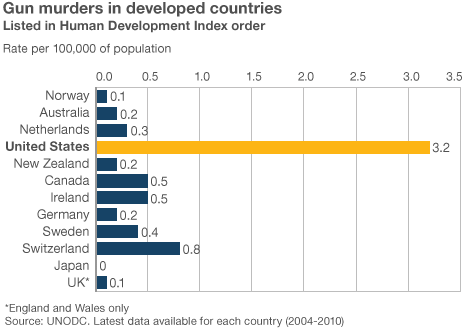
Well, you know what they say about statistics, particularly when spun by partisans like this NRA speaker.  If you throw in every third world sink-hole, countries in poverty with violent gangs, repressive governments, a lot of guns and low value on human life, yes, the US looks relatively OK.

 
Compared to other wealthy nations, not so good, as a glance at the attached chart compiled by the UN will show you.
Image

Doing Something Impossible

Why impossible?  I ask myself as 11:46 shows on the countdown timer.  Once the impossible thing is done it is shown to be clearly possible.  There are a million examples, like enormous, heavy hunks of metal flying through the air filled with people and luggage.  A video phone in your pocket.

Technology is what comes to mind first, but the impossible things I’m thinking about are massive changes inside individual hearts, inside our collective heart.   We are raised inculcated with certain truths, facts about us and the world that seem immutable.  I argued with my father for decades over whether people can fundamentally change themselves.  I believe we can, and don’t discount how difficult and sometimes painful it is.   My father always argued that we can change only the superficial parts, our outward reactions perhaps.   To him, the impossibility of healing deep wounds was a psychological fact.  At the very end, with his last breaths, he regretted that he’d fought me all those years instead of doing the hard work to have a more joyful, generous, loving life.

I set out to do something impossible, set up a network of children’s animation workshops.  To inspire children to show adults what children can do– to inspire change in the way things are done in schools, in our ass-backwards educational system.  I take my inspiration in this from people like Sugata Mitra, Ken Robinson, Seth Godin, Vandana Shiva, people I’d never even heard about six months ago.   I take courage from discovering new things that continue to help me as I go.

Is what I’m trying to do impossible?  I can’t concede that, though the odds against me are pretty impressive.  Is it impossible for one person to do alone?  Yes, that is clearly impossible.  So to gather a small group to help me push the project ahead I have to not only be inspired, I have to inspire them.  I cannot complain, I can’t hesitate, must be calm and confident at all times.  Hard!  As annoying as it may be when a kid screeches into a microphone with headphones on, thrilled to be hearing the echo in his voice, I have to show no annoyance, realize the bigger picture is about letting children feel these thrills.   Easier with children, to keep this philosophical stance.  It is the adults.  Man, the adults are the hard part.

Gratitude Check

Time to be grateful again.  Easy to forget that, when health is good, the legs are strong, the will is there, fear doesn’t have its sweaty hand on your chest at the end of a quivering, demonically strong arm.  

But I remember it now, remember to be glad, and grateful, and tick off the list in my head as I tap these keys.   Near the top of the list I am grateful at how often I remain mild these days, certainly compared to days past.  

Certainly compared to those days, for sure.

My Father’s Death

When I arrived in Florida, a few days after my father’s sudden hospitalization with undiagnosed end-stage liver cancer, a couple of days before he died, my father told me “you’re the only one who knows what’s going on.”   Although everyone around him knew he was dying, and the look on the Emergency Room doctor’s face had made that unmistakably clear to my sister, who urged me to get on the next plane, he was somehow trying to give me credit he’d often withheld.

“I want to talk to you, I’m gathering my thoughts,” he told me a while later, and I bought him a tiny digital recorder to speak into, if he was moved to speak when nobody was around.  He was beyond writing things down, and though he was an excellent writer, he rarely put pen to paper when he was able to.

We were fortunate to have that conversation, the thoughts he gathered were impressively organized, clearly expressed in that scratchy voice he had at the end.  I don’t know if anyone could have written, edited and delivered those thoughts better.  He always was an excellent speaker, and spoke virtually without notes.  Lucky for us both I have always been a night owl and when I drove over to the hospital at 1 a.m. he was awake and waiting to talk.  Turned out to be the last night of his life, he died before sundown the following day.

I am thinking about my father’s death because of something he said right at the end, it may have been the last thing he said.   We were sitting around his hospital bed, he’d become agitated, grabbed my sister’s hand, and mine, and when he let go I got the nurse and convinced him to take a mild sedative, an anti-anxiety pill, atavan, that a friend of mine is fond of.  I assured him it was fast-acting and would only take the edge off, since he was always very concerned with remaining in control and had never had so much as a beer, let alone a mind-altering pill.  Reassured, and feeling desperate perhaps, he agreed to take it and quickly composed himself.

“I’m feeling much better,” he announced a few minutes later, sounding like his old self.  “Why don’t you all go down and take a break and have a bite to eat downstairs, you’ve been sitting here a long time.  Elie can stay with me, it’s OK.”  My mother, sister, uncle and brother-in-law all got up and went down to the cafeteria.  It was dinner time and outside the sky was turning into a beautiful painting of a Florida sunset.  I recall the silhouettes of palm trees outside the hospital windows becoming more vivid as the light slowly began to fade.  

Two nurses were in the room and one of them said to me “it’s almost time.”  She pointed out that my father’s fingers were turning blue under the fingernails, something to do with the blood no longer delivering enough oxygen to the extremities, apparently a sign that Death is close by.  

“If you pray, now is the time to do it,” said the other nurse.  I told her we were not religious and she took it on herself to sing a Jewish tune she knew.  The African-American woman sang a chorus of Dayenu, a song from the Passover service that indicates we’d be thankful for any fraction of the many blessings God has laid on us. Thinking about it now, the snippet of song was as good a prayer as I could have thought of, though it seemed a bit surrealistic at the time.  She had a nice voice, and carried the tune well, but I remember thinking at the time that it was bizarre.

They helped me take down the railing at the side of the bed so I could sit closer to my father, then silently left the room.  My father looked at me helplessly and said “I don’t know how to do this…”   I assured him that nobody does, that it was OK.  I sat close as he breathed a bit faster for a minute or two, maybe five, perhaps fifteen, and then breathed his last.  His eyes were open, I closed them with two fingers of one hand, like playing a simple chord on the guitar or piano.  It was eerie how natural the movement was.  The nurses returned a moment later and I took the oxygen tube out of my father’s nostrils.  “He won’t be needing this,” I said softly, handing it to them.   I took his glasses and put them in my baritone ukulele case, where they are to this day.

I was amazed at how simple and graceful my father’s last moments were.  I’d been told a day earlier that death by kidney failure, the way terminal liver cancer actually kills you, is an accelerating sleepiness that ends in a usually peaceful death, but it was striking how peaceful that final struggle was.  A friend who read Jewish scripture for years quoted a line from the Talmud, I think, that stated it poetically and true to my father’s death: the moment of death is like lifting a hair off a glass of milk.

“I don’t know how to do this….” rang in my head just now, as I thought of the mountain I am trying to climb, an impossible one, really, for anybody but an exceptional being who is able to recruit exceptional helpers, and I thought to myself, with a sinking feeling “I don’t know how to do this.”   Same phrase.  It struck me.  Now, the same mercy I gave the old man, I extend to myself, if such a thing is possible– “nobody does, it’s OK.”

Either way, there will be the last breath and then darkness.  I’ll be happy to meet angels, and the souls of loved ones who have passed on, but I’m not expecting to.  The only thing to see between now and then is how exceptionally I can climb in whatever time remains for me to climb.