The Ten Days of Repentance

The rabbis have long spun the fable about how God, the All-Merciful, sits over His gigantic ledger, the Sefer Chayeem, the Book of Life, during the first ten days of the new year.   In that unimaginably vast book the fate of every human is mapped out in detail for the coming year.  Who shall live and who shall die.  Who shall wax rich and who shall be poor.   On and on, to every disease, accident, windfall, every twist of fate we can, none of us, imagine.    

The Sefer Chayeem and God sitting over it like a divine accountant is a metaphor, of course, and we moderns see it that way.  I think we do.  I can’t speak for the rest of the moderns, but to me the image has the ring of a poem written to explain the inexplicable.   Jews have the first ten days of the year to make amends to people we have wronged.   When night falls on the tenth day, Yom Kippur, right after the final long blast on the shofar, a ram’s horn, and before the Jews rush home to eat after a long, high-stakes day fasting and praying, God seals the Book of Life and everyone’s fate is sealed for the year.   That’s the poetic version, anyway.

The Jewish New Year (5779 this year) is the first day of ten days, Days of Awe, when Jews are required to search our souls and do whatever we can to set right whatever we have upset during the previous year.    This is difficult work, since we rarely do things that are knowingly wrong, making it much harder to see our own bad deeds than it is to see the ones others commit towards us, and as the songsters sing, sorry seems to be the hardest word.  It is rare, and the truest sign of love, to feel another person’s pain as strongly as your own.   In those situations, we are required to act, directly and without hesitation.

Meanwhile, God sits with the Sefer Chayeem open, watching.  God is watching for a hard heart to soften, for someone who has angrily told a loved one to fuck himself, at the worst possible moment, to approach that same person and sincerely show contrition, and love.   When someone who has wronged you is truly contrite, you should never turn them away.  Under that circumstance, especially during the Ten Days of Repentance, a Jew is obliged to accept a sincere apology, a repaid debt, an attempt to restore what was torn or taken.  

Like I said, this is fucking hard work all around, and, because humans are a deeply flawed species of ape, is work more often not done at all.   There are the endless prayers at this time of year, hours and hours in the temple, rising and being seated. Please rise, please be seated, please rise.  Special prayers are chanted aloud and others are recited silently, standing.  The prayers beseech God to show His infinite mercy, not like to all the victims of unspeakable horrors, who seemed to have died or been maimed without any mercy from the All-Merciful, but to those who promise their everlasting love and unfailing obedience to His will, whatever that may be, however it may stack up against Free Will, which, as far as I can see, is almost as puckish a phrase as Free Market.  Almost.   Unlike the Free Market, Free Will is something each of us possesses, in matters of our heart, in how we act, even if it seems to be the merest spark.

Personally, I am not one for prayers, for rising and please being seated.   It was ruined for me in my youth, the whole congregation rising and being seated again together, and rising, and being seated.   Struck me as an exercise in appearing to be doing the right thing, without the hard work of actually having to do anything more than turning pages, rising, being seated, mouthing words in a language you don’t know to a deity who may or may not exist.   A communal worship of the source of all that is miraculous, while all that is truly horrific is, we are told, the work of humans abusing the great God-given gift of Free Will.   God loved us all so much, you dig, that He left each of us free to become Hitler, if we can.   Nice work, God.

Of course, God needs my praise as much as He needs my prayers.   Which is to say, not at all.   The only thing God or, more to the point, my fellow creatures, need from me is my heart and my mind and the actions I take in this broken world.  Our life is only the things we do, no matter how hard we pray to be spared responsibility for the most thoughtless of our deeds and the people we hurt.

The DU was not generous

My father, the Dreaded Unit, was not a generous person.  He gave us things, he provided a nice lifestyle for the family, he didn’t begrudge us what we needed or wanted, he just was not personally generous.   It seems easy enough to blame this on the “grinding poverty” he experienced until he was drafted into the Army.   Though the most generous kids I ever worked with were always the poorest.   My sister’s experience working with children has been the same.   We both, at different times and in different places, taught classes of well-to-do kids and classes of poor kids.   Certain rich kids were prone to grabbing the last cookie and shoving it into their mouth.   Poor kids always seem concerned that everyone gets a fair piece.  Of course, I over-generalize, there were wonderful rich kids and poor kids who were complete dicks.   When it came to sharing, and my sister will back me up, the poor kids unfailingly shared, rich kids not such unfailing sharers.  So my father’s poverty by itself does not explain his difficulty being generous.

Generosity is a trait, like kindness and fairness, that if not planted young has a hard time growing later in the depleted soil of a love-starved soul.  My father told me as he was dying, in that weakened voice as his life force ebbed, that he’d had never had any idea how to show affection.   “I’d never seen it done,” he told me, a slight pleading in his tone, alluding to the house of violence, poverty and madness he’d grown up in.   His mother and father never touched each other.   No affection was ever shown.

These days I am trying to learn each of the lessons of my father’s tragic life and put them into practice to live a better life.   Being unforgiving is closely related to a lack of generosity — you will not extend the pardon you yourself would want to be given in the same situation.   It is a terrible thing never to forgive.  I watched my father do it all his life, the man never forgave anyone, starting with himself.   Unforgiveness feeds a deeply destructive need, the need to feel completely vindicated in one’s anger.  We see it played out on a mass level today with our vengeful Insane Clown President, as Matt Taibbi dubbed him when writing about the 2016 campaign.

I am always impressed by generosity.   I recall going to the home of a Palestinian who lived in East Jerusalem, in the Old City.   He took everything out of his refrigerator, he and his children literally emptied it, and put it all on the table in front of us.  “Take, take,” he said, smiling, gesturing at everything.   There turned out to be more to the story, but this kind of generosity, holding nothing back, is a beautiful thing.   

What does it cost to be moved by something beautiful somebody has just done and saying “beautiful”?   The thing is beautiful, is there a price to saying so?   I don’t know, I can’t see one.   To some people, I suppose, it costs a lot.  It appears that way, anyway.    Maybe it’s related to envy, or distraction, or simply being bitter, I don’t really have a handle on that kind of reticence.  My mother didn’t have it.   She would read something I’d picked out for her and smile and say “it’s wonderful”.   I could tell she meant it.   My father would read the same piece looking for the fatal booby trap I’d hidden in there, the tell-tale adjective that would show the rigging about to collapse on his head.

What does it cost to give the benefit of the doubt?   You can give it once, be disappointed, give it again, remaining hopeful.   After enough disappointments you will stop extending this generous courtesy, but what does it cost to give it in the first place?   It requires trust, I suppose, a certain faith that good will is going to be returned.   It often is.   It often isn’t.   I think more often than not, good will is reciprocated.   My father did not think so.   It was hard for him to make himself vulnerable in any way.    

As he was dying he said:

I know a lot of people are sorry for what they did, yet at the time you don’t see anything but just a battle which there has to been winners or losers, and there’s no gradation.

 I know when we had our differences, I realize that it was nothing personal in the classic sense but I also know that it’s the only way that I could live… like I told mom, we always had these battles where she’s saying “we’ve got enough money, we’ve got enough money” — for me it was never enough. I’ve got to make sure that every dot is dotted, every ‘t’ is crossed because I don’t want her to want a thing.  So, it’s kind of a lifetime battle, I don’t know, I think now how much richer my life would have been if I hadn’t seen it as a battle—good versus evil.

I know we should have had this talk ten, fifteen years ago. I couldn’t reach that level because I was really thinking that it was going to be a battle and that there wasn’t any way I could make it into a dialogue, and that’s my fault. You’re supposed to have some fucking insight.


Son of Why Do You Bother?

I was extremely reluctant to spend $152 for a pen, even a fountain pen with a beautifully flexible nib.  I’ve dreamed of a pen like that for years, but $152 seemed nuts.   I carry several favorite pens with me every day and their price in total doesn’t come near $100.   Which is not to say I don’t value each of my favorite pens greatly, I do.  A good pen is like a true musical instrument, one that stays in tune and is a pleasure to play.   You can’t make music without a true instrument, nor love the marks you make on a piece of paper without a pen that feels good leaving its mark.  

Still, $152 for a pen struck me as ridiculous, even in a store that sells $4,000 pens.   It was a beautiful pen, with a wonderfully flexible nib.  I tried it for a long time in the store and sighed when I handed the pen back to the salesman.   The salesman took the pen back when I told him I couldn’t spend that much for a fountain pen.   He smiled and said “you’ll come back for it.”

A few days later I did.  It quickly became my favorite pen.   The salesman had assured me that the soft, delicate, flexible nib was under warranty for three years.  That was reassuring, especially since, from the beginning the pen was temperamental, finicky.   It was a challenge to get it to write sometimes.  I learned a few tricks to gently help get the ink flowing.  I cleaned it with cool distilled water periodically.   I learned I had to use it every single day to keep it flowing.  My cheaper pens never hesitate, this little prima dona rarely wrote as soon as you picked her up.   I began carrying a little pill bottle filled with distilled water to clean the nib, on subways and wherever else I drew.  

Over the course of seven months I had worn the nib down, mostly from trying to get it to write when it didn’t feel like writing, and, eventually, found myself trying to write with the dreaded “sprung nib”.   This means the nib no longer flexes since it cannot return to its thin state, the tines being now permanently separated.   Picture two fingers splayed apart.  The pen is ruined.   I hesitated for a long time, dreading the likeliest outcome,  and finally brought it back to the “Fountain Pen Hospital” where I had purchased the fine writing instrument.  Sekhnet met me there for moral support. 

The kid at the counter was sympathetic when I told him how much I loved this pen and that the patient was in bad shape and needed a fountain pen hospital.   He recommended a place I could send it where they could fix the nib for about a hundred dollars.   I reminded him of the three year Namiki warranty.  The older man at the desk chimed in to tell me there was no warranty for the nib.  He told me he’d been doing this for sixty years and that nobody gives a warranty for a nib.   I told him what his salesman had told me.  He said it was impossible, Paul had worked for him for twenty-five years, he could not have told me the nib was under warranty.   Paul himself passed by a few times.   I was clearly a desperate man, lying, and Paul was cool as a cucumber, his boss had his back.

I somehow left the store without expressing any anger and walked away feeling a little bit kicked in the balls, but there was little I could do but call the number the kid had given me and plead my case to Namiki/Pilot.   I’m not optimistic there either, but it’s worth a shot.  Japanese companies still seem to take a pride in their products that American corporations have long ago realized is for losers.  

Our next stop was the Samsung store in the ultra-trendy Meat Packing District of New York City.   The guy who sets up the repair appointments admitted that the oversensitive moisture sensor of the Galaxy S-8 that prevents charging with a cable was a design defect.  They had fixed the defect in subsequent models, Jose said, examining my phone.    In high humidity the sensor goes off, and even though the phone is advertised as surviving immersion in water… but hold on.   My screen was cracked, my warranty was voided and I’d have to pay $249.99 for Samsung to correct the design defect that prevents me from charging the expensive phone with a cable.   Here is my cracked screen:

IMG-20180820-WA0003.jpg

I snarled and stalked away from the guy to cool off, as Sekhnet continued to talk to Jose.   A large security guard, hearing my curses before I walked away from Jose, came over to stand guard nearby.   I calmed myself, looking into the distance, breathing slowly.  After a minute I  went over to the guard, who had been watching me.   I explained why I’d gotten angry and showed him the phone.   He agreed that the tiny scratch voiding the warranty was bullshit.   He agreed that corporations regularly fuck customers, it’s just part of their business plan.  Profit making means breaking a few balls here and there, no big deal for a “person” who only has one job, maximizing profit.   The security guard was a lovely guy.  I told him about “The Corporation”  available to watch on youtube, and he told me he’d definitely check it out.  My friendly chat with him helped calm me the rest of the way down.

I went back over to Jose and Sekhnet to confirm my appointment for the following day and Jose said he hadn’t made the appointment since I’d walked away from him.  I told him he would have walked away too.   He admitted he probably would have. “I can’t lie,” he said, as likable a response as you could hope for in that circumstance.   I’ll be going over there in a couple of hours to have the phone ‘s design defect repaired, the battery replaced with an improved one, the screen replaced.   All for only $249.99 plus tax.   Minus the 15% goodwill discount Jose said he’ll give me, which brought the actual price down to a mere $230.43.  

Minor interaction in an art supply store we went to next left me feeling no better.   The manager was confused and defensive regarding a refund for a bunch of piss-poor nibs I’d bought in another store of their chain.   She told me she couldn’t refund anything without the original packaging (they came out of boxes behind the counter, there was no original packaging), and that to her knowledge they didn’t make the 3B mechanical pencil leads I was looking for (I held up my pencil with the 3B lead in it– another branch a few blocks away, I learned later,  had it in stock)… etc.   I started getting pissed off and left my credit card with Sekhnet to take care of the business while I sat outside, calming myself, reading off my “cracked screen”.  A few minutes later Sekhnet handed me the receipt and I saw that, for whatever reason, $2.18 had been not refunded.   Well worth the price of not walking back into the store.

Then I remembered Sekhnet pays for insurance for the two phones, about $25 a month.  Almost 40 minutes on the phone with T-Mobile (the first 25 or so on hold, with a syphilitic robot periodically coming on to tell me to please continue to hold, we don’t value you pieces of shit enough to hire enough representatives, all of whom are busy helping other customers) eventually connected me to the third party that Sekhnet pays to insure both of our fancy phones.  

I could send my phone in, they’d send me a temporary replacement phone, and they’d do the repairs for only a $175 deductible (about $60 less than Jose’s place which will do everything within 3 hours today).  I asked her what the deductible is if the phone is lost or stolen.  $175 she said.

“So your company’s policy incentivizes fraud,” I said, “I’d be better off just tossing the phone into the nearest sewer, or selling it to a crackhead for $20 and reporting it stolen.”

“Well, that’s why our rates and deductibles have to be high, because people take advantage of insurance companies, that’s why it’s so important for us to be watchful for fraud,” she said pleasantly.  

“No,” I told her, ” that’s insurance industry b.s..  Your rates and ‘deductibles’ are high because insurance companies are in business to pay out as little as possible.   It’s a fabulous scheme as far as your profits go, even if a bit sleazy, though nothing personal, you sound like a very nice person.”  

I managed again, for a third time in a few hours, not to get unreasonably angry.  One’s asshole eventually gets used to the uninvited probes, I suppose. 

If the corporation was actually a person it would be someone like Donald Trump.  They owe nothing to anybody.   They are incapable of real conversation, of any kind of mutuality, really.  They control the terms of every interaction.   They refuse to lose, or even compromise, no matter what the price.  They can never admit wrongdoing, nor can they apologize.  They do what they do because the law allows it, or at least does not explicitly proscribe it.   If it comes to it, they’ll  change the law to make their latest profit-increasing scam legal.   They have an army of lawyers, on salary, just waiting around to make their boss’s day.   Ever been sued by a billionaire?  Nothing like it, boys and girls.   

Capitalism, its defenders always say, is the most accurate reflection of human nature.   It is an expression of human freedom that incentivizes creativity and innovation, rewards the entrepreneurial spirit, maximizes liberty and the pursuit of happiness for everyone.  These defenders are always at least moderately wealthy. Those who do not fare as well under the Darwinian law of the jungle may be excused for seeing the out of control greed-driven psychopathic form of capitalism that is currently energetically destroying our habitat as a reflection of only a certain facet of human nature:  the insanely greed-driven psychopath.    

A powerful church that rapes children and protects the rapists is… we may as well just say it, even if the Pope can’t … evil in the eyes of Jesus, and of every dispassionate child you can ask.   An economic system that makes obscene wealth possible for a very few and a decent lifestyle possible for another 10% or so, while creating health-destroying insecurity or inescapable poverty for many times that number… and unspeakably brutal  poverty for billions more worldwide, the unseen collateral damage of the global “free market”, well, you do the math.

And have a blessed day…

Shades of Anger and Avoiding Rage

Anger comes in varying shades.   Not every shade is dangerous, but unchecked anger always has the potential to explode into rage, which is the main thing to avoid.  Anger is a threatening emotion, difficult to sit with, and anger that is denied, pushed down, diverted toward people who don’t deserve it, is as corrosive as sulphuric acid.

Anger often starts as annoyance, escalates to feeling provoked.  Sufficient provocation gives rise to a righteous and difficult to control desire to strike back.   Depending on the situation, anger can easily turn to rage.   Recognizing the initial signs that you are becoming angry, and taking as many breaths as needed to avoid the easy cycle of anger,  is crucial to not flying into a rage.  Not flying into a rage may be the best we pitiful earthlings can do when we are provoked to anger.   Important work, friends, learning to not fly into a rage, even when sorely provoked.

I have been in this cycle of provocation and escalation countless times.  Over my childhood angry confrontations were a regular occurrence in the little house I grew up in.   I was a kid, and did the best I could in an insane situation where everyone was screaming at each other.   Much of the anger came straight out of my parents’ frustrations with their own lives.   Neither of them ever learned to control their anger very much, certainly not when it came to the two ungrateful children who presented such challenges to them.  In terms of dealing with their anger, both of my parents were essentially children.

I had a friendship for a while with a New York City criminal court judge.   He was a brilliant man, if also deeply troubled.  Sekhnet, who has a talent for hitting such nails on the head, said of him “Bill’s a child.   A brilliant child, but a child.”   The same could be said for my father, and to a great extent, my mother.   Both were highly intelligent, both had been raised by domineering mothers who frequently made irrevocable vetoes of their child’s deepest wishes.  

Each overbearing mother had broken up the most exciting  romance of each of their childrens’ lives.  My mother’s mother chased off her daughter’s first fiance, simply would not stand for this dashing young con-man becoming her son-in-law.  In my father’s case, it was a longterm relationship with a Christian woman, a young widow a couple of years older than my father.   There are photos of them together before World War Two in Connecticut and after the war in Syracuse.   My father never looked happier than in those couple of black and white photos.   It appears to have been some kind of love story.   In the end, the overbearing mother won, the lover was extirpated forever from my father’s life.  

There is the kind of anger that makes people lose their minds.  When angry, they feel they are simply fighting to stay alive.   Anything is fair to somebody in this hopped up state.   This is very common with anger– it convinces you of the rightness of whatever you do in that state.   Defend the homeland!!!  Death to the infidels!!!  Death before dishonor!!!  Take it out of their skulls!!!

I am thinking about anger today because yesterday, once again, I spent a considerable amount of time on the phone with someone who called to tell me, essentially, that I had no right to my feelings.  No matter how much I may have been hurt and provoked, the caller told me, or how many times I may have been hurt in the exact same way, they love me, I am like family and the thought of me not in their lives is too painful for them to deal with.   All this was happening, I was told, because I was not looking at myself deeply enough, not finding a way to forgive a series of escalating provocations that were very aggravating, true, but completely, or at least largely, unintended.

It was an aggravating conversation with a person I like very much.  It was aggravating largely because the person had no idea, outside of endless, limitless forgiveness on my part, for what I should do going forward with a friend seemingly incapable of not provoking me in every encounter.  Aggravating because I’ve thought deeply about all these things, studied the situation over the course of the last few months, consulted friends whose opinions I respect.  

In the end, I had nothing, and nobody else could see any way forward, outside of the miracle of an old friend suddenly discovering how to be a mensch, something completely out of my hands.  I gave this old friend every opportunity not to keep attacking, but he was unable to refrain from being on defense and offense instead of seeking a way out of the toxic cycle that was killing our friendship.

A few times during the conversation yesterday I got angry.   Each time the person I was talking to squawked, hurt and mad that I was expressing anger at not being heard.   Each time I took a deep breath and quietly expressed the thing that couldn’t be heard when I expressed it with anger.  In the end little that I said seemed to have had much effect, but the exercise of not exploding in anger was a good workout.  A sad, mutually unsatisfying conversation ended calmly enough, with neither of us telling the other to fuck off.

No matter what else can be said about the difficulty, sometimes, of not exploding in rage, it is always a good idea.   It is hard work, Jack, very goddamned hard work. Especially if I keep denying your right to feel hurt by something I did to you, no matter how unfair I admit that thing was.   Keep bringing it up, I will keep shifting the blame back to you — you are unforgiving, you are heartless, rigid, you don’t see yourself, you exaggerate, you betray.  If you look deeply enough into yourself, I will say, you will see that you are wrong — it is possible, isn’t it, that you are wrong also? Love conquers all.    I will lay down the love card, the final card, the card only someone without love could deny.   I could not have really hurt you that badly because I LOVE YOU.

You respond that love is not words, no matter how beautiful, but actions, how we treat the person we love.  If I treat you harshly you have every right to expect a sincere apology from me, if I care about your feelings.  If I can’t give you an assurance that I understand the harm I’m doing, will do my best not to inflict more of it, there is no way forward.

I will insist, if I am that type of person, that you are no saint either.  You betrayed my confidence by writing on a blahg that you know a person who has a faulty memory.  I would never do that to you!   You have no idea how hurtful that public betrayal was to me.   I wouldn’t be surprised if you wore a wire on me when we talked the other day.   Are you wearing a fucking wire on me now, you fucking fuck!?   I’ll bet you are.

And away we go!


Heartbroken

My sister recently recommended Home, a book she loves, by Marllynne Robinson. The book is apparently part of a trilogy, all deep and beautifully written, according to my sister, but Home is her favorite and it stands alone as a story.   I placed a hold on a copy at my local library and a few days later began reading it.  

The protagonist arrives at the ancestral home to stay with her old, ailing father in his last days.   On page two the narrator writes: 

Why would such a staunch and upright house seem to her so abandoned? So heartbroken?

Framing the question this way made me suddenly see the book through my sister’s eyes, our father’s eyes.   Our father, like that staunch and upright house, was heartbroken.    He was abandoned and heartbroken.  It struck me that in the 1,200 page manuscript I’ve written about the man I don’t recall using the essential word heartbroken even once.  

The human world is impossible to understand without grasping the mortal suffering a broken heart inflicts.   Heartbroken people try many things to not feel like their hearts are broken, almost all of it in vain.   Heartbreak does not heal, fade with time or go away of it’s own accord.   We are resilient creatures, our damaged nerve endings display impressive plasticity, an ability to regenerate and recover from many kinds of harm.  A broken heart is in a category by itself.  Difficult hard work, empathy, fortitude, persistence and a few strokes of luck can begin to heal a broken heart, if it is the right kind of luck.

Irv, my father, had his heart broken very early in life.  He didn’t have a single stroke of righteous luck, really.   Being an infant and child in extreme poverty inflicts one kind of permanent damage, life-impairing  damage already very close to heart break.   Having nobody in your life to love and protect you in that harrowing situation breaks your heart, would break any little heart.   Add to this poverty and non-love your mother whipping you in the face from the time you can stand, your father cowering, powerless, without the ability to stop your pain.   Your child’s heart will shatter into a million pieces. 

Hours before your death, eighty years later, you will tell your son “my life was essentially over by the time I was two.”   You will insist, after a life as a well-read, quick-witted and brilliant conversationalist, that you were the dumbest Jewish kid in the depressed little river town you grew up in.  Your son will express disbelief.  You will emphatically respond “hmmpf!  by far!”

Did little Irv really have nobody in his life to love and protect him?   His first cousin Eli, maybe, though he feared the tough, sandpaper voiced man his entire life.   Outside of Eli, who by his own admission more than once witnessed the whipping of baby Irv without stopping his beloved aunt, Irv’s mother, who?   Nobody.   Abandoned and heartbroken.   His entire life, a desperate exercise in not appearing to be mortally wounded.  

And yet, I would not reduce his life to this terrible misfortune, this cruel tragedy.    To do so ignores the admirable traits he also displayed, his principled morality, the struggles he wrestled with (even if not very successfully) not to inflict on his children the harms done to him, the many valuable life lessons he was able to impart to his children about mercy, kindness to animals, fairness, protecting the weak.    It would be a terrible tale without a moral, the tragedy of someone crushed before he was two spending his entire life desperately fighting the horror of feeling how he was crushed.  

Many years ago I sent a description, and a few sample pages, of my Master’s thesis/novel (the degree was in Creative Writing) Me Ne Frego (“I Don’t Give A Damn”) to a contact I’d been given at Farrar, Straus and Giroux.  I have the concise rejection letter somewhere in my unorganized library of fifty to a hundred and fifty thousand pages of drawings and other papers.  The kind and thoughtful rejection letter was from a young woman named Straus, no doubt with literary credentials from one of our top Ivy League schools, who praised the writing but found the material, unfortunately, not suitable for their prestigious house to publish.  The kernel of wisdom she imparted was that every great narrative is the story of a dramatic change in the protagonist.  She had seen no such change in the narrator in the few pages I’d sent.   She wished me the best of luck, which I proceeded not to have.

Part of my father’s abiding tragedy was that he fought the idea that people can change themselves in any fundamental way.  I might think I could get a handle on my temper, believe I might make myself less easily provoked, become more gentle, but he was there to assure me at every step that my struggle was doomed, that we are what we are born and wired to be and that was that.   Better, he always said, to simply suck it up and act like a man.   And no, he countered, eight years-old was not too young to start taking responsibility for your own life and acting like a man.  

He had nobody to teach him any differently.   Nor did I.   I didn’t have a magical stroke of luck in my life that left me believing, and able to somehow confirm, that we can change fundamental things if they cause us enough pain.  I have seen it in two old, very dear friends, fundamental changes in character.   Further proof, for me, is my greatly improved ability to forebear, a stubborn challenge I’ve worked on for decades now.    I can now, for the most part, endure direct, prolonged provocation without completely losing my shit, that is to say without doing anything violent or insane. [1]  

In a way Ms. Straus’s idea about a compelling narrative necessarily involving a dramatic transformation of the protagonist (now that I think of it, she probably wrote her under-graduate thesis on that proposition) was reflected in my father’s last words about his life.    He lamented that he had been too fucked up to realize how much richer his life would have been had he embraced its many gradations instead of blindly fighting for black or white. 

Broken-hearted, that’s what the man was.   He had deep regrets as he was dying, and long overdue apologies that came very late in the game, hours before he died, that was as close to change as he could come,.   But, in a way, Ms. Straus, aren’t those both proofs of how much he was actually able to transform in the end?   Does that count toward your compelling narrative thesis?


[1] Sekhnet, in her infinite love for me, always likes to tweak me when she hears me make this claim, but it is a tic of her’s I do my best to ignore.   Screaming horrible things at a computer in frustration, or venting angrily about the thousand indignities we are forced to suffer for the privilege of living in an inhumanly capitalist world,  is not the same as taking a hammer and smashing the computer, or hurting another person.   Even if the computer is made by slaves somewhere so that the global corporation that sells it can triple its own value on the stock market.  

I have improved my ability to endure all this, though, it goes without saying (especially by a man who regularly waxes Tourretic) that I have not perfected my absolute equanimity.   That is not the point of the exercise.   The point is to avoid the worst of what you’re inclined to do when you feel angry.  That you rein yourself in and learn to take a breath when you need to.   That you are not distracted from the conversational point by anger.  Those things are all good, and each one of them is quite valuable.


Grandson of the Awful Ease of Incoherence

The ease of incoherence is awful
because it is so easy.
The idiot ease of it: effortless
no effort needed.

Incoherence makes no demands,
anything you can
pull out of your ass
will do, really,
there is no problem with anything
you might pull out,
the less likely the better,
actually, for purposes of
incoherence.

Meanwhile these affectionate ferals
born with two strikes against them
and five personal fouls,
eight of their nine lives wasted,
spend a few minutes in the sun,
chasing a delicious smell
then gone forever
like the Polar Ice Caps,

like everyone
you’ll ever love.

The climbing sorrow of death

Death waits, in no particular hurry most of the time, since every living soul must go with Death in the end.   Some beings get to live the full wink of an eye, eighty, ninety years.   Many delightful winks are far briefer.  It helps to think of the quality of a short life in these cases.  

A tiny colony of feral cats coexist in Sekhnet’s garden, along with a couple of large, gingery raccoons and the occasional giant possum, who come by after dark to finish off whatever food the cats leave over.   We get to witness the brutality of nature up close, its brutal cuteness and its seemingly random viciousness. 
Screenshot_20180717-212209_WhatsApp (1).jpg

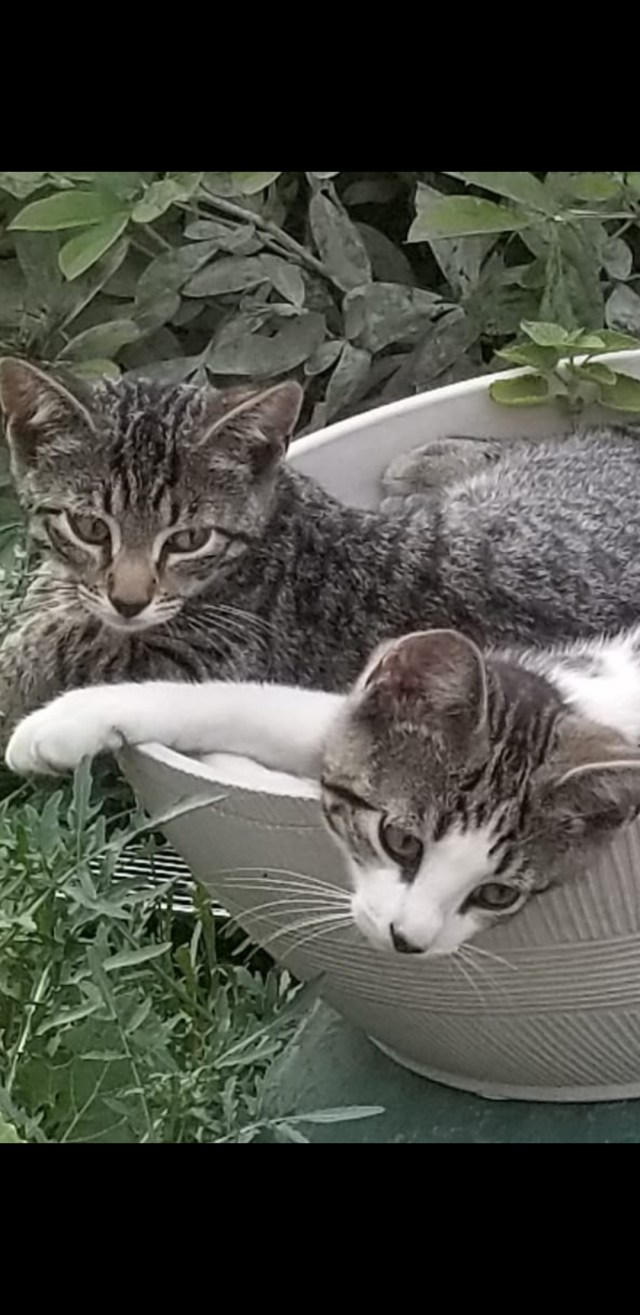
These two brothers, Whitefoot and Turtleback (foreground) were photographed hanging out in a flower pot on July 17, 2018.   They were three months old at the time.  I am lucky to have this photo, one of very few pictures I’ve shot in the last year or so that I’m still able to view on my phone. [1]   

Their mother, the beautiful Mama Kitten, had her first litter two or three years ago, at six months old.   Talk about babies giving birth to babies.   Six months old and Mama Kitten.  When they were big enough she dragged them from their hiding place and marched the adorable mice in front of Sekhnet.  

“You see,” she told her kittens, “soon, when I stop giving you milk, you will come to her, act cute, and do just what I’m doing now, see?”.  Mama Kitten would fix Sekhnet with a winsome look, make a quick cat move toward her and rub her head and her side along the human’s leg, using the tail to give a gentle caress as she makes her circle.

Sekhnet and I became familiar with the exquisitely gentle touch of a cat’s tail from my original cat Oinsketta, an affectionate cat who practiced the art delightfully.   The late A.W. Skaynes was also a master of the tail caress.   A few of these feral cats get pretty adept with their tails too, they’re generally the ones who like to be petted.  Mama Kitten did not let a human touch her until she was several months old.  She took to human affection cautiously, but she is now a very tactile cat who sometimes loves to have her sideburns scratched.  And she uses her head and her tail very tenderly.

We had many great photos of those adorable kittens interacting with mom, playing with each other, eating food off of spoons.   Suddenly it seemed Mama Kitten was in a hurry to wean her kittens and turn them over to Sekhnet for feeding.  We didn’t understand the urgency.  We soon realized she was pregnant again.  Chemicals coursing through her body telling her to protect her turf, make it safe for her offspring who were about to be born.

Mama Kitten had her most recent litter, four beautiful kittens, two male, two female, in April.  These four made the number of good-looking little cats Mama Kitten had given live birth to around twenty.   She has been pregnant or taking care of a litter continuously since before she was  six months old.   When she is about to give birth to the next brood she drives her young kittens out to fend for themselves.  Of course, they only know how to hunt by being cute to the humans who feed them, and there is only one other house on the block where feral cats are welcomed (see this here for that).

We once trapped three of her kittens who had lived to be five or six months old.  We took them to a vet and had them all neutered.   Each of them was dead within a very short time.   There was no connection to the minor surgery, they were all fine after they got back from the vet’s.   They simply disappeared, one after another, in the space of a couple of weeks.

Their lives tend to be short.  The oldest so far was probably Grey Guy, who lived almost two years.  There are hawks around that love a nice one or two pound kitten for lunch.   We assume the hawks get most of them.   A few have died from some kind of poisoning, we think they may have drank anti-freeze on a hot day.  All four of those kittens died within a few hot early summer days one awful summer before Mama Kitten was born.  A feral cat in this area that lives to be a year old is a survivor, an outlier.

It is a cruel thing to grow attached to these beautiful little creatures who have little hope of surviving more than a season or two.   We try not to give them names, remembering the fate of oddly cute Dobbie, or Cathead (a playful, affectionate kitten I would have made a pet, if it was up to me, and we’d had her spayed, too) since the attachment makes their disappearance more painful.

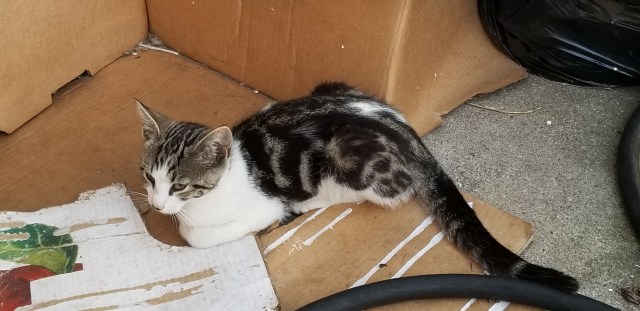
Still, it turns out that just for reference you need to call each one something.  Sekhnet takes care of that, keeping it simple.  Whitefoot advances on a white foot, both of his front feet are white.  Turtleback, mostly white but with nice markings, including a large beautifully painted section on his back that looks like a tortoise shell.    Here is a picture of Turtleback taken two days ago.   We were a little worried since we hadn’t seen the adventurous young male when his siblings were having dinner.  I later found him relaxing on their favorite box, and snapped this to send Sekhnet to reassure her that Turtleback was alive and well.
20180806_191451.jpg

Sekhnet has been furious at Mama Kitten since seeing how viciously she keeps attacking her almost year-old daughter, Paintjob (talk about a beautiful coat, that little cat was painted by a genius).   Mama drove that poor soul Paintjob out of the yard two or three litters ago and somehow the timid Paintjob is still alive and, until recently, managing to get fed by me or Sekhnet every second or third day.  

She eats fast, warily, wolfing her food and then stopping, tensing every muscle, marshaling all of her senses for threats.  Then she will eat another can of food, using the same procedures.   Paintjob is skinny but appears otherwise quite healthy.

Lately, even though she has lost her last pregnancy through some kind of natural miscarriage, Mama Kitten has been particularly vigilant and ruthless in violently chasing Paintjob off.

Sekhnet has seen this many times, how Mama Kitten discovers each secret place where Sekhnet has arranged with Paintjob to throw her a quick feed.   Paintjob was quite adept at making Sekhnet know where she’d be for a fast secret feed.  Mama keeps guard, watches Sekhnet like a hawk, peeks around every corner, pops out of nowhere and viciously attacks Paintjob who runs off at an amazing speed.   Their screams are heart-rending.  

I keep telling Sekhnet not to make such human judgments against Mama Kitten.  I point out that Mama is, and has always been, in pure survival mode, plus she’s crazed with chemicals produced by her constant pregnancies.  I point out that she’s  programmed to survive and is by far the longest lived feral cat to live season after season in Sekhnet’s garden in the back.   Sekhnet points out that Mama is a complete psycho bitch who savagely attacks her own daughter when there is plenty of food for everybody.

Yesterday as I fed the kittens, Mama Kitten came around to see what was on the menu.  She was not impressed with the first offering, which her kids all ate quite happily.   She tasted a bit of the tuna and found it not to her liking that day, though her kittens were quite pleased with that one too.   As everyone seemed interested in having a bit more dinner, I opened a third can, and this one Mama Kitten found to her liking.  I fed her some slime from the spoon, to test it before dividing it among her kittens, and this one she wanted.   She ate a bit.  

Then I saw, suddenly standing less than two feet away, an emaciated, haunted, desperate looking Paintjob, staring at the food, almost hypnotized.  I was aware that as soon as Mama saw her the savage attack would occur and that there was nothing I could do to get any food to Paintjob, or to stop what was about to happen.  A few seconds later Mama Kitten took off screaming in savage pursuit of a wailing Paintjob.  The kittens scattered in terror.

This scene was truly heartbreaking.  I understood why Sekhnet finds it so hard to forgive Mama Kitten for this seemingly heartless, irrational and murderous rage against her own kitten.  True they’re now both adult females, we get that, but, it’s hard to understand why it has to be this way.   Only a cruel god would design nature to feature this kind of nonchalant, horrible savagery.  

After I told Sekhnet this story of witnessing the vicious attack on Paintjob she became morose.  I had a text from her at 3:20 a.m. (we stay together half the week) and I called her right away.   She was tearful, couldn’t stop thinking about the doomed Paintjob.   “As she gets weaker and weaker from lack of food it will become impossible for her to escape her psycho mother,” she said, her voice cracking, and it planted an image in my mind I did not want to see either.

Sekhnet reported a bad night’s sleep.  She dreamed of Paintjob, lying on her side, her paws cut off, crying for food.  In the dream Sekhnet was unable to get any food to the helpless cat.  I tried to reassure her that she had not made the world, that nature was cruel, we’d seen it first hand over and over, the short, brutal lives these beautiful little animals live in the extremely limited, ruthlessly competitive wild in that part of Queens.  Then she got a call, there was a dead white kitten near the area where the backyard animals eat dinner.

It was one time when, being a man, all I could say is what a man should say at such a time.  I told Sekhnet I’d go to the house, carry away the body, that I would take care of it.  We arranged to go together.  There was a real-feel of 99 degrees in New York City again today.   We had images of the little cadaver getting ripe, covered with flies, possibly bloated.  

Halfway to the house, the sky got dark and a deluge fell from the sky in a massive electrical storm.  It rained as hard as I have ever seen rain fall, the traffic began to crawl along cautiously, and it continued to pour down in sheets for a long while.  The windshield wipers, on their fastest speed, had a hard time keeping the windshield clear.  There was flooding in places.

We killed some time, gassed up the car, sat in front of the house until the rain stopped.  I went to the back of the house.  It was Turtleback, on his side, feet stretched in a slightly grotesque final pose.  His timid little white-faced sister, who looks like him but without the turtleback, looked sad.  All of the kittens, and Mama Kitten, seemed determined to make sure I knew that their fellow was dead, was just lying there   Before I fed them dinner they all made sure I noticed the dead Turtleback lying there on his side, skinny and soaked.   Each one passed close to him as I went to get their food.

Sekhnet brought a sturdy box, just the right size, and handed me a shovel.  It took a moment, but it was an easy operation once I got the shovel positioned the right way.  He fit in the box perfectly.  “Watch his tail,” said Sekhnet and I tucked it into the box before I closed the flaps.  

I carried him a short distance, to a wooded place by the highway.  The area was filthy, littered with plastic bags and plastic take-out containers and probably much worse.  I did not venture far in the dark, placing his coffin behind the closest trees.  I got back and Sekhnet and I agreed that Turtleback himself was not there in that squalid place, just an empty vessel that had been, briefly, the beautiful little cat.

I am aware that nature is cruel, even as it can be so generous.  That severe thunderstorm struck me as a gratuitous, a mocking touch for a gentle God to interpose in the path of two people heading somewhere to try to do a decent thing.   I had several thoughts about God as that rain pissed down, as we killed an hour in the car before I could go back and lay whichever poor devil had died so young to his or her rest.  

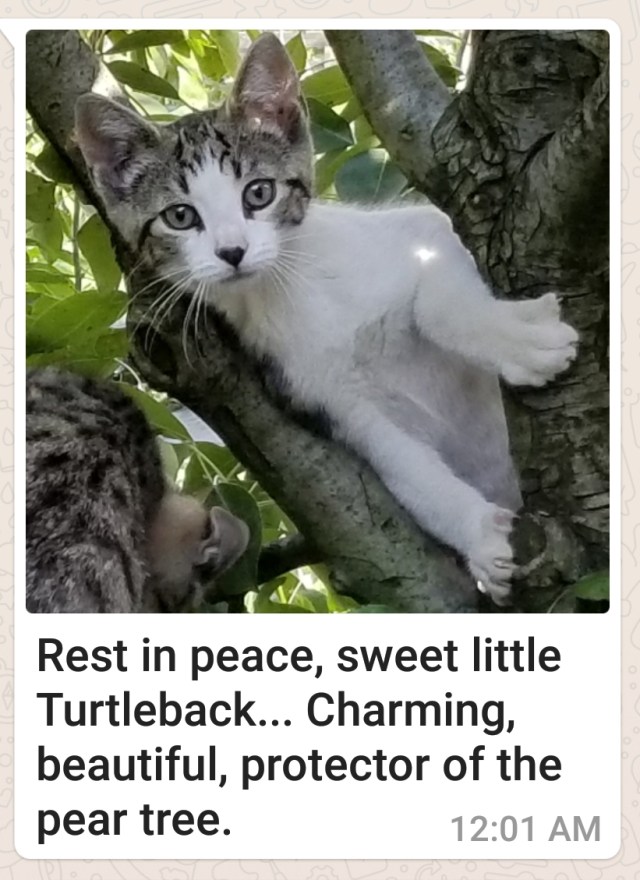
Afterwards we hung around a bit hoping Paintjob would show up for a feed while I was there to distract Mama in the back, but no sign of her anywhere.  It is hard to shake the thought that yesterday’s desperate move by Paintjob may have been her final one on this earth.   I got back home and began writing this, my attempt to, as they say, process all these thoughts and feelings.  Then a notification beep, a WhatsApp from Sekhnet.  

Sekhnet, among her many talents, apparently also has the power the make me sob in loud, honking notes, my nose drowning in snot, alone in my apartment.   My emotions all night had betrayed nothing but manly resolve, stoically placing the tiny cadaver in its carboard coffin, stilly carrying the dead kitten to his eternal resting place, manfully reassuring Sekhnet at every turn.   I don’t know what my neighbors must have been thinking to hear me weeping that way, it is rare to hear a grown man sobbing, especially a grown man prone to angrily cursing.
Screenshot_20180808-000553_WhatsApp.jpg 


[1]  Naturally, of course, the format has been randomly dicked with, it is not displaying full frame as I shot it, it’s messed up.   I never inserted those moronic blocks of black at the top and the bottom.   I am not even sure how to edit those out with the programs and apps I have.  

Background:   I took dozens of photos of these beautiful cats.  Yesterday my phone spontaneously deleted  over 2,400 photographs.   The girl at the T-Mobile store said there is no way T-Mobile can recover the photos and that they were probably deleted because I accidentally hit something.  I told her I had hit “restart” after several days of being unable to move or delete photos.   When the phone restarted, 3,000 photos were wiped out.  She was a pretty girl, and friendly enough, but there was something about her reply “you must have accidentally hit something that deleted the photos:  that made me want to ask her to come around the counter to take a nice, quick knee to the stomach.

“A Samsung problem,” she told me.   She showed me how to find the randomly saved photos in something called Google photos that I never signed up for.   Apparently Google randomly collects images from your phone, to show you how they provide this great cloud backup for all your data.   If you pay them, they will save everything.  If you take their free version, which you might not ever know you even are using, they will choose what to save and what to delete, probably by some brilliantly calibrated algorithm.

This was the only photo  remaining of perhaps 100 shots of these great looking feral kittens and their beautiful mother.


Noticing Small Things

They call this mindfulness these days.   Awareness of your mind, your body, your surroundings, other living beings, their presence, your presence, your interactions with the world.   We live in an age where “reality” itself is presented to us, constantly, in small, exciting boxes.   These boxes arrive continuously, with alert beeps if you set your phone to give you notifications.   You look at the phone and through a filter you instantly see a selected slice of life.  

Your life is clearly not this selected thing you are looking at, but the irresistible device  is designed to make you feel that it is very important.  Breaking news, crucial, need to know, this just in, ten things that will make your jaw drop, five amazing secrets nobody will ever tell you, the seven, yea, eight best cures for distraction,  the most erotic nude photo of the most beautiful person ever photographed, very tasteful.  Click here.

All very compelling, but not your life.  In most cases it is only the thinnest, most superficial slice of your life.  In many cases it has nothing whatsoever to do with you as an individual and everything to do with you as part of a discrete/discreet [1] demographic.    

I had some drama with my smartphone the last few days, it wasn’t letting me move, copy or delete photos.  I take hundreds of photos, very happy now to finally have an excellent camera on my phone.  I had more than 2,000 photos in the folder marked Camera.   There have long been two folders marked Camera.  The first has about 80 photos in it, the last one taken on July 4, 2017.   All the photos since have been saved in a second folder, also marked Camera, which was created autonomously by the smartphone on July 5th.

Frustrated at being unable to delete or sort photos the last few days, I finally restarted the phone.  The phone reset.  When it came back on-line there was one folder marked Camera.  It had 80 pictures in it, all taken before July 5, 2017.   Almost every photo and video I’ve taken since is, inexplicably and without warning of any kind, no longer on the phone.

I think of this and consider it in the context of a glance I had at my face in a magnified mirror just now.  I see the results of the original “plastic surgery” I had to close and cover the incisions from removing  the basal cells on the right side of my nose a decade ago,  a kidney shaped piece of shiny beef jerky, with jagged outlines.   It is my own fault, I had shit insurance.   The upper East Side surgeon wasn’t going to bust her ass for what they were paying her.  My mother actually put up $500 for some cosmetic follow up, but that was clearly money down the toilet.

My skin is scarred, so the ugly one on my nose sort of blends in.  My hair is gone, eyebrows scraggly.  My teeth are crooked, uneven, brownish.  My eyes are strained, pinkish in the whites, and they do not track exactly.  I rarely look at my face closely in the mirror, and that’s better, since my general impression of myself is of a decent looking man.   Do not look too close, you will see the enlarged pores, the tiny veins in the eyeballs, the unhealthy-looking little tags growing on your skin.

Still, it gave me perspective.   I am a unique and beautiful creature, I realize and remind myself at times like this.  It is not my skin, or even my bones, that make me this way.  It is how I try to be with the creatures around me.   I rarely clench my hands these days, they’re open.  Soft to the touch.  I do not often offend with my touch.  

I don’t even mind taking a metaphorical punch, if there’s a chance for something better on the other side.   I won’t take more than one, usually, but I extend that courtesy.   It is a better world if we do extend each other the courtesy.  Kant’s Categorical Imperative, Hillel’s Golden Rule, Ahimsa and all.  Good enough for these deepest of thinkers, who am I to say no?

I will go to the T-Mobile store tomorrow and try to recover those deleted photos, though I have no reason to be optimistic.  It would be a great bummer if they are gone forever, yes, but no less a blow than seeing that jagged piece of beef jerky over my right nostril, extending across half the lower nose, and half again as tall.  A ragged dry lake bed on a bumpy, pitted topographical map in a place where the most lovely faces have a smooth expanse of skin.  Think of any beautiful face.

That is what I see, actually, when I think of my face, when I think of faces I love.   There is nothing to compare to those faces, in my world.


[1] discrete:  individually separate and distinct.   Discreet:  careful and circumspect in one’s speech or actions, especially in order to avoid causing offense or to gain an advantage.  also, intentionally unobtrusive. 

Irrationality 101

For most human purposes, rationality takes a back seat.   All that is necessary for human action, most of the time, is a rationale, a slogan, an emotionally resonant excuse.   It is hard to think of a collective misfortune more horrible than war.   Yet every war is always somehow justified, even when it is inexcusable aggression, illegal under the spongey law of nations and conducted solely for the profit of a few who don’t care how many others must die so they can grow richer and more powerful.  Justified.  Read your history book, read virtually any history book.   War, unfortunate, yes, hell, of course, but necessary, you see, because… that guy over there is Hitler.  He’s fucking HITLER!   Nuff said.

My sister and I had a good laugh when she pointed out a howlingly imbecilic line I’d written in an otherwise promising first draft about our family life.   Describing our nightly fights around the dinner table as a battle field I went a step too far.   My sister read the line with beautiful archness: “the brutal battlefield of our family dinner table was as nightmarish as any war scene you can imagine.”    ANY war scene, she repeated, with deft intonation for maximum ironic emphasis.  In the beat it took me to reply she reeled off a string of famous atrocities that left no doubt of the idiocy of my claim.   Instead of a reply I burst out laughing.  We had the best laugh we’ve had together in years.   Then I caught my breath, pulled myself together and deleted the absurd line.  

There I had a rare moment of good fortune, somebody gently pointing out my foolishness, and doing it with humor and superb understatement that made me see it for myself.   The laugh made it undeniable, how laughable my claim had been.   I submit that this moment was an outlier in general human affairs, a rare moment when rational good sense triumphs over a feeling of poetic license, shoddy but justifiable thinking, emotional overstatement.    

Yes, of course, no child should ever be subjected to the mistreatment my sister and I regularly endured from our parents.   Yes, of course, I have a right to be hurt and indignant, even angry, about the abuse we were made to suffer.   But was it really as horrific as Turks on horseback driving helpless Armenians into a river to drown, worse than the Janjaweed, ISIS, the viciousness of the fanatical SS?

Eh, probably not, now that you put it that way.

But there’s the thing about irrationality, as a general rule it doesn’t stop anyone.    We have an irrational chaos-monger insisting he will make our country great again, apparently by wiping out every vestige of decency that people have fought for centuries to achieve here.   All he needs is a slogan and his base will roar, full-throated support, chant anything, no matter how idiotic.  “Drain the Swamp!” which they chanted during his historic presidential campaign, a slogan he told an interviewer he had his doubts about, but then decided was great when he saw how the crowds took to it, was actually translated from the original Italian– it was a mantra of Benito Mussolini as he rose to power [1].  Many people are saying Mussolini was a fascist, but there are many views, on many sides, on many sides.  Just sayin’.

There is no point feeling superior to a stadium full of desperate people chanting “lock her up!” or “Fake NEWS!” or “Suck my ass!!!”.   No reason to feel superior to a strutting, supremely confident-seeming cruel bully with seemingly very few actual thoughts in his head.  As a species, we are no more rational than anyone in that Make America Great Again crowd.   Which is not to say we don’t each have the ability to be more rational — all it takes is somebody stating the truth in a way we can hear it.   After my sister and I had a good laugh, there was no way to deny how laughable my claim about the atrociousness of our family war was.   Is being called a “fucking cobra” as bad as being locked in a church with everybody in your town and having it burned to the ground?   I suppose not.

And so it goes down virtually every issue we constantly debate in our battling society where unfair competition for material possessions is shrugged off as merely the law of nature.  One of the “debates” that drove me most insane during those madcap Cheney-Dubya days was the torture debate.  A fucking “debate” that will not fucking die, I might add.  We had an administration determined to use practices we’d long ago signed on, as part of the civilized world, to ban forever.   All that was necessary to overcome all those treaties was a horrific event followed by convening a small team of partisan lawyers to craft an argument — how idiotic an argument didn’t matter, just a secret memo to justify it in the odd event anyone was ever held accountable for the illegal program.  

In light of the secret torture memo a hard kick in the balls was now “enhanced interrogation” instead of “torture” because it was not as painful as the shutdown of a major organ system.  Nobody in their right mind could argue that a little kick in the balls is as bad as, say, your lungs shutting down.  Are you fucking crazy, you’re going to claim a kick in the balls, or sleep deprivation, or a freezing cell, or stress positions, or “walling” or water-boarding is as bad as your goddamn heart stopping?  Fuck off, peace bitch, we reframed this “debate” and there’s nothing you can do about it.

The other day I had a tiny moment of blessed relief, when a friend who loves to argue somehow drew me back into the fucking torture debate for a moment.   “You’re saying even if you have the person who planted the ticking time bomb that’s about to kill 5,000 children, you can’t use torture to make him talk.”   I took a breath.  

“In that one in a million scenario, where you have the actual guilty fuck strapped to a chair, and in a matter of minutes 5,000 kids will die if you don’t get him to talk– yeah, sure, put the fuck on a water-board, electrodes on his balls, the works.  I’ll fucking torture him myself, if we somehow know for sure that this is the actual psycho who planted the bomb.   The murderous fanatic probably won’t talk in any event, but it’s worth a shot, to save that stadium full of kids.    But the likelihood of that imagined scenario ever happening  is less than a lightning strike, winning the lottery,  inheriting 300 million from dad, like David and Charles Koch did.” 

In that liberating moment I felt free from the moronic “ticking time bomb scenario” hypothetical always used to justify torturing anyone who might possibly “hate our freedom”.   But it was a momentary feeling of relief.  My friend, although he backed off a bit, still seemed to believe that there are situations where, the absurdity of the highly unlikely (how about NEVER) “ticking time bomb” hypothetical notwithstanding, that you would be justified in torturing somebody.   It reminded me of our long ago torturous debate on the subject via email when I eventually asked in exasperation: what next, are you going to start actually torturing me?    To which he wrote something to the tune of: Oh, but I already am…  

So here we have a man, highly intelligent, well-read, a skilled debater, a moral person with nuanced political views, many of them progressive, for whom a “hypothetical” with a likelihood of 0.001% is good enough to justify, in some cases, an otherwise morally unjustifiable position.   Not to say I could picture him torturing anyone (not physically, anyway) but that idiotic hypothetical is all he needs to keep arguing the position of the most vicious, ruthless, cruel and lawless among us.  

Imagine the average person, without my friend’s fine education, generally refined moral awareness, wide reading, long professional experience making and dissecting arguments,  confronted with an irrefutable bit of logical sounding rhetoric like “we got to fight ’em over there so we don’t have to fight ’em here!”   Jesus, that makes perfect sense.   We just need to go over there, kill or capture all of ’em, detain the live ones forever, torture ’em — end of problem!  Next!

You see, they hate our fucking freedom.   They’re not like us.  They don’t love their children, they use them as human shields.  They’re terrorists who hate us because we’re better than them.  You get that?   They have a massive cultural inferiority complex that makes them insane.  Somebody who would do what they do is not a human in the same sense that a middle class white American is a human.   They’d kill us all, and certainly not hesitate to torture us, in much worse ways than the many techniques in the $10,000,000 manual our legal team deemed totally legally defensible.  You see, we’re talking savage, primitive fucking fucks here.   You do understand the difference, don’t you?  

On the other hand, my dear fellow American, you can see the obvious flaws in that stinking pile of horse diarrhea.  I know you can.   You just have to look directly at it, get a real whiff, think of your friend from school, the kid from Pakistan, a self-effacing, warm, funny guy…  well, you would exempt Fahrid from any torture program, if you could…


[1] According to Madeline Albright in her recent book Fascism: A Warning.

The Process

Humans are not strictly rational beings.  Human Nature 101, people will kill, march to certain death, commit unimaginable atrocities, for seemingly insane causes, or for no rationale they can articulate.   In America millions of us routinely vote against our interests, in nakedly profit-driven elections now decided by the unlimited “speech” of legally created “persons” who exist only in the minds of unappealable activist judges.     We vote for imperfect candidates who serve these interests,  in the states where we’re still allowed to vote, our ability to vote less a given now than a few years ago, when the Supreme Court deemed the Voting Rights Act unnecessary in our colorblind, post-racist, er, post-racial democracy.   Yeah, we all know, n-words can’t take an f-wording joke, particularly about American history.  I’m not laughing either, and I’m technically a white man.

As fucked up as human beings so often are, there is a quality called integrity that many of us admire.   The dictionary defines integrity as “the quality of being honest and having strong moral principles; moral uprightness.”   The synonyms include — honesty, probity, rectitude, honor, good character, principle(s), ethics, morals, righteousness, morality, virtue, decency, fairness, scrupulousness, sincerity, truthfulness, trustworthiness.

It’s plain to see that the definition of integrity will vary based on your beliefs about the nature of decency, fairness, morality.    There are often arguments, in democracy, about what is moral, honorable,  right.   These debates, in our smash-mouth culture, are often conducted by adamant partisans (many of dubious intellect) on a maddeningly reductionist level: abortion is always murder, a sin despised by God; abortion is a mother’s difficult decision and her absolute right to choose, at any time and for any reason, even the day before birth.  

“You got a glass of water, Elie?    Even for a blahg that virtually nobody reads, this post is a little bit dry, no?   A tad academic, might we dare suggest?  A wee bit pedantic, preacher?” says a pile of bones, interrupting.  “Seriously, Elie, don’t mind me, I’m just here wearing the coxcomb, so to speak, to break the spell.”

Fuck me.

“Let’s get down to it, man.  You’re thinking hard about something that is stuck like a jagged fiber between your molars.   Play it out, motherfucker, work the damned dental floss.  This piece is called ‘Process’, explain the process.  Show us, don’t perfessor us.”

Fair enough.  There is little enough we control in our lives.  I’ve been in two discussions recently with people who doubt there is such a thing as “free will”.  Let us suppose that free will is like the “free market”, a tiny speck of truth in the ocean of bullshit it claims is all fact, all freedom.  There is little enough we have control of here in a world of chaos often run by the most ruthless psychopaths among us.    We have our reputations, which are built on the goodwill of people who… never mind.  

On the most elemental level, in our personal lives, all we really have is how we act in the world, how we are with the people we encounter.   Each of us almost without exception have hurtful things we do, morally neutral things, and helpful things.  If we are great, we also have the healing things that we do. There is no greater work, I think, than calming a distraught kid, listening with empathy, helping someone recover from trauma.   There is plenty of trauma in our troubled world.

“Like this excruciating fucking post, for example.   What the fuck, really, Elie, can you make your goddamned point while some of them are still alive?” said the pile of bones.  

Your friend Eichmann cited Kant’s Categorical Imperative during his trial for crimes against humanity in Jerusalem.   Hannah Arendt gave the otherwise dull defendant a gold star for stating it more or less correctly: to act in such a way that your actions could be universally practiced and the world would be better for it.  Kant’s imperative is related to Hillel’s famous formulation of the Golden Rule:  what is hateful to you, do not unto another.   Now all this is quaint stuff in our modern world, our commodified, monetized world where the exact worth of an individual;s life can be reckoned down to the nickel by calculating their “net worth.”   

“Elie, I’m fucking begging you,” said the skeleton.  

No good deed goes unpunished.  The sassy devil of this cliche is in the waggish details.  Say you take the high road with an old friend, somebody who we will stipulate can be difficult, prone to tirelessly trying to prove himself right, no matter how many contortions are involved, a man in deep trouble, at any rate.   He is unaware of the effect his actions have on those around him, seems to have little insight into how provocative he can be, is locked in a constant zero-sum war for survival.   In this war he has shown that he will do whatever he has to do to survive, even things most of us would shrink from.  That is what people often do in war.

“So why take the notoriously thankless high road?  Why not just take your leave of him if he’s such a toxic person?”

I don’t have a good explanation, except that I am trying to redeem a friendship we once had, for the sake of learning a better way than just shoving these types off the back of my yacht and leaving them bobbing in my wake. 

“Nothing better than a good shove and bobbing in the wake job, it seems to me, if the person has been loudly demanding it for some time.”

Well, I wont say no to that.   But here’s the point I’ve been stumbling toward about my process.    First I have to try to understand as much about the thing as I can, try to see the thing from as many sides as I can, extend the benefit of the doubt if a friend is involved.  I do that by thinking and then writing here.   I arrange things until they make sense.   I arrive at conclusions that help shape my actions.   In writing I see clearly…

“Unless you’re as deluded as your, eh, friend…”

… for example, that this chap has rage he is unaware of, pent up, waiting for an occasion to let some of it out.   He appears to be largely unaware of this rage or its unconscious seepage.  He is nervous, so that things that might not rile a less nervous person really drive him nuts.  He reacts pungently.  I have to map all these things out, to get a handle on how to best approach the problem.

“While exacerbating the problem by writing about it here where your angry, nervous, distracted friend can stumble on it and stoke his righteous anger at being once again betrayed.   A laudable process, I have to say.”   

Well, sure, he  would know the anonymous allusion to, say, a person who keeps forgetting key agreements and so on, are about him.   On the bright side, he’s too busy most of the time to read anything that’s not somehow related to his overwhelming professional life, so his stumbling on anything on my blahg is unlikely.   In any case, I always write with an eye toward preserving the anonymity of the people I mention in my “work” here.

“Your ‘work’,” said the skeleton, silently opening his jaws in a pantomimed guffaw, “I love that.  Thanks for tickling me with those quotation marks.”  

Shut up.  Here is my point.  Someone can make you mad, give a meaningless apology that is dragged out of them (“implied apology” asshole, I’m already covered, you merciless dick), and then continue aggravating you in the very manner he’s already apologized for.   That’s a person that needs to be extirpated from your world, no question.  Is it better or worse if the motherfucker has no idea of their neurotic habit of making others angry?  An irrelevant question, really.    

My point: I wrestle with the right way to approach all this and then, after a hellishly combative several hour long attempt at reconciliation during which I manfully avoided physically assaulting my decisively unrepentant old friend, I get an email congratulating me on the test showing a trend toward remission of my kidney disease (which I’d bcc’d to everyone on the list) and saying he’s looking forward to our next get together.

“Your fault, Elie, why on earth did you bcc him the health news?”

Point taken, bone breath.  I suppose in an ill-considered attempt to preserve relationships with his wife and kids.   Eichmann again: Hannah Arendt notes that the three German-Jewish judges who decided the war criminal’s fate were unfailingly humane and respectful to Eichmann.   Unaccustomed to this treatment, Eichmann took their attitude as sympathy and was cruelly disappointed when these men, who had treated him so decently, suddenly condemned him to death.  Arendt watched the face of the man in the glass booth and saw this reaction for herself.   He couldn’t believe it, they’d been so respectful, even kind, and now they were fucking hanging him?  

“Look, if you’re comparing an old friend to Eichmann, I’d say the poor devil is already off the back of your yacht and bobbing, utterly betrayed, in the wake.”  

My friend would never do what Eichmann did.  I take your point, but let me finish.   I am stuck musing over this, and because I cannot clear my mind of it, it floats up in conversation.  I made the mistake of bringing it up yesterday.   I myself don’t know a productive thing to say about this festering idiocy that remains so clearly oppressive to me.  I’ve done everything I know how to try to make this person understand the peril our long friendship is in,  I’ve been more patient [1] than I ever thought myself capable of being, in the face of mind-numbing obliviousness, denial and attack from my desperate old pal.  

“Yer a fucking saint, Elie, no question now.  Join a religion pronto, my boy, so you can be canonized.”  

Good idea.  Anyway, there is nothing anyone can say about this situation.  I’ve got nothing.

“Outside of the last few thousand words of postmortem.”  

Yeah, and I’m hoping this last bit of coughing will hack up whatever’s left of it.   The point is, this process has made me see all the issues very clearly, anyway.  If someone is unaware of their anger, and it causes them to provoke others, who then become angry, and they are bitter about the angry friend’s demand that they apologize for something they don’t even know they’ve done, no matter how clearly the facts point to it, and then they argue instead of being at all contrite… well, there you have it.  So there’s not much that can be said.  My experiment failed.  Case closed.  But still you feel compelled to rattle on about it.  What is a friend supposed to say at this point?

“You’re empowering him to bother you,” a friend says, in an attempt to be helpful.   The attempt was well-meant.   The effect of the comment is to blame you for being unable to put the hideous conundrum out of your head.  

“We’re back to free will now, Bozo.  If you have free will, your friend is right.  You’re giving this irredeemable neurotic the power to continue endlessly fucking with your mind.  Be done with the slimy little bastard.  Trust me, the clueless, enraged little fuck will look much, much better bobbing hopelessly in the wake of your yacht.”       


[1]  The Hebrew word for patience is more profound than our English word.   In Hebrew they say “sovlahnoot” which means the ability to endure suffering.  The Hebrew word for patience comes from the root “sevel” which means suffer.  It takes no patience to endure something that does not make us suffer, true patience involves enduring something that is difficult to endure.