Corporate Culture — you’re soaking in it

I often lament that I can’t remember a single line of Shakespeare accurately, or more than a snippet of any poem (“…acrobat, hunchbacked with senseless muscles”[1]), or any of my favorite proverbs from the Old Testament, but I can remember the words and melodies to hundreds of advertising jingles and TV themes.  This, I suspect, is largely an American phenomenon, perhaps largely of my specific generation, who came up during the golden age of television advertising.

Whatever the case, it starts young, this inculcation with commercial messages.   I can sing you the great Ballantine beer jingle that used to run day after day on Yankees radio broadcasts.   I can describe a beautiful Fresca commercial, sing the theme song for Veep, so lemon light (Vee-eeeep never spoils… your appetite), a soft drink like Sprite or Seven Up, now long extinct.  When my mother used to take me to the supermarket, when I was barely more than a toddler, she’d send me off looking for some product.   I’d race off down the aisle, singing the jingle, recognizing the product at once among the many on the shelf, grabbing it and running back to throw it into the cart.  

“People used to be amazed.   Sometimes they asked me if you were a midget,” my mother used to tell me.  

 “Yeah, ‘somebody get that midget a cigar’, a guy in a store once said of you,” said my father.   

I suspect many American children could do the same act.   The ads ran continuously on TV.   They were designed to be catchy and memorable, and they always showed the product in close up for the last few seconds.   We were raised literally soaking in it.   

What does that mean, “soaking in it”?  Every American of a certain age will know the reference.  There was an ad with the tag line “you’re soaking in it” that a google search (23,600,000 results in 0.47 seconds) finds for us in the blink of an eye. Apparently the ad ran, in many variations, and with the same actress as the colorful Madge, for literally decades.   Wisecracking beautician Madge is giving a woman a pedicure, soaking her hand in a solution to soften it.  Madge recommends Palmolive dishwashing liquid to the woman, to keep her hands soft.  The woman asks if it really works and Madge informs her, to the comical shock of the woman getting the manicure, that she’s soaking in it now.  The woman starts to jerk her hand out of the liquid, but Madge pats it back into place, another wisecrack on her lips.  A classic thirty second spot, here  you go, from 1967 —> clickez, mes enfants.

We can’t see it because we are soaking in it.

Now we live in an age when our consumer data, our buying habits down to the things we once thought about buying but didn’t wind up buying, are harvested directly by the companies that market to us.  That data is apparently more valuable to corporations than anything else about us.   Ain’t that some shit?    Corporations, by the way, are just “persons” like every other human you meet.  You know, they have rights, and feelings too.   The Supreme Court says so, they came to the legally binding opinion that these business entities, created under certain enumerated sections of American law, have a life and rights of personhood as sacred as those of any unborn child in Mississippi.

Yesterday, after literally years of struggle with an extremely customer-hostile ISP with a monopoly in my neighborhood, getting poor internet service and even worse customer service, I learned, from two angels in the Philippines who work for another global corporation, how to use my phone as a modem, for free, and never again have to talk to the hapless reps who work for the inhuman ISP run by smiling multi-millionaire psychopath Tom Rutledge.   DONE!   A miracle, truly — and about $600 a year back in my pocket.    

We have the technology, in our pockets, to create miracles.  In less than a second we can have information that would have taken a long time to dig up just ten or fifteen years ago.   We have access to an amazing array of things, just by saying a couple of words to our smart phones.    We have a lot to be grateful for, even as powerful “persons” recklessly plunge us toward the death of all life on this planet, even as other psychopathic types wield outsized, merciless influence in human affairs, but there is a lot of work to do.   Including becoming aware of what we are soaking in, that is the first step, surely.  

A lot of work to be done, if the grandchildren are to avoid a dystopian future of famine and cannibalism on a ravaged earth destroyed, in our lifetimes.  Scientists are now emphasizing that we have only twelve years to the point of no return, as far as global climate catastrophe.   Twelve years and counting down, with every incentive to preserve our beautiful planet, only industrialized human greed standing against us.

Corporate culture changes how we look at the things around us, what we value, how we treat each other.   We are soaking in it, friends.


[1]

I’m that played-out, grown-up acrobat,
hunchbacked with senseless muscles,
who knows that advice is a lie,
that sooner or later there’s falling.  

(piece of a great poem by Yuvegny Yevtushenko) 

link to whole poem    (whatever you do, do not click on expressionless robot reading the poem aloud– WTF?)

The Difficulty of Apologizing in America

We live in a litigious society here in the USA!  USA!!!    We are raised to be competitive (cooperation is for the weak) and if things do not go our way– bring a lawsuit.   One of Shakespeare’s characters insults another as a coward, an “action taking knave”.   Here in America taking legal action is not shameful or cowardly in the least, it’s what the powerful do to dominate challengers.  In fact, we have here what’s known in other places as “The American Rule”– each side pays its own legal fees, virtually no matter how the parties found themselves in court.  If I have money to burn I can sue you over virtually nothing, and if you don’t pay thousands of dollars to a competent lawyer, guess what:  you lose.

What the American Rule means in practice is that a very rich person (or “person”) can have lawyers make out a case with just enough substance not to be dismissed outright.   They can often bludgeon the other side into submission with the threat of bankrupting their adversary with huge legal fees.   The less wealthy party will have to hire a lawyer who will make a motion to dismiss the flimsy case outright, based on the papers themselves.   The judge will not be able to do that, if the pleadings are well-drafted, because certain issues of fact raised in the pleadings must be decided in court first.  It could take years in court to resolve all these issues, if the rich man’s lawyer is proactive enough.   Run out of money?   You lose, asshole.   The American rule says so.

Along with this zeal for combat in court comes a moral code that includes never admitting fault, culpability, responsibility, wrongdoing, malfeasance, misfeasance, nonfeasance, anything that could lead to legal liability.  This code comes down from corporate “persons”, these powerful, conscience-free legal fictions understand very well that an apology is an admission of wrongdoing that can come back to bite them in the ass in court.   This “don’t admit shit” ethos trickles down to the masses — when someone accuses you of something, concede nothing, throw it back on them, fuck them.  They are the asshole!

It’s easy to understand how this works in the context of the law.   What is harder to grasp is the reflex to do this among your closest personal relations.   My father was traumatized as a kid by an insane and violent mother, I understand that he was disabled in a fundamental way.   Apologizing was very difficult for him, as was forgiving.   He simply did not trust people enough, including himself, to engage in the vulnerability that is required for a real apology, for real forgiveness.   Most people are not handicapped this way, or seemingly should not be, based on not having lived childhoods of extreme abuse and deprivation. 

It occurred to me just now, in the context of a friendship of almost 55 years I had to finally pronounce dead, that if my old friend had simply been able to apologize the long friendship could have probably been saved.   When, during our last talk, I recounted some of the worst instances of the behavior I find intolerable, things he would have very much hated being done to him, he was silent.   It was a last chance to admit, yes, I would have very much hated that if someone did it to me, I was wrong to do it, I am very sorry and will try to do better, I can promise you that.  

Instead he made distinctions, disputed details, suggested that nobody can promise anything, really, about the future, asked what about me, the things I do, like calling him a “moral retard” and saying I wanted to sock him, offered excuses, used the passive voice to describe how things, indeed, went badly that day in the car, how it was a bad day for him, the last time we saw each other, when, instead of apologizing outright he defended himself, his good nature, his good character, his love of peace, his inability to hurt anyone, his love.

Then, of course, having not been able to take responsibility for the results his own actions had ensured, and seeing me unmoved, he took a few moments to demonstrate that I was as blameworthy as him, my intransigent demand for a better apology, when a perfectly good one had already been given, and would be given again, for what it was worth, in the most general possible terms of regret, without any promise of anything being different, because, as we all know, some promises are pointless to make.

I wonder now why it is so hard for some people to admit fault, even when a consequence they say they very much don’t want is staring them in the face.   There is no court proceeding involved, no police or FBI investigation, no job at stake.  The stakes are saving a personal relationship you claim to deeply value.   I seriously don’t understand the impulse to defend yourself at all costs.  Why?   How does it help you?

Although it is still my reflex to snarl and defend my choices whenever Sekhnet is either confused by something I’ve written, or thinks what I’ve written should not be posted on-line, I usually change the offensive lines after a moment’s reflection.  If a sentence is confusing to a reader, it is not written well.  It needs to be rewritten more clearly.   If putting the otherwise well-written sentences on-line could cause some harm, to me or somebody else, I usually wind up seeing it from her point of view and changing the lines to remove the offending parts.   In each case, the change is for the best and the writing is better for me not resisting the editorial input.   How much does it take for me to listen to criticism from an intelligent reader?   Doesn’t feel like it takes much at all.

To some people, they would rather, it seems, torment and kill everyone they claim to love rather than admit that they have some bad impulses sometimes, impulses that consistently do harm to others and to themselves, that they find impossible to control.  Is it harder to say “I hurt you and I’m very sorry, I’ll try to do better” than to “double down” with the self-justification, no matter how incoherent?    Insight, well, that’s really in the eye of the beholder, isn’t it?

Three short summaries

For those who don’t like to wade through long posts, here are capsule distillations of three recent ones I struggled to get right (and edited numerous times for clarity before and after posting):

I was hurt for weeks over an inability to salvage my oldest friendship.  I finally composed a question to put the final pieces to the troubling puzzle in my hands.   I asked the guy what my final unforgivable act was.   He told me: my wife told me you recorded our last conversation, she told me you said you were mad enough to punch me in the face, she told me you said I was a pussy and she won’t be married to anyone whose so-called friend regards him as an unmanly coward.   link

I pondered the two most common approaches to anger: getting angry and repressing anger.   I concluded that the advantage to feeling anger, and sitting with it long enough to understand why you were angry, is that it gives you the possibility of having less anger in your life.   Repressing anger cannot lead to that place.  I provided an illustration or two of each approach.    link

An aggravating medical situation persisted for an additional week as I waited for test results that would determine whether I needed to worry about late stage bladder or prostate cancer.  The cause for my aggravation turned out to be a failure of technology (Samsung phone will not display T-Mobile voicemail notifications) and poor office follow-up with the doctor.   I learned, a week belatedly, that the doctor had promptly left me a compassionate voicemail with all the info I needed, but the message was not readily available on my phone.  His staff took days to follow-up with him and I didn’t get his subsequent voicemails until days after that. Things escalated unnecessarily as I kept receiving bureaucratic stonewalling, instead of empathy and help and the doctor kept leaving me messages I didn’t get as messages from the insane patient grew increasingly hostile.   Everything was finally resolved amicably during a short talk with the doctor.   link

That post, which began with a sentence claiming “we were both right” now begins, more precisely:

A completely avoidable misunderstanding, made possible by a design flaw and human error.  The first party did exactly the right thing, the second party was continually misinformed, by day seven both parties were right to be indignant, both parties were right to think the other a complete asshole.

Sometimes things actually shake out that way.   Both parties wind up angry, and both have good reason to feel angry, based on what they are each being told about the other.  Cutting out the unreliable “middleman” is really the only way to resolve this kind of difficulty.


The lesson of my father’s life

The painful regrets and too late apologies my father recited the night before he died dramatically illuminated mistakes to try to avoid in my own life.    My father had a quick wit, was sensitive, well-read, thoughtful, well-spoken.    He also saw the world as black and white, a zero-sum game that had only winners and losers.

“That’s not really how it is, Elie,” he told me in that weak dead man’s voice the last night of his life.  “I wish I’d been able to see the many gradations and colors of the world,  I think now how much richer my life would have been…”

As he was leaving the world he regretted his maniacal focus on being a “winner”, a silly abstraction in a game that everyone, in the end, must lose by giving up life, consciousness, all possessions.  Being a winner to my father meant never tolerating disrespect, and, more precisely, never losing an argument.   He was a strong, confident debater, even if he reflexively exerted this well-exercised power on his young children.   He deeply regretted this lifelong mistake and the merciless burdens it placed on his children, expressing his sorrow in a weak voice about sixteen hours before he breathed his last breath.

He came by his obsession with winning honestly, early in his life, but I think the word ‘winning’ is more properly rendered ‘surviving’ or ‘maintaining integrity’.   He’d been born in desperate poverty, raised by a cruel, violent, religious mother and a father of few words whose main concern was not getting beaten any more.   My father told me that he and his little brother were earmarked as classic losers, the sons of a brain damaged man, from day one.  Their future was decided by their uncle and his brilliant son and daughter — the Widem boys would go to trade school, learn to work sheet metal.   They were fit for nothing higher, in the opinion of the people in charge of the family.    Both made it to college, graduate school and the middle class, in spite of the odds against them.

 The fear and the indignities of their childhood never left them.  It didn’t help, of course, that all but a couple of their many aunts and uncles were slaughtered in a Belarusian hamlet that was wiped off the world map forever.  

“Elie, not to be a prick or anything,” said the skeleton of my father from his grave in Cortlandt, New York, “but didn’t you recently write over a thousand pages about my life already?   Presumably there were lessons in there too, I mean, in a sense, wasn’t that why you started the process in the first place?”    

Yes, of course.   My focus today is a little different, though.    

“Not seeing the sad parallels between my essentially solitary life and your own?   Locked in an endless battle to be conclusively right, in spite of your dedication to non-harm, or what did that little Indian guy who slept naked with his naked teenaged nieces to show he could overcome lust call it– ahimsa.   You know, you can be absolutely right and at the same time blind to the effect your insistence on being right has on others.”    

Jesus, dad, you’re reading my mind.   What I’m thinking about glancing from the computer screen to the window out into the grey afternoon, are the choices we make, how we use our time.   Not everyone is wired to think deeply on the things that vex them.    

“Well, I had a large part in wiring your brain that way, providing endless vexations for a small boy with a curious, nimble mind to brood upon.   Your imagination is a blessing and a curse.   Imagine less, sometimes you’re better off.   Look, clearly, you’re imagining these words of mine now, I am now but a long-time skeleton, a literary conceit, and maybe, at this point, also a tired one.   A rubber crutch, if you will.”

Funny as a rubber crutch, the jokes that killed vaudeville… 

“Yeah, listen, Elie, you write everyday but nobody is all that interested until a book or an article comes out of it.  Nobody you know is capable of being interested in that ton of verbiage you produce, even if most of it is well-written, even if some of it is genuinely insightful.    As that alcoholic dispatcher at Prometheus used to sympathetically tell you all the time, whenever you complained —  ‘nobody cares, nobody cares.’  

“A writer writes not for the handful of readers he or she knows, they write for people they don’t know, and they get paid to do it.  You grasp this, and yet, you are constantly disappointed that nobody you know gives a shit.  Nobody you know gives a shit, only you can care about this uncontrollably prolific output.   Trust me on this.  Get some of your writing in print and they will be very happy to be happy for you, even read it.  Were they not all happy for you when you got a few words published and paid for?”

Yes, they were unanimously happy for me, every one of them.    They read each of those hamfistedly edited thousand word pieces, loved ’em.

“I know what sent you to the keyboard to write this today.   You’re wrestling with a need to be right that suddenly seems to you uncannily like my need to be right, a need you correctly condemn as primitive and conflict-producing.   The need to be right is deeply human, it’s also at the root of most human conflict.   Most people when they begin fighting with an old friend, have the same fight a few times, conclude the other person is not worth fighting with and walk away.   The person who keeps fighting is an unreasonable jerk, not a friend.  Done.  

“You don’t do this, though, do you?   You’re always looking for some kind of deeper principle about the way friends should treat each other, why this person is not a friend but a deluded, clueless antagonist.   You write thousands of words about it, like you’re insane.  You think you are working out some dark puzzle about human nature, but, seriously, Elie, what the fuck?”

That is what I am wrestling with, all of the above.   If we are to live principled lives, isn’t it necessary to clearly understand the principles we live by?

“That depends on how many angels are dancing on the head of a particular metaphysical pin.  Yes, you’ve come to the same conclusions about particular people that I did when I was alive.   We disagreed about my need to condemn and walk away from them, and years later you came to the same conclusion I did.  So what?   Why should this concern you?   The old lady who constantly lied, taught her daughter to lie, who in turn taught her son and insane daughter to lie— where is the mystery in any of that?  The woman who did not know how to not fight kept irrationally fighting with you?   Quelle surprise, monsieur!   as we used to say in Peekskill.  What is this sudden torment today?”

I want to nail the lids on the coffins of a trio of glowering vampires.  

“God bless you, then, son, that’s what you do with vampire coffins.   Why even agonize a second about taking a stake to the undead?   Take a hammer, or a rock, and nail that shit closed, bang! done, next case!    Lights, camera, action!  Enough with the Hamlet routine– be done.”

The chill that is making the trees outside this window tremble creeps into this room.  The fading light outside a premonition, touching me lightly with Isaac Babel’s cold, dead fingers.    The imperative keeps goading me — to find a resting place for my thoughts.

A Modern Tragedy

A completely avoidable misunderstanding, made possible by a design flaw and human error.  The first party did exactly the right thing, the second party was continually misinformed, by day seven both parties were right to be indignant, both parties were right to think the other a complete asshole.  It took seven days for these things to shake out, once the truth became clear, and it is a modern tragedy completely of the digital age.  The whole ugly thing could have been avoided, but for a failure of technology (and, failing that, human follow-up).

When I was fifty my mother and Sekhnet ganged up on me to make me buy private health insurance [1].   One of the first doctors I saw was wiry a young urologist who introduced himself, with a firm handshake, as Matt.   He looked at my records, smiled and said “fifty years young.”   He was probably thirty-one at the time.   Matt was very good about returning an email.   If I had a concern or question I had his return email within a very short time.   This alert responsiveness to a patient’s concerns is an excellent trait in a caregiver.

Five weeks ago I had a single two-day incident of gross hematuria, blood in the urine (with clot).   The second day I painlessly passed a soft blood clot half the size of a Q-tip and that was the end of the bloody urine.   I went to Matt’s office and had a CAT scan and blood and urine tests at the end of October.   My last test was a cystoscopy (google it) on November 8, when I would also get the other test results and some medical insight, but the cystoscopy had to be postponed at the last minute, for a legitimate, unforeseeable reason.   My new test was scheduled for a month later.   I wanted to know the results of the CT scan and other tests, to know if those tests had ruled out the possibility the hematuria was a final symptom of late stage bladder or prostate cancer.

When the cystoscopy was rescheduled I called to ask Matt the results of the previous tests.  His receptionist told me he’d get right back to me.  When I didn’t hear back, I called the following day and the receptionist expressed surprise, told me she’d given him the message, that he was very good about getting back to patients.   I called back twice more over the next few days and on day four I asked for Matt’s email address to follow up (my last email to him was maybe ten years back and they’ve changed email addresses).  I was told they don’t give out personal email addresses for doctors.  I persisted and was reluctantly given the email address of  the director of the urology office.  She would forward the message to Matt, which was better than nothing.  I sent a detailed email.  I knew once Matt read the email he’d get right back to me.

On the fifth day, still having heard nothing, I was connected to the director of urologic delay who told me she wouldn’t be able to forward the email to him until two days later, when he was physically in the office.   This was some kind of semi-rational but inviolable protocol at the corporation that employs Matt.   When she told me this I restrained a snarl and told her to keep in mind that the next step for me, if I didn’t hear back two days later, was filing an ethics complaint.

In the late afternoon of the day the email was supposed to have been forwarded to Matt I found the number for the Patient Services Administration.   The woman I spoke to placed me on a long hold to speak to the urology department.   I hung up and waited for her return call, which came a few minutes later.   I was promised a call from her supervisor, probably the following day.    A few minutes later I got a call from Matt’s receptionist, telling me the doctor wanted to speak to me.   She put me on hold.  After a minute or two on hold I hung up.  Matt called back, but his number kept coming up “Scam Likely” on my phone and I ignored the first couple of calls.  Thankfully, he persisted.  

He was plainly aggrieved, since he had already done exactly what any patient would have wanted him to.  He didn’t know what was the matter with me, why I was threatening an ethics complaint.  An ethics complaint, seriously?   He told me he’d left me at least four messages since day five, the first time he’d heard that I’d called.  He had all the date and time stamps of his calls on his phone, in case I needed proof that he’d called me numerous times.   He then made an excellent, very cogent argument defending his behavior and questioning mine.  

I told him I’d had only one missed call from “private”, early in the morning of day five, but no message.   I get notifications of missed calls and I’d had only that one.   He told me that I need to learn to use my phone, because he’d left at least four voicemails.   He told me I should perhaps get a “second opinion” from another urologist.   He was clearly hurt and pissed, felt unfairly attacked.  We patched things up, he told me the tests had come back fine, gave me his email address (in violation of hospital policy, he noted), and we said goodbye.

There is a known issue with voicemail on my phone that is now also known to me.  It is known to Samsung, who makes my Galaxy S-8 phone, and known to T-Mobile, the company that provides my cell phone service.   It is impossible to get notification of new voicemails, somehow.   Frustrating, yes, and there are youTube videos and user forums about it, but nobody, including the tech experts at either company has a solution.   I spent almost two hours with experts at both companies and searching the web.   You can’t fucking do it.   Unless you periodically check for voicemail you have no way of knowing if you have any new messages or not.   I didn’t fully grasp this until Matt chided me for not retrieving his several messages.  I rarely check voicemail, most of them left by robots, because people who need to reach me send a text, an email or a WhatsApp and I get right back to them.

I went through my mostly robotic voicemails and found his first, not from five days after the postponed cystoscopy, as he’d told me, but from the moment I was supposed to have been having the procedure, less than half an hour after I spoke to his receptionist. He informed me that the CAT scan was fine, the urine cell test showed nothing suspicious, that to be thorough he needed to take a two minute peek into my bladder, but that there was nothing to worry about.   He said he knows how anxiety producing this kind of thing can be but that I should be reassured that the tests had all come back fine and there was no likelihood of a worst case scenario.

Now, a full week later, he was peeved because an insane patient, probably driven mad by unwarranted anxiety, kept calling, sent a controlled but clearly angry email and was escalating things in the bureaucracy and threatening to put him in front of an ethics board.    I was peeved because I kept being told that the doctor had my message and that I simply had to put my thumb back up my ass and continue waiting for his call.  

He was right to be peeved, since not only had he done nothing wrong, he had done the very thing you want your doctor to do, and he’d been compassionate in his message as well.   I was right to be peeved, because as far as I was being told by his staff, Matt was now simply acting like the bureaucratic, liability alert, ass-covering institution he works for and there was nothing I could do about it, except to stop bothering them.   Nobody I spoke to apparently even bothered to follow up with him until day five.  If his receptionist had talked to him the first time I called back, he would have told her to have the patient check his voicemail.  And — done.  I’d have left him a thank you note.  As it is I sent him an email clarifying and apologizing, though, based on what I was told every time I called his office, I hardly knew what else I could have done, given the information I was getting.

A modern day tragedy, seriously.   Each of us assumed the ubiquitous technology was working as designed, each of us assumed the other was acting badly.   The only saving grace that kept things from getting really ugly is that the doctor I was dealing with is a mensch, something that I also strive to be.


[1]  It was fairly expensive, even at the discounted rate for my low income, and my premiums increased by 10% to 20% every year, doubling within a few years.    I pay much, much less now under the Affordable Care Act.

Two Approaches to Anger

Anger is a complicated emotion most often triggered by feeling unfairly treated.   I don’t know that the exact recipe for anger can be arrived at, since it is a protean emotion that comes in many distasteful flavors.   A feeling of aggravating powerlessness is probably always present, as is fear and the associated fight or flight chemicals — and feeling hurt.   Having unfair things done to you that increase your feeling of powerlessness, of being disrespected, will almost certainly make you angry.

I knew a couple who rage at each other constantly.   When their children were young the man agonized about the damage they were doing to their growing kids by openly warring in front of them all the time.   Apparently they couldn’t help it, when the rage built to a certain point they simply had to start screaming at each other.    Unfortunately, this kind of thing sometimes happens in families.   I saw a lot of rage in my childhood home and, in spite of a lot of hard, conscious work, I am still not entirely healed from it.   I am 62, by the way, and have come to understand there is no complete healing possible, if you’ve been scarred enough by violence. You might learn to do much better, but that’s the best you can do.  The damage is always there too.

There are two common approaches to anger.   One involves feeling and expressing it and the other’s main concern is repressing it.   Anger is a supremely threatening emotion, and either way, express or repress, there is a cost.  

The only productive use for expressing anger in a relationship, it seems to me, is to let someone know (and this only works if the person cares about your feelings and is not enraged themself) why you got angry.   If you can make the reason you’re hurt clear, there is a chance the other person, being aware of your sensitivity, will do better to avoid doing the specific thing that hurts you and makes you angry.    That is the best case scenario.   It is hard to do, and is only effective if you can express what you need without anger.   That’s another good reason to calm yourself before attempting to talk to someone who has made you mad.   Feeling anger and being able to calm yourself enough to talk about the underlying issues is hard to do, hard to learn, takes a lot of practice.

I understand that this path requires sitting with a painful emotion, deep thought, difficult introspection, digesting how much of the anger-producing situation might be your own doing, figuring out what you could have done differently, better.  It means engaging with an extremely unpleasant emotion.   The upside is that if you can express your needs clearly and sensibly, and the other person is mature and not a jerk, things might be better in your relationships.  

The way of repression, suppression, denial is a lifelong trap, it seems to me.  When my warring friends make up they scrupulously pretend that everything is fine, speaking softly, walking delicately on yer proverbial eggshells.  The underlying things each does to provoke the other to rage are waiting, poised, sly, opportunistic, always at the ready.   They leap out at each other with teeth bared, ready to fight to the metaphorical death.   This couple has learned nothing about their mutual rage over the course of many years, except that pretending everything is fine is preferable to looking directly at the monstrous emotions that make them want to kill each other.  Until those emotions take over again and they are screaming at each other while their now adult children wince.

If you become adept at suppressing anger you inevitably suppress other emotions that make us human.   If you don’t allow yourself to feel the common human emotion of anger, something each of us has to struggle with, you also deny yourself the mercy to forgive, to fully and freely feel the many changing emotions that are part of life.  You must be eternally vigilant against anger, clamp down on every other strong emotion in the interest of repressing anger.

The most positive, grateful, peaceful person in the world will, from time to time, encounter aggravating and frustrating situations and people.    You don’t have to always express anger, it’s better to remain mild, sure, but you really do have to feel anger to learn to deal with it better.   Training yourself not to feel anger no matter what will make you a kind of monster.   That is because the anger is actually impossible not to feel once provoked and the feeling has to go somewhere.   If you suppress it, the anger can only go inside.   Anger turned inward produces depression, anxiety, self-justifying assholishness of every kind.

I knew a guy whose best friend in college, a writer he looked up to in the writing program they were in, was screwing the guy’s longtime girlfriend on the sly.   Apparently turned to him in a bar one night, smiled and sang “You’re Gonna Lose That Girl” to him before he quietly went off and seduced the young woman.   This guy wrote a reality-based novel about his college days, and his narrator agonizes for chapter after chapter about why his girl has suddenly, unaccountably given him the cold shoulder.   After page after page of self-torment it turns out the novel’s charismatic protagonist, the writer friend, had turned her into a party girl.    She was no longer interested in the bookish sidekick, she moved on while this guy wrote a doorstop of an unpublished novel about it.  

I asked the guy why his doppelganger in the memoir-based novel wasn’t at all angry when he found out the reason for his months of unbearable misery, the double betrayal by his best friend and his lover.   He told me he simply wasn’t mad, that’s what actually happened.  Not very satisfying from a narrative point of view, I told him.  But it’s exactly what happened in his life, he said, defending his choice to write an accurate, if thinly fictionalized, account of what actually took place.  Forty years later, he’s still good friends with the now professional writer, though he himself no longer writes.

This same guy suffers frequently from a particularly active case of Tension Myoneural Syndrome.   That is crippling pain, usually in the spine, that is (according to Dr. John Sarno, this man’s guru)  the body’s dramatic attempt to distract the consciousness of the sufferer from crippling, terrifying rage.   My insistence on talking about anger, and working on reducing its power over my life, has made this man decide to write me off as a person not worth knowing.    I have to laugh, though it’s not a pleasant laugh.   Fuck the guy’s wife, you’re cool.   Engage the subject of the anger that torments most of us, that actually physically cripples him regularly, and you are fucking out of bounds, sir, completely fucking out of bounds!

Oh.  So sorry!

Another sad illustration of one the many ways undigested anger can fuck you up.  

20181114_134711.jpg

The Saddest Punchline I know

It’s funny how much clearer a thing sometimes becomes once it’s dead, its lifecycle complete.   It happens with people, and beloved pets and it happens with relationships gone wrong.   You see the thing whole, finally.    I recently lost a friend I’ve known since we were eight and it’s been bothering me for some time, exactly how the friendship became toxic, why it is now so intolerable to me to be treated the way he continues to treat me.

Now that our long friendship is truly dead, the whole outline is there for me to see.  Today I got the last few elusive pieces to complete a sorry picture I could not, for the life of me, truly understand.   Now I finally get it.  The punchline is deep, but about the unfunniest one I can think of at the moment.

He seemed to look up to me and often competed with me, and I never knew why.   Years ago he told me to use a certain gauge of string on my guitar “you’ll feel better about yourself,” he told me unaccountably.   His vying sometimes took insane forms.   

At some point he found he could make me angry by being provocative and steadily ignoring my mounting aggravation.  As my feelings got more unpleasantly stirred, and he pressed on stirring, I’d eventually react with anger, restraining myself each time, but barely.   This sick pastime seemed to become a tic with him.   I really believe he actually could not help himself, it gratified him, somehow, to see me angry.

His wife, who I was quite friendly with [1], was often furious with him because he was not always honest with her. The thing she hated most was a liar, which I can understand, since without trust, what do you really have with another person?   Funny to say, his occasional untruthfulness never bothered me that much, though I prize honesty more than most things.  

It also outraged her that he never stood up for himself, except against her.  I think this enraged her even more than his occasional looseness with the facts.

My childhood friend’s wife weaponized a casual remark I made to her and deployed it to crippling effect during a marriage counseling session they were having.  “Your best friend says you’re a fucking liar too!” and she took my remark, which she bent to her use, and whipped him across the face with it until he was bloody.  

“And you’re not even man enough to stand up to him!” she later told him.  The therapist apparently agreed with his wife that if he didn’t confront me, his marriage was over.

He showed up in a panic to confront me, his right eye actually twitching as he leveled his accusation:  you deliberately or recklessly tried to destroy my marriage, our friendship is probably over, it all depends on your answers.   I thought hard and explained things as best I could, as friendship demands — when you see a friend in anguish you do what you can to help.  I agreed that if I maliciously or negligently undermined his marriage, neither he nor his wife should be friends with me.  I described how my casual remark was weaponized and gave him reasonable things to tell the therapist and his wife.  I did this under pressure, but though he seemed calmed down, gratitude wasn’t in the cards any more than an apology was for the wild accusation.

I realized afterwards that things had clearly gotten out of hand and we needed to either stop the ugly cycle or call it a day on our friendship.   We spent five hours or more trying to talk it out, but he could not yield.   He would not allow that he’d been a shaky friend, put me in impossible positions, returned acts of friendship with repeated senseless provocation.  He defended his actions in detail and when I remained skeptical (it was at the end of five hours of this) told me he loved me.   I told him love is how you act when someone you care about is in pain.  Doing a dance and singing a song and telling your friend he is not really hurt when he is, none of that is  love.  Merciful action is love.

Provoking, being unrepentant, though you apologize grudgingly, explaining why you really didn’t provoke, how there was actually an implied apology that you’re lying about not receiving, well, that’s not really love.

One thing bothered me more and more.   With our estrangement I’d lost the friendship of his wife, his two sons, great young men, and a mutual friend who appeared to have taken his side in our impasse.   I wanted to know what my final unforgivable act against him had been.  I suspected it was my exasperated detailing of many the reasons I don’t respect him, twenty minutes into our five hour marathon, but I couldn’t be sure, since he never contacted me or sought to reconcile after our meeting went badly.  “It was a bad day,” he admitted today with some sadness, as close to admitting he’d been wrong in how he acted as he can get.

It took some time, and some work on my part, a series of calls and emails, but today he called me back to answer my question.  He did not want to talk about the past.  He felt it was a mistake to go over the hurtful things again, it would only lead to more and more conflict to go back over those mutually aggravating things.  It was both of our faults, even though he admitted without condition that he’d been wrong too.   His idea was that we just need to put it all behind us and continue on as if none of it had ever happened, just be friends again, like we used to be.   It struck me as an impossibly stupid idea and I told him why.  

With patience, about forty minutes in, I was able to get the answer to my original question about my unforgivable final act.   When we parted after the long talk he had no particular gripe against me, he said, in fact, he was still hopeful about saving our friendship.   After all, I had been for the most part mild during most of that long, sometimes agonizing conversation on that bad day for him.   It was after his wife called a week later to give me an ultimatum about forgiving him immediately and unconditionally or dropping dead that he learned the reasons to be furious at me.

His wife told him I’d made a secret recording of our conversation, which was a betrayal he simply could not forgive.   I explained the difference between being a fucking fuck who wears a fucking wire (for purposes of making a tape for others to use to incriminate somebody) and recording a talk, for personal use, with someone who has a famously spotty memory, is addicted to equivocation and energetic and nimble disputing specific arguable details.   This guy, I must point out, while very emotional, is also highly intelligent and skilled in the art of verbal self-defense.

The second unforgivable thing I’d done, and again, he qualified it, this was admittedly second hand, from his wife again, was that I’d told her that shortly into his bad day trying to make me accept his apology without having to take full responsibility for his actions, he’d made me mad enough to feel like socking him, throwing him on the ground and kicking him, just to make it stop.  In his opinion, and in his wife’s, that is simply intolerable to say about a friend of more than fifty years, no matter how mad you feel, no matter what the provocation might have been, no matter how many provocations in a row you’d been hit with.

I didn’t bother pointing out that I hadn’t laid a finger on him, that I used the image of violence to convey to his wife how angry he’d made me.  Fuck him, you know? Plus, of course, his wife, who I said this to (“to whom I said this”…), has felt exactly the same way about him countless times and understood the impulse very well when I said it.

Now here is the punchline, and it is as horrible as I promised.   

The real reason he was so angry at me was that I’d told his wife, and I had this insight only at the very end of a long talk with her, that the reason he always feels he’s in an unfair competition with me is that he has trouble standing up for himself and believes that I don’t.   “Rob feels like he’s a pussy,” I told her,  as it dawned on me, “and he believes, for whatever reason, that I am not a pussy, and he’s very angry about it.”    

“You are definitely not a pussy,” she told me.

Then she told her husband that anyone who could be friends with someone who says he’s a pussy is a fucking pussy she will not be married to.

Yow.  

It also turns out she never conveyed my conciliatory offer, made several times and emphasized, repeated once more as I said goodbye.   I told her Rob was welcome to call me as soon as he made some of the progress he promised he was striving for in therapy.   He needs to develop some insight about the often provocative effect of his actions on those close to him.   “She never told me that,” he said, sounding sad.

Lady MacBeth got nothing on this girl, nor does her husband either, for that matter.

writing as meditation

Young writers sometimes wonder where the line is between attempted self-therapy and writing that others will find worth reading.   It is a worthwhile question to ponder, though there is sometimes no bright line between writing to work out your own issues and writing to engage others.   It has a test, though, whether what you write interests somebody else in reading it.   Is there enough here, and in my own life, for me to identify with what the writer is writing about?   Does this thing I’m reading engage me enough to read on?

You are always the judge of that, reader.

At the moment I’m writing to meditate, to calm my roiled mind.  I spent fifty-one minutes an hour ago talking to a frenetic moral tap-dancer.   He could not allow, without condition, that what I was saying, though he told me he agreed with it, was actually correct because perhaps I was overlooking that other thing, you know, the thing?   Maddening, but thankfully the last conversation with this particular poor devil.   His wife apparently told him in no uncertain terms that only a “pussy” would continue trying to be friends with someone who suggested he was a “pussy”.   Thank god all that got resolved.

My next call was to the office of the urologist who cancelled my appointment on November 8 and has been silent since, in spite of my three calls, repeated promises from his receptionist that he’d call me, and a detailed email from me.  I was told, after a very short hold, by the director of urologic bureaucracy at the well regarded medical corporation, that she could not forward the email I’d sent for her to forward to the doctor, since he was not physically in the building until Thursday.   You can understand, I imagine, why this would be so.   My deep breathing facade cracked for only a moment, as I told her to keep in mind that this ongoing failure to respond to a patient’s legitimate concerns was approaching a medical ethics complaint.   She told me she’d keep it in mind.

There are many battles in this life that you cannot win.   They should not be battles in the first place, but they are.  It should not be a matter of winning or losing, but it is.  If there was a fair arbiter somewhere (there pretty much isn’t for most things) the fact that you are in the right would be weighed in your favor.  In many cases the fact that you are right, maintain your position and keep insisting on being heard, makes you a goddamned stubborn troublemaking loudmouth, a problem, a challenge, an adversary.

A Saudi prince imprisons his rivals for power, kills a few, makes himself heir to the throne, promises liberal changes in his medieval religious fundamentalist kingdom.  Suddenly an upstart Saudi writing for a prestigious American newspaper is criticizing him!   Bring him to the consulate, put a bag over his head.  Of course he will say “I’m suffocating. … Take this bag off my head, I’m claustrophobic.” (as reported by Al Jazeera, citing a Turkish reporter who allegedly heard the recording).    Suffocating, you say?  Oh, so sorry.  Here, let me chop off a few fingers for you, that should make you feel better.  We want you to be comfortable, your business is very important to us, please continue to suffocate.

How do we recover our humanity in the face of brutality?   My best bet is by sitting still, hands on the keyboard, and combing through my thoughts, setting them down as clearly as I can while I breathe.   It is not for everybody, I know, but it seems to help me.  I recommend it.   It is certainly better than smashing furniture or being mean to people.

It helps to think of justice and basic fairness, though they are both increasingly endangered in our world of alternative fact, xenophobia, race hatred and blame.   When people are in a rage, or defensive, they are not at their best.  They are, sad to say, probably at their worst.  They are capable of justifying every terrible thing and throwing the entire blame on you.   Look at the president insisting in a pre-dawn tweet that the Florida elections, though too close to call by Florida’s own laws, should be done, done now, stop counting ballots, infected ballots, while his candidates are still winning, clinging to statistically tenuous margins of victory.   

Yet, there is a sense of justice, and fairness, always alive in the hearts of people who are not enraged.  If you look at a situation fairly, and calmly, the answer is usually pretty clear.  Fair means looking at things from various angles, deciding which is the most just course to take in light of everybody’s needs and concerns.   It’s not that hard.

Unless you are an institution, with a corporate reputation to defend, or someone benefiting from a very unfair arrangement, or someone so aggrieved that you want to bash so-called fairness in its fucking face.   Blow the whole thing up.  Take explosives and make everything shred into oblivion, or do it with a gun, yeah, I said a gun!   These types often have the last incoherent word, then turn the gun on themselves.  Winners, don’t you know?

Don’t be like that, friend.  We are all better than that.

“Do you feel a little better now, El?”

ah, shut the fuck up…


Thinking v. Selling

There is a big difference between critical thinking to solve problems, a largely neglected art, and selling, the most widely practiced art in the world today.    It extends far beyond politics, where the distinction could not be more clear.    To think productively, to actually solve problems, we need to be able to look squarely at facts and have as many relevant pieces as possible in front of us to consider.   Thinking well requires open-mindedness, intellectual honesty and a small measure of courage.  

In selling, certain facts need to be deemphasized, harmful facts removed entirely from the conversation.  The problem in sales is much more limited — simply to get the customer to buy — and the techniques used are infinitely more practical, with success or failure readily measurable, written in red or black.     One downside for us, as a society, is that being constantly subjected to the unabashed puffery of 24/7 sales pitches makes us question almost everything we hear as possible bullshit.

The imperative to learn, the thing that makes us wonder and think in the first place, often needs to be suppressed in the service of making the sale.   The art of persuasion, in the highest sense, requires laying out as much as can be known and allowing fairness to emerge organically from an open-ended dialogue.   The honesty needed for growth as a human is almost the opposite of the main quality needed for clinching a sale.

I don’t want to bring in our compulsive liar-in-chief, though he is perhaps the best illustration of this distinction that comes to mind, and of course, he’s ubiquitous.   Thoughtfulness, and reference to the observable world, is replaced, in every case, with the imperative to win, to clinch the sale, to “make the deal”.   You give a massive tax cut to the wealthiest people and “persons” in the world, selling it as a gift to the middle class.  It is clearly not, as almost all of the benefits go to the already fabulously well-off.  

At election time you swear you are about to pass a real middle class tax cut, in the next few days, in fact.   You swear to this even though Congress is not in session and no law can be passed when Congress is not in session.   When somebody from the press raises this obvious flag that you’re not being truthful, simply call them rude, stupid, fake, working for a failing outfit, an enemy of the people, tell them brusquely to sit down, scold them with authority, like you’d talk to a disobedient dog.   The angry base loves this kind of alpha dog behavior.  

The invading illegal caravan of smallpox, leprosy and tuberculosis infected raping child terrorists, same deal.   An immediate and terrifying existential threat to all of us, trumpeted hundreds of times in the days before the election, many millions spent to send troops to the border for a muscular photo op — nothing mentioned about this rapidly advancing murderous hoard since.  The art of the deal.

Writing, it strikes me more and more, is thinking made visible.  Blessedly, from time to time, we see wonderful, thought provoking (as we say) books and articles being published.   The art of selling is something I know almost nothing about.   Thinking as clearly as I can is something I try to practice every day as I set my thoughts down here.   My hope is that sometimes these musings can help shed light on what others are also mulling over.  The daily practice of writing/thinking has improved my life, I have to say.   I couldn’t put a price to it, though it certainly would behoove me to.  

I offer, once again, an example from my own life of the muddle of emotions that can blot out virtually all thought and possibility for insight.   By way of introduction, let us note again that emotion is almost always the deciding factor in life.   The way something makes us feel determines how we react to it.  The most intelligent argument is not often persuasive unless it is also engaging and emotionally satisfying.    Both strands, feeling and analytical thought, must be brought into play to make a persuasive case.   We humans love a sensible story that makes emotional sense to us.

So here’s a little story that may illuminate the difference between thoughtfulness and the unreasoning need to win at all costs.  I had a childhood friend who went to an Ivy League college where he made a friend, Andy, a brilliant guy with a history of periodic stints in the laughing academy.   Originally diagnosed as schizophrenic, Andy’s occasional spells of wild behavior were later classified as the manic end of Bipolar Disorder.   Psychiatry is as much an art as a science, though some scientists make arguments to the contrary.   Levels of various chemicals in the brain can be tested, neurotransmitter and other levels balanced, rebalanced, and so forth.  It can make a difference, or not.

For decades they did this to the brain of this fellow, who became one of my closest friends.  I was around for at least two dramatic episodes of Andy slipping over to the other side of madness, had to bring him to the mental ward myself the final time.    It was scary to be close to someone in the grips of full-blown mania, full of energy and far from reason, though it never caused me to question our friendship.

When, in the end, years later, he behaved with viciousness toward me, I did not attribute it to his mental illness.  I attributed it to him being an enraged asshole, pure and simple.   Our mutual friend was devastated to hear that I’d finally written Andy off and did his best to convince me, during a long phone call, that I needed to forgive and forget, that we all needed to be friends.  

I told him I appreciated the sentiment, and the peace-making impulse, but that I was too hurt and angry at the moment to consider any of it.  I explained to him that as far as him trying to be a mediator between us, he was in the worst possible position to do it.   The first requirement for a mediator is that she be disinterested in the issues and outcome, focused impartially on trying to help the parties resolve their dispute.   Here, his close involvement with both of us would make that disinterest impossible.  He said he understood.

Now we can fairly consider whether I was right or wrong to feel so hurt by my mad friend’s betrayal, or so angry.  That is certainly a reasonable question.   Put it to the side for the moment and consider, for purposes of this story, that I was deeply hurt and very angry.   All you really need to know is that when Andy and I spoke to try to work things out, my old friend attempted to bully me over the phone.   It was an impressive demonstration of the opposite of good will.

I have learned, over the years, that you can’t argue with someone’s feelings. Feelings are real.   You must address those feelings first, if you care about having a relationship, or even a conversation.   If you tell me I hurt you, and I care about you, I have to accept, first of all, that you are hurt.  The impulse may be to say you’re crazy to feel that way, I never intended, I would never, blah blah blah, but that self-justifying impulse does nothing to help assuage the hurt your friend has expressed.   Only acknowledgment of the feeling can be of any help when strong emotions are in play.  It is a necessary first step to any real dialogue and sensitivity to a person’s emotions is a prerequisite for friendship.

I saw my old friend a few days after that phone conversation.   He once again began trying to convince me that I needed to forgive my former friend Andy, who had reportedly told him “I owe him an apology, but I’m too stingy to give it”.   I gave Andy’s advocate hypothetical after hypothetical to try to make him understand how hurt I was, since he could not seem to grasp it.  He brushed each one aside.  “That would never happen to me,” “you seem to have a fixation on that”, “well, that’s because you handled that completely wrong” “that’s your problem right there,”  “I’m not prone to violent anger like you are,” “you foolishly trusted Andy” and so forth.   I grew aggravated and told him so, but he would not relent.  There was an important point he needed to make, a point he believed would make me see how rashly I was behaving, mitigating facts I needed to know that might make me actually forgive poor Andy.    

In the end, in the face of my rising aggravation and finally real anger, he put the important facts on the table, Andy’s excuses for his final “betrayal”.   Andy claimed he’d left me a missed call, apparently, that I didn’t return for days,   He hadn’t slept for days before and had bronchitis on the day he promised to help me with a vexing programming problem he told me he could solve in a few minutes.   He couldn’t keep his promise to do that simple thing because he had several excuses, he was very sick, sleepless, tried to call, had obligations to members of his Zen cult that came first.   Why was I being so rigid, so petty, so fucking angry?

“Why didn’t you get the hell out of there?” a friend asked reasonably when I told him the story of my friend’s ruthless attempt to make me forgive.   I told him he’d picked me up and driven me to his house, I had no immediate way to leave his suburban enclave.  

Incidentally, all of Andy’s excuses were known to me, my friend and I had discussed them all a few days earlier.

Eventually, after a long negotiation that tested every bit of my resolve to be nonviolent, my friend apologized for his insensitivity.   We remained friends, but a troubling trend soon emerged.   He did not seem able to resist provoking me.  In the end, when I could not get past this tic of his, he admitted that he had only apologized about the Andy business because I was so upset at the time.  He had been right, he said, to insist, to try to bring facts to my attention that might help me forgive.  He would do it again, he said.

In other words, no matter how aggravated you may have been, no matter how many times you urged me to stop, or reconsider, or slow down, no matter how disturbed your feelings, no matter how angry you became, what I had to say was more important than any of your so-called feelings.  Your anger is your own problem, not mine.

Now at this point you may be thinking this person simply may not really know what friendship is.   Maybe he needs to be left where he is, done. Goodbye friend, as little hope for you as for peace in your endlessly contentious marriage, or easily healing the many harms you’ve done to your children by your long example.

Call it a snapshot of the definition of insanity attributed to Einstein, or some kind of sentimental Anne Frank-like naivete about long-time friendship, or me just being a fool.    A couple of months after our falling out I called a couple of times, left messages, and, at his texted request, sent this email:

It depresses me that people I was friendly with and had no quarrel with, your wife, your sons, R____, have all vanished from my life as a result of our falling out.  Not to mention you.   I understand your wife and kids have to take your side, whatever it is, but still.   And you can’t even pick up the phone and return a missed call? (that was a rhetorical question)

What was my final, unforgivable act against you?

What did you tell R_____ that made him cut off communication with me?   When he left the US we were seemingly the best of friends, he was apologizing that we’d only managed to squeeze in one quick visit when he first arrived.  Then, as a prelude to complete radio silence,  I got a reference to “other developments over the last year or so” that presumably magnified the differences between us beyond the point of possible friendship.

Did you talk to your rabbi in the days before Yom Kippur and, if so, what did he tell you?    I don’t think it’s possible that a rabbi would advise someone to make no further attempt at reconciliation with his oldest friend during the Ten Days of Repentance.   I conclude you didn’t discuss it with your spiritual adviser.   I think you should consider this seven minute discussion on apology, forgiveness and atonement: 

https://www.wnycstudios.org/story/metoo-men-repent

It only took him a few days to craft this measured reply:

I do want to find a way for us to be friends again, but I suspect that responding to your questions will get us into the same back and forth mess that electronic communication had got us into earlier this year.  What I suggest would be for us to cut to the chase and for you to let me know what you are looking for from me?  If you are interested in exploring what Judaism would counsel us to do, I’d be open to sitting down with a Rabbi (like Rabbi P_____ from the Chabad) and put our situation before him.

Just one more test, I see, of my ability to rein in the impulse to dash an impossible person to the ground and deliver just enough kicks to let him know how I truly feel about his idiosyncratic take on love and friendship.
 

Veterans Day Efforts in Vain

It was raining today in New York City, on and off, and grey and chilly all day.    Since Veterans Day, November 11, falls on a Sunday in 2018, retailers begin their special Veterans Day Sales on Monday, November 5, the day the holiday is celebrated by banks and other institutions in such years.  I could have that wrong, I’m now told the reason there has been no talk about Veterans Day, or the awful plight of many veterans, is that it is celebrated on November 12th this year.   

Whatever, this Monday fell on the last day of all out tribal warfare before the midterm elections which will decide whether the almost 40% who love Trump will continue to control both houses of Congress as well as the Executive and Judiciary branches of our great democracy.   The House of Representatives is in play, and if Democrats recapture a majority, by swinging about thirty seats, they will gain subpoena and investigatory powers.   These powers will help keep the president and his people honest, restore our federal republic’s checks and balances closer to what the framers of the constitution intended.

In July 2014 a man was killed on a street corner in Staten Island.  He was a big, easy-going man, well-known in the area.  He put in long hours on his feet every day selling illegal cigarettes, evading the New York State taxes and effectively putting those tax dollars in his pocket by selling contraband cigarettes he had driven up from the South where the legal price of cigarettes is apparently much lower due to a much lower “sin” tax there.  He did this black market business for years, at the same place, and the cops had arrested him numerous times.  He served at least one hitch in prison, but he was not a hard man.   He was known as a peace maker in that section of Staten Island.  Sometimes he was arrested, sat in jail overnight, was issued a summons, and went home.  

One particularly hot summer day he told the cops to please not fuck with him, that it was too hot to go to jail, to come back another time.   The police left.   A few days later, when cops came to arrest him, one got him in a chokehold and continued to choke while the man, Eric Garner, gasped “I can’t breathe” over and over until the officer choked him to death. 

The Staten Island grand jury that heard the charges brought by District Attorney Dan Donovan on behalf of the family of the dead man and the community of Staten Island was unlikely to indict the cop for murder or even manslaughter.  The dead man had a long criminal history, was an imposing man, with a prison record, much bigger than the officer, Officer Pantaleo, and so it was hard to argue that the case was murder or even manslaughter.   No white blue collar community in America is going to indict a cop for killing a lowlife of any race, especially not a black ex-con.  It doesn’t seem fair to them to try an officer for murder in a situation like that.  The coroner ruled the death a homicide, but that doesn’t mean a grand jury had to indict the killer.

There was a strong case to made that Officer Pantaleo had been reckless, or careless, or negligent, in using excessive and ultimately deadly force on an unarmed man he was arresting.  The DA of Staten Island never brought the criminal charge of reckless endangerment before the grand jury and so Officer Pantaleo was never indicted or prosecuted for anything in connection with Garner’s killing.  

The DA was a Republican party stalwart who once ran unsuccessfully for New York State Attorney General.   He was elected to Congress from New York’s Eleventh District in a special election in May 2015, after Republican congressman Michael Grimm resigned following his indictment for felony tax evasion.   He got 56.8% of the vote when he was re-elected in 2016, in a district Trump won by over 20%, the only district in New York City Trump won.   He is running for reelection after overcoming a challenge from Michael Grimm, now out of prison, in which he “out-Trumped” the former representative.[1]   He is being opposed by a thirty-one year old Afghanistan war veteran named Max Rose.  Over a million dollars has come into the Rose campaign chest from outside the district, though none of it from corporations, who are major donors to Donovan.  If I was rich, I’d probably give Rose a generous donation.  

Instead, I headed to Staten Island to canvass for him on this final day.  I wanted to speak face to face with as many registered Democrats and the over 100,000 Independents on Staten Island as I could, convince as many as possible to vote for Rose the following day.  The margin of victory is likely to be in the low thousands, or even closer, if the predictions of a tight race are right.  It will be an uphill battle for Rose and truly every last vote counts in these district elections.  

If you are dealing with brutal forces in a contest where brutality is winked at, signaled to each other, it is best to come right out and express your political views in the most direct possible way.  I wanted to talk to voters face to face, let them see this old man who’d made a long trip to talk to them about why this race, the only race where a Republican and a Democrat are vying for a Congressional seat in New York City (all the rest are solidly Democratic), is so important.

Max Rose is for gun control, Dan Donovan supports the Second Amendment, though he would also support background checks.  Max Rose will vote for legislation to curb climate change, Dan Donovan is not sure, since he’s not a scientist, how much human pollution really affects the escalating climate catastrophe we are all seeing.   “You have to ask the scientists,” he says, in a very confident, politic way.  He tends to vote with the rest of his party, and to go along with the wishes of our strongman-type president.  He fended off a primary challenge from Michael Grimm by veering further toward the extreme right, swearing his allegiance to the president.   He is a politician I would like to see out of office.

A friend was kind enough to give me a ride to South Ferry in his car, which saved me a lot of time and hassle getting down to the ferry.   After being casually sniffed by a beautiful golden retriever, a working dog with a security handler, I waited for the next ferry to Staten Island.    I was lucky enough to board one of the old ferries with the outside deck for my cruise to Staten Island.  These old ferries had been taken out of service for years after a maniac hacked a bunch of people with a machete.  It is much easier to safeguard a ferry where everyone is in one large compartment.   This is the first ferry I’ve been on since that maniac’s attack, decades ago, that had the outdoor deck.  We passed Ellis Island in the distance, the place where poor people from Europe and beyond came seeking to be admitted as immigrants or refugees.  


20181105_140648.jpg

All four of my grandparents had checked in there in the years before the immigration restrictions for poor people, strict national quotas, were put into place the year my father was born, 1924.    People crowded along the railing to get photos of the Statue of Liberty.   We all did.  There was a group of Indians or perhaps Pakistanis (the women wore head scarves, and sandals, though it was chilly and rainy) and they were delightedly taking and posing for pictures, along with everyone else who was traveling with someone.   People lined up along the railing, took turns smiling for the cellphone camera, with the dramatic statue behind them. The woman next to me on the bench and I smiled at each other as we approached the Statue of Liberty.    You have a camera and you pass that beautiful statue, a symbol so full of promise for a better life to millions over the years, millions who have contributed richly to American life and history, you do this:

20181105_141104.jpg

On ramps right outside the Saint George ferry terminal in Staten Island there are dozen of bus stops.   I was informed by google maps that I could take the S-46 or the S-48 buses to Max Rose headquarters at 629 Forest Avenue.   It was chilly on that bench by the water.  I put on my extra layer and turned to the other old fart on the bench at the S-46 bus stop with me.   He was wearing a baseball hat with a huge American flag on it.  I asked him if the 46 would take me to Forest Avenue.   He told me the 48 was better, because it went along Forest itself, and I could watch the numbers, it would be hard for me to get lost.  The 46 went on a street parallel to Forest, but you really had to know your way around or things would get bad fast.  I thanked him and went over to sit on the bench at the 48 stop.

(I witnessed, and was a second too slow to help out on, a surprising and poignant scene between high schools kids on that 48 bus– but that will have to wait for another post).

When I got to the office, about fifteen minutes before my required training for canvassing was to begin, the young woman at the door informed me that if I was here for canvassing, they were turfed out.  She explained that meant that all of the names and addresses they had to canvass had been covered already by volunteers.  She told me that I could join the phone bank, and motioned to a room full of young people, shoulder to shoulder, consulting lists and talking on their phones.  They were reading some kind of script, I suppose, it was noisy in there.   I used the bathroom and headed back to the front door.  

“You want to join the phone bank?” she asked me as I approached the door. It wasn’t what I’d come for, I wanted to show some Staten Island Democrats my old face, talk to them in person for a few moments, impress on them the importance of going to vote the next day.   The Democrats need to flip about 30 seats in the Congress and this race, expected to be an easy win for the Republican, appears to be running neck and neck.  Making calls from the makeshift call center did not have the same appeal to me that speaking to people face to face did.   I told her I was going to walk around the block and think about it.

I stepped out into pissing rain.   It was raining hard enough now that ten minutes out in it were enough to soak your pants.   I decided to look for something to eat, to sit inside and stay warm and dry while I decided what to do.  I saw two young women with a pile of Max Rose brochures in front of them, sitting in a coffee shop.  I thought about going in to speak with them, then felt self-conscious about approaching them.  They would probably have been happy to talk to me about Max Rose, I’m sure, maybe even convince me how important it was for us all to be making phone calls.   They never got the chance.  I bought a hot pretzel a few doors away and caught the next bus back to the St. George Ferry Station.  

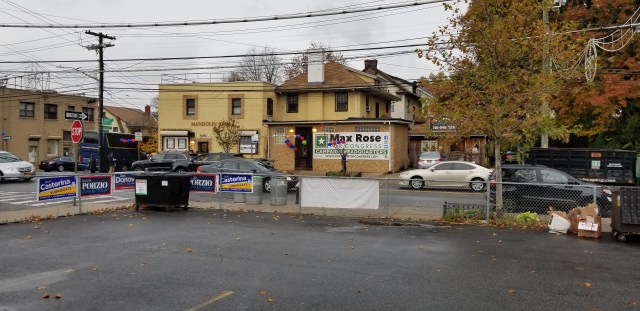
Right before I went to sit down at the sheltered bus stop I snapped a photo of Max Rose’s Staten Island campaign office (the eleventh district extends into Brooklyn where Max Rose already has an 80 to 20 lead).  It was then that I noticed that his campaign headquarters was in the same small building as Mandolin Brothers.   Mandolin Brothers was a famous purveyor of excellent new and vintage stringed instruments.   You could play and buy beautiful guitars, mandolins, banjos, ukuleles there.   I was only there once, years ago, and pretty close to closing time, but it was a great place I always intended to return to.  I smiled to think they’d loaned their space to Max Rose for his campaign.  Not only great musical instruments, I thought but good political impulses.  (I later learned from my smartphone that the store is long gone).

20181105_151543.jpg

The ferry back was one of the now typical ferries that have no external decks along the sides for good, open air views.  The ferry was entirely closed, which was fine with me, it was shitty out, and cold, I was disappointed, and tired, and I sat on a bench hardly noticing that we were traveling over a vast stretch of ocean water.   In a little over twenty minutes we were docking at the foot of Manhattan Island.  I passed a black lab with a working dog collar on and also the golden lab, who was now barking continuously.  It must have been close to quitting time for the golden lab, and her patience was just about done.

A short walk north and west from the ferry station in lower Manhattan, you come to this museum:

20181105_165030.jpg

On the front door is this sign:

20181105_165121.jpg

We are stronger than hate, until hate actually murders us.  It happens.  It has not stopped happening for many years now, though the names of those being murdered by hate keep changing.   Genocide continues with horrific consistency, on massive scales and on more limited scales.    Four years ago, for example, a few thousand Yazidi men were slaughtered in the Sinjar Massacre, too few for a proper genocide, perhaps, but still very, very horrible.  The Rohingya were recently the subjects of persecution and genocide in Myanmar, the nation formerly known as Burma.   Everyone in Yemen is catching hell, children are being killed every day, casualties of  the brutal Saudi war there, which rages with American support.  Protesters and rock throwers are being shot to death in more than one country, threatened with being shot to death here, by the American president.   So-called strongmen appear here and there to enforce their will by organized mob violence and with their armies.   They use the military to intimidate citizens and perceived enemies, as our president is doing now, having soldiers install concertina wire along the border fence at a cost CBS news reported tonight is perhaps $200,000,000.

Many people feel the world is overdue for its next, and final, world war.  Look at the world, it’s in chaos, violent storms and other natural disasters are regularly destroying homes and killing people all over the planet, species are disappearing, violent ideologies are waging ruthless wars against unarmed civilians in many places.  Some historians claim that we are living in the most peaceful moment of human history.   I think that’s a wonderful thought, probably backed by some kind of very convincing statistical evidence.   I also don’t think it’s true.   The world is waiting to explode into the next mass murder, many people everywhere are desperate, snarling angrily, we are one big bomb away, and violence is in the air.

So I say, to myself and to people of all faiths and original nationalities who vote in American elections: vote today for the party that is less racist, less xenophobic, less nationalist, less extreme in its divisive rhetoric.  Changing one-party control of our democracy is not the answer to all of America’s problems, but it is the start.   The other way lies madness.


[1] Wikipedia:

In 2018, Donovan faced a primary challenge from former Rep. Michael Grimm.[27] During the primary campaign, Grimm accused Donovan of having tried to entice Grimm to drop out of the race by offering to lobby Trump to pardon Grimm.[27] Grimm pleaded guilty to federal tax evasion charges in 2014 and spent several months in prison.[27] During the primary, both candidates emphasized their loyalty to Trump, seeking to “out-Trump each other,” according to the Washington Post.[28] In the 2018 general election Donovan is facing Max Rose.[29]