Be very careful what you say when you’re hurt

“I don’t know what I did to make you treat me so unfairly and so disrespectfully,” while possibly accurate, is probably not the best line of approach when someone you love has treated you hurtfully.

If you have degenerative arthritis, say, and did not qualify, until a few weeks ago, for palliative injections that will allow you to exercise for six months without pain while building up surrounding muscle, why is that really anyone’s concern besides yours? Why would you expect automatic acknowledgment of your physical limitations and the empathy that follows from considering a loved one’s disability?

Say you feel wrongly accused of a flaw you try not to have, say in addition to an unreasonable expectation of sympathy, there’s the perception of your habitual comfort inconveniencing everyone around you. You like to sleep all day, so nobody can even be on the road for a vacation workout by a reasonable 10 a.m.

All these feelings, after someone shows you an implacable face, must be put to the side as you figure out the best way to restore trust and mutuality. It may take more patience than you have, particularly when you feel hurt, but that’s a separate question.

The real question is how to convey to them how hurt they would feel, placed in the unfair situation they’ve placed you in. That is not the work of a few minutes or a few hours, of simply choosing the right words. It requires a supremely patient telling of the right story, framed sympathetically, to keep everyone calm and help them understand.

It may take more patience than you feel you have. It becomes easy to think up past wrongs echoing the latest and be hurt by the confirmation of callousness, but making this list carries the risk of making you sound petty and prosecutorial. Best to focus on understanding, clarity and directness, toward a more loving future.

Otherwise, speaking out of pain, you are much more likely to do harm than to say anything that will contribute to healing or empathy.

Try writing the situation out first, it may help you grasp things better, to be more clear and better able to stay out of the many deadly traps hurt will steer you towards.

Best of luck, there is no harder work I know than remaining mild when you feel deeply hurt. It is worth the price to master this supremely difficult skill. In the meantime, be very judicious in what you say while still smarting.

Meditation on 5782

Today is the first day of the Jewish year 5782. The most religious Jews believe that HaShem, according to Jewish tradition, created the universe by performing the miracle of dividing light from darkness, land from waters and creating life 5,782 years ago, literally, as it is written. Thus Jews believed two thousand years ago and, so it is, to the most fervently religious, to this day. Other Jews see 5782 as a symbolic number, the bit about God creating all the plants and animals one by one, culminating in his masterpiece, his special children, humans, woman created out of the first man’s spare rib, as so much Biblical poetry.

Religious belief has never interested me, I have no talent for it. My first thought is armies of the fucking righteous, putting the faithless to the sword, century after century. Virtually every religion has had a turn at Holy War. The most righteous of every creed recognize that the reward of an ethical life, some version of heaven or enlightenment, belongs to the righteous of all nations, when they are not slaughtering them.

My second thought is the hotbed of anti-Semitism that was Hillcrest Jewish Center, where, for several years, I was forced to attend classes after the regular school day was over.

Beyond the “fuck that” of a kid who’d just been sprung from jail having to report to another jail for a few hours, especially on beautiful days when playing baseball was much closer to God than learning to parrot prayers, in an unknown language, that were never translated or explained, there was the silencing of all questions. The blotting out of critical thinking was the most intolerable part of the Hillcrest Jewish Center religious experience. It was a gaslighting similar to what I experienced at home, where my very clever father endlessly fought me over everything, generally by recasting whatever else we were talking about as a damning referendum on my character.

Trips to the principal’s office, fucking Frieda Berkman was her name, did not cure me of my need to question things we were supposed to believe, rites we were supposed to perform by rote, mouthing prayers we didn’t understand. After Berkman got sick of having me wait in her tiny outer office day after day under a poster that said “a teacher attempting to teach without inspiring the pupil with the desire to learn is hammering on cold steel” (I asked her about that one, she didn’t like my disrespectful question at all), I was sent to wait in the plush outer office of the rabbi, Israel Moshowitz by name. Moshowitz was photographed shaking Nixon’s hand, of course. He was a big deal. I have no recollection of the pious speech he eventually laid on me about being a good Jew and just doing what I was told. I’m fairly sure it involved the Holocaust.

It took me many years to get over the antiSemitism that was instilled in me by my early religious miseducation at Hillcrest. I used to recoil from the well-dressed swarm of once-a-year hyper-religious Jews who congregated at the Yom Kippur service (the Day of Atonement is ten days from Rosh Hashana, Jewish New Year). I’d feel real disgust watching them hurry home to break their fast, in a huge hurry, all full of the righteousness of not having eaten in 24 hours. I’d walk to the synagogue to meet my father, shouldering my way past these hungry, rushing, bad-breathed creatures, and walk him home to break our fast.

I had no patience for the meaningless “please rise, please be seated” ritual of the Hillcrest gymnasium, where cheaper seats for High Holiday services were made available to those who were unable or unwilling to pay top dollar for an expensive seat in the sumptuous main chapel. Once in a while, in the gym, people would faint, and fall off their folding chair on to the lacquered wooden floor where, on other days, I’d played basketball.

No need to mention the vengeance of Frieda Berkman, who snarled at me over a loudspeaker during assemblies, or the united fucking by the synagogue itself, first in not presenting me with the Bar Mitzvah kiddush cup I had earned by reciting a few lines of Torah when I turned 13, and then by inviting me to a special service, in the Ferkauf Chapel, where, I was promised, I’d be presented with my kiddush cup. I put on a suit, went down there, “please rise, please be seated, please rise, please continue to stand,” and, at the end of the ponderous droning, there was no kiddush cup. I think of this every time I celebrate shabbat with friends who have their own, and their adult children’s, kiddush cups on the table filled with wine. I also think of how telling it was that my parents never intervened on my behalf.

So ritual for me, for the most part, so much contemptible horse shit. I say this with God Himself looking down on me, only slightly hurt. Worse things have been said by Jews, by Christians, by the otherwise righteous of all nations. If you experience a sense of community and spiritual completeness by sitting in a temple with others of your faith, God bless you, more power to you.

For me, religious ritual just reminds me of the super-religious Amy Coney Barrett, quickly ruling that religious gatherings during Covid-19 must be exempt from all health regulations, because God requires worship, and then, a short time later, ruling that an unconstitutional abortion ban in a state with a notoriously high infant and maternal mortality rate, a law designed to kill more poor women by forcing them to give birth whether they want to or not, is perfectly fine because the unconstitutional law is administratively complex. You can keep the ritualistic, inhuman religion of fanatics like Amy.

I emerged from a scarring childhood of incoherent religious idiocy, years later, to separate the moral teachings of Judaism from the empty rituals. There is a moral core to the teachings of the rabbis that is worth embracing. If you hate something, don’t do it to others. Be not intimate with the ruling authorities. Remember that you were a slave, do not tolerate the enslavement of others – freedom demands it. If you hurt somebody, do your best to make amends. A pretty good set of core principles, I believe.

These are moral precepts I have gleaned, some during interminable services (bar and bat mitzvahs, usually) where I flipped to the back of the prayer book and read Pirkey Avot, Selections from the Fathers, a short collection of pithy sayings that is part of the Mishnah, a vast book explaining every aspect of God’s laws. “Be not intimate with the ruling authorities” is in there somewhere, and it makes a great deal of sense to me. “What is hateful to you, do not unto others” is Rabbi Hillel’s famous formulation of what would later become Jesus’s Golden Rule “Love thy neighbor as thyself” and, to my mind, it provides a much more concrete guide for how to live an ethical life. If you hate something, don’t do it to somebody else. We humans know few things more deeply than what we hate.

Love, on the other hand, while precious beyond poetry, is a much shakier guide for how to act. A woman I used to know, who loved me, once gave me some counsel I argued against following. She countered that she wasn’t telling me anything she wouldn’t tell herself. I told her I knew that, but pointed out that in the past she had told herself to shut all the windows, turn on the gas and put her head in the oven, something I would never consider doing myself. In fact, I’d fight somebody who tried to insist I kill myself. She had the grace to concede that I had a point. Love is slippery as hell, and many of us don’t love ourselves as unconditionally and faithfully as we should, making it hard to love our neighbors as ourselves in the kindest possible way. At the same time, we, and those we love, are all we really have.

So I was happy today to see my smiling friends, regular synagogue goers, video me from a beautiful beach where they are celebrating today. “The beach is our shul this year,” my friend said, smiling from her beach chair, a light breeze tickling the shade umbrella under a perfect blue sky. I told her how beautiful their shul was, as she got up to take a panoramic shot of the sand, sky and ocean, and stop filming our other friend, who’d said hello but, like me, had had enough of the video conference after a short time. “Please be seated,” I should have told her.

Cover note to a former close friend

I will fold this up, put it in an envelope, and send it to this longtime friend who told me he loved me like a brother, before repudiating me forever. Oh, well. I don’t write it for him, I write it for myself. You be the judge:

Maybe friendship, like everything else in nature, has a natural life span. On the other hand, long, close friendships that end in mutual enmity, while both former friends are still alive, reflect an unwillingness (or inability) to reach a humane understanding. Not that humans are primarily rational, of course, as we see on the world stage daily, and friendship is not an entirely rational thing. On the other hand, concluding that a person you once loved and trusted is an irredeemably hurtful asshole reflects a fundamental emotional/intellectual disconnect, an irreconcilable battle with your past self. Most tragically, in a world where we’re lucky to connect with a few kindred souls over the decades, this fatal falling out cuts off all possibility of redemption, a more nuanced understanding that leads to reconciliation and a better life. The traditional image of heaven, old misunderstood enemies tearfully embracing — not for chumps like us.

To clarify, I’m not trying to change your mind about anything. It’s pointless to go over the angry phone call when you rang to confront me about what you said was my dangerously out of control anger. If nothing else, your aggravating show of “concern” was a reflection of emotions that had long been simmering in your heart. We’ll agree that your inability to understand why I was so upset when you dismissed my right to have strong feelings about a screwing you couldn’t personally relate to was genuine.

We can safely assume I’ve always been the kind of vicious, hypocritical, ruthlessly angry hurtful fuck you now conclude I’ve always been, regardless of my protestations of patience and mildness, and that you’ve always been a hectoring bully confidently pessimistic about the possibility of real human growth. Not a problem. I try to learn lessons from things like a falling out with a friend of fifty years. I know saying that is provocative, especially to someone who doesn’t believe people are capable of truly learning from pain, or making meaningful changes in their emotional lives. It is one more of my irrationally superior tics, something that makes a lazy lost soul like me so despicably infuriating.

Here is a bit I wrote the other day, trying to work out some more lessons from life, as I wait for the update on whether or not I am dying of prostate cancer. Have a great day, man!

Why do you write?

People write for different reasons, just like we play music for different reasons. Thinking of music, I know some people who play music for the applause, in hope of fame, dreaming of playing to and impressing large, appreciative audiences and being thought of by others as a real musician. In writing it that way, I see I am passing judgment on them, just for doing the normal, natural thing in a competitive society where all we are is what we can prove to others we do better than most. It also suggests there is another way to think about making beautiful sounds, about writing, about doing anything we love. I will explain.

When you play an instrument to produce the best possible sounds you can on it, you are attuned to it, related to it, and you will always play as well as possible. When you pay attention to your intonation, the dynamics of your notes, how you produce different sounds, which sounds most make you love the instrument in your hands, how you bend the note, or slide to the note, or hammer it from a lower note, you are playing in a universe that has nothing to do with others appreciating it. You play for love of what you are doing, love of the sounds your fingers (or breath) and the instrument are making.

I suspect every great instrumentalist plays this way, because they love the sounds they begin to master, love the instrument that produces the sounds, love the way it interacts with other instruments in the mix. When you are in this zone, nothing else really matters to you. When you play out of this kind of love, you naturally get better and better, because it’s not a matter of practicing to attain a goal, it’s always a matter of joyful play. You are absorbed in making a beautiful melody sound as beautiful as you can, laying in a harmony or counterpoint line as perfectly as you can. There really is no better work.

You play a note on the piano. You can bang it hard, stepping on the sustain pedal, and have it ring like a gong. The instrument is called the pianoforte because it is capable of playing pianissimo (quietly) or forte (strong!). A good player can make a piano whisper too, whenever needed. You can sound some notes loudly and others quietly to achieve all kinds of subtle effects. There is a range of things you can do on an instrument capable of this palette of dynamics that were impossible to do on the instruments that preceded the piano, like its direct ancestor the harpsichord. Writing is the same thing, there is a vast range of what you can do with words, lining them up in different ways, loud and soft, for different effects.

I’ve been writing since I was a kid, and I’m officially an old man now. I often wrote out of a feeling of being unable to understand and make myself understood. Though I always spoke well enough, it was not enough. There were things I struggled to express, things I barely understood myself, and I found early on that writing, and thinking, and editing, clarifying what I felt and what I was actually trying to say about what I was wrestling with, was a very helpful process. Writing led me to understand things that perplexed me and it allowed me to share them, through the writing itself or talking, in light of what I’d worked out on the page.

What struck me more and more as I went along was the incomparable beauty of clarity. The writers I admire most set things out clearly. If you don’t give the reader all the necessary background, set out concisely so as not to waste her time, you are doing nobody any favors. If the solid back story needed to understand a point is missing, ambiguity floods in. There’s enough of that in life, it does not enhance expository writing, in my experience.

My goal when I write is clear expression, and I cut away anything that interferes with clarity. I often have to murder a darling, resist the impulse to make the words dance, or shimmy, or call attention to themselves. My main thought when I’m reviewing and revising my words is to make them as plain and clear as I can. This is particularly important when dealing with a difficult, perplexing subject.

For example, and this example stretches over decades, you are perplexed at an unresolvable contradiction about a parent. In my case my father was very smart, very funny, his politics always favored the underdog, the oppressed, he loved animals and treated them with great tenderness, he was insightful, keenly interested in the world and could be very reassuring when he wanted to be. A wonderful man. At the same time, he was very often irritable, angry, critical and mean. He was an abusive prick to my little sister and a determined enemy to me for most of my life. How do you reconcile these things? How is it possible not to take your father’s seething anger at you personally?

If you internalize this kind of parent’s view of you, it makes no sense, the world makes no sense, your life is a painful jumble. A devoted friend of the underdog, a man who believes deep in his soul in human equality, in a right to be free of tyranny, who teaches you to be kind to others, to treat animals with tenderness, snarling every night that you’re a venomous snake … WTF?

How do you understand this? You take an insight, like George Grosz’s comment that in order to understand how someone can behave brutally you have to study the humiliation they underwent. You read this in a biography of Grosz you are reading as you research how this political artist used his talent as a weapon, how he was forced to flee by the Nazis, who would have happily made a gruesome example of him, how he struggled in the US. You started reading about Grosz because your father once compared your drawings to Grosz’s, a compliment you did not take to heart at the time, but one you cherish in hindsight.

You have to study the humiliation that makes a man act with brutality. How do you do this? You can’t really ask the man. One kind of writer would write a novel, create a character she could interrogate, put in different situations, see how he acted, what made him brutal, fill in the imagined humiliation that made the story make sense. I am not this kind of writer, though I love good fiction I’m not drawn to writing it, my attempts over the years strike me as mostly sketchy. I need actual details to work with directly, to describe as accurately as I am able.

So I spent many, many hours conversing with my father’s beloved seventeen years older first cousin, Eli. The man was mostly estranged from his own three children and grandchildren, and great-grandchildren, the result of his tyrannical insistence on raising them as he saw fit, not as they might have liked to have been raised. He could be very difficult, flew into a rage easily, but also, as with my mother, was very easy for me to placate if I acted the right way, backing off just a bit, like I was easing up on the gas pedal.

As easily as Eli’s face turned purple, spittle formed on his lips and he became savage as a leaping panther, he would calm down and return to being a funny, wonderful story-teller. I suppose it was the same dynamic between him and me as the one between my mother and him. They loved each other and fought constantly.

As often as he was blind to the needs of others, to his own role in making people miserable, he also had frequent moments of great insight. It was fascinating to watch these two contradictory things marching forward side by side in our conversations. If I’d spent 40 hours talking to him, I’d never have learned what I needed to know. It took hundreds of hours, over the course of dozens of drives up the twisting Sawmill River Parkway to visit him, before he thought to reveal the difficult truth I needed to know about how my father was humiliated, from the time he could stand.

It was a crushing revelation and he made it with all appropriate hesitation and regret to have to tell me, but describing it to me was an act of love that turned a light on in the universe and enabled me to start to let go of much of the pain and anger that had been building in me for decades. It allowed my father, a few years later, to have a son standing next to his deathbed who knew exactly why he felt his life was over by the time he was two. In a sense, it is a miracle my father did only as much damage to my sister and me as he did.

I have mused about this, and Eli’s gift, over the course of a thousand page first draft that is sitting on this blahg, needing another pass to start turning it into a book you could read and extract lessons from for your own life. Click on the subject “Book of Irv” to the right of this post and you will see what I’m talking about.

A word about “by Oinsketta” instead of publicizing my name, Eliot Widaen, as any normal writer would do. When I started this blahg it was to get access to a supposed archive of research on Malcolm X compiled by Manning Marable a scholar who died shortly after (or maybe right before) the publication of his biography of Malcolm X, El Hadj Malik el Shabbaz. I’d read the book in fascination, thinking it was a great and insightful work, and then the critical shit hit the fan. People who loved Malcolm (as my father had, as I do) were outraged by some of Marable’s assertions in the book. I’d seen a reference to an online archive of Marable’s research, went looking for it, found it, logged in and found virtually nothing of use there.

I remember feeling quite disgusted at the “archive”, that the sources of the controversial parts of what Marable had written had apparently gone with him to the grave. Before being able to access the Malcolm research archive site, I had to log in to something called WordPress. I logged in as my late, beloved cat, Oinsketta, created a PIN and was given a blog. That was about ten years ago. I don’t think I can change the author’s name at this point, on the other hand, I never really checked it out. On the other hand, I suppose I don’t really care enough to research it. At the same time, the clock is ticking, and I’m trying to get some of the best of my thousands of pages of writing into publishable form.

Why do you write?

Playing soothing music for my dying mother

My mother died a long, slow, painful death from endometrial cancer. She did not want to talk about death, though she often asked, rhetorically, why she felt so awful all the time. I understood that I was not supposed to mention death, or the deadly cancer eating its way out from the lining of her womb.

My mother always gave my father a hard time about his napping. He’d fall asleep a few times a day and, when I was visiting, my mother would point at him and complain. It turns out he was dying of undiagnosed liver cancer the last few years of his life, which could well explain his more frequent naps, but that’s another story.

As my mother got closer to the end, she found herself exhausted during the day and would often fall into a nap. I asked her if she’d changed her opinion of napping.

“Oh, I LOVE to nap!” she said with a big smile.

One day toward the end of her life, when she was trying to sleep off some unbearable pain, I went quietly into her room with my guitar and began playing a soft, soothing vamp, something like this one:

Her breathing seemed to become more relaxed as I played. I played softly for a few minutes, hoping to help her to sleep. Suddenly she sputtered and opened her eyes on the pillow.

“What IS that?!” she said crossly, “it sounds like you’re tuning your guitar!”

I withdrew from her bedroom and didn’t try that shit again.

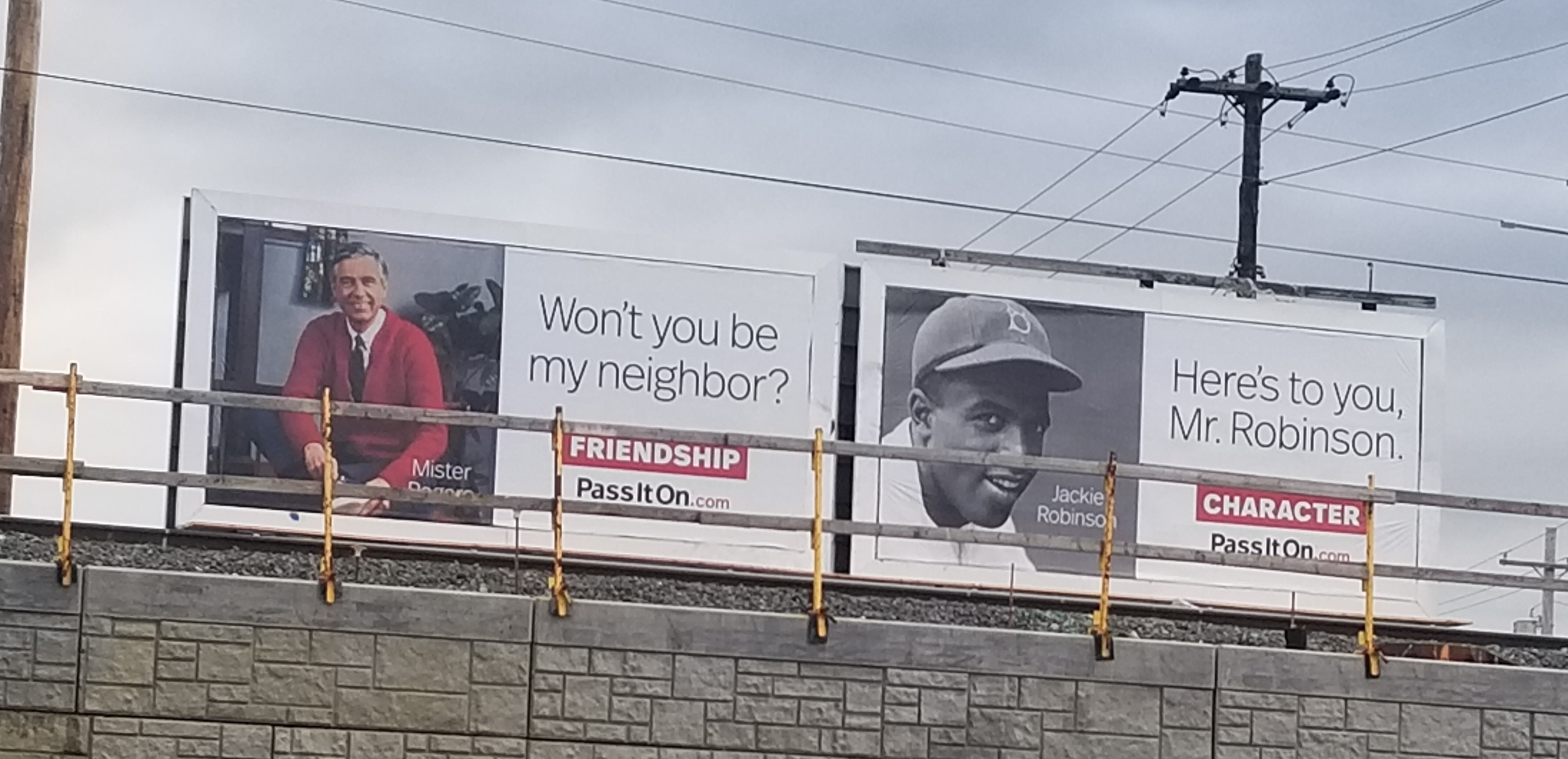
Good billboard ads

Illustrating that advertising can be used for good rather than strictly for evil, or the indifference of an honest buck. (Assuming the business they’re advertising is not some kind of Apple-type product, using iconic images of Gandhi, Einstein and Martin Luther King, in conjunction with a similar one of Apple’s CEO, to illustrate Apple’s world-changing genius).

These two signs will make some people think and feel just a little, a good thing in our brutally divided, black and white time of gathering violence and destruction. Friendship, pass it on. Not a bad message.

Check out the great documentary on Fred Rogers, Won’t You Be My Neighbor?, an inspiring story of a great man. I knew virtually nothing about him before I saw the movie, but I have great admiration for him now. In the case of Jackie Roosevelt Robinson, consider for a moment that it was not until after World War II, the war we fought against fascist racism, that our national pastime was “integrated”. Robinson was chosen to be the major leagues’ first Black baseball player because of his toughness and his ability (which he had to promise to maintain) to be spit on and jeered as a “nigger” without retaliating (except, once in a while, on the base paths).