I don’t know how the artificial intelligence of YouTube algorithms determined to send me this particular video, (and I shudder to think about the sophistication of the surveillance we are all under using our smart devices) but as I watched it I said “damn!” A pretty smart little film clip with a short, powerful comparison of emotional immaturity and emotional maturity.
The narrator asks what our characteristic reactionis when someone we love hurts us. We can sulk, hoping for a magical solution. We can rage, like the cartoon of a powerful autocrat. We can grow cold and withdraw. Babies and children act this way, why shouldn’t adults?
For one thing, the world would know nothingbut war and no interpersonal conflict could ever be solved.
Three characteristics of emotional maturity needed to actually solve musunderstandings and mistakes:The capacity to explain why we are hurt. The capacity to stay calm and extend the benefit of the doubt when hurt. The capacity to be vulnerable.
The narrator asks reasonably and humanely how we can expect to emerge from childhood with emotional maturity if we are raised by people lacking the emotional vocabulary, or emotional maturity, to show us how adults deal with pain? Lacking that, it’s just years of hard goddamn work not to act like a baby when we’re fucking hurt.Here’s a neat six minute primer:
When I was in my late twenties, visiting the farm of my parents’ best friemd, Arlene, she laid a great truth on me. As we watched the sun set one evening shesaid:
“You feel like you disappointed your parents, like you’re responsible for their unhappiness. I love your parents to death, as you know, they’re my best friends, but they are both very unhappy people. They just are, they were that way long before you were born. Their unhappiness has nothing to do with you, there is nothing you can do to change it, the burden of it is not something you need to carry through life.”
Though what she said sounds obvious to me now, it was like she’d reached up and pulled a string to turn on a light in the universe.
That understanding was an immense help to me, comparable to my father’s older first cousin Eli, years later, describing how he witnessed his beloved Aunt Chava grab the thick, burlap covered cord for her steam iron, from a drawer behind her seat at the kitchen table, and whip little Irv across the face with it.
“In the face?”I said.
“Yep, over and over,” said Eli.
“Jesus,” I said, “how old was he?”
“However old you are when you can stand on your two feet without falling over,” he said, with limitless sorrow. He saw it many times after that, and he said that over time all she had to do was rattle the drawer where she kept thewhipping cord and young Irv would stand at rigid attention, staring at the ground, trembling, waiting for the whipping to start.
I was raised by parents who had been physically and psychologically abused as children. They grew to adulthood with little ability to restrain themselves when frustrated and, quick to anger, took out their unbearable feelings on their children. My sister and I were blamed for all kinds of things, some of them ridiculous. I trace my need to express myself to my childhood desperation to untie the knot of the incoherent story I was expected to accept about myself, about my sister. I started writing fairly young, and before that I drew, constantly.
“Why are your drawings so scary?” my mother would sometimes ask.
“Because I can’t write yet,” I might have told her.
I had a girlfriend and her baby visit me in New York decades ago, saved up, sent them plane tickets. The child, who I loved very much, is now in her thirties, maybe forty (damn!). I last saw her on her fourth or fifth birthday. Her mother was beautiful, talented, had a great sense of humor, we got along great, I loved her, but in the end things didn’t work out between us. During the week they were my guests, the two year-old had a few temper tantrums, as two year-olds do, and her mother tried to press me into moving to California and join the community she lived in with her Indian guru, Baba Hari Dass. I felt increasingly pressured as the week went on.
After they left I found a drawing I’d done while they were in NY. It was a shapely woman’s leg, standing firmly on its lovely foot, with a leash tied to the thigh, where a garter would be. The leash was taut and straining against it was a dog with a human face, and a huge boulder on his back.
“Fuck,” I thought when I saw that drawing afterwards, “that self-portrait says it all…”
I find this unexpected revelation of my deeper feelings with writing sometimes. I read something I wrote and a phrase jumps out to clarify a complicated quandary for me. Here’s a paragraph I wrote recently that made me realize something very important about a prolonged estrangement from two of my oldest, dearest friends.
Long, deep talk with old friends recently [different ones — ed.], reminding me of the healingpower of being heard and of forcing yourself to hear things you may not like to hear. These are crucial perspectives you can’t come to on your own when you are impaired by pain. Good friends don’t always have to agree with you, though they often do, but they always treat you with care when you need care.
Simple test: did my oldest friends always treat me with care when I needed care?
Well, not always, and lately, for the last nine months or so, no care at all. In fact, the opposite of care. They insisted I was wrong to feel the way I did after one jumped ugly with me, since in their story she was only reacting to my threatening attitude. They blamed me for ruining a wonderful vacation with a flash of anger the last day, denied there was any tension at all leading up to my outburst, just a simple misunderstanding I blew up over, until seven months later one of them admitted things had been very tense, because she had been micromanaging everything to make sure it was all perfect. The other one later threatened me that he’d walked away from friendships for less than what I’d done to him. The first one had a temper tantrum, then was so shocked later that I still needed to talk about it that she went incommunicado for months, then had another temper tantrum when I dared to bring up the troubling pass our long relationship has come to.
Understanding does not lead to a clean solution to your vexations, but it is better to see the thing clearly than to have it muddily painful in your head, waking you hours too early, like a toothache. I compare this depressing impasse with my dear, old friends to having a knife stuck in my side by one of them, unintentionally, let’s say. When I pointed to it, the other pushed it in a little further. Months later, when I gestured toward the still unhealed knife wound, the first one stuck her finger deep into it and wiggled it around. I didn’t bleed out, I didn’t lose consciousness, so what am I fucking blubbering about? That’s a tiny flesh wound, asshole, I’ll give you something to blubber about!
To forgive is divine, truly, and to be slow to anger is praiseworthy. I managed not to respond to either of them with anger, but their conditional apologies turn out to be hollow, empty, without form or substance, without any change in behavior. I don’t need apologies anyway, as I explained to them, I need to be heard and understood by loved ones when I’m hurt. You know, empathy, understanding, the benefit of the doubt — basic friendship. I expect to be treated with the same care I extend to them. But that turns out to be unreasonable when the only pain the other person can truly relate to is their own.
We are all capable of casting ourselves as the victims when things get ugly, and things are ugly enough for all of us right now on this imperiled little planet, at the doorstep of climate destruction and surging worldwide fascism. There are also not always two equally compelling sides to every story. Treating friends with care is the most basic duty of friendship. Dereliction of that duty, especially if repeated over and over, is an indication that the friendship you are clinging to may already be dead.
I still have a hope that these two dear friends will have an unexpected change of heart the next time we meet, whenever that might be. I’m ready to be pleasantly surprised, delighted and relieved, by that change of heart, that deeper understanding. It’s a slim, wan, simpering hope, I know, but it is a hope and I appreciate it. Hope is always better than no hope, I believe, until the proof is irrefutable and the hope for something better is crushed by dull, heavy, merciless reality.
When a relationship is strained, lines are drawn, sides taken and moral stances struck. The first casualty in such standoffs is often honesty, which is a shame, since it’s also the only way back to health. But since feelings are strained, hackles are easily raised and things are at a breaking point, you must be very careful about what you say, how you say it, what you leave out, what is safe terrain and what is a minefield that will blow everybody up if you set a toe on to it.
Though this limited honesty may feel to you like a kind of death, if you are used to an honest back and forth, it is nothing like death. It is an attempt to save the life of a frayed relationship in the only way possible, by putting things on a respirator in hopes of an eventual return to health and good cheer.
Only time will tell if your efforts towards repair succeed. A primal wound feels the same every time someone pokes a finger into it. The loss of a long, close friendship, in spite of your best efforts, always hurts exactly the same way, is identical to the grief of death in its inexorable finality. I will say, from my experience, a friendship that ends with someone screaming at you or bullying you is much easier to walk away from than one where your friend expresses only hurt, confusion and exasperation. It is as if the anger of the friend you are trying to reach cauterizes the wound, since you feel immediately relieved to be away from someone who can’t stop hissing and snarling. Good riddance to the raging bastard.
It is a tricky business, to be a human, as anyone who has tried it will tell you. The most important tool to mending hurt ismutual understanding.
Trying to reach understanding with only limited honesty, certain things never on the table for discussion, is supremely challenging. If the relationship means enough to you it is possible to find the patience to wait, even though it may seem impossible to be that patient at certain points. As long as you don’t lose your temper there is a chance of repair, even with the prickliest, most defensive of characters. The hope is that at that point mutual honesty will also be restored, everyone wiser for the long, terrible disruption of good will.
Close friendship, that state of grace where we extend the benefit of the doubt to sympatico strangers who become friends by returning the kindness with reciprocal care, adds years to our lives, psychologists tell us. We feel this every time we are refreshed by a relaxed visit with old friends. We don’t need science to tell us that laughing, breaking bread together, catching up, retelling old stories is a great antidote to the many daily horrors we are powerless against.
The other side of the picture, a life without close connections to anyone, is about the most hopeless darkness imaginable for social creatures like us. Millions and millions are confronted by this terrible darkness, many of our relationships reduced to tapping out little notes to each other on the phones that surveil us and mine our quirks for dollars. Isolation, as so many of us felt much more acutely during the pandemic lock down, kills.
Deaths of despair multiply where there is no hope for relief, new records are set every year for overdose deaths, deliberate and accidental, here in the USA. Shooting by gun is now the number one cause of death for people ages one to twenty years old in this country! Mass murders of enraged despair become common as young men break under isolation, particularly when isolation itself is weaponized to further divide us, the “reasoning” of the killers being that since nobody will understand or care about me anyway, might as well go out as a “gunman”, in a hail of bullets, and make others feel the unbearable pain I fucking feel.
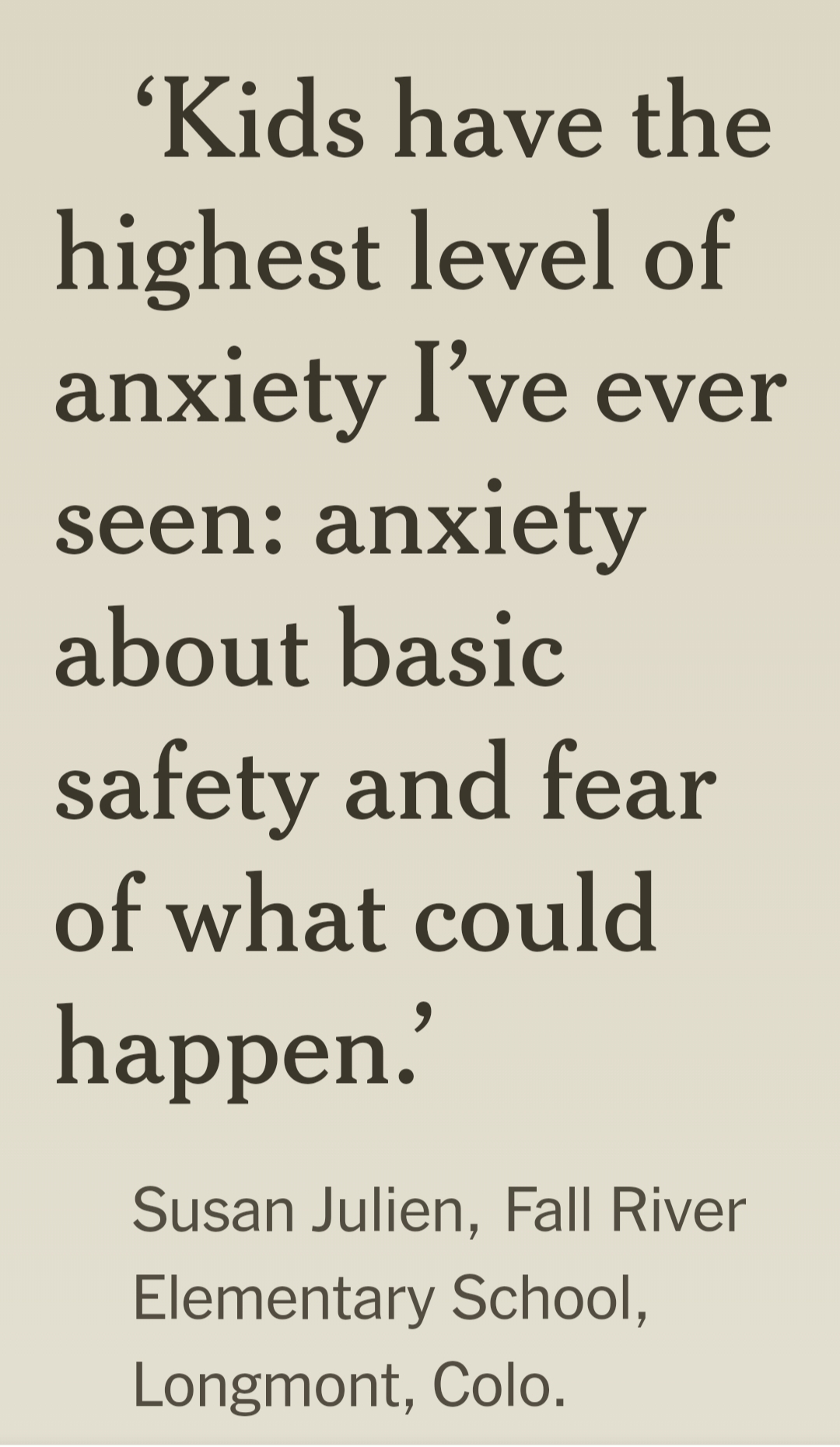
The New York Times periodically publishes a story like this one, 362 School Counselors on the Pandemic’s Effect on Children: ‘Anxiety Is Filling Our Kids’ Do you need to read the report to understand how shattered young people are absolutely right to feel today? It’s not as if we lived in a harmonious, universally fair nation of infinite promise and hope before the pandemic. Add a world-leading million pandemic deaths, at least half of them preventable, and the hot war over who is to blame for all those deaths, scientists or political absolutists, and you don’t need the New York Times to delve into the uniquely American reasons for more schoolyard fights than ever in our history as school mass murders reach record levels, adults clash angrily over whether any laws can change this grim exceptionally American reality, and a handful of Senators insist on the right of a minority to block all discussion of such laws in the Senate, should it come to that.
The question I wrestle with today is what to do when every direction you look in, public and private, leads to sorrow? There are only so many things we can do to distract ourselves from it, or numb ourselves to it, before the sorrow in every direction we look turns to despair, hopelessness, misdirected anger. Old friends deliberating over whether they can accept your immediate, sincere apology for momentarily losing your cool? A blow that lingers over the course of their ongoing deliberations, which can extend indefinitely through months of avoidance, denial and a pointless argument over who has the greater right to be hurt. A slowness to forgive becomes coupled with a new readiness to take offense? The self-preserving reflex is to walk away, the harder path of continually extending understanding for your old friends’ weakness is very fucking hard after feeling enough extended unresolved hurt. Keep the door open or finally close it, to keep the grave-scented chill out? Hard question, that one, with terrible consequences to loved ones beside yourself for a hasty choice.
My family was brutally truncated by angry mobs mobilized by the fanatical followers of Adolf Hitler, an insane man of limited intellect and great apparent charisma. Of the many dozens of family members alive and struggling before Hitler invaded their insecure little corner of then Russia only five or six (all but one in the US) were alive after 1943. The letters just stopped coming, in my father’s chosen description of their slaughter.
The loss of all these close relatives, whose names I never even learned, these abstractions (“mere abstractions” as my father called them), haunts me as I watch the world gearing up for the next round of irrational mass killings in the name of hopeless, senseless rage that needs somewhere to go, an “ideology” to direct it. That sympathetic, funny youngest brother of my grandmother’s, her favorite, little Joey (the only one whose name I know), might have been my most beloved great uncle, had it not been for the gleeful, drunken mob that massacred them all in a ravine to the northwest of town thirteen years before I was born. It takes one particularly relatable loving family member, or stranger, like a great teacher, or sympathetic neighbor, or friend of your parents, to change the course of your young life. Or, as many beautiful ghosts as you can imagine, which is a poignant substitute for the touch of the living hands and expressive faces of those souls when they werecapable of showing you love.
My niece and nephew grew up without their playful, sympathetic uncle in their lives. They saw him regularly when they were kids, their mother’s only brother, their only uncle, recalled his visits with love, and then, after their grandmother was buried, never saw him again. They never learnedthereason — that the lies their parents tell to protect them, and themselves, those desperate attempts to shield themselves from shame they actually lived were impossible for him to play along with. To preserve his tenuous relationship with their mother, the uncle would never lay out explicitly to his now adult niece and nephew that the reason for their estrangement was the dishonesty required of him, the pretend smile, the erasing of shared, lived history, a strict adherence to a lifetime of lies he, his sister and his brother-in-law all know are lies. How to tell the truth without becoming the enemy their parents always feared stymied the uncle every time he contemplated how to explain to them why he hadn’t seen them in more than a decade. From their point of view, they can only take it as a personal abandonment, otherwise their strange, inconstant uncle would have found a way to spend time with them.
How many years of unresolved sorrow can we expect ourselves to endure before our life expectancy begins to take a hit?I am fairly sure my old former friend Friedman, a man who fought with and was eventually betrayed by everyone he ever cared for, literally died of a broken heart when he expired in his chair from no apparent cause a few years ago, at age 65.
Here is what I have worked out for myself, though I don’t know how coherently I can lay it out or how helpful it will be to you. I exert myself to remain mild in the face of aggravation, in ways I could not have imagined twenty years ago. That, by itself, it turns out,only helps a little. You will get no points for it. The heat can always be turned up and turned up until your old reflexes finally boil up and you must tell someone in no uncertain terms that it’s enough, they can feel free to fuck off now, for the following seven impossible to unhear reasons.
More important to facing sorrow is my sense of fairness, my determination not to treat others in a way I hate to be treated, nor to endlessly accept such treatment from others, no matter how ingeniously rationalized. The knowledge that we can all only tolerate a certain amount of unfairness is important to working through sorrow caused by friends who may, under great stress, need to blame you for the strains we all feel from time to time. I give myself permission to grieve, to feel hurt, to eventually stop extending the benefit of the doubt to people who continue to insist on denying me the same. Their insistence is usually based on a purely emotional appeal, a protestation of love that will be instantly withdrawn if you don’t relent and return their love without hesitation or need for further discussion. That far I know now I will never come in my long quest to be as unfailingly gentle as the Christian’s Jesus, as my imagined Hillel, or the Buddha.
Spend time every day doing something you love. Creativity for its own sake, if we are lucky enough to enjoy it, is a great balm, and an excellent tonic, though it is somewhat dependent on mood. You can become overwhelmed by the sorrow all around and even the act of making yourself feel better by taking your imagination out for a spin can seem futile.
Do not succumb to futility, action to improve your mood and situation, to exercise your liberating imagination, is always better than inaction, impossible as it may sometimes feel.
I write, every day, to you. We have never met, you and I, but I imagine the reader of these words with the fond hope of making an intelligent connection. Those readers who know me, once in yer proverbial blue moon, will mention that they were moved by something I wrote, which always makes me feel good, but most of the time it’s just a “like” or a larger than usual number of readers clicking on a certain post that tells me I have made some kind of connection. I remind myself periodically that the clarifying act of sitting down to write, and making it as clear as possible to others and myself, is itself a net benefit and a good swing in the fight against felt debility.It is also indispensable to me beyond that, the quiet in your mind as you write is a kind of sacred space. Being able to hone your expression, in a way not possible in daily speaking, an infinite blessing.
This impulse to connect to others is important to nurture in the larger project of avoiding despair. The feedback we get is also very addictive. Lately the number of views of these posts has dropped dramatically and I feel disappointed when I don’t get the usual hit of dopamine I felt after posting something when I saw that several people had immediately clicked on it. That piece hit the mark, I think to myself lately, as the number of views stays at the same low count for hour after hour, as if rebuking me in my belief that I can connect with strangers.
This is the world young people were born into, likes, dislikes, friend, unfriend, LOL, WTF. Shoshana Zuboff laid out the dystopian world of social anxiety, conformity and future robbing this online feedback loop from peers real and virtual produces. A brilliant hermit I know, once a good friend, has zero in person social connections, but hundreds of friends and followers on “social media”. Going online to find missing connections, as I am doing right now when Sekhnet is sick of hearing me talk about things that make her sad, is like wearing those goggles that realistically put you in a three dimensional, totally realistic world that doesn’t exist. Girl of your dreams? She’s waiting for you when you put on the goggles and check out that smile of happiness to see you and thedream outfit she’s wearing for you! Why would you ever leave that conscious dream world? Predictions are that you would not, time would disappear, the illusion of fun, love and excitement infinitely preferable to a world where your best bet for coping with your sorrow is a strong anodyne (some of which will kill you if taken wrong) or a military assault rifle to give yourself a feeling of agency, importance and godlike power.
I’d like to end on a note of hopefulness. The forces that would make us all fight each other to the death so that they can own and control everything seem to have become bullyingly triumphant here in the US a few months too early to take the absolute power that has long been their dream. This tiny but powerful reactionary core appear to have overplayed their autocratic hand with time to organize against them before the crucial midterm elections.
After the Civil War (War of Northern Aggression to you, Yank) there was a brief period, called Reconstruction, during which our Constitution was amended to reflect a better understanding of democracy and a more perfect union. We created the Department of Justice to enforce laws required by this better understanding. Reconstruction, which proved we can do much better as a nation, was soon halted in a series of Supreme Court decisions and political compromises, after about ten years.
During the time Reconstruction was allowed to proceed it demonstrated that democracy can work to produce a better, more fair and inclusive society. Such a result was intolerable to thosefew with the most power, north and south, and the most to lose by “equality” and “justice”. In the defeated Confederacy it was not long until a form of race-based American fascism took over. Elite, wealthy local white men, backed by a secret army of terrorists and like-minded police, lawmakers and judges, and empowered by a block of similar white men in the state and federal legislatures, ruled unchallenged in every area of the South, with a firm, autocratic hand, until LBJ betrayed his former buddies by signing both the Civil Rights Act of 1964 and, even more importantly, the Voting Rights Act of 1965.
Hope? The American oligarchs and their paid apologists seem to have overplayed their hand in a way that if mobilized around correctly will jar millions out of their apathy to vote for candidates who do not insist that the 75% who support gun control, the right of a pregnant woman or girl — particularly one who was raped, or in danger of death from the pregnancy — to end an unwanted pregnancy, who support fair taxes on the wealthiest to fund desperately needed public programs, a living wage for all workers, affordable health care, real measures to slow the gathering climate catastrophe and all the rest of the “kitchen table” issues simply stop acting like spoiled “woke” babies and socialists and shut the fuck up.
What is the official current GOP platform? The guy who repeatedly lies about losing by 8,000,000 votes is himself the victim of LIES!!! By a bipartisan cabal of powerful pedophiles, queers, anti-fascists, Black racists, dirty immigrants, Muslims and Jews!!! After enough frustration, that kind of transparent bullshit wears thinwith all but a diehard 39%, particularly in the face of a premature, in-your-face celebration of minority triumph in defeating what the powerless 75% strongly prefers. We are told 110,000,000 eligible American voters didn’t bother casting a vote in 2020, thirty million more than voted for either presidential candidate. Those are the sorry, demoralized citizens we have to reach, instill with minimal hope, get them to cast a vote for the minimum of what the majority of us needs andwants.
That may not be direct, personal hope for a lonely world where all we can personally see is sorrow in every direction we look, but any steps we take, with others, away from the march toward worldwide oligarchy and fascism, are steps in the right direction, steps toward hope rather than despair.
As a personal matter, treat your friends and family with as much care as you can, but know also that agreeing to a demand that you somehow overcome prolonged, unresolved suffering has its limits and a time may sadly come when the best course is to step away, that very few things last a lifetime. I’m going to compose a long letter to my niece and nephew, setting out the harm done to our ability to know each other by years of insistence that lies be accepted as the real truth, no matter what some disturbed, childless uncle in NY might think. If I can set out the issues clearly and non-judgmentally enough, one or both of them may actually be able to hear me. If so, I’ll chalk one up to the power of love speaking truth without blame.
Above all, and however difficult it might be at a given moment, be of good cheer!
An incoherent insistence on the righteousness of your beliefs isn’t the same as a persuasive argument that can convince somebody else to change their point of view. Incoherence is only only persuasive to people who are already angry and who share your belief andyour outrage.Their anger will make them agree without question.
So, cunningly, wealthy reactionaries have, over decades, spent billions to create an industry to stoke and focus the rage of millions of powerless Americans who need to feel righteous and powerful,somehow.
Cue the AR-15 sales reps, these vultures ain’t merchants of death they’re purveyors of security and freedom from Socialist tyranny and oppression by an illegitimate government! If the occasional mass killing of tiny children is an unfortunate side effect, we have ways of protecting these kids, by “hardening” the schools in which they are slaughtered against would be slaughterers , and other common sense things of this nature. Besides, to be brutally candid, only the children of losers ever get slaughtered in their classrooms anyway.
And, like gambling addicts who can’t walk away from the table until they’re bankrupt, these incoherent motherfuckers only know how to “double down” like their leader, the most insecure and perpetually angry victim we have seen in public life in living memory of the oldest among us.
Incoherence can prevail for a time, sometimes for years, but reasonable people eventually figure out how to get together and put a stop to it.Time to get busy.
Emotions move us through life, or stop us in our tracks, but, when trapped, only thinking, and learningfrom our mistakes, can lead us out of a deadly maze. Start with a reasonable idea, test it out, if it doesn’t help, think about what was wrong with the first idea. Make it better, test it again.
This is how we learn, by profiting from our failures, and to many it feels much harder than just slugging our way through an emotional challenge. There is no guarantee that you’ll be able to think your way out of a given problem, but thinking about a difficulty as deeply and fairly as you can, understanding your predicament as clearly as you can, drawing on past experience, only helps. If nothing else, actively thinking restores a feeling of agency and hope as you work to extricate yourself from something that makes you feel awful. Hope is no small thing. Without it, you are finished.
The hardest part is listening to the perspectives of people close to you when they go against everything your adrenaline and cortisol are telling you is true. The difficulty of sitting long enough to let something you don’t want to hear sink in, make an impression, inform your thoughts, means that many people don’t do it. You must do it, sometimes, if your goal is to become a wiser, better person, or to live without clenched fists.
There are traps you cannot think your way out of, but even a trap you can spring is impossible to escape while all you can think about is the agony of your ankle in the metal jaws of the trap that is keeping you stuck until the hunter arrives to administer the coup de grace. One day we all find ourselves powerless against some variation of that scene, but not yet.