The roots of my need for coherence

Growing up in a home where I was treated as a dangerous adversary from the day I came home as a newborn affected my wiring in fundamental ways.  Because my parents were always ready with anger and blame, and I was often regularly excoriated over trumped up offenses, sometimes things I was not remotely at fault for, I became painfully sensitive to the brutality of an incoherent, self-serving narrative.   

It was much easier for my parents, two overwhelmed abused children who grew up without essential tools to process their own frustrations, to unite in their blame of a kid who was, in their view, just an irrationally angry little bastard constantly fighting for no apparent reason.  In their story their own behavior had nothing to do with their child’s mysterious, unfortunate, completely innate bad feelings.  They insisted they were right, stuck together most of the time, and that was that.

My life’s work was set for me early on — to discover a truth deeper than the harmful bullshit that was being angrily forced on me and explaining to myself coherently the reasons for the insane arrangement I was expected to subscribe to as simply reality.  As I learn reasons that make sense to me I begin to calm myself. 

Understanding is my most important tool and I wield it with as much clarity as I can against the sometimes awesome incoherence of a world that requires little by way of reason or clarity to form huge enraged armies to inflict hell on their enemies.   Finally learning of the extreme abuse my father underwent, from infancy, (I was in my forties when I learned some key details) unlocked a door of empathy and understanding for me that my father was unable to approach, until hours before his death.

Whenever I am confronted with an incoherent reframing of actual upsetting events it gets my back up.   If someone treats me in a thoughtless way that hurts me and when I react with pain tells me I am wrong to be hurt in any way, that it wasn’t thoughtlessness at all, it was an innocent misunderstanding and I have to forget about it because they love me, because they wouldn’t have been hurt at all if I’d done the same to them, it never quite gets down the old craw.   

I literally can’t swallow an incoherent story, maybe because it makes no fucking sense.  Maybe it’s just me, I don’t know.  I think I am probably not alone in preferring a story that is understandable in the light of observation and experience to a senseless one designed to serve an emotional agenda to protect someone else against feeling bad.   

Friends, when they feel defensive, see my need for coherence, which requires an openness to accepting one’s part in things that actually happened, as a relentless need to be “right”.   I can understand why it could look that way to them, particularly in a competitive and violently adversarial culture like ours, but it is a need for honesty and mutual understanding on my part, more than anything else I can put my finger on.   I was forced to defend myself from before I could even speak, in adversarial proceedings brought daily by a father/prosecutor who was very good at prosecuting.  I developed skills in arguing way before I finally, misguidedly, went to law school.   People sometimes tell me they feel overmatched and it gets their backs up, because they need to feel “right” too and I’m a more skilled fighter with words than they are, so their disadvantage makes them fight harder.  There are many ways to fight against something that makes you feel defensive and many are familiar from my childhood.   

Reframing is a famous technique for avoiding any discussion of anything you don’t want to talk about and my father was a genius at constantly steering the conversation away from what his children needed to talk about to a much deeper thing that we were “really” talking about.   Any conversation about being hurt was constantly reframed until we were talking about the real, and only, issue:  what an irrationally angry little fuck I’d always been, and remain.   

If I behave toward you in a way that’s wrong, and keep defending it as a mistake, like all humans make, I am choosing a neutral, understandable synonym to let myself off the hook for hurting you.   I was wrong because I made a mistake and I made a mistake because I was wrong are fairly close, almost interchangeable.  Wrong carries a bit more moral weight than mistaken, since using it accepts responsibility for the harm the mistake caused, so to shift the ground from the moral idea that it is wrong to do something to you that I hate done to me, I can insist on calling it a mistake and put the onus on you, the person I wronged/mistaked to have the human compassion to forgive me without more.  It is a painful thing to be unforgiven and an ugly thing to be unforgiving, isn’t it?  About a simple mistake?  Come on.

Then there is the greatest weapon of all against responsibility or reconciliation — silence by way of response.

This is kryptonite to me, as it would be to you, if applied steadily and consistently over years to make sure there was no possibility of being heard, no chance for reconciliation of any kind.  After months of silence about my last attempt at reconciliation with my father (and, naturally, I’d chosen the infuriating medium of a letter, where I have the unfair advantage of not being interrupted, reframed, dismissed, or ignored while communicating as clearly as I am able) he spoke words that live with me to this day “oh, that letter (the one I’d sent twice before hand delivering a third copy).  Yeah, I read that.  You have to respect my right not to respond to that.”

A debatable proposition, but there you are.  As polite and crisp as my father’s sentence was “you have to respect my right not to respond to that” is, it’s a problematic, even incoherent, response to a loved one expressing a need for something better, even as it attempts to close a door forever, even as it succeeds, until the last night of the poor devil’s life when he admits, hours before he breathes his last and I close dead eyelids over eyes I never really noticed were the stormy grey green color of a troubled sea, that he had been wrong.   Wrong or mistaken, he blamed himself harshly, as he was dying, for things he understood that last night he should have had the sense and strength to work on in himself, instead of being content to blame a baby for being a deadly adversary.

Sometimes there are swamps we walk into without knowing where we are, and clarity is essential here in order to avoid wading into danger for everyone.  We can mistakenly believe that people we love can show us an intimate side, a dark side, make themselves exceptionally vulnerable, and then not act desperately to make painful things disappear.   The private lives of a couple, how they treat each other, show anger to each other, accept or reject each other, is a swamp we must exit as quickly as possible once we see we’ve stepped into it.  Any attempt to protect one against the other will go as badly as reaching into the muddy depths of a swamp to pull at something you can’t see.   

This last piece is recently acquired wisdom, thanks to friends who shared experiences to illuminate the truth of this.  If you doubt the truth of it, try it yourself sometime, spend a few days alone with a couple and begin trying to protect the wife against the open hostility of the husband and tell me you are not suddenly neck deep in a hot, humid, mosquito rich paradise for dangerous reptiles.  Live and learn, my friend, and take the lessons you learn to heart.   Only by doing that can we get out of a dangerous swamp that can easily swallow everything we love.

The terror of inchoate rage defended incoherently

Long, deep talk with old friends the other day, reminding me of the healing power of being heard and of forcing yourself to hear things you may not like to hear because these are crucial perspectives you can’t come to on your own when you are impaired by pain. Good friends don’t always have to agree with you, though they often do, but they always treat you with care when you need care.   A walk through the experiences they share sheds light that can reveal important, difficult things impossible to see on your own.   

I forgot, in all the emotion of a long, complex talk about heartbreak and forgiveness, to make a point about my personal, visceral terror of an incoherent argument insisted on to the death.   

In worldwide politics this kind of incoherent argument is made every day, insisted on by partisans and, spreading via “social media” able to gain millions of enthusiastic adherents almost instantly.   

What is the argument against continuing to fund a program that very recently took millions of vulnerable little children, our fellow Americans, out of the living hell of poverty?   The program seems to have done a great deal of good, cost a tiny fraction of the world’s highest military budget. What is the argument against helping the neediest and weakest to avoid a life that nobody, particularly a tender young child, should ever be forced to experience?

The arguments are all variations on Democrats “tax and spend”, liberty means no government “coercion” (unless you’re planning to murder a zygote or embroyo), Makers versus Takers, the president is a doddering dotard puppet, the Democrats are communists, socialists, liberals, it’s a slippery slope from a Child Tax Credit to forcibly closing all the Christian churches and confiscating all firearms, we are under attack by powerful Jews with a plan to dilute our vote by brainwashing millions of imported brown idiots to vote Democrat, the most powerful Democrats, and smiling, false-faced liberal monsters like Tom Hanks, are pedophiles, and child murderers, who drink the blood of the helpless kids they kidnap and rape, when they are not out aborting nine month old fetuses, looking them in their tiny eyes and sadistically slaughtering them in cold blood to prevent their baptisms.

The horror of such arguments, aside from the “argument” itself, is that they prevent agreement about anything you can actually talk about, let alone resolve, they preempt all reasonable discussion.  No compromise is possible between fervent followers of the Prince of Peace and Love and Satan.   Why Satan advocates for a program to take two year-olds out of poverty is a separate and complicated theological argument that no secular humanist could possibly understand.  God is infinitely mysterious in His infinite love and mercy.   Heathens, heretics and “humanists” simply lack any understanding of the higher realms of faith and divine justice. End of chat, have a blessed day.

It makes me sound old, I know, but there was a time, not long ago, when a president who was caught lying many times every day, and openly, angrily, disrespecting all law and democratic tradition, would be a villain who’d be turned out of office.   He would lose reelection not by 8,000,000 votes but many times that, and after he lost he would not be able to convince millions that he’d won in a landslide, his victory stolen by LGBTQ, hoards of angry, cheating urban Blacks and woke college students, Muslims, anti-fascist terrorists, dirty recent immigrants, disloyal Jews, etc.   

My biggest terror about the world today is that our lowest human impulse, to fight to the death for an insane cause when locked in righteous rage, has been monetized by people of infinite wealth and privilege who decide, strictly on the basis of how much more money they can make, that they will automate the process of spreading incoherent hatred that cannot be corrected by reasonable discussion.   The “invisible hand” of the Free Market, you understand, protects their absolute right to do this.

If you remove the ability of people to argue about issues of mutual and public interest, on the merits, weigh the advantages and disadvantages of a government policy, and replace it with legally sanctioned partisan incoherence (unlimited spending by billionaires and legally created “persons” to influence elections is guaranteed by the First Amendment now), we are close to done as a free society.  It’s a coin toss whether we will soon stick a fork in our long, overcooked experiment in democracy, to protect, in perpetuity, the privileges our most privileged are entitled to.

That’s the piece I forgot to mention to my old friends the other day, not that it changes anything — how much it freaks me out trying to make a point to someone in my personal life who has closed their mind, insists I accept an incoherent narrative and stands on their demand to have me respect their right never to have the issue brought up again.   In a world with so much anger, shapeless, formless and deadly, loaded gun anger that can be pointed anywhere, the only small comfort I can take is in carefully taking in and analyzing what’s raging all around us, understanding it as clearly as I can and finding small signs of hope in the details that point toward decency, fairness and Lincoln’s better angels of our nature.  

With politics there is a widespread feeling of debility among those not in a rage toward authorianism, a learned, media-enforced helplessness and fatalism on the part of the great majority of our cynically, deliberately divided nation.  We have seen over and over that corrupt officials and powerful criminals are not punished, except once a decade or so when a particular powerful person is ceremonially held accountable for some particularly heinous crime and sent to prison, to prove that not every such person is above the law. 

In my personal life I have almost no tolerance for a senseless argument that I am expected to swallow without protest, an unappealable verdict I must never smart from the unfairness of or even refer to again. 

But there are other ways of looking at occasional insistent incoherence among close friends, and they must be looked at with love and a patience that may at times seem superhuman.    It is not superhuman if you are lucky enough to have kind, honest friends to help you understand the burden you are carrying and offer a way you can’t see in your hurt to take the impossibly heavy load off of your shoulders, off your heart.

when a friend shows you what they are incapable of, believe it

Sometimes, sadly, we hurt people we care about by our actions or inactions.   When we become aware we’ve caused pain to someone we love, the only thing I’ve figured out to do is acknowledge causing the pain, take responsibility for acting badly and sincerely ask for forgiveness.  I don’t know of any other way, though some people buy gifts, take special care of the person they hurt as a way of making it up to them.  Not everybody is capable of taking responsibility for cruel things they do in anger.

Anger itself is partly to blame, it is a famously terrible emotion and as difficult to sit with as grief.  When you’re angry you can only see the thing that makes you angry, in vivid black and white — no gradations of any kind.  When you’re mad you can’t see the harm your anger may be making you inflict.  You let the arrow loose from the bow in an act of righteous anger and it finds its mark, and even if it doesn’t inflict a fatal wound, it can still kill.

If somebody shows you their shock and anger when you ask to discuss something they did that hurt you, believe what they are showing you.  They are not capable of anything beyond that.  Believe them.

Harder to sit with sorrow than with anger

Sorrow is draining and terrible, it forces you to feel the pain of loss in its pure form. Anger, while blinding, gives you energy, purpose and a bracing sense of righteousness.

If you are quick to anger, try sitting with sorrow sometime, feeling the loss of a soul you love. It is an illuminating exercise.

My father found it humiliating to feel vulnerable. His early hurt made him unable to risk giving anybody the power to hurt him, so he never let his guard down. His fists were always ready, his blows were struck with glares and harsh words. If he had begun to taste the pain of the ocean of pain he was thrashing in, he would have drowned.

But I couldn’t have understood any of that while I was still his adversary. I couldn’t break free from that endless, senseless vying until I learned about his traumatic infancy. Seeing him as a whipped two year-old flooded me with compassion, and opened a window, for the first time, into his valiantly defended, tortured soul.

The inviolable law of every cult

Homo sapiens, as Yuval Noah Harari points out in Sapiens, appears to be the only species capable of uniting behind an abstract myth, an animating principle that can unleash gigantic armies launched into ant-like coordinated action.  This ability enables humans to build inconceivably giant structures and to solve massive global problems.  We are, also, the only species capable of mass murder in the service of an abstract idea. 

The thought of an idea powerful enough to change the world is both thrilling and terrifying, depending on the idea.  The notion of Enlightenment, a world illuminated by Reason, where hereditary oppression would be replaced by agreement on reasonable principles, was a more noble one than making sure the faithful remain steadfast in their beliefs, no matter what.

Every cult, every nation, every family, has a story that explains the chaos and darkness of the world in simple terms everyone can understand.  Membership in every kind of tribe depends on members remaining loyal to a core idea.  In theory, Christians, for example, emulate the man of peace and teacher of love for whom their religion is named.  He was kind, patient, dedicated to feeding and clothing the poor Andy protecting the weak, he preached about love and not being slavishly devoted to earthly rulers.  Christians have, for millennia, taught each other that it is their Christian duty to practice in their lives what Jesus preached, to imitate Christ.   With certain exceptions, of course.  All bets are off when warring with Muslims and other infidels, punishing Jews for allegedly killing the Messiah, slaughtering other Christians who belong to churches hostile to your own in their worship of God, hating any of God’s creatures that offend your version of sanctity and righteousness.  Homo sapiens are not always consistent in how we behave, though we do believe!

One consistent thing among us all is a belief in the importance of loyalty.  This is the inviolable law of every cult, every nation, every family.  We share core beliefs, and if you betray those central principles you are disloyal and subject to the agreed on penalties. Taking an article of faith, examining it and deciding it is false is the ultimate threat to the community.  Excommunication is a time honored way of dealing with dissenters and heretics, you cast them out of the hive to die in the wilderness.

Members of a cult accept things as true that nonmembers see as clearly false.  The GOP, with their strict adherence to a defeated candidate’s insistence that he had victory stolen from him by massive, bipartisan fraud, is a glaring example that leaps to mind.  One of their lifetime appointees on the Supreme Court, Clarence Thomas, told Americans the other day that they have to accept outcomes they don’t like — like the widespread banning of abortion for half the population.  This is often true, there are many things we cannot immediately do anything about in life and we must find some kind of acceptance of intolerable outcomes or go mad.   It is also the case that Thomas’s best friend, lover and life partner could not accept an outcome she didn’t like.  From her well-connected right-wing insider seat she frantically tried to overturn the results of an election whose outcome deeply offended her deepest beliefs.   The winner of that election, Joe Biden, and his wife, she wrote, were being taken by barge to the US prison camp at Guantanamo Bay to be imprisoned with other terrorism suspects for their treasonous betrayal of America!  

But I am thinking more about families at the moment, my own and others.  To be a member of my family I am expected never to reveal anything embarrassing about a compulsive liar, serial embezzler, shoplifter, road raging bully who has done great damage to other family members.  Just the threat that I might say something that raises shame, like mention a secret bankruptcy sprung on everyone on the eve of buying their dream house, means I must be kept at arms length, anything I have to say viewed with suspicion, my character, and even my sanity, called into question.   To be a member of some families, you need to recognize that dad is never wrong, or mom is always right, or whatever the deepest binding principle of that group is.

I understand the attraction of cults, they give a powerful sense of certainty in a dizzyingly uncertain world.  You belong to a community and are loved unconditionally in a cult, as long as you are loyal to its beliefs.  If belief in a demonstrable lie, or a story that distorts reality beyond recognition, is the condition of membership in a cult, or a family, you are pretty much going to have to count people like me out.  We are just goddamned iconoclasts, I suppose, like the father of monotheism, Abraham, who as a boy smashed the idols in his father’s shop and was not punished by false gods who didn’t exist.  He went on to form his own cult, with very strict laws, but that’s a story for another day.

If membership in your club requires taking an oath that I am a blameworthy, evil sinner, one who can never be fully forgiven, someone who must be eternally penitent… well, with respect, not for me, kids.


The silent death of Little Girl

Reminding us again that the real sting of death is that eternal silence where a beloved life once was.

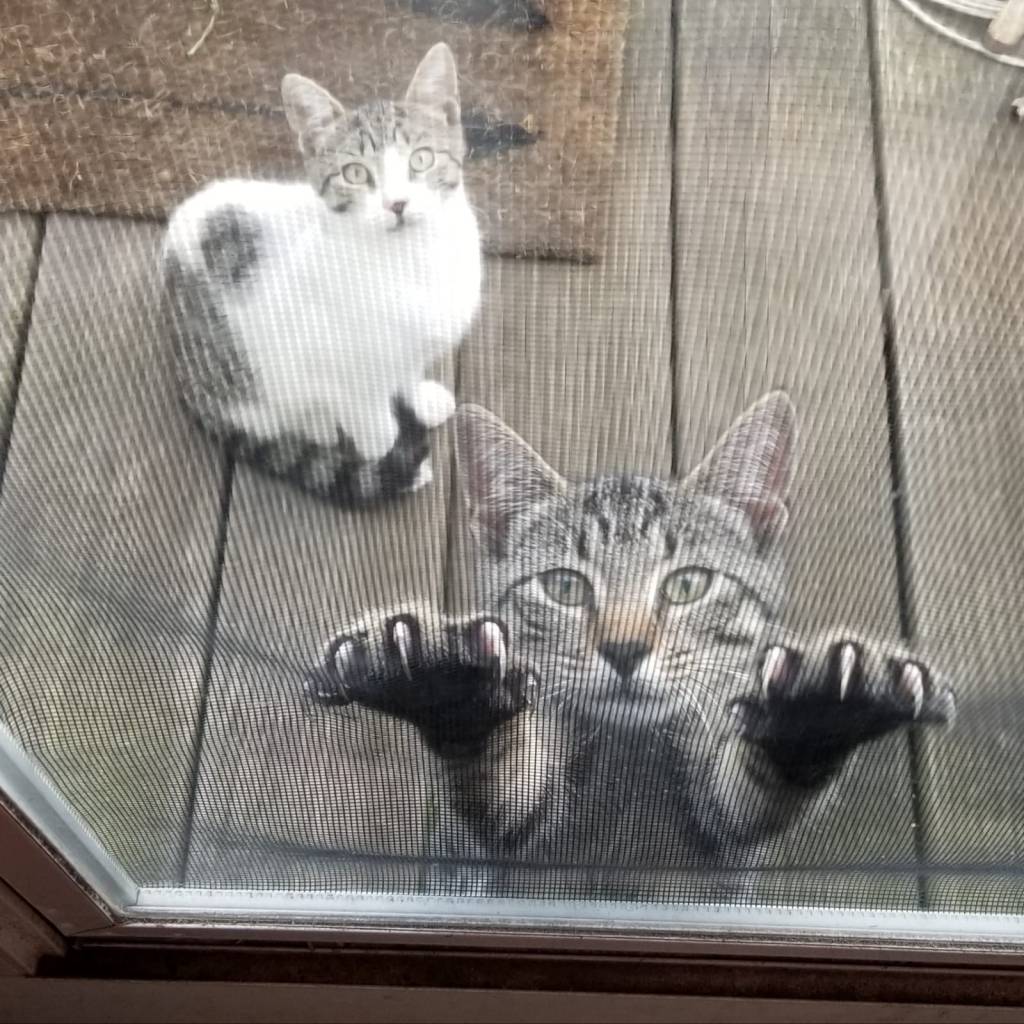
two young kittens 2018

Little Girl (foreground, her sister White Back behind her, as always), who greatly resembled her beautiful mother Mama Kitten, her constant companion and ally, left us as gracefully as she came into this short, precious life four years ago. 

Her absence hangs heavily over the turf she bravely defended and enjoyed the many roosts of, and where we touched base late almost every night.   She was an agile, athletic hunter who could grab a bird out of the air, a gold glover who could catch a tossed treat and pop it into her mouth. She always showed up in the driveway to shake us down every time we approached the door. She carried on the tradition her mother started. They were known as the Driveway Bitches, two natural beauties, demanding their due, and they always happily collected their toll.

An ordinary event, the natural death of a sometimes affectionate feral cat we loved, filling our mortal hearts with sorrow, threatening to burst them, until the sorrow overflows.

Reminding us again that what takes your breath away at death is that eternal silence where a soul we loved once was.

My strange belief in the power of understanding

I say strange belief because the world often appears to defy understanding. Look around, and tell me an understanding can be reached between people who hate each other. I believe it is possible for two enemies to become friends, once they learn how much they have in common, how many fundamental beliefs they actually share. It is rare, sure, but it has been known to happen.

The mother of a boy randomly killed by a new gang member tells the kid when he’s convicted that she will kill him. She visits him in prison, sends him books and money. When he’s released she lets him live in her murdered son’s room, which he does gratefully as he finishes his education. They become as close as mother and son. The young man asks one day if she still believes what she said at the end of his trail, that she’d see him dead. She tells him she does, and that his current life proves she did kill that monster he was becoming. He understands the truth of that. A beautiful true story I heard the woman herself narrate years ago on a program about the power of forgiveness. Rare, and wonderful, and also, proof that things that seem impossible can be done, if the heart is right and the actions taken are intelligent and consistent.

I enjoy talking with people, particularly when the conversation goes beyond normal pleasantries and daily observations and takes unexpected turns into new terrain and unknown commonalities are revealed.  There are difficult things we learn sometimes, important life lessons, and I particularly love those rare occasions where conversation takes this deeper turn and we compare the personal details of hard lessons we’ve learned about a particular vexation. 

In my home growing up, though the four of us were all reasonably good at talking, and liked to chat, our conversations often turned into angry arguments.   In that previous sentence we see, I suppose, the roots of my strange belief in the power of listening, speaking clearly, acknowledging — my belief in the importance of understanding.

You can argue adamantly, to prove you’re right, dominating the person you’re arguing with, yielding nothing, ever, or you can argue without stubbornness, open to another perspective and trying to illuminate a misunderstanding or unintended cruelty.  Dispassion is a word Buddhists and others use to describe thinking and communicating that is not the slave of passion, not in service to strong feelings that impede our ability to reason, to weigh things fairly, under a warm light.  If you speak and listen dispassionately you hear better and your responses are not as likely to add fuel to anger.  Dispassion is sometimes derided as unemotional, robotic, inhuman, but the real essence of it, I think, is keeping your thoughts slightly apart from your feelings, particularly strong feelings that will often stir you to assemble the troops to counterattack, and bearing in mind the larger, more humane purpose of the conversation.

In the grips of strong emotion we are often not at our best, emotionally, intellectually or morally.   In the last five years of my mother’s life, on the rare occasions I said something that made her explode in anger,  I became adept at quickly changing the subject to something pleasant.   It worked very well, she’d immediately release her mask of aggression and smile with great relief.  I came to see that the thing she was angry about was something I could immediately stop pressing and the thing I distracted her with showed that I understood her pain and we were now talking about something she liked instead.   I recognized that there were some things, like her painful relationship with her daughter and grandchildren, that she needed to vent about, and get my sympathy for.  She was unable to imagine anything better between them and her hurt and anger got inflamed whenever ideas about how to improve the hopeless situation were suggested by her know-it-all son.   Finally recognizing this inability of hers, an inability she shared with her daughter, sad to say (and which doomed every suggestion I might make),  I would desist in my doomed peacemaking efforts at the first sign of anger.

My father and I had a lifelong debate on whether people can change their fundamental natures.  There are good points on either side of the issue, but I was locked into proving that my belief that we can change much of what is painful to us was reasonable and based on evidence, and he was determined to prove that the idea that we have this kind of autonomy and power to change is a cruel illusion that does more harm than good.  I can see truths on both sides of the debate as I type these words.   Because of the acrimony between my father and me it was never possible to persuade my father of how much we can change our reactions to things that bother us or to move him off his fixed belief about the inevitability of pain, frustration and anger.   

“You admit you’re only changing your reaction, the superficial part, and that doesn’t touch the inborn, fundamental nature at all,” my father would say. “If you are born with a prickly disposition, no amount of navel gazing is going to make you able to resist provocation when it arises, provocation that would not even bother some one with an innately placid nature .   You might get a tiny bit better at not immediately snarling, but you are only changing your surface reactions, not your genetically programmed reflex. The fundamental things about ourselves are immutable and it’s pathetic to believe in something impossible.” 

“But changing your reaction, say not responding with reflexive anger, makes it possible to have a reasonable conversation with others, and that’s not a small thing,” I’d say.  In the end I pointed out that he himself had changed his angry reactions toward me, and that our relationship was better for it.  This proved a bad example to hand to a wartime prosecutor like my father, though he had, in fact, greatly moderated his angry reactions to me in recent years, after a difficult conversation I’d initiated with him one Yom Kippur.

“I only changed my superficial reactions,” he told me, “nothing fundamental changed in me.  I became a better actor, is all.  If I ever honestly told you what I really think of you it would do such irreparable harm to our relationship that we’d never be able to talk again.”   

He rested his decades-long case by saying the one thing that proved he was determined to be right, more than anything else in the world, and this neither he, nor I, nor any power in the universe could change — and here was the final proof.  All this talk of emotional plasticity and the value of a skilled therapist, of introspection, self-criticism and self-acceptance, so much bullshit for contempibly weak people to believe.  As for him, he was man enough to admit the difficult truth about humans — however we are, emotionally, at two years old, is how we are for the rest of our lives.

Therefore, following the logic, we cannot learn anything important, not really.  Superficial things, OK, we all learn to use toilet bowls, and language, academic subjects, but we can never learn how to hurt ourselves and others less.  Some people are born decent, reasonably happy, they get along in the world without friction or conflict.  Others are born riled up, unhappy, critical, ready to rumble, and these angry little ass kickers, who can never be wrong, are doomed to live in a world of hurt.

His tune changed on his deathbed, as apparently not infrequently happens.  Part of it, I believe, was seeing his lifelong adversary quiet, thoughtful and willing to do whatever he could to make his father’s death easier.  He lamented that he’d been unable to consider so many things, had been so limited in what he could imagine, had been so adamant, seen the world as so black and white.   He had painful regrets that he expressed for the first time, and I did my best to reassure him about each one that he’d done the best he could.

Now, it’s important to note how many times I have infuriated people close to me in recent years by my determination to remain peaceful and mild-mannered in the face of escalating bad feelings.   In the end the ugliness where there was once friendship and laughter, the absence where mutual good will used to be, becomes impossible to ignore. In their defense, there is nothing more maddening when you are angry than some fucking prig on the high road, managing to keep the anger off his tongue.

Expressing anger dramatically is a deadly game I’ve played countless times over the years, so, in the end, after enough angry invitations to tell a friend to go fuck himself, I yield to the surge of righteousness I’ve been trying not to express as contempt and tell the person, in detail, all of the irredeemable things about them I can no longer tolerate.   Friendship does not recover from this, because at the point where everything about another person is reduced to their worst and most shameful weaknesses, well, that’s irreparable harm.

So maybe my pre-deathbed father was right all along.  If you are locked in a battle with an adamant rival, intent on winning at all costs, you will, in the end, revert to however you were born to be.   The angry will rage, the placid will cry. You can pursue dispassion, believe in the power of conversation to illuminate difficulties, remove hostility, the plasticity of the human soul, forgiveness and all the rest, but in the end, when a line is crossed that is impossible to get back to the other side of, you are only prolonging the terminal phase of something that is already dead. All your high ideals about the power of understanding are so much useless, smelly, self-righteous baggage. 

Maybe so. 

I continue to work on being clear, and listening carefully to others. It is not the work of a few days, that.  Do we get better at things we practice faithfully?  All signs say we do, however loud the hooting chorus of fatalistic naysayers gets.

Anger is a mask for feelings even more threatening

It hit me last night during a walk, after a day sadly considering the ongoing righteous anger of people I’ve known for years, that anger is a powerful emotion that often masks even more painful emotions.   It is unbearable to sit with the pain of feeling unloved, rejected, abandoned, ignored, powerless, harshly judged, vilified, unfairly punished.   Shame, of course, is a famous goad to violence, a cycle observed in every prison, in every slum, where people kill each other for the capital crime of disrespect. 

The easy fix for terribly painful feelings is a nice surge of anger at the perpetrators, or those you focus your anger on, which works just as well.  In the clean, harsh, black and white light of anger, all becomes clear.  These merciless fucking fucks deserve no less than the full force of my manly wrath!

Anger is an automatic reflex to being hurt. Easy as kicking when the doctor expertly hits your kneecap with that little rubber hammer. It also has the great advantage of closing off any conversation that might make you feel uncomfortable, possibly force you to confront whatever terrifying personal demons you are trying to hold at bay. Anger is far superior, and feels much more empowering, than crying in pain about something beyond your control or ability to heal from. It also has the inherent advantage of making you the victim of the person who made you mad. Being the victim is very important for a feeling of righteousness and personal integrity since it lets you off the hook for doing anything you’d be at fault for if you had not been the victim of the person you’re rightfully getting back at with your anger.

On a mass level, which is the aggregate of millions of individuals, anger works exactly the same way.  You have middle class citizens who work hard and play by the rules, losing ground every day in a world where your savings are constantly losing value and only the casino of the stock market offers the kind of interest banks used to pay depositors, although you can lose it all when you place your small nest egg on the Wall Street roulette wheel.   The job you work hasn’t seen a raise in decades, the union is gone, the plant is about to close so the corporation can make a bundle for the shareholders by moving production to a country with no regulations at all about anything.   You look around and more and more “minorities” are getting ahead, they’re on TV, in the movies, winning awards, championships, these rich, spoiled bastards complaining about being mistreated, the victims of systemic prejudice.   The so-called party of the working class is openly owned by billionaire corporate donors, just like the other party has always been, and has done little to protect what is being taken from you every day.  It’s a billionaire’s world now, and you don’t stand a fart’s chance in a hurricane of getting out of this in the comfort your parents enjoyed at the end. We all know who’s to blame. Time to get some payback!

Make America (insert any country’s name here) Great Again!   Like it was in the good days, when everybody was prosperous and before a bunch of activist commie dupes on the Supreme Court unanimously overturned the longstanding protections we all enjoyed during perfectly legal racial segregation.  Women knew their place in those days too, did their duty and gave birth to whatever was in their womb, as God intended.   And the so-called gays kept their perversions to themselves, on pain of a nice ass whupping, or worse.  We put Jesus Christ into the Pledge of Allegiance, for fuck sake, and still the godless communists keep coming, for our God, for our guns, for our children.

Much easier to feel rage toward all these hyped up perceived enemies than to realize you’ve been suckered, divided, conquered, force fed a gallon of stinking bullshit, down the old gullet with a funnel and hose.  The problem was never a vast cabal of powerful pedophiles, no such cabal exists (except in fevered fascist propaganda, it’s a favorite charge of Putin) these destructive creatures are universally hated (even when protected and hidden in hierarchies, or by their great wealth and political connections) and don’t last ten minutes in prison.  The problem was never most of what you are constantly told it is.  Believe it or not, it’s not even a worldwide Jewish conspiracy, and I would know. if it was

The problem in the US and elsewhere is that the super-wealthy 0.01% have finally taken over the political system. Here they’ve orchestrated the appointment of a hand-picked Christian corporatist majority on the Supreme Court, installed by them, that decides what’s constitutional and what must be struck down as contrary to our democratic values. These super wealthy include the eternal vampire psychopaths, created by our courts, known as corporations.   Endowed by federal judges with feelings and rights, and even personhood, equivalent to an innocent embryo, these artificial persons are entitled to do whatever they feel necessary, legally spend unlimited amounts of secret money to make the laws, and have the government, that protect themselves, and their profits, the best.

The thought that anger is just a mask, much of the time, for more threatening emotions, struck me as a good starting point to think about a lot of things related to non-harm and kindness.   The easiest thing, and it is part of basic survival, is to simply get mad when you feel mistreated.   Fuck the fucking consequences, I don’t have to take this kind of treatment from an actual piece of shit!   I will rage, and feel righteous, and the unbearable pain and life-sapping fear that lurks inside when I start to consider the harms that were inflicted on me personally will be replaced by a surge of being 100% in the right to smash your fucking face, asshole.

This mechanism, I realize now, was the emotional engine that drove my father, from his shameful childhood to his deathbed regrets.  A man, particularly in the 1950s, 1960s, 1970s, could not give in to the need to have a good cry about the painful betrayal he experienced in his earliest life.  Feeling humiliation is unbecoming, unhealthy, crippling, weak.  Fuck that, a man takes action! 

Sometimes, sadly, that action needs to be righteously bellowing at your children.  It’s your right, you feed the ungrateful little provocative bastards, and clothe them, house them, bust your ass working two jobs to give them a life a hundred times better than the horror show you experienced.  I understand the anger itself, I saw it regularly, daily, for almost the entire time I knew my father.  It was only once, not long before he breathed his last breath, that he had his first inkling that maybe there was a better way to be a human being than raging at his children, keeping his wife on a short leash.

Lack of imagination is a crippling handicap, and a very common one.   Without it, you cannot imagine better options than variations on the old standard you inherited from your own fucked up parents. It’s like the corporate insistence that it’s either unregulated worldwide capitalism (freedom) or totalitarian communism. Limited in your seeming choices, you are bound to justify everything you do as the only real choice. Real choice, of course, being limited by what you can imagine your choices to be.

If you do something, and feel totally justified doing it, it must be universal, otherwise, shit… it could be abnormal. The thought of not being normal was one of the most terrifying things my father, who never forgave any hurt, was ever confronted by. When I told him once that he was weird, his brain almost short circuited. The odd expressions that played on his face as he repeated the word “weird” with incredulous inflections made a big impression on teen-aged me. Luckily, for him, everyone in the family knew how fucked up and abnormal I was.