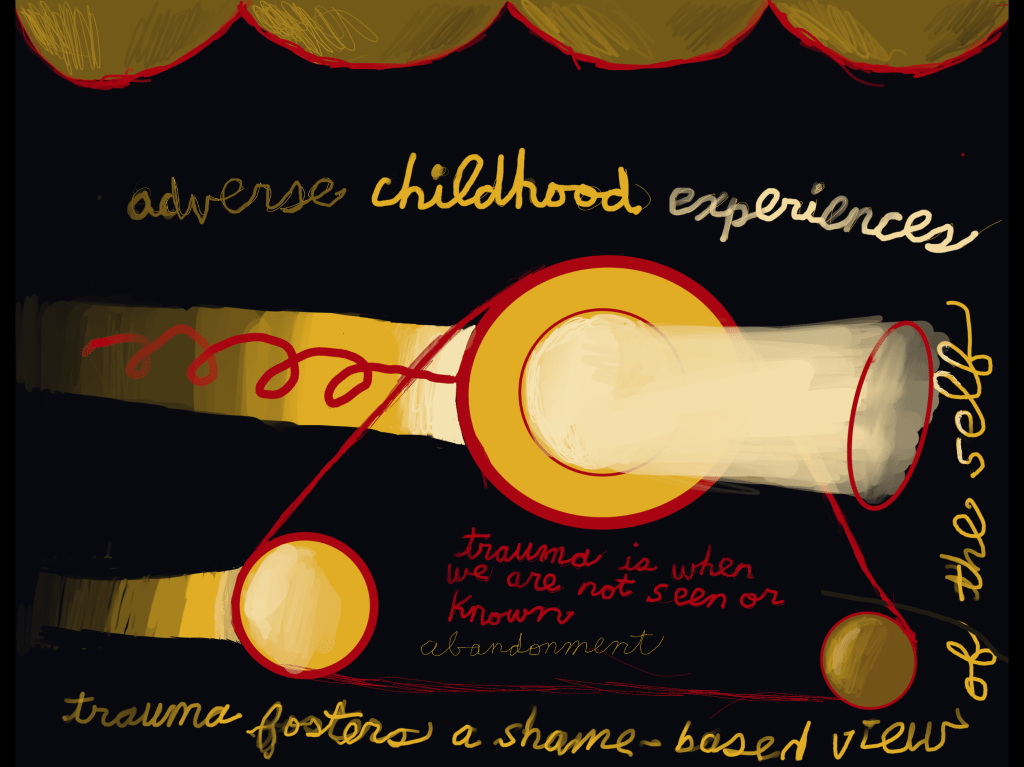
digital painting No. 10
There are some people, you’ll discover, if you ever have a conflict with them, who are incapable of ever being wrong. These can be close and loving friends, it turns out, and everything will be fine as long as you are always conciliatory and never make a fuss about the occasional mistreatment you may experience. Their tragic, aggravating flaw is that they cannot compromise because such weakness is intolerable to them.
When real conflict arises, and you don’t pretend not to be irritated, you will suddenly see that you are up against a monster, because to them the stakes are not the human ones of sometimes feeling bad about being wrong, but utter humiliation for them. They simply cannot tolerate being wrong and they will kill you, if necessary, to prove that they are the most loving and perfect people ever created.
It’s tempting to call these kind of people psychos but I prefer to think of them as extremely damaged. The problem comes when these damaged people become destructive, as they always do when they feel threatened. They are hypervigilant about threats.
They act with no regard for the brutal harm they inflict because they are always justified in their rage. Their only interest is in being above reproach, being right, being superior. They cannot control their fury to “win” and will do whatever it takes to prove themselves perfect and beyond reproach. They are some of the most dangerous motherfuckers in the world. They tend to write, and rewrite, history.
My two closest friends, for literally decades, turned out to be people who cannot be wrong, people who, if they are wrong, will prove themselves right by any means necessary. After a nightmarishly tense long weekend in a rented vacation house they barely made eye contact as we said goodbye. The anger I had witnessed between them in that house required the end of our relationship and my removal from our circle of friends. They made it very clear to me that unless I admitted that I was the cause of all anger and bad feeling in that house, we were not going to be friends.
Somebody else would have told them to go fuck themselves, and would not have been wrong to do so, but, out of love for them, and valuing our long friendship, I spent over a year trying to make peace with them. It was possibly the most difficult year of my life. I did learn a few important, painful things. One is that you can’t make peace with people who can never be wrong.
Long periods of angry silence did not cure me of the need to talk about the hurtful events of that vacation from hell. Threats to walk away from our friendship, for the unforgivable things I had done (unspecified) did not deter me. I sent letters they claimed never to have received. They got angry whenever I tried to talk about healing our friendship. They began lying.
After a joyous wedding we attended with a group of longtime friends I got a text saying we could only talk to each other in front of a mediator. When I suggested a meeting to agree on facts to present to the mediator they agreed. Covid was still raging so we sat outside to talk, as the temperature dropped. It was literally cold as hell as they squared off with me. They both were angry during the conversation, resisting everything I said. There was no fact they’d agree to, facts would be left up to the mediator.
This type sees people like mediators as tools to prove themselves right. Why not let the professional decide who is right and who is wrong, that’s what mediators do — according to people who cannot be wrong.
If two parties go to a mediator with no agreement about the nature of the conflict, or what their respective interests and positions are, the mediator cannot possibly help mediate any kind of compromise. That’s not the point for people who can never be wrong.
These two would present reasonable, successful, normal faces to the mediator, complain that I, an unreasonable, unsuccessful, abnormal and tormented person simply refused to accept responsibility for being an asshole, and that they greatly loved me in spite of that. The mediator might be convinced. Then, in their mind, I’d finally have to shut the fuck up. Set and match.
When it became clear they would fight every attempt to heal, except for their fail safe mediator ploy, I told them it was useless to go to a mediator. A month of silence followed.
During that month they got busy, working on all of our mutual friends. The story all of our mutual friends heard was that Eliot sadistically tortured them for over a year trying to bend them to his will. Not only that, his rage was unappeasable. He refused their desperate last ditch attempt to heal with a professional mediator. They had apologized to him over and over and over but it was never enough. So Eliot was also unforgiving, inhumanly so. Eliot was so enraged at them, because of his childish childhood pain, that he simply could not recognize how much they loved him, how hard they were trying to convince him of their love. Eliot had made it literally impossible for them to live. Eliot had killed them, Eliot was a murderer and a lawyer specializing in denial, distorting the plain facts to make other people look like liars. Eliot had laughed as he slashed them to death, laughed and joked as he was slaughtering them. You think Eliot is an easygoing, philosophical guy with a quick wit, but that’s his mask. Eliot is a cruel, vicious, venomous monster. Once you are determined to “win” at all costs, trifles like truth and lies be damned.
I’d like to say that these long-time mutual friends all called me and asked me what the hell was going on. None did.
In fact, they all told me that I had nothing to say, that they were not prepared to listen to my longwinded protests about what I claimed actually happened. They spoke in one voice: unless I was ready to do the hard work to heal from my irrational childhood pain, and honestly forgive people who loved me dearly, I was as good as dead to the rest of them.
And so it was, and so I am.
One could say I’m better off, not having these brittle friendships in my life anymore. I’m not so sure. We shared a lot of love and many laughs for 50 years, and none of us is perfect (outside of the two assholes who smeared my good name).
But if you can’t be wrong, and you’ve lived your life acquiring the power and the manipulative skills to do so, you will kill anybody who threatens the image of you as a perfect being. Such is the treacherous world we make our way through on our journey toward death.
One hallmark of a depressive episode is how impossible it is to understand that depression always passes. This is impossible to imagine when you are depressed. Depression removes all hope, closes off all creativity, every possibility for overcoming it. Depression is rage turned inward, against the self.
I speak from experience. I was in the dark pit of what felt like a major and endless depression around the time I turned thirty. I could see no possibility for moving forward. I spent months in therapy, walking, avoiding people and falling asleep on a friend’s couch when I went to visit him after therapy.
Depression removes all options for action, preemptively torepedoing any thought that might lead you away from self-torment.
Though it feels impossible, reach out to people who can listen to you and help. Your support group is very concerned but not often up to the task of offering you perspective or relief from the burden of other people’s harsh judgments that have led you to the dark abyss you find yourself at the bottom of. You lose all sense of your own value, and decency, all sensitivity turned against yourself for disappointing those who love you.
Though it feels impossible, and I understand why, reach out to people who have made you feel loved. They are the only ones who can help you up and out.
And know this. While it sounds impossible, this depressive episode will pass, depression always does. You could look it up.
As Yuval Noah Harari sets out in his epic Sapiens, a book rightfully loved by then President Barack Obama (my cousin, who read it in the original Hebrew, compared it to an excellent graduate course), human beings are unique among all the animals with our talent for organizing vast armies that march faithfully under banners of abstract, arbitrary beliefs. It is the human ability to adopt unshakable belief in powerful abstractions that has allowed all human triumph and thousands of years of human history written in the blood of every other creature, as well as the blood of Mother Earth herself.
No reason to get excited, faith is the cure for all pain. It is true belief that gives meaning to a terrifying and otherwise meaningless existence. Belief that love is returned, and earned, believe in community, in an all-powerful, all-merciful creator who bestows all gifts on each of us. The faith to love purely, intertwined with the faith to kill, righteously. You can look at human history, and the history of ideas, and see much nobility and many great ideas. But you will also see much mass madness and many horrific ideas embraced by entire societies.
What is it with these puny earthling motherfuckers, made in the image of gods who also don’t hesitate to allow unimaginable suffering to countless innocent children, doomed to their short, desperate lives? You’d have to ask your mullah, priest, minister, preacher, teacher, guru, Pope or rabbi, I suppose.
Nobody can teach you something they have no ability to do and no understanding of. Our first teachers, from before we can do anything but imbibe lessons we don’t understand, are our parents. If our parents don’t know how to compromise, how to resolve conflict, how not to become frustrated and enraged at others, how to forgive — we have a hard time unlearning whatever they demonstrated for us everyday so we can learn those crucial skills.
Rage is hard, fear of shame is devastating, the need to be right, no matter what, is crippling. The best some people can do, with every intention of being loving and teaching those they love by their example, is not very good. It is very bad. They will teach their children to take the blame for their parents’ shortcomings. The child grows to be an adult with deep cognitive dissonance. On the one hand, their parents are great people. On the other hand, they find themselves always in pain, especially around their parents, who love them, but are exhausting to be around.
My father lamented just before he died that in a challenging world with so many obstacles in everyone’s path that he placed additional obstacles in the path of his son and daughter, the two people, beside his wife, who he loved the most in the world. I’d have followed up on it, but he was dead.
If you work hard and have some luck, you can figure out how to become the parent to yourself that your disabled parents weren’t capable of being. Clearly, if we got to choose, it is much better never to have had this kind of asshole parenting. Parenting is in large part based on authority, but when the respect isn’t mutual, you wind up having to accommodate yourself to tyranny that may cause your brain to explode, unless you can come to see it for what it actually is. As Robin Williams’s character, the shrink in Goodwill Hunting, told Matt Damon’s, his super vulnerable tough guy patient, “it’s not your fault.”
It’s not your fault.
Imagine a vexing event from your own life, a time someone treated you badly. Take all the names out and present it to an imagined jury of twelve reasonable citizens, like so:
An overbearing, tyrannical father talking to his college grad son who has moved back home while looking for a job, tells the young man that he knows of a good contact to get into his field, television, writing and media. Then he tells his son that he’s not going to set up a meeting with this excellent lead because “what would that teach you about life?”
In hindsight the adult son knows his father probably knew no such person. Falsely claiming to know him, to be able to help, gave him the power to fuck the son he hated almost as much as he hated himself. So, armed with this knowledge, and a time machine, the son goes back to the original moment of abuse with the father.
“OK, dad, I get what you’re saying. Give me the guy’s name and I’ll do the legwork to get an appointment with him.”
“How would that teach you about pulling yourself up by your own initiative, will and strength of character?”
“By teaching me to help others, when it is within my power, instead of hindering them. Please just give me the guy’s contact info and I’ll take it from there.”
After more tap dancing from his grandiose father, madly insisting that by providing a phantom lead and then hindering him in his moment of need that he is actually building his character, the son comes to the point.
“If you actually know this guy, let me call his office. If you’re lying, what is your fucking problem, father?”
Questions for the Jury:
If the father doubles down with the whole “I’m doing this abusive thing for your own good, son, and I’m right and you’re wrong, no matter what” bullshit, is the son within his rights to get angry?
If so, and the father escalates to yelling, is there a point where the son might be justified in grabbing his father by the front of shirt?
A point where a slap might be in order, with a stern instruction to stop talking?
Is there any point to any of it? Should the son just tell the father to have a nice day and get as far from him as he can?
BUT, he is unemployed and broke. He is living in the abusive father’s house.
Discuss equitable remedies, in light of the requirements of justice.
There is no greater love, believes the group, than undeviating antipathy toward a hated betrayer of the group. This principle seems to operate everywhere, throughout history. If you can show someone is disloyal, a traitor, has betrayed a loving group, well, whatever is coming to such a person is well deserved, in the eyes of the loyal, loving group.
We see it daily with MAGA. We see it with groups like the Klan, Nazis, all those fine people, in every insular group. We see it on the left and on the right, though it is most conspicuous lately on the right. There is nothing a beloved member of the far right can do that will cause other members to condemn the behavior. Loyalty über alles. On the other hand, criticize the beloved member and you will be promptly vilified and tossed out of the group. MAGA has a great term for traitors like Bill Barr, lately come to a realistic assessment of his former master: RINO. Republican in name only, like Liz Cheney and her filthy ilk.
Having experienced this ostracism recently in my personal life – a minor conflict with two people who can never be wrong, a series of threats and long periods of silence, lies about my behavior, unanimous judgment by old friends insisting they love me but won’t talk about what they already know I did and am now lying about — I understand that the evil involved in this human reflex is almost incidental. Going along with the group is as natural as taking the underdog’s side in a fight.
At the same time, the person who tells the initial lies, no matter how desperate they feel when they assassinate the good name of an old friend, has no right to do that. The group, if they take her side, is acknowledging that truth and falsehood are trifles when it comes to the seriously hurt feelings of an overwhelmed, beloved member of the group. You could also call those reputation killing lies evil, I would, but, fuck, I’m judgmental enough without bringing good and evil into it. Ask any of my former close friends.
If your parent, whenever you were upset and needed comfort, told you that you were weak, cowardly, needy — well, that is a gift that keeps on giving. If they alternated between merciless blaming and name calling and silence, well, silence by way of response will take on a magically painful quality for the rest of your days.
It’s very easy while waiting for a reply, if you’ve been subjected to cruel, strategic silence, to imagine, just because somebody is being silent (they could, of course, be busy, preoccupied, forgetful, distracted, ill, in a crisis, taking care of someone else), that they are silently seething at you. You can picture them glaring, arms folded, in a hostile posture of complete opposition and denial. Whatever you say their answer is ready – a silent glare of negation and blame.
Silence, to which you have been morbidly sensitized from before you can do anything to defend yourself against it, will be your kryptonite. Loved ones who know this about you, when smarting over their own issues, may deploy it from time to time, as blamelessly as the parent who simply kept quiet when you most needed a few sympathetic words.
The emotional mind is literally like a bucking bronco sometimes. When it starts to kick all you can do is take a few deep breaths and use your rational mind to try to rein it in. “This steep path is very rocky, “ you might say calmly to your bucking bronco mind, trying to recall it to reason. “There’s a long drop down the side, maybe a thousand feet… OK, OK … there you go… there you go, good mind, good mind!”
Imagine you had a relatively minor conflict with two of your oldest friends. Afterwards, as they withdrew from you, you remained patient, reassuring when they threatened you, or told you they were unsure that they could ever forgive you, or were angry at you. Imagine you extended friendship to them, no matter how wildly they attacked you.
Now imagine that after a year of this they told all of your friends in common, and everyone in their family, that you were implacably enraged, unforgiving, bent on being right at all costs, sadistic, harshly judgmental and totally unloving.
Then imagine that all of your friends embraced this series of lies, this character assassination. The only problem, everybody agrees, is your immature paralysis, the result of a painful childhood that left you incapable of dealing with your rage.
Now the thought experiment is not imagining how to get through or make peace with these people who, there’s a very strong case, were never really very good friends in the first place, but how do you move on with your fucking life?
$64,000 question, doc.
 gratuitousblahg