
A relic found while cleaning the other day

“Wokeness” is a baby’s insult, like cooties, for use by adult-aged childish people who prefer a sophisticated sounding synonym for “poopy head” to use against those they hate for making them feel insecure, bigoted, stupid and inferior. Nice to see they’re giving the merch away for free, if you can believe any come-on by the cynical hucksters who ruthlessly exploit their innocently faithful believers.
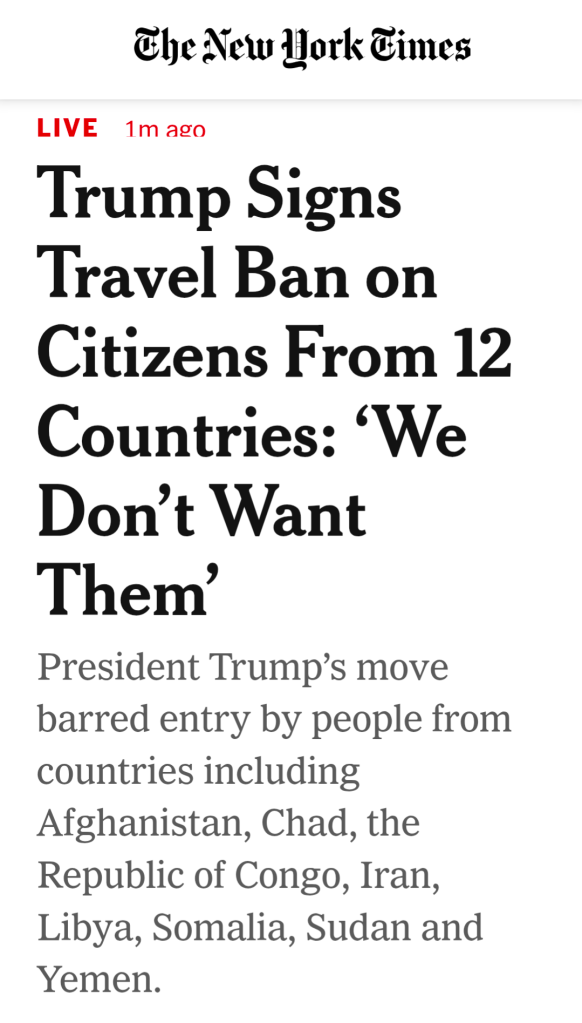
Shithole countries, need I say more? I mean, you know what color all of these people are, don’t you?
Just because then-senator Marco Rubio’s committee concluded that Putin had indeed done everything possible to tip the election to Trump in 2016, after Robert Mueller documented 140 incidents of coordination between Trump’s campaign and Putin’s administration in the lead up to the election, there is no reason, except for the facts themselves, to believe that the whole “Russia thing” was anything more than a vicious hoax perpetuated by insane enemies afflicted with Trump Derangement Syndrome.
Look, Putin and Trump are just friends, very good friends. They speak on the phone every so often, as they did during Trump’s four years as an “ordinary citizen” and it’s nobody’s business what they talk about. Trump may or may not have shared top secret defense documents he illegally took when he left the White House, then had his lawyers lie about having returned, as he held off Merrick Garland and his team until his handpicked MAGA judge could dismiss the Espionage Act case with an audaciously novel repudiation of the Special Counsel statute. Putin may well have sent his protege a handsome gratuity for strategic information supplied by his useful idiot friend, also nobody’s business. Now Donald is back to work, securing a future safe for plutocrats, autocrats and kleptocrats. It’s the persecuted billionaires against the rest of us, and Trump is determined to make his side immune from law and all other consequences.
Here’s Heather Cox Richardson with some recent history as background for the latest tour de force of brazen Trumpian Trumpishness:
The struggle for Ukraine to maintain its sovereignty, independence, and territory has become a fight for the principles established by the United Nations, organized in the wake of World War II by the allied countries in that war, to establish international rules that would, as the U.N. charter said, prevent “the scourge of war, which twice in our lifetime has brought untold sorrow to mankind, and to reaffirm faith in fundamental human rights.” Central to those principles and rules was that members would not attack the “territorial integrity or political independence” of any other country. In 1949 the North Atlantic Treaty Organization (NATO) came together to hold back growing Soviet aggression under a pact that an attack on any of the member states would be considered an attack on all.
The principle of national sovereignty is being tested in Ukraine. After the breakup of the Soviet Union in 1991, Ukraine held about a third of the USSR’s nuclear weapons but gave them up in exchange for payments and security assurances from Russia, the United States, and the United Kingdom that they would respect Ukraine’s sovereignty within its existing borders. But Ukraine sits between Russia and Europe, and as Ukraine increasingly showed an inclination to turn toward Europe rather than Russia, Russian leader Putin worked to put his own puppets at the head of the Ukrainian government with the expectation that they would keep Ukraine, with its vast resources, tethered to Russia.
In 2004 it appeared that Russian-backed politician Viktor Yanukovych had won the presidency of Ukraine, but the election was so full of fraud, including the poisoning of a key rival who wanted to break ties with Russia and align Ukraine with Europe, that the U.S. government and other international observers did not recognize the election results. The Ukrainian government voided the election and called for a do-over.
To rehabilitate his image, Yanukovych turned to American political consultant Paul Manafort, who was already working for Russian billionaire Oleg Deripaska. With Manafort’s help, Yanukovych won the presidency in 2010 and began to turn Ukraine toward Russia. When Yanukovych suddenly reversed Ukraine’s course toward cooperation with the European Union and instead took a $3 billion loan from Russia, Ukrainian students protested. On February 18, 2014, after months of popular protests, Ukrainians ousted Yanukovych from power in the Maidan Revolution, also known as the Revolution of Dignity, and he fled to Russia.
Shortly after Yanukovych’s ouster, Russia invaded Ukraine’s Crimea and annexed it. The invasion prompted the United States and the European Union to impose economic sanctions on Russia and on specific Russian businesses and oligarchs, prohibiting them from doing business in U.S. territories. E.U. sanctions froze assets, banned goods from Crimea, and banned travel of certain Russians to Europe.
Yanukovych’s fall had left Manafort both without a patron and with about $17 million worth of debt to Deripaska. Back in the U.S., in 2016, television personality Donald Trump was running for the presidency, but his campaign was foundering. Manafort stepped in to help. He didn’t take a salary but reached out to Deripaska through one of his Ukrainian business partners, Konstantin Kilimnik, immediately after landing the job, asking him, “How do we use to get whole? Has OVD [Oleg Vladimirovich Deripaska] operation seen?”
Journalist Jim Rutenberg established that in 2016, Russian operatives presented Manafort a plan “for the creation of an autonomous republic in Ukraine’s east, giving Putin effective control of the country’s industrial heartland.” In exchange for weakening NATO and U.S. support for Ukraine, looking the other way as Russia took eastern Ukraine, and removing U.S. sanctions from Russian entities, Russian operatives were willing to help Trump win the White House. The Republican-dominated Senate Intelligence Committee in 2020 established that Manafort’s Ukrainian business partner Kilimnik, whom it described as a “Russian intelligence officer,” acted as a liaison between Manafort and Deripaska while Manafort ran Trump’s campaign.
Government officials knew that something was happening between the Trump campaign and Russia. By the end of July 2016, FBI director James Comey opened a counterintelligence investigation into Russian interference in the 2016 election. After Trump won, the FBI caught Trump national security advisor Lieutenant General Michael Flynn assuring Russian ambassador Sergey Kislyak that the new administration would change U.S. policy toward Russia. Shortly after Trump took office, Flynn had to resign, and Trump asked Comey to drop the investigation into Flynn. When Comey refused, Trump fired him. The next day, he told a Russian delegation he was hosting in the Oval Office: “I just fired the head of the F.B.I. He was crazy, a real nut job…. I faced great pressure because of Russia. That’s taken off.”
Or, as Putin’s BFF pronounced recently, with characteristic humility, truthfulness and presidential gravitas:
“I think I have the power to end this war, and I think it’s going very well. But today I heard, ‘Oh, well, we [Ukraine] weren’t invited.’ Well, you’ve been there for three years,” Trump told reporters at his Mar-a-Lago resort. “You should have never started it. You could have made a deal.”
The president-elect meeting with his nominee for Director of National Intelligence, one of the country’s main contacts with Vladimir Putin, a cunning, mega-wealthy war criminal currently playing the next president like a vintage accordion.

undecided, voter?

Using lies to turn love to hate, friendship to enmity, a willingness to help into a desire to hurt.
If you know a better definition of evil, let me know.

Just because it’s a complete lie and could easily lead a maniac to commit a despicable act against a sitting federal officer, that doesn’t mean that it’s not completely protected by a political candidate’s absolute right to absolute freedom of speech, no matter what!

Fuck that fucking orange puto. Lock him up.

 gratuitousblahg