low carb vegan nachos

Heat a little avocado oil in a skillet. Cover half of the bottom with cumin seeds, half with fennel seeds. Stir. Add 2 to 5 large cloves of garlic and a thick 3 inch chunk of ginger, minced, and a chopped red pepper, stir until lightly sauteed.

Add one can each of red and black beans (drained and rinsed), sprinkle liberally with ground cumin, stir. Add a large can of crushed tomatoes, stir. Add small amount of water to tomato can, swish it around to get remaining sauce, add to mixture.

Continue cooking on medium low flame stirring frequently for maybe 40 minutes, adding small amounts of water as needed to keep it simmering. Cook until done to taste. Add a chopped jalapeño (seeds removed) at the end, stir.

Sprinkle top with vegan cheese, a yellow and white mix, cover and heat until cheese melts.

Serve over a bed of salad containing chopped scallions, thin sliced jalapeños (watch them seeds), carrots, red cabbage, red peppers, shredded romaine lettuce. Top with cubed avocado. Enjoy.

Fair vs. Corrupt

Every child believes deeply in fairness, until the world teaches it otherwise, the kid begins picking a side in every fight and fairness becomes secondary to her team prevailing. Unfairness is universally painful, being treated unfairly hurts everybody it happens to. We all like to think we’re fair, it is a synonym for reasonable, but the fact is that adults can be fair or unfair, recognize the importance of rules to ensure fairness or defy any norm that allows any outcome they don’t want.

A reasonable person listens to a story with an open mind (to the extent possible) and assesses it as likely or unlikely based on experience and knowledge. The purely transactional listener evaluates a story based solely on how well it advances the interests he wants to advance. The mercenary listener is looking for an angle, a simple transaction, not complicated by the merits of the case, the evidence presented or that abstract quality of fairness, only how it increases advantage and enhances the desired bottom line. You have either a fairness based vision of justice, or a might makes right mentality.

You treat everyone as equal under the law or, under might makes right, you treat your friends as above the law, exempt from all legal coercion, and demand that anyone who opposes your desires be subject to the harshest of laws available (and not ruling out extra-judicial forms of discipline, which are always on the table). While you are in charge your friends and supporters don’t have to worry about any law that will stop them from acting on their strong feelings. As long as they are vocally loyal to you, you will protect them, until it is transactionally advantageous to cut them off. Because what the fuck is Fair anyway?

You can weigh the arguments on the actual facts of the case or you can weigh the arguments and frame them cleverly, to reach the desired outcome. The second way is the way of the zealot, the partisan, the political activist, the way of the Federalist Society.

The stench coming off the McConnell/Trump Supreme Court today is a reminder of how crucial nonpartisan elections are for democracy. How it is crucial to elect a few more Democratic senators, to prevent two from vetoing filibuster reform to get election and voting rights laws passed.

Norms, it turns out, don’t restrain zealots and extremists who believe only in power, and in using power to retain power (the updated definition of “conservative”). Laws can ensure a certain measure of justice, but only if they are always enforced. Selective enforcement, and the outcomes of court challenges often hinging on which party has more money to spend on an army of top lawyers, ensures rule by the most corrupt. Which, as any eight year-old will tell you, is completely unfair.

Neoliberalism 101 (redux)

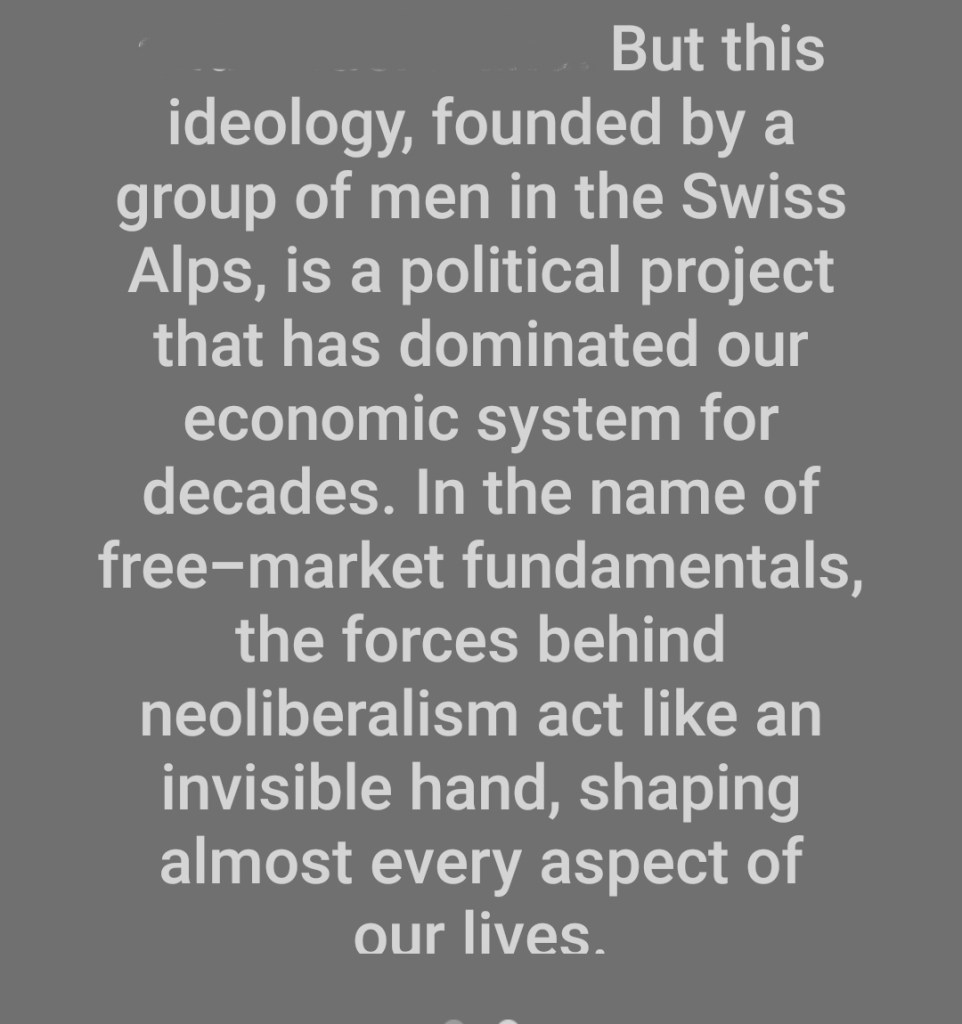
Here is a great primer on the once fringe economic and political theory called neoliberalism. It is a wild variation on the old laissez-faire philosophy of capitalism, based on the well-worn theory that the Invisible Hand of the Free Market is wiser, more fair and infinitely more flexible than any government regulation could ever be. Neoliberalism has done as much as any political force to bring the world to the brink of global authoritarianism. This podcast does a great job laying neoliberalism out clearly.

Throughline: Capitalism: What Makes Us Free? (2021) https://play.podtrac.com/npr-510333/edge1.pod.npr.org/anon.npr-mp3/npr/throughline/2022/04/20220407_throughline_neoliberalism_with_ads_kd_040722.mp3?awCollectionId=510333&awEpisodeId=1091050251&orgId=1&topicId=1136&d=3038&p=510333&story=1091050251&t=podcast&e=1091050251&size=48612502&ft=pod&f=510333

The personal roots of “political” rage

When you feel helpless, are in need of the consoling connection to others that all living creatures require, a common response to this desperation is anger.  You derive energy and a feeling of righteousness from galvanizing your hurt into rage.  You can also turn anger on yourself, blaming yourself for feeling helpless, hopeless, weak, abandoned and so forth, but this self-directed rage inflicts even more damage than what has already been done to you.   Turning the anger outward requires only a good story, a good enough story (it can actually be a completely incoherent story), to let you know who is to blame for the pain you are in.   Once you can ascribe blame you’re on your way.

Today’s radical right wing has become expert in keeping the rage turned up all the time.   You feel fucked?   We’ll tell you why — it’s that senile puppet Joe Biden’s fucking fault, like it was Obama’s before him, and fucking Clinton’s before that.   The only time you were watched over tenderly in recent memory, these extremists preach, was under Donald Trump and Dick Cheney.   Radical antidemocratic oligarchs like Charles Koch have no hesitation to use any tactic that works to convince millions that large societal problems aren’t being solved, not because of the zero sum divisive political warfare he has been relentlessly waging for decades, and the lawmaking gridlock their obstructionist tactics have caused, no! — it’s the fault of the fucking communists who have taken over one of the major political parties in the country!   

I suspect that every person susceptible to this “argument” — that everything was, more or less, perfect until these “woke” libtard cucks took over the party of our enemies and are constantly acting like “snowflake” victims, cynically exploiting “identity politics,” to win rigged elections that always favor majoritarian tyranny — has personal reason to be angry.  Focusing the free floating personal anger and anxiety on enemies, who can be blamed, hated and, in a perfect world, publicly executed, is the genius of the radical right, has been all throughout history.  It exploits the feeling of justice we have every time we put a bully on his ass.

On a personal level we can often see the roots of rage quite clearly.   An abusive parent, insisting they never abused anyone.  A rape that nobody in the legal system, unfortunately, is going to be able to do anything about.  That one day hesitation to report the crime proved fatal to the legal case against the rapist fuck.   Indigestible things happen to us sometimes, and those things are food for anger, which, like water, can take on any shape, fit any container perfectly, and is always flowing.   The ratings king of rage, the guy with the puckered brow who just keeps asking innocently leading questions of his gigantic audience, Tucker Carlson, has only recently revealed the partial roots of his always boiling, though jovially presented, “just asking” anger.

For many years, Tucker Carlson was tight-lipped about the rupture [with his mother]. In a New Yorker profile in 2017, not long after his show debuted, he described his mother’s departure as a “totally bizarre situation — which I never talk about, because it was actually not really part of my life at all.” But as controversy and criticism engulfed his show, Mr. Carlson began to describe his early life in darker tones, painting the California of his youth as a countercultural dystopia and his mother as abusive and erratic.

In 2019, speaking on a podcast with the right-leaning comedian Adam Carolla, Mr. Carlson said his mother had forced drugs on her children. “She was like, doing real drugs around us when we were little, and getting us to do it, and just like being a nut case,” Mr. Carlson said. By his account, his mother made clear to her two young sons that she had little affection for them. “When you realize your own mother doesn’t like you, when she says that, it’s like, oh gosh,” he told Mr. Carolla, adding that he “felt all kinds of rage about it.”

All kinds of rage, you know.  Many different forms of rage.  Rage rages, it’s all it can do.  It may rage quietly or loudly, but everything it does is in the service of keeping the righteous feeling of being totally fucking right pumping away.   And, as everybody knows, there are few feelings to equal the satisfaction of knowing that you are totally fucking right and justified, in anything you do to bring justice to the vicious fucks you blame for hurting you.

Homerun by Heather

Out of hope, democracy fan? Are you buying the doom for electoral democracy pushed by all mass media? Not so fast, here’s historian Heather Cox Richardson, describing democracy’s response to a past moment of oppressive American oligarchy during a previous gilded age, hitting another one into the bleachers. As she often does.

https://heathercoxrichardson.substack.com/p/april-30-2022?r=74gv9&s=r&utm_campaign=post&utm_medium=email

Dred Scott, y’all, the law of the land, 1857 style

Chief Justice Roger Taney bluntly and maliciously described their status in the 1857 Dred Scott decision:

“[Black people] had for more than a century before been regarded as beings of an inferior order, and altogether unfit to associate with the white race, either in social or political relations; and so far inferior, that they had no rights which the white man was bound to respect; and that the negro might justly and lawfully be reduced to slavery for his benefit. He was bought and sold, and treated as an ordinary article of merchandise and traffic, whenever a profit could be made by it.”

A Prayer

I am not a person who prays, though I have sometimes prayed to be able to pray.  Not really.   I suppose, on the good side, prayer is a kind of meditation, an act of surrender to a higher power, a display of humility and faith, to recite your deepest wishes and needs out loud to a deity that may or may not be listening.  Perhaps prayer is also an act of arrogance, to suppose your humble personal request to God, one of a billion the deity gets every minute, will be heard and acted upon by the Creator of the Universe.  I guess prayer is primarily an act of participation in a community, everyone in the hall reciting prayers in unison, rising, being seated, kneeling, bowing as one.  Whatever prayer is, I am not drawn to it.   If I did pray, my bedtime prayer last night might have gone like this:

O, Eternally busy one, please hear my humble prayer.   Grant me the serenity not to wake up with acid in my stomach thinking about harms done to me in the past by people I love and trusted.  Give me the strength to bear these inadvertent injuries in the spirit they were given, that is, without a second thought.  Grant me the ability never to think of these as burdens I must carry, let alone need to talk to anyone about.  Others hurt by the same things that lodge painfully in my own spirit, spare them these acidic ruminations too.  Let them dwell not on unfairness, thoughtlessness, unreasonable demands to get over hurtful things that can never be openly discussed.  Let them see there is nothing to be gained by imagining peaceful resolutions are possible in all interpersonal conflicts.

Also, Unfailingly Merciful One, let not today’s angry mobs continue to be directed by the inhuman forces of deadly fascist/religious nationalism.  These forces relentlessly inflame the passions of the aggrieved people they exploit and gain their violent allegiance — for their own mad ends. You know what happens every time You turn Your All-merciful Face away during such epochs.  Just sayin’, God.     

Amen. 

My strange belief in the power of understanding

I say strange belief because the world often appears to defy understanding. Look around, and tell me an understanding can be reached between people who hate each other. I believe it is possible for two enemies to become friends, once they learn how much they have in common, how many fundamental beliefs they actually share. It is rare, sure, but it has been known to happen.

The mother of a boy randomly killed by a new gang member tells the kid when he’s convicted that she will kill him. She visits him in prison, sends him books and money. When he’s released she lets him live in her murdered son’s room, which he does gratefully as he finishes his education. They become as close as mother and son. The young man asks one day if she still believes what she said at the end of his trail, that she’d see him dead. She tells him she does, and that his current life proves she did kill that monster he was becoming. He understands the truth of that. A beautiful true story I heard the woman herself narrate years ago on a program about the power of forgiveness. Rare, and wonderful, and also, proof that things that seem impossible can be done, if the heart is right and the actions taken are intelligent and consistent.

I enjoy talking with people, particularly when the conversation goes beyond normal pleasantries and daily observations and takes unexpected turns into new terrain and unknown commonalities are revealed.  There are difficult things we learn sometimes, important life lessons, and I particularly love those rare occasions where conversation takes this deeper turn and we compare the personal details of hard lessons we’ve learned about a particular vexation. 

In my home growing up, though the four of us were all reasonably good at talking, and liked to chat, our conversations often turned into angry arguments.   In that previous sentence we see, I suppose, the roots of my strange belief in the power of listening, speaking clearly, acknowledging — my belief in the importance of understanding.

You can argue adamantly, to prove you’re right, dominating the person you’re arguing with, yielding nothing, ever, or you can argue without stubbornness, open to another perspective and trying to illuminate a misunderstanding or unintended cruelty.  Dispassion is a word Buddhists and others use to describe thinking and communicating that is not the slave of passion, not in service to strong feelings that impede our ability to reason, to weigh things fairly, under a warm light.  If you speak and listen dispassionately you hear better and your responses are not as likely to add fuel to anger.  Dispassion is sometimes derided as unemotional, robotic, inhuman, but the real essence of it, I think, is keeping your thoughts slightly apart from your feelings, particularly strong feelings that will often stir you to assemble the troops to counterattack, and bearing in mind the larger, more humane purpose of the conversation.

In the grips of strong emotion we are often not at our best, emotionally, intellectually or morally.   In the last five years of my mother’s life, on the rare occasions I said something that made her explode in anger,  I became adept at quickly changing the subject to something pleasant.   It worked very well, she’d immediately release her mask of aggression and smile with great relief.  I came to see that the thing she was angry about was something I could immediately stop pressing and the thing I distracted her with showed that I understood her pain and we were now talking about something she liked instead.   I recognized that there were some things, like her painful relationship with her daughter and grandchildren, that she needed to vent about, and get my sympathy for.  She was unable to imagine anything better between them and her hurt and anger got inflamed whenever ideas about how to improve the hopeless situation were suggested by her know-it-all son.   Finally recognizing this inability of hers, an inability she shared with her daughter, sad to say (and which doomed every suggestion I might make),  I would desist in my doomed peacemaking efforts at the first sign of anger.

My father and I had a lifelong debate on whether people can change their fundamental natures.  There are good points on either side of the issue, but I was locked into proving that my belief that we can change much of what is painful to us was reasonable and based on evidence, and he was determined to prove that the idea that we have this kind of autonomy and power to change is a cruel illusion that does more harm than good.  I can see truths on both sides of the debate as I type these words.   Because of the acrimony between my father and me it was never possible to persuade my father of how much we can change our reactions to things that bother us or to move him off his fixed belief about the inevitability of pain, frustration and anger.   

“You admit you’re only changing your reaction, the superficial part, and that doesn’t touch the inborn, fundamental nature at all,” my father would say. “If you are born with a prickly disposition, no amount of navel gazing is going to make you able to resist provocation when it arises, provocation that would not even bother some one with an innately placid nature .   You might get a tiny bit better at not immediately snarling, but you are only changing your surface reactions, not your genetically programmed reflex. The fundamental things about ourselves are immutable and it’s pathetic to believe in something impossible.” 

“But changing your reaction, say not responding with reflexive anger, makes it possible to have a reasonable conversation with others, and that’s not a small thing,” I’d say.  In the end I pointed out that he himself had changed his angry reactions toward me, and that our relationship was better for it.  This proved a bad example to hand to a wartime prosecutor like my father, though he had, in fact, greatly moderated his angry reactions to me in recent years, after a difficult conversation I’d initiated with him one Yom Kippur.

“I only changed my superficial reactions,” he told me, “nothing fundamental changed in me.  I became a better actor, is all.  If I ever honestly told you what I really think of you it would do such irreparable harm to our relationship that we’d never be able to talk again.”   

He rested his decades-long case by saying the one thing that proved he was determined to be right, more than anything else in the world, and this neither he, nor I, nor any power in the universe could change — and here was the final proof.  All this talk of emotional plasticity and the value of a skilled therapist, of introspection, self-criticism and self-acceptance, so much bullshit for contempibly weak people to believe.  As for him, he was man enough to admit the difficult truth about humans — however we are, emotionally, at two years old, is how we are for the rest of our lives.

Therefore, following the logic, we cannot learn anything important, not really.  Superficial things, OK, we all learn to use toilet bowls, and language, academic subjects, but we can never learn how to hurt ourselves and others less.  Some people are born decent, reasonably happy, they get along in the world without friction or conflict.  Others are born riled up, unhappy, critical, ready to rumble, and these angry little ass kickers, who can never be wrong, are doomed to live in a world of hurt.

His tune changed on his deathbed, as apparently not infrequently happens.  Part of it, I believe, was seeing his lifelong adversary quiet, thoughtful and willing to do whatever he could to make his father’s death easier.  He lamented that he’d been unable to consider so many things, had been so limited in what he could imagine, had been so adamant, seen the world as so black and white.   He had painful regrets that he expressed for the first time, and I did my best to reassure him about each one that he’d done the best he could.

Now, it’s important to note how many times I have infuriated people close to me in recent years by my determination to remain peaceful and mild-mannered in the face of escalating bad feelings.   In the end the ugliness where there was once friendship and laughter, the absence where mutual good will used to be, becomes impossible to ignore. In their defense, there is nothing more maddening when you are angry than some fucking prig on the high road, managing to keep the anger off his tongue.

Expressing anger dramatically is a deadly game I’ve played countless times over the years, so, in the end, after enough angry invitations to tell a friend to go fuck himself, I yield to the surge of righteousness I’ve been trying not to express as contempt and tell the person, in detail, all of the irredeemable things about them I can no longer tolerate.   Friendship does not recover from this, because at the point where everything about another person is reduced to their worst and most shameful weaknesses, well, that’s irreparable harm.

So maybe my pre-deathbed father was right all along.  If you are locked in a battle with an adamant rival, intent on winning at all costs, you will, in the end, revert to however you were born to be.   The angry will rage, the placid will cry. You can pursue dispassion, believe in the power of conversation to illuminate difficulties, remove hostility, the plasticity of the human soul, forgiveness and all the rest, but in the end, when a line is crossed that is impossible to get back to the other side of, you are only prolonging the terminal phase of something that is already dead. All your high ideals about the power of understanding are so much useless, smelly, self-righteous baggage. 

Maybe so. 

I continue to work on being clear, and listening carefully to others. It is not the work of a few days, that.  Do we get better at things we practice faithfully?  All signs say we do, however loud the hooting chorus of fatalistic naysayers gets.