There was great excitement on the pro-democracy side yesterday when the Colorado Supreme Court, in a beautifully written 4-3 majority opinion, affirmed the finding of the trial court that Trump engaged in an insurrection (that included his riot on January 6, 2021) and overturned the odd finding that the president is not an officer for purposes of the 14th Amendment’s disqualification clause [1]. The Colorado Supreme Court found that Trump is ineligible to be on the primary ballot, under Colorado law, because having taken an oath to defend the constitution he engaged in insurrection against it.
Late last night, amid the general hubbub, I heard conservative superstar Judge Michael Luttig’s enthusiastic praise for the elegant ruling and found a copy online (link here) It was a gratifying read, and beautifully reasoned, with plenty of zingers to the Trump defense team for its weak, sad arguments. I kept doing screen captures to post here. It begins:
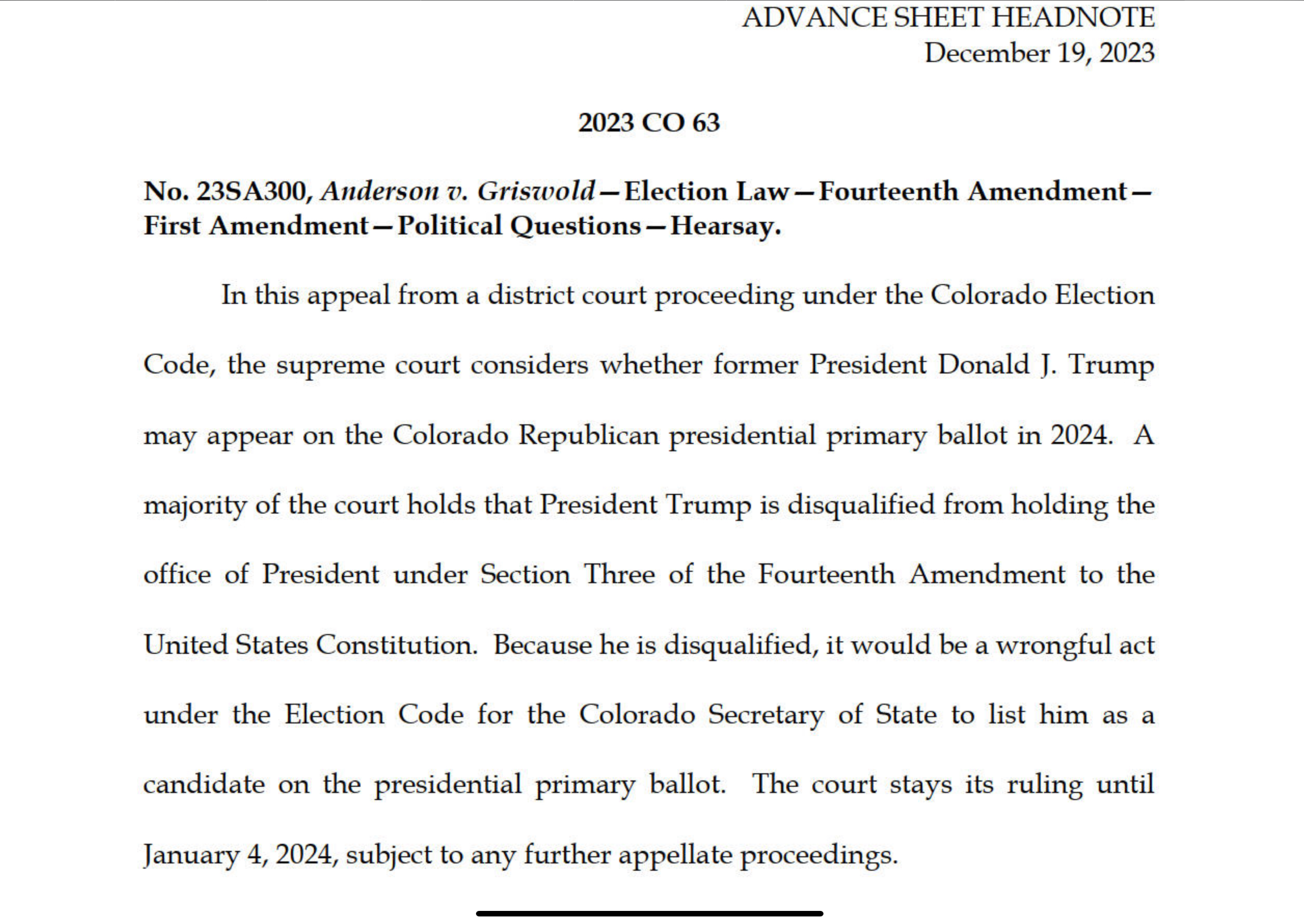
Here’s a refreshing, clear description of legal common sense, making the law accord with justice, “in light of the objectives sought to be achieved and the mischief to be avoided”:

As for the president not being an officer under the meaning of the disqualification clause of the 14th Amendment:
President Trump concedes as much on appeal, stating that “[t]o be sure, the President is an officer.” He argues, however, that the President is an officer of the Constitution, not an “officer of the United States,” which, he posits, is a constitutional term of art. Further, at least one amicus contends that the above referenced historical uses referred to the President as an officer only in a “colloquial sense,” and thus have no bearing on the term’s use in Section Three. We disagree.
The majority recites some of the evidence of insurrection:
The question thus becomes whether the evidence before the district court sufficiently established that the events of January 6 constituted a concerted and public use of force or threat of force by a group of people to hinder or prevent the U.S. government from taking the actions necessary to accomplish the peaceful transfer of power in this country. We have little difficulty concluding that substantial evidence in the record supported each of these elements and that, as the district court found, the events of January 6 constituted an insurrection.
¶186 It is undisputed that a large group of people forcibly entered the Capitol and that this action was so formidable that the law enforcement officers onsite could not control it. Moreover, contrary to President Trump’s assertion that no evidence in the record showed that the mob was armed with deadly weapons or that it attacked law enforcement officers in a manner consistent with a violent insurrection, the district court found—and millions of people saw on live television, recordings of which were introduced into evidence in this case—that the mob was armed with a wide array of weapons. See Anderson, ¶ 155. The court also found that many in the mob stole objects from the Capitol’s premises or from law enforcement officers to use as weapons, including metal bars from the police barricades and officers’ batons and riot shields and that throughout the day, the mob repeatedly and violently assaulted police officers who were trying to defend the Capitol. Id. at ¶¶ 156–57. The fact that actual and threatened force was used that day cannot reasonably be denied.
¶187 Substantial evidence in the record further established that this use of force was concerted and public. As the district court found, with ample record support, “The mob was coordinated and demonstrated a unity of purpose . . . . They marched through the [Capitol] building chanting in a manner that made clear they were seeking to inflict violence against members of Congress and Vice President Pence.” Id. at ¶ 243. And upon breaching the Capitol, the mob immediately pursued its intended target—the certification of the presidential election—and reached the House and Senate chambers within minutes of entering the building. . .. . .Substantial evidence in the record showed that even before the November 2020 general election, President Trump was laying the groundwork for a claim that the election was rigged. For example, at an August 17, 2020 campaign rally, he said that “the only way we’re going to lose this election is if the election is rigged.” Anderson, ¶ 88. Moreover, when asked at a September 23, 2020 press briefing whether he would commit to a peaceful transfer of power after the election, President Trump refused to do so. Id. at ¶ 90.
¶198 President Trump then lost the election, and despite the facts that his advisors repeatedly advised him that there was no evidence of widespread voter fraud and that no evidence showed that he himself believed the election was wrought with fraud, President Trump ramped up his claims that the election was stolen from him and undertook efforts to prevent the certification of the election results. For example, in a December 13, 2020 tweet, he stated, “Swing States that have found massive VOTER FRAUD, which is all of them, CANNOT LEGALLY CERTIFY these votes as complete & correct without committing a severely punishable crime.” Id. at ¶ 101. And President Trump sought to overturn the election results by directly exerting pressure on Republican officeholders in various states. Id. at ¶ 103.
¶199 On this point, and relevant to President Trump’s intent in this case, many of the state officials targeted by President Trump’s efforts were subjected to a barrage of harassment and violent threats by his supporters. Id. at ¶ 104. President Trump was well aware of these threats, particularly after Georgia election official Gabriel Sterling issued a public warning to President Trump to “stop inspiring people to commit potential acts of violence” or “[s]omeone’s going to get killed.” Id. President Trump responded by retweeting a video of Sterling’s press conference with a message repeating the very rhetoric that Sterling warned would result in violence. Id. at ¶ 105.
¶200 And President Trump continued to fan the flames of his supporters’ ire, which he had ignited, with ongoing false assertions of election fraud, propelling the “Stop the Steal” movement and cross-country rallies leading up to January 6. Id. at ¶ 106. Specifically, between Election Day 2020 and January 6, Stop the Steal organizers held dozens of rallies around the country, proliferating President Trump’s election disinformation and recruiting attendees, including members of violent extremist groups like the Proud Boys, the Oath Keepers, and the Three Percenters, QAnon conspiracy theorists, and white nationalists, to travel to Washington, D.C. on January 6. Id. at ¶ 107.
¶201 Stop the Steal leaders also joined two “Million MAGA Marches” in Washington, D.C. on November 14, 2020, and December 12, 2020. Id. at ¶ 108. Again, as relevant to President Trump’s intent here, after the November rally turned violent, President Trump acknowledged the violence but justified it as self-defense against “ANTIFA SCUM.” Id. at ¶ 109.
¶202 With full knowledge of these sometimes-violent events, President Trump sent the following tweet on December 19, 2020, urging his supporters to travel to Washington, D.C. on January 6: “Statistically impossible to have lost the 2020 Election. Big protest in D.C. on January 6. Be there, will be wild!”
¶203 At this point, the record established that President Trump’s “plan” was that when Congress met to certify the election results on January 6, Vice President Pence could reject the true electors who voted for President Biden and certify a slate of fake electors supporting President Trump or he could return the slates to the states for further proceedings. Id. at ¶ 113.
¶204 Far right extremists and militias such as the Proud Boys, the Oath Keepers, and the Three Percenters viewed President Trump’s December 19, 2020 tweet as a “call to arms,” and they began to plot activities to disrupt the January 6 joint session of Congress. Id. at ¶ 117. In the meantime, President Trump repeated his invitation to come to Washington, D.C. on January 6 at least twelve times.On December 26, 2020, President Trump tweeted: If a Democrat Presidential Candidate had an Election Rigged & Stolen, with proof of such acts at a level never seen before, the Democrat Senators would consider it an act of war, and fight to the death. Mitch [McConnell] & the Republicans do NOTHING, just want to let it pass. NO FIGHT! Id. at ¶ 121.
¶206 And on January 1, 2021, President Trump retweeted a post from Kylie Jane Kremer, an organizer of the scheduled January 6 March for Trump, that stated, “The calvary [sic] is coming, Mr. President! JANUARY 6 |Washington, D.C.” President Trump added to his retweet, “A great honor!” Id. at ¶ 119.
¶207 The foregoing evidence established that President Trump’s messages were a call to his supporters to fight and that his supporters responded to that call. Further supporting such a conclusion was the fact that multiple federal agencies, including the Secret Service, identified significant threats of violence in the days leading up to January 6. Id. at ¶ 123. These threats were made openly online, and they were widely reported in the press.
A stinging footnote, on the standard of proof in the trial court, quoting a particularly lame and poorly written Trumpian argument

I read the long decision late into the night, relishing every detail in its clear logic and beautifully constructed chain of legal reasoning. It set out exactly why Trump undoubtedly engaged in insurrection (his lawyers had idiotically argued at one point that “inciting” insurrection was not the same as “engaging” in it, and that therefore he had done nothing unconstitutional per the 14th amendment), what the intent behind the 14th amendment’s disqualification clause was and why it obviously applied to a former insurrectionist president seeking office again.
When I woke up today I read the rest of the decision (213 pages with the dissents) and, after reading the three dissents (also by Democratic judges, all seven on the Colorado Supreme Court are not of Trump’s party) realized with sick certainty exactly how the Supreme Court will overturn the Colorado decision, if they decide to take the case at all. They will focus strictly on procedure, and have no need to reach the merits at all, as they learned to do in the Federalist Society.
The dissent argues there is a lack of due process, the right of the accused to mount a robust defense before being deprived of a right, after the expedited, truncated trial process under the Colorado election law. The dissenters invoke the limited scope of the law the trial judge heard the case under and make a fairly persuasive argument that the law did not allow her to consider the complicated constitutional issue of insurrection at all. If the trial judge lacked jurisdiction to hear the case, no need to consider her findings at all.
The dissent writes that the summary proceeding in Colorado law was designed as an expedited process to hear challenges and to determine whether candidates are qualified to be on the ballot. It was created, according to the three dissenters, one of whom quotes it at length, to decide things like residence, age and other easily justiciable issues. Does the candidate live in the district? Quick proceeding with a yes or no answer. The complex question of whether a candidate is an insane, violent, compulsively lying fuck who fomented an insurrection and is disqualified as a matter of constitutional law is well beyond the scope of the Colorado election law, as John Roberts, if pressed, will calmly point out, writing for the majority, which may include one or more of the non-Federalist Society judges. If there is a procedural or jurisdictional ground to avoid reaching the merits of the actual case, count on a good lawyer to find it.
On the other hand, if the Colorado Supreme court is not the most authoritative final arbiter of Colorado state law, and entitled to great deference, our federal system is a mockery. We have good reason to believe that this 6-3 majority is capable of anything, though this stretch seems too much even for the Leonard Leo three (if not billionaire pets Alito and the Black Klansman). If the highest state court is the ultimate interpreter of state law (which our legal tradition says it is) the 4-3 majority ruling holds. Trump is disqualified after a preponderance of the evidence demonstrated that he orchestrated, pushed, propagandized, organized and incited a violent riot to disrupt the peaceful transition of power.
It was frustrating, after reading that beautiful, thorough, perfectly reasoned, majority opinion, to read the dissent’s argument about plain statutory grounds for throwing out the whole goddamn decision. In spite of the uncheckable power of Leonard Leo’s loyal nine, lifetime appointees whose always ethical rulings may not be appealed, except to God Himself, we still have to put our faith in the rule of law — and in the mountain of incriminating evidence we already know of in the several criminal and civil fraud cases the Orange Polyp is currently facing. We can also reassure ourselves by noting the feebleness of most of the arguments his increasingly less skilled lawyers continue to make in these cases.

[1] Clearly, in splitting the baby that way (insurrection, yes, officer no), with an easily overturnable finding that the president is not officer of the US, the trial court judge was hoping to spare herself and her family more death threats and the real possibility of having to move several times, to protect them, in the manner of Christine Blasie Ford, Ruby Freeman, Shay Moss, and countless other enemies of MAGA fingered by the big guy as deadly enemies to be dealt with appropriately.
 gratuitousblahg