(photo credit)
As we learn, words matter very much. What we call something frames the conversation and removes certain aspects completely from the discussion. Most of us recognize that there is a more truthful description of an actual incident and a less truthful one. Those who would manipulate public opinion seize the selected description that serves them best. We can see this daily in the asinine pronouncements of President Pantload and the often convoluted defense of these remarks by his loyalists. It is an old ploy: call the thing something else and we are no longer talking about the thing that concerns you the most.
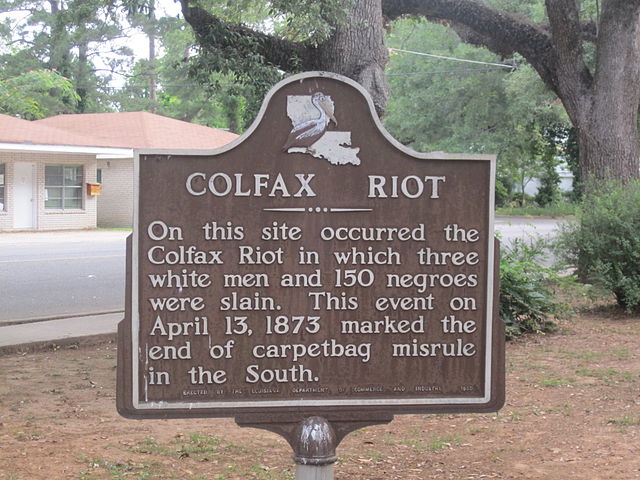
Look at the thirty-four words on this marker about an event that took place on April 13, 1873, Easter Sunday that year. A beautiful example of this.
Context: this incident took place less than a decade after the end of the Civil War, a war that grew out of a peculiar form of commerce, institutionalized racism and a region’s military defense of chattel slavery based on that racism and commerce. It is an American war that continues to rage, as a glance around today will confirm.
The side that lost America’s bloodiest war was forced by the winners to ratify constitutional amendments that would give full citizenship to a race that had until a few years earlier been mostly enslaved. The former Confederate states were not happy about being forced to do this, but they were compelled to sign so they could get Federal funds to restore the destroyed infrastructure of the South.
After the election of 1872 local whites were enraged that former slaves were again attempting to vote and, worse, were intent on trying to enforce the results of an election their candidate had won. An armed garrison of blacks guarded the courthouse at the county seat of Grant Parish, to ensure that their candidate was sworn into office. Local whites, heavily armed, most on horseback, with at least one cannon, besieged the former slaves guarding the voting box. After the surviving outnumbered blacks surrendered they were taken prisoner. Dozens of these unarmed prisoners were summarily executed by the mob over the next few hours.
Riot or massacre? You decide.
Note that three white men were killed. In a riot. Then 150 blacks were killed, probably while running amok. “You know how those people are…” is presumed here, I can almost hear the demur, lowered voice, almost apologetic.
The passive voice “were slain” is another great touch. You know, shit happens in a riot. It is so much more tasteful than “were butchered” or “shot point blank by members of a mob who also tortured many before killing them”.
Then the historical marker concludes, like an incompetent president doubling down, with the punchline, of sorts.
“This event on April 13, 1873 marked the end of carpetbag misrule in the South.”
It is amazing in its bluntness and accuracy, to cite only two ways it is amazing. Once local mobs could kill blacks with impunity there was no way the former slaves could hope to enjoy the rights of citizenship. It was probably the Supreme Court decision on the case a few years later, freeing all the white perpetrators/victims of the riot, that marked the end of so-called carpetbag rule, and the compromise that settled the 1876 presidential election, and removed federal troops, that led to the end of enforcement of the new federal laws in the South, the return of “home rule”, but that is a trifle.
The carpetbaggers were unscrupulous northerners who came down to plunder the helpless south after the war. There were a bunch of them, no doubt, and some enriched themselves in the manner of ticks gorging on the blood of a noble animal too weakened to resist. But the “carpetbag misrule” on that plaque refers to the efforts of the Federal government to enforce the constitutional amendments preventing slavery, extending full citizenship and the vote to former slaves. This “misrule”, enforced with troops and often called “bayonet rule”, included making the former Confederacy do everything it had gone to long and bloody war to prevent: treat its blacks as equal citizens. “Misrule” because it is so unfair for the victor of a war to impose its will on those who lost, no matter who fired the first shots.
The fucking issue is still being bitterly fought. The racism behind it is deeply baked into our society. Calling it by another name? Just more of the same.
Bravo, by the way, to the creators of that historical marker. Making America great again.
 gratuitousblahg