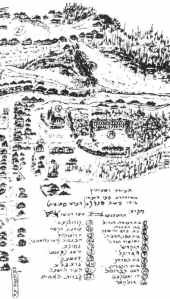
It may be too small to see here, and the half image is oddly distorted and cropped (click on it to see entire map), but on the key provided with this hand-drawn map of Vishnevets you can see, along with the post office, synagogue, cemetery and hekdesh (poor house) a large blot on the northern end, top left center of map, marked in Hebrew “brothers’ graves”, where the victims of the most recent slaughter in that town were buried together in a pit. The English words printed on the map there, “mass graves”, need no translation. The mass grave was necessitated by “Nazi brutality and cruelty”, (enthusiastically carried out by local Ukrainians), in (August) 1943, according to the monument at Mt. Hebron cemetery in Queens, NY, erected by the Wishnevitz Brothers Benevolent Society and the Wishnevitz Ladies Auxiliary.
Other information about the unlucky town is summarized in this on-line excerpt from the book of memory:
In 1500 the town was destroyed by Ivan the Terrible. In 1653 the Jews were killed by the Tartars. By 1765 there were 475 Jews in the Old City and 163 in the suburbs. In 1847 there were 3,000 in Wishnowitz.
I could not stop myself from reading the gut-wrenching survivor accounts, determined to get a clear picture of exactly how my grandparents’ families were murdered. It chilled me to read their names mentioned in one survivor account:
March 16, 1943
On that date, which was a Tuesday, the order was given to set up a ghetto. The buildings to be included in the ghetto were marked. According to the order, the ghetto had to be constructed in three days. The Jews were assigned to build the ghetto with their own hands and with materials they had to supply.
To make sure the order would be carried out in full, two hostages were taken: Yakov Markhbeyn and the writer of these lines. Any diversion from the details of the order would jeopardize their lives.
The ghetto encircled a narrow part of the town and the length of one long street. It extended from Alter Layter’s house to Beni Mazur’s house and from the road leading to Lanovits to the entrance to the Old City.
The gruesome details of the massacre, which I learned for the first time a moment ago here:
At night we could talk, and we asked the two young men from Vyshgorodok to tell us what had happened. And the two young men from Vyshgorodok told me what they had seen with their own eyes-how Vishnevets Jewry had been destroyed-and here is their story.
All the people were brought to a ravine behind the Old City on the road leading to Zbarazh. The ravine served as a readymade grave, with a capacity that met the Nazis’ needs. The ravine had been prepared by Ukrainian farmers. They stood with their tools, clearing the surface of the ravine. They leveled it, removed small mounds, scraped the stones from the sides, and dug the walls. They covered the bottom with the stones and soil they had removed from the walls in order to create a kind of crushed-soil foundation for the victims.
Once the foundation had been prepared, the first group of Jews was led to their burial place.
Two policemen ordered them to take their clothes off and remain in their underwear. They undressed, piled up their clothes on the side, and were then ordered to lie down in a row in the ravine, face down.
When they were all lying face down, the policemen ran over them with their submachine guns in their hands, shooting bullets into the heads of the people who were lying down.
Afterward, they inspected. They walked from person to person and with a handgun killed those who didn’t die immediately, using the gun butt or a bullet shot into the center of the skull.
When they were done with one group, they brought the second, and so on.
The Ukrainians walked over the bodies inside the ravine with horrifying skill. They lifted the bodies that were not level and laid them straight. The Germans sat on the walls of the ravine and supervised the work. They gave the orders, and the Ukrainians executed them.
The farmers took over after the Ukrainian policemen were done inspecting and leveling the layer after the last round of shooting. They covered the layer of bodies with soil in order to place another layer on top. They used shovels to do this. They covered it with a thin layer of soil, and the area was ready for another row of bodies. The clothes piled up on the side were given as a gift to the farmers in exchange for their work. Immediately, they collected the victims’ clothes and loaded them onto their carts, and while the others were busy with their work of killing and taking care of the bodies, they set off to sell their booty.
That was what the two young men from Vyshgorodok told me, and it is the utmost truth, because while they told us their story, they were very detailed and corrected each other so as not to distort what their eyes had seen.
========
It was with another shuddering thought of ruthless fate that I recalled that Beni Mazur’s house was likely the same place where my grandfather Sam grew up, and narrowly escaped death by typhus during the epidemic after World War One. If my grandfather had not escaped death from typhus (which killed at least one other family member and caused the deafness of one of his parents, and which he referred to as a “very bad item”)… you know the rest.
 gratuitousblahg
My grandparent both came from this town but came to New York long before the war. However this is almost the identical story told to me about my grandmother’s sister and her family who remained in Europe.
Amazing to hear from someone else whose family comes from what was finally reduced to the Jewish Ghetto of Vishnevitz and thanks for being in touch.
My grandparents (who arrived here right before the severe immigration restrictions of 1924) each lost six siblings, their parents and everybody else the left behind. Neither one ever talked about what happened in Vishnevitz, though my grandmother became a heavy drinker in her later years. All I was ever told is that “one day the letters just stopped coming.” It was a deep family trauma, obviously, as I understand now, and none of them knew how to deal with it. How does anyone deal with something like that?
When did you hear the story?
In my case, aside from that monument in the cemetery where my grandparents are buried, I learned everything I know on-line from the Vishnevitz Yizkor Book (and great thanks to the folks who put that online!) shortly before I posted the piece about my grandparents’ little town.
My grandparents came in the 19 teens. Both came from Wishnevitz,My dad was born on the Lower East Side of New York City in 1918. One of Grandma’s sisters remained in Wishnevitz along with most of that family while another sister moved to NYC and yet another to Buenos Aires. One son (Joe) came to New York, and another went to Buenos Aires. At a funeral for my uncle, (my father’s brother) several years ago, Joe’s daughter told me the story of what had happened to her grandmother’s family. Not sure how she found out, but she talked about a trench by the side of the road and the Jews being shot.
My paternal family are all buried at Mount Hebron. When the original plots were filled, the Society purchased more graves. parents, uncle and aunt and some of Joe’s family are all buried in the newer plots. I live several hours away from the city but try to get to the cemetery once year or so.
I have a picture of the Wishnevits family that remained in Europe that I restored and also a picture of what I believe was the town hall.
I too have a copy if the Yizkor Book but when I researched it about 20 years ago, it was not translated. Can you share the website for the translated version. My father once told me that there was a picture of his Aunt Ida in the book.
The translation of the Yizkor book is at: https://www.jewishgen.org/yizkor/Vishnevets/Vishnevets.html#TOC49
The eye witness accounts of the massacre in the ravine are here:
https://www.jewishgen.org/yizkor/Vishnevets/vis049.html
My maternal grandparents are buried at Mt. Hebron, we live not far from there. Next time you’re coming to visit, drop me a line here with a contact number (I won’t approve the comment, so it will remain private) and we can arrange to meet you there and go for coffee, if you like.
I wanted to keep this connection going but the past few weeks have been very busy. Thanks for the link to the Yizkor book. It’s hard to describe the feeling of finding relative names in the back of the book. I live upstate near Albany and try to come to the cemetery in the fall. I definitely will contact you to get together.
Linda,
Sorry for the delay getting back to you, had my knee replaced recently and haven’t been keeping up. I sent an email to the address that came with your comment (a couple of weeks ago) and maybe it never got to you.
I wrote: I know what you mean about the feeling of seeing those names, impossible to describe. We have been left so few traces that each one we find, even just a name, seems amazing, somehow.
I also gave details on how we can get in touch when you plan to come to Queens next. Send me your current email address in your next comment, I won’t approve/post the comment but I’ll forward you the email I sent you a couple of weeks back.
All the best,
Eliot