Dearest Elliot [sic],
I got your letter yesterday and after trying to read the whole thing a few times, I stopped and just slept on it.
I tried to think about why you were writing it and why to me.
I can’t say I was able to make sense of it, but my heart clearly understood.
I felt how much pain you are in and how deep your suffering goes. It obviously didn’t begin with the event that triggered your divorce from your bosom buddy and the community that came with him. It began way back within your own family and all the unfinished business you carry like an albatross throughout all your relationships and life.
The letter was more like a purge than an invitation to a conversation.
I also don’t believe there’s anything I can say to you that will assuage your suffering. If you’re willing to unpack it all, you have to see a professional. I can tell you that Ilan found his peace many many years ago through meditation. I can attest to the change the man internalized over the years and the impact it has had on our life together.
If you’re comfortable with just being ‘right’ you’ll spend your life brewing and it will take it to the grave. If you want to find your peace, you know what you have to do. If you want to face your demons you have to find a neutral setting and do all the hard painful work that it takes. You can’t change all the people in your world, but you can change yourself and heal.
Think about it Elliot [sic]. Do you want to throw away the remainder of your years by being angry, by being ‘right’ or do you want to find your peace.
Only you have the answer.
With much love,
Redacted
I replied with more explanation of why I’d been so hurt and so forth. That night I had a call from the Flying Monkey, Redacted’s best friend and confidant. After that loving chat, I had no choice but to amend my reply:
Oh, one last thing. You asked why I sent you the pages you could make no sense of. A reason I forgot to mention in my previous email is that I consider you perhaps the sharpest and most perceptive person in the circle. I was hoping for understanding, which, clearly, you could not provide.
In replying to you a few days ago I made the same stupid mistake I’ve been making all along, since that hideous year bookended by two angry Yom Kippurs. I tried to use reason to persuade someone who had clearly made up her mind, based on the other party to my ugly “divorce” from X/Y having already persuaded everyone we know in common that they behaved perfectly and Eliot is, alone in the history of divorce and every other conflict, entirely to blame for everything that happened. When he’s frustrated he says the fucking f-word! And worse!
It was very clear from your moralistic response that you follow that interpretation, only one party has behaved aggressively and immaturely (from my point of view, I am not that party, of course – and I have the receipts, if anyone who has judged me unworthy of friendship were interested in being fair, or empathetic).
Consider for a second: if I was the enraged person you portrayed in your pitying judgment, would I have reacted as mildly as I did to what can fairly be seen as the judgment of someone who feels infinitely superior to me? Based on a false account imparted during a successful attempt to assassinate my good name among people I have long loved, listened to, made laugh? No feelings I might have about being unfairly judged and banished by an entire group of old friends, most of whom I never had a hint of a quarrel with, are appropriate — except as manifestations of a need for intensive psychiatric work?
When someone you care about is upset, you ask them what happened, you listen to them. You offer to help, if you can.
When someone is upset and you tell them they have no right to be upset, that they are wrong, and immature, and irrationally clinging to childhood pain, and unable to get past their previous abuse, are aggressively angry, unforgiving, hellbent on being right at all costs and trying to change everyone in the world but themselves, and are unwilling to do the hard work everyone else in pain has presumably done to become more fully human — well, you really shouldn’t sign that kind of message “much love,” darling.
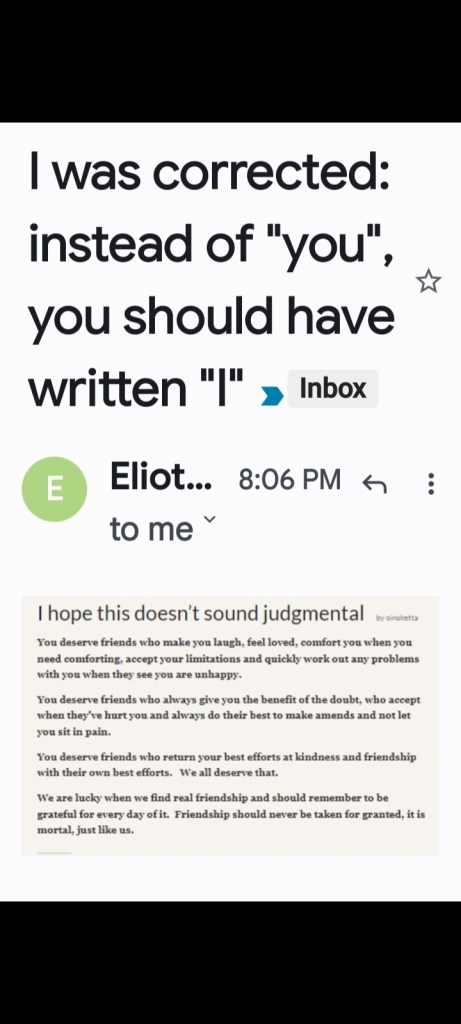
I’ll leave our dear friend the final word on this ugliness (well, me, actually, but you know how I am).
The only way to flush these hard feelings, dear Seedj, is by having the last word in a quiet battle with self-righteous, toxically clannish pinheads.
[Part two is here]





 gratuitousblahg