Personality Conflict

If you are raised by a relentless bully there is a challenging process you must go through not to become a relentless bully yourself when you grow up.   Granted, it is not a process for everyone.

Under stress, we sometimes revert to type, in spite of what we may have learned to do better, through great effort.   Human.

I don’t want to argue with people all the time.  I try my best to avoid it, I really do. You want to argue me out of my desire not to argue, since it is a waste of a good skill set, to your way of seeing it.  I understand you can’t help the constant demand that I justify everything I say and do, but I don’t like it, can’t make you understand how much I don’t like it.

“You have an emotional blind spot,” I say, when subjected to this again, when I can see no other way out, no way to make you see my point of view.  

“I don’t see it,” you say, reflexively asserting your human right to see things as you do.  

Later, blood pressure rising as the futility becomes more and more impossible not to feel, I will make an ill-advised reference to tone-deafness that will send you into a rage, cause you to scream and slam down the phone.  

“I am neither tone-deaf nor do I have an emotional blind spot, I, in fact, love you more than just about anyone in the world,” you will write in a long, reasonable email a few days later.   “As for your ‘kryptonite’ — silence by way of response — I don’t get why your right to a response supersedes my right not to have my innocent silence misconstrued.   Further, my recent apology, which I found it unfair and unreasonable of you to demand,  was only given because you were so irrationally enraged…”

At which point my desire to continue reading fades, the stomach acid returns to my stomach and I reach for my guitar.  I play “That’s Amore”– now in the key of D, a much better key for a solo guitar version of this snappy tune, which I can’t seem to get out of my head.   Play it in D, you will like it very much.   

I later rescue from undeserved obscurity two paragraphs I wrote in closing a post I later deleted for fear of offending an old friend, my last words on the subject:

Silence, ideally, is the best remedy for unwanted silence, to demonstrate exactly how it eats at a heart that has posed an unanswered question.  To know how it actually feels, a thing difficult to explain in words.

Though here, in the odd event that my old friend who could be affected by this ever reads these words, I’d have to sacrifice the cold satisfaction of that beautifully symmetrical working of easy, elemental justice in the name of further digesting this true, hard stone — that professed love is worth little without a reflex to unconditionally empathize when your friend is in pain.  


Corporate/Public Partnership During a Worldwide Plague

As I’ve noted, Nazi-admirers and other authoritarians (and our greediest wealthy citizens) wake up every day on fire to consolidate and expand their power.   They eagerly use any means necessary, since they believe themselves in an existential struggle against a host of murderous evils.   They see themselves as underdogs, eternally under attack and fight like well-organized, maniacally disciplined devils for what they deeply believe in.   They believe themselves surrounded by superhuman enemies, and therefore they give no quarter in their quest to prevail over these inhuman creatures.   They go to sleep dreaming of the glorious fight and wake up fighting violently to change the world.

The large masses of average people just want to live decent lives, share adventures, take care of the people they love, help strangers when they can.   They tend not to be organized into quasi-military hierarchies, not to march in huge, angry rallies, not to brandish weapons and chant things like “Death to the Other!”   They seldom threaten to break anyone’s bones, burn anyone alive or hang traitors from lamp posts.  The masses of ordinary people are, as these tough-minded warriors see them, a bunch of passive pansies fully responsible for their own powerlessness. And, of course, contemptible for their weakness.

I’ve been trying to use my own unfortunate situation regarding twice-canceled public/private health insurance to illustrate how far this authoritarian belief system has come in recent decades.    If you are low-income, tamp your expectations for fair treatment, quaint things like “due process,” way down — there is a whole separate body of laws that protects what you losers believe to be your rights.  Our Free Market explicitly blames the poor for their poverty, the homeless for living outside, the weak for needing our help.   This is the prevailing public narrative of our “Free Market” system — a system which, naturally, provides generous support for our largest private enterprises and our most successful hoarders of wealth.    

The unexamined truism among many hardworking people is that if you had every opportunity not to be low-income, and were too lazy to work hard for it, something is fundamentally wrong with your values if you choose to live a life of outsized degradation.  If you choose to live this kind of disempowered lower class life, you have only yourself to blame for the unfair treatment you might receive.

Here, in a nutshell, is what our Free Market does when it comes to profit-driven health care, which grinds on obedient to the corporate bottom line, even during a worldwide plague.   You are notified that you have successfully re-enrolled for low-cost health insurance in 2020.   You call to pay and are told you missed a ten day grace period.   This private company insists that no notice is required before they can terminate your policy, lawfully, during this once-a-year chance for private insurance companies to terminate unprofitable, low-cost health insurance policies subsidized by the government.   You manage to get this “erroneous” ruling overturned and have your insurance restored.    Three months later, with notice from a government agency only to the private insurance company, your insurance is summarily canceled without notice.   You only find out by accident that you have no health insurance, during a plague, ten days after it is cancelled.

Fair is fair, of course.  No court in the nation will hear your case, particularly in a nation currently overwhelmed by mass infection, frightful deaths and dislocations. Two documents are produced by the State that offer the fig leaf of proof of the notice you never received.  It is the word of an angry person who made a clear error of omission (fixed 45 days too late) versus the word of government/corporate partners who claim to have followed the law to its letter, whatever that law might be.  

A law that, by the way, you have no right to know.  The government agency that regulates the private insurance company does not know the law, or if they do, they’re not obliged to inform a member of the unwashed public.  In fact, the agency returns your call to reiterate that it has no jurisdiction, you must appeal to the separate agency that administers programs for poor people, they operate under an entirely separate, but presumably equal, body of law.   The law has an apt phrase for this: “de minimis non curat lex” — the law doesn’t give a rat’s armpit for your hurt feelings, jerk-off.

Nothing to see here!  

Look, I am actually privileged, very much so.  I will have my insurance back in a few days, as opposed to the four and six month waits the last two times it was cancelled or held up due to the overwhelmed NYS agency’s own errors.  I have no major disease or health crisis requiring immediate medical care.   I am not at risk of homelessness, starvation, preventable death from undiagnosed heart disease or cancer or any other silent killer.   Tens of millions of Americans are in desperate situations, increasingly facing hunger, terror and actual death — I am not.      I live on a modest income but I am not suddenly unemployed and hopeless in a nation where the CEO of the non-profit corporation that twice terminated my low-cost health insurance in 2020 made $1,900,000 last year.  FAIR IS FAIR.

Thankfully, this headless galloping insanity might be slowed after November 2020, assuming the bulk of the electorate is allowed to cast ballots.   The opposition candidate, the gaffe-prone near-octogenarian with the million dollar smile, the man who can turn this all around and give us back both Hope and Change, is keeping pretty much quiet during this historic crisis.   A wise strategy by his strategists, minimize the damage he can do to own his campaign by staying as low on the radar as possible.   Hope and Change, baby!   Leadership on demand.  The best losers can hope for, one supposes, certainly the best we deserve.  And if not, blame us!


Notice to sustain legal termination of benefits for those who rely on a government program for health care

It gets better, the closer you look.  By better I mean, of course, much worse.

Here is the top of the March 11 notice I had absolutely no notice of (until, in desperation, suddenly, irrevocably without health insurance or access to affordable health care, I stumbled on it on April 14):

Screen shot 2020-04-28 at 12.01.26 PM.png

That highly effective, legally impeccable March 11 notice, transmitted immediately to my insurer (my only copy was belatedly found, a month too late, nestled in the inbox of the website we are forced to visit once a year to re-enroll,) referred to the “separate notice” I also had, exclusively in my inbox on their website, the one placed in my inbox the day after I re-enrolled last December.  

Emails from your agency, your corporation, reminding us about voluntary customer surveys untaken, updating us about your handy new phone app?  Sure, absolutely, we can send as many of those as you like.  A single email informing you your health insurance is in immediate jeopardy of sudden cancellation without notice?   Show us the law that requires that, loser!

An unambiguous warning, you must admit, that March 11 notice.  If I’d seen it, I would have known what I needed to do immediately (as I quickly and easily did on April 14, as soon as I found the March 11 notice on-line).  Unfortunately, the law doesn’t protect LOSERS from their own negligent mistakes, loser!  What’s hard to understand about read the fine print CAREFULLY?

There was, admittedly, a strong hint in December’s “separate notice” informing me that, although I had apparently successfully re-enrolled for 2020, and would be covered for a long period, that I was not yet actually fully qualified for the insurance that had been approved (and that covered me from Jan.1 through March 31, and from May 1 til the end of the year, presumably).  

That much was  made plain in the very first lines of the 12/7/19 letter, the “separate notice” noticed in the notice of March 11.  In hindsight, the clues “for a limited time” and “required document(s)” are dead giveaways. How could I have been so dang STOOOO-pit?!

The 12/7 notice begins:

We have redetermined your household’s eligibility on December 6, 2019 for enrollment through NY State of Health based on updated information we recently received.  Below are the results of our determination: EW Marketplace ID: HX000075019789123123345677889

Eligibility Result: Eligible to enroll in the Essential Plan with a $(redacted) premium per month for a limited time. This means that you must return required document(s) to NY State of Health to continue your eligibility. The Essential Plan will cover all essential health benefits with low co-pays for certain services and no annual deductible. You may choose to also enroll in dental and vision benefits for an additional monthly premium. This eligibility is effective as of January 1, 2020.

What you need to do next: Provide additional information in order to confirm your eligibility – More information about what documents you need to provide NY State of Health can be found in the “Request for Additional Information to Confirm Your Eligibility” section of this letter.

Using your health coverage – You will receive services through your health plan. Information about your benefits can be found in the “Additional Plan Enrollment Information for Essential Plan” section of this letter.

In fairness, the “Request for Additional Information to Confirm Your Eligibility” section plainly described the  document I needed to submit.  It was right there, in impossible to miss black and white, on a long list on page 12 of the twelve page letter.   It is likely the drop-dead cancellation date of March 5 (triggering the March 11 notice to insurer to cancel effective March 31) was also explicitly mentioned somewhere in the bulk of the letter, perhaps after the several pages that repeated certain legal rights in a host of languages spoken by the citizens of New York State (which is where the tax document I uploaded was listed).

The point, of course, is not whether any of it is fair or not.  The point is not whether somebody with the means would hire a lawyer and take legal action to have something done about this kind of outrageous institutional abuse.  A person of means would not find themselves in this position anyway, there are certain minimal protections for the average prosperous citizen, even as they may not be robust protections (except for the extremely wealthy).    The point is:  if you depend on the kindness of your government and the corporations it does business with TO HELP YOU, what are you going to fucking do about it, you fucking loser?  LOOO-zuh!

Go write a sarcastic tweet, as is your absolute privilege under the United States Constitution, Amendment One.

No Intent Can Be Implied– though, to be honest, the intent is pretty clear

We are sometimes reminded, often by lawyers for people doing bad things, that we cannot infer legal intent from a mere course of conduct, no matter how consistent or seemingly suggestive.   This lawyerly principle applies even when that intent is expressed in a clear, polite, unambiguous “fuck you, asshole.”  

I’ve had my health insurance cancelled without warning twice since January 2020; luckily for me I found out about it the second time (cancelled without notice March 31) just in time to have my low-cost insurance back, as of May 1.  Nobody is to blame for any of this except, presumably, me, though intent on my part remains unclear.  

In January, when I called to pay my insurance premium for the ACA health coverage I’ve had for several years, the insurer told me I’d missed a ten-day “grace period” they’d had no obligation to inform me of and that my insurance had been irrevocably cancelled, pursuant to the “guidelines” (whatever those might be).   Two days later Healthirst, the insurer, confirmed that I’d lost an internal appeal and that my insurance had been properly terminated.

Meanwhile, I found an on-line consumer complaint form at the New York State Department of Financial Services, the agency responsible, among other diverse duties, for regulating health insurance companies that do business in the state.   Within two business days of submitting this complaint I had a call from Healthfirst, apologizing for its mistake and restoring my health insurance.

I was naturally curious about what law or regulation had caused them to reconsider their irrevocable, unappealable, legal decision.  They could not tell me. I want to know this law.  I’d like to publicize it to the many agencies I’d spoken to, government agencies who had no idea what the patient protection law in New York State requires of insurers before they can terminate ACA insurance without notice. Hearing nothing back from the Department of Financial Services, after my complaint quickly resolved my sudden lack of insurance,  I wrote them this:

I had a call from Healthfirst on January 28 informing me that their termination of my insurance had been a “mistake” and that they were sorry.  They admitted they had received my 1/24 NYSDFS complaint and were ready to accept the payment for January-June 2020 I’d attempted to make on January 22 when they informed me that I had no health insurance and that there was no further appeal at Healthfirst, or anywhere else.

I am wondering why:

1) there is no notice requirement before a health insurance company can terminate health insurance.  (I had absolutely no notice of the “ten day grace period” they suddenly waived after my DFS complaint);

2) NYSOH Marketplace, sole provider of ACA health plans in NYS, does not inform consumers of the practice of insurance companies abruptly (and “mistakenly”) terminating insurance for failure to pay during a “grace period” nobody is informed of;

3) there is no findable provision in the Patient Protection and Affordable Care Act, or NYS law, that sets out notice required before terminating policies.  

Is there no provision requiring private health insurance companies to direct suddenly insurance-free patients to the new NYSDFS on-line complaint process that can force immediate compliance with the unknowable law?

Is there someone I can talk to at DFS for more information about these questions?

Two weeks later, on Valentine’s Day, in fact, I had a response from DFS [1], a form letter, addressed to me, instructing me that DFS has no jurisdiction over my low-income healthcare and that all future correspondence should be addressed to the overwhelmed NYS Department of Health, the agency that oversees all Medicaid and Medicaid-like health plans for low-income New Yorkers.   The NYS Department of Health, perhaps because its programs serve primarily poor people with no other options, has no analogous on-line process for quickly resolving violations of undiscoverable laws.

My individual story had a quick reversal of fortune, a lucky, happy ending.   I did not lose my insurance for more than a few days, and it had been retroactively restored with alarming speed.   That was the position of the attorney at DFS who was assigned to provide me a copy of the law that had caused Healthfirst to reconsider its unappealable termination of my insurance.   He e-mailed me that since the insurer had admitted its error and restored my insurance that I should no longer need to see the provision of the law that had forced them to do so.

I periodically wrote to this lawyer for status updates, since he’d been assigned to provide me the relevant legal provisions I’d requested.   He asked me again, only six weeks in, to be patient, and questioned my stubborn-seeming need to know the law, since my insurance had been restored.  He also disputed my assumption that I’d not been alone in having my low-cost insurance abruptly terminated.  

He didn’t necessarily agree that a private company, with every incentive to cull non-profitable low-income insured from its rolls, and no disincentive, outside of being forced to admit error, if one of the poor devils stumbled on a legal remedy at the agency that regulates them; none of that meant that private insurance corporations would necessarily take advantage of unsophisticated or language-challenged low-income customers it was forced to insure by the opaque 906 page Patient Protection and Affordable Care Act.

It became a kind of hobby of mine, trying to remain polite to this government attorney, who seemed to be a kind of troll, judging by his terse non-responsive responses.   I was probably being unfair to the man.  He was probably right; I should have simply been grateful instead of a persistent burden to this hardworking government lawyer.

All was well, until, suddenly, in the midst of the worldwide pandemic, where I found myself at its epicenter, a doctor’s office I had an upcoming kidney disease-related appointment with (by phone) informed me that my insurance came up “inactive”.  I told them that was a mistake, my premiums were paid through June.  They told me I’d have to straighten this out with my insurer.   

It could not be straightened out with my insurer, who informed me that unfortunately there was nothing they could do — they were following orders from a New York State agency that they were forbidden, by law, to contact on my behalf.   I was told on that April 10 call that the insurer had been informed, electronically on March 11, to cancel my insurance effective March 31.   I’d had no such notice. Nobody, apparently, had any legal duty to inform me that I was about to lose my insurance or even that I was now uninsured.  During a pandemic.

I did not react well to this news.   In spite of the personalized February 14 warning that I was not entitled to use the DFS on-line complaint form (a warning not made anywhere on-line when you go to complain) I immediately submitted this:

I was informed Friday afternoon, when I called my insurer after being told by a doctor that my insurance came up “inactive,” that my Healthfirst health insurance, prepaid through June, had been cancelled, effective March 31 by the New York State of Health Marketplace.  

According to Healthfirst, no reason for this termination was given by NYSOH, NYSOH, I was told, had sent Healthfirst notice of their intent to terminate my ACA insurance on March 11.  Neither Healthfirst nor NYSOH provided me any notice of this termination, not prior to the effective date nor since.

I am instructed to call NYSOH, an overwhelmed and unresponsive agency on a good day, where one hears this recording:

New York State of Health is experiencing high call volume.  Because of the public health emergency we are extending the due date for people who are expected to renew before April 15.   You will receive another notice of the new due date before any changes will be made to your coverage.   You do not need to take any action at this time.  

Also, because of a new federal law, no person who currently has Medicaid coverage will lose their coverage during this emergency.  If you are enrolled in Medicaid and get a notice from New York State of Health telling you that your coverage will end after March 18, 2020, you can disregard this notice.  You will have no gap in coverage.  If you have Medicaid you do not need to report any changes to your account except a permanent address change.

I have to assume that termination of prepaid health insurance without notice violates some NYS law, administrative rule or something, in addition to the due process protection of the US Constitution and the PPACA.  One searches for New York’s legal answer to this question in Titles 10 (Health) and 11 (Insurance) of the NYCRR  in vain, there is no chapter on point.  

Can you help me get my improperly terminated insurance back during this worldwide plague? I’d be eternally grateful.


Thankfully, before they had time to act on this complaint, a friend helped me discover a copy of the March 11 “notice” from the NYSOH, on their website, in my inbox.  I’d received no email informing me of its existence on the website low-income New Yorkers are required to visit annually to re-enroll, not that day (when I could have acted to save my insurance for April), not any day.   I also did not receive a copy of this notice by mail, not in March, not on any day.   When my friend asked if I’d checked the website, and my “inbox”, I went on-line, saw the “notice” for the first time, fixed the omission in my application, re-enrolled and was quickly good to go effective only a few weeks later, on May 1.

I attempted twice to retract my DFS complaint, on April 14 and April 15.  I wrote:

I withdraw complaint CSB-2020-01351366.  Healthfirst had nothing to do with this termination of my ACA health insurance. They might have informed me of the impending loss of my insurance, which they knew of for three weeks before it was terminated, although they likely had no legal duty to do so and every business reason not to.  My complaint should not go to Healthfirst.

My insurance was terminated by the NYSOH, for my own oversight,which remained uncorrected for lack of notice of the mistake by NYSOH.  I have since been able to correct this oversight and my insurance will be restored effective 5/1/20.  

Please terminate this complaint. 

I was too late, though, the wheels of justice were already grinding on my behalf. The very next day I had a call from the same Resolution Specialist at Healthfirst who’d resolved nothing previously, informing me in grim tones that they had received the DFS complaint, that she was calling pursuant to it and so forth.   My description of that unexpectedly pleasant chat is here.

Here’s the thing, though.   Within a couple of days, on April 17, I had an email from DFS with two attachments.  The first attachment was the same form letter I’d received previously, directing me, as a low-income New Yorker, to the Department of Health, informing me, again, that, although they’d once again quickly investigated my complaint, DFS was not the proper agency to contact, since I was too poor to qualify for their on-line consumer services.  

The second attached PDF was an official summary of legal findings  — something we must note was not prepared or sent to me in the previous case, when the insurer had, and later admitted, erroneously terminated my health insurance in January.  

Again, no inference of intent is drawn, why should it be?   Can an agency or a corporation even have intent?   The report of their legal findings was dated April 16, 2020, the day after my second attempt to retract my complaint.

Curiously, on the cover sheet of this three page report, next to the box “Has the member been made whole?” the answer DFS inputted was NO.

I have transcribed it from the PDF faithfully (outside of a few added comments):

This communication serves as the Plan’s Response to the Member EW (sic), grievance against the Plan regarding his termination of coverage on 03/31/2020.  We have researched the member’s grievances and provided below is a summary of our findings and resolution.  

Upon receipt of the complaint the Enrollment and Billing Departments advised:  

* The Member EW enrolled into Healthfirst Essential Plan with an effective date of coverage for 01/01/20.   The Member’s coverage was active and paid through March 31, 2020 (paid through June 30, actually, but why quibble?).  

* On 04/15/20 the Enrollment and Billing Department advised (who?) that the Member’s coverage was terminated as per the New York State of Health transaction file no. ET00158341700 received on March 11th, 2020.   (Note, 4/15 was days after I complained of this conversation, which took place April 10)

* An inquiry was sent to the New York State of Health regarding the Member’s coverage termination.

The Plan advised (was advised?) that on:  

*On 12/07/2019, the New York State of Health sent a letter requesting proof of income that needed to be submitted by 03/05/20, in order to maintain continued coverage.  (why March 5, a deadline both arbitrary and capricious?)

* On 03/11/2020, the New York State of Health sent another letter indicating that proof of income was not received as requested, and that Member’s coverage will be terminated effective 03/31/2020.     (really)

* On 4/14/2020, the Member uploaded the required documents and was re-enrolled for an effective date of coverage 05/01/2020.  

* On 04/16/2020, the Member Services Department outreached the  Member regarding his complaint.   The Member informed the Plan that he realized that the termination was not Healthfirst’s decision, but on the part of the New York State of Health.   The Member advised that he tried to rescind the complaint but realized it was too late (he did when he got the call from insurer– for sure — ed.).  The Member verified that as per New York State of Health that his coverage would begin 05/01/20. A credit is currently on file and will be applied to the Member (sic) future coverage (applied to July’s premium, actually).  

We trust that this response provides sufficient explanation for your inquiry.

The official report was signed by a female employee of DFS, to whom I can only say, (with Joe Biden-like insouciance), it could all not have been clearer, sweetheart.


[1]

Screen shot 2020-04-28 at 2.46.39 PM.png


It’s Essential to Have Words to Describe Tricky Things

Without the language to describe something, it’s hard to even conceptualize the thing we may want to talk about.   We see this everywhere.   In the absence of a good frame in language, you basically have to invent a way to talk about things that are hard to make clear.  When you have the phrase — voila! — it’s instantly much easier to have a meaningful discussion.

When I heard our scarcity-based economic system called “extractive” and the sustainable alternative called “regenerative” a light bulb went on — it’s a very clear, concise way to describe an energy policy based on burning up resources that can’t be renewed, a regime that has taken us a long way toward destroying the planet we all live on– and a saner alternative.   A fossil fuel run economy is “extractive” by it’s nature.

Yesterday I heard a great phrase that explains the forces that ensured the rise, and unchecked power, of the Mitch McConnells and the Donald Trumps — “Plutocratic Populism” — unpopular policies that benefit only the super-wealthy that are ushered in by mass popular rallies of galvanized angry have-nots funded by the plutocrats, who ride these tractable hoards, booted and spurred, as their kind was born to do, in their quest for ever more well-protected privilege.    

Same with racism.   One response to centuries of deep institutional racism in our great land, an organized movement to protest regular police shootings of unarmed minority citizens– “Black Lives Matter”– has been seized on by very fine people on both sides — an overdue demand for justice;  another example of unprovoked rage by dangerous, very angry people [1].  

I am thankful to a friend who, several years back, clipped out a little definition of an odd, ingeniously descriptive term for a tricky, but widespread, problem and called my attention to it.  The concept is called Complementary Schismogenesis, and it explained a lot about a certain kind of irreconcilable difference that only gets worse the more energetically both sides try, blindly, to resolve it.  

My every attempt to calm you down only makes you more upset, and vice versa. Seeing the other incomprehensibly more upset, instead of less, we redouble our vain efforts, to similar effect, our now mutually impatient, morally obtuse-seeming responses increasing the frustration between us.   Let me see if I can find the clipping, which was sent to me in digital form.

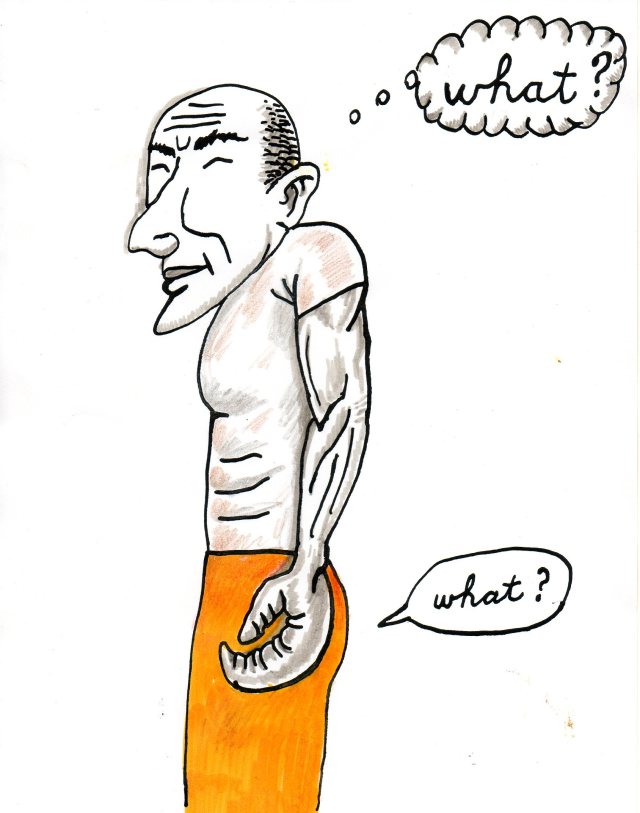
I can’t find it.  I did find this 2012 drawing, though:

what  2-19-11003


Turns out I’d written out my take on Complementary Schismogenesis pretty clearly four years ago:   

Complimentary Schismogenesis, I am told, is when two opposites are locked in some kind of conflict, neither getting what they need out of the arrangement, the attempts of each to resolve it, coming from opposite orientations, only make the problem more intractable, tighten the knot.   The schism continues to deepen as the two struggle cluelessly in opposite directions to heal the underlying fissure.

If we assume everyone is somewhat fucked up, damaged by life, laboring under certain sometimes vexing disabilities, friends are those whose asshole side we are able to overlook.  The friend has other lovable qualities we value that counterbalance the bad tendencies we all have.  We extend the benefit of the doubt to friends, a benefit we do not readily confer on random people we encounter.  

I told a friend recently that whatever other problems we may have had with each other over the years, we both are confident that neither of us would, seeing the other strapped in the electric chair, throw the switch before insisting that every single witness had a chance to speak.  He agreed.


Only one thing has changed since then, the guy who agreed that if I was strapped to the electric chair he’d let every witness for me speak before throwing the switch, may have revised that generous offer, the witness list might no longer be very extensive.  

The precipitating reason for this recent falling out — my attempt not to get angry when hurt wound up infuriating my friend who honestly had no way of knowing how upset I was since I didn’t even fucking scream at him like a normal person who claims to be so goddamned upset!   Plus, I was an aggressively self-righteous cunt about my “right” not to be “hurt,” even thoughtlessly, innocently.

My attempt to remain mild made him wild.  

If the glove don’t fit, don’t have a snit.

The Difficult to See Slow-Killing Murder of (attempted) Love (Part 2)

Love is what we all seek in life, what every living creature needs to flourish, even to survive, and I don’t mean to shit on anyone’s interpretation of love.   We all know what love feels like when we are loved, virtually every one of us has been blessed to feel this and remembers it gratefully.   I’m going to try to analyze how thwarted, frustrated or imperfect love can lead to anger, violence, lifelong hatreds and other terrible things.   Not thwarted in the sense of a hope for love that is rebuffed, most of us know how bad that kind of romantic strike-out feels, but love that is not given in a way the loved one can derive real support from.

I have to be fair.  Not everyone is always good at expressing their deep feelings for others.  I’m not.   We are all creatures of our upbringing, our genetic predispositions, society’s often unrealistic and harmful myths [1].    I’ve only recently made a habit of returning Sekhnet’s regular “I love you” greetings, and I’m glad I have, but it was something I had to learn.   My father, as he was dying, lamented that he had had no idea how to express love, never having seen it done in the miserable home he grew up in.   Made me feel great tenderness for the poor devil and even sadder about his last-hours’ struggle to make peace with a representative of the people he’d hurt by his disabilities.    It really was not his fault, in a certain very real way, as I finally came to see.

I woke up today an hour or two before I was done sleeping and couldn’t get back to sleep.  I woke up thinking about fairness, what it feels like to be the victim of unfairness.  A regular theme, of course, but as I was recently shrieked at by an outraged old friend who keeps a close watch on his emotions, I woke up wondering if I’d been unfair.   Was it really fair of me to ask for things this old friend was clearly incapable of giving?   Clearly he didn’t think so, nor would he admit he is incapable of anything– he’d always given me his best version of philia and agape (two crucial kinds of love that don’t involve romance) and I’d ungratefully, maliciously taken a greasy, prissy dump on it.   Incoherently demanding yet more of him, after all he’s struggled to give, over more than half a century, an intolerable demand that was irrational and fundamentally unfair.

I thought of a phone call I had a year or two ago.  The wife of another childhood friend I could finally not continue to negotiate the terms of a frayed adult friendship with.   She informed me that I had to remain friends with him, and her, and their two sons, because they loved me.   “We love you!” she told me, and I know she was telling me the truth, the deepest truth she knew, an undeniable truth.    I knew it myself, they clearly did love me.  Then she gave me the ultimatum:  forgive him immediately, I’m giving you this one chance, out of love, but if you don’t — you’re dead.  I told her what had become unbearably clear to me:  “forgiving” a person who can’t see he’s constantly hurting you, no matter how many times you try to make it clear, is kind of impossible.   We came to a kind of understanding, out of mutual love  — I am a dead man writing today.  

I don’t think I need to give the details of that situation beyond this restatement of what I was being asked to accept:  love is what we feel toward you, not how we may sometimes act toward you.   My husband and I, now long-since estranged and living apart, practiced our best version of love for years, fighting, making up, storing grievances, yelling at each other, hating each other, making up, storing grievances, etc.   We loved you the same way.   It was the best we could fucking do, and we fought with you MUCH LESS than we fought with each other, you judgmental fucking asshole!

I am not trying to sound morally superior to anyone (he said, unconvincingly).   It’s pointless to judge people on the basis of what they’re unable to do, just as it’s important to get away from them if it has a bad effect on you.   I guess I draw the line where someone demands the right, out of love,  to treat me in a way I can’t tolerate.   It’s a bottom line for everyone, I suppose, not accepting being treated badly, unfairly by people who claim to love you.   It may take a long time to get to that bottom line, but in the end, somebody you feel is treating you unkindly will not be able to convince you that they are treating you well.  Or that the treatment  is the best you deserve.  

Again, not to knock anyone’s life choices, many people come to accept that what they get from those closest to them is the best they deserve.   More power to them if they are comfortable in that belief.    My parents had a lot of personal demons, both of them had been ruthlessly subjugated by very angry mothers from the time they could sit up and look at the world.   In the end, I felt loved by both of my parents, nonetheless.   We fought constantly and at times I felt I hated them, but I know I was loved.   Funny how those things can all be true.   One thing I emerged from childhood convinced of:  I did not want to replicate the unhappy lives of either of my parents.

There is a subjective element of love, for sure.  When we are full of love for somebody we truly want only the best for them.   It is not always possible for us to give it, but we always intend to give it and we hope our intention outweighs our mistakes or failures.   We all have our limitations and our needs.   We have design flaws.  We can’t help being angry when someone we try to always show love and patience to is ungrateful for our best efforts.    None of this is hard to understand.

The hard part, it would appear, is not letting our disappointment show in a way that infuriates somebody who loves us, no matter how imperfect that love might feel to us.   A secret to avoiding their fury, I would guess, is never to expect more than the person who loves us is able to give.  


[1] One example: you must always forgive every hurtful thing that is ever done to you, it is primarily for yourself that you must forgive, to free yourself from the pain of what was done to you.   This sensible sounding idea is repeated in many forms, by many of our subcultures.  To forgive is divine, even if the ability to easily hurt is human.   Jeanne Safer brilliantly lays out the destructive fallacy of this A Good Person Always Forgives dictum in her book Forgiving & Not Forgiving: A New Approach to Resolving Intimate Betrayal.  

Look, it should be clear enough: you have no moral obligation to forgive the unrepentant serial rapist uncle who has only fond memories of raping you and keeps insisting you just have an irresistible ass, LOL!  Is it necessary to resolve things within yourself to close off the pain the evildoer caused, absolutely, but to forgive?   That’s some pretty divine ability to forgive right there.   Fuck that puto. Forgive him right after you forgive Hitler, or whoever else might have murdered your family in the name of bettering the world…

The Difficult to See Murder of Slow-killing Love (part one)

A few days after an unfortunate event at my sister’s wedding decades ago, my parents and I met in their living room for a violent confrontation.  There was snarling, bad language exchanged, overheated comments made on both sides, and once things became too much for me, physical violence — a single finger passed inexcusably across my father’s nose — to illustrate to him the real difference between physical violence and the emotional violence that was his specialty.

I have to back up for a moment, as I’ve tried to condense too much there.   The argument between my parents and me was over whether I had a right to be upset after an attempted beating, by the caterer of my sister’s wedding, who, by the end, had the assistance of three or four fellow off-duty cops who held me by my arms. True, he’d only thrown a dozen punches, or so, and I’d managed not to be hurt, though it was an undeniable ordeal, deserved or not, particularly while wearing a rented tuxedo I later got some of my blood on.  

My parents position was that, since I had clearly provoked the confrontation with this polite, smiling stranger, no matter how I might try to spin it to justify myself, I had only gotten what I deserved.  I found that position unfair, particularly coming from my parents, who I’d hoped would be at least partially sympathetic listening to my side of things.   Their unified, hardline attitude made it impossible for me to restrain myself from expressing my opinion at length, and with increasing conviction.

And so, because these two irreconcilable emotional positions could not be peacefully resolved, things quickly came to an ugly stalemate there in my parent’s comfortable living room.   After the illustrative pass of a single finger across my father’s nose, all hell broke loose.  It was like throwing a lit match onto a lake of gasoline.   The explosion of ugliness was not without an instant of timely, dark wit from me, but this story is not about any of that.

After enough screaming was done, I gave my parents the finger one last time as I left their home, a home I’d been told I was no longer welcome in, and rode off on my bicycle, through the rain, toward the subway for the long ride back to my apartment.   Passing the nearby home of an artist friend, a woman my parent’s age, I stopped by and rang the bell.   Florence and her husband listened to my story, troubled and sympathetic, and told me gently that time would heal this too, that these kind of mad family things have a way of blowing over and that I should not be too hard on myself.   All good to hear.  I hugged them and went on my way through the cold, dark, rainy night.

The point of this story:  the next morning I woke up to sunshine, birds singing, feeling unexpectedly light as a feather.   It was as though an immense anvil had been lifted off my chest, a tremendous weight I’d carried always, without realizing it, was suddenly gone.  I felt like leaping through the air, the relief was exhilarating. I remember the surge of energy I felt to be free of the kind of love that sadly concludes that if somebody wanted to punch you in the face over and over, they probably had a damned good reason for it.  [1]

Understand, I’m not trying to present myself as an innocent victim.   As you can probably conclude just from reading these words today, the words of a man who’d whip his own father across the nose with an outstretched finger, I am not a person who shrinks from a fight, nor any kind of angel.  When I was younger, if somebody told me I couldn’t talk to them like that I’d smile and tell them to go fuck themselves.  Cost me more than a few jobs in my day.   I have tried to learn to do better.  I’m pretty sure I do better, certainly in terms of not always giving vent to my anger, but that is not the point of this story either.  

People who insist they love you sometimes don’t really grasp what love is, and, in fairness to them, they may have come to their understanding of love honestly, never having experienced it.  The first requirement of love, it seems to me, is wishing no harm to the person, or creature, that you love.   First order of business, tend to the hurt they are expressing.   Feelings are real and can’t be dispelled by mere logic when they are enflamed.   Later order of business, once things are calm, if it will be helpful in the future, talk about the underlying issues involved, how to resolve things, etc.  But when you see a loved one crying, the first instinct must be to help them dry their tears and sit with them until they start to breathe normally again.  

That may sound kind of tender, coming from a man who’d slap his father across the nose with a finger, I know, but does it ring true to you?  

You come to me upset.  I say “before I hear your entire long story, let me quickly tell you five reasons why you really shouldn’t be upset, you need to let me finish — JUST LET ME FINISH–  before you can continue.  Try not to interrupt me, it will only take a few minutes and my calm explanations will clarify everything for you.  I have a right to tell you these things, because I love you.”  You raise a hand, extend one finger and slap me smartly across the nose.   Knowing what I know now, I really can’t blame you for that reaction.  

The thing to do, except in a situation where someone you love is about to hurt herself or somebody else, is let the person you love do what they need to do, say all they need to say, particularly when they’re upset.   The time may come, when heads are cooler, to discuss why I wasn’t actually wrong to insist on telling you the reasons you were wrong to be so upset.   But that time is not when you are upset.  

The immortal Charles Bukowski, in his immortal “The Shoelace” catalogues some of that swarm of trivialities that kill quicker than a heart attack.  On that list, and leaping off of it some days, are “people who insist they’re your friends.”   They claim to love you like family, and often they do.   It is good to remember that many assaults, most murders, and all incest, occurs in families, but that is a side note.

The main note is this — horrific as it also is, and upsetting to the stomach and disruptive to sleep as it is — if a person who tells you they love you does not treat you the way they’d want to be treated by the people they love, then that love is probably not the best kind of love for you.  

If they impatiently sit through your explanation of why you were hurt, when they meant only to help, and they insist on their right to tell you why they still believe they did nothing to hurt you, intentionally or otherwise, no matter how precisely you try to explain the hurt — and they wind up screaming at you and hanging up the phone because you have so upset them by denying their right to be just as upset as you are, in fact, more upset because your upset over an “accidental tasering” is such an irrational and unfair accusation of them… well, the best you can probably hope for is waking up the next day feeling a bit lighter.   As I can practically guarantee you will.  


[1]  This wonderful feeling of liberation would not last long, my father called a few days later to negotiate a peaceful return to the status quo, and after some wrangling over the course of several powwows, we went back to the way things had always been.  It would take until the last few hours of my father’s life, thirty years later, before he expressed his deep regrets about having been the way he’d always been.


How to Deal with Unintentional Tasering

This tricky subject is definitely a work in progress, though I have a few strong theories I’ve been testing.  I am referring to the best way to react after someone close to you, with the very best of intentions and full of love, accidentally tasers you in the genitals.  Intentional tasering is another subject for another day.

Undeniably, this unintended injury hurts like Evangelical hell, but what is the best thing to do when you have recovered the ability to speak, and breathe, and refrain from writhing on the floor in agony?

I’ve had the opportunity to ponder this from time to time during my more than six decades of the occasional tasering virtually all of us experience once in a while.   I am trying to hold myself to a difficult standard of peacefulness in my personal life, a standard I wish was more universal.   I try to live a life of non-harm, what Winston Churchill’s little brown man in the diaper taught the world is called Ahimsa.  

Ahimsa is a strong, principled stance against violence that resists violence without inflicting it.    It has its limits, as far as I can see, I certainly would drop it like a bad habit if somebody was coming to kill me or do me or a loved one bodily harm, but as a general principle of behavior that would vastly improve all life in this world, I can find no fault in it.

Violence comes in many forms, some of them devilishly sneaky.   Being acutely conscious of exactly what hurts me, in its many shades and nuances, I try my best not to do it to people I care about.  In the abstract, I care about all people.  So, since I try not to react truculently to things like an accidental application of electric current to my testicles — if I know the shock was delivered unwittingly — I should also be working on not lashing out angrily at misguided Nazi-admirers, though that will have to be a project for another decade, I think.  Certainly the subject for another essay.

Hard enough in my personal life, not to get up from a tasering and smack somebody hard across the nose, before remembering that the taser was not applied with any ill-will.   The person may not even have realized they were holding a taser.  The first things to do when you are angry, I’ve learned, at a high personal cost, are breathe, wait, and think.  Your head will clear and after some time passes you will have a better idea than your first angry response.   Hard to do, friends, but very important, if you don’t want to live in a shrinking world of constant, eternally justifiable conflict.

I’ll give you an example, if I can, of a subtle form of tasering that may be delivered inadvertently.   Each of us has been sensitized to certain mistreatment by our upbringing.  To some people, silence is a perfectly valid response to a question.   “Hmmmm… you have very much provoked my thoughts, excellent inquiry… wow… let me work this one between my silent lips for a while as I meditate on your provocative line of self-reflection.”   I can picture Shakers, or Quakers, or some silently praying sect, nodding sagely, exchanging small smiles, while they ponder something deep one of them has offered.   On the other hand, there are people, and I am one of them, who have had strategic silence deployed against them, sometimes in a cruel manner, from their earliest memory.   When I ask a friend “what do you think?” and I hear no reply, it has the effect of a hard, accidental knee to the groin.  

This is because my father, a deeply troubled man, lived his personal life with a helmet and flak jacket on, probing with his bayonet whenever he felt cornered, which was often, since he lived in a trench with an opening on only one side.  If I’d ask him for something that was impossible for him to give — like non-judgmental emotional support in a moment of fear, for example — if he couldn’t deflect my question by framing it as another instance of my sniveling emotional neediness (sadly, I began displaying this lifelong trait at a very precocious age) — he would set his jaw and say nothing.   “Dad,” I would ask, at five, or six, before I learned better, “you are seriously not going to say anything?”   Silence and a short thrust of his bayonet would be his only reply.  As a result, I became very sensitive to this kind of silent reply when I ask things of people.  

My father, a highly intelligent man who was able to present his point of view adroitly, always argued that people cannot change on a fundamental level.  I can grant him part of that point — our fundamental natures, our original impulses, are very hard to change.   We are born with certain traits, we emerge from our mother’s womb more or less emotional than others, more or less prone to fear, anger, violence, calmness, happiness, whatever.  Then, of course, how we are nurtured plays a large role in how powerful these impulses remain in us.  Then, ideally, if childhood works out, we become adults with choices, people free to learn crucial skills we realize we lack, work on improving the limitations that increase our suffering and the suffering of those we care about.  

On a fundamental DNA level, sure, one person will still feel a reflex to be angry while another, given the same stimulus, will be reflexively optimistic, or whatever. My father’s argument, if taken to the logical extreme, is ultimately a defense of the wisdom of hopelessness, a proof against our ability to learn and improve ourselves, no matter how miserable we may be in our current stinking foxhole.  We should note that my father changed his view on this, and sincerely regretted he had not examined the view more carefully, hours before he died.

So the question, after being accidentally tasered by someone close to you, comes down to this, as far as I can see: a short series of direct questions to be put simply to ensure against future accidental genital tasering, each hopefully to be answered with a clear “yes.”  [1]

Do you understand why that thing you pressed the trigger of sent an electrical current to some very sensitive nerve endings in my privates?  

Can you relate to a sensitivity in yourself that would react the same way, if I accidentally sent a small charge of electricity there?    

Do you see my “please do not taser” area clearly now?  

Will you kindly promise to refrain from sending another jolt there?  

Outside of that, I see only the potential for more shocks to what my eight year-olds in Harlem sometimes referred to as my privacy.   If what constitutes a taser to the good friend’s privacy is not made clearly understood between both friends, feel free to live your life flinching, ducking, ready to writhe.   It doesn’t seem a viable life strategy to me, though we all have our own opinions on such things, one supposes.  

If somebody cares about you, they should be able to understand your non-angry explanation of why their sincere attempt to help you hurt you so much.  They should then make an effort not to taser you in the same place, ever again.  Kind of a bottom line, I think, in what we should expect from our loved ones in this best of all possible worlds.


[1]  Practice tip:  if these questions are not asked carefully, with supreme humility, they will result in the opposite of the intended effect, if the person you are seeking peace with is prone to flying off the handle when angered.    Live and learn…

Broken Record, Hitler’s Birthday edition

I’m aware that all I can seem to do is viciously criticize Nazi-admirers, instead of sometimes acknowledging any of the great things they also do.   I’m a broken record with a suspiciously Yiddish accent, what can I say?   This today:

In environmental news, the Trump administration has rolled back regulations on emissions of toxic mercury and other pollutants from coal- and oil-fired power plants. The new rule changes how the Environmental Protection Agency will run cost-benefit analyses for power plants: The perceived health benefits of cutting pollution will be reduced, while the economic costs of curbing pollution will be increased. Mercury is a highly toxic metal that causes brain damage and birth defects.

source

I know, I know.  There’s nothing any of us can do about it, mercury has probably not damaged any of our brains, why can’t I just shut the fuck up and take my increased air-borne mercury like a man?   The $64,000,000,000 question, I suppose.