When you argue with someone who constantly reframes what you’re talking about, so that you’re always discussing the issue they want to talk about, from their chosen perspective, it’s difficult, if not impossible, to ever reach agreement about anything. This technique is used all the time in bare knuckle politics and the partisan interpretation of law, and it can be maddening. It can also be hard to see or counter, until you learn to spot it as it’s happening.
Here is a recent example, from my life, which lays out clearly how reframing can create a false equivalency that can then be used to drop the mic, having won the argument. It’s likely you’ve experienced the same thing, possibly without being able to get a handle on what actually happened.If so, this illustration may help you see it more clearly.
An old friend questioned me about my falling out with an old jamming partner. I described how tensions had been rising and anger was being stored up by the ace harmonica player. I wasn’t aware of how much resentment this guy had stored up, since he never mentioned any of it to me. In the end, and suddenly, a spark burst into a bonfire. Hurt escalated quickly, and, had the confrontation been in person, and we were the types to resort to violence, we would have come to blows. Things were said in anger that could not be taken back. It was the end of our ability to ever get along again. My later attempt to make peace did not succeed.
The old friend who questioned me later jumped ugly during a couple of tense phone calls, yelling and angrily hanging up mid-sentence the last time we spoke. We then communicated a few times by email, trying to make things right. He felt no need to apologize until I brought it up weeks later, in taking my leave of the troubled friendship he said he was trying his best to save. He no doubt felt justified in his angry actions,under the theory, I suppose, that since I had mercilessly and infuriatingly provoked him, I was the one at fault and so he didn’t need to explain why a person would hang up on somebody like that, let alone apologize for it. Anyone with any self-respect would have done the same thing.
It became impossible to pretend to a friendship that had obviously outlived itself. I finally threw in the towel. To my mild but persistent dismay, he was determined to have the last word.
Here is his reframing of my comments about the awful final, unresolvable confrontation with the harmonica player, which he used to demonstrate that I was the unreasonable, unyielding party in our unresolvable dispute, the cruel bastard who had ended our friendshipfor no understandable reason:
You’ve said many unkind words to me, Eliot, and I’ve been deeply hurt. When we were discussing your issues with Noam about a year ago, you said something along the lines of, when you have a disagreement with a friend, you try hard to get to a meeting of hearts and minds, but once you conclude that’s not happening, you give it to them with both barrels. I feel that’s where you’re at with me. I feel you no longer value the relationship, but value articulating your grievances and causing me pain in retribution, for whatever purpose that may serve for you. If at this point you just want to be sure you’ve “given as good as you’ve gotten, and then some,” I think you have.
The beauty of this paragraph is that it makes one of us clearly wrong and the other one the victim of the wrong person’s senseless, deliberate cruelty. When I disagree with a friend, and don’t manage to persuade him I’m right, I blast him with both barrels of the old shotgun.
Note that it could not have been accomplished without reframing.
Substitute “disagreement” — a common human experience we all deal with regularly, a largely intellectual conflict — for “violent fight” — an emotional flare up, something hopefully rare, and always upsetting — et, voila! you have the proof you need of who’s being reasonable and who is undeniably at fault for the end of a long friendship. Never mind that it always takes two to Tango, Foxtrot or Waltz.
What I actually told him, in relation to Noam, was that once I recognize behavior as abuse, motivated by sustained, righteous anger, and I fail in my best attempts to defuse that abusive situation (where anger is dumped on us that we’ve done little to bring on and the other party won’t yield a millimeter in their insistence that we are exclusively at fault), I owe that person nothing but a figurative punch in the face.
Friends can do this sort of thing sometimes, argue using unfair politician’s tricks to reframe what is actually at stake and why, particularly when they feel defensive, and it is best to overlook it most of the time. We all can be assholes, our friends are people who value the best of us and don’t slam us for our weaknesses. I had a friend for many years who was a habitual liar, it never bothered me much since it rarely had a direct effect on me or my friendship with the guy.
These kinds of flaws only become dangerously contentious when good will has been otherwise lost in a friendship. When we share a problem with a friend who tells us we’re crazy, that it’s all in our head, or who won’t address our concerns at all — it’s pretty much game over. Once that happens, every technique available can come into play to pry whatever remains of friendship apart. What I think about then is trying to leave with integrity, taking my leave in a way that explains my position as clearly, and nonviolently, as I can.
Of course, not matter how gracious I may try to be, it doesn’t change the other person’s sincerely held belief that I am the violent, enraged asshole who deliberately and unilaterally blew everything up. Nothing I can do about that. Having extended courtesy and fairness to the other party makes me feel better about my difficult decision. It also supports my improved ability to make healthier choices based on an honest assessment of what actually took place, to own and try to fix damage I’ve caused and to let go of blame unfairly thrust on to me.
Of course, the injured party, reading this account, will snarl at this further proof of my pathological need to be right, and sanctimoniously unforgiving, and the lengths to which I’ll go to preserve my self-righteousness. Fortunately, that particular snarl is no longer really my problem.
No good deed goes unpunished, it is often said. Usually by people trying to be philosophical about that bitter feeling when your best attempt to make something better by doing a kindness comes around to bite you in the ass. I woke up with that cliche in mind today and find myself needing to organize some thoughts about it.
I saw a cool short discussion of why so many people want to be writers these days. The little animation makes a convincing case that the desire to write stems from existential loneliness (which is on the upswing in this era of “social media” — and heightened during the pandemic, of course) — an unfulfilled need for intimate back and forth conversation all too rare in real life. To accommodate ourselves to our relative isolation, many of us conduct internal conversations on the page that we wish we could have in life [1].
I recently attempted an extended soul-draining good deed over the course of several months and got a sharp, defensive, hurt retort by email the other day. The upshot is that I am mean, vengeful, incapable of generosity– and deluded. This is the verdict of an old friend with his own emotional limitations. Though I had no confusion about where the anger was coming from at this point in our long back and forth, it’s an argument, isn’t it?
Nonetheless, it irked me, after my patient efforts to get through were all ignored, to get this shotgun blast blaming me for being a rigid, vindictive, insensitive putz. I gave an adorably reluctant Sekhnet the two minute version last night, she was sympathetic as I read part of the email, after dismissing anything he might have written to me by telling me to consider the source and the context. She was right. Nobody else I know can reasonably be expected to listen to a few pertinent takeaways as I struggle toward them in conversation. So I’m going to give it an hour or two here, make a fuller account of why this resonates with me so much.
I’m also hopefully doing a good deed by providing a discussion that might be helpful to someone in turmoil about a relationship turned sour, and to anyone who’s had to give up on an old friendship after a long struggle not to.
First, there is the matter of the good deed itself. Most “good deeds” are done for a variety of reasons. For one thing, it makes us feel better to do something nice for a person in need. I once liberated two women, strangers, who were locked in their apartment, plaintively calling out of a window overlooking an alley. Overcoming my feeling, on that dark, deserted street, that someone might be waiting behind the door to knock me out with a baseball bat and take my wallet, I entered their lobby and went to unlock their door. The women were relieved and grateful to be saved from their predicament by a sympathetic stranger. I felt good too, and a little better about mankind in general.
One person’s good deed may be another person’s self-righteous, passive aggressive kick in the groin. Strictly a matter of perspective. Think of the difference between a terrorist and a freedom fighter. Picture outgunned, desperate Jewish partisans in the Warsaw Ghetto as the Nazis were “liquidating” the population. I suppose it’s possible to say there were very fine people on both sides, everyone believing they’re on the side of the angels, especially when fighting for their own notion of freedom. Not many would say that, perhaps, but you see what I’m driving at about our point of view being key to analyzing right and wrong.
For purposes of this exercise, let’s agree that a good deed is rarely 100% selfless and altruistic. It’s just part of the nature of good deeds. They make us feel better to do them, they help somebody else — or not. When they don’t help, they can hurt. Unwanted results in such cases are to be expected, sometimes lead to punishment, as they say.
I try to practice of my secular version of Ahimsa (non-harm) and I attempt to “first do no harm.” This doesn’t always result in a peaceful outcome, though I’m doing better now than years ago. It is much more important to me these days to avoid fights than to win them. I try my best to see things from the other person’s point of view, to listen, to be fair, to phrase things in a way I think will be heard, to eventually realize when I need to accept, with as little anger as possible, that there can be no agreement in this particular case. I try to avoid the bad feelings that can easily come from these clashes. I withdraw when I see a relationship is no longer a mutual exercise in overlooking human flaws in the other. Sometimes, in spite of my efforts, I get drawn into an existential showdown anyway.
I recognize that this strong reflex to fight back is from my childhood. I was raised by an implacably angry, very smart, adversarial father. In my conscious mind, I am now taking a nonviolent stand by being direct: laying out the causes of friction with as little anger as I can and appealing to conscience when I feel somebody is unfairly accusing me of being the aggressor. To a longtime observer, my need to take this stand probably feels like “here we go again, he really, really needs to be right…”
It’s true, it’s hard to know for certain sometimes that what we think we’re doing is what we are really doing. I had a troubled friend who dramatically and infallibly illustrated this principle. He lived the Repetition Compulsion over the decades I knew him– endlessly replaying the identical, primal three-act play in every situation. It always began with great excitement and inevitably ended in betrayal, anger, sometimes violence. No matter how often he fell into the same trap, he was never wrong. Also, he could not see the pattern, had no clue that he was performing the same idiot drama over and over. Maybe I’m the same way?
Memory is unreliable, we’re ruled as much by emotion as by Reason, we believe things that turn out to be shaky, outright mistaken. The world, if we scroll through the Doom that is today’s headlines, offers unlimited proofs of the power of irrationality and delusion. I am obsessed with this issue, as you can read here on any given day [2].
So, you may be forgiven for seeing my writing here as just so much venting, a twitchy, idiosyncratic virtue dance to make myself seem righteous. People I’ve known who thought themselves the most brilliant, the most insightful, were also, in fundamental ways, the most broken. We all virtually always believe we are doing the right thing for the right reasons. Otherwise, how could people gather to do things like burning down the home of a voting rights activist?
I’ve digressed from the story with these caveats about my own reliability.Of course, I believe I am right in this case– but, of course I do! So just two or three illustrations that I think will complete the point I’m trying to make.
A longtime friend, a lawyer by profession and personal style, called after my health insurance had been abruptly (and mistakenly, it finally emerged) cancelled last January. He was angry that I seemed to be so angry about it, had written him a couple of overwrought emails and then sent him one that he called “snide and inaccurate”. He told me he was concerned about my out of control anger, worried where it might lead me. Within a few minutes he cut me off and loudly challenged me to tell him to go fuck himself, if that’s what I felt like doing.
This guy was an old friend, one of a small handful I have left. I managed to calm him down. In the discussion that followed he admitted that my email had not been inaccurate, or even very snide. It was snide, he said, by the standard of my usual breezy communications with him, which is why the snideness struck him so hard that it also felt inaccurate, which he now allowed it was not. After the call, I felt good that I’d avoided a shouting match with an old friend who was obviously going through some stressful shit on his end.
I know, “Jesus, El, this guy sounds like… well, you described it yourself.” Sure, but we had been friends for about fifty years. He is a very smart guy, good sense of humor, we shared many beliefs about the world, a taste for blues guitar, a love for good, clear writing, we went back decades and had always been loyal friends to each other. You don’t throw all that away because the guy is having a bad day and calls to take it out on you. Or do you?
In hindsight, maybe you do. It certainly feels that way in light of the relentlessness that followed. But hindsight, you know what they say about that superpower.
The crankiness continued, on a slow boil, expressed through endless challenges to most things I said in the weeks that followed. This rigorous contestation was always part of my friend’s nature — he relates by parsing, analyzing, challenging assertions, testing the strength of claims. It served him well in his legal career, if not always in his personal life. I was very slow to grasp how much he was deploying these things to … I don’t even know, destroy our friendship?
He has a dark view of the human race, seeing people as basically flawed, unreliable, deluded, incapable of not being selfish. Perhaps it was inevitable that his closest friend had to be shown to be the same as everybody else. He said I was a better person than him, at least I was struggling against my crabbed human nature, but over the years more and more bitterness crept in.
I will spare you all the ugliness of the months that followed. I isolated for my friend the two most intolerable things in our frayed friendship. These were things I thought he’d be able to see and make adjustments for, as he told me I was his best friend and that he was determined to do everything in his power to make sure our friendship continued.
The first was the lack of response to concerns I raised. He would simply ignore them, no matter how many times I raised them. I told him this was particularly hurtful to me because it was my angry father’s favorite technique for getting under my skin. I presented him with my belief that virtually anyone, bringing a concern to a close friend, would be rightfully hurt if that concern was ignored. He had no comment about this, no matter how many times I raised it.
The other thing that was intolerable was the reflexive lawyerly reframing of every issue to shift the ground of the discussion. This was another dreadful adversarial technique I knew well from childhood. As a kid I’d try to explain why I was upset and my father would cooly counter that I was conveniently sidestepping the real issue: my vicious, uncontrollable temper. Suddenly I am struggling to defend myself, and stay calm enough not to prove my father’s provocative point, the hope to get my father to understand why I was upset long gone.
Reframing is a very easy technique to use. Even a man of limited smarts like Mike Pence can do it almost in his sleep, as he did over and over the other night while talking over his female opponent for Vice President. All you need for reframing is a perceived weakness in the person you’re talking to and a desire to dominate. They say A and you immediately pivot to X, and, HA! now they have to defend why they want to put 100,000,000 Americans out of work!
In the end, after thousands and thousands of words spoken and written, and reducing the friction between us to just these two crucial points, I had no response to anything I’d raised, except for my friend’s protestations that he still didn’t understand exactly what I was asking him for. In the end, after all my attempts had come to nothing, I sent him these thoughts, before repeating, with some anger, a few of my many unheeded attempts to make peace:
Intimate friendship is rare and can be hard to maintain, in my experience. Real mutuality takes trust, mutual vulnerability and sometimes work, including a two-way readiness to overlook a friend’s faults and to accommodate ourselves to a friend’s weaknesses and problems. We can all be assholes sometimes, the beauty of real friendship is that our asshole side is not held against us, not tallied on some kind of ledger for future use at the worst possible time — and that we repay our friend’s generosity in kind.
When our attempt to explain why we’re hurt is met with resistance, reluctant acceptance, impatience, then anger, and that anger is redoubled (as when a friend angrily cuts us off, hangs up the phone and texts us back to tell us he’s done with us violating him), then, for weeks, the friend stands on his right to be angry and unapologetic, and later, after multiple explanations, claims to still not understand the exact nature of his hurtful acts … I’m not sure how a friendship moves on from there. I haven’t figured it out in my life, anyway.
It may be that like all living things, friendships have life spans. As much as I understand from your last email that you want to somehow salvage our friendship, the idea that you’re unable to imagine, after so many years, how I feel, how I think, even what I actually mean when I try my best to be clear (let’s stipulate that I express myself with reasonable clarity), is impossible to get past.
It turns out knowing how to take care of a friend’s hurt feelings is the most essential part of being a good friend. Of having good friends, of deserving the few close friendships we’ve managed to sustain. Knowing how to take care of a friend’s hurt feelings is another way of describing intimate, mutual love, which requires a reflex to mercy above all else.
I’m not entirely sure how we’ve come to this sorry pass — this brutal contest of vanities — and, outside of this little intro, I really don’t have anything to add to what I’ve written below. Along with the sadness is a sense of disappointment at our mutual limitations, that I, in spite of exhaustive efforts, haven’t been able to figure out a way to solve this sickening moral puzzle. It feels like a failure of my ahimsa shtick, the “first do no harm” business of being a loyal friend, and a mensch.
I balance that disappointment with the knowledge that we can only work to change ourselves, not others. If you can’t overcome a reflex to act abusively when you feel righteously angry, even with someone you deeply care about, nobody but yourself can help you with that. The breaking point for me is when somebody, claiming to love me, stands on their right to act abusively — fuck that.
Anyway, no need for a reply like to the other emails. Each reply did more harm than good, in spite of the good intentions expressed in each one, each one made the hole deeper. Your good intentions were complicated by the confusion you expressed, and the lack of confidence that you knew how to interpret the past, understand the present or move productively forward. Your confusion and lack of confidence in our friendship are things it’s unproductive for me to grapple with at this point — particularly since you acknowledge that I’ve always been a good friend to you.
I understand you may want to have some kind of last word, but it’s not necessary. As I’ve sat weeks (now months) with this email ready to go I’ve wondered from time to time if there’s any real point to sending it. I’ve decided I don’t want to leave you hanging after our many years of good friendship and your last good faith attempt to salvage it. It doesn’t seem right to finish without some kind of closure that might help you understand the impossibility of my situation, of our friendship, even if only a complete explanation of why I have nothing to add to what I wrote weeks, and now months, ago.
I understand the impulse to have a last word of some kind might be strong. You may feel a reply would be your last chance for a summary, an understanding, an expression of any final regret, etc., but I urge you to consider, again, out of friendship, whether your reply will do anything to make me feel better about the end of our long friendship, or go any way toward mending what is torn. If not, just don’t do it, OK? In any case, if you need to reply, there’s absolutely no rush. At least hold on to what you may have written for long enough to repeatedly reread and refine it, if you need to make some kind of reply. On my end, there’s no need.
It’s very sad, either way you slice it — eternal silence by way of final reply or a categorical final reply like the one below. Little rehearsals for our own deaths, I suppose, these leave takings from old friends after so many decades. On the other hand, I don’t know anyone else who has a friend from Junior High School still in their life. Also, sadly, we all have to die, something I find myself thinking about more and more these days as the death count continues to rise in the greatest nation Jesus ever blessed.
I’m sad about the loss of our long friendship, but as I’ve seen in other situations like it over the years, it is best to be philosophical. The most important thing when a friend is not treating you with the mercy you’ve tried to extend (and have a right to expect in return), and when nothing you say or do makes any difference in that friend’s perceptions, is to leave.
Sad, truly, but sadder still is fragile, self-conscious, sentimental friendship, waiting for the next chance to repeat the same enraged, clueless dance and shatter into painful pieces again. There is relief at the end, to be finally out of harm’s way.
With that, my regrets and my immediate reply to your email of May 27
(in part that email offered many specific things I’d raised in previous emails that he’d never responded to– this is key to appreciating the last line of his first paragraph below).
Here he is, the final 10% of his long reply:
I understand well that I’ve hurt you, Eliot. I’ve told you I’m sorry. You apparently find my conduct unforgivable. I’ve asked myself (and others) many times what you might be looking to me for that I’ve failed to offer, that would demonstrate to you that I’m someone you still want to be friends with. I find no answers in your emails or elsewhere, and reluctantly conclude you really don’t want that.
You’ve said many unkind words to me, Eliot, and I’ve been deeply hurt. When we were discussing your issues with Noam about a year ago, you said something along the lines of, when you have a disagreement with a friend, you try hard to get to a meeting of hearts and minds, but once you conclude that’s not happening, you give it to them with both barrels. I feel that’s where you’re at with me. I feel you no longer value the relationship, but value articulating your grievances and causing me pain in retribution, for whatever purpose that may serve for you. If at this point you just want to be sure you’ve “given as good as you’ve gotten, and then some,” I think you have.
If I’m mistaken and you actually do still want to be friends with me, the door is open. If not, nothing more needs to be said. In any case, my best to you and M.
The issue with Noam, as presented by my friend, was slickly reframed, probably by the instinct to remember something in the light kindest to oneself. It is reducible to this:
If I have a disagreement with a good friend, try my best and can’t get my friend to agree with me, I give it to them with both barrels, like the brutal, self-righteous asshole I am.
The issue with Noam was not a disagreement, except in the broadest sense of the word. Noam had picked a fight with me, out of the blue, for no apparent reason, over what turned out to be a catalogue of unexpressed resentments, as he finally admitted. It was not a “disagreement” that could be worked out with Reason, it was open hostility that could not be pacified, that had become mutual.
For anyone who has made it this far, a bit of “sorbet”. Here is the footnote (written by this same articulate fellow) that I closed my last snide, if not inaccurate, email with, his own words about the end of my friendship with Repetition Compulsion Man from many moons ago:
[FN]
Not ever having really known him –I was around him at times but have no recollection of actually exchanging any words with him directly –I could only vaguely comprehend the basis for your position. His email opens a window. Very manipulative and emotionally Byzantine, the art of placing blame while trying to appear not to have done so, but rather to have made a bold and mature gesture. Very frustrating, if not infuriating, watching someone bob and weave so strenuously to evade emotional connection and basic responsibility, seeking to anticipate and counter objections and arguments rather than open a line of communication. I can only assume it’s infinitely more exhausting for him than it is for the recipient, and that’s saying something.
[1]
[2]
Just the other day, the Supreme Court ruled that lack of evidence of actual voter fraud is no obstacle to the South Carolina state legislature imposing its will in a democracy by passing laws to prevent a practice they believe could result in such fraud. We have a raving emotional basket case as our fearless leader. Tens of millions love him and regard him as their savior from a cabal of immensely powerful cannibal pedophiles. And so forth.
a gratuitous self-quoting headilne:
It’s very sad, either way you slice it — eternal silence by way of final reply or a categorical final reply like the one below. Little rehearsals for our own deaths, I suppose, these leave takings from old friends after so many decades
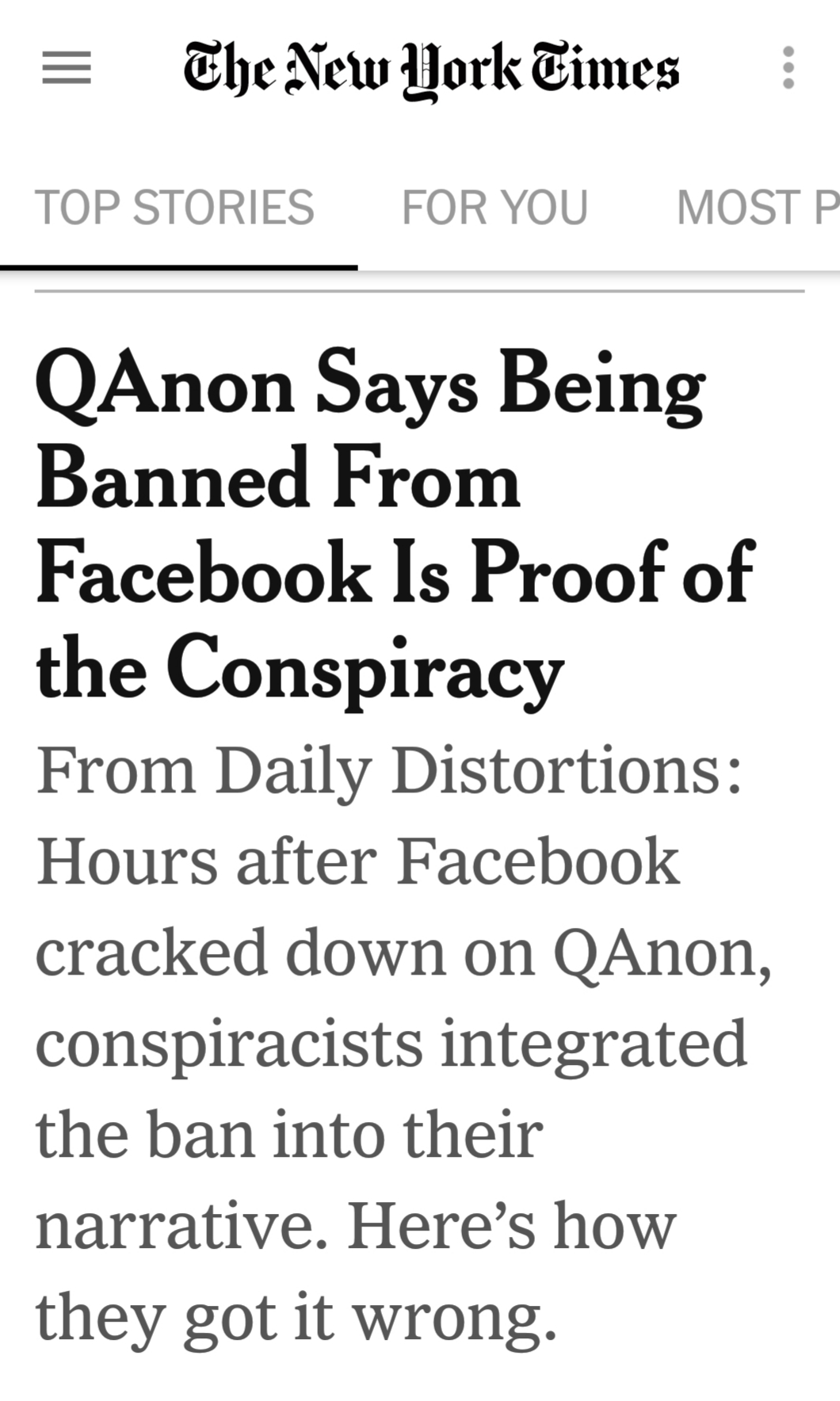
“Here’s how they got it wrong,” opines the know-it-all New York Times. Of course they’d attack a conspiracy they’re part of!
Another opinion: Look at Mark Zuckerberg, lifetime CEO of Facebook. Who looks and acts more like the personification of the monsters Q is exposing and fighting than that creepy, greedy bastard?Who has more motivation to crush the horrific truth, in all its forms, than Zuck?
I hope you know I am being arch here. QAnon is a recycling of the old antisemitic myth about Jews who control the world and live forever by drinking the blood of Christian children. The fuckers richly deserve to be prevented from spreading this horse shit in every public forum.
On the other hand, hard to disagree about Zuckerberg, I think.
Mr. Trump calls for Joe Biden, Barack Obama and Hillary Clinton to be locked up. LOCK THEM UP! LOCK THEM UP!! He’s not happy with his Attorney General, very disappointing fixer! Just bring the charges already… there’s more than enough proof.Of course, it goes without saying that Kamala Harris is a “monster,” a “communist” and a “smelly pirate hooker.” It’s not like 1,000 women have accused Trump of gross sexual assault, like that animal Bill Cosby, this latest liar is only the 26th to accuse the unfairly attacked president. Women love Trump!
Of course, the lying, despicable, desperately corrupt New York Times gleefully piles on, on top of the disappointing Barr and the weak Mike Pompeo, and ran this headline:
Trump Lashes Out at His Cabinet With Calls to Indict Political Rival
… The president castigated his own team, declaring that Attorney General William P. Barr would go down in history “as a very sad, sad situation” if he did not indict Democrats like Mr. Biden and former President Barack Obama. He complained that Secretary of State Mike Pompeo had not released Hillary Clinton’s emails, saying, “I’m not happy about him for that reason.” And he targeted Christopher A. Wray, the F.B.I. director. “He’s been disappointing,” Mr. Trump said.
“Unless Bill Barr indicts these people for crimes, the greatest political crime in the history of our country, then we’re going to get little satisfaction unless I win and we’ll just have to go, because I won’t forget it,” Mr. Trump said, referring to the investigation into his 2016 campaign ties with Russia. “But these people should be indicted. This was the greatest political crime in the history of our country, and that includes Obama and it includes Biden.”
Mr. Trump has often argued that his political antagonists should be prosecuted, but in this case, he went further by indicating that he had directly pressured Mr. Barr to indict without waiting for more evidence. “He’s got all the information he needs,” the president said. “They want to get more, more, more, they keep getting more. I said, ‘You don’t need any more.’”
and
During his hourlong morning call with Maria Bartiromo [at FOX-ed.], he seemed to suggest he may have been infected by the Gold Star parents of soldiers killed in battle at an event honoring them last month at the White House, although a spokeswoman later denied he meant that.
The president’s phone interviews were his first time answering questions since he was infected with the virus and flown to the Walter Reed National Military Medical Center, where he stayed for three nights. He said he was no longer taking the experimental drugs used to treat the virus, but he added that he was still taking a steroid that doctors say can produce bursts of energy, euphoria and even a sense of invulnerability.
“I felt pretty lousy,” Mr. Trump said. But, he added, “I’m back because I’m a perfect physical specimen and I’m extremely young.” He once again played down the severity of the disease. “Now what happens is you get better,” he said. “That’s what happens, you get better.”
For the Trump haters who smirk to read that the president suggested he’d been infected by Gold Star parents of suckers, er, soldiers, killed in the line of duty, and the White House spokeswoman denying he meant what he said–how about a moment of honesty, of personal humility? Everyone knows by now that the president doesn’t mean what he says or say what he means, unless he means to say something that is the opposite of what he said, if what he said causes a publicity headache, which happens. It happens to everybody!
Anyone can say “I don’t see why he would” when talking about a geopolitical adversary accused of meddling in your election when what you actually meant to say was “I don’t see why he WOULDN’T”. Two tiny letters, and one of those marks that look like a misplaced comma– Jesus, any of us could make the same little mistake, sound like we just said the opposite of what we actually said. Fucking libtards, man, brutal bunch.
On the other hand, it’s hard to disagree with the president’s assessment of the ethically challenged William P. Barr. His tenure as America’s top law enforcement official will go down in history “as a very sad, sad situation.” SAD!
My friend was on a steroid as treatment for something his body was fighting, maybe before a medical procedure of some kind. Early in the morning his wife woke up in an empty bed. Looking out the window she saw him up on a ladder, tirelessly scraping at the wall. They reported that before breakfast that day he did the work of five men.
I read this account just now, from a guy who took dexamethasone in the lead up to surgery for an acoustic neuroma:
I can’t imagine that anyone took me seriously during those weeks of higher-than-hell discombobulation — and if they did, they shouldn’t have. After all, I was a sick man on the brink of a life-changing operation, feeling a false sense of invincibility thanks to a flush of steroids. So I get where Trump is coming from, and I can somewhat understand the misguided, Chuck Norris-worthy level of bravado that comes with dramatically walking up a set of steps, defiantly tearing off your mask, and saluting a military helicopter as it flies into the sunset. He probably feels like the hero in his own action movie right now, and maybe he deems it necessary to communicate that sense of strength to the rest of the world.
The problem is, it’s not real strength. It’s a steroid. It’s a drug. And, judging by my personal experience, dexamethasone may be giving him the same false feeling of stability and empowerment that it gave me.
The difference? I was a touring musician singing songs about my wife; Trump is the leader of the free world with literally millions of lives in his hands.
Dexamethasone is a cheap and widely available corticosteroid that is used to head off an immune system overreaction and treat inflammation.
The drug has risen to prominence as a COVID-19 treatment after a study published in the New England Journal of Medicine in July found it significantly improved the chances of survival for seriously ill COVID-19 patients.
Researchers behind the study found the drug reduced deaths by 35 percent for patients on ventilators and by 20 percent in those only needing supplemental oxygen, although the steroid did not appear to show any benefit to COVID-19 patients who didn’t require ventilation or oxygen.
The announcement that Trump was being treated with dexamethasone raised concerns about the severity of his condition as the drug is typically reserved for patients with severe COVID-19 and not prescribed to patients in the early stages of infection as it can suppress the immune system’s capability to fight off the virus.
The National Institutes of Health’s treatment guidelines recommend against the use of dexamethasone for the treatment of patients who do not require supplemental oxygen.
Trump’s doctors said the president received oxygen on Friday following a temporary drop in oxygen level. On Saturday morning, Trump’s oxygen saturation dropped to 93 percent, prompting the decision to initiate the steroid therapy. Healthy blood oxygen levels range from 95 to 100 percent.
Dexamethasone can cause a range of side effects, from blood clots, headaches and blurred vision to aggression, agitation, anxiety, irritability and depression.
“It can cause psychosis. It can cause delirium. It can cause mania,” Megan Ranney, an emergency physician and associate professor at Brown University, told CNN Sunday.
“I would never want to say the president is experiencing steroid-induced psychosis, but it is certainly concerning to see some of his actions today in the wake of this potentially deadly diagnosis and infectious disease.”
Peter Bach, director of the Center for Health Policy and Outcomes at Memorial Sloan Kettering Cancer Center, told The Washington Post a well-known effect of the drug is euphoria and the tendency to over-exaggerate how well they feel.
Dexamethasone is also a banned performance-enhancing drug, according to the World Anti-Doping Agency’s 2019 list of prohibited drugs. The drug is listed under “glucocorticoids,” which are prohibited when administered by oral, intravenous, intramuscular or rectal routes.
Prior to the recent presidential debate, Trump demanded former Vice President Joe Biden take a drug test, suggesting Biden had used drugs to bolster his performance during the Democratic debates.
“I will be strongly demanding a Drug Test of Sleepy Joe Biden prior to, or after, the Debate on Tuesday night. Naturally, I will agree to take one also,” Trump tweeted. “His Debate performances have been record setting UNEVEN, to put it mildly. Only drugs could have caused this discrepancy???”
Trump tweeted Tuesday he plans to move forward with the second presidential debate scheduled for Oct. 15 in Miami.
Trump, who is still infected with the virus, was discharged from Walter Reed Monday evening and returned to the White House determined to show the public he had gotten the better of the virus. He walked up the stairs of the South Portico upon his return, removed his mask and posed for photos while looking over the balcony above the South Lawn.
In a video posted to Twitter following his return, Trump said he “felt better than 20 years ago” and urged people not to be afraid of the coronavirus or let it “dominate” their lives.
The message of these ads is pretty clear, I suppose. Biden coddles criminals and hates the police, and so you will live in violent chaos if he’s elected — cops won’t do their jobs under a president who hates them, because they have a higher loyalty than enforcing the law.
Martin Luther King is either with us or, more likely, a precise illustration of the existential threat posed by such men, and the reason we need to keep fighting against lying, Jesus-quoting troublemakers who claim we’re a materialistic, violent, racist nation, placing greed for money and lust for war above human life.
And, while we’re on the subject of never surrendering, the glorious Confederacy,which only fought against American tranny, after all, and only when provoked beyond human endurance, and who fought not for slavery but for “states rights” and “home rule” (whatever those articles of secession might have supposedly stated) never lost the Civil War. The proof of this commitment to the “Lost Cause” is the Republican party we have today, the party of Trump and the most extreme of our billionaires — and millions of loyal citizens who will not take the evidence of their own eyes for an answer, not without a fight.
Stay strong, Karen Pence (only person at the Vice Presidential debate yesterday, outside of debaters and the moderator, not wearing a mask.)
The quote above (reported HERE) was a cornerstone of the Republican argument in the U.S. Supreme Court, defending enforcement of a South Carolina law that requires a legally prescribed witness statement to be included with every mail in ballot — in order for the vote to be valid. South Carolina enacted this law because of the claimed danger of runaway voter fraud, incidence of which has been documented (by well-paid voting fraud conspiracists like Hans von Spakovsky) at less than ten thousandths of one percent: 0.00004%
It begs the obvious question in a democracy: how is the State different than the will of the voters who elect their representatives? How is the safety of citizens different than the safety of the State?
Here is how CNN reported on the Republican effort to limit mail-in ballots in a state where Republican Senator Lindsey Graham is running neck and neck with his Democratic challenger Jaime Harrison.
Republicans argued to the Supreme Court that more than 150,000 absentee ballots “have been mailed out already, and each passing day increases the risk that ballots will be returned, that, in mistaken reliance on the district court’s injunction, do not comply with the witness requirement.”
They said, “Although COVID-19 might make in-person voting less desirable, courts cannot hold private citizens’ decisions to stay home for their own safety against the State.”
Justice Brett Kavanaugh explained why he had voted in favor of the Republicans. He said a state legislature’s decision either to “keep or to make changes to election rules to address COVID-19 ordinarily should not be subject to second-guessing by an unelected federal judiciary” and that the court has repeatedly emphasized that federal courts should not alter state election rules too close to an election.
“Although COVID-19 might make in-person voting less desirable,”
Presumably the possibility of catching a serious and sometimes deadly disease is less desirable than staying out of an infectious indoor space where you are likeliest to be exposed to this dangerous pathogen. This phrasing is an example of why lawyers are so hated.
“courts cannot hold private citizens’ decisions to stay home for their own safety”
Courts can’t elevate the selfish desire of private citizens to protect themselves against the inconvenience of some flu-like disease above the right of the…
“against the State.”
As for Justice Boof Kavanaugh’s explanation: it makes perfect sense — in a nation with no history of persistent and widespreadvoter suppression and intimidation — or in a nation that was not forced to make a number of laws to stop these anti-democratic practices and to enforce those laws in the courts (until the Supreme Court gutted the Voting Rights Act in 2013) — or in any nation in the middle of a deadly pandemic that rages most uncontrollably in indoor, crowded spaces, like polling places, particularly the few open in “underserved” areas.
But — come on, now. Crimes against the State, y’all.
Someone close to me is close to someone who routinely lies to her. It is very uncomfortable for me to see her in this position, since if you can’t trust somebody you rely on, how can you trust them — or rely on them? The lies have not been small or infrequent, they are regular, big and sometimes about things of great importance.
Once, trying to be supportive, a few years back,I asked how this person (who I can’t stand) was doing.
“How would I know?” she said, wearily.
Point taken. I no longer ask her how the untruthful fellow is doing.
I’ve been watching the often excellent legal analyses of former federal prosecutor Glenn Kirschner on youTube. I began to notice his insightful take on law and justice during Mr. Trump’s attorney, General Barr’s, attempt to finally do what fired FBI Director James Comey would not do — make the “Flynn thing” go away.
Mr. Trump’s former National Security AdvisorGeneralMike Flynn, we recall, was fired by Mr. Trump after it came out that Flynn had lied about illegal contacts with the Russian ambassador, lies that VP Mike Pence then repeated as true on television. Flynn then lied to the FBI about lying, eventually pleading guilty as part of a plea deal that involved admitting other lies (involving payments from Turkey and Saudi Arabia).
Trump was outraged at the persecution of this good, loyal man (Flynn had led the “Lock Her UP!” chant at the RNC) and made his outrage known, in speeches and via twitter. Eventually, AG Barr decided that the crimes Flynn had pleaded guilty to were not actually crimes after all — and that he’d been trapped into lying by liars and likely criminals — and Barr now seeks to dismiss the DOJ’s case against Flynn outright.
Kirschner has been fiercely following every detail of Judge Emmet Sullivan’s principled stand to get a coherent explanation for this seemingly politically motivated DOJ reversal — the highly unusual dismissal of a prosecution after a guilty plea. Naturally, Judge Sullivan is vilified on FOX as an “abjectly biased” politically corrupt judge persecuting the wrongfully prosecuted, innocent General Flynn out of political animus, something Ronald Reagan surely never suspected of Sullivan when he appointed him to the federal bench in 1984 [1].
Anyway, good people, on all sides, one supposes. Back to Glenn Kirschner — he has been questioning whether the president even has the coronavirus at all or whether it is merely a stunt to refocus and change a political narrative that is going very badly for the president lately in the weeks that will decide if he is re-elected or becomes a criminal defendant at more than one trial.
Kirschner keeps insisting that he won’t believe Trump is sick unless he hears it from a reputable source, like Anthony Fauci. He has been pointing out the many contradictions and abrupt changes in the official reports of how sick the president actually is. Many of these constantly shifting comments from the president’s spokespeople have been ridiculous, even in the age of Trump.
What we know is limited: Mr. Trump took no test Tuesday night before his debate with Joe Biden, his close associate Hope Hicks, who he’d been campaigning with, had symptoms and tested positive Wednesday, he then met with big money donors on Thursday, shortly before (or possibly after) his positive covid test result came back. When was his last negative test? When did his symptoms start?
I didn’t really get why Kirschner was so exercised on this point — or what the upside of Trump pretending to be very sick could be– until yesterday.I kept wondering what Trump has to gain by claiming to have been felled by the coronavirus he has been downplaying for months.
Kirschner explained yesterday, after Trump checked himself out of the hospital, pulled off his mask and stood on the White House balcony in his bare-chested Putin on horseback moment. Trump smiled his infectious smile, or a game attempt at his infectious smile, no less infectious for being less than 100% convincing. He looked tired in that short appearance for the cameras; haggard, his eyes smaller than usual and red.
The first part of Kirshner’s point about Trump’s actual medical condition was the obvious “how would we know?” There is nobody of any credibility remaining around the president, outside of Dr. Fauci.
The second part, which I just got, is the strongman propaganda value of an indomitable president refusing to be dominated by a deadly disease. If Trump is hospitalized with serious enough COVID symptoms to need steroids, oxygen, experimental monoclonal antibody treatment, then — in only three days– has a miraculous recovery, shouldn’t we all believe in miracles just a little more than we already do? The miracle is much easier to pull off if the recovery was after a non-illness, it stands to reason.
Just because somebody has lied many times, by long habit, by reflex, and insists that people lie constantly on his behalf, that doesn’t mean that they can’t be telling the truth now.
Call it a miracle if you want. Some people will call “bullshit!” — others will see the will of God, working in divinely mysterious ways, through this most imperfect of imperfect vessels.
The coronavirus’s rampage through America threw a spotlight on its failings — on the galling inequality, the fatal partisanship, the susceptibility to fiction and the way in which rugged individualism had curdled into plain old selfishness.
The coronavirus’s rampage through the White House has had the same effect. What we have seen over recent days is Donald Trump’s presidency in miniature, his worst traits distilled. Two in particular — mendacity and recklessness — are on especially unsettling display.
and later, after commenting on the report that Trump’s people in the West Wing know the boss will not be happy if they bring a mask to work, or try to maintain social distancing, or act in any way like a deadly pandemic is sweeping the world, including inside the White House:
That’s a metaphor for a whole lot more. If you want to make the boss happy, you tell him that his inauguration drew many more people than it did. You tell him bad news is fake. You tell him the polls are off. You tell him Robert Mueller’s investigation is a hoax. You tell him that President Obama spied on his campaign.
You become Attorney General Bill Barr, a one-man factory of exonerations and excuses. You abet his existence in an alternate reality, where the sun is always shining and will magically zap an inconvenient virus into oblivion.
Nicely done, Frank.
Speaking of Trump’s attorney, General Barr, today we learn (from the NY Times) that there is a legal challenge to Mr. Barr’s game, eleventh hour attempt to use the Federal Tort Claims Act to make the E. Jean Carroll defamation suit against Mr. Trump go away. Her suit was commenced after the president publicly called Ms. Carroll a liar and said she “wasn’t his type”(by way of saying it was idiotic of her to accuse him of raping her, and outrageous to demand his DNA for comparison to the specimen on the clothes she wore that day at Bergdorf Goodman that nothing happened).
Barr’s DOJ intervened at the last possible moment, to prevent Mr. Trump from having to turn over some DNA in the New York State case. Barr’s perfectly reasonable rationale is that Mr. Trump was performing his official duties as president when he called E. Jean Carroll a sexually unattractive liar.
In fairness to the unfairly beleaguered Mr. Trump,name one president who hasn’t been called upon, at some point in the course of his official duties, to publicly denounce a media-hungry, vicious, lying dog who claimed he raped her?
Ms. Carroll’s lawyers made a motion to block Barr from making the defamation lawsuit disappear by this arguably corrupt legal maneuver.
In their newly filed court papers, Ms. Carroll’s lawyers asked a judge to block the move, arguing that while the law in question, the Federal Tort Claims Act, generally applies to lower-level government employees, it did not apply to Mr. Trump — or to any other president. They also said that Mr. Trump, in any case, was not acting in his official role when he denied Ms. Carroll’s claims.
“There is not a single person in the United States — not the president and not anyone else — whose job description includes slandering women they sexually assaulted,” the lawyers said.
Barr, for his part, had his unimpeachable, iron-clad answer ready:
“The law is clear,” Mr. Barr told reporters. “It is done frequently. And the little tempest that’s going on is largely because of the bizarre political environment in which we live.”



 gratuitousblahg