Revenge of the Loser

When a child is born to a ruthless and destructive parent, the kid has two choices growing up — once she recognizes what she is up against (no easy task). The child can follow the path set by the parent — learn to kill like an alpha predator or become prey, a weakling, a “loser” unworthy of love, say — or grow up to repudiate that pernicious worldview. The world is a place of infinite gradation, becoming like or disavowing a destructive parent is one of the few truly black and white choices we are given in this life, though far from an easy one.

It’s hard enough for a child to get a clear view of a parent’s destructiveness. Much of the damage parents do is unintended and passionately justified by love. The hardest injuries to recover from are the subtle ones, the hardest ones to even see. It takes dedicated work, and luck, to see a parent clearly enough to understand the damage they were able to inflict. Children naturally blame themselves when their parents are angry at them. It often takes many years, if ever, to get a more useful adult perspective that can guide you going forward in your own life.

It can become even more complicated to recover from parental abuse when that parent has vast resources to manipulate the kid with. Back in 1948 our current lame duck president, as a two year-old, was effectively given a $4,000 a week (in 2018 dollars) allowance. He was a millionaire by eight, a multi-millionaire by his teen years. He learned from both of his striving parents that there is only one value in life: increasing your fortune by any means possible. A person who was given great wealth and did not tirelessly increase that wealth was a piece of shit, a “loser”, in the Frederick Christ Trump household.

The president’s charismatic older brother, who sought independence from an overbearing and vicious father, ended his alcoholic life heading a janitorial crew in one of his punitive father’s buildings. Drank himself to death, as the saying goes. The lesson was not lost on young Donald. He would not take the risk of defying his iron-willed father, besides, the idea of being the most powerful and envied man in the world appealed to him greatly.

And so it was. In 2016 he became the most powerful man in the world. A petulant, childish most powerful man, but one able to exact terrible revenge on anyone who hurt him with criticism, disloyalty, a perverse insistence on being bound by abstractions like lawfulness and norms. A man who could order the Mother of All (non-nuclear) Bombs to be dropped somewhere in the Middle East, devastating a huge area, for no apparent purpose, with no blowback from anyone. He was hailed all around as “presidential” for this kind of bold, decisive action. As he was, by his loyal base, when he crammed through the rushed, last-minute lifetime appointment of a religious zealot on to the Supreme Court, cementing the anti-abortion majority he’d promised. Coney Barrett promptly provided the decisive vote on a controversial and wrongly decided “religious liberty” case that will cost countless more American lives during the pandemic.

Before he lost the recent election, decisively defeated by a man he called “the worst candidate in history,” Joe Biden, Trump announced, over and over, that any election he lost would be contested in court as fake, the result of a vast conspiracy to rig the election. On election night, as early vote counting showed him ahead and he strongly suggested to his millions of followers that he had, in fact, already won the election, he also spoke of the army of lawyers he was going to unleash to overturn the election results that stole the presidency from him. Coherent messaging is not his thing, nor is it demanded by any of the 73,000,000 who voted for him.

His record in those forty post-election lawsuits was not good. Team Trump and the RNC compiled a losing record, they went 1 and 39, (a winning percentage of .025, for you sports fans). The New York Times, among others, wrote mean sub-headlines like:

A small group of lawyers for Mr. Trump’s campaign has presided over a widely mocked, circuslike legal effort to try to invalidate votes and prevent states from certifying their results

In the end, all of his machinations to evade the law, obstruct justice (the only real through-line of his wildly litigious life) and maintain his power by sheer force of personality (and the considerable power and prestige of his office) failed. Tens of millions love him, but there were not enough millions of violent, well-organized followers who were also willing to die in street battles, fighting the US government, to keep Mr. Trump in power.

All that remains now is Trump’s unslakable will for revenge, to mark the world in his image as much as he can in the last days of his presidency. His loyalists are in place in every government agency to make permanent changes in his incoherent image, lawyers are working tirelessly to change the civil service rules to make it impossible to get rid of his unqualified appointees, his senseless changes to longstanding rules and procedures.

He is hurrying work on The Wall, his legacy, crews are furiously dynamiting remote mountains, destroying habitat, bulldozing indigenous burial grounds to build another 30 miles of WALL before he leaves office. He is currently pursuing 117 lawsuits in states like Arizona to force property owners to allow the wall to be built across their private property. If Biden wants to halt construction after January 20th, he will have to pay enormous cancellation fees on all the contracts Trump handed out, each with a large fee for cancellation written into it.

I recall Trump being interviewed during the campaign and answering forthrightly about several of his campaign slogans. “Lock her up!” the chant that recently pardoned perjurer and undisclosed employee of Turkey Michael Flynn led at the RNC was a no-brainer. They’d branded Hillary Clinton “Crooked Hillary” and ran against her as the corrupt, criminal butcher of those poor, betrayed Americans in Benghazi. The interviewer asked candidate Trump about “Build that wall!” He said somebody suggested it, and he didn’t think it was very good, but was amazed at how crowds took to it. Crowds loved chanting that, so he made sure to lead the chant in every speech after that. A gigantic wall went on to become a huge part of his legacy.

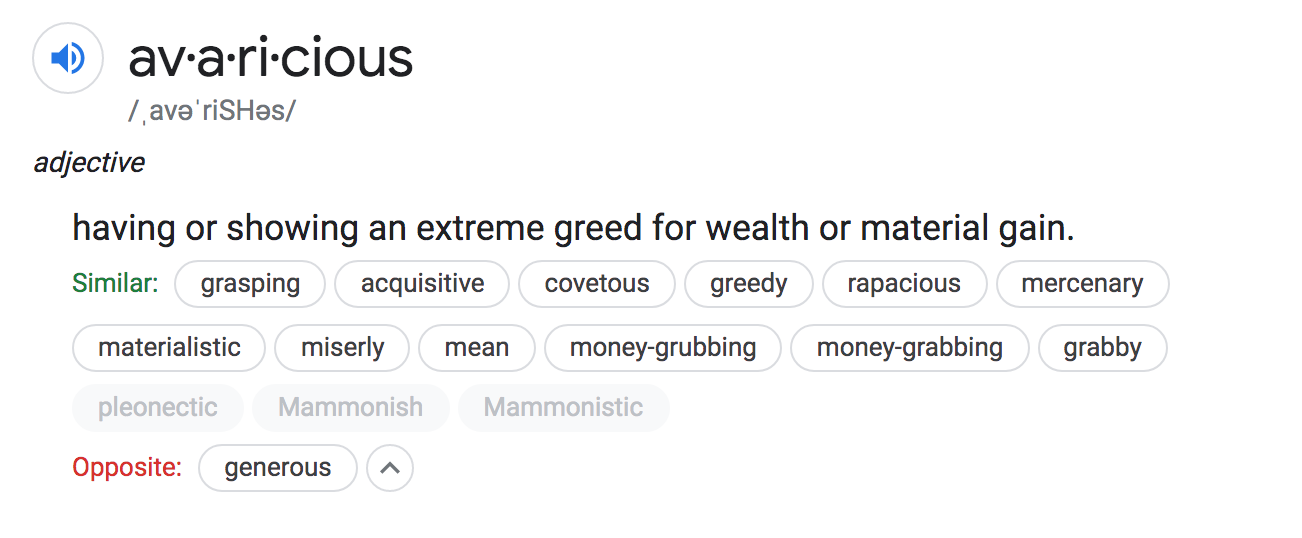
Mr. Trump is often called “transactional” which is a nice way of describing a lifelong loser obsessed with being seen a winner [1]. Every encounter is a zero-sum transaction– one winner, one loser. It is a pathetic, damaged way to view the world, which is only saved from destruction by intelligent negotiation and compromise. Compromise is disgrace, in the eyes of a killer. You do not compromise with prey, you tear out its throat, eat its flesh. That’s what winners do.

Winners”, apparently, will do anything imaginable not to be seen as “losers”.

In the dark of night, a day or two before Christmas, in the waning hours of the Bush-Cheney administration, by voice vote, Congress passed a law to cripple the United States Postal Service by forcing it to fund its retirement plans 75 years in to the future. The draconian law requires the USPS to fully fund the retirement of workers not yet even born. It is the only business in the world subjected to this kind of unfeasible mandate.

When you read about this law you generally see “Congress passed” attached to it, but there’s no hint of the midnight partisan vote in the last days of a presidency that, until Trump’s, was seen as the most disastrous in history. Stay tuned for Trump’s version of this kind of angry loser power-play– Trump is the worst we’ve ever seen, on steroids.

[1]

The problematic NY Times lays it on:

The president’s inability to concede the election is the latest realty-denying moment in a career preoccupied with an epithet

source

Final Note on Estranged Friends

Note: the title of this piece is probably about as true as any of Mr. Trump’s assertions — this subject is one my thoughts inevitably return to from time to time [1]. Fascinating and terrible at once, it’s hard for me to keep from periodically chewing on the perplexing mystery of losing old friends. I will try to add a few thoughts to a piece I posted the other day called The Complex Difficulty of Human Affairs.

Zora Neale Hurston, toward the end of her 1937 masterpiece Their Eyes Were Watching God, wrote of two women sitting together under the night sky sharing that “oldest of human longings — self-revelation.” The desire to know and make yourself known to another in an authentic way ideally leads to acceptance — you will know all these things I share and give me similar things in return and neither will judge the other. It strikes me as a profound comfort human beings often seek in a world that is often indifferent, in a life that inevitably ends in death.

It is foolish, of course, to seek this profound connection in every relationship. Mutual self-revelation, on more than a minimal scale, is a rare thing. The good news is that good friendship can be based on many things, without any express self-revelation as such. We know each other by our deeds, our mutual willingness to help, our desire not to hurt. When you need my help, I’m there, when I need a hand, you won’t hesitate to lend one.

In thinking about the end of my long correspondence with Karl, a short, politely worded email about the impossibility of continuing our almost daily writing, I have to think about our very different expectations of life. Also, Karl as part of a troubling pattern over the course of the second half of my life — fatal estrangements. As a friend noted recently, finally putting these terminal friendships out of their misery helps me sleep at night. On the other hand, the mystery of why I’ve experienced so many of these fatalities remains. Is it not better to let friendships that have outlived their lives simply drift away?

It is a mild spring-like day outside, and an argument could be made I’d be better off vigorously exercising out there than rattling the keys here in a dim room overlooking Sekhnet’s garden. We each have our own way of doing what we need to do. I’ll take a long walk with Sekhnet when the sun is low in the sky.

I’ve written about my now deceased former friend Mark and his eternal three act tragedy. Mark, a man with high expectations, was compelled to relive the same excitement, deterioration, betrayal pattern in every relationship he ever had. It was easy for me to see, easy for anyone I mentioned it to to recognize, there were countless examples, stories with the identical dramatic arc. Mark had no insight into his need to idealize, criticize, alienate. He lived an unhappy life and died alone, probably of a broken heart, naked in his chair.

Looking at the many friendships I’ve had over the years, relationships that I no longer have, I must recognize the possibility that I am as blind to my role in their inevitable deaths as Mark was to his role in driving people he once loved away. After all, it is not one person who has angrily attacked me for being angry, or considered himself so intolerably provoked by me that he had to strike back hard, or felt the need to use deadly force to defend himself against a detailed list of “intolerable” offenses I insisted on “resolving”.

It could simply be that the many subtle ways I learned to infuriate my father during our hundreds of senseless fights to the death are something I cannot control. I believe, when I reach my breaking point with someone I’ve known for years, that I’m being logical, fair and humane, that I am presenting reasonable needs calmly; the recipient sees only a death ray. I do not discount the possibility that to them I show every aspect of a raging, over-sensitive asshole, though I also don’t accept that view as necessarily true.

I can also see that the people I wind up estranged from fit a certain personality type, not unlike my father on a fundamental level. They are people who will never back down when they feel cornered, no matter how gently one may have “cornered” them. This kind of casting is a feature of the Repetition Compulsion, placing others into the role of a primal trauma-inducer in an attempt to replay the psychological drama to a better outcome. It’s a game for suckers, that, a game we play unconsciously. I can also see, in hindsight, that over my life I’ve chosen many friends for their intelligence, wit and, often subtle, similarity to my combative father’s desperate zero-sum mentality. We both can’t be partially right and come to an understanding based on compromise of any kind — one of us has to die.

There is a small counterbalance to be had, looking at the subsequent lives of people I could no longer maintain friendships with. Raj and his wife finally divorced, his old friend I fell out with years ago (former husband of a woman I recall as Hitler) and Raj are no longer friends, Pavel told me I was by far his closest friend (before I unfairly accused him of insensitivity when he was only being cooly analytical about my vexing medical insurance situation) Karl lives an isolated life in Poland swallowing anger and serving a strong-willed second wife, etc.

I can look at each of these largely unhappy guys and think — we couldn’t help each other when we needed support the most. It happens. It is not the fault of anything but our respective human natures. The miracle is not that we finally went our separate ways, but that we were friends for so many years.

What expectation do I have of the world? To try to be patient listening to and honestly discussing the worries of my mate, without making her feel worse about things that already bother her. To have her listen to my troubles, without rushing to offer solutions before she’s heard the entire problem. To immediately make amends when I know I’ve hurt somebody. I have to admit, I eventually find these things, when they are missing, intolerable.

What expectations does Karl have of the world? I have no idea, but his worldview seem fundamentally more pessimistic than mine. Life is brutish, unfair, short, I suppose. In his case, it strikes me as a characteristically grim Protestant view of our duties to each other here on the earth. Impossible in the end, perhaps, for a humanistic Jew like me to fully grasp and appreciate, just as my outlook must seem absurd to him.

What expectations does someone who will only offer an apology when forced into it have? It seems they’d be unlikely to expect an apology if they were hurt — though perhaps they would expect it more than most. It is largely futile trying to imagine what is in the head and heart of somebody else, unless they work to reveal it to us. In most cases, the inner lives of others are a mystery.

As we can see all around us, people will construct whatever meaning they need to live as they see fit in our troubled world. A candidate they back can lose an election by more than six million votes and they can honestly insist he didn’t lose — the states that returned majorities against him were in on a conspiracy to steal the office from him. Proof or lack of proof do not come into strong convictions that will cause righteous armies to march — they feel the truth of it boiling in their blood.

So it is with people I’ve been close with, who, in several cases, I have had to behead in the end. They will believe, with the irrefutable proof that I wielded the sword that felled our friendship, that I am a vicious and unforgiving hypocrite who talks about not causing harm but who is as destructive as end-stage cancer. In my estimation, they were not capable of the kind of honesty that is a bottom line in my own life: if someone tells you they are hurt, hear them out before dismissing their complaint as the whining of a weak, corrupt, spoiled, hypocrite bastard.

On the other hand, and, of course, I may simply be a whining, weak, corrupt, spoiled, hypocrite bastard. Something like that is very hard to ever know for sure, no matter how certain we may feel in our bones.

[1]

A murdered darling I couldn’t totally delete, I’d originally added: as a dog returneth to his vomit.

Which is part of that great, largely meaningless, proverb:

כְּ֭כֶלֶב שָׁ֣ב עַל־קֵאֹ֑ו כְּ֝סִ֗יל שֹׁונֶ֥ה בְאִוַּלְתֹּֽו

As a dog returneth to his vomit, so is a fool who repeateth his folly.

The Complex Difficulty of Human Affairs

A few days ago I read a few pages of that eternal provoker of thoughts, Hannah Arendt’s masterpiece Eichmann in Jerusalem, a book I pick up and open at random from time to time — most of the time finding something I didn’t notice in the previous readings.   Read a section on the Israeli judges asking Eichmann, who knowingly and diligently sent countless people to their deaths, about his conscience.  Arendt then shows how he actually exercised a kind of conscience, at first (a little) in diverting a trainload of Jews and Gypsies to a ghetto instead of a killing center (they were still using bullets at that point) and then how quickly (four weeks) his conscience reformed itself into a standard loyal Nazi one.    

That gave me a fleeting thought about former buddy Karl, American expatriat in Poland (the action on the page had taken place in the Nazi Protectorate, near Lodz) and my childhood friend Raj’s concern a few years back that his childhood friend Karl was becoming a fascist (I’d also noted a slide to the nationalist right in Karl).

Which led me to this thought, in regard to someone like Karl being angry enough to silently write me out of his life forever (for my offense of no longer being friends with Raj, I suppose, since Karl and I never had any argument I can recall). This is that area of human life that makes knowing anything for certain tricky — for we are all very certain of our justifications when we act decisively. When we write somebody off there is seldom any doubt in our mind that our decision was a righteous one.

To Raj, I was heartless not to keep forgiving the inadvertently aggravating things he may have sometimes, even often, done. He was angry that I wouldn’t let an ongoing bygone be a bygone. To me, Raj’s habitual passive aggression was as intolerable as his “I know you are, but what am I?” insistence that he was not doing anything objectionable, that I was the one who was being unreasonable in trying to get him to refrain from doing things that, in his mind, I constantly overreacted to.

Karl seems to have written me off out of simple loyalty to his childhood friend, tartly dismissing whatever we’d observed about the difficulty of dealing with Raj’s neurosis. Karl, in Poland, had little regular contact with Raj and as for their once yearly visits, things were as cool between them as between Karl and any of his other longtime friends in the USA.

I’ve always tended to express my feelings more than most people I know. This leads to my not unfair reputation as a belly-acher, a tendency I’ve tried to dial back in recent years — with mixed results.  I get this largely from my mother, I think, this sometimes plaintive expressiveness. I’ve also always had more time and inclination than most people to ponder and more ways to express myself– as well as a greater need to do those things than most.  My friends know pretty much exactly how I feel most of the time.  I’m interested in their thoughts and feelings too, and I try to listen to them with the same engagement and empathy I hope for from them. Because we are all homo sapiens, this does not always guarantee a good result. That’s where mutual compassion becomes indispensable.  

We are lucky if we have one other person in our life who we can safely have this kind of mutually vulnerable exchange with. With a close friend there should never be much mystery about how the other feels about things that are important to us, and it’s a big part of the strength and resilience of a close friendship — managing to listen with engagement even when the other person’s feelings might not be like our own in a similar circumstance.   

A rare and extremely valuable thing, that.  It goes a long way to reminding each other we’re no more insane than the next person, no matter how shook up we might have felt before discussing the thing, and, importantly, it may be the only assurance we get of that from anyone.

Here’s the thought that dawned on me, taking Karl as the example.  He’s very bright, an excellent writer, introspective, sensitive, dry sense of humor, fine piano player (though he rarely plays in recent years).   Karl has been married to two women (divorced from the first after her traumatic open infidelity) who are strong-willed, demanding and make all the life decisions.   He is very devoted, but also chafes under their tyranny, while not allowing himself to talk about it except in quick, bitter asides — and suffers what he recognizes as regular repressed-rage symptoms from digestive, to migraines, to sometimes crippling nerve pains in back, neck, legs, hands, to other ailments.   

What could be more infuriating to a man who constantly swallows his anger than watching somebody else assess an unfair relationship, identify exactly what is intolerable about it, make several attempts to fix it and finally throw up his hands and say “so be it, asshole, adios” ?  

I don’t know why the Eichmann pages made me think of this, exactly. The insight about Karl here is not new, it just popped into relief somehow. You can sometimes trace a conflict to a fairly simple root. Karl, of course, will have an equally compelling story behind his brief formal email telling me not to bother writing back, ending an almost daily correspondence of several years.

There is also this about Karl. He is a fine writer who no longer writes (except to confide to his journal), an excellent piano player who doesn’t play. It is not surprising that he might well take a bitter view of a lesser writer (such as myself) who writes a “public” journal every day and although not a good piano player, plays contentedly several times a week.

 We’ve had a recent whiff of totalitarianism here in the USA, where we have came sickeningly close to a fascist overthrow of an election that went against a strongman, members of his party looking for ways beyond the law to nullify the clear will of the voters. It inspires nothing but horror in me (horror and a strong desire to stand with others against it). Karl’s drift to the right, his support of a nationalistic autocracy in Poland, seems an apt illustration of Hannah Arendt’s portrait of the ideal supporter of totalitarianism.

The “fascist” angle, Karl’s lurch to the right, seems to confirm to me that an inauthentic emotional life like the internally dishonest one Karl leads is fertile ground for a politics of grievance like Polish Nationalism, whatever the hell that entails.   Arendt makes this profound point about those who embrace totalitarianism, they are isolated and emotionally hollowed out, finally incapable of comparing things intelligently and making humane decisions — preferring membership in an orderly, militant hierarchy of (even insane) beliefs to the terrifying uncertainty of their emotional isolation.

This feeling gets stored up for release as hostility, saved for when the friend is in a tight spot. I was in a spot like this when my old friend Pavel expressed his curiously neutral concern when I was angrily flailing, again suddenly and unfairly without the health insurance I’d already paid for, during a pandemic, trying to find the laws governing termination of a policy under the Patient Protection and Affordable Care Act– laws nobody in the world can find, as it turns out. 

Karl, Raj and Pavel had something in common, all three spent years in combative relationships with their womenfolk, marriages that ended badly, as so many do.   I watched the ugliness up close with Raj, heard tales of an insanely bitter divorce from Pavel and had many examples of subtle one-sided warfare from Karl. Sekhnet and I have our share of conflict, but here’s a funny thing about our relationship — how good it must look to guys who are in constant war with their partners.

Sekhnet is hard-headed. I say this with a mix of admiration and vexation. Sekhnet is as loving a hard-headed woman as you will find anywhere. She is also funny, cute, smart and a great actress in social settings (as many of us are, but she’s really good). From the point of view of somebody battling hourly with his significant other, in a war that will eventually end in an ugly divorce, I seem to have an almost ideal situation that I often seem to be ungrateful for. From their vantage point, watching Sekhnet and me interact, I am a lucky bastard who enjoys a stress-free, relaxed relationship  with a supportive, delightful, loving mate with a great sense of humor.

So how intolerable must it be to them that I’m constantly belly-aching about my hard life, while men like Karl manage to manfully keep their fucking mouths shut and don’t trouble others with their personal problems, which are many times worse than my pampered whining about how hard it is being carried from pillow to pillow? 

Which leads finally to the fuller answer to my old friend’s good question from the other day — why is it often necessary to kill them in the end? 

There comes a point in the frustrating back and forth, after a once close friend’s hostility has become impossible to ignore, after they insist that they love me (Pavel, and his new girlfriend, and Raj and Raj’s wife, all insisted that because they “loved” me that I was being a complete vicious asshole not to forgive them, an assholishness which would justify them hating me if I didn’t immediately forgive them) when I am handed poison to swallow — in Raj’s case that I am wildly oversensitive to imagined “provocation” and an unforgiving monster insanely determined to be right and “win” at any cost, I demur. When poison is splashed into my mouth, I have to spit it out, cat with a hairball style, as I would pantomime for you if we were not interacting on a page.

Part of the process, sometimes, is severing the insistent hand that is holding out the familiar poison, to prevent another attempt to force it on me.   It is a move I had to use many times during childhood as I battled my poor bastard of a flailing father, who regenerated more limbs than a thousand embattled crabs and octopuses — a move, ironically, he implied at the end was right and appropriate when somebody is doing that to you. I don’t relish the brutality, but once it reaches the point of irreconcilable war, all attempts at peace dashed, it is preferable to the taste of poison in my mouth and I sleep better once it’s done.

Got to Love it…

We all want this pandemic to be over. We’re all tired of being afraid of this terrible disease. This is not a partisan issue, nobody wants to die, or see loved ones die, an awful death from this merciless illness.

I went into a pharmacy today and saw this sign on the door.

Immediate unkind thought: Ricky Gervais as prophet

Taiwan, population 24,000,000, flooded with Chinese tourists as COVID-19 hit. Total number of COVID-19 deaths in Taiwan: 7. They did this by quickly quarantining all infected (240,000 or so) and those who had contact with the infected, in their own homes, and bringing them all three meals a day at home while supervising quarantine with 3 random daily calls to government issued cellphones to ensure compliance. No lock down, healthy people wore masks, social distanced and were quickly tested if they felt symptoms, were immediately quarantined if infectious. Head of Taiwan’s pandemic response was a PhD trained at Johns Hopkins. The key to Taiwan’s success was their quick, smart action undertaken as early as possible [1].

It is likely that if our federal response had started along these lines when Mr. Trump told Bob Woodward how terrifying and deadly this airborne disease was, on February 7th, when he knew exactly what kind of plague we were up against, many, many, many, many, many American lives would have been saved. We’ll never know the number, but tens of thousands at minimum.

Not to be negative on the eve of our holiday dedicated to national gratefulness, thank God Operation Warp Speed is speeding along!

Happy Thanksgiving.

[1]

source: Larry Wilmore interview with Fareed Zakaria about his recent Ten Lessons for A Post-Pandemic World.

Hunger is only a problem for the Hungry. Really?

By now we should all realize with clarity exactly what we are up against. The state envisioned by “winners” like Charles Koch, Donald Trump, Jared Kushner, Steve Mnuchin and other right-wing stalwarts born into incredible wealth, is like an autocratic, abusive, but very wealthy father they stand to inherit the world from. That ruthless state sets all the conditions you must live by if you want the rewards it may or may not hold out to you, and you have no right to any say about the conditions. You do exactly what the overbearing parent-state tells you to do, you obey, this is not a “democracy”!

The autocratic state rightfully tells anyone in need that their trouble is entirely their own problem and that they need to simply grow up and stop whining about it or the state will really give ’em something to whine about.

How about a life sentence in a state-supervised rape room for your sniveling and persistent illegal drug habit, loser? Do you think the state has any obligation to offer help if your life is crippled by drug addiction? Think again, our public-private partners make billions a year keeping you locked up, that’s called win-win. Do the math again, inmate, you’re still the loser.

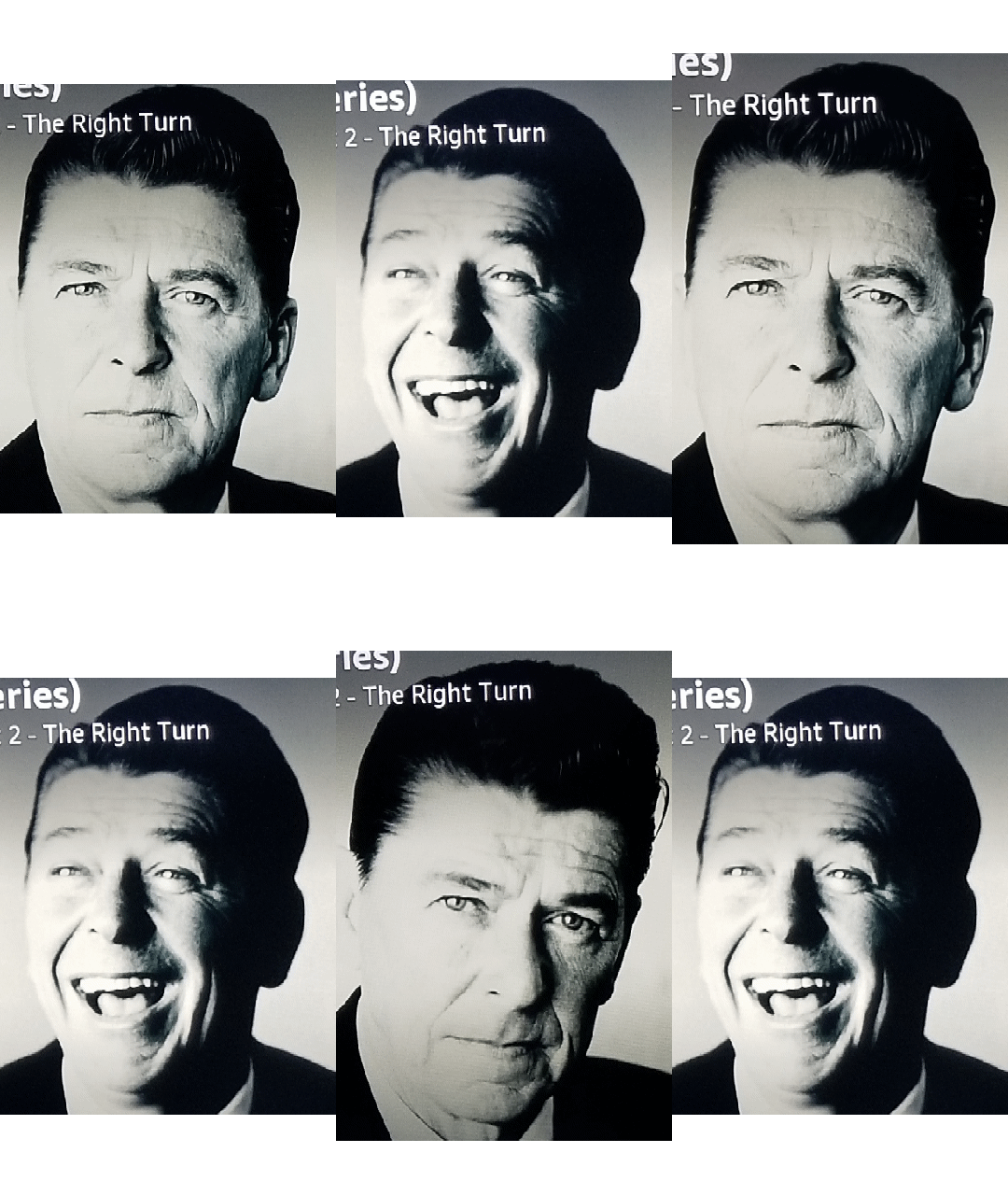
This ideology in its current form dates back to Ronald Reagan, and Margaret Thatcher — the idea that we are all individuals competing, the best of us win and as for the millions who lose, nobody has any obligation to help weaklings who cannot help themselves, there is no social contract except ME. Though sometimes remembered with some nostalgia, these were two supremely vicious and destructive bitches, whatever superficial charms either may have displayed at times.

Relieved as I am that the worst will not come to pass in regard to the peaceful transfer of power to a far more human president, now is actually the time we have to start fighting in earnest, to the extent we can organize and make ourselves heard. We have to rebuild what has been ripped up, create a stronger, better social contract and a sturdier social safety nets, particularly during these once-in-a-century hard times. We are as strong as the weakest among us. The mark of a just society is how it treats its most vulnerable: children and old people, the sick and the poor. Take this for example:

As the U.S. enters the holiday season, millions of people across the country are struggling to find enough to eat, with the hunger relief group Feeding America warning that some 54 million U.S. residents currently face food insecurity amid a massive public health and economic crisis. Food insecurity in the U.S. has intensified after the expiration of federal assistance programs in the CARES Act, and the United Nations World Food Programme predicts acute hunger could affect 270 million people worldwide by the end of 2020 — an 82% increase since the start of the coronavirus pandemic.

source

some 54 million U.S. residents currently face food insecurity amid a massive public health and economic crisis.

Mitch McConnell just, since Election Day, rammed another six right-wing judges, some deemed “not qualified” by the conservative American Bar Association, onto lifetime spots on the federal bench. Then Mitch sent his hardworking colleagues home for a well-deserved break, while the millions of hungry Americans lining up at food pantries all over the country before Thanksgiving, during a highly contagious pandemic… well… what can you do? Mitch likely went home to Kentucky to eat turkey with all the fixin’s until he falls asleep in front of the football game on his gigantic TV.

Joe Biden has said over and over that “we are better than this, America” and rightfully so. We are better than this. The bar for “better” is presently very, very low, because these types, well… we have seen every day for four years that they are prepared to do literally anything to advance their ruthless vision of the state — an autocratic, abusive state that rewards only loyalty to the leader and the dumbest of dumb fucking luck (a nod to you, Betsey DeVos).

We need to be better than just better. We need to head, resolutely and steadily, away from the totalitarian impulse to simply “dominate” anyone who has a problem by forcing them to obey without question. Questioning authority, and the right to receive reasoned, responsive answers, is essential to fairness, which is another word for justice.

We all know what justice is, don’t we?

Thanksgiving Gift

Although Mitch McConnell spent his last few days before the current Senate Thanksgiving vacation busily packing a few more loyal far-right zealots onto the federal courts, and food lines grow at pantries around the country as hungry Americans line up during a raging pandemic with no federal aid in sight (Mitch has priorities — debating how to help suffering Americans, sadly, will just have to wait [1]) there is finally some belated news to be thankful about on the eve of what promises to be a somber Thanksgiving.

Trump’s charm/terror campaign with the Michigan Republicans and the Georgia Republicans to nullify the will of the voters has not worked. Michigan certified its vote for Biden today, Pennsylvania and Georgia will do the same, if they haven’t already. Trump’s hundreds of election-related lawsuits failed, his appeals will now dry up and blow away, his remaining legal team in the bunker is a damp Rudy Giuliani (crazed Mike Flynn attorney and QAnon believer Sidney Powell was disavowed by Team Rudy today). Trump’s desperate faith in faithless electors (tip of the cap to Brian Lehrer at WNYC [2]) has not been rewarded, his violent supporters have not rallied to his cause and the bunker is about to empty out. As Jimmy Kimmel said recently, the rats are starting to put on their little bathing suits.

The Trump loyalist who heads the General Services Administration, the agency that gives the green light for the peaceful transition of power, releasing the money so Biden and his transition team can get up and running with national security and other briefings, transition logistics, office space, and everything else, has finally fucking signed the papers for the transition to begin in earnest– after only a few weeks of insane delay ordered by her boss. You can now stick a fork in Trump’s sweaty dream of a Trump States of America any time soon.

I had a wonderful sigh of relief getting much of this good news just a little while ago from the tireless Heather Cox Richardson who broke the best of the news above (to me, anyway) and laid out the history of the Republican party’s descent into what it has become, the party of white supremacy and protection of an antidemocratic elite. She set out this authoritarian lurch to the hard right concisely and with precision. Never have I seen this history described so well, in so few words.

The future is what we fight to make it, the fight will continue to be hard and nobody knows what will come next, but for me, reading Heather’s brilliant assessment tonight let me breathe a long overdue exhale of relief. I hope it will do the same for you.

[1]

Democratic Representative Ocasio-Cortez said on Friday during a House hearing that Mr McConnell, the Senate Majority Leader, was “abandoning our people”.

Just a day or two ago, the Senate majority leader, Senator McConnell, decided to break the Senate,” Ms Ocasio-Cortez said.

“And he broke the Senate as there are thousands of people in Texas lined up for food lines. He broke the Senate while hospitals no longer have beds to house the sick. He broke the Senate, and dismissed the Senate, while 30 million Americans are on the brink of eviction.

“And in breaking the Senate, we are abandoning our people.”

source

[2]

Faith in Democracy vs. Trump’s Faith In Faithless Electors

November 20, 2020

Trump’s attempts to overturn the election in the courts isn’t going well for him. But are there other ways, through quirks in the Electoral College, that he could hold on to power? On today’s show, Robert Alexander, professor of political science and founding director of the Institute for Civics and Public Policy at Ohio Northern University and the author of Representation and the Electoral College (Oxford University Press, 2019), talks about how tightly the Electoral College is bound by certified election results in their states. source

Corruption, according to our Attorney General

The professorial looking madman who auditioned for his position as top law enforcement officer for the most litigious and lawless president in history, lectured his questioner on the definition of the squishy word “corruption.” First, an excerpt from his audition for Attorney General:

This is an expression of Barr’s wildly extreme view of the powers of the Unitary Executive. Presidential accountability for ‘corrupt’ acts committed while in office? Balderdash! Nothing the president does under his limitless Article II powers can be scrutinized for corruption if the president does not want it to be.

During his confirmation hearing, Barr patiently gave Senator Dianne Feinstein one of his trademarked circular lectures on the definition of “corruptly” (while running out the clock on substantive questions, like an expert college basketball team freezing the ball in the old days):

What it means is using it in the nineteenth century sense, it meant ‘to influence in a way that changes something that’s good and fit to something that’s bad and unfit’, namely the ‘corruption of evidence’, or ‘the corruption of a decision maker’. That’s what the word “corruptly” means, because once you dissociate it from that it really means, very hard to discern what it means. It means “bad”… what does “bad” mean?

source

Fair point, Bill. Who among us can really define a word like “bad”? It’s almost meaninglessly vague, like the world “corruptly” itself, as used in the twenty-first century sense. Presumably even the nineteenth century mind would have had trouble comprehending something as abstract as “corruption of the Department of Justice.” It’s all such a matter of opinion!

And so it is with the Law and Order president, who lost thirty legal challenges to the orderly election that decisively ousted him. He will not be thwarted by an election he knows was rigged (he himself did his best to rig it, after all), by mere law as applied by so-called “judges”, when there are “bad” things he can still do to cling to power that he will never be held accountable for.

Michigan, a state he lost by 155,000 votes (15 times Trump’s 2016 margin in Michigan, twice the total 78,000 combined margin that gave him the Electoral College when he narrowly won Michigan, Wisconsin and Pennsylvania) has a process for a final statewide vote certification, after each county certifies the votes (which they’ve already done). No problemo — after you lose in court to stop the counties, which all legally certify their results, here’s what you do:

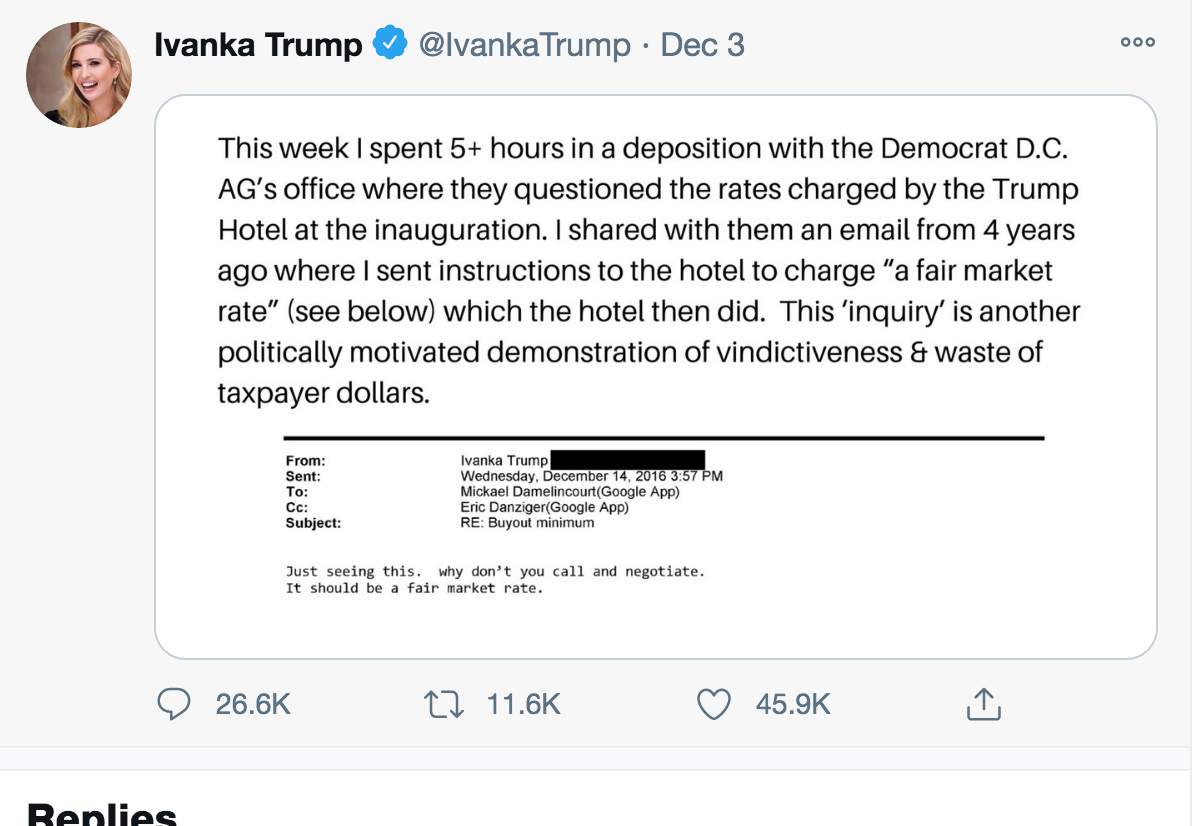
Fly the Republican members of the Michigan state canvassing board, along with top Republican state legislators, to Washington D.C. where you meet them at the White House, treat them to a lavish meal at the four-star Trump Hotel (the RNC will pay) and unleash the famous charm/terror offensive on them, convince BOTH canvassing board members to “illegally” contest the certification results in every county in Michigan. Stall things, to throw the election results, known to everybody and recounted in several places, into chaos.

After all, as Mr. Barr argues, along with nonpartisan legal geniuses like Alan Dershowitz, the president is the only one with the power to decide, if he honestly (even if delusionally — or delusively, which we learn is a more proper, if more obscure, statement of the same thing) believes something is in the best interests of the nation, whether that thing is, to be crude, “good” or “bad.” Simple, right?

Nothing wrong with wining and dining Republican state officials at your luxurious hotel to influence them to refuse to do their sworn legal duty so you can hopefully throw out an election result, delay, delay, delay the official certification of your corrupt enemy as president and hopefully find a way to game the constitutional system. Article II says so — there’s nothing about a president’s obligation to “obey” so-called election results in there. Nothing!

Reasons to remain optimistic

Because a friend called me Mr. Sunshine the other day, with some irony (for one thing, I avoid the sun, I hate that life source which has caused me multiple operations to remove cancers from my nose) I feel an obligation to set out a few reasons to feel hopeful and to act with optimism and determination.   Particularly about taking those two senate seats in Georgia, the ones that will allow the democratic process to move forward without the deliberate, cynical obstruction that McConnell and his 51-49 will insist upon.

Terror is scary as hell — obviously, it’s terror. The threat of terror can be terrifying, as it is intended to be.   When an angry, powerful person promises an army of 50,000 armed loyalists making sure there’s no (wink wink) “voter fraud” at certain polling places — it’s very scary.   It didn’t happen, anywhere really.  There were no crowds of Proud Boys standing by, or Bugaloo Boys, or Game Boys, few of the best members of the Klan, very few of the finest of American Nazis.   The goon squads, the death squads, the terrifying, bellowing armies of the night did not appear.   A beautiful thing, speaking well of our nation, and something to be happy about.   

ONE:  We withstood the threat of goon squads intimidating voters to support a would-be tyrant (and tens of millions lined up to vote in spite of the threats)

The goon squads were as absent as the predicted rioting, invocation of the Insurrection Act, martial law, counter-insurgency forces deployed in “anarchist jurisdictions” and the rest of a would-be dictator’s terrifying fever dreams.  Of course Trump is going to do everything possible to set a thousand shit fires before he leaves office, and will certainly set hundreds, but the very worst did not come to pass, which speaks well of our experiment in democracy here.

TWO:  In spite of the relentless pressure on millions of our fellow citizens, there has been no wave of crime during this awful pandemic

The pandemic is terrifying.  Under the best government control, it would be a hard road protecting millions from a worldwide disease that is airborne, highly contagious, incurable and potentially deadly.  Under our federal government’s laissez-faire approach (that’s French for “let the powerless fuck themselves, ehn?“) a quarter of a million of our fellow citizens who didn’t need to die horrible deaths died unspeakably awful deaths.   Our neighbors and loved ones continue to get sick, thousands die.  The stress of it is sometimes hard to bear. 

We have an administration coming in that will make every effort to have us all follow the best medical advice to control the spread until everyone can be vaccinated, but the beginning of their work could be another 100,000 deaths from now, as the disease continues surging uncontrolled in many parts of the country.   

There is only this reason to be hopeful at this moment in regard to the pandemic (yes, the vaccines will be great, too, but in a few months, at the earliest — if you and your loved ones live that long):  under incredible pressure, terror and increasing desperation, Americans, particularly ones forced into official poverty and threatened with imminent homeless, have not been committing violent crimes of desperation. 

 Think of that for a minute, this lack of wild lawlessness says something very good about the basic humanity of our people here.   A corollary — people tend to help each other during public emergencies, after catastrophes, when trouble is worst, Americans always have too.  

THREE:   The incumbent Republican president lost the race in faithfully Republican Georgia.   We can get two senators to make it 50-50.

Trump’s open (and clandestine) attempts at nationwide voter suppression, although many and mighty, did not manage to swing the election to the unhinged would-be strong man.  In spite of an open criminal conspiracy to suppress mail-in voting, and widely stoked fear about intimidating in-person voters, record numbers lined up, sometimes for 8 hours, to personally cast enough votes to indisputably vote the “You’re Fired” guy out by the largest margin since incumbent Herbert Hoover lost to Franklin Roosevelt in 1932.   

In Georgia, where the current governor was elected by a 55,000 vote margin (after purging 107,000 eligible voters who were likely to vote against him — among the more than 500,000 voters he’d purged prior to the gubernatorial election he supervised), where voter suppression is practiced fairly openly, the anti-Trump candidate managed to eke out a victory. 

 Reason to be optimistic: Americans, including a large contingent of Georgians understand exactly how crucial a 50-50 senate is to the continuation of democracy.  Every reactionary, evangelical and racist in the great state of Georgia will be driving people to the polls to vote Republican– millions will go to cast their votes for Jon Ossoff and Reverend Raphael Warnock.   Warnock led Loeffler by 7 points on Nov. 3, though he didn’t approach the 50% needed to win in Georgia [1]. Ossoff and Perdue were close, Perdue had a 2% lead (and thankfully 2/10ths of a percent less than the required 50%). 

Democracy can win this close runoff in Georgia.  There are activists, led by Stacey Abrams (who registered tens of thousands of voters in Georgia) who is mobilizing many of them, bringing out the vote, particularly those voters who never registered.  It’s going to be close in Georgia, two votes crucial for democracy or continued corrupt government dysfunction and obstruction.   

More on what you and I can do to bring out the vote in Georgia tomorrow. 

Love beats hate in the end.  Believe it, because subscribing to the opposing view leads inexorably to the end of all hope for anything better, ever.   Things that look hopeless often get better, if enough work is done.  The work starts now.

[1] 

On Nov. 3, Warnock topped a field of 20 candidates running in a “jungle primary” special election that included Loeffler, who Gov. Brian Kemp appointed to fill the Senate seat vacated by Johnny Isakson in late 2019. Warnock received 32.9 percent of the vote, while Loeffler got 25.9 percent. Her main Republican challenger, Rep. Doug Collins, received 19.9 percent.

source