A few more words on resurgent American fascism

From the insightful article by SARAH CHURCHWELL I quoted the other day, another reminder of exactly what we are up against inside the party of Trump:

In June 2020, as millions of Americans protested against systemic racial injustice following the murder of George Floyd – a killing described by many as a modern lynching – the proposal that some military bases be renamed after someone other than white supremacists prompted a tirade from Trump. He tweeted that they were “Monumental and very Powerful Bases”, “Magnificent and Fabled Military Installations” that “have become part of a Great American Heritage”, a “history of Winning, Victory, and Freedom” – in brazen denial of the fact that they had started a war over slavery and lost. Thus for “Winning, Victory, and Freedom”, we must read “losing, defeat, and slavery”, while remembering the importance of the big lie to the Nazi propaganda machine.

source

Thus for “Winning, Victory, and Freedom”, we must read “losing, defeat, and slavery”, while remembering the importance of the big lie to the Nazi propaganda machine.

Reminiscent of the great man’s clarification, after declaring Putin innocent of election interference after their private tete a tete in Helsinki when he changed his remark to the opposite of what he’d said at the time (“I don’t see why he WOULD” to “I don’t see why he WOULDN’T”), as one does.

And equally interesting:

The Klan became mythologised while many of its fellow paramilitary travellers were forgotten, thanks in large part to the so-called “Plantation School” of American literature, devoted to glorifying the Lost Cause of the noble South, especially Thomas Dixon’s enormously popular The Clansman (1905), the novel that inspired The Birth of a Nation. Dixon was drawing on the tradition established by Thomas Nelson Page, in whose fiction grateful, deferential black slaves loyally serve benevolent, ­paternalistic white masters on idyllic Southern plantations until the perfidious and ­corrupt Yankees start the “War of Northern Aggression” – as some Americans below the Mason-Dixon line call the Civil War to this day. This includes the statement of the great-grandson of the Louisiana governor who took power after the Colfax massacre, in which he objected to the removal of his ancestor’s memorial while insisting that the white supremacist confederate generals who had led a treasonous war against the US were “good people”.

source

Very fine people, on both sides, on both sides. As you say after Klansmen, American Nazis and assorted other groups very fine extremist young men mount a threatening show of racist and antisemitic force — as some of Trump’s staunchest supporters did four years ago Wednesday. USA! USA!!!!

Divergent thinking vs. strict logic

If you read this blahg you’ve probably noticed that I am almost always annoyed by irrational narratives. Sounds judgmental, of course, to call somebody’s worldview irrational at a time when an angry crowd screaming “we know who you are! we know where you live!” to people who testified in favor of a mask mandate for school children is just as entitled to their opinions as those following scientific advice about preventing the spread of a persistent and sometimes deadly pandemic.

Every one of us is at times ruled by irrationality, even the most doggedly rational among us — fear of the dark, fear of appearing fearful, fear of death, what have you. We all may come to mistaken conclusions, based on what we know, since what we know is often not the complete picture. Add a single piece of solid information, missing from our previous evaluation, and we will come to a different logical conclusion [1]. Entire nations are subject to irrationality, as we see daily in these troubled times. By changing the concept of “destructive asshole selfishness” to “freedom!” wars are launched and bombs begin to fall, to the cheering of “patriots”.

I was thinking of divergent thinking, a way of thinking that generates a web of connections, sets out many things to consider and sometimes leads to unexpected creative solutions. Divergent thinking is not linear, not strictly logical, sometimes the leaps from thought to thought cannot be explained to others, or if they can be explained, others sincerely won’t give a shit, but it is a way of making new connections and coming across surprising, sometimes important, ideas or solutions that a strict logical flow chart will never provide. Creative people operate this way without thinking about it, it is part of creativity to let the mind wonder where it will during creative pursuits.

It’s the difference between hitting up google for an answer and going with it and reading something that refers you to an unrelated source that teaches you something new about the question you googled. To confirm a definition, or get some background, or a source for what you’re talking about, a search engine is great. To find a concrete answer that is irrefutable (location and hours of a restaurant you want to go to) it’s amazingly handy.

The problem is that the twitch of a few fingers and the instant answer replaces the old, more time-consuming, way of researching and learning about things — finding a footnote on a page that leads you to a source you never heard of where you read something that alerts you to an entire body of knowledge you never knew existed. The “answers” that experts and idiots put out there are easy to find online, but the underlying ongoing discussion that leads to these conclusions is not as readily available from a smartphone. Hitting a screen for an answer is much different than turning the pages of a book, which has an index, bibliography and so on that contains many more leads you’d never see with a Google hit.

In law school, during the first semester, students (at least in my day) were not allowed to use to electronic legal databases that provide updated legal sources instantly. We were left to struggle in the library, searching the stacks for a book that could give us a clue, a lead to another set of books we’d never heard of, where the answer might be provided. This forced us to acquaint ourselves with the wide range of legal sources in the vast rooms full of books in the law library. The CFR (Code of Federal Regulations), which can be found instantly with a few keystrokes, was something each of us had to discover the existence of for ourselves in the course of those frustrating first semester hours in the law library. You’d find a legal decision that seemingly helped your argument, but you were instructed to always consult the pocket part, the annual update inserted in the front of the book, that contained the latest action on the case you thought was promising. The pocket part might contain a mention of your case. Oops, reversed by 19 U.S. 173 (2001)… Searching online you’d get this reversal of precedent instantly, without having to read the previous case, or even the case notes, of the overruled case. Sometimes these prior cases have important information not even mentioned in the ruling that reversed it (this is a specialty of ideological judges like Kavanaugh and Roberts). Read only the decision overturning the case and know less about the issues than you did going in.

Divergent thinking is useful for many things, especially things like looking at history. Human collective action is rarely motivated by strict rational consideration. Why did this mob feel this way on this date? That open-ended question leads down many avenues that a strict quest for “the reason” will rarely turn up. Here’s a divergently derived example:

Ukrainians slaughtered almost my entire family, on my mother’s side, one hot evening in August 1943. My grandmother, who lost everyone, was a lifelong leftist, influenced by the internationalist Marxist commissars who came with the revolutionary Soviet troops that liberated her area of the Ukraine briefly. They taught her that the future of mankind was one without anti-Semitism, without wars between nations, without the forever exploitation of the poor by the rich. It was an intoxicating message for my teenaged grandmother, that she was living in the dawn of a new era of human justice. A few years later, the leader of the Soviet Union, a mass-murdering psychopath some called Uncle Joe, killed as many as four million Ukrainians (mostly by starvation) to prove his point about his view of international justice (which he’d changed to Socialism in One Country). A few years after that, Herr Hitler’s forces “liberated” Ukraine from the Communists. The execution of my family? Logical in that context, Ukrainians viewed Jews as Communist sympathizers and took revenge on their murderers. But, logical?

The helpful term ‘divergent thinking’ was apparently coined by the psychologist J.P. Guilford in 1956 (the year I was born), as I learned from more than two minutes of exhaustive internet research. Guilford contrasted Divergent Thinking with Convergent Thinking, and the little two minute video I’ve linked to in the last sentence sets the whole thing out nicely. Spoiler alert: both forms of thinking are important.

Divergent thinkers can be a pain in the ass, constantly bringing up random ideas seemingly unrelated to anything, prolonging the discussion endlessly. Convergent thinkers can be a pain in the ass, continually focusing on the problem as having only one logically correct solution, being intolerant of “distractions” in this quest. We are all pains in the ass to people not exactly like ourselves.

I tend toward divergent thinking much of the time. If you are this way and you write, vigilance is required (and the passive voice used), since you need to lay things out in a way that doesn’t confuse, or lose, the reader. My solution, sometimes, is footnotes. A paragraph that slows the flow too much (like the digression about law school above) might be better shoved into a note at the bottom, for anyone interested. On the other hand, a strict linear telling, without providing pertinent background perspective to aid understanding and even empathy, can create a dry and pedantic piece [2]. Like anything else, balance between these two ways of thinking is crucial.

I’m listening to historian Ruth Ben-Ghiat’s excellent Strongmen: Mussolini to the Present. I will post an abstract of the book when I’m done listening to it and making notes on it. One thing that strikes me again and again is the way she eschews the strict chronological telling, jumping from Berlusconi to Putin to Mussolini to Mobutu to Trump and back to Herr Hitler. In this way we are constantly struck by the uncanny similarities in how all modern “strongmen” operate. She is not making a checklist and comparing A-B between these various dictatorial leaders, in order, in one chapter after another. Instead, without making direct comparisons, she provides a ton of detailed information that makes her point for her.

Example: In describing the excellent work lobbyists did to internationally legitimize the rule of Mobutu, longtime dictator of Zaire [3], she lays out a few crucial services the lobbying firm Manafort and Stone performed for the corrupt, murderous African leader. She doesn’t mention Manafort’s heroic and well-paid efforts to get corrupt pro-Putin Ukrainian Viktor Yanukovych elected president of Ukraine (he was forced to flee to Russia after a popular anti-corruption uprising drove him from office), at least not there. She does mention that all strongmen deploy pardons for those who perform arguably criminal services for them.

Anyway, friends, I could obviously go on all day. Let’s end it here, with a final thought on the usefulness of a little daydreaming that can generate a web of ideas for problem solving. It’s a good way to generate ideas, as you relax and exercise the muscles of critical thinking, if nothing else.

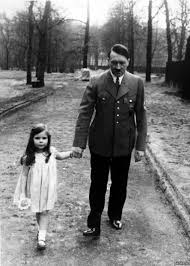
The Fuhrer indulges an adoring young fan.

[1]

I heard a great anecdote, from Zen teacher Jack Kornfield (on the late Joe Frank’s show), that illuminates this. A man on a train is angry that several children are wildly carrying on as the father sits head in hands, not stopping them. He confronts the father about controlling his unruly kids. The father nods, apologizes and explains that they’ve all just come from their mother’s funeral and nobody knows what to do. Perspective instantly changed from anger to sympathy, based on that new fact.

[2]

To paraphrase the Orange Polyp, “I prefer my pedantic pieces juicy, not dry.”

[3]

Mobutu Sese Seko Kuku Ngbendu Wa Za Banga was a Congolese politician and military officer who was the President of the Democratic Republic of the Congo from 1965 to 1971, and later Zaire from 1971 to 1997. He also served as Chairman of the Organisation of African Unity from 1967 to 1968. Wikipedia

The Limits of Human Empathy

Even among good, kind, well-meaning people, which most people are, empathy has its natural limitations. Unless we have actually experienced a thing, the specific suffering it causes can be hard to understand, even inconceivable, until someone who has suffered a certain way recounts it to us in a way that moves us to empathize. We can also get overwhelmed by empathy when we watch a video of victimization that is particularly harrowing. Both of these forms of empathy are of generally short duration, because we are most enduringly empathetic to the troubles of those most like us.

I was reminded of this the other night when a woman I’ve known for decades told me she always took the NYC bus rather than the subway, had done so since her teenaged years. It took her longer to get around, but she always sat near the driver and didn’t have to worry about creeps bothering her. When she told me this I understood immediately, and it made perfect sense, but I have been on 2 a.m. subways many times over the years and never once worried about a creep making a creepy sexual advance in my direction. I literally never thought about how regularly menacing things are on a late night subway for a woman.

Same with race, whites argue about the extent of racism all the time, pugnacious experts like Bill Barr use it as a potent “fuck you”, saying there is no systemic racism in the American justice system and Blacks better show gratitude to the cops who disproportionately, inadvertently, manhandle and kill them, or else.

Like my female friend on the bus, no black person I’ve ever met has any doubt about the prevalence of racism in the USA. When you directly encounter a reality every day, it takes on a much different aspect than when you imagine something in a thought experiment, with no danger of actually experiencing the thing you are weighing in your mind.

Any black person I’ve ever talked to about history immediately identifies famous progressive president and League of Nations idealist Woodrow Wilson as a racist, klan sympathizer, and wanton slaughterer of brown people. I was an adult before I came across the indisputable proof that the man who re-segregated the federal government and gushed over D.W. Griffith’s epic three-reel paean to the heroic Ku Klux Klan as being “like history written in lightning!”, the only US president who was a child of the Confederacy, was, whatever else he might have been, a white supremacist. He put the first Jew on the Supreme Court, distinguished champion of justice Louis Brandeis, but it’s safe to assume Wilson didn’t think much of the masses of Jews, particularly the poor ones that were teeming into North American slums during his time.

This same principle of the empathy/experience disconnect works for just about any vexation you can think of. Think of how truly empathetic you can be about a situation you have never remotely experienced yourself. You feel terrible, sure, and empathize at once, even if abstractly, because suffering is suffering, but, truly, how much can you actually identify with an unfamiliar horror?

A terminal cancer diagnosis, dementia, a child with a terrible lifelong disease, or who dies as an infant, sudden blindness, being a quadriplegic, being poor, being the victim of serial rape, or beatings, working full-time for less money than you need to pay rent, being unfairly imprisoned, being a family member or close friend of the wrongfully convicted and executed, or the family of the guy busted for selling joints who causes his entire family to be evicted and disqualified from public housing for life, or the guy who spends many pre-trial months in prison after arrest because he can’t afford to post bail — and then, on advice of counsel, takes a plea for “time served” for a crime he didn’t necessarily commit, the list is literally endless.

So, sure, many of us are kind, well-intentioned people who truly hate injustice and will leap to help anyone in trouble when we see it. That is not the question here. I’m raising the slippery idea that unless you’ve actually experienced a certain horror, empathy is far from automatic or intuitive. We can imagine the pain of a certain disease or loss, the agony of being wrongfully convicted and having the rest of your life become a one-sided battle you cannot win, but we are imagining it.

And sometimes we imagine it only when confronted with an evocation of it so wrenching that even a monster would be moved by it. Like watching big, strong George Floyd, legitimately in fear for his life, in a nation with arguably no racism in policing, being slowly murdered by several police officers who will file a routine, false report about Floyd getting hysterical (you know how they get) having a medical emergency and dying en route to the hospital, poor guy.

“Give me liberty or give me death!”

OK, fine, death it is!

From today’s Washington Post, the latest irrational calls to battle from two of the most vocal Senate leaders of Trump’s Death Cult:

As a resurgent coronavirus is forcing states to address soaring cases and hospitalizations, Republican Sens. Ted Cruz (Tex.) and Rand Paul (Ky.) denounced health mandates against the virus at a time when the United States recorded its highest single-day number of new cases since January.

The United States reported nearly 160,000 cases on Monday, pushing the seven-day average to almost 115,000 daily, according to data compiled by The Washington Post. It was the most severe day for new cases in the country since Jan. 29, when coronavirus vaccines were not widely available. Hospitalizations are also up to nearly 70,000 as businesses and schools grapple with mandates for vaccinations and masks during the fourth wave of the pandemic.

But Cruz said to Fox News host Sean Hannity that no health regulations are needed to help curb a nationwide surge fueled by the highly transmissible delta variant and the millions who remain unvaccinated.

“There should be no mandates — zero — concerning covid,” Cruz said. “That means no mask mandates, regardless of your vaccination status. That means no vaccine mandates. That means no vaccine passports.”

Cruz’s call for no covid mandates of any kind came hours after he and Sen. Kevin Cramer (R-N.D.) introduced two bills that would ban mask and vaccine mandates. The bills would countermand recent guidance from the Centers for Disease Control and Prevention, which recommends people wear masks indoors regardless of their vaccination status.

With just half the country fully vaccinated, the White House has taken a more aggressive approach in recent weeks in pushing Americans to get inoculated. President Biden has told federal employees they must get vaccinated or they will have to wear masks and maintain social distance at work, and he has directed the military to examine similar steps. As The Post’s Annie Linskey reported, the Biden administration is in the early stages of reviewing whether to use federal regulatory power, or the threat of withholding funds, as added ways to get private entities to require vaccines.

Texas, Cruz’s home state, is seeing a rise in new infections that is now limiting the availability of hospital beds. A Houston hospital system is preparing huge tents to treat an overflow of patients, while a doctor there said intensive care units in the city resembled a “war zone.” The state is averaging more than 13,500 new cases a day, trailing only Florida.

Yet Cruz accused Biden, without evidence, of “imposing unscientific and burdensome mandates.”

“Thanks to vaccinations and the natural immunity of Americans who have recovered from covid-19, America is reopening,” Cruz said. “America is recovering, our kids are going back to school, and small businesses are returning as our nation’s economic heartbeat.”

Cruz joined Paul in denouncing mandates amid a resurgence in cases and hospitalizations. The Kentucky senator — who has fashioned himself as the Senate’s chief skeptic of Anthony S. Fauci, the country’s top infectious-disease doctor — released a video Sunday that urged people to resist the regulations implemented by health experts and elected officials to help prevent the spread of the deadly delta variant.

“It’s time for us to resist. They can’t arrest all of us,” Paul said. “They can’t keep all of your kids home from school. They can’t keep every government building closed, although I’ve got a long list of ones they might keep closed or ought to keep closed.”

Coronavirus cases in Kentucky are up by 50 percent in the last week, data shows. Almost every county in Kentucky has “high community transmission,” according to the CDC.

School districts in the state have expanded virtual offerings as classes start again. In Jefferson County Public Schools, which includes Louisville, data shows that nearly 53 percent of the more than 95,000 students in the district will not be old enough to be vaccinated, according to the Louisville Courier Journal.

Paul, who Fauci has said does not know what he’s talking about when it comes to the pandemic, called the CDC’s mask guidance “anti-science.”

“Will we allow these people to use fear and propaganda to do further harm to our society, economy, and children?” Paul tweeted. “Or will we stand together and say, absolutely not. Not this time. I choose freedom.”

source

“GIVE ME LIBERTY OR GIVE ME DEATH!!!”

Very well, you freedom loving motherfuckers, death it is!

Good Day, Fascists

Former Acting Assistant Attorney General Jeffrey Clark, the man who heroically tried to keep his boss Donald Trump in power by amplifying Trump’s absurd and false claims after the Orange Polyp lost the election, no doubt fancies himself a man of principle. Most fascists believe they are serving a higher calling that does not require them to play by the ordinary rules, rules made for weaklings. They operate with urgency, goaded by a sense of outraged grievance. As Trump said during his long exhortation on January 6, before sending an angry mob down to gently hug and kiss the Capitol Police: “when you catch somebody in a fraud you’re allowed to go by a different set of rules.” Indeed.

Today Jeffery Clark, a man who went by a very different set of rules (“alternative rules”) that included attempts to have the DOJ knowingly lie to keep Trump in power, heads the New Civil Liberties Alliance, the extreme right-wing outfit that is dragging universities into courts to challenge mask mandates and trying to get the eviction moratorium lifted. You know, NEW civil liberties. A reminder of what fascists actually stand for, from that great article on the shady history of American fascism that I cited the other day:

Fascism is not a principled or ­ideological stand; it is the politics of grievance, an ­instrumentalist response to a ­political ­situation it perceives as unacceptable. ­Fascism is the counter-revolutionary politics of force, justified by ultra-nationalism, glorified by myths of ­regeneration and purification, performed by masculine cults of personality and sold as the will of the people.

source

After Hitler launched a bloody and failed insurrection in Munich, 1923, his famous Beer Hall Putsch, a sympathetic right wing judge in the scrupulously democratic Weimar Republic gave him a platform to make patriotic speeches to his fellow citizens, day after day. He got a slap on the wrist by way of a sentence, for treason, a short stay in plush accommodations in Landsberg Prison. He emerged as a national celebrity with a book to sell.

After Trump launched a bloody and failed insurrection on January 6, a quick, failed second impeachment and … crickets. Sure he’s been harshly punished by Twitter, and Facebook tiptoes around a temporary ban until, presumably, the incorrigible liar changes his stripes, but otherwise . . . crickets. Where are the federal charges? Where is the indictment in Georgia for his seditious recorded call to Raffensberger during which he violated every clause of the Georgia criminal law regarding interference in elections? It’s mystifying and disquieting that, even with the Fourteenth Amendment specifically banning insurrectionists from holding public office, the man who has always played by radically different rules is poised to be the GOP presidential candidate in 2024, perhaps after serving as savage, punishing Speaker of the House for a couple of years.

It is exhausting to repeat that American democracy itself hangs in the balance, as the forces of democracy fret about the right thing to do, while the well-funded friends of fascism are busy day and night planning and carrying out the next steps in their decades-long campaign for one-party rule. 51 votes in the Senate would end the filibuster, or carve out an exception for voting rights, which should not be in question more than 50 years after the Voting Rights Act the now supermajority right-wing Supreme Court has been vivisecting in recent years.

The 51 principled votes to limit or abolish the filibuster could be there, should be there, except that Kirsten Synema insists on performing her quirky, haughty, mavericky dance, Joe Manchin meets with oil and coal barons to get his orders, and Dianne Feinstein, who gushed at Miss Lindsey Graham’s graciousness while shoving Federalist Society superstar Amy Coney-Barrett down the nation’s throat, sits on the fence, referring obliquely to some higher principle about compromise. Trump’s people have no such scruples.

Trumpism at its bitter heart

I sometimes wonder why the poor whites of the Confederacy fought to the death in a war for the wealthy that their neighbors who owned enough slaves (twenty) were exempt from fighting in. It turns out one big reason is that the Confederacy was ruthless in hunting down and executing deserters. The same beefed up patrols that hunted down runaway slaves hunted down “disloyal” white men who would not fight and die to defend “home rule”. The leaders of the Confederacy kept it simple: this is a war to defend our noble way of life, uplift the white race and keep the inferior race where it belongs. If you are a traitor to our glorious cause we will hunt you down, kill you and perhaps also burn your family home to the ground.

Life is damned complicated, which is one reason a system that simplifies the world, no matter how grotesquely, is so appealing to so many. There has always been a large wedge of the US population that has no interest in nuance, cause and effect, the reverberations of history recurring like a bad meal. They want to keep what they have, get more, be entertained and believe what they want to believe and you can kiss their asses over whether what they believe is “correct” or not.

Covid-19? Obviously a deadly scam run by Joe Biden and the Chinese Communist Party, first to steal the election from the Man of the People who actually won in a landslide, then to tyrannize the population into abject surrender to the coercive government. Global warming and so-called climate catastrophe? So much liberal fucking bullshit, these regular new record high temperatures, killer storms, droughts, floods and so-called wild fires are just nature being nature. These themes resonate with desperate people who truly do not give a fuck about anything but “winning”. What do they actually win? Membership in the winners’ circle, cuck.

Not that long ago, in this great nation, people assembled to be entertained and uplifted by the public torture and murder of some purportedly demonic bastard, most often Black. We couldn’t make laws to outlaw this popular entertainment because all federal bills to criminalize lynching were filibustered or vetoed in the interest of maintaining power relationships just the way they were between the races. Politicians in areas where lynching was popular knew that allowing a vote to make this wildly popular sport a federal crime would kick their career in the nuts, not that they’d ever dream of supporting this kind of federal overreach, not after fighting a long and bloody war for “States’ Rights”.

The following is from a long, excellent discussion of the roots of American fascism. The author notes that Fascism was always about entertainment, however: the deep root of its poison was that it made hatred entertaining.”

Public lynchings in the United States, at which thousands sometimes gathered in the early 20th century, functioned as a spectacular display of white power that terrorised the black population and exhilarated white audiences with a sense of their own racial superiority. But they were sold as amusement. Lynchings were often advertised ahead of time in the local press and on neighbourhood flyers, just as a funfair or circus might have been. Sometimes street vendors sold popcorn and other snacks.

Lynchings were the violent obverse of folk traditions such as minstrelsy that had long unified white crowds over the degradation of black people. Whether through ostensibly comic mockery or overtly sadistic violence, both were performed for the pleasure of a crowd enjoying its political dominance by dehumanising other people. The forms that lynching took included not only hangings, but public torture, dismemberment, castration and burning alive, sometimes for hours. Spectators took photographs that circulated openly in the mail as postcards, and collected body parts as souvenirs. It was all just another carnival.

That lynching was a barbaric form of mass entertainment was perfectly clear at the time. The influential journalist HL ­Mencken observed as early as 1917 that lynchings were a local “sport” that took “the place of the merry-go-round, the ­theatre, the symphony orchestra and other diversions” in larger communities.

Within a few years, movie theatres were advertising Westerns with a “special added attraction” of exciting footage showing the “Klu Klux Klan in Action” during a “midnight initiation”. In 1934 the New Yorker published a cartoon that showed a grandmotherly white woman holding up a small girl in a large crowd in front of a burning house while excitedly telling her neighbour: “This is her first lynching.”

Then, as now, groups like the Klan were motivated not purely by racial hostility, but by a sense of economic grievance they had been encouraged to understand in terms of race. In a 1926 pamphlet called “The Klan’s Fight for Americanism”, the Klan’s imperial wizard argued that the organisation’s members were the “average citizen of the old stock” motivated by “economic distress” who found themselves “increasingly uncomfortable and finally deeply ­distressed” as “the assurance for the ­future of our children dwindled. We found our great cities and the control of much of our industry and commerce taken over by strangers, who stacked the cards of success and prosperity against us.” But the Klan was also itself a money-making venture, a pyramid scheme populated by grifters and hucksters, literally setting up stalls at state fairs so that racial violence and economic ­resentment could make a buck [1].

source

Racism, xenophobia (fear of “others”) and cultural and economic resentment continue to be great for the old fascist bottom line. One of Trump’s most glorious “fuck you” pardons (which the DOJ should challenge as corrupt and integral to his seamless pattern of ongoing obstruction of justice, quid pro quos for the silence and perjury of criminal co-conspirators like Stone, Manafort and Flynn) was of Steve Bannon, arrested (by the US Postal Service!) aboard a Chinese billionaire’s yacht for fleecing a crowd of loyal Trump supporters out of their hard earned money in a fake “Build the Wall” campaign.

Welcome to the winners’ circle, chumps.

The Fuhrer walks little girl to gas chamber

[1]

Of course, don’t try teaching any of this ugly history in Florida, Texas or any other GOP-controlled Covid hotspot state. There are new laws, in these “Right To Work” states that will put you out of a job right quick if you bad mouth the Klan, or the Texas Rangers, who began their existence chasing down and killing Comanches, Kiowas, Apaches and Mexicans who were on disputed (by the Texans) Mexican territory. Texas justice, y’all. Who doesn’t get excited at a good old neck tie party?! Don’t try peddling this kind of dogshit (see below) in Texas!

Despite the fame of their deeds, the conduct of the Rangers during this period (post-Reconstruction] was illegally excessive. In particular, Leander H. McNelly and his men used ruthless methods that often rivaled the brutality of their opponents, such as taking part in summary executions and confessions induced by torture and intimidation [20] . . .

. . . The Rangers were responsible for several incidents, ending in the January 28, 1918 massacre of the male population[23] (15 Mexican men and boys ranging in age from 16 to 72 years) of the tiny community of Porvenir, Texas, on the Mexican border in western Presidio County. Before the decade was over, thousands of lives were lost, Texans and Mexicans alike. In January 1919, an investigation launched by Texas lawmaker José Tomás Canales found that from 300 to 5,000 people, mostly of Hispanic descent, had been killed by Rangers from 1910 to 1919, and that members of the Rangers had been involved in many acts of brutality and injustice.[24] The Rangers were reformed by a resolution of the Legislature in 1919, which saw the special Ranger groups disbanded and a complaints system instituted.[25]

source

What is wrong with the NY Times?

America’s journal of record, the venerable Grey Lady, has a consistent tic that drives me mad. It also undermines the paper’s famous credibility and detracts from its often excellent investigative reporting. The tic is unrelated to the paper’s commitment to good writing (most of the material in the New York Times is well-written) — it is a determination to appear objective at all costs that often teeters into misinforming readers. Here are two examples that leaped out at me the other day and grabbed me by the throat.

The article, entitled Former Acting Attorney General Testifies About Trump’s Efforts to Subvert Election begins:

WASHINGTON — Jeffrey A. Rosen, who was acting attorney general during the Trump administration, has told the Justice Department watchdog and congressional investigators that one of his deputies tried to help former President Donald J. Trump subvert the results of the 2020 election, according to a person familiar with the interviews.

source

It is very good news that Rosen is speaking, voluntarily, to the Inspector General of the DOJ and a Senate Committee. Only good can come from Rosen confirming details of the depths that Trump was willing to go to to preserve his reign.

The article goes on to describe a Trumpist in the DOJ, Jeffrey Clark, who was working directly with his master to overturn the results of the 2020 election so that Trump could illegally remain in power. Acting AG Jeffrey Rosen, Clark’s boss, asked Clark not to have further meetings with Trump alone. Clark continued to meet with Trump alone. The DOJ had announced, under Barr and under Rosen, that they had found no fraud on a level that could have changed the outcome of the presidential election. Clark pressed the DOJ to change its position to give traction to Trump’s Big Lie about the stolen election he claims to have won in a landslide. Clark drafted a letter to Georgia officials based on this unfounded lie, that he asked Rosen to sign. The New York Times:

Mr. Rosen also described subsequent exchanges with Mr. Clark, who continued to press colleagues to make statements about the election that they found to be untrue, according to a person familiar with the interview.

source

statements that they found to be untrue

His colleagues “found them to be untrue” these statements Clark was pressuring them to make?

Clarification? Clark wanted them to make statements that the DOJ had investigated and found to be false, baseless, not based in evidence? Statements that some in the DOJ “found to be untrue”? An honest disagreement between colleagues in these highly charged partisan times? The Times, setting new standards for anodyne exposition? Seriously.

Then, as far as clarity, good writing, elegance of language in the service of informing readers:

He also discovered that Mr. Clark had been engaging in unauthorized conversations with Mr. Trump about ways to have the Justice Department publicly cast doubt on President Biden’s victory, particularly in battleground states that Mr. Trump was fixated on, like Georgia. Mr. Clark drafted a letter that he asked Mr. Rosen to send to Georgia state legislators, wrongly asserting that they should void Mr. Biden’s victory because the Justice Department was investigating accusations of voter fraud in the state.

Such a letter would effectively undermine efforts by Mr. Clark’s colleagues to prevent the White House from overturning the election results, and Mr. Rosen and his top deputy, Richard P. Donoghue, rejected the proposal.

source

Idea for the copy editor, change one word to make this sentence more clear and more accurate:

falsely asserting that they should void Mr. Biden’s victory because the Justice Department was investigating accusations of voter fraud in the state.

Look, it was false because the DOJ was not investigating accusations of voter fraud in the state when Clark wrote the letter. It was false because Clark knew that there were no ongoing investigations. It was knowingly false, because, in spite of knowing it, and three recounts in Georgia, Clark tried to get his boss to sign the false letter. I understand the Times may want to avoid implying intent on the part of Mr. Fucking Eichmann Clark, but “wrongly” is ambiguous, open-ended and just plain misleading. There are many reasons a person can be wrong, knowingly lying is only one.

Medal for most squeamishly anodyne sentence in the article, with a star for contortion:

Such a letter would effectively undermine efforts by Mr. Clark’s colleagues to prevent the White House from overturning the election results, and Mr. Rosen and his top deputy, Richard P. Donoghue, rejected the proposal.

Or, perhaps just a tad more accurately

The false letter Clark wanted his boss to sign would have put the acting AG on record as knowingly lying to overturn the election Mr. Trump continues to falsely insist he won, in a fucking landslide.

Come on, Grey Lady, we want to believe you’re better than this…

Here’s a roadmap for the Justice Department to follow in investigating Trump

Opinion by Laurence H. Tribe, Barbara McQuade and Joyce White Vance [1] from the August 5, 2021 Washington Post:

As evidence of Donald Trump’s efforts to overturn the 2020 election mounts, the time has come for the Justice Department to begin, if it hasn’t already, a criminal investigation of the former president’s dangerous course of conduct. Attorney General Merrick Garland has worked to restore the badly frayed public trust in a nonpartisan DOJ. But failing to investigate Trump just to demonstrate objectivity would itself be a political decision — and a grave mistake. If we are to maintain our democracy and respect for the rule of law, efforts to overturn a fair election simply cannot be tolerated, and Trump’s conduct must be investigated.

The publicly known facts suffice to open an investigation, now. They include Trump’s demand that Georgia Secretary of State Brad Raffensperger “find” 11,780 votes to declare he won that state’s election; Trump’s pressure on acting attorney general Jeffrey Rosen as well as Vice President Mike Pence to advance the “big lie” that the election was stolen; the recently revealed phone call in which Trump directed Rosen to “just say the election was corrupt, [and] leave the rest to me,” and public statements by Trump and associates such as Rudolph W. Giuliani and Rep. Mo Brooks on Jan. 6 to incite the mob that stormed the Capitol.

None of these facts alone proves a crime beyond a reasonable doubt, but together they clearly merit opening a criminal investigation, which would allow prosecutors to obtain phone and text records, emails, memos and witness testimony to determine whether Trump should be charged

One possible charge is conspiracy. It is a federal crime for individuals to agree to defraud the United States by interfering with governmental functions. Special counsel Robert S. Mueller III included such a conspiracy in his indictment against the Internet Research Agency, alleging the Russian group engaged in a conspiracy aimed at “impairing, obstructing, and defeating the lawful functions” of government agencies.

An investigation could also explore whether Trump agreed with others — Giuliani, Brooks and possibly members of his inner circle — to obstruct Congress’s function of exercising its statutory duty to certify the election results on Jan. 6. By using disinformation to sow unfounded doubt, Trump and his allies may have tried to induce members of Congress to vote against certifying the election results, creating enough chaos to throw the election to the House, where Republicans controlled a majority of state delegations.

Another plausible charge is obstruction of an official proceeding. The relevant statute makes it a crime to corruptly obstruct, influence or impede any official proceeding or attempt to do so. Agreeing with others to obstruct the Jan. 6 vote certification for a wrongful purpose and the commission of any act in furtherance of that agreement would suffice to prove a violation, putting Trump at the heart of a conspiracy, with his public statements and tweets constituting overt act

A related but distinct charge is the Racketeer Influenced and Corrupt Organizations Act, “RICO,” which has often been used beyond its original intended target of organized crime. To prove RICO, the DOJ would need to establish that Trump was associated with an enterprise affecting interstate commerce, such as the office of the presidency, and committed at least two racketeering acts. One such act is extortion, which encompasses transmitting a threat to harm another’s reputation with intent to extract something of value. Trump’s conversations with Raffensperger, in which he suggested the secretary of state might have committed a crime and “that’s a big risk to you,” could fit that definition.

Equally fit charges for investigation include violating the federal voter fraud statute and coercing federal employees to violate the Hatch Act by working to advance his political candidacy. Trump’s well-documented efforts to pressure state officials not to certify Biden’s election could run afoul of the voter fraud law, which prohibits anyone from defrauding the residents of a state of a fair election by tabulating false ballots, although Trump might argue that he believed he had won in those states.

Likewise, Trump’s pressure on Rosen to “just say the election was corrupt” could run afoul of the Hatch Act’s criminal provision, which makes it “unlawful for any person to intimidate, threaten, command, or coerce” a federal employee to “engage in … any political activity.” It doesn’t get much more coercive or political than pressuring your attorney general to declare an election corrupt without proof.

Two other potential crimes that merit investigation are inciting insurrection and seditious conspiracy. Both statutes appear to fit the facts, but the DOJ might hesitate to bring charges because of possible defenses. For instance, even though language intended and likely to incite imminent violence meets the Supreme Court’s test for unprotected speech, a court might conclude that Trump’s exhortations to the crowd do not rise to that level of incitement and are protected by the First Amendment.

The bottom line is this: Now that Trump is out of office, the DOJ’s view that sitting presidents cannot be indicted no longer shields him. Attempted coups cannot be ignored. If Garland’s Justice Department is going to restore respect for the rule of law, no one, not even a former president, can be above it. And the fear of appearing partisan cannot be allowed to supersede that fundamental precept.

source

[1]

Laurence H. Tribe is Carl M. Loeb University Professor emeritus and a professor of constitutional law emeritus at Harvard Law School. Barbara McQuade is a law professor at the University of Michigan Law School and the former U.S. attorney for the Eastern District of Michigan. Joyce White Vance, the former U.S. attorney in Alabama, is a professor at the University of Alabama School of Law.

source

Why is Jeffrey Clark an American Eichmann?

After Donald Trump lost the 2020 election, by a healthy 10% margin in the popular vote (81,000,000 to 74,000,000) and the identical, “historic” Electoral College “mandate” that Trump got vanquishing Crooked Hillary in 2016, the Orange Polyp went to work. According to his playbook, announced before the election, he never committed to the peaceful transition of power, if he lost. His loss, he said, could only result from massive communist/BLM/antifa/pedophile cannibal fraud. He still claims to have won by a “landslide”, an alternative fact most Republicans apparently take as true.

The former president was often dismissed as unhinged, delusional, crazy, and a compulsive liar. Of course, the faithless said the same about Adolf Hitler. Both men had the talent and charisma to convince millions of their unhinged delusions. What is keeping America from greatness? Mexican rapists, in caravans, bringing drugs — and China, Jina! Wait, also Muslim terrorists who hate our freedom. Also, sexed up women getting abortions whenever they want. Also, black people who are angry for no fucking reason even though America kisses their asses every day out of liberal guilt for something nobody ever even did to them. Poor people and cripples, bitter about being losers, who expect the government to give them money for nothing. Etc. With Hitler, it all boiled down to the Jews – get rid of the poisonous Jews and Aryans live happily ever after. With the elites who find Trumpism useful, all of the above, but also, mostly the Jews, and those who think, for whatever crazy reason, that it’s not the fucking Jews. Or, to put it more bluntly, whoever we can pin our own crimes on.

As a Jew whose large family was almost completely exterminated in the Nazi era, I am prone to see Nazis among supremely ambitious people who are merely extremely prejudiced and unprincipled. Is Lyin’ Ted really a Nazi? Give the boy a chance, I say, and he’ll do whatever needs to be done for his party. Mitch McConnell? The impartial juror who announced he was working closely with Trump’s defense team to quickly end the farce of a trial in the Senate where no witnesses or testimony would be allowed, the guy who rammed religious extremist Coney Barrett on to the Supreme Court days before the election? Please. Jim Jordan? He speaks to the president “all the time, yes, I spoke to him on January 6, sure I did, but, you, heh… now that you ask when I talked to him on the 6th… heh… ahumenuh humena humena…”. Alabama representative Mo Brooks, in his bullet proof vest, exhorting an armed crowd to go to the Capitol and fight for America, after organizing three White House strategy meetings for his fellow Congressional presidential election challengers prior to January 6 to plan for the big day? I shouldn’t call Brooks a Nazi, he might merely be a high-spirited klansman, for all I know.

While all this seditioning was going on (and it is still going on big time as AG Merrick Garland methodically works to prove the DOJ is now non-political again) we now know, with proof from newly released DOJ memos and other documents, that Trump made a continuous effort to use the DOJ to overturn the 2020 presidential election in states Trump lost (Congressional races won by the GOP in the same elections would not be challenged, no fraud there). Bill Barr, a conservative Christian culture warrior who served as historically shameless, bellicose gunsel for Trump, announced, after blusteringly promoting massive voter fraud allegations for months, that there had been no fraud on a scale that would have changed the election results anywhere. Then, with a final wet kiss to his former master, Barr resigned to spend Christmas with his family (and presumably to avoid future prosecution for seditious conspiracy to commit the insurrection that was being planned).

The lackeys at the top of the DOJ resisted Trump when he asked them to merely announce the election had been corrupt, in spite of the fact, established by the DOJ’s own investigations, that it had not been, and let him and Brooksie, and Jordan, and a few other hearty fanatics, “take care of the rest”. Then, in his moment of need, Trump found his loyal American Eichmann, Jeffrey Clark, right there at DOJ. Like Eichmann, Clark was ready, willing and able, to promote any lie that might be useful to his Leader.

Clark drafted a letter for the acting-AG to sign, informing Georgia officials that they had a legal responsibility to obey the will of the Republican state legislature, not the courts, not the election boards, not the fatuous arguments of cynical liberal constitutional law liars who clearly were involved in the corruption that stole the election from the rightful winner. This letter is part of the public record now, and Barr’s successor, to his credit, refused to sign it (to his discredit, he kept his mouth shut about, and gutlessly tap-danced around, the whole ugly insurrectionish episode).

There was a standoff, a la Trump’s old reality TV show The Apprentice, Clark, his audition letter in hand, arguing to be made AG so he could sign it, with the rest of DOJ leadership threatening to resign. Trump decided not to risk the resignation of DOJ leadership and called Georgia instead, finally getting through, on his 18th try, on January 3, to ask the fellas there to give him a break and find the stinkin’ 11,780 votes he needed, and then proceeded with his desperate last stand, the January 6 MAGA riot to “stop the steal”.

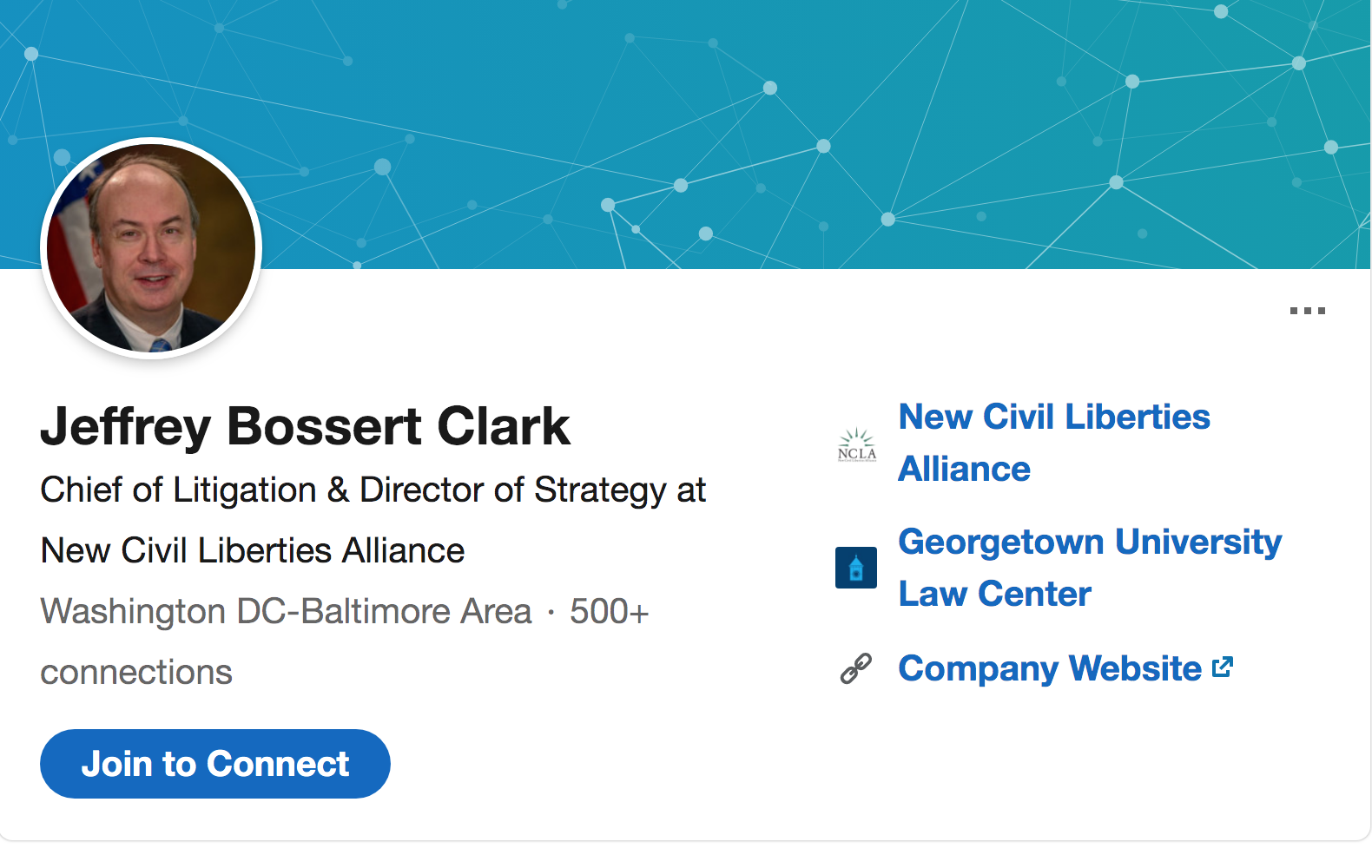
Eichmann, the man who kept the trains rolling to the death camps, packed to capacity, was a man of modest intellectual gifts, an incomplete high school education and a talent for bureaucracy. Clark, an accomplished attorney, graduated from college and law school, had a distinguished legal career at one of the world’s top corporate law firms, fighting for ultra-conservative causes and making enough money and powerful right wing contacts that he is set for life (he’s now Chief of Litigation & Director of Strategy at New Civil Liberties Alliance, a self-described young and vibrant organization focused on restoring the historically more robust civil liberties long enjoyed by federal and state citizens—liberties that have come under fire with the rise of the modern “administrative state.”) He’s fighting for “civil liberties” like the right not to be forced to wear a fucking mask by an overreaching government. American Nazis always find well-paying jobs with like-minded, right wing billionaire-funded outfits fighting for their version of liberty and justice.

Hannah Arendt painted an unforgettable and insightful portrait of this kind of ambitious, mindless, true believing public servant in her masterpiece Eichmann in Jerusalem. He is supremely ambitious, does what he’s told, never questions his superiors, proceeds with absolute faith and unwavering belief in the rightness of his cause, knows the millions he loads on to trains are going to death camps, steels himself and does his duty no matter what.

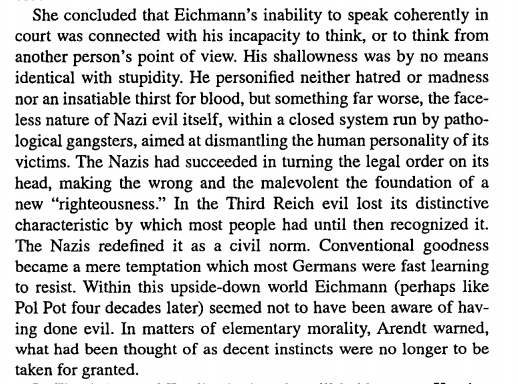
Not to torture this comparison beyond the plain fact that both men, Eichmann and Clark, were ready, willing and able to do whatever was needed to advance their beliefs and their careers — and serve their masters. Of Eichmann, Arendt noted the lack of what we usually call “evil” in his CV and pointed out how he reflected a chillingly modern concept of evil, flowing directly and inexorably from a hateful belief system implemented on a mass level by an unblinking loyalist bureaucracy. From the intro:

Screen shot 2018-06-05 at 6.44.37 PM.png

As for what most of us call “conscience,” the Nazis, like the current GOP, had that shit covered. For Nazis conscience was, as Hitler himself had said, a debilitating “Jewish invention.” Conscience, they believed, made people weak and vulnerable and must be rooted out of the Nazi soul, like any vestige of human empathy that did not serve the Leader’s vision. For the current GOP? I don’t know, you tell me.

American Eichmann, Jeffrey Clark

Sickening

Clark’s anti-democratic treachery was already known and reported on back in January. Insurrection moves fast, democratic adjustment to insurrection moves with deliberate, lawful slowness.

The NY Times (January 24, 2021):

Justice Department colleagues said they were shocked by Mr. Clark’s embrace of the president’s falsehoods and plan to oust the acting attorney general in an effort to overturn Georgia’s election results.

source

Jeff Clark is the newly established Chief of Litigation and Director of Strategy for the nonpartisan New Civil Liberties Alliance. NCLA is a young and vibrant organization focused on restoring the historically more robust civil liberties long enjoyed by federal and state citizens—liberties that have come under fire with the rise of the modern “administrative state.”

Before joining NCLA, Mr. Clark was dual-hatted as the Acting Assistant Attorney General of the Civil Division at the U.S. Justice Department from 2020-2021, as well as the Senate-confirmed 35th Assistant Attorney General of the Environment and Natural Resources Division (ENRD) from 2018-2021. ENRD is a component of the Justice Department with an illustrious, more-than-a-century’s worth of history. He has personally appeared in every federal Court of Appeals. . .

. . . During his two periods of service inside the federal government, Mr. Clark focused on how to implement Federalist 51’s vision of “oblig[ing the government] to control itself.” Now at NCLA, he will focus on enforcing, from the outside, the constraints of the Constitution and the laws on the government.

Interspersed with his government service, Mr. Clark was a partner at the international law firm of Kirkland and Ellis LLP, where he practiced general appellate litigation, environmental law, and administrative law. Moreover, Mr. Clark has also worked in numerous substantive areas of law, ranging from labor law, to class actions, to intellectual property, to bankruptcy, and to products liability.

(from his Linked in profile)